

|
시장보고서
상품코드
2099471
CRISPR 기반 유전자 편집 : 시장 점유율 분석, 업계 동향 및 통계, 성장 예측(2026-2031년)CRISPR-based Gene Editing - Market Share Analysis, Industry Trends & Statistics, Growth Forecasts (2026 - 2031) |
||||||
 Mordor Intelligence
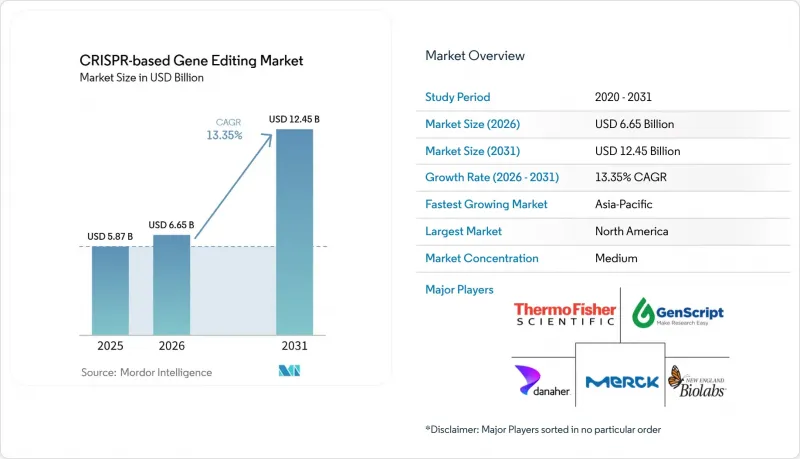
Mordor Intelligence에 의하면, CRISPR 기반 유전자 편집 시장 규모는 2025년 58억 7,000만 달러로 평가되었습니다. 2026년 66억 5,000만 달러에서 2031년까지 124억 5,000만 달러로 확대되어 2026년부터 2031년에 걸쳐 CAGR 13.35%를 나타낼 것으로 예측됩니다.
본 보고서는 제공 분야(제품, 소프트웨어, 서비스), 기술(Cas9, Cas12, Cas13, 염기 편집 등), 유전자 편집 기법(체외, 체내), 용도(치료법 개발, 신약 개발, 전임상 모델, 진단), 최종 사용자(제약·바이오기술 기업, 학술 기관, CRO 등), 지역(북미, 유럽, 아시아태평양 등)별로 분류되어 있습니다. 예측치는 금액(달러)으로 표시되어 있습니다.
세계의 CRISPR 기반 유전자 편집 시장 동향 및 인사이트
유전성 질환 치료 개발 가속화
CRISPR 기반 유전자 편집 시장은 개념 증명(PoC) 단계를 넘어, 여러 질환 분야에서 임상 개발의 재현성이 높아지고 있는 단계로 전환되고 있습니다. CASGEVY의 2025년 상업적 성과는 승인된 CRISPR 치료법이 실제 환자에게 도입되고 의미 있는 수익 창출을 뒷받침할 수 있음을 보여주고 있으며, 이는 과학적 검증과 상업적 실행 간의 격차를 좁힌다는 점에서 중요합니다. 2025년 5월 『뉴잉글랜드 의학 저널』의 보고에 따르면, 카르바모일인산 합성효소 1 결핍증에 대한 환자 맞춤형 생체 내 염기 편집 치료가 진단 후 수개월 이내에 시행된 사례가 소개되었습니다. 이는 치료 수요가 높은 상황에서 개발 일정이 얼마나 신속하게 단축될 수 있는지를 보여줍니다. 이는 CRISPR 기반 유전자 편집 시장에 중요한 의미를 지닙니다. 진단부터 치료 개입까지의 과정을 가속화함으로써, 중증 유전성 질환의 향후 대상 환자층을 확대할 수 있기 때문입니다. 또한, 이러한 추세를 통해 효과적인 규제 및 제조 공정가 입증된다면, 희귀질환 프로그램이 보다 명확한 개발 논리에 기반하여 진행될 수 있다는 점에 대한 후원사의 신뢰도 높아질 것입니다. 그 결과, CRISPR 기반 유전자 편집 시장에서 치료법 개발은 더 이상 단순한 과학적 개척 분야가 아니라, 미래의 수익 확대를 뒷받침하는 주요 원동력으로 기능하고 있습니다.
CRISPR 기반 세포 및 유전자 치료의 임상 검증
임상 검증의 범위는 현재 체외 세포 치료, 생체 내 간 편집, 그리고 초기 단계의 RNA 표적화 접근법까지 미치고 있으며, 이를 통해 CRISPR 기반 유전자 편집 시장은 기존의 유전자 치료 흐름보다 광범위한 증거 기반을 갖추게 됩니다. CRISPR Therapeutics사의 CTX310에 관한 1상 임상시험 데이터에 따르면, 1회 정맥 내 투여 후 ANGPTL3이 평균 73% 감소하고, 트리글리세라이드가 55% 감소하며, LDL이 49% 감소한 것으로 나타났으며, 초기 데이터 세트에서는 유해 사건 보고도 거의 없었습니다. 또한, 넥시구란(디클루메란)은 다발성 신경병증을 동반한 유전성 트랜스사이레틴 아밀로이드증에서 혈청 TTR의 신속하고 대폭적이며 지속적인 감소를 가져왔으며, 임상적으로 의미 있는 상황에서 생체 내 유전자 편집에 관한 새로운 인간 대상 실증 사례를 추가했습니다. 종양학 분야에서는 종양 침윤 림프구에서 CISH의 CRISPR-Cas9에 의한 노크아웃을 통해 1상 임상시험에서 전이성 대장암에 대해 완전하고 지속적인 반응이 확인되었으며, 치료가 어려운 고형암에서도 지속적인 항종양 활성이 가능함이 입증되었습니다. 이러한 결과를 종합해 보면, CRISPR 기반 유전자 편집 시장은 단일하고 제한적인 이용 사례에 의존하는 것이 아니라, 다양한 편집 시나리오에서 그 유효성이 입증되고 있음을 알 수 있습니다. 또한, 보다 확고한 인간 데이터를 바탕으로 개발 단계에 접어든 후기 프로그램에 대해 상업적 및 규제적 기대가 높아지고 있는 이유도 드러났습니다.
전달 효율 및 조직 특이적 흡수 제한
전달 기술은 CRISPR 기반 유전자 편집 시장이 현재의 간에 초점을 맞춘 이용 사례를 넘어 어디까지 확대될 수 있는지에 있어 여전히 가장 중요한 기술적 제약으로 남아 있습니다. 지질 나노입자는 간에서의 유전자 편집 프로그램을 뒷받침해 왔지만, 뇌, 심장, 골격근 및 체외 환경 이외의 조혈모세포로의 전달 기술은 여전히 충분히 성숙되지 않아, 이것이 단기적인 적응증의 범위를 제한하고 있습니다. 『Precision Medicine and Engineering』 저널의 2025년 총설에서도, 장기 특이적 전달 전략은 여전히 생체 내 분포 및 면역에 의한 제거라는 과제에 직면해 있으며, 많은 표적에서 벡터의 정확도가 아직 불충분하다는 점이 제시되었습니다. rAAV-CRISPR을 통한 전달에는 또 다른 어려움이 더해집니다. Cas9을 표적으로 한 면역 제거가 치료 효과를 약화시켜, 일시적인 면역 억제 프로토콜의 사용을 불가피하게 만들 가능성이 있기 때문입니다. 이러한 과제로 인해 CRISPR 기반 유전자 편집 시장은 간을 중심으로 한 초기 생체 내(in vivo) 단계와, 그 이후의 비간 영역으로의 확대라는 양극화된 상태가 지속되고 있습니다. 이러한 전달 관련 장벽이 개선될 때까지는 많은 프로그램에서 재주입 전에 편집 및 품질 관리를 용이하게 수행할 수 있는 체외(ex vivo) 환경이 계속해서 선호될 것입니다.
부문 분석
2025년 시점에서 제품은 제공 부문의 72.31%를 차지하며, CRISPR 기반 유전자 편집 시장에서 현재 가장 큰 수익원입니다. 이러한 위상은 연구 환경과 임상 개발 워크플로우 모두에서 가이드 RNA 합성, Cas 단백질 효소 및 전달 벡터에 대한 지속적인 수요를 반영합니다. 또한, 더 많은 프로그램이 규제 대상 치료 용도에 가까워짐에 따라 품질에 대한 기대치가 높아지고 있는 점도 시약 수요를 끌어올리고 있습니다. ISO 13485 인증 및 FDA GMP 준수 조건 하에서 제조되는 Synthego사의 cGMP 등급 gRNA 솔루션은 임상 단계 연구에서 시약에 대한 기준이 어떻게 높아지고 있는지를 보여줍니다. 서비스 부문은 CRISPR 기반 유전자 편집 시장에서 세 번째 제공 분야를 형성하며, 편집 설계, 세포 치료제 제조, 그리고 고정 자산을 최소화하고자 하는 후원사를 위한 기능 유전체학 지원 아웃소싱에 이릅니다.
소프트웨어 및 바이오인포매틱스 도구는 현재 가장 규모가 작은 제공 부문이지만, 2031년까지 연평균 성장률(CAGR) 18.38%로 확대될 것으로 예측되어, CRISPR 기반 유전자 편집 시장에서 가장 빠르게 성장하는 분야가 되고 있습니다. 2025년 『Nature Biomedical Engineering』에 보고된 CRISPR-GPT는 에이전트형 소프트웨어가 실험 설계 및 데이터 분석을 자동화할 수 있음을 보여주었으며, 이를 통해 고도의 계산 자원이 부족한 연구실의 전문 지식 진입 장벽이 낮아졌습니다. 2026년 7월에 발표된 인간 iPS 세포에 대한 CRISPRi 아틀라스는 바이오정보학이 더 이상 하류 보고 단계에 머무르지 않음을 다시 한번 보여주었습니다. 이는 현재 학계와 산업계 모두에서 대규모 데이터 분석을 지원하게 되었기 때문입니다. 이러한 변화가 중요한 이유는 CRISPR 기반 유전자 편집 시장의 조달 동향이 실험실 내 편집 능력과 더 강력한 컴퓨팅 기반의 의사결정 지원을 결합한 플랫폼으로 전환되고 있기 때문입니다. 시간이 지남에 따라 시약이 절대적인 규모 면에서는 여전히 큰 카테고리로 남아 있더라도, 제품과 소프트웨어 간의 수익 격차는 점차 줄어들 것으로 예측됩니다.
2025년 시점에서 CRISPR-Cas9은 기술 부문의 52.24%를 차지하며, CRISPR 기반 유전자 편집 시장 전체에서 핵심 플랫폼으로서의 지위를 유지했습니다. 이러한 우위는 ex vivo 세포 치료 워크플로우와의 깊은 통합과, 간을 표적으로 하는 in vivo 편집 프로그램에서의 활용 확대에 기인합니다. 또한, 각 후원사들은 상용화 단계에 있는 유전자 편집 시스템 중 Cas9가 임상 현장에서 인지도가 가장 높고 규제상의 선례도 가장 명확하기 때문에 계속해서 Cas9를 선호하고 있습니다. 베이스 편집은 중요한 인접 플랫폼으로 발전하고 있으며, 그 임상 로드맵은 이미 제조 관리 요건 및 후기 임상시험 설계 기준에 대한 주목을 받고 있습니다. 이러한 동향에 따라, CRISPR 기반 유전자 편집 시장에서는 Cas9가 구조적으로 우월한 지위를 유지하는 한편, 새로운 편집기는 보다 선택적인 임상 도입 시점을 통해 그 유효성을 입증해 나가고 있습니다.
CRISPR-Cas13은 2031년까지 연평균 성장률(CAGR)이 19.52%에 달하는 가장 빠르게 성장하는 기술 분야로, 이는 RNA를 표적으로 하는 접근 방식이 CRISPR 기반 유전자 편집 시장 내에서 독자적인 성장 궤도를 개척하고 있음을 여실히 보여줍니다. SHERLOCK 및 DETECTR 플랫폼은 아토몰 수준의 감도를 갖추고 있으며, 30분에서 60분 내에 결과를 얻을 수 있어, 시간적 제약이나 자원이 제한된 환경에서 CRISPR 진단법은 PCR에 비해 현장 진단(point-of-care) 분야에서 중요한 위치를 차지하고 있습니다. 프라임 에디팅(Prime Editing)도 2026년에 인간을 대상으로 한 첫 임상시험 단계에 진입했으나, 효율성과 전달 방식은 여전히 광범위한 보급을 가로막는 주요 장벽으로 남아 있습니다. OpenCRISPR-1과 같은 AI로 설계된 Cas 변이체는 미래의 기술 지도가 현재 잘 알려진 Cas 계열의 범위를 넘어 확장될 것임을 시사합니다. 그 결과, CRISPR 기반 유전자 편집 시장은 현재 Cas9이 규모 확대를 뒷받침하는 한편, 새로운 편집기가 미래의 응용 범위를 넓혀 나갈 것이라는 이원적인 구조를 유지할 가능성이 높다고 볼 수 있습니다.
지역별 분석
2025년, 북미는 CRISPR 기반 유전자 편집 시장 점유율의 41.62%를 차지하며, 현재 세계 시장 구조에서 가장 큰 기여를 하는 지역으로서의 지위를 유지했습니다. 이 지역의 우위는 탄탄한 생명공학 인프라, 자금 조달의 용이성, 확립된 임상시험 네트워크, 그리고 후기 단계 또는 상용화 단계의 CRISPR 자산을 보유한 기업들이 집중되어 있다는 점에 기인합니다. CRISPR Therapeutics는 약 20억 달러의 현금과 여러 진행 중인 임상 프로그램을 보유한 채 2026년을 맞이했으며, 이는 CRISPR 기반 유전자 편집 시장에서 북미가 가장 탄탄한 자본 및 파이프라인 기반으로서의 역할을 강화하고 있습니다. 또한, Editas Medicine사도 2026년에 EDIT-401의 첫 인체 임상시험 진전을 계획하고 있으며, 이는 해당 지역의 생체 내 개발 모멘텀을 더욱 가속화할 것입니다. 아울러, 미국 특허상표청이 CRISPR/Cas9 간섭 소송에서 브로드 연구소의 입장을 재확인한 것은 이 주요 지역 클러스터에서 지적 재산권이 여전히 경쟁적 입지와 라이선싱 구조를 형성하고 있음을 보여줍니다.
유럽은 CRISPR 기반 유전자 편집 시장에서 여전히 2위 지역 블록이며, 유럽의약품청(EMA)의 ‘첨단 치료 의약품(ATMP)’ 프레임워크 하에서 개발이 진행되고 있습니다. EMA는 CASGEVY에 PRIME 지정을 부여하고, 유전체 편집 의약품에 대해 15년간의 장기 추적 조사를 권고했습니다. 이는 해당 지역의 전체 파이프라인에 걸쳐 개발 비용 및 일정 계획에 직접적인 영향을 미칩니다. 2025년 12월 유럽연합(EU)에서 주요 의약품법 개정에 관한 합의가 타결된 것은 첨단 치료에 대한 거버넌스를 합리화하고, 해당 지역에 진출하는 개발자들의 불확실성을 줄이겠다는 의도를 보여줍니다. 독일과 영국은 여전히 가장 강력한 거점이며, 한편 프랑스, 이탈리아, 스페인, 기타 유럽 국가들에서는 치료 센터의 수용 능력과 보험 급여 경로의 개선에 따라 시장이 확대되고 있습니다.
아시아태평양은 2031년까지 연평균 성장률(CAGR) 15.15%를 나타낼 것으로 예측되며, CRISPR 기반 유전자 편집 시장에서 가장 빠르게 성장하는 지역 부문이 되고 있습니다. 중국과 일본은 임상 활동의 확대, 국내 개발 역량, 그리고 첨단 치료법에 점점 더 적합한 정책 체계를 통해 이 지역의 성장 모멘텀을 주도하고 있습니다. 인도, 한국, 호주 역시 학술 활동의 활성화와 후원자 주도 임상시험 참여를 통해 기여하고 있으며, 이 두 주요 시장을 넘어 더 광범위한 지역 기반을 뒷받침하고 있습니다. 겸상적혈구증 및 지중해빈혈의 유병률이 높은 GCC 국가들이 주도하는 중동 및 아프리카에서는 접근 경로가 성숙해짐에 따라, 승인된 CRISPR 치료법에 대한 수요 주도형 기회가 창출되고 있습니다. 브라질과 아르헨티나를 주요 거점으로 하는 남미 지역은 여전히 도입 초기 단계에 있으며, 광범위한 상업적 확산이라기보다는 대학의 연구 및 후원형 임상시험 활동에 의해 형성되고 있는 상황입니다.
기타 혜택 :
- 엑셀 형식 시장 예측(ME) 시트
- 3개월간의 애널리스트 지원
자주 묻는 질문
목차
제1장 서론
제2장 조사 방법
제3장 주요 요약
제4장 시장 구도
제5장 시장 규모 및 성장 예측
제6장 경쟁 구도
제7장 시장 기회 및 향후 전망
KTH 26.08.10According to Mordor Intelligence, the CRISPR-based gene editing market size is projected to expand from USD 5.87 billion in 2025 and USD 6.65 billion in 2026 to USD 12.45 billion by 2031, registering a CAGR of 13.35% between 2026 to 2031.
This report is Segmented by Offering (Products, Software, Services), Technology (Cas9, Cas12, Cas13, Base Editing, and More), Modality (Ex-Vivo, In-Vivo), Application (Therapeutic Dev, Drug Discovery, Preclinical Models, Diagnostics), End User (Pharma and Biotech, Academic Institutes, Cros, and More), Geography (North America, Europe, Asia-Pacific, and More). Forecasts are Provided in Value (USD).
Global CRISPR-based Gene Editing Market Trends and Insights
Accelerating Therapeutic Development For Genetic Disorders
The CRISPR-based gene editing market is moving beyond proof-of-concept and into a stage where clinical development is becoming more repeatable across multiple disease areas. CASGEVY's 2025 commercial performance showed that approved CRISPR therapies can support real patient uptake and meaningful revenue generation, which matters because it narrows the gap between scientific validation and commercial execution. A May 2025 New England Journal of Medicine report described a patient-specific in vivo base-editing treatment for carbamoyl-phosphate synthetase 1 deficiency that was delivered within months of diagnosis, which showed how quickly development timelines can compress in high-need settings. That matters for the CRISPR-based gene editing market because faster movement from diagnosis to intervention can widen the future addressable population for severe inherited disorders. The same pattern also improves sponsor confidence that rare disease programs can progress with clearer development logic once a working regulatory and manufacturing path has been demonstrated. As a result, therapeutic development is no longer just a scientific frontier in the CRISPR-based gene editing market, because it now functions as the main engine behind future revenue expansion.
Clinical Validation Of CRISPR Based Cell And Gene Therapies
Clinical validation now spans ex-vivo cell therapy, in-vivo liver editing, and early RNA-targeting approaches, which gives the CRISPR-based gene editing market a broader evidence base than earlier gene therapy waves. Phase 1 data for CRISPR Therapeutics' CTX310 showed a 73% mean ANGPTL3 reduction, a 55% triglyceride reduction, and a 49% LDL reduction after a single intravenous infusion, with few adverse events reported in the early dataset. Nexiguran ziclumeran also delivered rapid, deep, and durable serum TTR reductions in hereditary transthyretin amyloidosis with polyneuropathy, which added another human proof point for in-vivo editing in a clinically meaningful setting. In oncology, CRISPR-Cas9 knockout of CISH in tumor-infiltrating lymphocytes produced complete and ongoing responses in metastatic colorectal cancer in a Phase 1 study, which showed that durable anti-tumor activity is possible even in difficult solid tumors. Together, these results show that the CRISPR-based gene editing market is gaining validation across different editing settings rather than relying on one narrow clinical use case. They also show why commercial and regulatory expectations are shifting upward for later programs that now enter development behind a stronger body of human data.
Delivery Efficiency And Tissue Specific Uptake Limitations
Delivery remains the most important technical limit on how far the CRISPR-based gene editing market can expand beyond current liver-focused use cases. Lipid nanoparticles have supported hepatic editing programs, but delivery to the brain, heart, skeletal muscle, and hematopoietic stem cells outside ex-vivo settings remains much less mature, which restricts the near-term indication map. A 2025 review in Precision Medicine and Engineering also found that organ-specific delivery strategies continue to face biodistribution and immune clearance challenges, which shows that vector precision is still inadequate for many targets. rAAV-CRISPR delivery adds another layer of difficulty because Cas9-directed immune clearance can weaken treatment effect and force the use of transient immunosuppression protocols. These issues keep the CRISPR-based gene editing market segmented into a liver-led early in-vivo wave and a later non-hepatic expansion path. Until that delivery barrier improves, many programs will continue to favor ex-vivo settings where editing and quality control are easier to manage before reinfusion.
Other drivers and restraints analyzed in the detailed report include:
- Expansion Of Translational Workflows In Pharma And Biotech R&D
- Widening Use In Multiplex Screening And Functional Genomics Platforms
- Off Target Risk And Editing Fidelity Concerns
For complete list of drivers and restraints, kindly check the Table Of Contents.
Segment Analysis
Products held 72.31% of the offering segment in 2025, which made them the largest current revenue pool inside the CRISPR-based gene editing market. That position reflects recurring demand for guide RNA synthesis, Cas protein enzymes, and delivery vectors across both research settings and clinical development workflows. Reagent demand is also being lifted by tighter quality expectations as more programs move closer to regulated therapeutic use. Synthego's cGMP-grade gRNA solutions, which are produced under ISO 13485 certification and FDA GMP-compliant conditions, show how the reagent bar is moving upward for clinical-stage work. Services form the third offering pillar in the CRISPR-based gene editing market, spanning editing design, cell therapy manufacturing, and outsourced functional genomics support for sponsors that want to limit fixed investment.
Software and bioinformatics tools remain the smallest current offering segment, but they are projected to expand at 18.38% CAGR through 2031, which makes them the fastest-growing component of the CRISPR-based gene editing market. CRISPR-GPT, reported in Nature Biomedical Engineering in 2025, showed how agentic software can automate experiment design and data analysis, which lowers the expertise barrier for laboratories that lack deep computational resources. The July 2026 CRISPRi atlas in human iPSCs further showed that bioinformatics is no longer a downstream reporting layer, because it now supports high-scale interpretation within both academic and industrial settings. This shift matters because procurement in the CRISPR-based gene editing market is moving toward platforms that combine wet-lab editing capability with stronger computational decision support. Over time, that should narrow the revenue gap between products and software even if reagents remain the larger absolute category.
CRISPR-Cas9 held 52.24% of the technology segment in 2025, which keeps it as the anchor platform across the CRISPR-based gene editing market. Its lead comes from deep integration into ex-vivo cell therapy workflows and from its growing use in liver-directed in-vivo editing programs. Sponsors also continue to favor Cas9 because it carries the strongest clinical familiarity and the clearest regulatory precedent among commercial-stage editing systems. Base editing is progressing as an important adjacent platform, and its clinical roadmap has already drawn attention to manufacturing control requirements and later-stage trial design standards. That dynamic keeps Cas9 structurally dominant in the CRISPR-based gene editing market, while newer editors build validation through more selective clinical entry points.
CRISPR-Cas13 is the fastest-growing technology segment at 19.52% CAGR through 2031, which highlights how RNA targeting is creating a distinct growth lane inside the CRISPR-based gene editing market. SHERLOCK and DETECTR platforms offer attomolar sensitivity with results in 30 to 60 minutes, which gives CRISPR diagnostics a meaningful point-of-care position relative to PCR in time-sensitive or resource-constrained settings. Prime editing also entered first-in-human trial stages in 2026, although efficiency and delivery remain important barriers to wide adoption. AI-designed Cas variants such as OpenCRISPR-1 indicate that the future technology map will extend beyond the currently familiar Cas families. As a result, the CRISPR-based gene editing market is likely to keep a dual structure in which Cas9 supports scale today while newer editors expand the future application perimeter.
Complete Report Scope:
- By Offering
- Products
- Software And Bioinformatics Tools
- Services
- By Technology
- CRISPR-Cas9
- CRISPR-Cas12
- CRISPR-Cas13
- Base Editing
- Prime Editing
- Epigenetic Editing
- Other Technologies
- By Gene Editing Modality
- Ex-Vivo Editing
- In-Vivo Editing
- By Application
- Therapeutic Development
- Drug Discovery And Target Identification
- Preclinical Model Development
- Diagnostics
- Other Applications
- By End User
- Pharmaceutical And Biotechnology Companies
- Academic And Research Institutes
- Contract Research Organizations And CDMOs
- Diagnostic Laboratories
- Other End Users
- Geography
- North America
- United States
- Canada
- Mexico
- Europe
- Germany
- United Kingdom
- France
- Italy
- Spain
- Rest of Europe
- Asia-Pacific
- China
- Japan
- India
- Australia
- South Korea
- Rest of Asia-Pacific
- Middle East and Africa
- GCC
- South Africa
- Rest of Middle East and Africa
- South America
- Brazil
- Argentina
- Rest of South America
- North America
Geography Analysis
North America held 41.62% of CRISPR-based gene editing market share in 2025, which kept it as the largest regional contributor in the current global structure. The region's lead rests on deep biotechnology infrastructure, stronger financing access, established clinical trial networks, and a concentration of companies with late-stage or commercial CRISPR assets. CRISPR Therapeutics entered 2026 with approximately USD 2 billion in cash and multiple active clinical programs, which reinforces North America's role as the deepest capital and pipeline base for the CRISPR-based gene editing market. Editas Medicine also planned first-in-human progress for EDIT-401 in 2026, which adds to the region's in-vivo development momentum. The U.S. Patent and Trademark Office's reaffirmation of the Broad Institute's position in the CRISPR/Cas9 interference case also shows how intellectual property still shapes competitive positioning and licensing structures in the leading regional cluster.
Europe remains the second-largest regional block in the CRISPR-based gene editing market and continues to develop under the EMA's Advanced Therapy Medicinal Products framework. The EMA granted CASGEVY PRIME designation and recommended 15-year long-term follow-up for genome-editing medicinal products, which has direct implications for development cost and timeline planning across the regional pipeline. The December 2025 agreement on major pharmaceutical legislation reform in the European Union signaled an intent to streamline advanced therapy governance and reduce uncertainty for developers entering the region. Germany and the United Kingdom remain the strongest national anchors, while France, Italy, Spain, and the rest of Europe are expanding as treatment center capacity and reimbursement pathways improve.
Asia-Pacific is projected to grow at 15.15% CAGR through 2031, which makes it the fastest-growing regional segment in the CRISPR-based gene editing market. China and Japan lead the region's momentum through expanding clinical activity, domestic development capability, and policy structures that are becoming more relevant to advanced therapies. India, South Korea, and Australia also contribute growing academic activity and sponsored trial participation, which supports a broader regional base beyond the two leading national markets. The Middle East and Africa, led by GCC countries with high sickle cell disease and thalassemia burden, represent a demand-pull opportunity for approved CRISPR therapies as access pathways mature. South America, with Brazil and Argentina as the main anchors, remains in earlier adoption and is still shaped more by university research and sponsored clinical trial activity than by broad commercial penetration.
- Agilent Technologies
- Bio-Rad Laboratories
- Bio-Techne
- Caribou Biosciences
- CRISPR Therapeutics AG
- Danaher
- Editas Medicine, Inc.
- Genscript
- Integrated DNA Technologies
- Intellia Therapeutics, Inc.
- Merck
- New England Biolabs
- OriGene Technologies
- Prime Medicine, Inc.
- QIAGEN
- Synthego Corporation
- Takara Bio
- Thermo Fisher Scientific
- Twist Bioscience Corporation
Additional Benefits:
- The market estimate (ME) sheet in Excel format
- 3 months of analyst support
TABLE OF CONTENTS
1 Introduction
- 1.1 Study Assumptions & Market Definition
- 1.2 Scope of the Study
2 Research Methodology
3 Executive Summary
4 Market Landscape
- 4.1 Market Overview
- 4.2 Market Drivers
- 4.2.1 Accelerating Therapeutic Development For Genetic Disorders
- 4.2.2 Clinical Validation Of CRISPR Based Cell And Gene Therapies
- 4.2.3 Expansion Of Translational Workflows In Pharma And Biotech R and D
- 4.2.4 Widening Use In Multiplex Screening And Functional Genomics Platforms
- 4.2.5 GMP Grade Tooling And Workflow Standardization For Commercial Programs
- 4.2.6 IP And Reagent Ecosystems Supporting Next Generation Editing Modalities
- 4.3 Market Restraints
- 4.3.1 Delivery Efficiency And Tissue Specific Uptake Limitations
- 4.3.2 Off Target Risk And Editing Fidelity Concerns
- 4.3.3 Ethical And Germline Governance Constraints
- 4.3.4 High Cost Of Translational Scale Up, QA, And Regulatory Evidence Generation
- 4.4 Value Chain Analysis
- 4.5 Regulatory Landscape
- 4.6 Technological Outlook
- 4.7 Porter's Five Forces Analysis
- 4.7.1 Bargaining Power Of Suppliers
- 4.7.2 Bargaining Power Of Buyers
- 4.7.3 Threat Of New Entrants
- 4.7.4 Threat Of Substitutes
- 4.7.5 Industry Rivalry
5 Market Size & Growth Forecasts (Value, USD)
- 5.1 By Offering
- 5.1.1 Products
- 5.1.2 Software And Bioinformatics Tools
- 5.1.3 Services
- 5.2 By Technology
- 5.2.1 CRISPR-Cas9
- 5.2.2 CRISPR-Cas12
- 5.2.3 CRISPR-Cas13
- 5.2.4 Base Editing
- 5.2.5 Prime Editing
- 5.2.6 Epigenetic Editing
- 5.2.7 Other Technologies
- 5.3 By Gene Editing Modality
- 5.3.1 Ex-Vivo Editing
- 5.3.2 In-Vivo Editing
- 5.4 By Application
- 5.4.1 Therapeutic Development
- 5.4.2 Drug Discovery And Target Identification
- 5.4.3 Preclinical Model Development
- 5.4.4 Diagnostics
- 5.4.5 Other Applications
- 5.5 By End User
- 5.5.1 Pharmaceutical And Biotechnology Companies
- 5.5.2 Academic And Research Institutes
- 5.5.3 Contract Research Organizations And CDMOs
- 5.5.4 Diagnostic Laboratories
- 5.5.5 Other End Users
- 5.6 Geography
- 5.6.1 North America
- 5.6.1.1 United States
- 5.6.1.2 Canada
- 5.6.1.3 Mexico
- 5.6.2 Europe
- 5.6.2.1 Germany
- 5.6.2.2 United Kingdom
- 5.6.2.3 France
- 5.6.2.4 Italy
- 5.6.2.5 Spain
- 5.6.2.6 Rest of Europe
- 5.6.3 Asia-Pacific
- 5.6.3.1 China
- 5.6.3.2 Japan
- 5.6.3.3 India
- 5.6.3.4 Australia
- 5.6.3.5 South Korea
- 5.6.3.6 Rest of Asia-Pacific
- 5.6.4 Middle East and Africa
- 5.6.4.1 GCC
- 5.6.4.2 South Africa
- 5.6.4.3 Rest of Middle East and Africa
- 5.6.5 South America
- 5.6.5.1 Brazil
- 5.6.5.2 Argentina
- 5.6.5.3 Rest of South America
- 5.6.1 North America
6 Competitive Landscape
- 6.1 Market Concentration
- 6.2 Market Share Analysis
- 6.3 Company Profiles (includes Global Level Overview, Market Level Overview, Core Segments, Financials as available, Strategic Information, Market Rank/Share, Products and Services, Recent Developments)
- 6.3.1 Agilent Technologies, Inc.
- 6.3.2 Bio-Rad Laboratories, Inc.
- 6.3.3 Bio-Techne Corporation
- 6.3.4 Caribou Biosciences, Inc.
- 6.3.5 CRISPR Therapeutics AG
- 6.3.6 Danaher Corporation
- 6.3.7 Editas Medicine, Inc.
- 6.3.8 GenScript Biotech Corporation
- 6.3.9 Integrated DNA Technologies, Inc.
- 6.3.10 Intellia Therapeutics, Inc.
- 6.3.11 Merck KGaA
- 6.3.12 New England Biolabs, Inc.
- 6.3.13 OriGene Technologies, Inc.
- 6.3.14 Prime Medicine, Inc.
- 6.3.15 QIAGEN N.V.
- 6.3.16 Synthego Corporation
- 6.3.17 Takara Bio Inc.
- 6.3.18 Thermo Fisher Scientific Inc.
- 6.3.19 Twist Bioscience Corporation
7 Market Opportunities & Future Outlook
- 7.1 White-Space and Unmet-Need Assessment


