

|
시장보고서
상품코드
2099477
DRAM 팹용 특수 가스 : 시장 점유율 분석, 업계 동향 및 통계, 성장 예측(2026-2031년)Specialty Gases For DRAM Fabs - Market Share Analysis, Industry Trends & Statistics, Growth Forecasts (2026 - 2031) |
||||||
 Mordor Intelligence
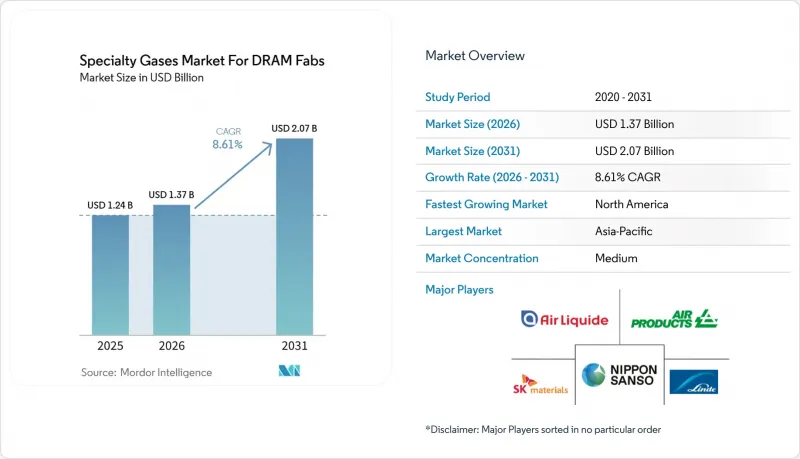
Mordor Intelligence에 의하면, DRAM 팹용 특수 가스 시장은 2025년에 12억 4,000만 달러 규모로 평가되었습니다. 2026년 13억 7,000만 달러에서 2031년까지 20억 7,000만 달러로 확대되어 예측 기간(2026-2031년) CAGR은 8.61%를 나타낼 것으로 전망됩니다.
본 보고서는 가스 유형(불소계 가스, 실리콘 전구체 및 수소화물, 비활성기체/희소 가스 등), 공정 용도(챔버 세정, 플라즈마 에칭/반응성 이온 에칭(RIE), 박막 증착(CVD/ALD/에피택시) 등), DRAM 제품 유형(표준 DRAM, 모바일 DRAM(LPDDR) 등), 지역별로 분류되어 있습니다. 시장 전망은 금액(달러) 기준으로 제시되어 있습니다.
DRAM 팹용 특수 가스 시장 인사이트 및 동향
DRAM 노드의 복잡화와 멀티패터닝의 고도화
DRAM 팹용 특수 가스 시장은 1z 세대에서 1b 및 1c 세대로의 전환에 의해 직접적인 견인력을 받고 있습니다. 이는 미세화가 진행됨에 따라 각 웨이퍼의 제조를 완료하기 위해 필요한 증착, 스페이서 형성, 패턴 전사 및 세정 공정의 수가 증가하기 때문입니다. 구체적으로, 라인 치수가 좁아짐에 따라 팹에서는 패턴의 충실도를 유지하기 위해서만 더 많은 불소계 에칭 가스와 실리콘계 재료를 사용하고, 공급 조건을 더욱 엄격하게 제어하고 있습니다. 이로 인해 제조되는 1비트당 가스 소비량이 구조적으로 증가하고 있으며, 첨단 DRAM 노드로의 전환이 진행되는 가운데 이는 웨이퍼 생산량 그 자체보다 더 중요한 요소가 됩니다. 또한, 램 리서치(RAM Research)의 조사에 따르면, 주요 메모리 제조업체들이 2025년에 EUV 건식 포토레지스트 기술을 생산에 도입했을 때, 공정의 일부에서 공정 통합이 이루어지면 공정의 다른 부분에서 새로운 기상 재료나 새로운 순도 요건이 발생할 가능성이 있는 것으로 나타났습니다. 그 결과, 공정 로드맵에 따라 리소그래피 구성이 변화하더라도 DRAM 팹용 특수 가스 시장은 계속해서 혜택을 누리고 있습니다. 이는 패턴 전사, 결함 밀도 및 박막 품질을 관리해야 하는 압박이 여전히 변함없기 때문입니다. 이것이 한국, 대만, 일본의 전체 DRAM 팹에서 공정 고도화가 수요 증가의 가장 강력한 원동력 중 하나로 남아 있는 이유입니다.
HBM의 적층 수 증가가 증착 및 에칭 주기를 늘립니다.
DRAM 팹용 특수 가스 시장은 HBM에 의해서도 뒷받침되고 있습니다. 스택 내의 다이가 하나 늘어날 때마다 실리콘 관통 비아(TSV) 형성, 더 컨포멀한 배리어 층의 증착, 그리고 유닛 수준에서의 충전 공정이 증가합니다. 이는 중요한 점입니다. HBM의 양산 확대는 단순히 생산량 증가뿐만 아니라 공정 밀도의 향상도 수반하며, 스택의 높이가 높아질수록 완성된 패키지당 가스를 많이 사용하는 공정이 포함되기 때문입니다. 스택이 높아질수록 더 깊고 깨끗한 에칭 성능, 더 높은 공정 균일성, 그리고 재현성이 더 뛰어난 ALD 및 CVD 사이클이 요구되며, 그 결과 안정적인 불소화 가스 및 증착 전구체공급 중요성이 커지고 있습니다. HBM의 확대는 패키징 및 테스트와 같은 관련 분야의 가스 수요도 이미 견인하고 있으며, 그 일례로 에어 리퀴드가 2026년 6월 SK하이닉스의 청주 P&T7을 대상으로 질소 제조 유닛의 건설 및 운영에 관한 합의를 체결한 것을 들 수 있습니다. DRAM 팹용 특수 가스 시장은 웨이퍼 제조뿐만 아니라 그 주변의 첨단 메모리 생태계에도 서비스를 제공하고 있기 때문에 HBM은 좁은 틈새 제품이라기보다는 수요를 배가시키는 요인이 되고 있습니다. 따라서 각 공급업체들은 HBM과 관련된 생산 능력, 인증 및 현지화에 대한 결정을 단순한 표준 DRAM 수요의 부수적인 확장이 아닌, 핵심적인 전략적 우선순위로 삼고 있습니다.
불소계 가스 배출 규제 강화에 따른 비용 증가
DRAM 팹용 특수 가스 시장은 불소계 온실가스 규제가 강화됨에 따라 명백한 비용 제약에 직면해 있습니다. 이는 에칭 및 챔버 세척에서 핵심적인 역할을 하는 화학 물질이 바로 가장 큰 배출 부담을 초래하기 때문입니다. 유럽연합(EU)은 규정(EU) 2024/573에 따라 이러한 방향성을 강화했으며, 유럽집행위원회의 시행규칙(EU) 2026/286에서는 반도체용 칠러에 대한 영구적인 적용 예외가 아닌, 2029년까지의 잠정적인 적용 예외만을 규정했습니다. 이러한 정책적 신호는 유럽을 훨씬 넘어 중요한 의미를 지닙니다. 더 엄격한 기준이 장기적인 비용 및 규정 준수 계획에 영향을 미치기 시작하면, 메모리 제조업체들은 대개 전 세계 거점에서 장비 및 화학 약품의 선정 기준을 통일하는 경향이 있기 때문입니다. DRAM의 에칭 깊이가 증가하고 HBM의 층수가 늘어남에 따라, 가스를 대량으로 소비하는 공정에서는 배출 감축, 보고 및 공정 최적화의 부담이 커져, 물리적 수요가 견조하더라도 실질적인 총소유비용(TCO)이 상승하게 됩니다. 이로 인해 DRAM 팹용 특수 가스 시장의 성장이 저해되는 것은 아니지만, 팹과 공급업체 모두에게 이익 마진은 줄어들고, 인증 기준을 충족하는 저 GWP 대체 가스의 상업적 가치는 높아질 것입니다. 향후에는 규정 준수 비용이 어떤 가스를 구매할 것인지뿐만 아니라, 팹 수준에서의 모니터링, 추적성 및 배출 감축 통합을 어떤 공급업체가 지원할 수 있는지에까지 영향을 미치게 될 것입니다.
부문 분석
2025년, 불소계 가스는 DRAM 팹용 특수 가스 시장에서 40.61%의 점유율을 유지했습니다. 이는 모든 주요 DRAM 공정 흐름에서 플라즈마 에칭 및 챔버 세척에 있어 이러한 가스가 핵심적인 역할을 하고 있음을 반영합니다. NF3, CF4, C2F6, CHF3 및 C4F8은 챔버 상태, 피처 전사, 처리량 안정성에 직접적인 영향을 미치는 고빈도 공정을 뒷받침하고 있기 때문에 여전히 대체하기 어려운 상황입니다. 이러한 위상은 DRAM 팹용 특수 가스 시장에서 특히 중요합니다. 세정 및 에칭 공정이 빈번하게 반복되기 때문에 사소한 공정 변경이라도 팹 수준의 총 가스 수요에 변화를 가져올 가능성이 있기 때문입니다. 동시에 경쟁 압력도 점차 높아지고 있습니다. 2026년 IOP Science의 조사에 따르면, COF2(N2O가 첨가된 COF2 포함)는 기존 대안보다 훨씬 낮은 GWP(지구 온난화 계수)를 가지면서도 실리콘 나이탈리아드 챔버 세정에서 유망한 성능을 발휘할 수 있는 것으로 나타났기 때문입니다.
실리콘 전구체 및 수소화물은 DRAM 팹용 특수 가스 시장에서 2026년부터 2031년에 걸쳐 연평균 성장률(CAGR) 9.38%로 가장 빠르게 성장하는 가스군이며, 이는 높은 종횡비 메모리 구조에서 컨포멀 증착으로의 전환이 원동력이 되고 있습니다. 커패시터 및 배리어 아키텍처에 대한 요구 사항이 엄격해짐에 따라, 팹에서는 더욱 정밀한 두께 제어와 더 깨끗한 표면 특성이 요구되고 있으며, 이로 인해 ALD용 전구체의 화학 조성 및 공급 안정성이 한층 더 중요해지고 있습니다. 비활성기체 및 희소 가스의 직접 취급량은 여전히 적지만, 공급이 부족해지면 리소그래피 지원, 에칭 안정성, 퍼지 성능 모두에 영향을 미칠 가능성이 있으므로 전략적으로 매우 중요한 위치를 차지하고 있습니다. N2O, CO2, H2 등의 기타 가스는 가치 기준으로 혼합 가스의 주요 부분을 차지하지는 않더라도 산화, 캐리어, 컨디셔닝의 역할을 계속 수행하며, 전체 공정 흐름을 통해 폭넓은 수요를 뒷받침하고 있습니다. DRAM 팹용 특수 가스 시장에서 이는 광범위한 화학 물질 라인업을 지원할 수 있는 공급업체와 여전히 한두 개의 기존 제품 라인에만 의존하고 있는 공급업체 사이에 뚜렷한 격차를 만들어내고 있습니다.
지역별 분석
2025년, 아시아태평양은 DRAM 팹용 특수 가스 시장 규모의 87.58%를 차지했습니다. 이는 해당 지역에 최첨단 DRAM 제조가 압도적으로 집중되어 있으며, 해당 팹 주변에 가스 생산 자산이 집중되어 있음을 반영합니다. 한국은 DRAM 팹용 특수 가스 시장에서 여전히 가장 중요한 단일 거점이며, 삼성의 평택 복합 단지와 SK하이닉스의 기존 및 계획 중인 거점이 장기적인 가스 인프라 구축 노력의 기반이 되고 있습니다. 2026년 4월, 에어프로덕츠(Air Products)가 평택에 위치한 삼성의 새로운 첨단 반도체 팹에서 여러 가스 생산 시설을 건설, 소유 및 운영하게 된 것은 공급 기반이 한국의 메모리 확장 계획에 얼마나 깊이 통합되어 있는지를 보여줍니다. 2026년 2월, SK하이닉스가 용인(龍仁)에 대한 투자를 결정한 것도 이와 유사한 수요 동향을 뒷받침하는 것이었습니다. 이 규모의 주요 팹 프로젝트는 장비 설치와 인증이 진행되면 장기간에 걸쳐 가스 수요를 확보하게 될 것이기 때문입니다. 대만 또한 메모리 및 소재 분야에서의 활동을 통해 DRAM 팹용 특수 가스 시장에서 역할을 강화했습니다. 이는 2026년 3월 에어 리퀴드가 타이중시에 증착 및 에칭 제품을 위한 자사 최초의 대규모 첨단 소재 공장을 개설한 것이 뒷받침되었습니다.
일본은 DRAM 웨이퍼 생산량 자체보다는 업스트림 공급 역량의 강점을 통해 DRAM 팹용 특수 가스 시장에서 여전히 중요한 위치를 차지하고 있으며, 특히 초순도 대기 가스, 에칭용 화학 약품 및 전구체공급에서 그 존재감이 두드러집니다. 2026년 4월, 에어 리키드가 히로시마에 초고순도 가스 생산 설비 2기를 건설하기 위해 2억 유로(2억 2,600만 달러)를 투자하겠다고 발표한 것은 최첨단 반도체 생산에서 극히 신뢰할 수 있는 가스 공급이 요구되는 가운데, 일본이 여전히 장기적인 투자를 유치하고 있음을 보여줍니다. 중국에서는 현지 메모리 관련 사업이 확대되고, 국내 공급업체들이 첨단 용도용 공정 가스 인증 취득을 추진하고 있어, DRAM 팹용 특수 가스 시장에서 중국은 점점 더 중요한 수요 거점으로 부상하고 있습니다. 이러한 추세는 CXMT의 2026년 기업공개(IPO) 투자설명서 및 보다 광범위한 메모리 생산 거점 확충 계획에도 반영되어 있습니다. 기타 아시아태평양은 DRAM 웨이퍼 제조 규모 면에서는 여전히 작지만, 첨단 패키징 지원 및 지역적 공급망 통합을 통해 그 중요성이 점차 높아지고 있습니다.
북미는 DRAM 팹용 특수 가스 시장에서 가장 빠르게 성장하고 있는 지역으로, 2026년부터 2031년까지 연평균 성장률(CAGR) 9.38%를 나타낼 것으로 예측됩니다. 이는 국내 반도체 투자가 현지 가스 인프라, 공급 시스템 및 특수 소재 지원에 대한 새로운 수요를 창출하고 있기 때문입니다. 엔테그리스(Entegris)사가 2025년 8월에 발표한 국내 연구개발 및 설비 투자에 7억 달러를 투입할 계획과, 2024년 12월 CHIPS법에 따른 보조금 수령 합의는 첨단 반도체 소재 및 순도 솔루션을 중심으로 미국공급 기반이 어떻게 확대되고 있는지를 보여줍니다. 유럽 및 기타 지역은 DRAM 팹용 특수 가스 시장에서 직접적인 점유율이 훨씬 더 낮습니다. 이는 해당 지역에서 동등한 규모의 DRAM 양산이 이루어지지 않고 있기 때문입니다. 하지만 유럽의 F가스 규제로 인해 팹 및 공급업체들은 장기적인 배출 규제 강화에 대비해야 하므로, 유럽은 여전히 전 세계 화학물질 선정에 큰 영향력을 행사하고 있습니다.
기타 혜택 :
- 엑셀 형식 시장 예측(ME) 시트
- 3개월간의 애널리스트 지원
자주 묻는 질문
목차
제1장 서론
제2장 조사 방법
제3장 주요 요약
제4장 시장 구도
제5장 시장 규모 및 성장 예측
제6장 경쟁 구도
제7장 시장 기회 및 향후 전망
KTH 26.08.10According to Mordor Intelligence, the specialty gases market for DRAM Fabs was valued at USD 1.24 billion in 2025 and is estimated to grow from USD 1.37 billion in 2026 to USD 2.07 billion by 2031, at a CAGR of 8.61% during the forecast period (2026-2031).
This report is Segmented by Gas Family (Fluorinated Gases, Silicon Precursors and Hydrides, Noble / Rare Gases, and More), Process Application (Chamber Cleaning, Plasma Etching/Reactive Ion Etching (RIE), Thin-Film Deposition (CVD/ALD/Epitaxy), and More), DRAM Product Type (Standard DRAM, Mobile DRAM (LPDDR), and More), and Geography. The Market Forecasts are Provided in Terms of Value (USD).
Insights and Trends of Specialty Gases Market For DRAM Fabs
Rising DRAM Node Complexity and Multi-Patterning Intensity
The specialty gases market for DRAM fabs industry are gaining direct support from the move from 1z toward 1b and 1c process generations, because finer structures raise the number of deposition, spacer, pattern transfer, and clean steps needed to complete each wafer. In practical terms, fabs are using more fluorinated etch gases, more silicon-based materials, and more tightly controlled delivery conditions simply to preserve pattern fidelity as line dimensions narrow. That creates a structural rise in gas consumption per bit manufactured, which is more important than wafer output alone when advanced DRAM node migration is underway. Lam Research's 2025 production adoption of EUV dry photoresist technology by a leading memory manufacturer also showed that step consolidation in one part of the flow can still introduce new gas-phase materials and new purity requirements in another part of the flow. The result is that specialty gases market for DRAM fabs industry continue to benefit even as the process roadmap changes its lithography mix, because the pressure to control pattern transfer, defect density, and film quality remains unchanged. This is why process escalation remains one of the strongest supports for demand growth across South Korean, Taiwanese, and Japanese DRAM fabs.
HBM Stack Count Expansion Increasing Deposition and Etch Cycles
The specialty gases market for DRAM fabs industry are also being boosted by HBM, where each additional die in the stack increases through-silicon via formation, more conformal barrier deposition, and more fill activity at the unit level. This matters because the HBM ramp is not only a volume story, it is also a process-density story, with more gas-intensive steps embedded into every finished package as stack heights rise. Taller stacks need deeper and cleaner etch performance, stronger process uniformity, and more repeatable ALD and CVD cycles, which raises the importance of stable fluorinated and deposition precursor supply. The HBM build-out is already feeding adjacent gas demand in packaging and testing as well, illustrated by Air Liquide's June 2026 agreement to build and operate a nitrogen production unit for SK Hynix's Cheongju P&T7 HBM site in South Korea. Because the specialty gases market for the DRAM fabs sector serve both wafer fabrication and the advanced memory ecosystem around it, HBM has become a demand multiplier rather than a narrow product niche. That is why suppliers are treating HBM-linked capacity, qualification, and localization decisions as core strategic priorities rather than as a side extension of standard DRAM demand.
Tighter Fluorinated Gas Emissions Compliance Costs
Specialty gases market for DRAM fabs industry face clear cost constraints due to tighter controls on fluorinated greenhouse gases, because the same chemistries that remain central to etch and chamber cleaning also carry the greatest emissions burden. The European Union strengthened this direction under Regulation (EU) 2024/573, and the European Commission's Implementing Regulation (EU) 2026/286 provided only a temporary semiconductor chiller exemption through 2029, rather than a permanent carve-out. That policy signal matters well beyond Europe because memory manufacturers often harmonize tool and chemistry decisions across global sites once a tighter standard begins to shape long-term cost and compliance planning. As DRAM etch depth increases and HBM layers rise, gas-intensive steps entail a larger abatement, reporting, and process-optimization burden, which raises the delivered cost of ownership even if physical demand remains firm. This does not stop the specialty gases market for DRAM fabs industry from growing, but it does narrow margin room for both fabs and suppliers and raises the commercial value of lower-GWP alternatives that can pass qualification. Over time, compliance costs will influence not only which gas is purchased, but also which supplier can support monitoring, traceability, and abatement integration at the fab level.
Other drivers and restraints analyzed in the detailed report include:
- Fab Capacity Additions in Asia-Pacific Memory Hubs
- Geopolitical Localization of Semiconductor Gas Supply Chains
- High Qualification Burden for Memory Fab Gas Recipes
For complete list of drivers and restraints, kindly check the Table Of Contents.
Segment Analysis
Fluorinated gases retained a 40.61% share of the specialty gases market for DRAM fabs industry in 2025, reflecting their central role in plasma etch and chamber cleaning across every major DRAM process flow. NF3, CF4, C2F6, CHF3, and C4F8 remained difficult to displace because they support high-frequency steps that directly influence chamber condition, feature transfer, and throughput stability. That position is especially important in the specialty-gas market for DRAM fabs because cleaning and etch processes are repeated so often that even small process changes can alter total gas demand at the fab level. At the same time, competitive pressure is emerging, as IOP Science studies in 2026 showed that COF2, including COF2 with N2O addition, can deliver promising silicon nitride chamber-cleaning performance with a much lower GWP profile than legacy options.
Silicon precursors and hydrides are the fastest-growing gas family in the specialty gases market for DRAM fabs industry at a 9.38% CAGR from 2026 to 2031, driven by the shift toward more conformal deposition in higher-aspect-ratio memory structures. As capacitor and barrier architectures become more demanding, fabs need tighter thickness control and cleaner surface behavior, which lifts the importance of ALD-oriented precursor chemistries and delivery stability. Noble and rare gases remain smaller in direct volume terms, but they carry outsize strategic importance because lithography support, etch stability, and purge performance can all be affected when sourcing becomes tight. Other gases such as N2O, CO2, and H2 continue to serve oxidation, carrier, and conditioning roles that keep demand broad-based across the process flow even when they do not lead the mix by value. Within the specialty gases market for DRAM fabs industry, that creates a clear divide between suppliers that can support a broad chemistry basket and those that remain dependent on only 1 or 2 legacy product lines.
Complete Report Scope:
- By Gas Type
- Fluorinated Gases
- Silicon Precursors and Hydrides
- Noble / Rare Gases
- Other Gas Types
- By Process Application
- Chamber Cleaning
- Plasma Etching / Reactive Ion Etching (RIE)
- Thin-Film Deposition (CVD / ALD / Epitaxy)
- Doping / Ion Implantation
- Others Process Applications
- By DRAM Product Type
- Standard DRAM
- Mobile DRAM (LPDDR)
- Graphics DRAM (GDDR)
- High Bandwidth Memory (HBM)
- Server DRAM
- Others DRAM Product Types
- By Geography
- North America
- Europe
- Asia-Pacific
- China
- Japan
- South Korea
- Taiwan
- Rest of Asia-Pacific
- Rest of the World
Geography Analysis
Asia-Pacific commanded 87.58% of the specialty gases market size for DRAM fabs industry in 2025, reflecting the region's overwhelming concentration of advanced DRAM manufacturing and the clustering of gas production assets around those fabs. South Korea remained the single most important national center within the sspecialty gases market for DRAM fabs industry, with Samsung's Pyeongtaek complex and SK Hynix's established and planned sites continuing to anchor long-term gas infrastructure commitments. Air Products' April 2026 selection to build, own, and operate multiple gas production facilities at Samsung's new advanced semiconductor fab in Pyeongtaek showed how deeply the supply base is being embedded into Korean memory expansion plans. SK Hynix's February 2026 Yongin investment decision reinforced the same demand direction, as major fab projects of this scale lock in gas demand for many years once tool installation and qualification progress. Taiwan also strengthened its role in the specialty gases market for DRAM fabs industry through memory and materials activity, supported by Air Liquide's March 2026 inauguration of its first large-scale advanced materials plant in Taichung for deposition and etching products.
Japan remained critical to the specialty gases market for DRAM fabs industry through upstream supply strength rather than sheer DRAM wafer volume, particularly in ultra-pure atmospheric gases, etching chemistries, and precursor support. Air Liquide's April 2026 commitment of EUR 200 million (USD 226 million) for 2 ultra-pure gas production units in Hiroshima showed that Japan continues to attract long-horizon investment where advanced chip output requires extremely reliable gas supply. China is becoming a more important demand center in the specialty gases market for DRAM fabs industry as local memory activity scales and domestic suppliers try to qualify more process gases for advanced use, a direction reflected in CXMT's 2026 IPO prospectus and broader memory build-out plans. The rest of Asia-Pacific remains smaller in DRAM wafer fabrication, but it is becoming more relevant through advanced packaging support and regional supply-chain integration.
North America is the fastest-growing geography in the specialty gases market for DRAM fabs industry at a 9.38% CAGR from 2026 to 2031, because onshore semiconductor investment is creating new demand for local gas infrastructure, delivery systems, and specialty materials support. Entegris' August 2025 plan for USD 700 million in domestic R&D and capital investment, together with its December 2024 CHIPS Act award agreement, showed how the U.S. supply base is expanding around advanced semiconductor materials and purity solutions. Europe and the rest of the world held a much smaller direct share of the specialty gases market for DRAM fabs industry because they do not host the same scale of volume DRAM fabrication. Even so, Europe still influences chemistry decisions globally, since its F-gas rules are pushing fabs and suppliers to prepare for stricter long-term emissions compliance.
- Linde plc
- Air Liquide S.A.
- Air Products and Chemicals, Inc.
- Nippon Sanso Corporation
- SK Materials Co., Ltd.
- Merck KGaA
- Kanto Denka Kogyo Co., Ltd.
- Showa Denko K.K.
- Chengdu Taiyu Industrial Gases Co., Ltd.
- Linde Korea Ltd.
- Dongwoo Fine-Chem Co., Ltd.
- Solvay S.A.
- Iwatani Corporation
- Matheson Tri-Gas, Inc.
- Guangdong Huate Gas Co., Ltd.
- China Mengfei Group Limited
- REC Silicon ASA
- Entegris, Inc.
Additional Benefits:
- The market estimate (ME) sheet in Excel format
- 3 months of analyst support
TABLE OF CONTENTS
1 INTRODUCTION
- 1.1 Study Assumptions and Market Definition
- 1.2 Scope of the Study
2 RESEARCH METHODOLOGY
3 EXECUTIVE SUMMARY
4 MARKET LANDSCAPE
- 4.1 Market Overview
- 4.2 Market Drivers
- 4.2.1 Rising DRAM Node Complexity and Multi-Patterning Intensity
- 4.2.2 HBM Stack Count Expansion Increasing Deposition and Etch Cycles
- 4.2.3 Fab Capacity Additions in Asia-Pacific Memory Hubs
- 4.2.4 Geopolitical Localization of Semiconductor Gas Supply Chains
- 4.2.5 Shift Toward Ultra-High-Purity In-Line Gas Delivery and Monitoring
- 4.2.6 Increased Demand for Low-Defect Chamber Cleaning Chemistry
- 4.3 Market Restraints
- 4.3.1 Tighter Fluorinated Gas Emissions Compliance Costs
- 4.3.2 High Qualification Burden for Memory Fab Gas Recipes
- 4.3.3 Feedstock Concentration Risk for Rare Gases
- 4.3.4 Long Procurement Cycles and Supplier Switching Inertia
- 4.4 Industry Value Chain Analysis
- 4.5 Regulatory Landscape
- 4.6 Technological Outlook
- 4.7 Impact of Macroeconomic Factors on the Market
- 4.8 Porter's Five Forces Analysis
- 4.8.1 Threat of New Entrants
- 4.8.2 Bargaining Power of Buyers
- 4.8.3 Bargaining Power of Suppliers
- 4.8.4 Threat of Substitutes
- 4.8.5 Industry Rivalry
5 MARKET SIZE AND GROWTH FORECASTS (VALUE)
- 5.1 By Gas Type
- 5.1.1 Fluorinated Gases
- 5.1.2 Silicon Precursors and Hydrides
- 5.1.3 Noble / Rare Gases
- 5.1.4 Other Gas Types
- 5.2 By Process Application
- 5.2.1 Chamber Cleaning
- 5.2.2 Plasma Etching / Reactive Ion Etching (RIE)
- 5.2.3 Thin-Film Deposition (CVD / ALD / Epitaxy)
- 5.2.4 Doping / Ion Implantation
- 5.2.5 Others Process Applications
- 5.3 By DRAM Product Type
- 5.3.1 Standard DRAM
- 5.3.2 Mobile DRAM (LPDDR)
- 5.3.3 Graphics DRAM (GDDR)
- 5.3.4 High Bandwidth Memory (HBM)
- 5.3.5 Server DRAM
- 5.3.6 Others DRAM Product Types
- 5.4 By Geography
- 5.4.1 North America
- 5.4.2 Europe
- 5.4.3 Asia-Pacific
- 5.4.3.1 China
- 5.4.3.2 Japan
- 5.4.3.3 South Korea
- 5.4.3.4 Taiwan
- 5.4.3.5 Rest of Asia-Pacific
- 5.4.4 Rest of the World
6 COMPETITIVE LANDSCAPE
- 6.1 Market Concentration
- 6.2 Strategic Moves
- 6.3 Market Share Analysis
- 6.4 Company Profiles (includes Global Level Overview, Market Level Overview, Core Segments, Financials as available, Strategic Information, Market Rank/Share, Products and Services, Recent Developments)
- 6.4.1 Linde plc
- 6.4.2 Air Liquide S.A.
- 6.4.3 Air Products and Chemicals, Inc.
- 6.4.4 Nippon Sanso Corporation
- 6.4.5 SK Materials Co., Ltd.
- 6.4.6 Merck KGaA
- 6.4.7 Kanto Denka Kogyo Co., Ltd.
- 6.4.8 Showa Denko K.K.
- 6.4.9 Chengdu Taiyu Industrial Gases Co., Ltd.
- 6.4.10 Linde Korea Ltd.
- 6.4.11 Dongwoo Fine-Chem Co., Ltd.
- 6.4.12 Solvay S.A.
- 6.4.13 Iwatani Corporation
- 6.4.14 Matheson Tri-Gas, Inc.
- 6.4.15 Guangdong Huate Gas Co., Ltd.
- 6.4.16 China Mengfei Group Limited
- 6.4.17 REC Silicon ASA
- 6.4.18 Entegris, Inc.
7 MARKET OPPORTUNITIES AND FUTURE OUTLOOK
- 7.1 White-Space and Unmet-Need Assessment


