

|
시장보고서
상품코드
2099498
지역사회 획득성 폐렴 : 시장 점유율 분석, 업계 동향 및 통계, 성장 예측(2026-2031년)Community Acquired Pneumonia - Market Share Analysis, Industry Trends & Statistics, Growth Forecasts (2026 - 2031) |
||||||
 Mordor Intelligence
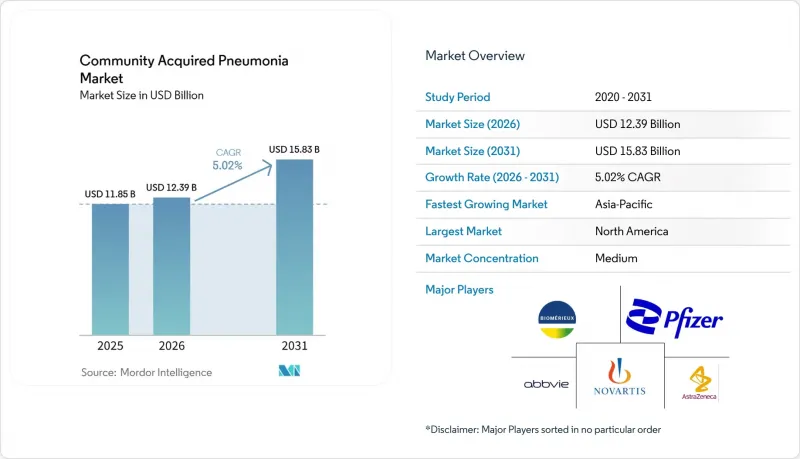
Mordor Intelligence에 의하면, 지역사회 획득성 폐렴 시장 규모는 2025년에 118억 5,000만 달러로 평가되었습니다. 2026년 123억 9,000만 달러에서 2031년까지 158억 3,000만 달러에 이르고 예측 기간(2026-2031년) CAGR은 5.02%를 나타낼 전망입니다.
본 보고서는 진단·치료(진단 방법, 치료 유형), 병원체 유형(세균성, 바이러스성, 진균성, 비정형 폐렴), 연령대(영아, 소아, 성인, 고령자), 위험 요인(만성 질환, 흡연, 알코올 의존증, 면역 기능 저하), 지역(북미, 유럽, 아시아태평양, 중동 및 아프리카, 남미)별로 분류되어 있습니다. 시장 전망은 금액(달러) 기준으로 제시되어 있습니다.
세계의 지역사회 획득성 폐렴 시장 동향 및 인사이트
고령자 및 면역결핍 환자에서 CAP의 부담 증가
지역사회 획득성 폐렴 시장은 중증화 및 재입원 위험이 높은 고령자 및 면역결핍 환자가 꾸준히 증가하고 있음에 따라 확대되고 있습니다. 2025년 『JAMA Network Open』지에 게재된 연구에 따르면, 미국에서는 65세 이상 성인이 가장 큰 입원 부담을 지고 있으며, 백신이 널리 사용되고 있음에도 불구하고 폐렴구균이 여전히 전체 사례의 14%를 차지하는 것으로 나타났습니다. 2025년 『European Journal of Internal Medicine』지에 게재된 메타분석에 따르면, CAP(지역사회 획득성 폐렴)으로 입원한 성인 3명 중 1명이 이듬해 이내에 사망했으며, 사망률은 65세 미만 환자의 경우 5%인 반면, 80세 이상 환자에서는 14%로 상승하며, 여러 가지 동반 질환을 가진 환자의 경우 43%에 달하는 것으로 밝혀졌습니다. 이러한 결과로 인해 급성기 치료에만 지출을 제한하는 것이 아니라, 예방, 조기 진단, 입원 치료 및 퇴원 후 관리에 대한 수요가 지속적으로 증가하고 있습니다. 이와 같은 추세로 인해 장기 요양 계획에서 지역사회 획득성 폐렴 시장의 역할이 더욱 중요시되고 있습니다. 이는 장기 이식 수혜자, 면역억제 요법을 받고 있는 환자, 그리고 암이나 HIV에 걸린 사람들이 더 다양한 병원체에 감염되기 쉽고, 치료 실패 위험도 높기 때문입니다.
내성 호흡기 병원체에 대한 항생제 혁신의 진전
지역사회 획득성 폐렴 시장은 내성으로 인해 기존의 경험적 치료법의 신뢰성이 저하되고 있는 만큼, 항생제 혁신에 의해서도 형성되고 있습니다. 2026년에 실시된 3상 OPTIC 및 OPTIC-2 임상시험의 통합 분석에 따르면, 플루오로퀴놀론계 항균제에 대한 감수성이 저하된 병원체를 보유한 환자를 포함하여, 미생물학적으로 다양한 지역사회 획득성 폐렴(CABP) 환자 집단에서 오마다사이클린이 목시플록사신에 비해 비열등성을 유지하고 있음이 확인되었습니다. 2026년 『Antibiotics』지에 게재된 논문에서는 레파무린이나 오마다사이클린과 같은 신약이, 하기도 감염에서 마크로라이드계나 플루오로퀴놀론계의 유용성을 저하시켜 온 내성 경로를 우회하도록 설계되었다고 설명하고 있습니다. 바실레아 파마슈티카(Bacillea Pharmaceuticals)는 2026년에 BAL2420의 1상 투여를 시작했으며, CARB-X의 추가 자금 지원은 현재 승인된 약제로는 완전히 대처할 수 없는 그람 음성균의 내성 격차에 대한 ‘퍼스트-인-클래스(First-in-Class)’ 접근법에 대한 지속적인 지지를 나타냈습니다. 그 결과, 지역사회 획득성 폐렴 시장은 단순한 약물 군의 대체를 넘어, 표준 요법이 효과를 보이지 않을 때 프리미엄 위치를 정당화할 수 있는 표적 치료로 전환되고 있습니다.
항생제 내성이 표준 치료법의 유효성을 저하시키고 있습니다.
지역사회 획득성 폐렴 시장은 내성균 증가로 인해 표준 1차 치료법의 유효성이 지속적으로 저하되고 있어 여전히 큰 장벽에 직면해 있습니다. 2026년에 실시된 CAP(지역사회 획득성 폐렴)에서 분리된 세균을 대상으로 한 횡단면 연구에서는 β-락탐계, 마크로라이드계, 플루오로퀴놀론계에 걸친 내성이 확인되었으며, 과거 항생제 노출 이력이 이러한 내성 패턴과 밀접하게 관련되어 있음이 밝혀졌습니다. 1차 치료법의 효과를 예측하기 어려워지면, 임상의는 더 신속하게 예비 약물로 전환하게 되며, 이로 인해 치료비가 증가하고 항생제 적정 사용 체제에 대한 부담도 커집니다. 많은 국가에서 보험 환급 절차가 내성 패턴의 변화보다 여전히 뒤처져 있기 때문에 새로운 브랜드 의약품이 그 임상적 가치에 걸맞은 속도로 시장에서 반드시 보급되는 것은 아닙니다. 이로 인해 더 우수한 치료법에 대한 수요는 존재하지만, 접근에 관한 규제, 예산 제약, 그리고 항균제 적정 사용 체제의 안전 조치들이 여전히 광범위한 도입을 방해하고 있어, 지역사회 획득성 폐렴 시장은 계속해서 어려운 상황에 놓여 있습니다.
부문 분석
2025년에는 진단법이 52.83%의 점유율을 차지하며, 이 부문 내에서 가장 큰 비중을 차지함과 동시에 지역사회 획득성 폐렴 시장의 주요 지출 축이 되었습니다. 흉부 X선 검사는 널리 이용 가능하고, 임상의들에게도 친숙하며, 입원 및 외래 환경 모두에서 비용 대비 효과가 높기 때문에 여전히 표준적인 초기 검사 수단으로 자리 잡고 있습니다. CT 스캔은 단순 X선 검사만으로는 감별 진단을 확정할 수 없는 복잡하고 재발성이 있는 사례나 면역 결핍 상태의 사례에서 더 빈번하게 사용되고 있습니다. 프로칼시토닌이나 C반응성 단백질(CRP) 등의 혈액 검사는 세균성과 바이러스성의 감별을 지속적으로 지원하고 있으며, 가래 배양은 약물 내성 감시에 여전히 중요하고, 맥박 산소 포화도 측정법은 트리아지 시 신속한 중증도 분류를 돕고 있습니다. 이러한 도구들 덕분에 부가가치가 더 높은 분자진단법이 일상적으로 사용되게 되었음에도 불구하고, 지역사회 획득성 폐렴 시장은 확립된 워크플로우에 기반을 둔 상태를 유지하고 있습니다.
치료 분야는 2031년까지 연평균 성장률(CAGR) 5.54%를 나타낼 것으로 예측되며, 이 카테고리 내에서 가장 높은 성장률을 보일 것으로 예측됩니다. 이는 검사만을 통한 확정 진단보다 의료 서비스 제공 자체에 더 큰 미래 가치가 부여되고 있음을 의미합니다. 항생제는 여전히 치료비의 가장 큰 비중을 차지하고 있으며, 병원이 약물 내성 위험과 처방약 목록에 대한 요구에 대응함에 따라 오마다사이클린이나 레파무린과 같은 신약이 그 역할을 확대되고 있습니다. 산소 요법에 대한 수요도 증가하고 있습니다. 이는 중증도가 높은 고령 환자가 증가하고 있는 데다, 재택 산소 요법용 기기가 특정 경증 사례의 외래 관리를 지원하게 되었기 때문입니다. 입원에는 추가적인 비용 압박이 가해지고 있으며, 이로 인해 중증도 평가, 원격 추적 관찰, 그리고 피할 수 있는 입원을 줄이는 외래 중심 치료법의 활용 확대가 촉진되고 있습니다.
2025년, 세균성 폐렴은 지역사회 획득성 폐렴 시장 규모의 60.38%를 차지하며, 다른 모든 병원체 범주를 크게 앞질렀습니다. 폐렴구균은 여전히 가장 잘 알려진 단일 병원체이며, 2025년 『JAMA Network Open』지에 게재된 연구에 따르면, 미국 내 고령자의 입원이 필요한 지역사회 획득성 폐렴(CAP) 사례 중 14%를 이 병원체가 차지하는 것으로 밝혀졌습니다. 2025년 학술지 『Pneumonia』에 게재된 체계적 문헌고찰에 따르면, 2020년 이후 고령 CAP 환자들 사이에서 백신 접종 대상이 아닌 혈청형, 특히 혈청형 3이 재유행하고 있으며, 이로 인해 백신 적용 범위 확대 및 병원체 특이적 검사에 대한 수요가 유지되고 있습니다. 클레브시엘라 뉴모니아에(Klebsiella pneumoniae)나 내성 헤모필루스 인플루엔자(Haemophilus influenzae)와 같은 그람 음성균도 고령자나 면역결핍 환자에서 더 큰 역할을 하고 있으며, 이는 치료가 어려운 세균성 질환에 대한 항생제의 지속적인 개발을 촉진하고 있습니다. 따라서 병원체의 구성이 점차 다양해지고 있음에도 불구하고, 지역사회 획득성 폐렴 시장에서는 세균성 폐렴의 관리가 여전히 상업적 가치의 대부분을 차지하고 있습니다.
바이러스성 폐렴은 2031년까지 연평균 성장률(CAGR) 6.76%를 나타낼 것으로 예측되며, 지역사회 획득성 폐렴 시장에서 가장 빠르게 확대되고 있는 병원체 군이 될 것입니다. 코로나19 대유행 이후, 호흡기 감시 체계의 개선으로 인해 비특이적 지역사회 획득성 폐렴(CAP) 범주에 분류되지 않고 구체적으로 특정되는 바이러스 감염증의 수가 증가하고 있습니다. 또한, 다항목 호흡기 패널의 보급으로 인해 바이러스성, 세균성 및 혼합 감염의 감별 정확도가 향상되고 있으며, 이에 따라 치료 방침과 역학적 보고 패턴에 변화가 생기고 있습니다. 진균성 폐렴은 사례 수는 여전히 적고 시장 규모도 작지만 그 가치는 높아지고 있습니다. 이는 면역결핍 환자, 특히 아스페르길루스나 뉴모시스티스 지로베시에 대한 전문적인 진단과 치료가 필요하기 때문입니다. 비정형 폐렴은 레지오넬라, 마이코플라즈마 뉴모니아에, 클라미도필라 뉴모니아에 등의 병원체가 β-락탐계 항생제에 대한 반응이 미미하기 때문에 임상적으로 여전히 중요하며, 이로 인해 지역사회 획득성 폐렴 시장에서 치료의 질을 확보하기 위해서는 정확한 병원체 동정이 여전히 극히 중요합니다.
지역별 분석
2025년, 북미는 지역사회 획득성 폐렴 시장 점유율의 35.63%를 차지하며 모든 지역 그룹 중 1위를 유지했습니다. 미국은 선진적인 병원 인프라, 강력한 백신 정책, 그리고 치료제 및 진단제 분야에서의 활발한 임상 개발을 모두 갖추고 있어 여전히 주요 수익원으로 자리 잡고 있습니다. ACIP(미국 예방접종자문위원회)는 폐렴구균 결합형 백신의 접종 대상을 50세 이상의 모든 성인으로 확대하여, 성인 질환 관리에 있어 장기적인 예방 기반을 강화했습니다. 또한 머크의 ‘CAPVAXIVE’도 FDA 승인을 받아 탄력을 받고 있으며, 회사에 따르면 이 백신은 해당 연령대의 성인에서 침습성 폐렴구균 감염증을 유발하는 혈청형의 83%에서 85%를 커버한다고 합니다. 캐나다는 국민건강보험 제도와 비용 중심의 의료 모델을 통해 안정적인 수요를 뒷받침하고 있는 반면, 멕시코는 수요량이 증가하고 있음에도 불구하고 첨단 진단 기술의 보급률은 여전히 낮은 수준에 머물러 있습니다.
유럽은 강력한 항생제 적정 사용 체계와 백신 및 진단제에 대한 꾸준한 수요에 힘입어, 지역사회 획득성 폐렴 시장에서 여전히 2위 지역 블록으로서의 지위를 유지했습니다. 프랑스는 2025년에 외래 환자 대상 지역사회 획득성 폐렴(CAP) 항생제 지침을 개정하여, 합병증이 없는 사례에 대한 치료 기간을 최대 7일로 제한했습니다. 이를 통해 항생제의 조기 감량과 보다 정확한 선택이 촉진되었습니다. 이는 표준 치료 요법의 처방량을 억제할 가능성이 있지만, 한편으로는 신속한 호흡기 검사 및 보다 표적화된 치료법의 가치 제안을 강화하는 결과로 이어집니다. 독일, 영국, 스페인, 이탈리아에서는 분자진단, 성인 대상 백신 접종, 그리고 병원 내 항생제 사용 분야에서 계속해서 의미 있는 수요가 확대되고 있습니다.
아시아태평양은 2031년까지 연평균 성장률(CAGR) 6.04%를 나타낼 것으로 예측되며, 지역사회 획득성 폐렴 시장에서 가장 빠르게 확대되는 지역이 될 전망입니다. 인도는 높은 유병률로 인해 여전히 중요한 시장이며, 광범위한 공중보건 프로그램을 통해 질병 부담 경감 및 치료 접근성 향상 노력이 모두 높은 수준으로 유지되고 있습니다. 2025년 중국에서 실시된 지역 조사에 따르면, CAP의 발생률은 1,000인년당 42.1건이며, 대부분의 사례는 병원체 확인 없이 외래에서 관리되고 있어, 이는 현장 진단(Point-of-Care)의 큰 잠재력을 시사합니다. 중동 및 아프리카 및 남미는 지역 획득성 폐렴 시장에서 여전히 초기 단계의 기회를 내포하고 있습니다. 이는 검사 네트워크, 공공 조달, 백신 접근성이 개선되고 있어 향후 진단 및 치료의 성장 기반이 점차 마련되고 있기 때문입니다.
기타 혜택 :
- 엑셀 형식 시장 예측(ME) 시트
- 3개월간의 애널리스트 지원
자주 묻는 질문
목차
제1장 서론
제2장 조사 방법
제3장 주요 요약
제4장 시장 구도
제5장 시장 규모 및 성장 예측
제6장 경쟁 구도
제7장 시장 기회 및 향후 전망
KTH 26.08.10According to Mordor Intelligence, the community acquired pneumonia market size was valued at USD 11.85 billion in 2025 and is estimated to grow from USD 12.39 billion in 2026 to reach USD 15.83 billion by 2031, at a CAGR of 5.02% during the forecast period (2026-2031).
This report is Segmented by Diagnosis & Treatment (Diagnosis Method, Treatment Type), Pathogen Type (Bacterial, Viral, Fungal, Atypical Pneumonia), Age Group (Infants, Children, Adults, Geriatric), Risk Factors (Chronic Diseases, Smoking, Alcoholism, Weakened Immune System), and Geography (North America, Europe, Asia-Pacific, MEA, South America). The Market Forecasts are Provided in Terms of Value (USD).
Global Community Acquired Pneumonia Market Trends and Insights
Rising CAP Burden in Older and Immunocompromised Patients
The community-acquired pneumonia market is expanding with the steady rise in elderly and immunocompromised patients who face a higher risk of severe disease and repeat care episodes. A 2025 study in JAMA Network Open showed that adults aged 65 and older carried the heaviest hospitalization burden in the United States, and Streptococcus pneumoniae still caused 14% of cases despite broad vaccine use. A 2025 meta-analysis in the European Journal of Internal Medicine found that 1 in 3 adults hospitalized for CAP died within the following year, with mortality rising from 5% in patients under 65 to 14% in those over 80 and reaching 43% in patients with multiple comorbidities. These outcomes keep demand strong for prevention, early diagnosis, inpatient treatment, and post-discharge management rather than limiting spending to the acute episode alone. The same pattern is reinforcing the role of the community-acquired pneumonia market in long-cycle care planning because transplant recipients, patients on immunosuppressive therapy, and people living with cancer or HIV present with broader pathogen diversity and higher treatment failure risk.
Increasing Antibiotic Innovation for Resistant Respiratory Pathogens
The community-acquired pneumonia market is also being shaped by antibiotic innovation as resistance weakens the reliability of older empiric regimens. A 2026 pooled analysis of the Phase 3 OPTIC and OPTIC-2 trials confirmed that omadacycline remained noninferior to moxifloxacin across a microbiologically diverse CABP population, including patients with pathogens showing reduced fluoroquinolone susceptibility. A 2026 paper in Antibiotics explained that newer agents such as lefamulin and omadacycline were designed to bypass resistance pathways that have reduced the utility of macrolides and fluoroquinolones in lower respiratory infections. Basilea Pharmaceutica started Phase 1 dosing for BAL2420 in 2026, and the added CARB-X funding showed continued support for first-in-class approaches against gram-negative resistance gaps that current approved agents do not fully address. As a result, the community-acquired pneumonia market is moving beyond simple class replacement and toward targeted therapies that can justify premium positioning when standard therapies fail.
Antibiotic Resistance Reducing Efficacy of Standard Regimens
The community-acquired pneumonia market still faces a major barrier because resistance continues to erode the effectiveness of standard first-line regimens. A 2026 cross-sectional study of CAP isolated bacteria documented resistance across beta-lactams, macrolides, and fluoroquinolones, and prior antibiotic exposure closely tracked with those resistance patterns. When first-line therapy becomes less predictable, clinicians escalate more quickly to reserve agents, which increases treatment cost and creates more pressure on stewardship systems. Reimbursement pathways in many countries still move more slowly than resistance patterns, so newer branded drugs do not always gain commercial traction at the same pace as their clinical value. This keeps the community-acquired pneumonia market under pressure because demand for better treatment exists, but access rules, budget limits, and stewardship safeguards still slow broad adoption.
Other drivers and restraints analyzed in the detailed report include:
- Wider Use of Rapid Diagnostics and Imaging in Early CAP Workup
- Broader Pneumococcal and Respiratory Vaccination Adoption
- Delayed or Inaccurate Diagnosis Leading to Non-Optimal Treatment
For complete list of drivers and restraints, kindly check the Table Of Contents.
Segment Analysis
Diagnosis method held 52.83% share in 2025, which made it the largest part of this segmentation and a core spending anchor in the community-acquired pneumonia market. Chest X-ray remains the standard entry point because it is widely available, familiar to clinicians, and cost-efficient in both inpatient and outpatient settings. CT scanning is used more often in complex, recurrent, or immunocompromised presentations where plain imaging does not settle the differential diagnosis. Blood tests such as procalcitonin and C-reactive protein continue to support bacterial versus viral differentiation, while sputum culture remains important for resistance surveillance, and pulse oximetry supports fast severity stratification at triage. These tools keep the community-acquired pneumonia market grounded in established workflows even as higher-value molecular methods move into routine use.
Treatment type is projected to grow at a 5.54% CAGR through 2031, giving it the fastest growth profile within this category and linking more future value to care delivery than to test confirmation alone. Antibiotics still account for the largest share of treatment spending, and newer agents such as omadacycline and lefamulin are widening their role as hospitals respond to resistance risk and formulary needs. Oxygen therapy demand is also rising because more elderly patients present with greater severity and because home oxygen devices now support ambulatory management in selected lower acuity cases. Hospitalization is facing more cost pressure, which encourages wider use of severity scoring, remote follow-up, and ambulatory compatible therapies that reduce avoidable admissions.
Bacterial pneumonia held 60.38% of the community-acquired pneumonia market size in 2025, which kept it well ahead of every other pathogen category. Streptococcus pneumoniae remained the best-known single pathogen, and a 2025 study in JAMA Network Open found that it accounted for 14% of hospitalized CAP cases among older adults in the United States. A 2025 systematic review in the journal Pneumonia reported that non-vaccine serotypes, especially serotype 3, have re-emerged among elderly CAP patients since 2020, which keeps demand in place for broader vaccine coverage and pathogen-specific testing. Gram-negative pathogens such as Klebsiella pneumoniae and resistant Haemophilus influenzae are also taking a larger role in elderly and immunocompromised patients, which supports continued antibiotic innovation against harder-to-treat bacterial disease. For this reason, the community-acquired pneumonia market continues to derive a large share of commercial value from bacterial management even while the pathogen mix is gradually broadening.
Viral pneumonia is forecast to grow at a 6.76% CAGR through 2031, making it the fastest expanding pathogen group in the community-acquired pneumonia market. Better respiratory surveillance since the COVID period has increased the number of viral infections that are specifically identified rather than left in an unspecified CAP category. The spread of multiplex respiratory panels has also improved differentiation between viral, bacterial, and mixed infections, which is changing treatment decisions and epidemiological reporting patterns. Fungal Pneumonia remains smaller in volume but higher in value because immunocompromised patients need specialized diagnosis and treatment, especially for Aspergillus and Pneumocystis jirovecii. Atypical Pneumonia remains clinically important because organisms such as Legionella, Mycoplasma pneumoniae, and Chlamydophila pneumoniae respond poorly to beta lactams, which keeps accurate pathogen identification central to treatment quality in the community acquired pneumonia market.
Complete Report Scope:
- By Diagnosis & Treatment
- Diagnosis Method
- Chest X-Ray
- CT Scan
- Sputum Culture
- Blood Tests
- Pulse Oximetry
- Treatment Type
- Antibiotics
- Oxygen Therapy
- Hospitalization
- Supportive Care
- Diagnosis Method
- By Pathogen Type
- Bacterial Pneumonia
- Viral Pneumonia
- Fungal Pneumonia
- Atypical Pneumonia
- By Age Group
- Infants
- Children
- Adults
- Geriatric Population
- By Risk Factors
- Chronic Diseases
- Smoking
- Alcoholism
- Weakened Immune System
- By Geography
- North America
- United States
- Canada
- Mexico
- Europe
- Germany
- United Kingdom
- France
- Italy
- Spain
- Rest of Europe
- Asia-Pacific
- China
- Japan
- India
- Australia
- South Korea
- Rest of Asia-Pacific
- Middle East & Africa
- GCC
- South Africa
- Rest of Middle East & Africa
- South America
- Brazil
- Argentina
- Rest of South America
- North America
Geography Analysis
North America held 35.63% of the community-acquired pneumonia market share in 2025, which kept it in the lead among all regional groupings. The United States remains the key revenue engine because it combines advanced hospital infrastructure, strong vaccine policy, and active clinical development across therapeutics and diagnostics. ACIP expanded pneumococcal conjugate vaccine eligibility to all adults aged 50 years and older, which strengthened the long-term prevention base for adult disease management. Merck's CAPVAXIVE also added momentum after FDA approval, and the company stated that the vaccine covered 83% to 85% of invasive pneumococcal disease-causing serotypes in adults within this age group. Canada supports steady demand through universal coverage and cost-focused care models, while Mexico adds volume but remains less even in advanced diagnostics penetration.
Europe remained the second largest regional block in the community-acquired pneumonia market, supported by strong stewardship frameworks and steady vaccine and diagnostics demand. France updated outpatient CAP antibiotic guidance in 2025 and limited uncomplicated treatment to a maximum of 7 days, which reinforced faster de-escalation and sharper antibiotic selection. This can limit unit volumes for standard regimens, but it also strengthens the value proposition for rapid respiratory testing and better targeted therapies. Germany, the United Kingdom, Spain, and Italy continue to add meaningful demand across molecular diagnostics, adult vaccination, and hospital-based antibiotic use.
Asia-Pacific is forecast to grow at a 6.04% CAGR through 2031, making it the fastest expanding geography in the community-acquired pneumonia market. India remains important because of the high incidence, and broad public health programs keep both disease burden and treatment access initiatives elevated. A 2025 community study in China found a CAP incidence of 42.1 per 1,000 person-years, with most cases managed in outpatient settings without pathogen confirmation, which points to a large opening for point-of-care diagnostics. The Middle East and Africa, along with South America, still represent earlier-stage opportunities in the community-acquired pneumonia market because better laboratory networks, public procurement, and vaccine access are gradually improving the base for future diagnostics and treatment growth.
- Abbott Laboratories
- Abbvie
- APTARION Biotech AG
- AstraZeneca
- Basilea Pharmaceutica Ltd.
- Beckton Dickinson
- bioMerieux S.A.
- Eagle Pharmaceuticals, Inc.
- GlaxoSmithKline
- Hologic
- Melinta Therapeutics LLC
- Merck
- Nabriva Therapeutics plc
- Novartis
- Paratek Pharmaceuticals
- Pfizer
- QuidelOrtho
- Roche
- Sanofi
- Shionogi and Co., Ltd.
- Takeda Pharmaceuticals
- Thermo Fisher Scientific
Additional Benefits:
- The market estimate (ME) sheet in Excel format
- 3 months of analyst support
TABLE OF CONTENTS
1 Introduction
- 1.1 Study Assumptions & Market Definition
- 1.2 Scope of the Study
2 Research Methodology
3 Executive Summary
4 Market Landscape
- 4.1 Market Overview
- 4.2 Market Drivers
- 4.2.1 Rising CAP Burden in Older and Immunocompromised Patients
- 4.2.2 Increasing Antibiotic Innovation for Resistant Respiratory Pathogens
- 4.2.3 Wider Use of Rapid Diagnostics and Imaging in Early CAP Workup
- 4.2.4 Broader Pneumococcal and Respiratory Vaccination Adoption
- 4.2.5 Underuse of Novel Agents in Outpatient Step-Down Therapy
- 4.2.6 Expansion of Outpatient and Home-Based Management Pathways
- 4.3 Market Restraints
- 4.3.1 Antibiotic Resistance Reducing Efficacy of Standard Regimens
- 4.3.2 Delayed or Inaccurate Diagnosis Leading to Non-Optimal Treatment
- 4.3.3 High Cost of Severe-Care Management and Newer Antibiotics
- 4.3.4 Limited Personalized Treatment Approaches for CAP Subtypes
- 4.4 Value / Supply-Chain Analysis
- 4.5 Regulatory Landscape
- 4.6 Technological Outlook
- 4.7 Porter's Five Forces Analysis
- 4.7.1 Threat of New Entrants
- 4.7.2 Bargaining Power of Suppliers
- 4.7.3 Bargaining Power of Buyers
- 4.7.4 Threat of Substitutes
- 4.7.5 Industry Rivalry
5 Market Size & Growth Forecasts
- 5.1 By Diagnosis & Treatment
- 5.1.1 Diagnosis Method
- 5.1.1.1 Chest X-Ray
- 5.1.1.2 CT Scan
- 5.1.1.3 Sputum Culture
- 5.1.1.4 Blood Tests
- 5.1.1.5 Pulse Oximetry
- 5.1.2 Treatment Type
- 5.1.2.1 Antibiotics
- 5.1.2.2 Oxygen Therapy
- 5.1.2.3 Hospitalization
- 5.1.2.4 Supportive Care
- 5.1.1 Diagnosis Method
- 5.2 By Pathogen Type
- 5.2.1 Bacterial Pneumonia
- 5.2.2 Viral Pneumonia
- 5.2.3 Fungal Pneumonia
- 5.2.4 Atypical Pneumonia
- 5.3 By Age Group
- 5.3.1 Infants
- 5.3.2 Children
- 5.3.3 Adults
- 5.3.4 Geriatric Population
- 5.4 By Risk Factors
- 5.4.1 Chronic Diseases
- 5.4.2 Smoking
- 5.4.3 Alcoholism
- 5.4.4 Weakened Immune System
- 5.5 By Geography
- 5.5.1 North America
- 5.5.1.1 United States
- 5.5.1.2 Canada
- 5.5.1.3 Mexico
- 5.5.2 Europe
- 5.5.2.1 Germany
- 5.5.2.2 United Kingdom
- 5.5.2.3 France
- 5.5.2.4 Italy
- 5.5.2.5 Spain
- 5.5.2.6 Rest of Europe
- 5.5.3 Asia-Pacific
- 5.5.3.1 China
- 5.5.3.2 Japan
- 5.5.3.3 India
- 5.5.3.4 Australia
- 5.5.3.5 South Korea
- 5.5.3.6 Rest of Asia-Pacific
- 5.5.4 Middle East & Africa
- 5.5.4.1 GCC
- 5.5.4.2 South Africa
- 5.5.4.3 Rest of Middle East & Africa
- 5.5.5 South America
- 5.5.5.1 Brazil
- 5.5.5.2 Argentina
- 5.5.5.3 Rest of South America
- 5.5.1 North America
6 Competitive Landscape
- 6.1 Market Concentration
- 6.2 Market Share Analysis
- 6.3 Company Profiles (includes Global Level Overview, Market-level Overview, Core Segments, Financials, Strategic Information, Market Rank/Share, Products & Services, Recent Developments)
- 6.3.1 Abbott Laboratories
- 6.3.2 AbbVie Inc.
- 6.3.3 APTARION Biotech AG
- 6.3.4 AstraZeneca plc
- 6.3.5 Basilea Pharmaceutica Ltd.
- 6.3.6 BD
- 6.3.7 bioMerieux S.A.
- 6.3.8 Eagle Pharmaceuticals, Inc.
- 6.3.9 GlaxoSmithKline plc
- 6.3.10 Hologic, Inc.
- 6.3.11 Melinta Therapeutics LLC
- 6.3.12 Merck and Co., Inc.
- 6.3.13 Nabriva Therapeutics plc
- 6.3.14 Novartis AG
- 6.3.15 Paratek Pharmaceuticals, Inc.
- 6.3.16 Pfizer Inc.
- 6.3.17 QuidelOrtho Corporation
- 6.3.18 Roche Holding AG
- 6.3.19 Sanofi S.A.
- 6.3.20 Shionogi and Co., Ltd.
- 6.3.21 Takeda Pharmaceutical Company Limited
- 6.3.22 Thermo Fisher Scientific Inc.
7 Market Opportunities & Future Outlook
- 7.1 White-space & Unmet-need Assessment


