

|
시장보고서
상품코드
2099500
실험실 장비 서비스 : 시장 점유율 분석, 업계 동향 및 통계, 성장 예측(2026-2031년)Laboratory Equipment Services - Market Share Analysis, Industry Trends & Statistics, Growth Forecasts (2026 - 2031) |
||||||
 Mordor Intelligence
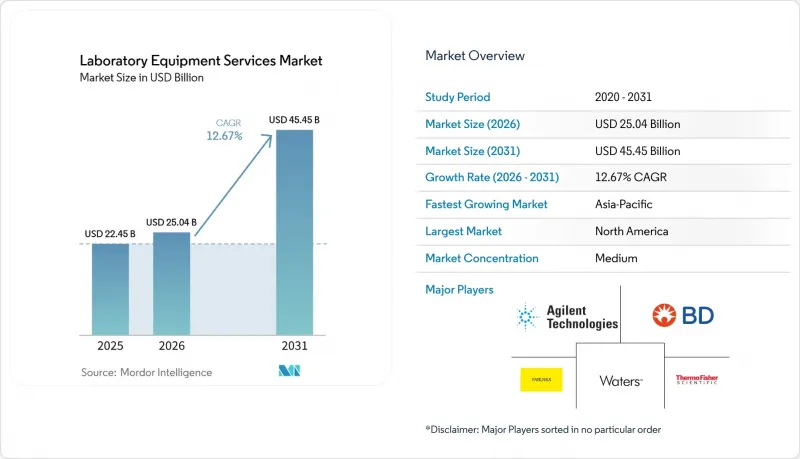
Mordor Intelligence에 의하면, 실험실 장비 서비스 시장 규모는 2025년에 224억 5,000만 달러로 평가되었습니다. 2026년 250억 4,000만 달러, 2031년 454억 5,000만 달러에 이를 것으로 예측되며, 2026년부터 2031년에 걸쳐 CAGR 12.67%로 성장할 전망입니다.
본 보고서는 서비스 유형별(수리, 교정, 검증, 예방 정비, 관리형 서비스, 교육), 서비스 제공업체(OEM, 제3자, 유통업체), 장비(분석 장비, 범용 장비, 특수 장비, 지원 장비), 계약 유형(표준 계약, 맞춤형 계약), 최종 사용자(제약·바이오기술, 임상, 학술, 정부, 산업), 지역(북미, 유럽, 기타)별로 분류되어 있습니다. 시장 전망은 금액(달러)으로 표시되어 있습니다.
세계의 실험실 장비 서비스 시장 동향 및 인사이트
실험실 가동률 향상 및 가동 중단 시간 방지에 대한 수요 증가
실험실 장비 서비스 시장은 제약 및 임상 실험실에서 발생하는 예기치 못한 가동 중단으로 인한 비용 증가라는 상황의 수혜를 받고 있습니다. 규제 대상 워크플로우를 운영하는 검사실에서는 분석 미실시, 결과 지연, 품질 관리 절차의 중단이 업무를 급속히 혼란에 빠뜨리기 때문에 가동 중단을 쉽게 감당할 수 없습니다. 이러한 압박으로 인해 서비스 계약은 선택적 구매라기보다는 고정적인 운영 요건으로 자리 잡고 있습니다. 또한, 장비의 복잡화에 따라 계획적인 유지보수와 긴급 대응 간의 비용 격차가 계속 확대되고 있어, 실험실 장비 서비스 시장에서는 예방적 유지보수 및 관리형 서비스에 대한 수요가 높아지고 있습니다. 다양한 장비를 혼합하여 운영하는 대규모 시설에서는 단일 공급업체가 여러 플랫폼에 걸친 가동 시간을 조정할 수 있기 때문에 멀티 벤더 서비스 프로그램에 대한 관심이 높아지고 있습니다. 이에 따라 가동 시간 확보를 지원하는 서비스는 단순한 사후 서비스의 부수적인 요소가 아니라, 실질적인 구매 우선순위가 되고 있습니다.
제약, 생명공학, 진단 실험실 인프라의 성장
실험실 장비 서비스 시장은 지속적으로 확대되는 제약, 생명공학 및 진단 인프라로부터 계속해서 뒷받침을 받고 있습니다. 새로운 분석 시스템, 검증 워크플로우 및 전용 플랫폼이 도입될 때마다, 장비 설치 후에는 정기적인 서비스, 교정 및 규정 준수 지원에 대한 장기적인 수요가 발생합니다. 규제 대상 환경에서는 서비스가 초기 판매로 끝나지 않고 자산의 전체 가동 기간에 걸쳐 지속되기 때문에 이러한 경향은 더욱 두드러집니다. 다나하(Danaher)사의 보고서에 따르면, 2026년 1분기 바이오프로세스 장비 수주량은 전년 동기 대비 30% 이상 증가했으며, 이는 향후 서비스 대응이 필요한 도입 장비 기반의 확대를 시사합니다. 또한, 애지런트 테크놀로지스(Agilent Technologies)와 비다 생명과학(Vida Life Sciences)는 2026년 5월 방갈로르에 공동 ‘분석 센터 오브 엑설런스(Center of Excellence)’를 개설했습니다. 이는 인도 내 실험실 인프라의 기술적 심도가 높아지고, 이에 따른 하이엔드 지원 서비스에 대한 수요가 증가하고 있음을 반영합니다. 따라서 실험실 장비 서비스 시장은 단순히 장비 판매 대수가 증가했기 때문뿐만 아니라, 도입되는 장비 한 대당 수리, 적합성 평가, 성능 보증과 같은 지속적인 서비스 수요가 발생하기 때문에 성장하고 있습니다.
첨단 장비의 고액 서비스 계약 비용
첨단 장비의 연간 서비스 비용이 고액인 경우, 실험실 장비 서비스 시장은 여전히 저항에 직면해 있습니다. 질량 분석기, 유세포 분석기, 다차원 크로마토그래피 플랫폼과 같은 복잡한 시스템의 서비스 계약 비용은 1대당 연간 2만 달러에서 8만 달러에 달할 수 있으며, 이는 운영 예산의 상당 부분을 차지할 가능성이 있습니다. 소규모 연구소나 중규모 기관에서는 이에 대응하여 서비스 범위를 축소하거나, 업그레이드를 연기하거나, 종합적인 계약 대신 시간 및 자재 기반의 서비스를 선택하는 경우가 많습니다. 이러한 조치로 인해 서비스 수요가 사라지는 것은 아니지만, 비용에 민감한 고객들의 종합적인 계약 도입을 지연시킬 가능성이 있습니다. 이러한 억제 경향은 조달 규모가 제한적이고, 구매자가 더 광범위한 장비군 전체에 걸쳐 더 유리한 가격 협상을 할 수 없는 경우에 가장 두드러집니다. 또한 이로 인해 공급업체는 제한된 예산에 더 효과적으로 부합할 수 있는 보다 모듈식이며 성과 연계형 계약을 제공하도록 압박받고 있습니다.
부문 분석
2025년에는 수리 및 유지보수 서비스가 42.83%의 점유율을 차지했으나, 검증 서비스는 2031년까지 연평균 성장률(CAGR) 14.71%를 나타낼 것으로 예측됩니다. 수익에 대한 가장 큰 기여 요인은 여전히 대규모로 도입된 장비군이 생산성과 규정 준수를 유지하기 위해 지속적인 유지보수가 필요하다는 단순한 사실에서 기인합니다. 제약 및 임상 현장 실험실에서는 장비의 가동 상태가 검사 처리 능력, 제품 출시 시기, 보고 의무에 직접적인 영향을 미치기 때문에 핵심 수리 작업을 장기간 미룰 수 없습니다. 검증 서비스의 성장이 더욱 빠른 이유는 장비의 설치, 이동, 업그레이드 또는 대규모 유지보수가 이루어질 때마다 적합성 평가 작업이 필요하기 때문입니다. 따라서 검증은 단순한 선택적 확장 기능이 아니라, 규제 대상 워크플로우에 통합된 필수 요건이 되었습니다.
또한, 이 부문 그룹 내에서는 실험실 장비 서비스 시장에서 기본적인 지원과 규정 준수를 중시하는 서비스 업무 간의 균형이 점차 균등해지고 있습니다. 교정은 규제 환경에서 정확도가 제품 출시, 시험의 유효성 및 감사 대비 태세에 직접적인 영향을 미치기 때문에 안정적인 수익원으로 자리 잡고 있습니다. 예방적 유지보수 서비스는 고객이 사후 대응형 서비스 요청에서 계획적인 유지보수로 전환함에 따라 꾸준히 그 중요성이 커지고 있습니다. 많은 연구소가 여러 거점 및 여러 공급업체에 걸친 지원을 조정할 수 있는 단일 공급자를 선호함에 따라, 관리형 서비스 및 계약 서비스가 확대되고 있습니다. 교육, 훈련 및 인증 서비스는 여전히 규모는 작지만, 사내 기술 부족으로 인해 장비의 올바른 사용이나 일상적인 유지보수가 어려운 경우 그 중요성이 높아지고 있습니다.
OEM(주문자 상표 제조업체)은 2025년에 46.38%의 점유율을 차지했으며, 2031년까지 연평균 성장률(CAGR) 13.32%를 나타낼 것으로 예측됩니다. 이러한 위상은 독자적인 소프트웨어, 순정 부품, 제조업체 교육을 이수한 엔지니어, 그리고 규제 대상 유지보수 서비스를 뒷받침하는 문서에 대한 OEM의 지배력을 반영합니다. 실험실 장비 서비스 시장에서는 고객이 기술적으로 복잡한 신규 장비를 구매하고 판매 시점에 서비스 계약을 부가하는 경우, 여전히 OEM에 명확한 우위가 있습니다. 이러한 경향은 제조업체의 직접적인 승인 없이는 서비스 이용이 어려운 장비 카테고리에서 특히 두드러집니다. 또한, OEM 계약에는 종종 가격 프리미엄이 수반됨에도 불구하고 OEM이 성장을 지속할 수 있는 이유도 여기에 있습니다.
실험실 장비 서비스 업계에는 여전히 독립형 제공업체가 진입할 여지가 있습니다. 특히 구매자가 저비용 구조나 여러 제조업체의 장비가 혼재된 환경에서의 지원을 필요로 하는 경우입니다. 타사 서비스 제공업체는 유연성을 중시하고, 여러 브랜드를 아우르는 단일 계약을 희망하는 중견 기업 시장에서 여전히 중요한 역할을 수행하고 있습니다. 유통업체 주도의 서비스 제공업체의 역할은 제한적이지만, OEM의 현장 지원이 미흡한 신흥 시장이나 서비스가 제대로 제공되지 않는 지역에서 기술적 격차를 메울 수 있습니다. OEM의 적극적인 지원 기간이 지난 구형 장비군은 독립형 서비스 전문 업체에게 새로운 비즈니스 기회를 창출하고 있습니다. 또한, 멀티 벤더 관리형 서비스 계약은 제3자가 독자적인 접근 권한뿐만 아니라 조정 능력과 대응의 유연성 측면에서도 경쟁력을 발휘할 수 있는 가장 명확한 분야 중 하나로 남아 있습니다.
지역별 분석
2025년, 북미는 실험실 장비 서비스 시장의 40.63%를 차지하며 지역별 최대 점유율을 기록했습니다. 이 지역은 제약 및 생명공학 연구 거점이 밀집해 있고, 임상 진단 인프라가 잘 갖춰져 있으며, 성숙한 멀티벤더 대응 생태계가 구축되어 있다는 점 등의 혜택을 누리고 있습니다. 미국은 정기적인 서비스가 규제 대상인 제조 및 실험실 운영과 밀접하게 연관되어 있기 때문에 검증, 교정 및 유지보수 수요 측면에서 여전히 중심적인 역할을 수행하고 있습니다. 서모피셔 사이언티픽(Thermo Fisher Scientific)은 2025년, 미국의 제조 및 실험실 서비스 역량 강화를 위해 20억 달러 규모의 투자를 발표했습니다. 여기에는 15억 달러의 설비 투자와 5억 달러의 연구개발비가 포함되어 있으며, 이는 향후 도입 기반의 확대와 관련 서비스 수요를 뒷받침하기 위한 것입니다.
유럽은 확립된 제약 기반, 연구 활동 및 전문적인 제조 거점을 보유하고 있어 실험실 장비 서비스 시장에서 여전히 중요한 비중을 차지하고 있습니다. 초안에 따르면, 독일은 분석, 생명공학 및 실험실 기술 제조업체의 강력한 국내 기반을 바탕으로 해당 지역에서 가장 큰 실험실 서비스 시장을 보유한 국가로 두각을 나타내고 있습니다. 영국, 프랑스, 이탈리아 역시 활발한 연구 활동과 규제 대상인 진단 활동이 지속적인 서비스 수요를 뒷받침하고 있어 중요한 기여를 하고 있습니다. 유럽 전역 수요는 임상 및 검사 환경의 규정 준수 요건에 의해 더욱 촉진되고 있으며, 이로 인해 더 광범위한 지출 환경이 어려워지더라도 검증 및 교정 활동은 여전히 중요한 위치를 차지하고 있습니다.
아시아태평양은 2031년까지 연평균 성장률(CAGR)이 12.91%에 달하고, 실험실 장비 서비스 시장에서 가장 빠르게 성장하고 있는 지역입니다. 중국, 인도, 한국, 호주, 그리고 일본은 모두 의약품 제조, 수탁 연구 및 진단 역량을 강화하고 있으며, 이로 인해 해당 지역의 도입된 장비 기반이 확대되고 있습니다. 애질런트 테크놀로지스와 비다 생명과학는 2026년 5월 방갈로르에 공동 ‘분석 엑설런스 센터’를 개설했습니다. 이는 인도의 생물분석 인프라가 고도화되고 있으며, 첨단 질량 분석 시스템을 둘러싼 서비스 기회가 확대되고 있음을 뒷받침하는 것입니다. 아시아태평양의 실험실 장비 서비스 시장은 많은 연구소가 빠르게 역량을 구축하고 있으며, 가동 시간 유지 및 감사 대응 준비를 위해 외부 지원이 필요하다는 사실에서도 혜택을 받고 있습니다. 중동 및 아프리카 및 남미는 여전히 초기 단계의 기회이며, 수요는 임상 진단, 석유화학제품의 품질 관리, 그리고 특정 다국적 기업의 서비스 네트워크에 집중되어 있습니다.
기타 혜택 :
- 엑셀 형식 시장 예측(ME) 시트
- 3개월간의 애널리스트 지원
자주 묻는 질문
목차
제1장 서론
제2장 조사 방법
제3장 주요 요약
제4장 시장 구도
제5장 시장 규모 및 성장 예측
제6장 경쟁 구도
제7장 시장 기회 및 향후 전망
KTH 26.08.10According to Mordor Intelligence, the laboratory equipment services market size is projected to be USD 22.45 billion in 2025, USD 25.04 billion in 2026, and reach USD 45.45 billion by 2031, growing at a CAGR of 12.67% from 2026 to 2031.
This report is Segmented by Service Type (Repair, Calibration, Validation, Preventive, Managed, Training), Provider (OEM, Third-Party, Distributor), Equipment (Analytical, General, Specialty, Support), Contract (Standard, Customized), End User (Pharma/Biotech, Clinical, Academic, Government, Industrial), and Geography (North America, Europe, and More). The Market Forecasts are Provided in Value (USD).
Global Laboratory Equipment Services Market Trends and Insights
Rising Need For Lab Uptime and Downtime Avoidance
The laboratory equipment services market is benefiting from the higher cost of unplanned downtime in pharmaceutical and clinical laboratories. Laboratories that run regulated workflows cannot easily absorb outages because missed runs, delayed results, and interrupted quality control steps can quickly disrupt operations. That pressure is pushing service contracts closer to a fixed operating requirement instead of a discretionary purchase. The laboratory equipment services market is also seeing stronger demand for preventive and managed coverage because the cost gap between planned maintenance and emergency intervention keeps widening as instruments become more complex. Large campuses with mixed instrument fleets are especially open to multi-vendor service programs because a single provider can coordinate uptime across several platforms. This makes uptime support a practical purchasing priority rather than a secondary after-sales consideration.
Growth In Pharma, Biotech, and Diagnostic Lab Infrastructure
The laboratory equipment services market continues to gain support from expanding pharmaceutical, biotechnology, and diagnostics infrastructure. Every new analytical system, validation workflow, and specialized platform adds a long-tail need for recurring service, calibration, and compliance support once the equipment is installed. That effect is stronger in regulated settings because servicing does not end with the original sale and instead follows the asset through its full operating life. Danaher reported that bioprocessing equipment orders grew more than 30% year over year in Q1 2026, which points to a larger installed base that will require future service coverage. Agilent Technologies and Veeda Lifesciences also launched a joint Analytical Center of Excellence in Bengaluru in May 2026, which reflects the rising technical depth of laboratory infrastructure in India and the related need for high-end support services. The laboratory equipment services market therefore, grows not only because more instruments are sold, but because each placement creates recurring obligations for repair, qualification, and performance assurance.
High Service Contract Cost for Advanced Instruments
The laboratory equipment services market still faces resistance when advanced instruments carry high annual service costs. Service contracts for complex systems such as mass spectrometers, flow cytometers, and multi-dimensional chromatography platforms can range from USD 20,000 to USD 80,000 per instrument each year, which can consume a meaningful share of operating budgets. Smaller laboratories and mid-sized organizations often respond by narrowing coverage, delaying upgrades, or choosing time-and-material service instead of comprehensive agreements. That behavior does not remove service demand, but it can slow the adoption of full-scope contracts in cost-sensitive accounts. The restraint is strongest where procurement scale is limited and buyers cannot negotiate better pricing across a broader instrument fleet. It also pushes providers to offer more modular and outcome-linked contracts that can fit constrained budgets more effectively.
Other drivers and restraints analyzed in the detailed report include:
- Remote Diagnostics and Predictive Maintenance Adoption
- Under-Reported Skill Shortage For High-End Instrument Servicing
- OEM Lock-In and Proprietary Parts Access Constraints
For complete list of drivers and restraints, kindly check the Table Of Contents.
Segment Analysis
Repair and maintenance services held 42.83% share in 2025, while Validation Services are projected to grow at 14.71% CAGR through 2031. The largest revenue contribution still comes from the simple fact that large installed bases need ongoing upkeep to remain productive and compliant. Laboratories in pharmaceutical and clinical settings cannot defer core repair activity for long because instrument availability directly affects test throughput, release timelines, and reporting commitments. Validation Services are growing faster because qualification work becomes necessary whenever an instrument is installed, moved, upgraded, or materially serviced. That makes validation an embedded requirement in regulated workflows rather than an optional extension.
The laboratory equipment services market is also seeing a more balanced mix between basic support and compliance-heavy service work within this segment group. Calibration remains a stable revenue stream because accuracy directly affects product release, test validity, and audit readiness in regulated environments. Preventive Maintenance Services are gaining steady relevance as customers shift from reactive service calls toward planned upkeep. Managed and Contract Services are expanding because many laboratories prefer a single provider that can coordinate multi-site and multi-vendor support. Training, Education, and Certification Services remain smaller, but they matter more where internal skill gaps make correct instrument use and routine upkeep harder to sustain.
Original equipment manufacturers held 46.38% share in 2025 and are also projected to grow at 13.32% CAGR through 2031. This position reflects their control over proprietary software, original parts, factory-trained engineers, and documentation that supports regulated servicing. The laboratory equipment services market still gives OEMs a clear advantage when customers buy new, technically complex instruments and attach service coverage at the point of sale. That pattern is especially visible in instrument categories where service access is hard to replicate without direct manufacturer authorization. It also explains why OEMs can keep growing despite the price premium that often accompanies their contracts.
The laboratory equipment services industry still leaves room for independent providers, especially where buyers need lower cost structures and mixed-fleet support. Third-party Service Providers remain relevant in mid-market accounts that value flexibility and want a single contract across several brands. Distributor-Led Service Providers hold a narrower role, but they can fill technical gaps in emerging markets and underserved locations where OEM field coverage is thinner. Legacy instrument fleets that have moved beyond active OEM support create another opening for independent service specialists. Multi-vendor managed service agreements also remain one of the clearest spaces where third parties can compete on coordination and response flexibility rather than on proprietary access alone.
Complete Report Scope:
- By Service Type
- Repair and Maintenance Services
- Calibration Services
- Validation Services
- Preventive Maintenance Services
- Managed and Contract Services
- Training, Education, and Certification Services
- By Service Provider
- Original Equipment Manufacturers
- Third-Party Service Providers
- Distributor-Led Service Providers
- By Equipment Type
- Analytical Equipment
- General Equipment
- Specialty Equipment
- Support Equipment
- By Contract Type
- Standard Service Contract
- Customized Service Contract
- By End User
- Pharmaceutical and Biotechnology Companies
- Clinical and Diagnostic Laboratories
- Academic and Research Institutions
- Government Research Facilities
- Industrial Laboratories
- By Geography
- North America
- United States
- Canada
- Mexico
- Europe
- Germany
- United Kingdom
- France
- Italy
- Spain
- Rest of Europe
- Asia-Pacific
- China
- Japan
- India
- Australia
- South Korea
- Rest of Asia-Pacific
- Middle East & Africa
- GCC
- South Africa
- Rest of Middle East & Africa
- South America
- Brazil
- Argentina
- Rest of South America
- North America
Geography Analysis
North America held 40.63% of the laboratory equipment services market share in 2025, making it the largest regional contributor. The region benefits from a dense concentration of pharmaceutical and biotechnology research campuses, strong clinical diagnostics infrastructure, and mature multi-vendor support ecosystems. The United States remains central to demand for validation, calibration, and maintenance because recurring service is closely tied to regulated manufacturing and laboratory operations. Thermo Fisher Scientific announced a USD 2 billion investment in U.S. manufacturing and laboratory services capacity in 2025, including USD 1.5 billion in capital expenditures and USD 500 million in R&D, which supports future installed-base growth and related service demand.
Europe remains a substantial part of the laboratory equipment services market because of its established pharmaceutical base, research activity, and specialized manufacturing footprint. Germany stands out as the region's largest national laboratory services economy in the source draft, supported by a strong domestic base of analysis, biotechnology, and laboratory technology manufacturers. The United Kingdom, France, and Italy also contribute meaningfully because research intensity and regulated diagnostic activity continue to support recurring service needs. Demand across Europe is further reinforced by compliance expectations in clinical and testing environments, which keep validation and calibration activity important even when broader spending conditions become less favorable.
Asia-Pacific is the fastest-growing geography in the laboratory equipment services market at 12.91% CAGR through 2031. China, India, South Korea, Australia, and Japan are all adding pharmaceutical manufacturing, contract research, and diagnostics capacity that expands the regional installed instrument base. Agilent Technologies and Veeda Lifesciences launch a joint Analytical Center of Excellence in Bengaluru in May 2026, which underlines the rising sophistication of India's bioanalytical infrastructure and the service opportunity around advanced mass spectrometry systems. The laboratory equipment services market in Asia-Pacific also benefits from the fact that many laboratories are building capability quickly and need outside support to maintain uptime and audit readiness. Middle East and Africa, along with South America, remain earlier-stage opportunities, with demand concentrated more heavily in clinical diagnostics, petrochemical quality control, and selected multinational coverage networks.
- Agilent Technologies
- Beckton Dickinson
- Bio-Rad Laboratories
- Bruker
- Calibre Scientific, Inc.
- CBRE Group, Inc.
- Danaher
- Eppendorf
- Esco Lifesciences
- Fisher Scientific International, Inc.
- Flagship Facility Services, Inc.
- Laboratory Advanced Solutions, Inc.
- Mettler Toledo
- PerkinElmer
- Sartorius
- Siemens Healthineers
- Solvd, Inc.
- Technical Safety Services, LLC
- Thermo Fisher Scientific
- Waters Corporation
Additional Benefits:
- The market estimate (ME) sheet in Excel format
- 3 months of analyst support
TABLE OF CONTENTS
1 Introduction
- 1.1 Study Assumptions & Market Definition
- 1.2 Scope of the Study
2 Research Methodology
3 Executive Summary
4 Market Landscape
- 4.1 Market Overview
- 4.2 Market Drivers
- 4.2.1 Rising Need For Lab Uptime and Downtime Avoidance
- 4.2.2 Outsourcing of Multi-Vendor Service Management
- 4.2.3 Growth in Pharma, Biotech, and Diagnostic Lab Infrastructure
- 4.2.4 Remote Diagnostics and Predictive Maintenance Adoption
- 4.2.5 Multi-Asset Compliance Burden in Regulated Laboratories
- 4.2.6 Under-Reported Skill Shortage For High-End Instrument Servicing
- 4.3 Market Restraints
- 4.3.1 High Service Contract Cost for Advanced Instruments
- 4.3.2 OEM Lock-In and Proprietary Parts Access Constraints
- 4.3.3 Budget Pressure In Academic and Public Research Labs
- 4.3.4 Digital Integration Risk Across Mixed-Vendor Installed Base
- 4.4 Value / Supply-Chain Analysis
- 4.5 Regulatory Landscape
- 4.6 Technological Outlook
- 4.7 Porter's Five Forces Analysis
- 4.7.1 Threat of New Entrants
- 4.7.2 Bargaining Power of Suppliers
- 4.7.3 Bargaining Power of Buyers
- 4.7.4 Threat of Substitutes
- 4.7.5 Industry Rivalry
5 Market Size & Growth Forecasts
- 5.1 By Service Type
- 5.1.1 Repair and Maintenance Services
- 5.1.2 Calibration Services
- 5.1.3 Validation Services
- 5.1.4 Preventive Maintenance Services
- 5.1.5 Managed and Contract Services
- 5.1.6 Training, Education, and Certification Services
- 5.2 By Service Provider
- 5.2.1 Original Equipment Manufacturers
- 5.2.2 Third-Party Service Providers
- 5.2.3 Distributor-Led Service Providers
- 5.3 By Equipment Type
- 5.3.1 Analytical Equipment
- 5.3.2 General Equipment
- 5.3.3 Specialty Equipment
- 5.3.4 Support Equipment
- 5.4 By Contract Type
- 5.4.1 Standard Service Contract
- 5.4.2 Customized Service Contract
- 5.5 By End User
- 5.5.1 Pharmaceutical and Biotechnology Companies
- 5.5.2 Clinical and Diagnostic Laboratories
- 5.5.3 Academic and Research Institutions
- 5.5.4 Government Research Facilities
- 5.5.5 Industrial Laboratories
- 5.6 By Geography
- 5.6.1 North America
- 5.6.1.1 United States
- 5.6.1.2 Canada
- 5.6.1.3 Mexico
- 5.6.2 Europe
- 5.6.2.1 Germany
- 5.6.2.2 United Kingdom
- 5.6.2.3 France
- 5.6.2.4 Italy
- 5.6.2.5 Spain
- 5.6.2.6 Rest of Europe
- 5.6.3 Asia-Pacific
- 5.6.3.1 China
- 5.6.3.2 Japan
- 5.6.3.3 India
- 5.6.3.4 Australia
- 5.6.3.5 South Korea
- 5.6.3.6 Rest of Asia-Pacific
- 5.6.4 Middle East & Africa
- 5.6.4.1 GCC
- 5.6.4.2 South Africa
- 5.6.4.3 Rest of Middle East & Africa
- 5.6.5 South America
- 5.6.5.1 Brazil
- 5.6.5.2 Argentina
- 5.6.5.3 Rest of South America
- 5.6.1 North America
6 Competitive Landscape
- 6.1 Market Concentration
- 6.2 Market Share Analysis
- 6.3 Company Profiles (includes Global Level Overview, Market-level Overview, Core Segments, Financials, Strategic Information, Market Rank/Share, Products & Services, Recent Developments)
- 6.3.1 Agilent Technologies, Inc.
- 6.3.2 Becton, Dickinson and Company
- 6.3.3 Bio-Rad Laboratories, Inc.
- 6.3.4 Bruker Corporation
- 6.3.5 Calibre Scientific, Inc.
- 6.3.6 CBRE Group, Inc.
- 6.3.7 Danaher Corporation
- 6.3.8 Eppendorf SE
- 6.3.9 Esco Lifesciences Group
- 6.3.10 Fisher Scientific International, Inc.
- 6.3.11 Flagship Facility Services, Inc.
- 6.3.12 Laboratory Advanced Solutions, Inc.
- 6.3.13 Mettler-Toledo International Inc.
- 6.3.14 PerkinElmer, Inc.
- 6.3.15 Sartorius AG
- 6.3.16 Siemens Healthineers AG
- 6.3.17 Solvd, Inc.
- 6.3.18 Technical Safety Services, LLC
- 6.3.19 Thermo Fisher Scientific Inc.
- 6.3.20 Waters Corporation
7 Market Opportunities & Future Outlook
- 7.1 White-space & Unmet-need Assessment


