

|
시장보고서
상품코드
2099509
신원 확인 소프트웨어 시장 : 점유율 분석, 업계 동향 및 통계, 성장 예측(2026-2031년)Identity Resolution Software - Market Share Analysis, Industry Trends & Statistics, Growth Forecasts (2026 - 2031) |
||||||
 Mordor Intelligence
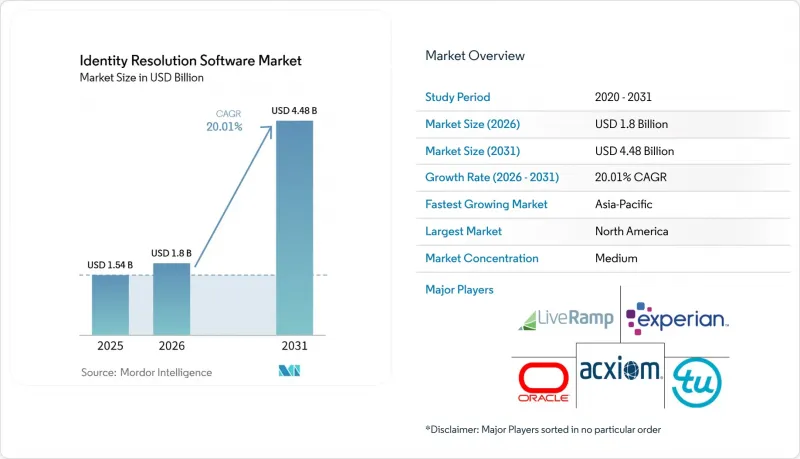
Mordor Intelligence에 의하면, 신원 확인 소프트웨어 시장 규모는 2025년에 15억 4,000만 달러로 평가되었고 2031년까지 44억 8,000만 달러에 이를 것으로 예측되며, 2026년부터 2031년까지 CAGR 20%로 성장할 전망입니다.
본 보고서는 구성 요소(소프트웨어 및 서비스), 도입 형태(클라우드 기반, On-Premise형, 하이브리드형), 기업 규모(대기업 및 중소기업), 최종 사용자 산업(소매 및 전자상거래, 은행, 금융서비스 및 보험(BFSI), 헬스케어 및 생명과학, IT 및 통신, 미디어 및 엔터테인먼트 등) 및 지역별로 분류되어 있습니다. 시장 전망은 금액(달러) 기준으로 제시되어 있습니다.
세계 신원 확인 소프트웨어 시장 동향 및 인사이트
쿠키 없는 디지털 광고로 인해 퍼스트파티 ID 통합에 대한 수요가 증가하고 있습니다.
주요 브라우저에서 써드파티 쿠키의 중요성이 감소하는 가운데, 아이덴티티 리졸루션 소프트웨어 시장 수요는 증가하고 있습니다. 현재 리테일 미디어 네트워크는 브랜드가 써드파티 데이터 브로커에 의존하는 대신, 고객 부문을 결정론적 식별자와 연결할 것을 요구하고 있습니다. 이러한 변화로 인해 신원 관련 업무는 독립적인 도구에 맡기는 대신, 커머스 및 광고 인프라로 이전되고 있습니다. LiveRamp는 2026년 4월, Unity Exchange 전반에 걸쳐 RampID 제공을 확대하여, 전 세계적으로 월간 활성 모바일 기기 29억 대, 미국 내에서는 2억 5,600만 대에 달하는 규모로 신원 기반 광고 구매를 확대했습니다. 또한, 프로그래매틱 환경에서 100밀리초 미만의 매칭이 요구되게 된 점도 신원 식별 솔루션 시장 형성에 영향을 미치고 있으며, 이에 따라 각 벤더들은 배치 처리에서 스트리밍 및 엣지 지원 아키텍처로 전환해야 하는 상황에 직면해 있습니다.
터치포인트 간에 파편화된 고객 데이터를 통합해야 할 필요성 증가
신원 확인 소프트웨어 시장은 CRM, 로열티, 커머스, 모바일, 오프라인 채널에 걸쳐 있는 고객 시스템의 파편화로 인한 부담 증가로부터 혜택을 받고 있습니다. 많은 조직에서는 여전히 5-15개의 시스템을 관리하고 있으며, 동일한 인물에게 서로 다른 식별자가 할당되어 있습니다. Amperity사의 2025년 4월 출시 자료는 『MIT Technology Review Insights』를 인용하여, 전 세계 기업의 78%가 AI 에이전트 도입 준비가 충분히 되어 있지 않으며, 그 주요 장벽으로 파편화되고 부정확한 고객 데이터가 꼽히고 있다고 밝혔습니다. 신원 확인 소프트웨어는 팀과 용도를 아우르는 통합된 고객 레코드를 지원하기 위해, 영구적이고 개인정보 보호를 고려한 식별자를 생성함으로써 이 문제를 해결합니다. 또한 Amperity에 따르면, 한 대형 소매업체는 이 회사의 신원 확인 기능을 활용하여 지금까지 파악하지 못했던 350만 건의 고객 이메일 주소를 식별할 수 있었습니다고 합니다. 이는 신원 확인 소프트웨어 시장이 마케팅 팀을 넘어 상업적인 지지를 얻고 있는 이유를 보여줍니다.
데이터 개인정보 보호 제약이 그래프의 지속성과 매칭률을 제한
신원 확인 소프트웨어 시장은 개인정보 보호 규제로 인해 대조 및 활성화에 활용할 수 있는 개인 데이터의 양이 감소할 가능성이 있어 구조적인 제약에 직면해 있습니다. 기업은 현재 소비자가 이러한 권리를 행사할 경우 데이터를 삭제, 수정 또는 제외해야 하며, 그 결과 시간이 지남에 따라 그래프의 지속성이 약화됩니다. 캘리포니아주의 개정된 CCPA(캘리포니아 소비자 개인정보 보호법) 프레임워크는 2026년 1월 1일에 시행되었으며, 자동화된 의사 결정, 사이버 보안 감사 및 위험 평가에 관한 규정이 추가되었습니다. 이러한 요건으로 인해 대규모 신원 그래프를 구축하고 유지하는 데 드는 비용이 증가함에 따라, 구매자들은 동의 거버넌스, 감사 대응 체계, 그리고 ‘프라이버시 바이 디자인(Privacy by Design)’에 기반한 관리 조치에 더욱 집중하고 있습니다. 따라서 신원 확인 소프트웨어 시장은 수동적 추적에 대한 규제가 현재만큼 엄격하지 않았던 시기에 비해 정확성, 규모 및 합법적 활성화 간의 균형을 더욱 신중하게 맞추어야 합니다.
부문 분석
2025년, 소프트웨어는 매출 점유율의 71.24%를 차지하며 신원 확인 소프트웨어 시장에서 선두 자리를 유지했습니다. 이는 프로젝트 주도형 접근 방식보다 플랫폼 도입을 선호하는 구매자의 경향을 반영한 것입니다. 구독형 가격 책정은 기업이 지출 패턴을 더 쉽게 예측할 수 있게 해주기 때문에 이러한 입지를 뒷받침해 왔습니다. 또한, 클라우드 네이티브 소프트웨어는 사내에서 이미 사용 중인 데이터 레이크, CDP, 활성화 플랫폼과 신속하게 통합될 수 있다는 점에서 지지를 얻고 있습니다. 신원 확인 소프트웨어 시장에서는 AI 기반 이용 사례를 위해 감사 가능하고 동의에 기반하여 관리되는 기록을 유지할 수 있는 플랫폼이 계속해서 높이 평가되고 있습니다. Acxiom이 Databricks에서 ‘Real ID’의 입지를 강화한 점과 Databricks CustomerLake의 에이전틱 CDP에서 Acxiom이 맡은 역할은 소프트웨어 벤더들이 플랫폼과의 더 깊은 통합을 통해 수익 창출 가능성을 확대하고 있음을 보여줍니다.
서비스는 신원 확인 소프트웨어 시장에서 가장 빠르게 성장하는 분야로, 2031년까지 연평균 성장률(CAGR) 22.83%로 확대될 것으로 예측됩니다. 이러한 성장 속도는 그래프 설계, 확률적 튜닝 및 동의 프레임워크 설정에 수반되는 도입 부담을 반영한 것입니다. 많은 기업은 여러 클라우드, 사업 부문, 관할 구역을 실용적인 신원 계층으로 통합하기 위해 여전히 외부 지원을 필요로 하고 있습니다. 데이터 계보, 접근 제어, 감사 추적에 대한 보다 강력한 모니터링이 필요한 의료 및 금융 서비스 사용자들 사이에서 매니지드 서비스 이용이 확대되고 있습니다. 서비스의 성장 속도가 빠르다고 해서 소프트웨어의 가치가 떨어지는 것은 아닙니다. 오히려 도입이 독립형 매칭에서 거버넌스가 철저히 적용된 엔터프라이즈 인프라로 전환됨에 따라, 신원 관리 소프트웨어 시장이 더욱 복잡해지고 있음을 보여줍니다.
2025년에는 클라우드 기반 도입이 매출의 68.41%를 차지하며, ID 솔루션 소프트웨어 시장에서 가장 큰 비중을 차지했습니다. 도입이 가장 활발한 곳은 이미 클라우드 우선 데이터 환경을 운영하고 있는 디지털 네이티브 소매업체, 미디어 플레이어 및 기술 기업입니다. 클라우드를 통한 제공은 실시간 API 액세스를 지원합니다. 이는 응답 시간이 엄격하게 제한되는 프로그래매틱 광고나 사이트 내 개인화에서 매우 중요합니다. 또한, 신원 조회 요청이 급증하는 쇼핑 성수기 동안 기업에 탄력적인 처리 능력을 제공합니다. LiveRamp가 2026년 3월에 출시한 플랫폼에서는 Snowflake 및 AWS 전반에 네이티브 신원 식별 기능이 확장되어, 신원 식별 소프트웨어 시장과 환경 내 그래프 관리 간의 연동이 더욱 강화되었습니다.
신원 확인 소프트웨어 시장에서 하이브리드 배포는 2031년까지 연평균 성장률(CAGR) 21.69%를 나타낼 것으로 예측됩니다. 이 모델은 기밀성이 높은 기록을 사설 환경에 보관하면서 검색, 데이터 보강 및 활성화를 위해 클라우드 링크를 활용하고자 하는 규제 대상 사용자들 사이에서 지지를 넓혀가고 있습니다. BFSI(은행 및 금융 및 보험) 및 헬스케어 분야의 구매 담당자들은 응답 속도를 희생하지 않으면서도 거주지 및 주권 관련 요건을 충족할 수 있기 때문에 특히 이 접근 방식을 지지하고 있습니다. 정책에 따라 외부로의 데이터 전송이 여전히 제한되는 레거시 환경에서는 On-Premise 배포가 여전히 중요하게 여겨지고 있습니다. 그러나 내장형 클라우드 제어 기능 덕분에 기존에 존재하던 ‘제어’와 ‘유연성’ 간의 상충 관계가 완화됨에 따라, ID 솔루션 소프트웨어 시장은 점차 하이브리드형 및 클라우드 기반 모델로 전환되고 있습니다.
지역별 분석
2025년, 북미는 매출의 34.62%를 차지하며 신원 확인 소프트웨어 시장에서 선두를 차지했고, 지역별 최대 시장 점유율을 기록했습니다. 이 지역은 기업용 소프트웨어에 대한 높은 지출, 잘 갖춰진 광고 기술 인프라, 그리고 기존 추적 방식을 약화시키면서 규정 준수를 준수하는 퍼스트 파티 ID 도구에 대한 수요를 높이는 규제 환경의 혜택을 받고 있습니다. 또한, 미국의 구매자들은 대규모 결정론적 신원 자산을 보유한 확립된 신용정보기관 및 플랫폼 제공업체를 활용할 수 있기 때문에 마케팅, 분석, 활성화와 같은 전반적인 이용 사례 전반에 걸쳐 도입이 가속화되고 있습니다. 캐나다와 멕시코 역시 개인정보 보호 규제의 현대화와 데이터 거버넌스 요건으로 인해 감사 가능한 매칭 시스템에 대한 수요가 증가함에 따라, 신원 확인 솔루션 소프트웨어 시장에 기여하고 있습니다.
유럽에서 독일, 영국, 프랑스는 신원 확인 솔루션 소프트웨어의 최대 규모 국가별 시장을 차지하고 있습니다. 이 지역 수요는 여전히 BFSI(은행 및 금융 및 보험), 소매, 미디어 및 엔터테인먼트 분야에 집중되어 있으며, 해당 기업들은 더욱 엄격해진 개인정보 보호 요건 하에서 사업을 전개하면서 채널 전반에 걸쳐 데이터를 대조해야 합니다. 익스페리안은 2026년 7월, 영국에서 ‘Identity Connect’를 출시했습니다. 이는 규정 준수를 중시한 제품 설계에 따라 생체 인증, 서류 확인, 부정 감지 정보, 신용정보기관의 데이터를 단일 API를 통해 통합한 것입니다. 남미 시장은 규모는 작지만, 금융 데이터의 상호 운용성이 확대되고 동의에 기반한 데이터 이용의 중요성이 높아짐에 따라 브라질과 아르헨티나가 신원 확인 소프트웨어 시장에 대한 수요를 주도하고 있습니다.
아시아태평양은 신원 확인 소프트웨어 시장에서 가장 빠르게 성장하는 지역으로, 2031년까지 연평균 성장률(CAGR) 24.19%로 확대될 것으로 예측되며, 시장 성장에 대한 지역별 기여도가 가장 높은 지역입니다. 모바일 우선(Mobile-First) 상거래 및 디지털 서비스의 성장에 따라, 해당 지역 전체에서 실시간 신원 확인 매칭에 대한 수요가 증가하고 있습니다. 중국에서는 금융, 통신, 전자상거래, 소셜 플랫폼에 걸쳐 광범위한 실명 인증 요건이 부과되어, 계속해서 수요를 뒷받침하고 있습니다. 일본과 한국에서도 개인정보 보호 및 데이터 거버넌스에 관한 지속적인 변화에 따라, 동의 기반의 신원 확인 시스템에 대한 필요성이 높아지고 있습니다. Trulioo사의 보고서에 따르면, 2025년 아시아태평양의 기업 인증 건수는 전년 대비 51% 증가할 것으로 예상되며, 이는 해당 지역 전체의 신원 확인 관련 기술 도입 속도를 보여줍니다. 중동 및 아프리카는 여전히 규모는 작지만, UAE와 사우디아라비아가 상호 운용 가능한 기업 인프라를 필요로 하는 국가 차원의 디지털 ID 프레임워크 구축을 추진하고 있어, 해당 지역의 ID 솔루션 소프트웨어 시장은 지지를 확대해 나가고 있습니다.
기타 혜택:
- 엑셀 형식 시장 예측(ME) 시트
- 3개월간의 애널리스트 지원
자주 묻는 질문
목차
제1장 서론
제2장 조사 방법
제3장 주요 요약
제4장 시장 구도
제5장 시장 규모와 성장 예측
제6장 경쟁 구도
제7장 시장 기회와 향후 전망
JHS 26.08.05According to Mordor Intelligence, the identity resolution software market size was valued at USD 1.54 billion in 2025 and is forecast to reach USD 4.48 billion by 2031, growing at a CAGR of 20% from 2026 to 2031.
This report is Segmented by Component (Software, and Services), Deployment Mode (Cloud-Based, On-Premise, and Hybrid), Enterprise Size (Large Enterprises, and Small and Medium Enterprises), End-User Industry (Retail and E-Commerce, BFSI, Healthcare and Life Sciences, IT and Telecom, Media and Entertainment, and More), and Geography. The Market Forecasts are Provided in Terms of Value (USD).
Global Identity Resolution Software Market Trends and Insights
Cookieless Digital Advertising Intensifies Demand for First-Party Identity Stitching
The identity resolution software market is seeing stronger demand as third-party cookies lose relevance across major browsers. Retail media networks now expect brands to match customer segments to deterministic identifiers rather than rely on third-party data brokers. That shift is moving more identity work into commerce and advertising infrastructure rather than leaving it with stand-alone tools. LiveRamp expanded RampID across Unity Exchange in April 2026, extending identity-based buying across 2.9 billion monthly active mobile devices globally and 256 million in the United States. The identity resolution software market is also being shaped by the need for sub-100 millisecond matching in programmatic environments, which is pushing vendors from batch processing toward streaming and edge-enabled architectures.
Rising Need to Unify Fragmented Customer Data Across Touchpoints
The identity resolution software market is benefiting from the growing burden of disconnected customer systems across CRM, loyalty, commerce, mobile, and offline channels. Many organizations still manage between 5 and 15 systems of record that assign different identifiers to the same person. Amperity's April 2025 launch material, citing MIT Technology Review Insights, said 78% of global companies were not very ready to deploy AI agents, with disconnected and inaccurate customer data named as the main barrier. Identity resolution software addresses that issue by creating a persistent, privacy-safe identifier that supports a unified customer record across teams and applications. Amperity also said one large retailer uncovered 3.5 million previously unreachable customer email addresses after using its identity resolution capabilities, which shows why the identity resolution software market is gaining commercial support beyond marketing teams.
Data Privacy Constraints Limit Graph Persistence and Match Rates
The identity resolution software market faces a structural limit because privacy regulations can reduce the amount of personal data available for matching and activation. Enterprises now have to delete, correct, or exclude data when consumers exercise those rights, which weakens graph persistence over time. California's updated CCPA framework took effect on January 1, 2026, and added rules on automated decision-making, cybersecurity audits, and risk assessments. Those requirements raise the cost of building and maintaining large identity graphs and increase buyer focus on consent governance, audit readiness, and privacy-by-design controls. The identity resolution software market must therefore balance accuracy, scale, and lawful activation more carefully than it did when passive tracking was subject to fewer restrictions.
Other drivers and restraints analyzed in the detailed report include:
- Enterprise Adoption of Real-Time Personalization and Next-Best-Action Engines
- Growth of Identity Graphs for Cross-Device and Cross-Channel Resolution
- Integration Complexity Across CRM, CDP, and Ad Tech Stacks
For complete list of drivers and restraints, kindly check the Table Of Contents.
Segment Analysis
Software held a 71.24% revenue share in 2025, giving it the lead in the identity resolution software market and reflecting buyer preference for platform deployment over project-led engagement. Subscription pricing has supported that position because it gives enterprises more predictable spending patterns. Cloud-native software has also gained favor because it integrates more quickly with data lakes, CDPs, and activation platforms already used across the business. The identity resolution software market continues to reward platforms that can maintain auditable and consent-governed records for AI-driven use cases. Acxiom's enhanced Real ID presence in Databricks and its role in the Databricks CustomerLake agentic CDP showed how software vendors are extending revenue potential through deeper platform integration.
Services are the fastest-growing component of the identity resolution software market and are projected to expand at a 22.83% CAGR through 2031. That pace reflects the implementation burden tied to graph design, probabilistic tuning, and consent framework setup. Many enterprises still need outside help to connect multiple clouds, business units, and jurisdictions into a usable identity layer. Managed services are gaining traction among healthcare and financial services users who need stronger oversight of data lineage, access controls, and audit trails. The faster growth of services does not weaken the software case; instead, it shows that the identity resolution software market is becoming more complex as deployments move from stand-alone matching to governed enterprise infrastructure.
Cloud-based deployment accounted for 68.41% of revenue in 2025, which made it the largest configuration in the identity resolution software market. Adoption has been strongest among digital-native retailers, media companies, and technology firms that already run cloud-first data environments. Cloud delivery supports real-time API access, which is critical for programmatic advertising and on-site personalization, where response times are tightly constrained. It also provides enterprises with elastic capacity during peak shopping periods, when identity queries can rise rapidly. LiveRamp's March 2026 platform release extended native identity resolution across Snowflake and AWS, reinforcing the alignment of the identity resolution software market with in-environment graph management.
Hybrid deployment is projected to grow at a 21.69% CAGR through 2031 in the identity resolution software market. This model is gaining ground among regulated users who want to keep sensitive records in private environments while still using cloud links for lookup, enrichment, and activation. BFSI and healthcare buyers are particularly aligned with that approach because it helps them address residency and sovereignty requirements without giving up response speed. On-premise deployment still matters in legacy estates where external data transfer remains restricted by policy. Even so, the identity resolution software market is gradually shifting toward hybrid, cloud-based models as embedded cloud controls reduce the historical trade-off between control and flexibility.
Complete Report Scope:
- By Component
- Software
- Services
- By Deployment Mode
- Cloud-Based
- On-Premise
- Hybrid
- By Enterprise Size
- Large Enterprises
- Small And Medium Enterprises
- By End-User Industry
- Retail and E-Commerce
- BFSI
- Healthcare and Life Sciences
- IT and Telecom
- Media and Entertainment
- Industrial Manufacturing
- Government and Public Administration
- Other End-User Industries
- By Geography
- North America
- United States
- Canada
- Mexico
- South America
- Brazil
- Argentina
- Rest of South America
- Europe
- Germany
- United Kingdom
- France
- Italy
- Spain
- Russia
- Rest of Europe
- Asia-Pacific
- China
- India
- Japan
- South Korea
- Australia
- Rest of Asia-Pacific
- Middle East and Africa
- Middle East
- Saudi Arabia
- United Arab Emirates
- Rest of Middle East
- Africa
- South Africa
- Nigeria
- Rest of Africa
- Middle East
- North America
Geography Analysis
North America accounted for 34.62% of revenue in 2025, giving it the lead in the identity resolution software market and the largest regional market share. The region benefits from high enterprise software spending, deep advertising technology infrastructure, and a regulatory setting that weakens traditional tracking while increasing demand for compliant first-party identity tools. U.S. buyers also have access to established bureau and platform providers with large deterministic identity assets, which support faster adoption across marketing, analytics, and activation use cases. Canada and Mexico are also contributing to the identity resolution software market, as privacy modernization and data governance requirements drive greater demand for auditable matching systems.
Germany, the United Kingdom, and France represented the largest country markets in Europe for identity resolution software. Demand in the region remains centered on BFSI, retail, and media and entertainment, where firms must match data across channels while operating under tighter privacy expectations. Experian launched Identity Connect in the United Kingdom in July 2026, combining biometric verification, document checks, fraud intelligence, and bureau data through a single API in a compliance-led product design. South America is smaller, but Brazil and Argentina are adding demand to the identity resolution software market as financial data interoperability expands and consent-linked data use becomes more important.
Asia-Pacific is the fastest-growing region in the identity resolution software market and is projected to expand at a 24.19% CAGR through 2031, making it the strongest regional contributor to market growth. Mobile-first commerce and digital service growth are increasing the need for real-time identity matching across the region. China continues to support demand through broad real-name verification requirements across finance, telecom, e-commerce, and social platforms. Japan and South Korea are also raising the need for consent-governed identity systems through ongoing privacy and data governance changes. Trulioo reported 51% year-over-year growth in Asia-Pacific business verification volume in 2025, which signals the pace of identity-related adoption across the region. The Middle East and Africa remain smaller, but the identity resolution software market is gaining support there as the UAE and Saudi Arabia move ahead with national digital identity frameworks that will require compatible enterprise infrastructure.
- LiveRamp Holdings, Inc.
- Experian plc
- TransUnion LLC
- Equifax Inc.
- Acxiom Holdings, Inc.
- Oracle Corporation
- Salesforce, Inc.
- Adobe Inc.
- SAP SE
- Tealium Inc.
- Amperity, Inc.
- Segments.ai, Inc.
- Dun and Bradstreet Holdings, Inc.
- The Nielsen Company (US), LLC
- IBM Corporation
- SAS Institute Inc.
- Neustar, Inc.
- Microsoft Corporation
- Cisco Systems, Inc.
- Pega Systems Inc.
Additional Benefits:
- The market estimate (ME) sheet in Excel format
- 3 months of analyst support
TABLE OF CONTENTS
1 INTRODUCTION
- 1.1 Study Assumptions and Market Definition
- 1.2 Scope of the Study
2 RESEARCH METHODOLOGY
3 EXECUTIVE SUMMARY
4 MARKET LANDSCAPE
- 4.1 Market Overview
- 4.2 Market Drivers
- 4.2.1 Cookieless Digital Advertising Intensifies Demand for First-Party Identity Stitching
- 4.2.2 Rising Need to Unify Fragmented Customer Data Across Touchpoints
- 4.2.3 Enterprise Adoption of Real-Time Personalization and Next-Best-Action Engines
- 4.2.4 Growth of Identity Graphs for Cross-Device and Cross-Channel Resolution
- 4.2.5 Expansion of Privacy-Safe Data Collaboration and Clean Room Workflows
- 4.2.6 Increasing Fraud Detection and Duplicate Record Suppression Use Cases
- 4.3 Market Restraints
- 4.3.1 Data Privacy Constraints Limit Graph Persistence and Match Rates
- 4.3.2 Poor Legacy Data Quality Reduces Resolution Accuracy
- 4.3.3 Integration Complexity Across CRM, CDP, and Ad Tech Stacks
- 4.3.4 High Dependency on Third-Party Data and Consent Coverage
- 4.4 Impact of Macroeconomic Factors on the Market
- 4.5 Industry Value Chain Analysis
- 4.6 Technology Outlook
- 4.7 Regulatory Landscape
- 4.8 Porter's Five Forces Analysis
- 4.8.1 Threat of New Entrants
- 4.8.2 Bargaining Power of Suppliers
- 4.8.3 Bargaining Power of Buyers
- 4.8.4 Threat of Substitutes
- 4.8.5 Intensity of Competitive Rivalry
5 MARKET SIZE AND GROWTH FORECASTS (VALUE)
- 5.1 By Component
- 5.1.1 Software
- 5.1.2 Services
- 5.2 By Deployment Mode
- 5.2.1 Cloud-Based
- 5.2.2 On-Premise
- 5.2.3 Hybrid
- 5.3 By Enterprise Size
- 5.3.1 Large Enterprises
- 5.3.2 Small And Medium Enterprises
- 5.4 By End-User Industry
- 5.4.1 Retail and E-Commerce
- 5.4.2 BFSI
- 5.4.3 Healthcare and Life Sciences
- 5.4.4 IT and Telecom
- 5.4.5 Media and Entertainment
- 5.4.6 Industrial Manufacturing
- 5.4.7 Government and Public Administration
- 5.4.8 Other End-User Industries
- 5.5 By Geography
- 5.5.1 North America
- 5.5.1.1 United States
- 5.5.1.2 Canada
- 5.5.1.3 Mexico
- 5.5.2 South America
- 5.5.2.1 Brazil
- 5.5.2.2 Argentina
- 5.5.2.3 Rest of South America
- 5.5.3 Europe
- 5.5.3.1 Germany
- 5.5.3.2 United Kingdom
- 5.5.3.3 France
- 5.5.3.4 Italy
- 5.5.3.5 Spain
- 5.5.3.6 Russia
- 5.5.3.7 Rest of Europe
- 5.5.4 Asia-Pacific
- 5.5.4.1 China
- 5.5.4.2 India
- 5.5.4.3 Japan
- 5.5.4.4 South Korea
- 5.5.4.5 Australia
- 5.5.4.6 Rest of Asia-Pacific
- 5.5.5 Middle East and Africa
- 5.5.5.1 Middle East
- 5.5.5.1.1 Saudi Arabia
- 5.5.5.1.2 United Arab Emirates
- 5.5.5.1.3 Rest of Middle East
- 5.5.5.2 Africa
- 5.5.5.2.1 South Africa
- 5.5.5.2.2 Nigeria
- 5.5.5.2.3 Rest of Africa
- 5.5.5.1 Middle East
- 5.5.1 North America
6 COMPETITIVE LANDSCAPE
- 6.1 Market Concentration
- 6.2 Strategic Moves
- 6.3 Market Share Analysis
- 6.4 Company Profiles (includes Global Level Overview, Market Level Overview, Core Segments, Financials as available, Strategic Information, Market Rank/Share, Products and Services, Recent Developments)
- 6.4.1 LiveRamp Holdings, Inc.
- 6.4.2 Experian plc
- 6.4.3 TransUnion LLC
- 6.4.4 Equifax Inc.
- 6.4.5 Acxiom Holdings, Inc.
- 6.4.6 Oracle Corporation
- 6.4.7 Salesforce, Inc.
- 6.4.8 Adobe Inc.
- 6.4.9 SAP SE
- 6.4.10 Tealium Inc.
- 6.4.11 Amperity, Inc.
- 6.4.12 Segments.ai, Inc.
- 6.4.13 Dun and Bradstreet Holdings, Inc.
- 6.4.14 The Nielsen Company (US), LLC
- 6.4.15 IBM Corporation
- 6.4.16 SAS Institute Inc.
- 6.4.17 Neustar, Inc.
- 6.4.18 Microsoft Corporation
- 6.4.19 Cisco Systems, Inc.
- 6.4.20 Pega Systems Inc.
7 MARKET OPPORTUNITIES AND FUTURE OUTLOOK
- 7.1 White-Space and Unmet-Need Assessment


