|
시장보고서
상품코드
2125324
모바일 ID : 시장 점유율 분석, 업계 동향과 통계, 성장 예측(2026년-2031년)Mobile Identification - Market Share Analysis, Industry Trends & Statistics, Growth Forecasts (2026 - 2031) |
||||||
 Mordor Intelligence
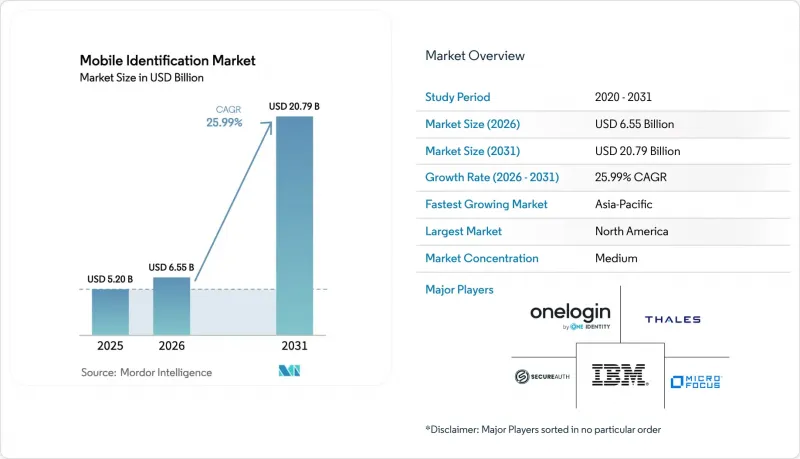
Mordor Intelligence에 의하면, 모바일 ID 시장 규모는 2025년 52억 달러로 평가되었고, 2026년에는 65억 5,000만 달러로 추정되고, 2026-2031년 CAGR 25.99%로 성장을 지속할 전망이며, 2031년까지 207억 9,000만 달러에 이를 것으로 예측됩니다.
본 보고서는 인증별(단일 요소 인증, 다중 요소 인증), 구성 요소별(생체 인증, 비생체 인증, 서비스), 배포 방식별(클라우드, 온프레미스), 용도별(금융 및 보험·증권, IT 및 통신, 소매, 의료, 정부·국방, 여행 및 호스피탈리티), 지역별로 분류되어 있습니다. 시장 예측은 금액(달러) 기준으로 제시되어 있습니다.
세계의 모바일 ID 시장 동향 및 인사이트
BFSI 분야의 eKYC 의무화
미국 및 캐나다의 금융 서비스 규제 당국은 신원 확인 기준을 강화하고 있으며, 이에 따라 은행들은 모바일 앱에 실시간 생체 인증 확인 기능을 도입해야 하는 압박을 받고 있습니다. 2021년 560억 달러로 추산되는 사기 손실 증가로 인해, 신용카드 발급, 디지털 지갑, P2P 송금 분야에서 다중 요소 인증 도입이 가속화되고 있습니다. 이와 병행하여 KYC 지침의 간소화가 진행되어, 인도 등 시장에서는 자기 신고가 허용됨에 따라 리스크 관리를 저해하지 않으면서 신규 등록 시의 번거로움을 줄이고 있습니다. 업계 워킹그룹에서는 현재 AI를 활용한 문서 검증의 정확도를 벤치마킹하고 있으며, 사용자들의 ‘번거로움 없는 로그인’에 대한 기대가 고위험 워크플로우에서 비밀번호 없는 방식의 시범 도입을 뒷받침하고 있습니다.
각국의 디지털 ID 프로젝트
아시아의 대규모 신분 증명 제도, 특히 인도의 13억 건의 기록을 보유한 Aadhaar 플랫폼과 싱가포르의 Singpass 생태계에서는 모바일 ID 정보가 결제, 의료, 공공 보조금에 통합되어 있습니다. 이러한 프로그램들은 아시아태평양의 신흥 경제권에서 디지털 결제 거래액이 연평균 성장률(CAGR) 43%라는 광범위한 성장의 기반이 되고 있으며, 민간 부문에서 전자 지갑, 대출, 보험의 활용 사례를 촉진하고 있습니다. 말레이시아와 인도네시아의 초기 도입 단계에서는 낮은 옵트인(opt-in) 비율이나 통합상의 격차와 같은 도입 장벽이 두드러지게 나타나고 있지만, 동시에 정규 경제 활동 참여를 촉진할 장기적인 가능성도 보여주고 있습니다. 세계 벤더들은 이러한 정부 입찰을 클라우드 기반 오케스트레이션 계층 및 각국 고유의 신뢰 프레임워크로 진입할 수 있는 통로로 보고 있습니다.
데이터 거주지 규제가 국경을 초월한 마찰을 야기하고 있습니다.
EU의 ‘디지털 시장법’ 및 ‘디지털 서비스법’은 엄격한 현지화 및 게이트키퍼에 관한 규정을 부과하고 있어, 미국에 본사를 둔 클라우드 ID 플랫폼의 규정 준수 비용을 상승시키고 있습니다. 동시에, 미국의 새로운 규제로 인해 지정된 우려 국가로의 기밀성이 높은 개인 데이터 수출이 제한되고 있습니다. 그 결과, 지역 간 지갑을 운영하는 제공업체들은 데이터 저장소의 복제, API 호출 우회, 하위 처리업체와의 계약 협상을 강요받게 되어 도입 일정이 장기화되고, 비용 측면의 우위가 훼손되고 있습니다.
부문 분석
2025년, 금융 서비스, 의료, 정부 포털에서 고액 거래에 대한 보증 요건이 강화됨에 따라 다중 요소 인증 프레임워크는 모바일 ID 시장의 61.37% 점유율을 차지했습니다. 이러한 급증은 규제 당국이 고객 인증 강화를 요구하고, 기업들이 기기,생체 인증, 컨텍스트 신호를 다층적으로 결합한 위험 적응형 정책으로의 전환을 추진하고 있는 상황과 일치합니다. 4요소 이상의 모델은 디지털 서명이나 하드웨어 기반 인증 정보를 통합한 국가 차원의 체계에 힘입어 2031년까지 연평균 성장률(CAGR) 28.74%를 나타낼 것으로 예측됩니다. OTP는 여전히 널리 보급되어 있지만, 표준화 기구들은 SIM 스왑 및 피싱 공격을 억제하기 위해 FIDO 준수 공개 키 암호화를 추진하고 있으며, 유럽 및 미국 시장에서는 SMS 코드가 점차 대체되고 있습니다.
도입 동향에는 미묘한 차이가 있습니다. 소매 은행 앱에서는 주로 계좌 개설 시 셀카 확인 기능이 탑재되어 있는 반면, 암호화폐 지갑에서는 법정 화폐 입금 시마다 실시간으로 KYC 정보가 갱신됩니다. 타이핑 리듬이나 기기 잡는 방식을 측정하는 행동 생체 인식 기능은 사용자 경험을 저해하지 않으면서 지속적인 인증을 실현합니다. 보안과 편의성의 균형을 추구하는 기업들은 벤더 간 신호를 표준화하는 ID API를 통해 이러한 계층을 통합함으로써 벤더 종속의 위험을 줄이는 동시에, 진화하는 위협 분류에 대응한 정책 업데이트를 신속하게 진행하고 있습니다.
2025년 매출의 67.92%는 생체 인증 모듈이 차지할 것으로 예상되며, 이는 얼굴 인증과 지문 인증이 소비자용 앱의 사실상 ‘게이트키퍼’임을 뒷받침합니다. 센서의 소형화, 대조 알고리즘의 개선, 기기 내 AI 가속기를 통해 지연 시간이 단축되고 생체 인식 정확도가 향상되어 사용자의 신뢰가 확고해지고 있습니다. 정부의 규제가 확대됨에 따라 백엔드 오케스트레이션 서비스(서류 검증, 리스크 스코어링, 행동 분석)는 연평균 성장률(CAGR) 26.35%로 하드웨어를 능가하는 성장이 예상됩니다.
서비스 계층에서 차별화의 핵심은 생체 인증 데이터의 중앙 집중식 관리를 피하면서도 부정 감지 휴리스틱을 향상시키는 페더레이티드 러닝 모델입니다. 또한, 각 벤더는 지속적인 인증 정보 무결성 점검, 정보 유출 알림 피드, 모바일 앱과의 신속한 통합을 가능하게 하는 UI 수준 SDK 등의 부가 기능을 통해 수익화를 도모하며, 서비스를 고수익률의 지속적인 수익원으로 자리매김하고 있습니다.
지역별 분석
북미는 견고한 핀테크 생태계, 세계 최고 수준의 모바일 뱅킹 보급률, 포춘 500대 기업에서의 제로 트러스트 아키텍처의 광범위한 도입에 힘입어 2025년에도 36.22%의 매출 점유율을 유지했습니다. 동의에 관한 규제의 명확화, 오픈 뱅킹 API, 디지털 정부 서비스의 확대가 공공 및 민간 각 업계 수요를 뒷받침하고 있습니다.
아시아태평양은 가장 빠르게 성장하는 시장으로, 2031년까지 연평균 성장률(CAGR)이 28.05%를 나타낼 것으로 예측됩니다. 인도의 Aadhaar와 연동된 UPI 시스템, 싱가포르의 Singpass 통합, 중국의 성(省) 단위 ID 시범 사업은 네트워크 효과를 창출하여 민간 디지털 대출, 차량 공유, 인슈어테크 사업자들을 공유 인증 기반으로 유도하고 있습니다. 중저가 휴대폰의 보급으로 첨단 생체 인증 기술이 널리 확산되면서, 도시와 농촌 간의 보안 격차가 줄어들고 포용성이 확대되고 있습니다.
유럽의 성장은 현지화 의무화로 인해 제약을 받고 있지만, 그럼에도 불구하고 곧 시행될 EU의 디지털 ID 지갑 규정에 따라 모든 회원국은 2026년까지 상호 운용 가능한 인증 정보를 발급해야 할 의무가 부과되어, 수십억 달러 규모의 조달 붐이 일고 있습니다. 벤더는 eIDAS 2.0의 보증 수준에 기반한 인증을 획득하고, ‘프라이버시 바이 디자인(Privacy by Design)’ 요건을 충족하기 위해 선택적 속성 공개를 통합해야 합니다.
중동 및 아프리카에서는 SIM 등록과 실시간 KYC를 연계하는 통신사·은행 간 파트너십을 통해 진전이 나타나고 있습니다. 지역을 초월한 통신사 컨소시엄은 GSMA Open Gateway API를 활용하여 A2P 사기에 대응하고 있는 반면, 걸프협력회의(GCC) 회원국에서는 거주 허가와 은행 접근을 결합한 모바일 운전면허증 제도의 시범 운영이 진행되고 있습니다. 광활한 농촌 지역의 유선 인프라 미비 현상은 모바일 엣지 네트워크에 대한 의존도를 높이고 있으며, 간헐적인 연결에 최적화된 경량 SDK의 중요성을 더욱 부각시키고 있습니다.
기타 혜택 :
- 엑셀 형식 시장 예측(ME) 시트
- 3개월간의 애널리스트 지원
자주 묻는 질문
목차
제1장 서론
제2장 조사 방법
제3장 주요 요약
제4장 시장 구도
제5장 시장 규모 및 성장 예측
제6장 경쟁 구도
제7장 시장 기회 및 향후 전망
AJYAccording to Mordor Intelligence, the mobile identification market size is expected to grow from USD 5.20 billion in 2025 to USD 6.55 billion in 2026 and is forecast to reach USD 20.79 billion by 2031 at 25.99% CAGR over 2026-2031.
This report is Segmented by Authentication (Single-Factor Authentication, Multi-Factor Authentication), Component (Biometric, Non-Biometric, Services), Deployment (Cloud, On-Premise), Application (BFSI, IT and Telecom, Retail, Healthcare, Government and Defense, Travel and Hospitality), and Geography. The Market Forecasts are Provided in Terms of Value (USD).
Global Mobile Identification Market Trends and Insights
eKYC Mandates Across BFSI
Financial-services regulators in the United States and Canada are tightening identity-proofing standards, prompting banks to embed real-time biometric checks into mobile apps. Rising fraud losses, estimated at USD 56 billion in 2021, are accelerating multi-factor authentication adoption across credit issuance, digital wallets, and P2P transfers. A parallel wave of streamlined KYC guidance allows self-declarations in markets such as India, cutting onboarding friction without diluting risk controls. Industry working groups now benchmark AI-scored document verification accuracy, and user expectations for frictionless login are driving passwordless pilots in high-risk workflows.
National Digital ID Projects
Asia's large-scale identity schemes, most notably India's 1.3 billion-record Aadhaar platform and Singapore's Singpass ecosystem, embed mobile credentials into payments, healthcare, and public subsidies. These programs anchor a broader 43% CAGR in digital-payment volumes across emerging APAC economies, catalyzing private-sector wallet, lending, and insurance use cases. Early-stage roll-outs in Malaysia and Indonesia highlight implementation hurdles - low opt-in rates and integration gaps - but also reveal long-run capacity to uplift formal economic participation. Global vendors view these government tenders as entry points for cloud-based orchestration layers and country-specific trust frameworks.
Data-residency Regulations Create Cross-border Friction
The EU Digital Markets Act and Digital Services Act impose strict localisation and gatekeeper provisions that raise compliance costs for U.S.-headquartered cloud-ID platforms. Simultaneously, new U.S. rules restrict the export of sensitive personal data to designated countries of concern. Providers operating pan-regional wallets must therefore replicate data stores, reroute API calls, and negotiate sub-processor arrangements, stretching deployment timelines and eroding cost advantages.
Other drivers and restraints analyzed in the detailed report include:
- Remote Workforce Zero-trust Roll-outs
- Telco-bank SIM-based ID Alliances
- High Spoofing in Low-light Environments
For complete list of drivers and restraints, kindly check the Table Of Contents.
Segment Analysis
Multi-factor frameworks held 61.37% of the mobile identification market share in 2025 as financial services, healthcare, and government portals elevated assurance requirements for high-value transactions. The surge coincides with regulators urging stronger customer authentication and enterprises migrating toward risk-adaptive policies that layer device, biometric, and contextual signals. Four-factor and higher models are projected to grow at a 28.74% CAGR through 2031, driven by national schemes embedding digital signatures and hardware-rooted credentials. While OTP remains widespread, standards bodies champion FIDO-aligned, public-key cryptography to curb SIM-swap and phishing exploits, gradually displacing SMS codes in Western markets.
Adoption dynamics are nuanced: retail-banking apps embed selfie checks mainly during account opening, whereas crypto wallets perform real-time KYC refreshes at each fiat on-ramp. Behavioral-biometric overlays - gauging typing cadence or device grip - offer continuous authentication without undermining user experience. Enterprises balancing security with usability orchestrate these layers via identity APIs that normalise signals across vendors, reducing vendor-lock risk and accelerating policy updates in response to evolving threat taxa.
Biometric modules generated 67.92% of 2025 revenue, confirming facial and fingerprint modalities as the de facto gatekeepers for consumer apps. Sensor miniaturisation, improved matching algorithms, and on-device AI accelerators have shortened latency and elevated liveness-detection accuracy, consolidating user trust. As government mandates expand, backend orchestration services-document verification, risk scoring, and behavioural analytics - are forecast to outpace hardware at a 26.35% CAGR.
Service-layer differentiation rests on federated-learning models that avoid centralising raw biometrics while still improving fraud-detection heuristics. In addition, vendors monetise add-ons such as continuous credential-health checks, breach-notification feeds, and UI-level SDKs for rapid mobile-app integration, positioning services as high-margin, recurring-revenue streams.
Complete Report Scope:
- By Authentication
- Single-Factor Authentication
- Multi-Factor Authentication
- By Component
- Biometric
- Non-Biometric
- Services
- By Deployment
- Cloud
- On-Premise
- By Application
- Banking, Financial Services and Insurance (BFSI)
- IT and Telecom
- Retail and E-commerce
- Healthcare and Life Sciences
- Government and Defense
- Travel and Hospitality
- By Geography
- North America
- United States
- Canada
- Mexico
- South America
- Brazil
- Argentina
- Chile
- Colombia
- Europe
- United Kingdom
- Germany
- France
- Italy
- Spain
- Middle East and Africa
- Middle East
- Saudi Arabia
- United Arab Emirates
- Turkey
- Qatar
- Africa
- South Africa
- Nigeria
- Kenya
- Egypt
- Middle East
- Asia-Pacific
- China
- Japan
- India
- South Korea
- Rest of Asia-Pacific
- North America
Geography Analysis
North America maintained a 36.22% revenue share in 2025, supported by robust fintech ecosystems, the world's highest mobile-banking penetration, and pervasive zero-trust architectures in Fortune 500 enterprises. Regulatory clarity around consent, open-banking APIs, and digital-government service expansion sustains demand across public and private verticals.
Asia-Pacific represents the fastest-growing theatre, with a 28.05% CAGR projected through 2031. India's Aadhaar-linked UPI rails, Singapore's Singpass integrations, and China's provincial ID pilots generate network effects that entice private digital-lending, ride-sharing, and insure-tech players onto shared credential backbones. Mid-tier handset proliferation makes advanced biometrics ubiquitous, narrowing the urban-rural security divide and broadening inclusion.
Europe's growth is tempered by localisation mandates; nevertheless, the forthcoming EU digital identity wallet regulation obliges all member states to issue interoperable credentials by 2026, creating a multi-billion-dollar procurement wave. Vendors must certify against eIDAS 2.0 assurance levels and integrate selective-attribute disclosure to meet privacy-by-design prescriptions.
Africa and the Middle East advance through telco-bank partnerships that align SIM registration with real-time KYC. Pan-regional operator consortia leverage GSMA Open Gateway APIs to counter A2P fraud, while Gulf Cooperation Council states pilot mobile-driver-licence schemes that couple residency permits with banking access. Skeletal fixed-line infrastructure in vast rural zones pushes reliance on mobile edge networks, amplifying the importance of lightweight SDKs optimised for intermittent connectivity.
- IDEMIA
- Thales Group
- Okta, Inc.
- OneLogin (One Identity LLC)
- IBM Corporation
- Micro Focus
- SecureAuth Corp.
- Trend Micro
- F-Secure
- Sophos Ltd.
- Telesign
- Regula
- Ping Identity
- Cisco Systems
- RSA Security
- NEC Corporation
- HID Global
- Duo Security (Cisco)
- ForgeRock
- Entrust Datacard
- Nok Nok Labs
- 42Gears Mobility Systems
Additional Benefits:
- The market estimate (ME) sheet in Excel format
- 3 months of analyst support
TABLE OF CONTENTS
1 INTRODUCTION
- 1.1 Study Assumptions and Market Definition
- 1.2 Scope of the Study
2 RESEARCH METHODOLOGY
3 EXECUTIVE SUMMARY
4 MARKET LANDSCAPE
- 4.1 Market Overview
- 4.2 Market Drivers
- 4.2.1 Growing eKYC Mandates Across BFSI in North America
- 4.2.2 National Digital ID Projects Accelerating Adoption in Asia (India Aadhaar, Singapore Singpass)
- 4.2.3 Surge in Remote Workforce Drives Zero-Trust Authentication Spend (Europe and U.S.)
- 4.2.4 Telco Banking Partnerships for SIM-Based ID in Africa and Middle East
- 4.2.5 Biometric Hardware Integration in Mid-Tier Smartphones (Asia)
- 4.2.6 Fintech and Crypto Exchanges Requiring Real-Time Mobile ID Verification (Global)
- 4.3 Market Restraints
- 4.3.1 Data-Residency Barriers in EU Impeding Cross-Border Mobile ID
- 4.3.2 High Spoofing Rates on Face-Recognition in Low-Light Regions (Africa)
- 4.3.3 Fragmented Device OS Security Standards Slowing Enterprise Roll-outs
- 4.3.4 Budget Limitations for MFA Roll-outs in SME Retail Chains (South America)
- 4.4 Supply Chain Analysis
- 4.5 Regulatory Outlook
- 4.6 Porter's Five Forces Analysis
- 4.6.1 Bargaining Power of Suppliers
- 4.6.2 Bargaining Power of Buyers
- 4.6.3 Threat of New Entrants
- 4.6.4 Threat of Substitutes
- 4.6.5 Intensity of Competitive Rivalry
- 4.7 Impact of Macroeconomic Trends on Mobile Identification Adoption
5 MARKET SIZE AND GROWTH FORECASTS (VALUE)
- 5.1 By Authentication
- 5.1.1 Single-Factor Authentication
- 5.1.2 Multi-Factor Authentication
- 5.2 By Component
- 5.2.1 Biometric
- 5.2.2 Non-Biometric
- 5.2.3 Services
- 5.3 By Deployment
- 5.3.1 Cloud
- 5.3.2 On-Premise
- 5.4 By Application
- 5.4.1 Banking, Financial Services and Insurance (BFSI)
- 5.4.2 IT and Telecom
- 5.4.3 Retail and E-commerce
- 5.4.4 Healthcare and Life Sciences
- 5.4.5 Government and Defense
- 5.4.6 Travel and Hospitality
- 5.5 By Geography
- 5.5.1 North America
- 5.5.1.1 United States
- 5.5.1.2 Canada
- 5.5.1.3 Mexico
- 5.5.2 South America
- 5.5.2.1 Brazil
- 5.5.2.2 Argentina
- 5.5.2.3 Chile
- 5.5.2.4 Colombia
- 5.5.3 Europe
- 5.5.3.1 United Kingdom
- 5.5.3.2 Germany
- 5.5.3.3 France
- 5.5.3.4 Italy
- 5.5.3.5 Spain
- 5.5.4 Middle East and Africa
- 5.5.4.1 Middle East
- 5.5.4.1.1 Saudi Arabia
- 5.5.4.1.2 United Arab Emirates
- 5.5.4.1.3 Turkey
- 5.5.4.1.4 Qatar
- 5.5.4.2 Africa
- 5.5.4.2.1 South Africa
- 5.5.4.2.2 Nigeria
- 5.5.4.2.3 Kenya
- 5.5.4.2.4 Egypt
- 5.5.4.1 Middle East
- 5.5.5 Asia-Pacific
- 5.5.5.1 China
- 5.5.5.2 Japan
- 5.5.5.3 India
- 5.5.5.4 South Korea
- 5.5.5.5 Rest of Asia-Pacific
- 5.5.1 North America
6 COMPETITIVE LANDSCAPE
- 6.1 Market Concentration
- 6.2 Strategic Moves
- 6.3 Market Share Analysis
- 6.4 Company Profiles (includes Global level Overview, Market level overview, Core Segments, Financials as available, Strategic Information, Market Rank/Share for key companies, Products and Services, and Recent Developments)
- 6.4.1 IDEMIA
- 6.4.2 Thales Group
- 6.4.3 Okta, Inc.
- 6.4.4 OneLogin (One Identity LLC)
- 6.4.5 IBM Corporation
- 6.4.6 Micro Focus
- 6.4.7 SecureAuth Corp.
- 6.4.8 Trend Micro
- 6.4.9 F-Secure
- 6.4.10 Sophos Ltd.
- 6.4.11 Telesign
- 6.4.12 Regula
- 6.4.13 Ping Identity
- 6.4.14 Cisco Systems
- 6.4.15 RSA Security
- 6.4.16 NEC Corporation
- 6.4.17 HID Global
- 6.4.18 Duo Security (Cisco)
- 6.4.19 ForgeRock
- 6.4.20 Entrust Datacard
- 6.4.21 Nok Nok Labs
- 6.4.22 42Gears Mobility Systems
7 MARKET OPPORTUNITIES AND FUTURE OUTLOOK
- 7.1 White-Space and Unmet-Need Assessment