|
시장보고서
상품코드
2099529
폴리에스테르 섬유 시장 : 점유율 분석, 업계 동향 및 통계, 성장 예측(2026-2031년)Polyester Fiber - Market Share Analysis, Industry Trends & Statistics, Growth Forecasts (2026 - 2031) |
||||||
 Mordor Intelligence
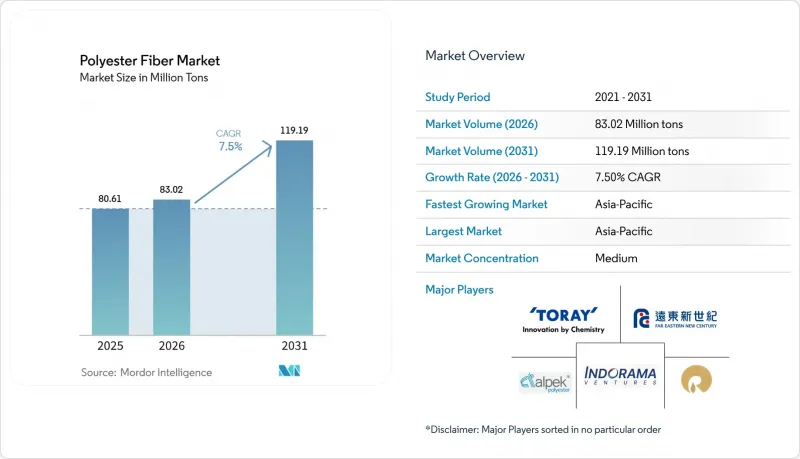
Mordor Intelligence에 의하면, 폴리에스테르 섬유 시장 규모는 2025년 8,061만 톤에서 2026년에는 8,302만 톤으로 확대되어 2031년까지 1억 1,919만 톤에 이른다고 전망되고 있어 2026년부터 2031년까지 CAGR 7.50%를 나타낼 것으로 예측됩니다.
본 보고서는 유형(폴리에스테르 단섬유 및 폴리에스테르 필라멘트사), 등급(폴리에틸렌 테레프탈레이트(PET) 폴리에스테르 및 PCDT 폴리에스테르), 형태(중실 및 중공), 용도(의류, 홈 텍스타일 등), 지역(아시아태평양, 북미, 유럽, 남미, 중동 및 아프리카)별로 분류되어 있습니다. 시장 전망은 수량(톤) 기준으로 제시되어 있습니다.
세계 폴리에스테르 섬유 시장 동향과 인사이트
가성비 우위가 천연섬유 대체를 촉진
폴리에스테르 섬유 시장은 광범위한 섬유 용도에서 폴리에스테르가 면에 비해 구조적인 운송 비용 우위를 유지하고 있어 판매량이 지속적으로 증가하고 있습니다. 2024년 및 2025년에는 미국, 인도, 파키스탄의 기상 관련 공급 차질로 인해 면 공급이 부족해졌고, 섬유 구매자들에게 천연섬유의 프리미엄 가격이 상승함에 따라 그 격차는 더욱 확대되었습니다. 이러한 변화는 학교 교복, 작업복, 홈 텍스타일 분야에서 가장 두드러졌으며, 해당 분야의 구매자들은 고급 천연섬유의 이미지보다는 가격 안정성, 세탁 내구성, 그리고 안정적인 공급을 우선시하고 있습니다. 이러한 경제적 요인으로 인해 혼방 원단의 배합 비율도 변화했습니다. 방적 제조업체들은 기존에 일반적이었던 65:35 배합에서 70:30이나 80:20의 폴리에스테르·면 비율로 전환하는 경향이 강해지고 있습니다. 그 결과, 의류 생산량이 같은 속도로 증가하지 않더라도 원단 1단위당 폴리에스테르 함유량은 이전보다 많아졌습니다. 따라서 이러한 대체 현상은 섬유 자체의 직접적인 대체와 기존 텍스타일 형태에서 폴리에스테르 함유율의 점진적인 증가라는 두 가지 측면을 통해 폴리에스테르 섬유 시장을 뒷받침하고 있습니다.
자발적인 브랜드의 노력을 넘어선 재활용 폴리에스테르 수요의 가속화
각 브랜드사가 조달 방침을 결정할 때 더 이상 자발적인 지속가능성 목표에만 의존하지 않게 됨에 따라, 폴리에스테르 섬유 시장은 규정 준수를 주도하는 재활용 단계로 전환되고 있습니다. 유럽의 섬유 순환 경제 관련 규제는 공급업체들에게 모든 섬유 카테고리에서 재활용 가능한 구조, 추적 가능한 원자재, 그리고 보다 견고한 사용 후 제품 처리 계획 수립을 요구하고 있습니다. 텍스타일 익스체인지(Textile Exchange)는 2026년 6월, 화학적 재활용을 통해 소비 후 및 산업용 폴리에스테르 폐기물을 모두 처리할 수 있을 뿐만 아니라, 열기계적 처리법으로는 완전히 제거할 수 없는 염료와 첨가물을 제거할 수 있다고 보고했습니다. 이를 통해 재생 폴리에스테르에 사용 가능한 폐기물 흐름이 확대되고 재생 제품의 품질이 향상되어, 더욱 엄격한 제품 사양을 충족할 수 있게 됩니다. 인드라마 벤처스는 2025년 11월, Jiaren Chemical Recycling사와의 합작 투자를 통해 이러한 방향성을 강화하고, 연간 최대 10만 톤의 섬유 재활용 폴리에틸렌 테레프탈레이트(PET) 방적 능력을 목표로 하고 있습니다. 생산 능력이 확대되고 전환의 경제성이 향상됨에 따라, 재생 폴리에스테르는 틈새 프리미엄 제품이라기보다는 폴리에스테르 섬유 시장에서 보다 안정적인 수요의 주축으로 자리 잡고 있습니다.
PTA 및 MEG 원료 가격 변동이 하류 부문의 이익률을 압박
폴리에스테르 섬유 시장은 PTA 및 MEG 원가 변동이 하류 생산자가 완제품 섬유 가격을 조정할 수 있는 속도보다 빠르게 일어날 가능성이 있어, 원유 가격에 연동된 변동 위험에 지속적으로 노출되어 있습니다. 업스트림 부문의 생산 능력이 확대되었음에도 불구하고 이 문제는 해결되지 않았습니다. 에너지 시장 및 지역별 수급 균형의 변화에 따라 가동률, 가공 마진, 시장 심리가 계속 변동하고 있기 때문입니다. 2026년 2월 하순부터 호르무즈 해협에서 발생한 해상 운송 혼란은 원유 및 그 파생 제품의 유통에 대한 우려를 높이며, 추가적인 불확실성을 초래했습니다. 하류 공급망이 이미 공급 과잉 상태에 있고, 구매자가 가격 인상에 저항을 보일 경우, 생산자는 상승한 투입 비용을 즉시 전가하는 데 종종 어려움을 겪습니다. 그 결과, 비통합형 생산자, 특히 경쟁이 치열한 수출 경로에서 차별화되지 않은 범용 제품을 판매하는 기업의 경우, 이익률 압박이 더욱 심화됩니다. 폴리에스테르 섬유 시장은 수량 기준으로 성장을 이어가고 있지만, 생산 과잉 상태이고 하류 구매자들이 신중한 태도를 보이는 시기에 원자재 가격의 급변동이 발생하면 수익성은 낮은 수준을 유지할 가능성이 있습니다.
부문 분석
폴리에스테르 단섬유(PSF)는 2025년에 폴리에스테르 섬유 시장 점유율의 57.84%를 차지하고, 이는 의류 충전재, 홈 텍스타일, 부직포, 섬유 충전재 등 폭넓은 용도로 활용되고 있음을 반영합니다. 이러한 위상은 그 규모, 가공에 대한 숙련도, 그리고 기초 용도에서 준기술 용도에 이르기까지 하류 시장에서의 폭넓은 관련성에 의해 뒷받침되고 있습니다. 범용 혼방사는 PSF에 대한 의존도가 높기 때문에 수출 시장 간 패션 유행 주기에 편차가 발생하더라도 수요는 견조하게 유지됩니다. 또한, 스테이플 섬유 부문은 처리 능력을 우선시하는 비용 중심의 생산 시스템과 잘 어울리고, 방적 거동이 예측하기 쉬우며, 여러 최종 제품에 유연하게 활용할 수 있다는 점도 강점으로 작용하여, 고부가가치이자 전문성이 더 높은 원사 카테고리의 압박에도 불구하고 그 입지를 유지하고 있습니다.
폴리에스테르 필라멘트 원사(PFY)는 폴리에스테르 섬유 시장에서 가장 빠르게 성장하고 있는 유형으로, 2031년까지 연평균 성장률(CAGR)은 8.05%로 전망됩니다. 그 연속 섬유 구조 덕분에 안전벨트용 웨빙, 타이어 코드, 보강용 직물, 기타 엔지니어링 텍스타일 등의 용도에서 더 높은 인장 강도와 안정적인 기술적 성능을 발휘합니다. 이 때문에 PFY는 스테이플 섬유보다 산업용 및 모빌리티 분야 수요와 밀접하게 연관되어 있으며, 서로 다른 성장 패턴과 가치 구성을 뒷받침하고 있습니다. 용액 염색 필라멘트, 바이컴포넌트 필라멘트, 텍스처드 필라멘트 등의 특수 하위 등급도 표준 스테이플 섬유 형태보다 높은 이익률을 가져옵니다. 기술용 섬유 및 내장재의 성능 규격이 엄격해짐에 따라, PFY는 총 생산량에서 스테이플 섬유를 능가하지는 않더라도 폴리에스테르 섬유 시장에서 더 큰 점유율을 차지할 것으로 예측됩니다.
2025년, PET 폴리에스테르는 폴리에스테르 섬유 시장의 82.90%를 차지하고, 이는 주류 섬유 및 비섬유 용도에서 PET가 차지하는 폭넓은 입지를 반영합니다. PET는 강도, 가공성, 그리고 확립된 재활용 경로를 모두 갖추고 있으며, 이를 대규모로 실현할 수 있는 대체 폴리에스테르 등급은 거의 없습니다. 조달 계약 및 제품 개발 로드맵에서 재활용 소재 함유율 요건이 더욱 공식화됨에 따라, 기존의 ‘병에서 섬유로(Bottle-to-Fiber)’ 시스템과의 호환성은 특히 중요합니다. 이를 통해 PET는 버진 생산뿐만 아니라, 자본 및 회수 시스템이 이미 성숙한 재활용 원료의 통합에서도 우위를 발휘합니다. 이러한 조합 덕분에 PET는 폴리에스테르 섬유 시장의 생산량 확대와 순환형 경제 계획 모두에서 계속해서 중심적인 위치를 차지하고 있습니다.
PCDT 폴리에스테르는 2031년까지 연평균 성장률(CAGR) 8.47%를 나타낼 것으로 예측되며, 폴리에스테르 섬유 시장에서 가장 두드러진 성장을 보일 등급이 될 전망입니다. 뛰어난 탄성 회복력, 높은 세탁 내구성, 그리고 우수한 내화학성은 자동차 내장재, 헤비 듀티 카펫, 고급 가구, 호텔·리조트용 텍스타일 등 까다로운 조건이 요구되는 용도에서의 사용을 뒷받침하고 있습니다. 이러한 최종 용도에서는 치수 안정성이나 외관 열화에 대한 허용도가 낮기 때문에 특정 사양에서 PCDT는 표준 PET보다 높은 가격 프리미엄을 확보할 수 있습니다. 또한, 이 부문은 경쟁 공급 기반이 좁다는 장점도 있어, 이러한 특수한 요구 사항을 이미 충족하고 있는 기존 제조업체의 가격 결정력을 뒷받침하는 데 기여합니다. 자동차 내장재 및 상업용 섬유 용도에서 내구성과 안정적인 미관이 점점 더 중요시됨에 따라, PCDT는 규모는 작지만 전문성이 높은 기반을 바탕으로 폴리에스테르 섬유 시장에서의 역할을 지속적으로 확대할 것으로 예측됩니다.
지역별 분석
아시아태평양은 2025년 폴리에스테르 섬유 시장 점유율의 57.23%를 차지하고 있으며, 2031년까지 연평균 성장률(CAGR) 8.24%를 나타낼 것으로 예측됩니다. 이 지역은 생산 인프라, 섬유 가공, 수출 물류, 하류 수요가 모두 집중되어 있어 폴리에스테르 섬유 시장에서 가장 깊은 역사를 가지고 있습니다. 중국은 여전히 최대의 생산 거점이며, 그 규모는 폴리에스테르 밸류체인 전반에 걸친 전 세계 가격 책정, 무역 흐름 및 설비 가동률 결정에 계속해서 영향을 미치고 있습니다. 인도에서는 통합적인 투자를 통해 국내 업스트림 및 하류 생산 능력이 강화되며, 보다 자립적인 성장 경로를 구축해 나가고 있습니다. 동남아시아의 중요성도 높아지고 있으며, 베트남이나 인도네시아 등의 국가에서는 중국산 섬유에 더해 직물 및 부직포 생산 능력에 대한 새로운 투자도 유치하고 있습니다. 이러한 요인들을 종합해 볼 때, 예측 기간 동안 아시아태평양은 폴리에스테르 섬유 시장에 대한 영향력을 유지할 가능성이 높을 것으로 보입니다.
유럽과 북미에서는 폴리에스테르 섬유 시장 수요 추세에 차이가 나타나고 있지만, 양 지역 모두 제품 및 원자재에 대한 더욱 엄격한 책임 요건의 영향을 받고 있습니다. 유럽에서는 섬유 제품의 순환 경제에 관한 규제와 보다 광범위한 친환경 설계(에코디자인) 프레임워크로 인해, 공급업체들은 재생 소재의 도입, 추적성 강화, 그리고 재활용이 용이한 제품 구조의 실현을 요구받고 있습니다. 북미에서도 신뢰할 수 있는 공급과 규정 준수 준비가 마찬가지로 요구되고 있지만, 그 규제 환경은 유럽만큼 중앙집권적이지는 않습니다. 세사 폴리에스테르 필라멘트에 대한 반덤핑 조치는 공급의 불확실성을 더욱 높이고 있으며, 이로 인해 공급의 지속성과 사양 관리를 보장할 수 있는 국내 또는 지역 밀착형 공급업체에게 비즈니스 기회가 생길 가능성이 있습니다.
남미, 중동 및 아프리카는 폴리에스테르 섬유 시장에서 여전히 비교적 작은 점유율을 차지하고 있지만, 두 지역 모두 구조적인 성장 가능성을 보이고 있습니다. 브라질과 아르헨티나는 계속해서 남미 수요를 지탱하고 있으며, 현지 수지 및 가공 능력이 정비되는 한편, 섬유 및 부직포 개발에는 아시아 공급업체의 원자재가 활용되고 있습니다. 중동 및 아프리카에서는 특히 걸프 국가들을 중심으로 광범위한 산업 다각화 프로그램의 일환으로 하류 섬유 분야에 대한 투자가 주목받고 있습니다. 남아프리카는 여전히 사하라 이남에서 가장 발전된 섬유 시장이지만, 인프라 제약과 환율 변동으로 인해 이 광범위한 지역 전체의 폴리에스테르 섬유 시장 확대 속도는 계속해서 제한되고 있습니다.
기타 혜택:
- 엑셀 형식 시장 예측(ME) 시트
- 3개월간의 애널리스트 지원
자주 묻는 질문
목차
제1장 서론
제2장 조사 방법
제3장 주요 요약
제4장 시장 구도
제5장 시장 규모와 성장 예측
제6장 경쟁 구도
제7장 시장 기회와 향후 전망
JHS 26.08.05According to Mordor Intelligence, the polyester fiber market size is expected to increase from 80.61 million tons in 2025 to 83.02 million tons in 2026 and reach 119.19 million tons by 2031, and is expected to grow at a CAGR of 7.50% over 2026-2031.
This report is Segmented by Type (Polyester Staple Fiber and Polyester Filament Yarn), Grade (Polyethylene Terephthalate Polyester and PCDT Polyester), Form (Solid and Hollow), Application (Apparel, Home Textiles, and More), and Geography (Asia-Pacific, North America, Europe, South America, and Middle-East and Africa). The Market Forecasts are Provided in Terms of Volume (tons).
Global Polyester Fiber Market Trends and Insights
Cost-Performance Superiority Sustains Substitution Against Natural Fibers
The polyester fiber market continues to gain volume as polyester maintains a structural landed-cost advantage over cotton across a wide range of textile applications. That gap widened in 2024 and 2025 as weather-related disruptions in the United States, India, and Pakistan tightened cotton availability and raised natural fiber premiums for textile buyers. This shift was most significant in school uniforms, workwear, and home textiles, where buyers prioritize price consistency, wash durability, and reliable supply over premium natural fiber positioning. The economics also altered blend structures in mixed fabrics, as mills increasingly shifted toward 70:30 or 80:20 polyester-cotton ratios from the more common 65:35 mix. As a result, each unit of fabric now contains more polyester than before, even when garment output does not increase at the same pace. Substitution therefore supports the polyester fiber market through both direct fiber replacement and a gradual increase in polyester intensity within existing textile formats.
Recycled Polyester Demand Accelerates Beyond Voluntary Brand Commitments
The polyester fiber market is entering a more compliance-driven recycling phase, as brands are no longer relying solely on voluntary sustainability targets to shape sourcing behavior. Textile circularity regulations in Europe are pushing suppliers toward recyclable construction, traceable inputs, and stronger end-of-life planning across textile categories. Textile Exchange reported in June 2026 that chemical recycling can process both post-consumer and post-industrial polyester waste while removing dyes and additives that thermomechanical routes cannot fully address. This expands the usable waste stream for recycled polyester and improves the quality of recycled output, thereby supporting stricter product specifications. Indorama Ventures reinforced this direction in November 2025 through its joint venture with Jiaren Chemical Recycling, targeting up to 100,000 tons of textile-recycled polyethylene terephthalate (PET) spinning capacity per year. As capacity builds and conversion economics improve, recycled polyester is becoming a more stable demand pillar within the polyester fiber market rather than a niche premium option.
PTA and MEG Feedstock Volatility Compresses Downstream Margins
The polyester fiber market remains exposed to crude-linked volatility because PTA and MEG costs can shift faster than downstream producers can adjust finished fiber prices. Large upstream capacity has not resolved this issue, as utilization levels, processing margins, and trade sentiment continue to fluctuate with changes in energy markets and regional supply balances. Shipping disruptions through the Strait of Hormuz from late February 2026 added further uncertainty by raising concerns around crude and derivative movement. Producers often struggle to pass higher input costs through immediately when the downstream chain is already oversupplied and buyers resist price increases. This results in more severe margin compression for non-integrated producers, particularly those selling undifferentiated commodity products into competitive export channels. The polyester fiber market continues to grow in volume, but profitability can remain weak when feedstock shocks occur during periods of heavy capacity and cautious downstream buying.
Other drivers and restraints analyzed in the detailed report include:
- Nonwoven Fabric Expansion Drives the Market's Fastest Application Growth
- Athleisure and Performance Wear Mainstream Polyester in Premium Segments
- Microfiber Pollution Concerns Escalate Toward Enforceable Regulation
For complete list of drivers and restraints, kindly check the Table Of Contents.
Segment Analysis
Polyester Staple Fiber (PSF) held 57.84% of the polyester fiber market share in 2025, reflecting its wide use across apparel filling, home textiles, nonwovens, and fiberfill. This position is supported by its scale, processing familiarity, and broad downstream relevance across both basic and semi-technical applications. Commodity-blended yarns rely heavily on PSF inputs, which keeps demand resilient even when fashion cycles become uneven across export markets. The staple segment also benefits from its compatibility with cost-sensitive production systems that prioritize throughput, predictable spinning behavior, and flexible use across multiple end products, maintaining its position despite pressure from higher-value and more specialized yarn categories.
Polyester Filament Yarn (PFY) is the fastest-growing type in the polyester fiber market, with an 8.05% CAGR through 2031. Its continuous-strand structure provides higher tenacity and more stable technical performance in applications such as seat belt webbing, tire cord, reinforcement fabrics, and other engineered textiles. This makes PFY more aligned with industrial and mobility demand than staple fiber, supporting a different growth profile and value mix. Specialty sub-grades such as solution-dyed filament, bi-component filament, and textured filament also offer stronger margins than standard staple formats. As performance specifications tighten in technical textiles and interior materials, PFY is expected to capture a larger share of the polyester fiber market even without overtaking staple fiber in total volume.
PET polyester accounted for 82.90% of the polyester fiber market in 2025, reflecting its broad presence across mainstream textile and non-textile applications. PET combines strength, processability, and established recycling pathways in a way that few alternative polyester grades can match at scale. Its compatibility with existing bottle-to-fiber systems is particularly relevant as recycled-content requirements become more formal across sourcing contracts and product development roadmaps. This gives PET an advantage not only in virgin production but also in recycled feedstock integration, where capital and collection systems are already more mature. This combination keeps PET central to both volume growth and circularity planning in the polyester fiber market.
PCDT polyester is projected to record an 8.47% CAGR through 2031, making it the fastest-growing grade in the polyester fiber market. Its stronger elastic recovery, higher laundering stability, and better chemical resistance support use in demanding applications such as automotive upholstery, heavy-duty carpets, premium furnishings, and hospitality textiles. These end uses are less tolerant of dimensional instability and appearance loss, which allows PCDT to command a price premium over standard PET in selected specifications. The segment also benefits from a narrower competitive supply base, which can support pricing power for incumbents already serving these specialty requirements. As vehicle interiors and commercial textile applications place more value on durability and stable aesthetics, PCDT is expected to continue expanding its role within the polyester fiber market from a smaller but more specialized base.
Complete Report Scope:
- By Type
- Polyester Staple Fiber
- Polyester Filament Yarn
- By Grade
- Polyethylene Terephthalate Polyester
- PCDT Polyester
- By Form
- Solid
- Hollow
- By Application
- Apparel
- Home Textiles
- Carpets and Rugs
- Nonwoven Fabrics
- Fiberfill
- Others
- By Geography
- Asia-Pacific
- China
- Japan
- India
- South Korea
- Rest of Asia-Pacific
- North America
- United States
- Canada
- Mexico
- Europe
- Germany
- United Kingdom
- France
- Italy
- Spain
- Russia
- Rest of Europe
- South America
- Brazil
- Argentina
- Rest of South America
- Middle-East and Africa
- Saudi Arabia
- United Arab Emirates
- South Africa
- Rest of Middle-East and Africa
- Asia-Pacific
Geography Analysis
Asia-Pacific held 57.23% of the polyester fiber market share in 2025 and is projected to grow at an 8.24% CAGR through 2031. The region has the deepest roots in the polyester fiber market, as production infrastructure, textile conversion, export logistics, and downstream demand are all concentrated here. China remains the largest manufacturing base, and its scale continues to shape global pricing, trade flows, and capacity utilization decisions across the polyester value chain. India is developing a more independent growth path as integrated investment strengthens domestic upstream and downstream capacity. Southeast Asia is also growing in importance, with countries such as Vietnam and Indonesia absorbing both Chinese-origin fiber and new investment in weaving and nonwoven capacity. These combined factors suggest that Asia-Pacific is likely to maintain its influence over the polyester fiber market during the forecast period.
Europe and North America show different demand patterns within the polyester fiber market, but both are being shaped by stricter product and material accountability requirements. In Europe, textile circularity regulations and broader ecodesign frameworks are pushing suppliers toward recycled-content integration, stronger traceability, and more recyclable product construction. North America faces a similar need for dependable supply and compliance readiness, although its regulatory environment is less centralized than Europe's. Anti-dumping measures on fine denier polyester filament add further supply uncertainty, which can create openings for domestic or regionally aligned suppliers that offer continuity and specification control.
South America and the Middle East and Africa remain smaller portions of the polyester fiber market, but both regions show structural growth potential. Brazil and Argentina continue to anchor South American demand, with textile and nonwoven development drawing material from Asian suppliers while local resin and conversion capabilities develop. In the Middle East and Africa, downstream textile investment is gaining attention within broader industrial diversification programs, particularly in the Gulf. South Africa remains the most developed sub-Saharan textile market, although infrastructure constraints and currency volatility continue to limit the pace at which the polyester fiber market can expand across the wider region.
- Alpek Polyester
- Bombay Dyeing & Manufacturing Company Limited
- DAK Americas LLC
- Far Eastern New Century Corporation
- GreenFiber International S.A.
- Hyosung Advanced Materials
- Indorama Ventures Public Company Limited
- Kayavlon Impex Pvt. Ltd.
- Markische Faser GmbH
- Nan Ya Plastics Corporation
- Reliance Industries Limited
- Sarla Performance Fibers Limited
- Shenghong Holding Group Co., Ltd.
- Sinopec Yizheng Chemical Fibre Company Limited
- TEIJIN FRONTIER CO., LTD.
- Tongkun Group Co., Ltd.
- TORAY INDUSTRIES, INC.
- UNIFI, Inc.
- Xin Feng Ming Group
- Zhejiang Hengyi Group Co., Ltd.
Additional Benefits:
- The market estimate (ME) sheet in Excel format
- 3 months of analyst support
TABLE OF CONTENTS
1 Introduction
- 1.1 Study Assumptions & Market Definition
- 1.2 Scope of the Study
2 Research Methodology
3 Executive Summary
4 Market Landscape
- 4.1 Market Overview
- 4.2 Market Drivers
- 4.2.1 Cost-performance substitution versus cotton
- 4.2.2 Recycled polyester adoption by brands
- 4.2.3 Growth in nonwovens, filtration, and hygiene
- 4.2.4 Athleisure and performance-fabric PFY demand
- 4.2.5 EU textile EPR and sorting economics
- 4.2.6 Mono-material design and digital product passport readiness
- 4.3 Market Restraints
- 4.3.1 PTA and MEG cost volatility
- 4.3.2 Microfiber and non-biodegradability scrutiny
- 4.3.3 China-led overcapacity and margin compression
- 4.3.4 Fine denier trade cases and sourcing disruptions
- 4.4 Value Chain Analysis
- 4.5 Porter's Five Forces Analysis
- 4.5.1 Supplier power
- 4.5.2 Buyer power
- 4.5.3 Threat of substitutes
- 4.5.4 Threat of new entrants
- 4.5.5 Competitive rivalry
5 Market Size & Growth Forecasts (Value and Volume)
- 5.1 By Type
- 5.1.1 Polyester Staple Fiber
- 5.1.2 Polyester Filament Yarn
- 5.2 By Grade
- 5.2.1 Polyethylene Terephthalate Polyester
- 5.2.2 PCDT Polyester
- 5.3 By Form
- 5.3.1 Solid
- 5.3.2 Hollow
- 5.4 By Application
- 5.4.1 Apparel
- 5.4.2 Home Textiles
- 5.4.3 Carpets and Rugs
- 5.4.4 Nonwoven Fabrics
- 5.4.5 Fiberfill
- 5.4.6 Others
- 5.5 By Geography
- 5.5.1 Asia-Pacific
- 5.5.1.1 China
- 5.5.1.2 Japan
- 5.5.1.3 India
- 5.5.1.4 South Korea
- 5.5.1.5 Rest of Asia-Pacific
- 5.5.2 North America
- 5.5.2.1 United States
- 5.5.2.2 Canada
- 5.5.2.3 Mexico
- 5.5.3 Europe
- 5.5.3.1 Germany
- 5.5.3.2 United Kingdom
- 5.5.3.3 France
- 5.5.3.4 Italy
- 5.5.3.5 Spain
- 5.5.3.6 Russia
- 5.5.3.7 Rest of Europe
- 5.5.4 South America
- 5.5.4.1 Brazil
- 5.5.4.2 Argentina
- 5.5.4.3 Rest of South America
- 5.5.5 Middle-East and Africa
- 5.5.5.1 Saudi Arabia
- 5.5.5.2 United Arab Emirates
- 5.5.5.3 South Africa
- 5.5.5.4 Rest of Middle-East and Africa
- 5.5.1 Asia-Pacific
6 Competitive Landscape
- 6.1 Market Concentration
- 6.2 Strategic Moves
- 6.3 Market Share/Ranking Analysis
- 6.4 Company Profiles {(includes Global level Overview, Market level overview, Core Segments, Financials as available, Strategic Information, Products & Services, and Recent Developments)}
- 6.4.1 Alpek Polyester
- 6.4.2 Bombay Dyeing & Manufacturing Company Limited
- 6.4.3 DAK Americas LLC
- 6.4.4 Far Eastern New Century Corporation
- 6.4.5 GreenFiber International S.A.
- 6.4.6 Hyosung Advanced Materials
- 6.4.7 Indorama Ventures Public Company Limited
- 6.4.8 Kayavlon Impex Pvt. Ltd.
- 6.4.9 Markische Faser GmbH
- 6.4.10 Nan Ya Plastics Corporation
- 6.4.11 Reliance Industries Limited
- 6.4.12 Sarla Performance Fibers Limited
- 6.4.13 Shenghong Holding Group Co., Ltd.
- 6.4.14 Sinopec Yizheng Chemical Fibre Company Limited
- 6.4.15 TEIJIN FRONTIER CO., LTD.
- 6.4.16 Tongkun Group Co., Ltd.
- 6.4.17 TORAY INDUSTRIES, INC.
- 6.4.18 UNIFI, Inc.
- 6.4.19 Xin Feng Ming Group
- 6.4.20 Zhejiang Hengyi Group Co., Ltd.
7 Market Opportunities & Future Outlook
- 7.1 White-space and unmet-need assessment