

|
시장보고서
상품코드
2099745
백신학 분야 AI : 시장 점유율 분석, 업계 동향 및 통계, 성장 예측(2026-2031년)AI In Vaccinology - Market Share Analysis, Industry Trends & Statistics, Growth Forecasts (2026 - 2031) |
||||||
 Mordor Intelligence
Mordor Intelligence에 의하면, 백신학 분야 AI 시장 규모는 2025년 72억 5,000만 달러로 평가되었습니다. 2026년에는 93억 2,000만 달러로 확대되어 2026년부터 2031년에 걸쳐 CAGR 28.52%로 성장을 지속하여, 2031년에는 326억 7,000만 달러에 이를 것으로 예측됩니다.
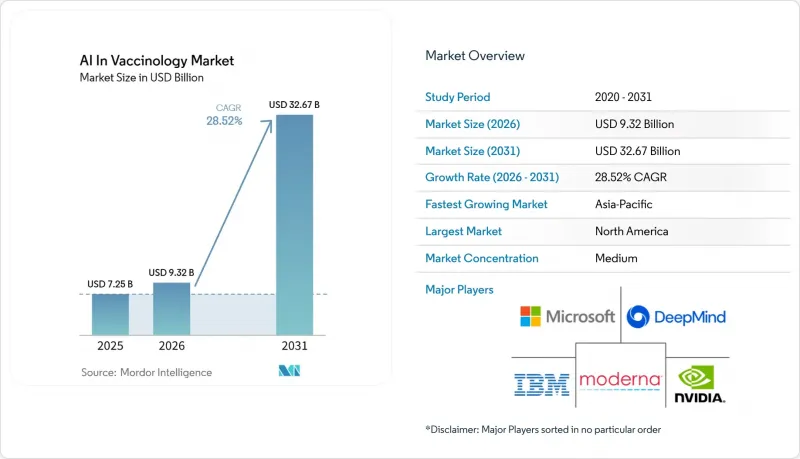
본 보고서는 제공 분야(소프트웨어, 서비스), 용도(항원 발견, 스크리닝, 시험 설계, 안전성 예측, 제조, 공급망), 최종 사용자(제약·바이오기술, 학술 기관, CRO, 정부 기관), 배포 방식(클라우드, On-Premise, 하이브리드), 단계(신약 개발, 전임상, 임상 등), 지역(북미, 유럽, 아시아태평양 등)별로 분류되어 있습니다. 예측치는 금액(달러)으로 표시되어 있습니다.
세계의 백신학 분야 AI 시장 동향 및 인사이트
AI를 활용한 항원 발견으로 백신 설계 주기 단축
백신학 분야 AI 시장은 항원 동정 주기의 단축에 힘입어 즉각적인 성장세를 보이고 있습니다. 이는 개발자들이 장기간에 걸친 반복적인 실험 프로그램을 기다릴 필요 없이, 몇 주 만에 표적 스크리닝과 선별을 수행할 수 있게 되었기 때문입니다. Google DeepMind의 AlphaFold를 활용한 연구는 실험실에서의 실증 시험이 시작되기 전에 연구자가 단백질의 구조적 거동과 안정성을 예측할 수 있도록 지원함으로써 이러한 변화를 뒷받침하고 있습니다. 이를 통해 설계 초기 단계에서의 판단이 더욱 정확해지고, 반복 작업이 줄어듭니다. 이러한 기간 단축이 중요한 이유는 구조 예측의 정확도 향상으로 인해 부적합한 후보를 조기에 배제하고, 실증 시험 단계로 넘어가는 분자의 품질을 높일 수 있기 때문입니다. 2026년 6월에 실시된 pEVAC-PS의 제1상 인간 임상시험에서는 AI로 설계된 범살베코바이러스 항원이 인간 시험 단계에 도달할 수 있음이 입증되었습니다. 이를 통해 백신학 분야 AI 시장에서 컴퓨터 기반 설계가 실제 개발 프로그램으로 발전할 수 있다는 명확한 실증 사례가 확보되었습니다. 또한, 2025년 『Nature Medicine』지에 게재된 연구에서는 AI를 활용한 인플루엔자 균주 선정을 통해 기존 방법보다 더 정확하게 유행의 주류를 이룰 균주를 예측할 수 있음이 밝혀졌습니다. 이를 통해 신약 개발 도구가 백신 프로그램의 매년 배합 변경 결정에 직접적으로 연결되게 되었습니다.
멀티오믹스 데이터의 통합을 통해 후보 선정 정확도 향상
백신학 분야 AI 시장이 확대되고 있는 또 다른 이유는 멀티오믹스 데이터의 통합을 통해 개발자가 단일 계층 스크리닝으로는 얻을 수 없는 보다 광범위한 생물학적 관점을 확보할 수 있게 되었기 때문입니다. 전사체학, 단백체학, 대사체학, 후성유전체학, 상호작용체학, 인산화 단백체학, 당체학, 지질체학을 통합하여 분석함으로써, AI 시스템은 기존 워크플로우에서는 파악하기 어려웠던 상호작용을 포착할 수 있습니다. 2026년 『Frontiers in Systems Biology』지에 게재된 총설에 따르면, 멀티오믹스 데이터에 AI를 적용함으로써 분자 수준에 걸친 복잡한 관계를 규명하는 면역 반응 예측 프레임워크를 구축할 수 있음이 밝혀졌습니다. 이는 백신학 분야 AI 시장에 중요한 의미를 지닙니다. 개발자가 유망한 항원뿐만 아니라 반응의 질을 좌우할 수 있는 면역 조건이나 제제 조건도 특정할 수 있게 되면, 후보 물질의 우선순위 결정이 개선될 수 있기 때문입니다. 2025년 GSK와 로렌스 리버모어 국립연구소가 수행한 연구에서는 교차반응성 항원 설계에 머신러닝을 활용함으로써 수막구균 백신 개발에서 기존의 조합 스크리닝 기법을 능가하는 성과를 얻을 수 있음이 밝혀졌습니다. 이어 2026년 『Nature Communications』지에 게재된 연구에서는 멀티오믹스 분석과 면역 기억 강화를 뒷받침하는 글루타민 분해 의존성 대사 경로의 연관성이 밝혀졌으며, 이를 통해 AI의 역할이 표적 스크리닝에서 반응 최적화로 확대되었습니다.
단편적이고 편향된 면역학 데이터셋이 모델의 일반화를 제한
백신학 분야 AI 시장은 여전히 심각한 구조적 제약에 직면해 있습니다. 이는 모델의 품질이 면역학 데이터에 의존하고 있는데, 해당 데이터의 포괄성, 품질, 지역적 대표성에는 편차가 있기 때문입니다. 2026년 『Frontiers in Systems Biology』 저널의 총설에서는 멀티오믹스 데이터셋에서 ‘세계의 남부’ 인구가 과소 대표되는 것이 중대한 제한 요인이라고 지적되었습니다. 이는 예측 결과가 백신 프로그램이 대상으로 하는 광범위한 인구층이 아닌, 제한된 유전적·환경적 기반만을 반영할 가능성이 있음을 의미합니다. 배치 효과, 일관성 없는 수집 프로토콜, 다중 공선성으로 인해 코호트 간 결과 재현 능력이 저하되면 이 과제는 더욱 심각해집니다. 표본 크기가 작고 고차원 데이터 세트의 경우, 인실리코에서는 설득력 있게 보일지라도 실험적 스크리닝 단계로 넘어가면 실패하는 과적합 모델이 생성될 가능성이 있습니다. 백신학 분야 AI 시장에서 이 문제는 희귀 병원체 프로그램에 가장 심각한 타격을 입힙니다. 데이터가 부족하면 후보 물질 생성 전반에 편향이 발생하여, 본래라면 더 강력한 알고리즘이 가져다주어야 할 성능 향상이 저해되기 때문입니다.
부문 분석
2025년에는 소프트웨어가 매출의 58.31%를 차지했으며, 이는 백신학 분야 AI 시장이 여전히 에피토프 매핑, 구조 예측, 후보 순위 지정, 워크플로우 통합에 사용되는 핵심 플랫폼을 중심으로 전개되고 있음을 보여줍니다. 이러한 우위는 벤더들이 기존의 바이오인포매틱스 도구를 넘어, 현재는 독자적인 훈련 데이터셋, 재사용 가능한 모델 레이어, 그리고 백신에 특화된 개발 워크플로우를 기반으로 한 시스템을 제공하고 있음을 반영합니다. 백신학 분야 AI 시장에서는 병원체 기록, 면역 반응 데이터 포인트, 검증 결과가 하나씩 늘어날 때마다 예측 정확도가 향상되고 전환 비용이 증가하기 때문에 소프트웨어의 우위는 시간이 지남에 따라 더욱 강화됩니다. 또한, 이 부문은 단일 기술적 과제를 해결할 뿐만 아니라, 설계, 스크리닝, 문서화를 연계하는 도구에 대한 수요 증가의 혜택도 받고 있습니다. 이러한 동향으로 인해 다른 서비스 기반 사업 분야가 더 빠르게 확대되고 있음에도 불구하고, 소프트웨어는 백신학 분야 AI 시장의 운영 모델에서 중심적인 위치를 계속 차지하고 있습니다.
서비스 부문은 2031년까지 연평균 성장률(CAGR) 31.38%를 나타낼 것으로 예측되며, 백신학 분야 AI 시장에서 가장 빠르게 확대되는 서비스 유형이 될 것입니다. 이러한 성장은 사내에 본격적인 AI 팀을 구축하지 않고도 모델 훈련, 어노테이션 지원, 도입 관리가 필요한 생명공학 기업, 연구 그룹, 공중보건 기관에 의해 뒷받침되고 있습니다. 서비스 기회는 단순히 계산 자원의 아웃소싱에 그치지 않습니다. 고객이 범용 플랫폼에 대한 접근이 아닌 특정 프로그램에 부합하는 성과를 요구할 경우, 응용 연구 지원이나 맞춤형 모델 개발이 더 높은 부가가치를 가져다주기 때문입니다. 이는 고객이 종종 독자적인 병원체 세트, 규제 조건, 데이터 구조를 다루며, 이에 맞춘 실행이 요구되는 백신학 분야의 AI 업계에서 특히 중요한 의미를 지닙니다. 앞으로 백신학 분야 AI 시장에서는 AI에 관한 기술적 전문 지식과 면역학, 백신 개발, 품질 관리가 이루어진 도입에 관한 도메인 지식을 겸비한 서비스 제공업체가 계속해서 우위를 점할 것으로 예측됩니다.
항원의 발견 및 설계는 2025년 매출의 32.24%를 차지하며, 백신학 분야 AI 시장에서 가장 큰 응용 분야로서의 위상을 유지했습니다. 이러한 선두 위상은 리버스 백신학의 파이프라인 성숙도와 초기 후보 생성 단계에서 단백질 언어 모델 및 구조 학습 시스템의 보급을 반영합니다. 2025년 『Nature Communications』지에 게재된 단백질 언어 모델과 기하학적 딥러닝 모델의 통합에 관한 연구에서는 AI가 기존의 면역정보학적 기법을 넘어 보호 항원의 예측을 어떻게 개선할 수 있는지가 제시되었습니다. 백신학 분야 AI 시장에서 이 응용 분야는 여전히 많은 고객에게 진입점 역할을 하고 있습니다. 이는 더 신속하고 정밀한 항원 우선순위 지정이 비용과 개발 기간 모두에 명확한 효과를 가져오기 때문입니다. 또한, 신약 개발 단계의 도구가 스크리닝, 전임상시험 및 제제 재설계 계획에서 하류 가치를 창출함에 따라, 이 부문에 대한 자금 지원도 계속해서 활발합니다.
임상시험의 설계 및 최적화는 2031년까지 연평균 성장률(CAGR) 32.52%로 확대될 것으로 예측되며, 백신학 분야 AI 시장에서 가장 빠르게 성장하는 응용 분야로 자리매김하고 있습니다. 이러한 변화는 AI의 가치가 실험실 지원에서 통계적 설계, 환자 세분화, 프로토콜 개선 및 용량과 관련된 의사결정 지원으로 이동하고 있음을 보여줍니다. 후보 물질 스크리닝 및 안전성, 유효성, 이상반응 예측 등 파이프라인의 중간 단계도 AI를 활용한 프로그램을 통해 라벨이 지정된 결과를 더 많이 얻을 수 있게 됨에 따라 강화되고 있습니다. 조직들이 우수한 시험 설계를 통해 초기 발견 단계의 성과 일부보다 측정하기 쉬운 형태로 실패 위험과 운영상의 낭비를 모두 줄일 수 있다는 점을 인식하게 됨에 따라, 백신학 분야 AI 시장의 이 용도 규모는 확대되고 있습니다. 2026년 7월 웨일 코넬 메디슨이 발표한 보고서는 AI 연구팀이 개발한 시스템이 실제 환자 데이터를 활용하여 임상시험을 시뮬레이션하고 이를 개선할 수 있음을 보여줌으로써 이러한 방향성을 뒷받침하고 있습니다.
지역별 분석
2025년, 북미는 매출의 38.62%를 차지하며 백신학 분야 AI 시장에서 최대 지역 블록으로서의 지위를 유지했습니다. 이 지역은 백신 개발 기업, AI 인재, 선진 연구 기관, 그리고 보건 안보 및 생물 방어 우선 과제와 연계된 공공 자금 조달 경로가 밀접하게 융합되어 있다는 이점이 있습니다. 또한, 북미의 백신학 분야 AI 시장은 컴퓨터 지원 설계와 확립된 중개 연구 및 규제 대응 능력을 결합할 수 있는 조직의 존재로부터도 혜택을 받고 있습니다. 캐나다에서는 서스캐처원 대학교의 VIDO와 같은 기관이 시장에 깊이를 더하고 있습니다. 이 기관은 전 세계 질병 예방 역량을 지원하기 위해 CEPI로부터 2025년 평균 요율 기준으로 최대 2,400만 캐나다 달러(1,760만 달러)의 자금을 지원받았습니다. 멕시코는 여전히 초기 단계에 있으며, 첨단 AI 주도 백신 설계보다는 물류 및 예방접종 계획 측면에서 단기적인 중요성이 더 높은 상황입니다.
유럽은 백신학 분야 AI 시장에서 구조적으로 중요한 위치를 계속 차지하고 있습니다. 이는 유럽 규제 당국의 기대가 플랫폼 구축, 문서화, 도입 방식에 영향을 미치고 있기 때문입니다. EMA(유럽의약품청)의 2024년 검토 보고서에서는 의약품 워크플로우 전반에 걸친 투명성과 설명 가능성에 대한 더욱 강화된 중점을 요구하고 있으며, 이에 따라 유럽은 규제 당국의 요건을 충족하는 설계 기준 수립에 있어 중요한 역할을 담당하고 있습니다. 2026년 2월, 유럽위원회는 EU4Health 프로그램의 일환으로 HERA를 통해 차세대 인플루엔자 백신 개발을 지원하기 위해 2026년 평균 기준으로 2억 2,500만 유로(2억 4,300만 달러)를 지원하기로 결정했습니다. 독일과 영국은 AI 연구의 깊이, 백신 개발 능력, 그리고 상용 플랫폼의 입지를 모두 갖추고 있어 여전히 유럽에서 가장 활발한 시장을 형성하고 있습니다. 따라서 백신학 분야 AI 시장에서 유럽의 점유율은 규모 그 자체보다는 규정 준수 및 플랫폼 설계 기준을 수립하는 데 있어 유럽이 수행하는 역할에 의해 뒷받침되고 있습니다.
아시아태평양은 2031년까지 연평균 성장률(CAGR) 31.15%를 나타낼 것으로 예측되며, 백신학 분야 AI 시장에서 가장 빠르게 성장하는 지역이 될 것입니다. 중국과 한국이 이러한 성장세의 대부분을 주도하고 있지만, 그 방식은 정책, 제조, 공공 부문의 각 채널에 따라 다릅니다. 2026년 2월, 중국과학원은 7만 7,000건 이상의 PubMed 기록을 활용해 학습된, 결핵 백신 항원 선정을 위한 LLM 기반 지식 그래프 시스템에 대한 세부 내용을 발표했습니다. 이는 백신학 분야의 응용 AI 분야에서 해당 지역의 전문성이 깊어지고 있음을 여실히 보여줍니다. 또한, 이 지역은 국내 백신 개발 역량과 지역 밀착형 플랫폼 개발에 대한 공공 부문의 관심 증가로 인해 혜택을 받고 있습니다. 중동 및 아프리카 및 남미는 여전히 초기 단계 시장이며, 예측 기간의 대부분 동안 플랫폼의 가용성보다 다자간 지원 및 인프라 구축 현황이 더 중요할 것입니다.
기타 혜택 :
- 엑셀 형식 시장 예측(ME) 시트
- 3개월간의 애널리스트 지원
자주 묻는 질문
목차
제1장 서론
제2장 조사 방법
제3장 주요 요약
제4장 시장 구도
제5장 시장 규모 및 성장 예측
제6장 경쟁 구도
제7장 시장 기회 및 향후 전망
KTH 26.08.10According to Mordor Intelligence, the AI in vaccinology market size is expected to grow from USD 7.25 billion in 2025 to USD 9.32 billion in 2026 and is forecast to reach USD 32.67 billion by 2031 at 28.52% CAGR over 2026-2031.
This report is Segmented by Offering (Software, Services), Application (Antigen Discovery, Screening, Trial Design, Safety Prediction, Manufacturing, Supply Chain), End User (Pharma/Biotech, Academic, Cros, Government), Deployment (Cloud, On-Prem, Hybrid), Stage (Discovery, Preclinical, Clinical, and More), and Geography (North America, Europe, Asia-Pacific, and More). Forecasts are Provided in Value (USD).
Global AI In Vaccinology Market Trends and Insights
AI-Enabled Antigen Discovery Shortens Vaccine Design Cycles
The AI in vaccinology market is getting immediate support from shorter antigen identification cycles, because developers can now screen and refine targets in weeks instead of waiting through long iterative lab programs. Google DeepMind's AlphaFold work has strengthened this shift by helping researchers anticipate protein structure behavior and stability before wet-lab testing begins, which makes early design choices more informed and less repetitive. This time reduction matters because better structural prediction can remove weak candidates earlier and improve the quality of molecules that move into physical validation. The first Phase I human trial of pEVAC-PS in June 2026 showed that an AI-designed pan-Sarbecovirus antigen could reach human testing, which gave the AI in vaccinology market a visible proof point that computational design can advance into real development programs. A 2025 Nature Medicine study also showed that AI-based influenza strain selection can predict dominant circulating strains more accurately than conventional methods, which connects discovery tools directly with annual reformulation decisions in vaccine programs.
Multi-Omics Data Integration Improves Candidate Selection Accuracy
The AI in vaccinology market is also expanding because multi-omics integration gives developers a wider biological view than single-layer screening can provide. When transcriptomics, proteomics, metabolomics, epigenomics, interactomics, phosphoproteomics, glycomics, and lipidomics are analyzed together, AI systems can capture interactions that are hard to isolate through traditional workflows. A 2026 review in Frontiers in Systems Biology showed that AI applied to multi-omics data can build predictive immune response frameworks that reveal complex relationships across molecular layers. This matters for the AI in vaccinology market because candidate prioritization improves when developers can identify not only likely antigens but also the immune and formulation conditions that may shape response quality. Research from GSK and Lawrence Livermore National Laboratory in 2025 showed that machine learning for cross-reactive antigen design could outperform older combinatorial screening methods in meningococcal vaccine development. A 2026 Nature Communications study then linked multiomic analysis with glutaminolysis-dependent metabolic pathways that can support immune memory enhancement, which broadens the role of AI from target screening into response optimization.
Fragmented And Biased Immunology Datasets Limit Model Generalization
The AI in vaccinology market still faces a deep structural constraint because model quality depends on immunology data that remains uneven in coverage, quality, and regional representation. A 2026 Frontiers in Systems Biology review identified underrepresentation of Global South populations in multi-omics datasets as a critical limitation, which means predictions can reflect a narrow genetic and environmental base rather than the wider populations vaccine programs are meant to serve. The same challenge becomes harder when batch effects, inconsistent collection protocols, and multicollinearity reduce the ability to reproduce findings across cohorts. Small sample sizes and high-dimensional datasets can produce overfit models that look persuasive in silico but fail when moved into experimental screening. In the AI in vaccinology market, this problem is most damaging for rare-pathogen programs because sparse data can bias entire candidate generations and flatten performance gains that stronger algorithms should otherwise deliver.
Other drivers and restraints analyzed in the detailed report include:
- AI-Optimized Clinical Trial Design Reduces Failure Risk
- Government and CEPI-Led Pandemic Preparedness Funding
- Weak Wet-Lab Validation Pipelines Slow Commercial Translation
For complete list of drivers and restraints, kindly check the Table Of Contents.
Segment Analysis
Software held 58.31% of revenue in 2025, which shows that the AI in vaccinology market still centers on core platforms used for epitope mapping, structural prediction, candidate ranking, and workflow integration. This lead reflects how platform vendors have moved beyond older bioinformatics tools and are now supplying systems built around proprietary training datasets, reusable model layers, and vaccine-specific development workflows. In the AI in vaccinology market, software advantage strengthens over time because every additional pathogen record, immune response datapoint, and validation outcome can improve future predictions and deepen switching costs. The segment also benefits from rising demand for tools that connect design, screening, and documentation rather than solving only one technical task. That dynamic keeps software central to the operating model of the AI in vaccinology market even as other service-based business lines expand more quickly.
Services are projected to grow at a 31.38% CAGR through 2031, which makes them the fastest-scaling offering type in the AI in vaccinology market. Growth is being supported by biotech firms, research groups, and public health agencies that need model training, annotation support, and deployment management without building full internal AI teams. The service opportunity is not limited to compute outsourcing, because applied research support and custom model development carry higher value when customers want program-specific outputs rather than generic platform access. This is especially relevant in the AI in vaccinology industry where customers often work with distinct pathogen sets, regulatory conditions, and data structures that require tailored execution. Over time, the AI in vaccinology market should keep favoring service providers that combine technical AI expertise with domain understanding in immunology, vaccine development, and quality-controlled deployment.
Antigen discovery and design accounted for 32.24% of 2025 revenue, which kept it as the largest application area in the AI in vaccinology market. Its lead reflects the maturity of reverse vaccinology pipelines and the wider use of protein language models and structural learning systems in early candidate generation. A 2025 Nature Communications study on integrating protein language and geometric deep learning models showed how AI can improve protective antigen prediction beyond conventional immunoinformatic approaches. In the AI in vaccinology market, this application remains the entry point for many customers because faster and better antigen prioritization has a clear effect on both cost and development timing. The segment also remains well funded because discovery-stage tools create downstream value for screening, preclinical work, and reformulation planning.
Clinical trial design and optimization is projected to expand at a 32.52% CAGR through 2031, which makes it the fastest-growing application in the AI in vaccinology market. The shift shows that AI value is moving from lab support into statistical design, patient segmentation, protocol refinement, and dose-related decision support. The middle sections of the pipeline, including candidate screening and safety, efficacy, and adverse event prediction, are also strengthening as more labeled outcomes become available from AI-informed programs. The AI in vaccinology market size for this application is rising because organizations now see that better trial design can reduce both failure risk and operational waste in a way that is easier to measure than some early discovery outputs. A July 2026 report from Weill Cornell Medicine reinforced this direction by showing that an AI research team system could simulate and improve clinical trials using real-world patient data.
Complete Report Scope:
- By Offering
- Software
- Services
- By Application
- Antigen Discovery and Design
- Vaccine Candidate Screening
- Clinical Trial Design and Optimization
- Safety, Efficacy, and Adverse Event Prediction
- Vaccine Manufacturing Optimization
- Supply Chain and Demand Forecasting
- By End User
- Pharmaceutical and Biotechnology Companies
- Academic and Research Institutes
- Contract Research Organizations
- Government and Public Health Agencies
- By Deployment Mode
- Cloud-Based
- On-Premise
- Hybrid
- By Stage of Vaccinology Workflow
- Discovery
- Preclinical Development
- Clinical Development
- Manufacturing and Scale-Up
- Post-Market Safety Surveillance
- By Geography
- North America
- United States
- Canada
- Mexico
- Europe
- Germany
- United Kingdom
- France
- Italy
- Spain
- Rest of Europe
- Asia-Pacific
- China
- Japan
- India
- Australia
- South Korea
- Rest of Asia-Pacific
- Middle East and Africa
- GCC
- South Africa
- Rest of Middle East and Africa
- South America
- Brazil
- Argentina
- Rest of South America
- North America
Geography Analysis
North America held 38.62% of revenue in 2025, which kept it as the largest regional block in the AI in vaccinology market. The region benefits from a dense mix of vaccine developers, AI talent, advanced research institutions, and public funding channels tied to health security and biodefense priorities. The AI in vaccinology market in North America also gains from organizations that can combine computational design with established translational and regulatory capabilities. Canada adds depth through institutions such as VIDO at the University of Saskatchewan, which received up to CAD 24 million (USD 17.6 million) at 2025 average rates, from CEPI to support global disease prevention capabilities. Mexico is still at an earlier stage, with stronger near-term relevance in logistics and immunization planning than in advanced AI-led vaccine design.
Europe remains structurally important in the AI in vaccinology market because regulatory expectations there are shaping how platforms are built, documented, and deployed. The EMA's 2024 reflection paper requires a stronger focus on transparency and explainability across medicinal product workflows, which gives Europe a significant role in setting regulator-ready design standards. In February 2026, the European Commission committed EUR 225 million (USD 243 million) at 2026 average rates, to support next-generation influenza vaccine development through HERA under the EU4Health program. Germany and the United Kingdom remain the most active European markets because they combine AI research depth, vaccine development capability, and commercial platform presence. The AI in vaccinology market share of Europe is therefore supported less by scale alone and more by its role in setting compliance and platform design norms.
Asia-Pacific is projected to grow at a 31.15% CAGR through 2031, which makes it the fastest-growing region in the AI in vaccinology market. China and South Korea are driving much of this momentum, although they are doing so through different policy, manufacturing, and public-sector channels. In February 2026, the Chinese Academy of Sciences published details on an LLM-assisted knowledge graph system for TB vaccine antigen selection that was trained on more than 77,000 PubMed records, which highlights the region's growing depth in applied AI for vaccinology. The region also benefits from stronger public-sector interest in domestic vaccine capability and local platform development. Middle East and Africa and South America remain earlier-stage opportunities where multilateral support and infrastructure capacity will matter more than platform availability through most of the forecast period.
- AstraZeneca
- Atomwise, Inc.
- Benevolent AI
- BioNTech
- Google DeepMind
- GlaxoSmithKline
- Absci Corporation
- IBM
- Insilico Medicine
- Johnson & Johnson
- Merck
- Microsoft
- Moderna
- NVIDIA
- Oracle
- Owkin
- Pfizer
- Recursion Pharmaceuticals
- Sanofi
- Generate Biomedicines
Additional Benefits:
- The market estimate (ME) sheet in Excel format
- 3 months of analyst support
TABLE OF CONTENTS
1 Introduction
- 1.1 Study Assumptions & Market Definition
- 1.2 Scope of the Study
2 Research Methodology
3 Executive Summary
4 Market Landscape
- 4.1 Market Overview
- 4.2 Market Drivers
- 4.2.1 AI-Enabled Antigen Discovery Shortens Vaccine Design Cycles
- 4.2.2 Multi-Omics Data Integration Improves Candidate Selection Accuracy
- 4.2.3 AI-Optimized Clinical Trial Design Reduces Failure Risk
- 4.2.4 Government and CEPI-Led Pandemic Preparedness Funding
- 4.2.5 Explainable AI Becomes Essential for Regulatory Acceptance
- 4.2.6 Model Training Demand Rises With Rare-Pathogen and Variant Surveillance
- 4.3 Market Restraints
- 4.3.1 Fragmented and Biased Immunology Datasets Limit Model Generalization
- 4.3.2 Weak Wet-Lab Validation Pipelines Slow Commercial Translation
- 4.3.3 Regulatory Uncertainty Around AI-Generated Biological Evidence
- 4.3.4 Data Sovereignty and Cross-Border Health Data Restrictions
- 4.4 Value Chain Analysis
- 4.5 Regulatory Landscape
- 4.6 Technological Outlook
- 4.7 Porter's Five Forces Analysis
- 4.7.1 Bargaining Power of Suppliers
- 4.7.2 Bargaining Power of Buyers
- 4.7.3 Threat of New Entrants
- 4.7.4 Threat of Substitutes
- 4.7.5 Competitive Rivalry
5 Market Size & Growth Forecasts (Value, USD)
- 5.1 By Offering
- 5.1.1 Software
- 5.1.2 Services
- 5.2 By Application
- 5.2.1 Antigen Discovery and Design
- 5.2.2 Vaccine Candidate Screening
- 5.2.3 Clinical Trial Design and Optimization
- 5.2.4 Safety, Efficacy, and Adverse Event Prediction
- 5.2.5 Vaccine Manufacturing Optimization
- 5.2.6 Supply Chain and Demand Forecasting
- 5.3 By End User
- 5.3.1 Pharmaceutical and Biotechnology Companies
- 5.3.2 Academic and Research Institutes
- 5.3.3 Contract Research Organizations
- 5.3.4 Government and Public Health Agencies
- 5.4 By Deployment Mode
- 5.4.1 Cloud-Based
- 5.4.2 On-Premise
- 5.4.3 Hybrid
- 5.5 By Stage of Vaccinology Workflow
- 5.5.1 Discovery
- 5.5.2 Preclinical Development
- 5.5.3 Clinical Development
- 5.5.4 Manufacturing and Scale-Up
- 5.5.5 Post-Market Safety Surveillance
- 5.6 By Geography
- 5.6.1 North America
- 5.6.1.1 United States
- 5.6.1.2 Canada
- 5.6.1.3 Mexico
- 5.6.2 Europe
- 5.6.2.1 Germany
- 5.6.2.2 United Kingdom
- 5.6.2.3 France
- 5.6.2.4 Italy
- 5.6.2.5 Spain
- 5.6.2.6 Rest of Europe
- 5.6.3 Asia-Pacific
- 5.6.3.1 China
- 5.6.3.2 Japan
- 5.6.3.3 India
- 5.6.3.4 Australia
- 5.6.3.5 South Korea
- 5.6.3.6 Rest of Asia-Pacific
- 5.6.4 Middle East and Africa
- 5.6.4.1 GCC
- 5.6.4.2 South Africa
- 5.6.4.3 Rest of Middle East and Africa
- 5.6.5 South America
- 5.6.5.1 Brazil
- 5.6.5.2 Argentina
- 5.6.5.3 Rest of South America
- 5.6.1 North America
6 Competitive Landscape
- 6.1 Market Concentration
- 6.2 Market Share Analysis
- 6.3 Company Profiles (includes Global Level Overview, Market Level Overview, Core Segments, Financials as available, Strategic Information, Market Rank/Share, Products and Services, Recent Developments)
- 6.3.1 AstraZeneca plc
- 6.3.2 Atomwise, Inc.
- 6.3.3 BenevolentAI
- 6.3.4 BioNTech SE
- 6.3.5 Google DeepMind
- 6.3.6 GSK plc
- 6.3.7 Absci Corporation
- 6.3.8 IBM
- 6.3.9 Insilico Medicine, Inc.
- 6.3.10 Johnson and Johnson
- 6.3.11 Merck and Co., Inc.
- 6.3.12 Microsoft
- 6.3.13 Moderna, Inc.
- 6.3.14 NVIDIA Corporation
- 6.3.15 Oracle
- 6.3.16 Owkin
- 6.3.17 Pfizer Inc.
- 6.3.18 Recursion Pharmaceuticals, Inc.
- 6.3.19 Sanofi S.A.
- 6.3.20 Generate Biomedicines
7 Market Opportunities & Future Outlook
- 7.1 White-Space and Unmet-Need Assessment


