

|
시장보고서
상품코드
2099749
무인 항공기 시스템용 카메라 : 시장 점유율 분석, 업계 동향 및 통계, 성장 예측(2026-2031년)Unmanned Aerial Systems Camera - Market Share Analysis, Industry Trends & Statistics, Growth Forecasts (2026 - 2031) |
||||||
 Mordor Intelligence
Mordor Intelligence에 의하면, 무인 항공기 시스템용 카메라 시장 규모는 2025년에 30억 3,000만 달러로 평가되었습니다. 2026년 36억 2,000만 달러에서 2031년까지 78억 달러에 이를 것으로 예상되며, 예측 기간(2026-2031년) CAGR은 16.59%를 나타낼 전망입니다.
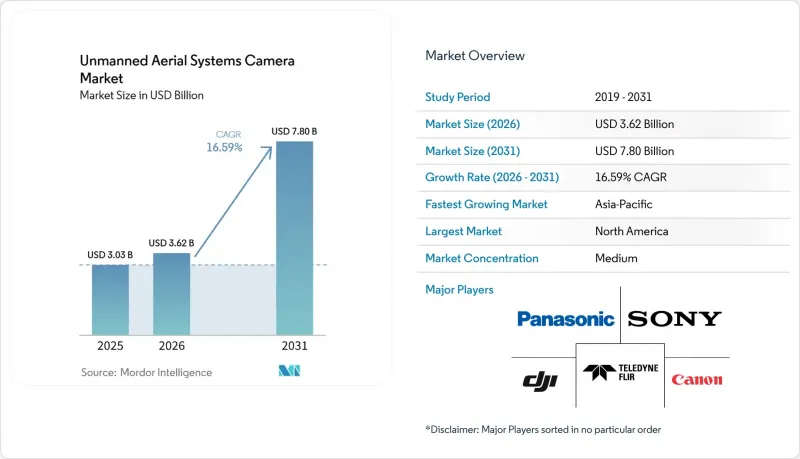
본 보고서는 카메라 유형(HD 카메라, 열화상 카메라, 기타), 용도(사진·동영상 촬영, 열화상, 감시 등), 해상도(12 MP 미만, 12 MP 이상 20 MP 미만, 기타), 최종 사용자(민간, 군사, 국토 안보), 지역(북미, 유럽, 기타)별로 분류되어 있습니다. 시장 전망은 금액(달러) 기준으로 제시되어 있습니다.
세계의 무인 항공기 시스템용 카메라 시장 동향 및 인사이트
AI 탑재 기내 영상 처리 시스템의 발전
페이로드 내부에서의 AI 처리에 따라, 구매자들이 무인 항공기 시스템용 카메라 시장에 기대하는 바가 변화하고 있습니다. 이러한 변화로 인해 지상 관제소에 대한 의존도가 낮아지고, 비행 중 실시간 물체 인식, 표적 추적 및 장면 해석이 가능해집니다. Gremsy사는 Teledyne FLIR사의 OEM 지원을 받아 2025년 10월에 'ORUS-L' 페이로드를 출시했습니다. 이는 열화상 센서와 EO 센서를, 드론용 패키지로 100 TOPS의 AI 연산 능력을 제공하는 NVIDIA Jetson Orin NX 모듈과 결합한 제품입니다. 이러한 통합을 통해 무인 항공기 시스템용 카메라 시장에서 페이로드는 단순한 촬영용 액세서리에서 자율적인 상황 인식 시스템으로 변모하고 있습니다. 2026년에 발표된 IEEE의 조사에서도 드론 스웜 상의 FPGA 기반 엣지 AI 파이프라인이 클라우드 연결 없이도 실시간 의미론적 추론을 실현할 수 있음이 밝혀졌으며, 이를 통해 현장 환경에서의 온보드 분석 활용이 더욱 확대될 것으로 나타났습니다.
정밀 농업을 위한 UAS 용도를 촉진하는 정부의 지원책
공공 지원 프로그램을 통해 카메라 탑재형 농업용 드론의 진입 장벽이 낮아지고 있습니다. 인도의 'Kisan Drone Yojana 2025'에서는 작물 평가, 살포, 토양 분석에 사용되는 드론에 대해 최대 90%의 보조금이 제공되었습니다. 또한, 여성이 주도하는 농가 조직이나 SC/ST(지정 카스트·지정 부족) 농가 조직이 실시한 실증 실험에는 100%의 자금 지원이 이루어졌습니다. 마디아프라데시 주의 ‘드론 촉진·활용 정책 2025’에서는 신규 제조 투자에 대해 상한 30카롤 루피(340만 달러)의 40%에 해당하는 설비 투자 보조금이 추가로 지급되었습니다. 이 주는 5년 동안 3억 7천만 루피(4,220만 달러)의 부문 투자와 8,000명의 일자리 창출을 목표로 하고 있습니다. 이러한 프로그램은 작물 모니터링 및 병해 검출에 표준 가시광선 촬영 이상의 기능이 필요하기 때문에 다중 스펙트럼 및 근적외선 페이로드에 대한 수요를 촉진하고 있습니다. 보조금에 따른 조달 확대에 따라, 무인 항공기 시스템용 카메라 시장은 중해상도 및 농업 전용 영상 시스템 분야에서 더욱 안정적인 상업적 기반을 확보해 가고 있습니다.
사이버 보안 강화 및 인증 규정 준수에 따른 비용 상승
인증 비용은 무인 항공기 시스템용 카메라 시장에서 실질적인 진입 장벽이 되고 있습니다. 현재 미국 국방부(DoD)의 ‘Blue UAS Cleared’ 등급 획득을 위한 절차로 활용되고 있는 AUVSI의 ‘Green UAS’ 프레임워크에서는 기업의 사이버 위생 관리, 제품 및 기기의 보안, 원격 제어 및 연결성, 그리고 공급망 리스크 관리에 대한 심사가 요구됩니다. 이러한 요건으로 인해 무인 항공기 시스템용 카메라 시장의 기체 제조업체와 페이로드 공급업체 모두에서 문서화, 시험, 감사 업무가 증가하고 있습니다. 또한 제조업체가 페이로드의 유형을 업데이트하거나 인증된 스택 내에서 공급업체를 변경할 때에도 지속적인 비용이 발생합니다. 정부 관련 수요를 완전히 충족시키기 전에 엔지니어링 비용과 규정 준수 비용을 부담해야 하기 때문에 이러한 부담이 가장 크게 가중되는 것은 중소규모의 전문 기업들입니다.
부문 분석
2025년에는 영화 촬영, 매핑, 건설 현장 점검 등에서의 광범위한 활용에 힘입어 HD 카메라가 시장의 53.67%를 차지했습니다. 상용 드론 기종은 이미 가시광선 이미징을 핵심으로 구축되어 있으며, 많은 사용자가 고도의 기내 연산을 필요로 하지 않고도 이 데이터를 효과적으로 처리할 수 있기 때문에 HD 카메라의 우위는 여전히 견고합니다. 2025년 9월에 출시된 DJI의 'Mini 5 Pro'는 고성능 촬영 기능이 더욱 가볍고 접근성이 높은 드론 등급에도 도입되고 있음을 보여주며, HD 카메라 시스템의 적용 범위 확대에 기여하고 있습니다. 한편, 멀티스펙트럼, 하이퍼스펙트럼, LiDAR 연동 페이로드를 포함한 기타 카테고리는 정밀 농업이나 재생에너지 점검 등 규모는 작지만 부가가치가 높은 이용 사례에 계속해서 기여하고 있습니다.
열화상 카메라는 2031년까지 연평균 성장률(CAGR) 18.65%를 나타낼 것으로 예측되며, 카메라 유형별 부문 중 가장 빠르게 성장하는 분야가 될 것입니다. 이러한 성장은 소형 상용 플랫폼에서도 사용 가능해졌으며, 더 작고 가벼우면서 규제 요건을 충족하는 LWIR 모듈에 의해 뒷받침되고 있습니다. 2026년 6월에 발표된 텔라다인 FLIR사의 'Boson SX8'은 크기나 전력 제약이 있는 UAS용으로 설계된 패키지에 더 높은 열 해상도를 구현하여, 양산 규모에서 고급 열화상 기능을 쉽게 활용할 수 있게 했습니다. 또한, ‘Thermal by FLIR’와 Gremsy의 제휴는 센서 공급업체와 페이로드 통합업체가 협력하여 제품 출시를 가속화하고, 밸류체인 전반에 걸친 인증 부담을 경감하고 있는 실제 사례를 보여주었습니다. 미국에서는 NDAA(국방수권법) 준수가 초기 단계부터 열화상 카메라 설계에 점점 더 큰 영향을 미치고 있으며, 유사한 포지셔닝을 목표로 하는 유럽공급업체들로부터도 주목을 받고 있습니다.
2025년 용도별 구성 비율에서는 사진·동영상 촬영이 34.40%의 점유율을 차지하며 1위를 기록했습니다. 이 부문은 상업용 컨텐츠 제작, 부동산, 라이브 제작, 소셜 미디어 관련 업무에서의 견조한 수요의 혜택을 지속적으로 누리고 있습니다. DJI의 ‘Mini 5 Pro’는 250g 미만의 드론 등급에 1인치 센서를 탑재함으로써 이러한 추세를 더욱 가속화했으며, 소비자용과 전문가용 간의 화질 격차를 좁혔습니다. 감시 용도는 여전히 중요한 이용 사례이지만, 일부 시장에서는 법적 감시가 더욱 두드러지고 있습니다. 2025년 7월, 오리건주 항소법원은 정밀 공중 감시를 영장의 근거로 사용할 경우 별도의 증거 뒷받침이 필요하다고 판결하며, 법 집행 기관 및 상업용 드론 영상 프로그램에 대한 보다 엄격한 감독의 필요성을 강조했습니다.
열화상 기술은 2031년까지 연평균 성장률(CAGR)이 19.10%에 달하며, 가장 빠르게 성장하는 응용 분야가 될 것으로 예측됩니다. 인프라 점검, 드론을 활용한 초동 대응 프로그램, 그리고 유사한 센서 및 처리 능력에 의존하는 군사 ISR(정보·감시·정찰) 임무에서 수요가 증가하고 있습니다. 고해상도 열화상 페이로드가 현재 양산 단계에 접어들면서, 이에 따라 관련 이용 사례에서 고성능 가시광선 영상 시스템에 대한 수요도 높아지고 있습니다. 2026년 암스테르담 드론 위크에서 전시된 소니의 'ILX-LR1'은 사진 측량 및 정밀 매핑 분야에서 고해상도 페이로드 표준으로의 전환을 반영한 것이었습니다. '기타' 카테고리는 환경 모니터링, 수색 및 구조, 통로 검사 분야에서 여전히 중요한 역할을 수행하고 있으며, 이러한 분야에서는 운영자가 동일한 임무에서 열화상 이미지와 가시광선 이미지를 모두 병용해야 하는 경우가 종종 있습니다.
지역별 분석
2025년, 북미는 무인 항공기 시스템용 카메라 시장 점유율의 32.88%를 차지하며 매출 측면에서 지역별 최대 기여도를 기록했습니다. 이 지역은 국방 및 국토 안보 분야의 대규모 수요 기반, 성숙한 상용 운영자 생태계, 그리고 다른 많은 시장보다 견고한 인증 문화의 혜택을 받고 있습니다. 이러한 요인들로 인해 단순한 저가형 카메라 유닛이 아닌, 규격을 준수하는 열화상, EO(광학), 멀티센서 페이로드에 대한 안정적인 수요가 뒷받침되고 있습니다. 또한 북미에서는 공공 안전 및 검사 용례가 더욱 정착되어 있어, 이로 인해 무인 항공기 시스템용 카메라 시장에서 재구매 및 업그레이드 주기가 촉진되고 있습니다. 이 때문에 해당 지역은 판매 수량뿐만 아니라 고부가가치 페이로드 구성 측면에서도 중요한 위치를 계속 차지하고 있습니다.
아시아태평양은 2031년까지 연평균 성장률(CAGR) 17.65%를 나타낼 것으로 예측되며, 무인 항공기 시스템용 카메라 시장에서 가장 빠르게 성장하는 지역 부문이 될 전망입니다. 이 지역은 대규모 제조 능력, 확대되는 농업 분야에서의 도입, 그리고 장시간 비행이 가능한 감시·검사 용도에 대한 관심 증가를 모두 갖추고 있습니다. 인도의 보조금 지원 프로그램인 ‘Kisan Drone Yojana 2025’와 마디아프라데시 주의 투자 지원 정책은 카메라를 탑재한 농업용 드론에 대해 이 지역에서 확실한 상업적 기반을 제공합니다. 또한, Gremsy사와 Aerosense사는 2026년 6월 Aerobo Wing VTOL에 LYNX EO/IR 페이로드를 통합하는 작업을 완료했으며, 이는 해당 지역이 소형 상용 시스템에서 더 장시간의 감시 및 점검 임무로 전환되고 있음을 보여줍니다.
유럽은 무인 항공기 시스템용 카메라 시장에서 두 번째로 큰 지역 클러스터를 차지하고 있으며, 국방 수요와 BVLOS(시야등) 운용을 점점 더 뒷받침하는 규제 환경에 힘입고 있습니다. 2026년 4월에 완료된 ESA의 Iris RPAS 비행 시험은 견고한 위성 및 지상 지휘 통신 링크가 장거리 임무의 실제 운용 조건을 지원할 수 있음을 입증했습니다. 이는 유럽 내 점검 및 민간 인프라 사업에 중요한 의미를 지닙니다. 규정을 준수하는 장거리 운용이 실현되면, 무인 항공기 시스템용 카메라 시장에서 전용으로 설계된 영상 촬영 페이로드에 대한 수요가 촉발될 것이기 때문입니다. 남미, 중동 및 아프리카는 현재 규모는 작지만, 농업용 영상 촬영, 에너지 점검, 공공 안전, 국경 감시용 페이로드에 대한 수요가 계속해서 예상됩니다.
기타 혜택 :
- 엑셀 형식 시장 예측(ME) 시트
- 3개월간의 애널리스트 지원
자주 묻는 질문
목차
제1장 서론
제2장 조사 방법
제3장 주요 요약
제4장 시장 구도
제5장 시장 규모 및 성장 예측
제6장 경쟁 구도
제7장 시장 기회 및 향후 전망
KTH 26.08.10According to Mordor Intelligence, the unmanned aerial systems camera market size was valued at USD 3.03 billion in 2025 and estimated to grow from USD 3.62 billion in 2026 to reach USD 7.80 billion by 2031, at a CAGR of 16.59% during the forecast period (2026-2031).
This report is Segmented by Camera Type (HD Cameras, Thermal Cameras, and Others), Application (Photography and Videography, Thermal Imaging, Surveillance, and More), Resolution (Less Than 12 MP, 12 To Less Than 20 MP, and More), End-User (Commercial, Military, and Homeland Security), and Geography (North America, Europe, and More). The Market Forecasts are Provided in Terms of Value (USD).
Global Unmanned Aerial Systems Camera Market Trends and Insights
Advancements in AI-Enabled Onboard Image Processing Systems
AI processing inside the payload is changing what buyers expect from the unmanned aerial systems camera market. The shift reduces dependence on ground stations and supports real-time object recognition, target tracking, and scene interpretation during flight. Gremsy launched the ORUS-L payload in October 2025 with Teledyne FLIR OEM support, combining thermal and EO sensors with an NVIDIA Jetson Orin NX module that delivers 100 TOPS of AI compute in a drone-ready package. That kind of integration shifts the payload from a capture accessory to a self-contained situational-awareness system in the unmanned aerial systems camera market. IEEE research published in 2026 also showed that FPGA-based edge AI pipelines on drone swarms can deliver real-time semantic reasoning without cloud connectivity, thereby supporting the broader use of onboard analytics in field conditions.
Government Incentives Driving Precision Agriculture UAS Applications
Public support programs are lowering the barrier to entry for camera-equipped agricultural drones in the unmanned aerial systems camera market. India's Kisan Drone Yojana 2025 offered subsidies of up to 90% for drones used in crop assessment, spraying, and soil analysis. It provided 100% funding for demonstrations with women-led and SC/ST farmer organizations. Madhya Pradesh's Drone Promotion and Utilization Policy 2025 added a 40% capital investment subsidy, capped at INR 30 crore (USD 3.40 million), for new manufacturing investments. They targeted INR 370 crore (USD 42.20 million) in sector investment over 5 years, along with 8,000 jobs. These programs favor demand for multispectral and near-infrared payloads because crop monitoring and disease detection require more than standard visual capture. As subsidy-backed procurement expands, the unmanned aerial systems camera market gains a steadier commercial base for mid-resolution and specialized agricultural imaging systems
Rising Costs Associated with Cyber-Hardening and Certification Compliance
Certification costs are becoming a real filter in the unmanned aerial systems camera market. AUVSI's Green UAS framework, now used as a pathway toward DoD Blue UAS Cleared status, requires review of corporate cyber hygiene, product and device security, remote operations and connectivity, and supply chain risk management. Those requirements increase documentation, testing, and audit work for both aircraft makers and payload suppliers in the unmanned aerial systems camera market. They also incur recurring costs when manufacturers update payload variants or switch suppliers within a certified stack. The burden is heaviest on smaller specialists because they must absorb engineering and compliance costs before they can fully meet government-linked demand.
Other drivers and restraints analyzed in the detailed report include:
- Emergence of SWaP-Optimized Thermal Imaging Cores for Public Safety UAS
- Progress in Satellite-to-UAS Optical Communications Enabling BVLOS Operations
- Stricter Export Controls on Dual-Use Electro-Optical and Infrared Payloads
For complete list of drivers and restraints, kindly check the Table Of Contents.
Segment Analysis
HD cameras accounted for 53.67% of the market in 2025, supported by their widespread use in cinematography, mapping, and construction inspection. Their lead remains strong because commercial drone fleets are already built around visible-light imaging, and many users can process this data effectively without needing advanced onboard computing. DJI's Mini 5 Pro, launched in September 2025, showed how premium imaging features are moving into lighter, more accessible drone classes, helping extend the reach of HD camera systems. The other category, which includes multispectral, hyperspectral, and LiDAR-linked payloads, continues to serve smaller but higher-value use cases such as precision agriculture and renewable energy inspection.
Thermal cameras are projected to grow at a CAGR of 18.65% through 2031, making them the fastest-growing camera type segment. This growth is being supported by smaller, lighter, and more compliant LWIR modules that can now be used on compact commercial platforms. Teledyne FLIR's Boson SX8, introduced in June 2026, brought higher thermal resolution into a package designed for size- and power-constrained UAS, making advanced thermal capability more accessible at production scale. The Thermal by FLIR collaboration with Gremsy also showed how sensor providers and payload integrators are working together to speed up product launches and reduce certification pressure across the value chain. In the US, NDAA compliance is increasingly shaping thermal camera design from the start, and this is also drawing attention from European suppliers seeking similar positioning.
Photography and videography led the application mix in 2025 with a 34.40% share. This segment continues to benefit from strong demand across commercial content creation, real estate, live production, and social media work. DJI's Mini 5 Pro helped reinforce this trend by bringing a 1-inch sensor to the sub-250g drone class, narrowing the gap between consumer and professional imaging performance. Surveillance remains an important use case, although legal scrutiny is becoming more visible in some markets. In July 2025, the Oregon Court of Appeals ruled that enhanced aerial surveillance required separate evidentiary support when used as the basis for a warrant, underscoring the need for tighter oversight of law enforcement and commercial drone imaging programs.
Thermal imaging is expected to record the fastest application growth, with a CAGR of 19.10% through 2031. Demand is rising across infrastructure inspection, drone-as-first-responder programs, and military ISR missions that rely on similar sensor and processing capabilities. Higher-resolution thermal payloads are now entering volume production, and that is also lifting demand for stronger visible-light imaging systems in connected use cases. Sony's ILX-LR1, showcased at Amsterdam Drone Week 2026, reflected this move toward higher-resolution payload standards in photogrammetry and precision mapping. The others category still has a role in environmental monitoring, search and rescue, and corridor inspection, where operators often need a mix of thermal and visible-light imaging in the same mission.
Complete Report Scope:
- By Camera Type
- HD Cameras
- Thermal Cameras
- Others
- By Application
- Photography and Videography
- Thermal Imaging
- Surveillance
- Mapping and Surveying
- Inspection and Maintenance
- Other Applications
- By Resolution
- Less than 12 MP
- 12 to Less than 20 MP
- 20 to Less than 32 MP
- More than 32 MP
- By End-user
- Commercial
- Military
- Homeland Security
- By Geography
- North America
- United States
- Canada
- Mexico
- Europe
- United Kingdom
- France
- Germany
- Italy
- Rest of Europe
- Asia-Pacific
- China
- Japan
- India
- South Korea
- Australia
- Rest of Asia-Pacific
- South America
- Brazil
- Rest of South America
- Middle East and Africa
- Middle East
- United Arab Emirates
- Saudi Arabia
- Turkey
- Rest of Middle East
- Africa
- South Africa
- Rest of Africa
- Middle East
- North America
Geography Analysis
North America accounted for 32.88% of the unmanned aerial systems camera market share in 2025, which made it the leading regional contributor by revenue. The region benefits from a large defense and homeland security demand base, a mature commercial operator ecosystem, and a stronger certification culture than many other markets. Those factors support steady demand for compliant thermal, EO, and multi-sensor payloads rather than simple low-cost camera units. Public safety and inspection use cases are also more established in North America, which improves repeat purchasing and upgrade cycles in the unmanned aerial systems camera market. This keeps the region important not only for volume, but also for higher-value payload configurations.
Asia-Pacific is projected to grow at a 17.65% CAGR through 2031, making it the fastest-growing regional segment in the unmanned aerial systems camera market. The region combines large manufacturing capacity, expanding agricultural deployment, and rising interest in long-endurance surveillance and inspection applications. India's subsidy-backed Kisan Drone Yojana 2025 and Madhya Pradesh's investment support policy provide the region with a clear commercial basis for camera-equipped agricultural drones. Gremsy and Aerosense also completed integration of the LYNX EO/IR payload onto the Aerobo Wing VTOL in June 2026, showing that the region is moving beyond small commercial systems toward longer-endurance surveillance and inspection roles.
Europe represents the second-largest geographic cluster in the unmanned aerial systems camera market, supported by defense demand and a regulatory environment that is increasingly supportive of BVLOS operations. The ESA Iris RPAS flight trials completed in April 2026 provided evidence that resilient satellite and terrestrial command links can support real operating conditions for long-range missions. That matters for European inspection and civil infrastructure work, where compliant long-range operations can unlock demand for purpose-built imaging payloads in the unmanned aerial systems camera market. South America, the Middle East, and Africa remain smaller in current scale, but they continue to present demand for agricultural imaging, energy inspection, public safety, and border surveillance payloads.
- SZ DJI Technology Co., Ltd.
- Sony Corporation
- Canon Inc.
- Panasonic Corporation
- Teledyne FLIR LLC
- Controp Precision Technologies Ltd.
- Yuneec (ATL Drone)
- Autel Robotics Co., Ltd.
- Parrot Drone SAS
- Victor Hasselblad AB
- PHASE ONE A/S
- Shenzhen Viewpro Technology Co., Ltd.
- GoPro, Inc.
- Garmin Ltd.
Additional Benefits:
- The market estimate (ME) sheet in Excel format
- 3 months of analyst support
TABLE OF CONTENTS
1 INTRODUCTION
- 1.1 Study Assumptions and Market Definition
- 1.2 Scope of the Study
2 RESEARCH METHODOLOGY
3 EXECUTIVE SUMMARY
4 MARKET LANDSCAPE
- 4.1 Market Overview
- 4.2 Market Drivers
- 4.2.1 Advancements in AI-enabled onboard image processing systems
- 4.2.2 Emergence of SWaP-optimized thermal imaging cores for public safety UAS
- 4.2.3 Declining cost of high-resolution CMOS imaging sensors
- 4.2.4 Government incentives driving precision agriculture UAS applications
- 4.2.5 Accelerated adoption of FPV drones in commercial cinematography
- 4.2.6 Progress in satellite-to-UAS optical communications enabling BVLOS operations
- 4.3 Market Restraints
- 4.3.1 Rising costs associated with cyber-hardening and certification compliance
- 4.3.2 Stricter export controls on dual-use electro-optical and infrared (EO/IR) payloads
- 4.3.3 Ongoing supply chain disruptions in critical imaging sensor components
- 4.3.4 Increasing legal challenges related to aerial biometric data collection
- 4.4 Value Chain Analysis
- 4.5 Regulatory Landscape
- 4.6 Technological Outlook
- 4.7 Porter's Five Forces Analysis
- 4.7.1 Bargaining Power of Buyers
- 4.7.2 Bargaining Power of Suppliers
- 4.7.3 Threat of New Entrants
- 4.7.4 Threat of Substitute Products
- 4.7.5 Intensity of Competitive Rivalry
5 MARKET SIZE AND GROWTH FORECASTS (VALUE)
- 5.1 By Camera Type
- 5.1.1 HD Cameras
- 5.1.2 Thermal Cameras
- 5.1.3 Others
- 5.2 By Application
- 5.2.1 Photography and Videography
- 5.2.2 Thermal Imaging
- 5.2.3 Surveillance
- 5.2.4 Mapping and Surveying
- 5.2.5 Inspection and Maintenance
- 5.2.6 Other Applications
- 5.3 By Resolution
- 5.3.1 Less than 12 MP
- 5.3.2 12 to Less than 20 MP
- 5.3.3 20 to Less than 32 MP
- 5.3.4 More than 32 MP
- 5.4 By End-user
- 5.4.1 Commercial
- 5.4.2 Military
- 5.4.3 Homeland Security
- 5.5 By Geography
- 5.5.1 North America
- 5.5.1.1 United States
- 5.5.1.2 Canada
- 5.5.1.3 Mexico
- 5.5.2 Europe
- 5.5.2.1 United Kingdom
- 5.5.2.2 France
- 5.5.2.3 Germany
- 5.5.2.4 Italy
- 5.5.2.5 Rest of Europe
- 5.5.3 Asia-Pacific
- 5.5.3.1 China
- 5.5.3.2 Japan
- 5.5.3.3 India
- 5.5.3.4 South Korea
- 5.5.3.5 Australia
- 5.5.3.6 Rest of Asia-Pacific
- 5.5.4 South America
- 5.5.4.1 Brazil
- 5.5.4.2 Rest of South America
- 5.5.5 Middle East and Africa
- 5.5.5.1 Middle East
- 5.5.5.1.1 United Arab Emirates
- 5.5.5.1.2 Saudi Arabia
- 5.5.5.1.3 Turkey
- 5.5.5.1.4 Rest of Middle East
- 5.5.5.2 Africa
- 5.5.5.2.1 South Africa
- 5.5.5.2.2 Rest of Africa
- 5.5.5.1 Middle East
- 5.5.1 North America
6 COMPETITIVE LANDSCAPE
- 6.1 Market Concentration
- 6.2 Strategic Moves
- 6.3 Market Share Analysis
- 6.4 Company Profiles (includes Global level Overview, Market level Overview, Core Segments, Financials as available, Strategic Information, Market Rank/Share for key companies, Products and Services, and Recent Developments)
- 6.4.1 SZ DJI Technology Co., Ltd.
- 6.4.2 Sony Corporation
- 6.4.3 Canon Inc.
- 6.4.4 Panasonic Corporation
- 6.4.5 Teledyne FLIR LLC
- 6.4.6 Controp Precision Technologies Ltd.
- 6.4.7 Yuneec (ATL Drone)
- 6.4.8 Autel Robotics Co., Ltd.
- 6.4.9 Parrot Drone SAS
- 6.4.10 Victor Hasselblad AB
- 6.4.11 PHASE ONE A/S
- 6.4.12 Shenzhen Viewpro Technology Co., Ltd.
- 6.4.13 GoPro, Inc.
- 6.4.14 Garmin Ltd.
7 MARKET OPPORTUNITIES AND FUTURE OUTLOOK
- 7.1 White-space and Unmet-Need Assessment


