

|
시장보고서
상품코드
2099790
고속 DDR5 DRAM 모듈 : 시장 점유율 분석, 업계 동향 및 통계, 성장 예측(2026-2031년)High Speed DDR5 DRAM Module - Market Share Analysis, Industry Trends & Statistics, Growth Forecasts (2026 - 2031) |
||||||
 Mordor Intelligence
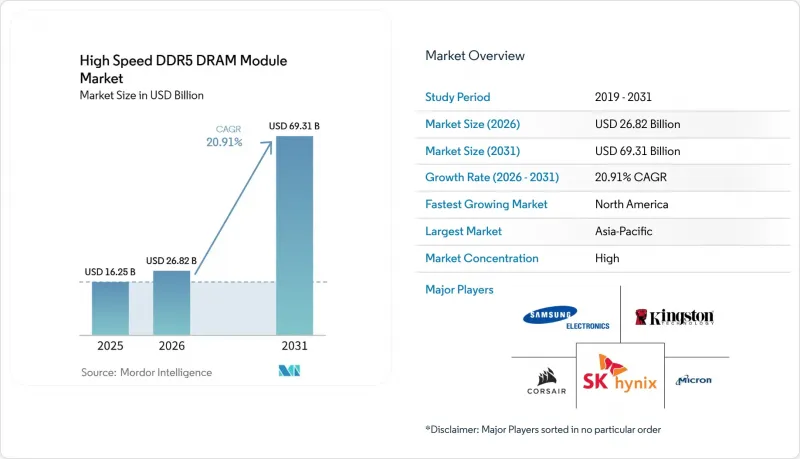
Mordor Intelligence에 의하면, 고속 DDR5 DRAM 모듈 시장 규모는 2025년 162억 5,000만 달러로 평가되었습니다. 2026년에는 268억 2,000만 달러로 확대되어 2031년까지 693억 1,000만 달러에 이를 것으로 예상되고 2026년부터 2031년에 걸쳐 CAGR 20.91%로 성장할 전망입니다.
본 보고서는 모듈 유형별(UDIMM, CUDIMM, SODIMM 등), 용량별(최대 16GB, 24GB-48 GB 등), 데이터 전송 속도별(5,600-6,400 MT/s, 6,800-7,200 MT/s 등), 최종 용도별(하이퍼스케일 및 클라우드 데이터센터, 엔터프라이즈 데이터센터 등), 그리고 지역별(북미, 유럽, 아시아태평양 등)별로 분류되어 있습니다. 시장 전망은 금액(달러) 기준으로 제시되어 있습니다.
세계의 고속 DDR5 DRAM 모듈 시장 동향 및 인사이트
AI 서버 및 고성능 컴퓨팅 분야의 메모리 밀도 요구 사항 증가
고속 DDR5 DRAM 모듈 시장의 가장 큰 수요 촉진요인은 AI 구축 초기 단계부터 연산 처리 근처에 대용량 메인 메모리가 필요한 대규모 추론 클러스터로의 전환입니다. 이러한 서버 환경에서는 모델 매개변수, 더 긴 컨텍스트 윈도우, 그리고 가속기 주변의 더 광범위한 메모리 실적를 지원하기 위해 대규모 DDR5 RDIMM 및 MRDIMM 풀에 의존하고 있습니다. 이로 인해 출하 대수 증가 속도가 동일하지 않더라도 서버 1대당 메모리 탑재량이 증가함에 따라 수요 패턴이 변화합니다. 또한, 사업자들은 랙 수나 전력 소비의 급격한 증가를 피하면서 더 많은 용량을 필요로 하고 있어 고밀도 모듈에 대한 관심도 높아지고 있습니다. 마이크론이 2026년 5월에 샘플 공급을 시작한 256GB DDR5 RDIMM 모듈은 최대 9,200 MT/s의 속도를 실현하며, 128GB 모듈 2개를 사용할 때와 비교해 동작 전력을 40% 이상 절감했습니다. 이는 고속 DDR5 DRAM 모듈 시장이 AI 인프라를 위해 고밀도 구성으로 전환되고 있음을 보여줍니다.
더 빠른 클라이언트 및 서버 메모리 플랫폼으로의 전환
고속 DDR5 DRAM 모듈 시장은 새로운 서버 및 클라이언트 플랫폼 전반에 걸쳐 검증된 최저 동작 속도가 꾸준히 상승하고 있다는 점에서도 혜택을 받고 있습니다. 시스템 로드맵이 상위 모델로 전환됨에 따라 저속 DDR5 빈의 점유율은 감소하고, 신호 무결성이 더 높고 검증 요건이 더 엄격한 프리미엄 모듈로 판매량이 이동하고 있습니다. 이로 인해 단기적으로는 서버 플랫폼에서 수요가 더 강하지만, 서버 및 클라이언트 양쪽 채널 모두에서 수요가 활발하게 유지되고 있습니다. 또한, 공급업체가 모듈 수준의 기능성을 강화하고, 더 고성능으로 포지셔닝된 모듈을 판매할 여지가 넓어짐에 따라 제품 구성도 변화하고 있습니다. JEDEC의 2026년 MRDIMM 로드맵은 새로 공개된 DDR5MDB02 규격을 바탕으로, 12,800 MT/s를 목표로 하는 Gen2 모듈, 더 나아가 최대 17,600 MT/s를 목표로 하는 Gen3 설계로 전개되고 있어, 고속 DDR5 DRAM 모듈 시장 내 고속 제품의 장기적인 성장을 뒷받침하고 있습니다.
기존 DDR4 제품과 비교했을 때 높은 비트당 단가
고속 DDR5 DRAM 모듈 시장의 주요 상업적 제약은 기존 DDR4 제품과의 비용 격차입니다. DDR5 모듈은 부품 수가 많고 전기적 요구 사항도 까다로워, 구매자가 대역폭의 이점을 최대한 활용하지 않는 경우에도 비용 하한선은 DDR4를 상회합니다. 이는 프리미엄급 DDR5의 속도가 제공하는 성능상의 이점이 제한적인 용도를 여전히 운영 중인 중견 기업이나 가격에 민감한 조직에게 특히 큰 과제가 됩니다. 이러한 경우, 지원 기간이 종료되지 않은 한 기존 DDR4 플랫폼이 더 현실적인 선택지가 될 수 있습니다. 그 결과, 성능에 대한 수요가 시급한 분야에서는 고속 DDR5 DRAM 모듈 시장이 가장 빠르게 성장하는 반면, 가성비를 중시하는 고객들은 프리미엄 DDR5 구성으로의 전환을 종종 미루는 경향이 있습니다.
부문 분석
2025년, RDIMM은 고속 DDR5 DRAM 모듈 시장에서 39.54%의 점유율을 차지했으며, 이는 엔터프라이즈 및 클라우드 환경에서의 표준 2소켓 서버 도입에서 RDIMM이 확고한 입지를 다졌음을 반영합니다. 조달 부서는 이미 RDIMM을 대규모 도입에서 가장 확립된 DDR5 서버 모듈 유형으로 간주하고 있으므로, 그 역할은 여전히 견고합니다. 폭넓은 호환성, 성숙한 공급망, 그리고 익숙한 운영 특성 덕분에 RDIMM은 현재 서버 업그레이드 프로그램의 중심적인 위치를 계속 차지하고 있습니다. LRDIMM은 부하 경감을 통해 보다 전문적인 서버 구성에서 대용량 메모리 구현을 가능하게 하는 고밀도 메모리 구성에 계속해서 활용되고 있습니다.
UDIMM 및 SODIMM은 여전히 주류 데스크톱 및 노트북의 요구를 충족시키고 있지만, 프리미엄 시스템 전반에 걸쳐 클라이언트 측의 고속화가 진행됨에 따라 CUDIMM 및 CSODIMM의 중요성이 높아지고 있습니다. DDR5 CAMM2는 2025년에도 소형 폼 팩터 형태를 유지했으나, 공간 효율성이 중시되는 슬림형 워크스테이션 및 프리미엄 노트북에서 주목받고 있습니다. MRDIMM/MCR DIMM은 AI 및 고성능 서버 환경에서 표준 레지스터드 모듈이 궁극적으로 직면하게 되는 대역폭 한계를 해결하기 위해, 고속 DDR5 DRAM 모듈 시장에서 가장 빠르게 성장하고 있는 모듈 유형입니다. 마이크론(Micron)의 256GB DDR5 서버 모듈 샘플 제공과 JEDEC의 MRDIMM 규격 로드맵은 프리미엄 서버 플랫폼이 더 높은 지속 대역폭과 고밀도 메모리 실적로 전환됨에 따라 MRDIMM 설계의 역할이 더욱 확대될 것임을 시사합니다.
2025년 고속 DDR5 DRAM 모듈 시장 규모에서 64GB-96GB 대역은 30.33%를 차지했으며, 표준 2소켓 서버 도입에 있어 현재 가장 적합한 용량 대역입니다. 이 용량 대역은 채널 탑재 수, 메모리 실적, 시스템 비용 간의 균형이 잘 잡혀 있어 광범위한 서버 배포에 적합합니다. 24GB-48GB 범위는 메모리 부하가 비교적 낮은 중급 엔터프라이즈 서버 및 워크스테이션의 요구를 여전히 충족시키고 있습니다. 128GB 계층은 주류 서버 구성과 부하가 더 높은 AI 지향 구성의 중간에 위치하며, 중요한 가교 역할을 하는 카테고리입니다.
128GB를 초과하는 모듈은 고속 DDR5 DRAM 모듈 시장에서 가장 빠르게 성장하고 있는 용량 계층입니다. 이는 대규모 추론 환경에서 시스템 메모리 내에 상주하는 모델 데이터의 양이 증가하고 있기 때문입니다. 이러한 요구 사항으로 인해 슬롯 사용 수를 1대1로 늘리지 않고도 용량을 확장할 수 있는 고밀도 모듈에 대한 관심이 높아지고 있습니다. 마이크론이 2026년 5월에 샘플 공급을 시작한 256GB DDR5 RDIMM은 3D 적층 다이 아키텍처, 최대 9,200 MT/s의 속도, 128 GB 모듈 2개 대비 40% 이상 낮은 동작 전력을 결합함으로써, 이 용량 대역의 기술적 실현 가능성을 입증했습니다. 또한, SK하이닉스가 2025년 12월 256GB DDR5 RDIMM으로 획득한 인텔 데이터센터 인증 역시 고밀도 서버 메모리로의 전환을 뒷받침하는 요소입니다. 이 회사에 따르면, 이전 세대 256GB 제품과 비교해 추론 성능이 최대 16% 향상되었으며, 소비 전력은 약 18% 감소했다고 합니다.
지역별 분석
2025년, 아시아태평양은 전 세계 고속 DDR5 DRAM 모듈 시장의 53.29%를 차지했으며, 이는 해당 지역이 업스트림 생산과 하류 수요 양면에서 종합적인 강점을 가지고 있음을 반영합니다. 한국은 주요 메모리 공급업체들이 첨단 제조 거점을 통해 전 세계 DRAM 공급량을 계속해서 좌우하고 있기 때문에 제조 분야의 핵심 지위를 유지하고 있습니다. 중국은 대규모 클라우드 및 AI 인프라 확장에 힘입어 이 지역의 주요 수요 거점으로 자리매김하고 있습니다. 대만은 모듈 조립 및 전자기기 생태계의 깊이를 통해 기여하고 있으며, 일본은 첨단 소재 및 패키징 체인의 중요한 부분을 뒷받침하고 있습니다. 또한 싱가포르는 동남아시아의 데이터센터 허브 역할을 수행하며 국경을 초월한 기술 인프라 수요를 뒷받침함으로써 해당 지역 내 입지를 강화하고 있습니다.
북미는 예측 기간 동안 고속 DDR5 DRAM 모듈 시장에서 가장 빠르게 성장할 지역입니다. 이 지역은 하이퍼스케일 AI 투자의 높은 집중도, 프리미엄 서버 교체 프로그램, 그리고 신규 데이터센터 건설에 따른 고밀도 메모리 구성에 대한 활발한 수요의 혜택을 받고 있습니다. 또한, 장기적인 공급 회복력을 뒷받침하는 국내 제조 노력의 혜택도 누리고 있습니다. 마이크론이 2026년 5월 버지니아주 매나서스에서 진행할 제조 거점 확장은 20억 달러 이상의 투자로 뒷받침되며, 2035년까지 2,500억 달러 규모의 미국 내 제조 및 연구개발(R&D) 계획과 연계되어 있어, 메모리 공급 및 기술 개발 분야에서 북미의 전략적 위상을 강화할 것입니다.
유럽은 시장 점유율 면에서 아시아태평양이나 북미에 뒤처져 있지만, 기업의 데이터센터 현대화 프로그램, 통신 인프라, 자동차용 컴퓨팅 플랫폼에서 꾸준한 수요를 창출하고 있습니다. '기타 지역'은 규모는 작지만, 각국이 주도하는 AI 프로젝트, 현대화 프로그램, 그리고 기업의 교체 활동이 여러 지역에 걸친 새로운 메모리 수요를 뒷받침하고 있어 계속해서 확대되고 있습니다. 중동 및 아프리카에서는 지역 데이터센터 거점이 현지 디지털 서비스의 지연 시간을 줄여주는 혜택을 누리고 있는 반면, 남미에서는 은행, 에너지, 정부 기관의 교체 주기에서 수요가 발생하고 있습니다. 또한, 인도는 장기적인 관점에서 볼 때 여전히 중요한 시장이며, 수입 대체 노력이 고속 DDR5 DRAM 모듈 시장의 조달 및 현지 생태계에 관한 의사 결정에 점차 영향을 미칠 가능성이 있기 때문입니다.
기타 혜택 :
- 엑셀 형식 시장 예측(ME) 시트
- 3개월간의 애널리스트 지원
자주 묻는 질문
목차
제1장 서론
제2장 조사 방법
제3장 주요 요약
제4장 시장 구도
제5장 시장 규모 및 성장 예측
제6장 경쟁 구도
제7장 시장 기회 및 향후 전망
KTH 26.08.10According to Mordor Intelligence, the high speed DDR5 DRAM module market size is expected to increase from USD 16.25 billion in 2025 to USD 26.82 billion in 2026 and reach USD 69.31 billion by 2031, growing at a CAGR of 20.91% over 2026-2031.
This report is Segmented by Module Type (UDIMM, CUDIMM, SODIMM, and More), Capacity (Up To 16 GB, 24 GB To 48 GB, and More), Data Rate (5, 600-6, 400 MT/S, 6, 800-7, 200 MT/S, and More), End-Use Application (Hyperscale and Cloud Data Centers, Enterprise Data Centers, and More), and Geography (North America, Europe, Asia-Pacific, and More). The Market Forecasts are Provided in Terms of Value (USD).
Global High Speed DDR5 DRAM Module Market Trends and Insights
Rising AI Server and High-Performance Computing Memory Density Requirements
The largest demand driver in the high speed DDR5 DRAM module market is the shift from earlier AI build phases toward larger inference clusters that need more main memory close to compute. These server environments depend on large DDR5 RDIMM and MRDIMM pools to support model parameters, longer context windows, and broader memory footprints around accelerators. This changes the demand pattern because memory content per server rises even when shipment growth does not move at the same pace. It also lifts interest in higher-density modules, since operators need more capacity without expanding rack count or power use too quickly. Micron's May 2026 sampling of 256 GB DDR5 RDIMM modules at speeds up to 9,200 MT/s and with more than 40% lower operating power than two 128 GB modules shows how the high speed DDR5 DRAM module market is moving toward denser configurations for AI infrastructure.
Shift Toward Higher-Speed Client and Server Memory Platforms
The high speed DDR5 DRAM module market is also benefiting from a steady rise in the validated speed floor across new server and client platforms. As system roadmaps move upward, slower DDR5 bins lose share and more volume shifts into premium modules with stronger signal integrity and tighter validation requirements. This keeps demand active across both server and client channels, even though the near-term pull is stronger in server platforms. It also changes product mix, because suppliers gain more room to sell modules with richer module-level functionality and higher performance positioning. JEDEC's 2026 MRDIMM roadmap, which extends from the newly published DDR5MDB02 standard toward Gen2 modules targeting 12,800 MT/s and Gen3 designs targeting up to 17,600 MT/s, supports the long runway for higher-speed products in the high speed DDR5 DRAM module market.
Higher Cost Per Bit Versus Legacy DDR4 Alternatives
The main commercial restraint in the high speed DDR5 DRAM module market is the cost gap against legacy DDR4 alternatives. DDR5 modules carry more component content and stricter electrical requirements, which keeps the cost floor above DDR4 even when buyers are not using the full bandwidth advantage. This is especially challenging for mid-tier enterprises and price-sensitive organizations that still run applications with limited performance benefit from premium DDR5 speeds. In these cases, existing DDR4 platforms can remain the more practical option while support life is still available. The result is that the high speed DDR5 DRAM module market grows fastest where performance demands are urgent, while value-focused customers often delay the move to premium DDR5 configurations.
Other drivers and restraints analyzed in the detailed report include:
- DDR4 Replacement Across Mainstream PC and Server Refresh Cycles
- Faster Adoption of On-Module Power Management and Signal Integrity Improvements
- Platform Qualification Complexity for Very High Data Rate Modules
For complete list of drivers and restraints, kindly check the Table Of Contents.
Segment Analysis
RDIMM held 39.54% of the high speed DDR5 DRAM module market share in 2025, reflecting its deep position in standard two-socket server deployments across enterprise and cloud environments. Its role remains strong because procurement teams already view it as the most established DDR5 server module type for scale deployments. Broad compatibility, mature supply chains, and familiar operational behavior keep RDIMM at the center of current server refresh programs. LRDIMM continues to serve dense memory configurations where load reduction supports larger memory footprints in more specialized server builds.
UDIMM and SODIMM still serve mainstream desktop and notebook needs, while CUDIMM and CSODIMM are becoming more relevant as higher client speeds gain traction across premium systems. DDR5 CAMM2 remained a smaller form factor in 2025, but it is attracting attention in thin workstations and premium laptops where space efficiency matters. MRDIMM / MCR DIMM is the fastest-growing module type in the high speed DDR5 DRAM module market because it addresses the bandwidth limits that standard registered modules eventually face in AI and high-performance server environments. Micron's 256 GB DDR5 server module sampling and JEDEC's MRDIMM standards roadmap both point to a broader role for MRDIMM designs as premium server platforms move toward higher sustained bandwidth and denser memory footprints.
The 64 GB to 96 GB tier accounted for 30.33% of the high speed DDR5 DRAM module market size in 2025, making it the current density sweet spot for standard two-socket server deployments. This tier balances channel population, memory footprint, and system cost in a way that works well for broad server rollouts. The 24 GB to 48 GB range still serves mid-range enterprise servers and workstation needs where memory intensity is lower. The 128 GB tier sits between mainstream server builds and heavier AI-oriented configurations, which makes it an important bridge category.
Above-128 GB modules are the fastest-growing capacity tier in the high speed DDR5 DRAM module market because larger inference environments increasingly need more model data to remain resident in system memory. That requirement raises interest in denser modules that can scale capacity without a one-for-one rise in slot usage. Micron's May 2026 256 GB DDR5 RDIMM sampling validated the technical path for this tier, combining 3D-stacked die architecture, speeds up to 9,200 MT/s, and more than 40% lower operating power than two 128 GB modules. SK hynix's December 2025 Intel Data Center Certification for its 256 GB DDR5 RDIMM also supports the move toward dense server memory, with the company reporting up to 16% higher inference performance and approximately 18% lower power consumption than its previous-generation 256 GB product.
Complete Report Scope:
- By Module Type
- UDIMM
- CUDIMM
- SODIMM
- CSODIMM
- DDR5 CAMM2
- RDIMM
- LRDIMM
- MRDIMM / MCR DIMM
- By Capacity
- Up to 16 GB
- 24 GB to 48 GB
- 64 GB to 96 GB
- 128 GB
- Above 128 GB
- By Data Rate
- 5,600-6,400 MT/s
- 6,800-7,200 MT/s
- 7,600-8,000 MT/s
- 8,400-8,800 MT/s
- By End-Use Application
- Hyperscale and Cloud Data Centers
- Enterprise Data Centers
- Workstations and Professional Systems
- Gaming PCs
- Consumer and Commercial PCs/Notebooks
- Industrial, Embedded, and Edge Systems
- Telecom and Networking Infrastructure
- By Geography
- North America
- Europe
- Asia-Pacific
- China
- Japan
- South Korea
- Taiwan
- Rest of Asia-Pacific
- Rest of the World
Geography Analysis
Asia-Pacific held 53.29% of the global high speed DDR5 DRAM module market in 2025, which reflects the region's combined strength in both upstream production and downstream demand. South Korea remains the anchor at the manufacturing layer because leading memory suppliers continue to shape global DRAM availability from their advanced fabrication base. China is a major demand center within the region, supported by large-scale cloud and AI infrastructure expansion. Taiwan contributes through module assembly and electronics ecosystem depth, while Japan supports critical parts of the advanced materials and packaging chain. Singapore also strengthens the regional profile because it serves as a data center hub for Southeast Asia and supports cross-border technology infrastructure demand.
North America is the fastest-growing geography in the high speed DDR5 DRAM module market during the forecast period. The region benefits from a high concentration of hyperscale AI spending, premium server refresh programs, and strong demand for dense memory configurations in new data center builds. It also gains from domestic manufacturing commitments that can support supply resilience over time. Micron's May 2026 manufacturing expansion in Manassas, Virginia, backed by more than USD 2 billion in investment and tied to a broader USD 250 billion U.S. manufacturing and R&D commitment through 2035, reinforces North America's strategic position in memory supply and technology development.
Europe trails Asia Pacific and North America in share, but it continues to generate steady demand from enterprise data center refresh programs, telecommunications infrastructure, and automotive compute platforms. The rest of the World is smaller, but it is expanding as sovereign AI projects, modernization programs, and enterprise refresh activity support new memory demand across multiple regions. The Middle East and Africa are benefiting from regional data center nodes that reduce latency for local digital services, while South America is seeing demand from banking, energy, and government refresh cycles. India also remains relevant over the longer horizon because import substitution efforts could gradually influence sourcing and local ecosystem decisions in the high speed DDR5 DRAM module market.
- Samsung Electronics Co., Ltd.
- SK hynix Inc.
- Micron Technology, Inc.
- Kingston Technology Company, Inc.
- Corsair Gaming, Inc.
- G.SKILL International Enterprise Co., Ltd.
- ADATA Technology Co., Ltd.
- Team Group Inc.
- Transcend Information, Inc.
- Apacer Technology Inc.
- PNY Technologies, Inc.
- Patriot Memory, LLC
- Silicon Power Computer and Communications Inc.
- Mushkin Enhanced MFG LLC
- SMART Modular Technologies, Inc.
- Nanya Technology Corporation
- Winbond Electronics Corporation
- KLEVV Co., Ltd.
- Lexar Media, Inc.
- GIGABYTE Technology Co., Ltd.
Additional Benefits:
- The market estimate (ME) sheet in Excel format
- 3 months of analyst support
TABLE OF CONTENTS
1 INTRODUCTION
- 1.1 Study Assumptions and Market Definition
- 1.2 Scope of the Study
2 RESEARCH METHODOLOGY
3 EXECUTIVE SUMMARY
4 MARKET LANDSCAPE
- 4.1 Market Overview
- 4.2 Market Drivers
- 4.2.1 Shift Toward Higher-Speed Client and Server Memory Platforms
- 4.2.2 Rising AI Server and High-Performance Computing Memory Density Requirements
- 4.2.3 DDR4 Replacement Across Mainstream PC and Server Refresh Cycles
- 4.2.4 Faster Adoption of On-Module Power Management and Signal Integrity Improvements
- 4.2.5 Growing Demand for Premium Gaming and Creator Systems
- 4.2.6 Qualification of 8,800 MT/s-Class Modules for Next-Generation Platforms
- 4.3 Market Restraints
- 4.3.1 Higher Cost Per Bit Versus Legacy DDR4 Alternatives
- 4.3.2 Platform Qualification Complexity for Very High Data Rate Modules
- 4.3.3 Thermal Design and Board Routing Constraints at Higher Speeds
- 4.3.4 Dependence on Limited Advanced DRAM Supply and Component Ecosystem
- 4.4 Value Chain Analysis
- 4.5 Regulatory Landscape
- 4.6 Technological Outlook
- 4.7 Porter's Five Forces Analysis
- 4.7.1 Bargaining Power of Suppliers
- 4.7.2 Bargaining Power of Buyers
- 4.7.3 Threat of New Entrants
- 4.7.4 Threat of Substitutes
- 4.7.5 Competitive Rivalry
5 MARKET SIZE AND GROWTH FORECASTS (VALUE)
- 5.1 By Module Type
- 5.1.1 UDIMM
- 5.1.2 CUDIMM
- 5.1.3 SODIMM
- 5.1.4 CSODIMM
- 5.1.5 DDR5 CAMM2
- 5.1.6 RDIMM
- 5.1.7 LRDIMM
- 5.1.8 MRDIMM / MCR DIMM
- 5.2 By Capacity
- 5.2.1 Up to 16 GB
- 5.2.2 24 GB to 48 GB
- 5.2.3 64 GB to 96 GB
- 5.2.4 128 GB
- 5.2.5 Above 128 GB
- 5.3 By Data Rate
- 5.3.1 5,600-6,400 MT/s
- 5.3.2 6,800-7,200 MT/s
- 5.3.3 7,600-8,000 MT/s
- 5.3.4 8,400-8,800 MT/s
- 5.4 By End-Use Application
- 5.4.1 Hyperscale and Cloud Data Centers
- 5.4.2 Enterprise Data Centers
- 5.4.3 Workstations and Professional Systems
- 5.4.4 Gaming PCs
- 5.4.5 Consumer and Commercial PCs/Notebooks
- 5.4.6 Industrial, Embedded, and Edge Systems
- 5.4.7 Telecom and Networking Infrastructure
- 5.5 By Geography
- 5.5.1 North America
- 5.5.2 Europe
- 5.5.3 Asia-Pacific
- 5.5.3.1 China
- 5.5.3.2 Japan
- 5.5.3.3 South Korea
- 5.5.3.4 Taiwan
- 5.5.3.5 Rest of Asia-Pacific
- 5.5.4 Rest of the World
6 COMPETITIVE LANDSCAPE
- 6.1 Market Concentration
- 6.2 Strategic Moves
- 6.3 Market Share Analysis
- 6.4 Company Profiles (includes Global Level Overview, Market Level Overview, Core Segments, Financials as available, Strategic Information, Market Rank/Share, Products and Services, Recent Developments)
- 6.4.1 Samsung Electronics Co., Ltd.
- 6.4.2 SK hynix Inc.
- 6.4.3 Micron Technology, Inc.
- 6.4.4 Kingston Technology Company, Inc.
- 6.4.5 Corsair Gaming, Inc.
- 6.4.6 G.SKILL International Enterprise Co., Ltd.
- 6.4.7 ADATA Technology Co., Ltd.
- 6.4.8 Team Group Inc.
- 6.4.9 Transcend Information, Inc.
- 6.4.10 Apacer Technology Inc.
- 6.4.11 PNY Technologies, Inc.
- 6.4.12 Patriot Memory, LLC
- 6.4.13 Silicon Power Computer and Communications Inc.
- 6.4.14 Mushkin Enhanced MFG LLC
- 6.4.15 SMART Modular Technologies, Inc.
- 6.4.16 Nanya Technology Corporation
- 6.4.17 Winbond Electronics Corporation
- 6.4.18 KLEVV Co., Ltd.
- 6.4.19 Lexar Media, Inc.
- 6.4.20 GIGABYTE Technology Co., Ltd.
7 MARKET OPPORTUNITIES AND FUTURE OUTLOOK
- 7.1 White-Space and Unmet-Need Assessment


