

|
시장보고서
상품코드
2099943
DDR5 DRAM 신뢰성 기술 시장 : 시장 점유율 분석, 업계 동향 및 통계, 성장 예측(2026-2031년)DDR5 DRAM Reliability Technology - Market Share Analysis, Industry Trends & Statistics, Growth Forecasts (2026 - 2031) |
||||||
 Mordor Intelligence
Mordor Intelligence에 의하면, DDR5 DRAM 신뢰성 기술 시장 규모는 2025년에 124억 6,000만 달러로 평가되었고, 2026년 179억 3,000만 달러에서 2031년까지 358억 6,000만 달러에 이를 것으로 예측되며, 2026-2031년 CAGR 14.87%로 성장할 전망입니다.
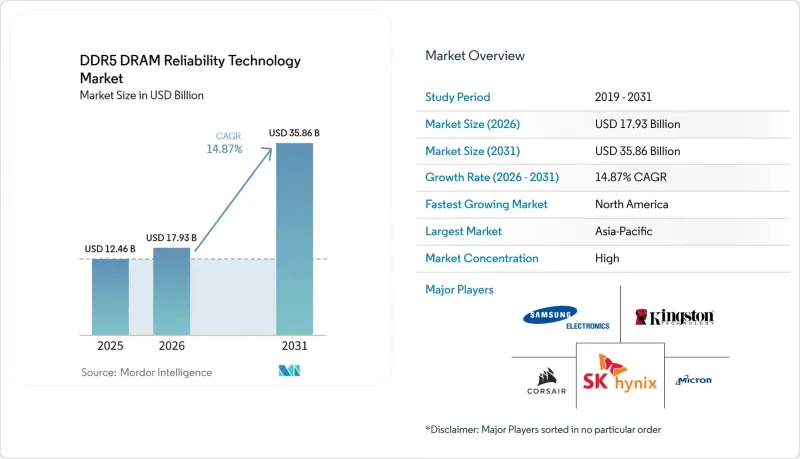
본 보고서는 기술별(온다이 ECC DDR5, 시스템 레벨 ECC DDR5 모듈 등), 모듈 유형별(RDIMM, LRDIMM, MRDIMM 등), 용량별(최대 32 GB, 32 GB-64GB 등), 데이터 레이트별(최대 5,600 MT/s 등), 용도별(하이퍼스케일 및 클라우드 데이터센터, 엔터프라이즈 워크스테이션 등), 그리고 지역별로 분류되어 있습니다. 시장 전망은 금액(달러) 기준으로 제시되어 있습니다.
세계의 DDR5 DRAM 신뢰성 기술 시장 동향 및 인사이트
AI 서버 메모리의 신뢰성 요구 사항
AI 서버의 메모리 요구 사항으로 인해 DDR5 DRAM 신뢰성 기술 시장 전체에서 신뢰성의 최저 기준이 높아지고 있습니다. 대규모 언어 모델(LLM) 추론 시스템에서는 단 하나의 수정되지 않은 멀티비트 오류가 눈에 보이지 않는 출력 손상으로 이어질 수 있습니다. 따라서 메모리의 내결함성은 부차적인 기능이 아니라 직접적인 운영 요구 사항이 되었습니다. 2025년 IEEE DSN 현장 조사에 따르면, DDR5는 DDR4보다 수정된 오류율이 낮은 것으로 밝혀졌으나, 온다이 ECC의 불투명성이 벤더와 운영자에게 진단 가시성을 저하시킬 가능성도 있다고 지적되고 있습니다. Open Compute Project는 2025년 GPU 및 가속기의 RAS 요구 사항에서 AI 서버의 메모리 서브시스템이 DDR5 x10의 칩 킬 기능을 지원해야 한다고 명시하고 있으며, 이에 따라 더욱 강력한 시스템 수준의 오류 수정 및 복구 계층에 대한 수요가 증가하고 있습니다. 따라서 DDR5 DRAM 신뢰성 기술 시장은 단순한 처리 속도 그 자체보다 인증의 깊이, 텔레메트리 처리, 그리고 플릿 수준의 장애 관리에 대한 의존도가 높아지고 있습니다.
서버 및 워크스테이션의 DDR5 플랫폼으로의 전환
서버 플랫폼의 전환으로 인해 DDR4의 단계적 단종 주기가 단축되었으며, DDR5 DRAM 신뢰성 기술 시장 전반에 걸친 채택이 가속화되고 있습니다. 새로운 Intel Xeon 6 및 AMD EPYC Turin 플랫폼은 DDR5를 핵심으로 하고 있기 때문에 새로운 서버 플릿을 구축하는 구매자들은 더 이상 DDR4 지원을 조달상의 리스크 헤지 수단으로 활용하지 않게 되었습니다. JEDEC은 2024년 4월 JESD79-5C DDR5 규격을 업데이트하여 타이밍 매개변수를 8,800 MT/s로 확장하는 한편, 로우 해머(Low Hammer) 등급의 오류 동작에 대응하기 위해 행별 활성화 카운트 기능을 추가했습니다. 이로 인해 많은 플랫폼 전환에서 신뢰성과 대역폭이 동시에 향상됨에 따라, 기업 구매 담당자들이 장비 교체 시기와 검증 우선순위를 고려하는 방식에 변화가 생기고 있습니다. 이전 기간이 단축됨에 따라 프로세서, 보드, 펌웨어 스택 및 서버 OEM 생태계 전반에 걸쳐 이미 인증 범위를 커버하고 있는 벤더들이 유리한 입장에 있습니다.
DRAM 공급 집중 및 할당 위험
공급 집중은 DDR5 DRAM 신뢰성 기술 시장에서 여전히 명백한 제약 요인으로 남아 있습니다. 삼성, SK하이닉스, 마이크론이 업스트림 DRAM 다이 시장을 지배하고 있어, 일관된 다이 특성과 검증된 펌웨어 동작을 필요로 하는 모듈 벤더의 조달 유연성이 제한되고 있습니다. 할당량이 부족해지면, 장기적인 공급 체계에 임베디드되지 않은 구매 기업은 안정적인 가격 책정, 생산 계획 수립, 납기 확보가 더욱 어려워집니다. 이는 DDR5 DRAM 신뢰성 기술 시장에서 특히 중요한 문제입니다. 신뢰성 등급별 모듈은 인증된 다이, 인터페이스 로직, 복구 기능 및 시스템 수준의 검증이 유기적으로 연계되어 작동해야 하므로, 호환 가능한 일반 상품이 아니기 때문입니다. 최종 수요가 견조하고 신규 설계 채택이 진행되더라도, 인증된 업스트림 공급망의 병목 현상이 해소되지 않는 한 성장은 둔화될 가능성이 있습니다.
부문 분석
2025년, ‘기술별’ 부문에서 고신뢰성 DDR5 모듈이 58.65%의 점유율을 차지했습니다. 이는 DDR5 DRAM 신뢰성 기술 시장에서 가장 가치가 높은 수요가 어디에 집중되어 있는지를 보여줍니다. 이러한 모듈은 온다이 ECC와 더 강력한 시스템 수준의 오류 정정 기능, 패트롤 스클럽, 복구 기능을 결합하고 있어 메모리 경로의 여러 계층에 걸친 장애를 처리할 수 있습니다. Open Compute Project는 2025년까지 AI 서버의 메모리 서브시스템이 DDR5 x10의 칩 킬 기능을 지원해야 한다고 밝혔습니다. 이로 인해 기본적인 오류 정정 기능을 뛰어넘는 모듈에 대한 수요가 더욱 높아졌습니다. 이 요구 사항은 가속기를 많이 사용하는 서버군을 대상으로 하는 공급업체에게 사실상 허용되는 설계 수준의 최저 기준을 높이는 것입니다. 그 결과, DDR5 DRAM 신뢰성 기술 시장에서는 하나의 검증된 패키지 내에서 다이, 모듈, 시스템 각 수준에서의 내결함성을 입증할 수 있는 벤더가 높이 평가받고 있습니다.
온다이 ECC DDR5 및 시스템 레벨 ECC DDR5 모듈은 비용 관리가 더 엄격하고 플랫폼에 대한 요구 사항이 그리 까다롭지 않은 워크스테이션이나 미드레인지 엔터프라이즈 시스템에서 여전히 중요한 역할을 하고 있습니다. 많은 구매자가 가장 복잡한 칩 킬(chip kill) 등급의 아키텍처에 추가 비용을 지불하지 않고도 신뢰성 높은 오류 정정 기능을 필요로 하기 때문에 이러한 제품들은 여전히 DDR5 DRAM 신뢰성 기술 시장의 중요한 부분을 차지하고 있습니다. JEDEC은 2025년 10월, JESD400-5D SPD 업데이트를 통해 MRDIMM의 오류 로깅 기능이 확장되었다고 발표했습니다. 이를 통해 엔터프라이즈 팀은 생산 시 장애 모니터링을 위한 보다 견고한 펌웨어 기반을 확보할 수 있게 되었습니다. 또한 JEDEC는 2026년 4월, MRDIMM Gen2가 12,800 MT/s로 완성 단계에 접어들었으며, Gen3 개발이 시작되었다고 발표했습니다. 이는 기술 스택의 최상위 계층이 시간이 지남에 따라 표준 DDR5에서 점점 더 멀어지고 있음을 보여줍니다. 이에 따라 기술 구성은 단순히 대역폭만을 추구하는 것이 아니라, 속도와 복구 능력, 텔레메트리 기능을 겸비한 모듈로 계속해서 기울고 있습니다.
모듈 유형별로 보면, 2025년 DDR5 DRAM 신뢰성 기술 시장 규모 중 RDIMM이 44.21%를 차지하고 있으며, 이는 Intel Xeon 및 AMD EPYC 서버 플랫폼 전반에 걸친 RDIMM의 보급률을 반영합니다. RDIMM은 주류 생산 속도로 작동하는 범용 엔터프라이즈 및 하이퍼스케일 워크로드에서 여전히 가장 광범위하게 검증된 폼 팩터입니다. MRDIMM의 현재 역할은 모든 서버에서 RDIMM을 대체하는 것이 아니라, 메모리 대역폭이 병목 현상이 되는 워크로드로 DDR5 DRAM 신뢰성 기술 시장을 확대하는 데 있습니다. 2026년 5월의 학술 분석에 따르면, MRDIMM은 이전의 확장 경로를 제한했던 신호 무결성 상의 절충점 없이 듀얼 랭크 인터리브를 가능하게 함으로써, AI 및 데이터 집약적 워크로드에서 성능과 에너지 효율 측면에서 이점을 제공하는 것으로 밝혀졌습니다. 이를 통해 RDIMM은 이 부문의 양산 핵심을 유지하는 한편, MRDIMM은 프리미엄 계층에서 명확한 발전 방향을 확보하게 될 것입니다.
JEDEC은 2026년 4월, MRDIMM Gen2가 완성 단계에 접어들었으며 12,800 MT/s를 목표로 하고 있다고 발표했습니다. 이를 통해 이 폼 팩터는 서버에 더 광범위하게 채택되기 위한 더욱 견고한 표준 기반을 확보하게 될 것입니다. 램버스(Lambus)는 2026년 7월, DDR5 9600 서버용 RDIMM 칩셋을 출시하며 이러한 추세를 가속화했습니다. 이 칩셋에는 더 빠른 서버 모듈에 필요한 인터페이스 계층을 지원하는 6세대 RCD가 포함되어 있습니다. LRDIMM은 대용량 메모리 구성에서 여전히 중요한 역할을 하고 있으며, HPE는 2026년 5월 자사의 ‘Compute Scale-up Server 3250’이 비즈니스 크리티컬 인메모리 워크로드를 위해 16소켓에서 최대 64TB의 DDR5를 지원한다고 발표했습니다. 또한 소형 폼 팩터 시장도 확대되고 있습니다. 2025년 8월, Innodisk는 자사의 DDR5 및 LPDDR5X CAMM2 모듈이 SODIMM에 비해 차지하는 공간을 60% 줄였으며, 가혹한 환경에서의 도입을 위해 나사 고정식 마운트를 채택했다고 발표했습니다. 이로 인해 DDR5 DRAM 신뢰성 기술 시장에는 다양한 모듈 구성이 형성되고 있으며, 양산 측면에서는 RDIMM이 주류를 이어가는 한편, 향후 차별화는 MRDIMM이나 특수한 소형 폼 팩터 설계에 초점이 맞추어질 것입니다.
지역별 분석
2025년, 아시아태평양은 DDR5 DRAM 신뢰성 기술 시장의 49.39% 점유율을 차지했으며, 이 지역은 공급과 수요 양면에서 중심적인 위치를 유지했습니다. 한국은 삼성과 SK하이닉스가 첨단 DRAM 생산 및 관련 인증 과정에서 여전히 중요한 역할을 수행하고 있어 이 지역의 기반을 뒷받침하고 있습니다. 대만은 모듈 조립, 인터페이스 로직 개발, 그리고 서버 메모리 플랫폼을 둘러싼 광범위한 생태계 조정을 통해 DDR5 DRAM 신뢰성 기술 시장을 뒷받침하고 있습니다. 일본은 패키징 소재 및 공정 장비를 통해 입지를 강화하고 있는 반면, 중국은 국내 클라우드 인프라가 지속적으로 고성능 서버 메모리를 도입함에 따라 중요한 최종 시장으로서의 지위를 유지하고 있습니다. 이러한 조합 덕분에 아시아태평양은 제조, 생태계 지원 및 대규모 도입 분야에서 깊이 뿌리내린 존재가 되었습니다.
북미는 2031년까지 가장 빠르게 성장할 지역이며, 이러한 성장은 서버, 가속기, 메모리 서브시스템에 걸친 AI 인프라의 급속한 확장과 밀접한 관련이 있습니다. 마이크론이 2026년 5월, 최대 9,200 MT/s의 256GB DDR5 RDIMM 샘플 공급을 시작한 것은 북미가 차세대 고밀도 서버 메모리 개발에서 여전히 중심적인 역할을 하고 있음을 보여줍니다. 마벨(Marvel)이 2026년 3월에 랙 수준의 DDR5 메모리 풀링을 위한 CXL 스위치를 출시한 것은 메모리의 확장 및 분산화도 이 지역의 아키텍처 발전의 일환이 되고 있음을 보여줍니다. HPE가 2026년 5월에 64TB 스케일업 서버를 발표했고, 델이 2026년 6월에 AI 인프라를 출시한 것은 북미 벤더들이 더욱 고도화된 DDR5 구성을 도입한 플랫폼을 추진하고 있음을 더욱 뒷받침합니다.
유럽은 DDR5 DRAM 신뢰성 기술 시장에서 소극적이면서도 전략적으로 독자적인 입지를 차지하고 있습니다. 이 시장에서는 순수한 생산량 확대보다 데이터 무결성, 산업 표준 준수, 그리고 더 장기적인 검증 주기가 중시되고 있습니다. 이 지역은 구형 서버 군이 교체 주기를 맞이하고, 기업 구매 담당자들이 장애 텔레메트리 및 문서화된 인증을 더욱 중시하게 됨에 따라 혜택을 보고 있습니다. JEDEC의 2025년 및 2026년 SPD 로깅 관련 업데이트와 MRDIMM 로드맵의 진전은 유럽의 구매 담당자들에게 고신뢰성 도입 계획을 위한 보다 견고한 표준 기반을 제공하며, 이러한 추세를 뒷받침하고 있습니다. 세계 기타 지역(Rest of the World)의 기여도는 여전히 미미하지만, 통신 사업자, 정부 데이터센터 프로그램 및 산업 사용자에 의해 검증된 DDR5 신뢰성 모듈의 도입 기반이 확대되고 있습니다. 따라서 가장 높은 성장세는 여전히 주요 AI 및 서버 투자 거점에 집중되어 있지만, DDR5 DRAM 신뢰성 기술 시장의 세계 확산 범위는 하이퍼스케일 시장에만 국한되지 않는 폭넓은 규모를 유지하고 있습니다.
기타 혜택 :
- 엑셀 형식 시장 예측(ME) 시트
- 3개월간의 애널리스트 지원
자주 묻는 질문
목차
제1장 서론
제2장 조사 방법
제3장 주요 요약
제4장 시장 구도
제5장 시장 규모 및 성장 예측
제6장 경쟁 구도
제7장 시장 기회 및 향후 전망
AJY 26.08.07According to Mordor Intelligence, the DDR5 DRAM reliability technology market size is projected to be USD 12.46 billion in 2025, USD 17.93 billion in 2026, and reach USD 35.86 billion by 2031, growing at a CAGR of 14.87% from 2026 to 2031.
This report is Segmented by Technology (On-Die ECC DDR5, System-Level ECC DDR5 Modules, and More), Module Type (RDIMM, LRDIMM, MRDIMM, and More), Capacity (Up To 32 GB, 32 GB To 64 GB, and More), Data Rate (Up To 5, 600 MT/S, and More), Application (Hyperscale and Cloud Data Centers, Enterprise Workstations, and More), and Geography. The Market Forecasts are Provided in Terms of Value (USD).
Global DDR5 DRAM Reliability Technology Market Trends and Insights
AI Server Memory Reliability Requirements
AI server memory requirements are raising the minimum reliability threshold across the DDR5 DRAM reliability technology market. Large language model inference systems can turn a single uncorrected multi-bit fault into silent output corruption, which makes memory resilience a direct operating requirement rather than a secondary feature. A 2025 IEEE DSN field study found that DDR5 showed lower corrected error rates than DDR4, but it also noted that the opacity of on-die ECC can reduce diagnostic visibility for vendors and operators. The Open Compute Project stated in its 2025 GPU and Accelerator RAS requirements that AI server memory subsystems should support DDR5 x10 chip-kill capability, which pushes demand toward stronger system-level correction and recovery layers. This leaves the DDR5 DRAM reliability technology market more dependent on qualification depth, telemetry handling, and fleet-level fault management than on raw speed alone.
DDR5 Platform Transition in Servers and Workstations
The server platform transition is compressing the DDR4 phase-out cycle and accelerating adoption across the DDR5 DRAM reliability technology market. New Intel Xeon 6 and AMD EPYC Turin platforms center on DDR5, so buyers building fresh server fleets no longer use DDR4 support as a procurement hedge. JEDEC updated the JESD79-5C DDR5 standard in April 2024 and extended timing parameters to 8,800 MT/s while adding per-row activation counting to address rowhammer-class fault behavior. This means many platform migrations now deliver a reliability upgrade and a bandwidth upgrade at the same time, which changes how enterprise buyers think about refresh timing and validation priorities. The shorter transition window favors vendors that already have qualification coverage across processors, boards, firmware stacks, and server OEM ecosystems.
DRAM Supply Concentration and Allocation Risk
Supply concentration remains a clear restraint on the DDR5 DRAM reliability technology market. Samsung, SK hynix, and Micron dominate the upstream DRAM die layer, which limits sourcing flexibility for module vendors that need consistent die characteristics and validated firmware behavior. When allocation tightens, buyers outside long-term supply structures face a harder path to stable pricing, production planning, and delivery timing. This is especially important in the DDR5 DRAM reliability technology market because reliability-tier modules are not interchangeable commodities, since they depend on qualified die, interface logic, repair features, and system-level validation working together. Even when end-demand is strong, growth can slow because new design wins do not remove bottlenecks in qualified upstream supply.
Other drivers and restraints analyzed in the detailed report include:
- Higher Memory Density and Bandwidth per Socket
- Compliance-Driven Adoption in Regulated and Safety-Critical Systems
- Qualification Complexity Across New DDR5 Form Factors
For complete list of drivers and restraints, kindly check the Table Of Contents.
Segment Analysis
Advanced Reliability DDR5 Modules held 58.65% share of the By Technology segmentation in 2025, which shows where the DDR5 DRAM reliability technology market is concentrating its highest-value demand. These modules combine on-die ECC with stronger system-level correction, patrol scrub, and repair features, so they address faults across more than one layer of the memory path. The Open Compute Project stated in 2025 that AI server memory subsystems should support DDR5 x10 chip-kill capability, which reinforced demand for modules that go beyond baseline error correction. That requirement effectively raises the minimum acceptable design level for suppliers targeting accelerator-heavy server fleets. As a result, the DDR5 DRAM reliability technology market is rewarding vendors that can prove resilience at the die, module, and system levels in one validated package.
On-Die ECC DDR5 and System-Level ECC DDR5 Modules remain relevant in workstations and mid-range enterprise systems where cost discipline is stronger, and platform demands are less severe. They still serve an important part of the DDR5 DRAM reliability technology market because many buyers need dependable correction without paying for the most complex chipkill-class architectures. JEDEC stated in October 2025 that the JESD400-5D SPD update added expanded MRDIMM error logging, which gives enterprise teams a stronger firmware basis for production fault monitoring. JEDEC also said in April 2026 that MRDIMM Gen2 was nearing completion at 12,800 MT/s and that Gen3 development had started, which shows that the top end of the technology stack will keep moving away from standard DDR5 over time. This keeps the technology mix tilted toward modules that pair speed with repairability and telemetry rather than pursuing bandwidth alone.
In module type terms, RDIMM represented 44.21% of the DDR5 DRAM reliability technology market size in 2025, which reflects its incumbency across Intel Xeon and AMD EPYC server platforms. RDIMM remains the most broadly validated form factor for general-purpose enterprise and hyperscale workloads that run at mainstream production speeds. The current role of MRDIMM is not to replace RDIMM in every server, but to expand the DDR5 DRAM reliability technology market into workloads where memory bandwidth has become the limiting factor. A May 2026 academic analysis found that MRDIMMs delivered performance and energy benefits in AI and data-intensive workloads by enabling dual-rank interleaving without the signal integrity tradeoffs that limited earlier scaling paths. That keeps RDIMM in the volume center of the segment while giving MRDIMM a clear path in the premium tier.
JEDEC stated in April 2026 that MRDIMM Gen2 was nearing completion and targeting 12,800 MT/s, which gives the form factor a stronger standards base for broader server adoption. Rambus added to that momentum in July 2026 when it launched its DDR5 9600 server RDIMM chipset, including a sixth-generation RCD, which supports the interface layer needed for higher-speed server modules. LRDIMM still has a role in large memory footprints, and HPE said in May 2026 that its Compute Scale-up Server 3250 supported up to 64 TB of DDR5 across 16 sockets for business-critical in-memory workloads. Smaller form factors are also expanding the addressable base, since Innodisk said in August 2025 that its DDR5 and LPDDR5X CAMM2 modules cut space use by 60% compared to SODIMMs and added screw-lock mounting for rugged deployments. This leaves the DDR5 DRAM reliability technology market with a broad module map, where volume remains with RDIMM, while future differentiation centers on MRDIMM and specialized small-form-factor designs.
Complete Report Scope:
- By Technology
- On-Die ECC DDR5
- System-Level ECC DDR5 Modules
- Advanced Reliability DDR5 Modules
- By Module Type
- RDIMM
- LRDIMM
- MRDIMM
- UDIMM and CUDIMM
- SODIMM and CSODIMM
- CAMM2
- Industrial and Embedded DDR5 Modules
- By Capacity
- Up to 32 GB
- 32 GB to 64 GB
- 64 GB to 128 GB
- 128 GB to 256 GB
- Above 256 GB
- By Data Rate
- Up to 5,600 MT/s
- 5,600 MT/s to 6,400 MT/s
- 6,400 MT/s to 7,200 MT/s
- Above 7,200 MT/s
- By Application
- Hyperscale and Cloud Data Centers
- Enterprise Servers and Data Centers
- AI Servers and HPC Systems
- Enterprise Workstations
- Telecom and Networking Infrastructure
- Industrial and Edge Computing Systems
- Consumer PCs and Notebooks
- Government, Defense, and Research Systems
- By Geography
- North America
- Europe
- Asia-Pacific
- China
- Japan
- South Korea
- Taiwan
- Rest of Asia-Pacific
- Rest of the World
Geography Analysis
Asia-Pacific held 49.39% of the DDR5 DRAM reliability technology market share in 2025, which kept the region at the center of both supply and demand. South Korea anchors the regional base because Samsung and SK Hynix remain critical to advanced DRAM output and related qualification flows. Taiwan supports the DDR5 DRAM reliability technology market through module assembly, interface logic development, and broader ecosystem coordination around server memory platforms. Japan adds weight through packaging materials and process equipment, while China remains an important end-market as domestic cloud infrastructure continues to absorb more advanced server memory. This combination keeps Asia-Pacific deeply embedded in manufacturing, ecosystem support, and large-scale deployment.
North America is the fastest-growing region through 2031, and its growth is tied to rapid AI infrastructure buildout across server, accelerator, and memory subsystems. Micron's May 2026 sampling of a 256 GB DDR5 RDIMM at up to 9,200 MT/s showed that North America remains central to the next wave of high-density server memory development. Marvell's March 2026 launch of a CXL switch for rack-level DDR5 memory pooling showed that memory expansion and disaggregation are also becoming part of the regional architecture path. HPE's May 2026 64 TB scale-up server announcement and Dell's June 2026 AI infrastructure launch further show that North American system vendors are pushing platforms that absorb more advanced DDR5 configurations.
Europe holds a moderate but strategically distinct position in the DDR5 DRAM reliability technology market, where data integrity, industrial compliance, and longer validation cycles matter more than pure volume expansion. The region benefits as older server fleets move through replacement cycles and as enterprise buyers place more weight on fault telemetry and documented qualification. JEDEC's 2025 and 2026 updates on SPD logging and the MRDIMM roadmap progression support this trend, as they provide European buyers with a stronger standards base for high-reliability deployment planning. The Rest of the World remains a smaller contributor, but telecom operators, government data center programs, and industrial users are expanding the installed base of validated DDR5 reliability modules. That keeps the global footprint of the DDR5 DRAM reliability technology market wider than hyperscale alone, even though the highest growth still clusters around the main AI and server investment centers.
- Samsung Electronics Co., Ltd.
- SK hynix Inc.
- Micron Technology, Inc.
- Kingston Technology Company, Inc.
- Corsair Gaming, Inc.
- ADATA Technology Co., Ltd.
- Transcend Information, Inc.
- Apacer Technology Inc.
- SMART Modular Technologies, Inc.
- Innodisk Corporation
- Lenovo Group Limited
- Dell Technologies Inc.
- Hewlett Packard Enterprise Company
- Super Micro Computer, Inc.
- IBM Corporation
- Nanya Technology Corporation
- Winbond Electronics Corporation
- TEAMGROUP Inc.
- Patriot Memory, LLC
- Viking Technology
Additional Benefits:
- The market estimate (ME) sheet in Excel format
- 3 months of analyst support
TABLE OF CONTENTS
1 INTRODUCTION
- 1.1 Study Assumptions and Market Definition
- 1.2 Scope of the Study
2 RESEARCH METHODOLOGY
3 EXECUTIVE SUMMARY
4 MARKET LANDSCAPE
- 4.1 Market Overview
- 4.2 Market Drivers
- 4.2.1 AI Server Memory Reliability Requirements
- 4.2.2 DDR5 Platform Transition in Servers and Workstations
- 4.2.3 Higher Memory Density and Bandwidth per Socket
- 4.2.4 Compliance-Driven Adoption in Regulated and Safety-Critical Systems
- 4.2.5 CXL-Enabled Memory Expansion and Pooling
- 4.2.6 Field-Level Memory Fault Analytics and Fleet RAS Automation
- 4.3 Market Restraints
- 4.3.1 DRAM Supply Concentration and Allocation Risk
- 4.3.2 Qualification Complexity Across New DDR5 Form Factors
- 4.3.3 High Price Premium for DDR5 ECC and High-Reliability Modules
- 4.3.4 Limited Transparency in Vendor-Specific Fault Diagnostics
- 4.4 Value Chain Analysis
- 4.5 Regulatory Landscape
- 4.6 Technological Outlook
- 4.7 Porter's Five Forces Analysis
- 4.7.1 Bargaining Power of Suppliers
- 4.7.2 Bargaining Power of Buyers
- 4.7.3 Threat of New Entrants
- 4.7.4 Threat of Substitutes
- 4.7.5 Competitive Rivalry
5 MARKET SIZE AND GROWTH FORECASTS (VALUE)
- 5.1 By Technology
- 5.1.1 On-Die ECC DDR5
- 5.1.2 System-Level ECC DDR5 Modules
- 5.1.3 Advanced Reliability DDR5 Modules
- 5.2 By Module Type
- 5.2.1 RDIMM
- 5.2.2 LRDIMM
- 5.2.3 MRDIMM
- 5.2.4 UDIMM and CUDIMM
- 5.2.5 SODIMM and CSODIMM
- 5.2.6 CAMM2
- 5.2.7 Industrial and Embedded DDR5 Modules
- 5.3 By Capacity
- 5.3.1 Up to 32 GB
- 5.3.2 32 GB to 64 GB
- 5.3.3 64 GB to 128 GB
- 5.3.4 128 GB to 256 GB
- 5.3.5 Above 256 GB
- 5.4 By Data Rate
- 5.4.1 Up to 5,600 MT/s
- 5.4.2 5,600 MT/s to 6,400 MT/s
- 5.4.3 6,400 MT/s to 7,200 MT/s
- 5.4.4 Above 7,200 MT/s
- 5.5 By Application
- 5.5.1 Hyperscale and Cloud Data Centers
- 5.5.2 Enterprise Servers and Data Centers
- 5.5.3 AI Servers and HPC Systems
- 5.5.4 Enterprise Workstations
- 5.5.5 Telecom and Networking Infrastructure
- 5.5.6 Industrial and Edge Computing Systems
- 5.5.7 Consumer PCs and Notebooks
- 5.5.8 Government, Defense, and Research Systems
- 5.6 By Geography
- 5.6.1 North America
- 5.6.2 Europe
- 5.6.3 Asia-Pacific
- 5.6.3.1 China
- 5.6.3.2 Japan
- 5.6.3.3 South Korea
- 5.6.3.4 Taiwan
- 5.6.3.5 Rest of Asia-Pacific
- 5.6.4 Rest of the World
6 COMPETITIVE LANDSCAPE
- 6.1 Market Concentration
- 6.2 Strategic Moves
- 6.3 Market Share Analysis
- 6.4 Company Profiles (includes Global Level Overview, Market Level Overview, Core Segments, Financials as available, Strategic Information, Market Rank/Share, Products and Services, Recent Developments)
- 6.4.1 Samsung Electronics Co., Ltd.
- 6.4.2 SK hynix Inc.
- 6.4.3 Micron Technology, Inc.
- 6.4.4 Kingston Technology Company, Inc.
- 6.4.5 Corsair Gaming, Inc.
- 6.4.6 ADATA Technology Co., Ltd.
- 6.4.7 Transcend Information, Inc.
- 6.4.8 Apacer Technology Inc.
- 6.4.9 SMART Modular Technologies, Inc.
- 6.4.10 Innodisk Corporation
- 6.4.11 Lenovo Group Limited
- 6.4.12 Dell Technologies Inc.
- 6.4.13 Hewlett Packard Enterprise Company
- 6.4.14 Super Micro Computer, Inc.
- 6.4.15 IBM Corporation
- 6.4.16 Nanya Technology Corporation
- 6.4.17 Winbond Electronics Corporation
- 6.4.18 TEAMGROUP Inc.
- 6.4.19 Patriot Memory, LLC
- 6.4.20 Viking Technology
7 MARKET OPPORTUNITIES AND FUTURE OUTLOOK
- 7.1 White-Space and Unmet-Need Assessment


