

|
시장보고서
상품코드
2099794
HBM 열 관리 및 TIM : 시장 점유율 분석, 업계 동향 및 통계, 성장 예측(2026-2031년)HBM Thermal Management and TIM - Market Share Analysis, Industry Trends & Statistics, Growth Forecasts (2026 - 2031) |
||||||
 Mordor Intelligence
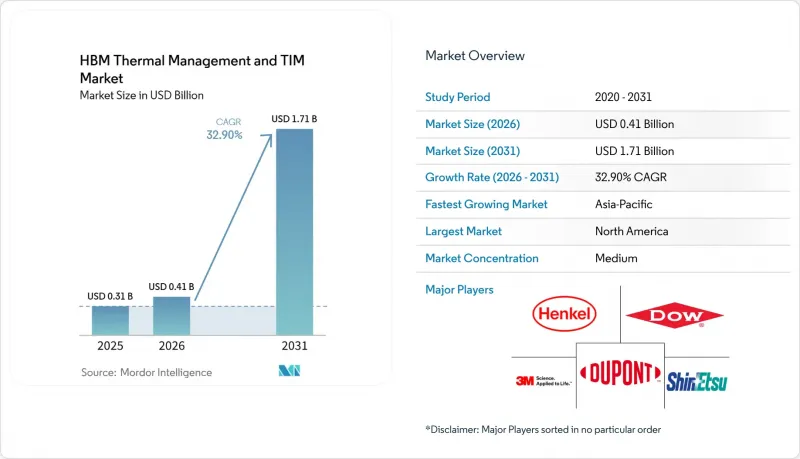
Mordor Intelligence에 의하면, HBM 열 관리 및 TIM 시장 규모는 2025년 3억 1,000만 달러로 평가되었습니다. 2026년에는 4억 1,000만 달러로 확대되어 2031년까지 17억 1,000만 달러에 이를 것으로 예상되고 2026년부터 2031년에 걸쳐 CAGR 32.90%로 성장할 전망입니다.
본 보고서는 솔루션 유형별(열 인터페이스 재료, 히트 스프레더 및 열전도 강화 부품, 능동 및 첨단 냉각 솔루션), TIM 유형별(실리콘계 TIM 등), 용도별(다이 부착 및 칩 보딩 등), 최종 이용 산업별(AI 가속기 및 GPU 등), 지역별로 분류되어 있습니다. 시장 전망은 금액(달러) 기준으로 제시되어 있습니다.
세계의 HBM 열 관리 및 TIM 시장 동향과 인사이트
AI 가속기의 전력 밀도 급증
HBM 열 관리 및 TIM 시장은 우선 GPU의 전력 엔벨로프의 급격한 상승에 대응하고 있습니다. 자료에 명시된 바와 같이, NVIDIA H100 시스템에서는 최대 700W였던 것이 Blackwell B200 패스에서는 1,000W로, B300 패스에서는 1,400W로 상승했습니다. 이러한 증가로 인해 GPU 다이와 HBM 스택이 동일한 실적 내에서 훨씬 더 까다로운 방열 경로를 공유할 수밖에 없게 되었기 때문에 패키지 전체의 열 마진이 축소되고 있습니다. 접합부 온도 제어는 단순히 벌크 전도도의 향상뿐만 아니라 여러 계면에서의 낮은 저항에 의존하게 되었기 때문에 이전 가속기 세대에서 유효했던 소재 선택은 점차 적합하지 않게 되고 있습니다. 또한 NVIDIA는 액체 냉각을 대규모 AI 시설의 운영 비용 절감과 연계하여, 차세대 메모리 노드가 양산 단계에 도달하기 전부터 고객이 열 사양을 높일 수 있도록 경제적 인센티브를 제공합니다. HBM의 열 관리 및 TIM 시장에서 이러한 변화로 인해, 공급업체 간의 논의는 단순한 열전도율 주장에서 패키지 개발 단계에서의 공동 설계 지원, 인터페이스 매칭, 시뮬레이션 기능으로 전환되고 있습니다. 따라서 설계 주기의 초기 단계에서 고객이 연산용 실리콘과 메모리 층 간의 열 흐름 균형을 맞출 수 있도록 지원할 수 있는 공급업체는 설계 채택 측면에서 더욱 확고한 입지를 다지고 있습니다.
HBM 스택 높이 증가가 패키지 열유량을 증가시킵니다.
HBM의 열 관리 및 TIM 시장은 메모리 스택 높이가 증가하고 있는 점에 힘입어 성장하고 있습니다. 이는 2025년 4월에 발표된 JEDEC의 HBM4 규격이 32Gb의 다이 밀도와 최대 64GB의 큐브 용량을 갖춘 최대 16층 스택을 지원하기 때문입니다. 층이 하나 추가될 때마다 발열 면적이 확대되는 한편, 하층 다이가 열을 방출하기 위한 수직 경로가 길어지기 때문에 스택의 형상 자체가 열적 제약 요인이 됩니다. Imec은 3D HBM-on-GPU에 관한 연구를 통해 이 문제의 규모를 밝혀냈습니다. 이 연구에 따르면, 대책이 없는 경우 GPU의 최고 온도가 141.7°C였던 반면, 구조 및 냉각 방식을 변경한 패키지에서는 70.8°C까지 낮아진 것으로 보고되었습니다. SK하이닉스는 2026년 5월, iHBM을 통해 유사한 문제를 해결했습니다. iHBM은 D2D PHY 계층에 통합 냉각 소자(ICE)를 배치하여, 간접 냉각 방식에 비해 열 저항을 30% 이상 저감했습니다. HBM의 열 관리 및 TIM 시장 공급업체들에게 이는 스택 레벨 인터페이스가 더 얇은 본딩 라인, 더 국소적인 핫스팟, 그리고 많은 기존 실리콘 제품의 검증된 범위를 뛰어넘는 성능 요구 사항으로 전환되고 있음을 의미합니다. 이러한 변화로 인해, 반복적인 열 스트레스 하에서도 신뢰성을 저해하지 않으면서 극히 얇은 본딩 라인에서 열 성능을 유지할 수 있는 배합의 가치가 높아지고 있습니다.
장수명 AI 및 HPC 도입에 따른 엄격한 신뢰성 요구 사항
HBM의 열 관리 및 TIM 시장은 하이퍼스케일 및 HPC 하드웨어에 기대되는 긴 수명으로 인해 명백한 제약에 직면해 있습니다. 이는 운영자가 시스템 교체까지 5년에서 7년에 걸쳐 지속적인 고부하 운영을 유지하기를 요구하기 때문입니다. 그래핀 강화 젤이나 갈륨계 액체 금속과 같은 첨단 소재는 실험실에서의 성능이 우수해 보일지라도, 기존의 실리콘계 시스템과 비교할 때 생산 규모나 실제 운영 실적이 여전히 제한적입니다. 2025년 IEEE THERMINIC의 조사에 따르면, 대형 다이 패키지에서 TIM1의 열화는 조립 시의 뒤틀림이나 열기계적 응력 하에서의 재료 거동에 의해 극히 국부적으로 발생하며, 그 형태도 달라질 수 있는 것으로 나타났습니다. 이는 장수명 인프라 도입을 결정하는 구매자에게 있어, 벌크 열전도율만으로는 실제 운용 시의 신뢰성을 충분히 예측할 수 없음을 의미합니다. 일단 소재가 인증되어 도입되면, 운영자는 수명 주기 도중에 변경하는 데 소극적입니다. 왜냐하면 교체에는 분해와 새로운 검증이 필요하기 때문입니다. 이로 인해 HBM의 열 관리 및 TIM 시장에서 ‘인증에 의한 락인(lock-in)’ 현상이 발생하고 있으며, 통제된 시험 환경에서 기존 소재의 열 성능을 능가할 가능성이 있는 새로운 화학 조성의 도입이 주춤하고 있습니다.
부문 분석
2025년, 열 인터페이스 재료(TIM)는 HBM의 열 관리 및 TIM 시장 점유율의 53.83%를 차지했습니다. 이는 AI 가속기 패키지의 다이 부착, 패키지 리드, 방열판 각 인터페이스에서 수년에 걸쳐 확립된 그 역할을 반영한 것입니다. 이러한 위상은 성능뿐만 아니라 도입 실적이 깊다는 점에서도 기인합니다. 왜냐하면 현재의 패키지 설계 대부분은 자동화된 생산 및 조립 공정에서 이미 인증을 받은 실리콘이나 폴리머계 소재에 여전히 의존하고 있기 때문입니다. 하지만 고객들이 사이클 시험이나 뒤틀림이 발생하더라도 규격 준수를 저해하지 않으면서 더 낮은 저항을 유지할 수 있는 배합을 요구하고 있기 때문에 이 부문의 성능 수준은 점차 향상되고 있습니다. 2025년 『ACS Applied Energy Materials』에 게재된 연구에 따르면, 수직 배열 그래핀 어레이는 그래핀 함유율 30.07 wt%에서 90.5 W m-1K-1의 체적 열전도율을 달성했으며, 이는 기존 실리콘 패드의 일반적인 범위를 훨씬 뛰어넘는 수치였습니다. HBM의 열 관리 및 TIM 시장에서 이 결과는 TIM1 및 관련 고열 인터페이스에 대해 실험실 검증 단계에서 초기 상용 샘플링 단계로의 전환을 촉진한다는 점에서 중요한 의미를 지닙니다.
히트 스프레더 및 열전도성 향상 부품은 중요한 중간 역할을 수행하며, 현재의 리드 부착 패키지와 HBM 스택 수준의 열 관리에서 주목받고 있는 새로운 리드 일체형 열 경로 개념을 모두 지원합니다. '능동형 및 첨단 냉각 솔루션'은 2031년까지 연평균 성장률(CAGR) 33.49%로 확대될 것으로 예측되며, 플랫폼 수준의 냉각이 패키지 쪽으로 가까워짐에 따라 가장 빠르게 성장하는 솔루션 유형이 될 전망입니다. NVIDIA가 2025년에 발표한 Rubin에 대한 해설에서는 팬을 제거하고 더 고온의 냉각액을 사용하는 완전 액체 냉각 시스템의 방향성이 제시되었으며, 이로 인해 하류 열 관리 소재가 충족해야 할 경계 조건이 변화하게 될 것입니다. Frore Systems는 2026년 3월, LiquidJet 플랫폼 확장을 위해 기업 가치 16억 4,000만 달러로 1억 4,300만 달러를 조달함으로써 이러한 방향성을 더욱 뒷받침했습니다. 이는 자본 또한 패키지 통합형 능동 냉각 개념으로 이동하고 있음을 보여줍니다.
2025년, HBM의 열 관리 및 TIM 시장에서 실리콘계 TIM은 42.19%를 차지했습니다. 이는 광범위한 인증 실적, 기계적 적합성, 그리고 기존 자동 디스펜싱 공정과의 호환성을 반영한 것입니다. CAGR은 연평균 성장률을 의미하며, 해당 연도의 성장률이 전년도 성장률의 2배 이상임을 나타냅니다. 그래핀 및 탄소계 TIM은 이론상 열전도율의 상한선이 훨씬 높고, 차세대 핫스팟 제어를 위한 유력한 수단이 될 것으로 예상에 따라, 2031년까지 34.08%라는 가장 높은 CAGR을 나타낼 것으로 전망됩니다. 서두에서 인용한 ACS Applied Energy Materials의 동일한 조사는 관심이 계속 높아지고 있는 이유를 설명하고 있습니다. 그래핀은 그 뛰어난 고유 열적 특성을 벌크 구조에 반영할 수 있으며, 가공상의 과제가 해결된다면 기존의 필러 기반 시스템보다 훨씬 뛰어난 성능을 발휘하기 때문입니다. HBM의 열 관리 및 TIM 시장에서 문제는 더 이상 탄소를 풍부하게 함유한 시스템이 성능을 발휘할 수 있는지 여부가 아니라, 안정적인 본딩 라인, 청정한 가공, 그리고 재현 가능한 패키지 신뢰성을 확보하면서 이를 대규모로 실현할 수 있는지에 있습니다. 따라서 이 부문에서는 기존의 실리콘 기반 시스템에서 즉시 벗어나기보다는 여전히 성장 가능성과 상용화 준비 상태 간의 균형을 맞추고 있는 것입니다.
2026년 5월, 다우(Dow)가 'DOWSIL TC-3120 열전도 젤' 를 출시한 것은 기존 실리콘 공급업체들이 여전히 성능의 한계를 높여가고 있음을 보여주는 것으로, 열전도율은 12 W/m*K에 육박하며 고밀도 광학·전자 모듈 인터페이스용으로 포지셔닝되고 있습니다. 실리콘 오염이 우려되는 분야에서는 비실리콘계 TIM이나 상변화물질가 여전히 중요하며, Laird의 ' Tpcm 7000'은 7.5 W/m·K의 열전도율과 원료 단계에서 2,000시간에 걸친 에이징 시험을 통해 입증된 신뢰성을 갖추고 있어 최고 수준의 벤치마크로 자리 잡고 있습니다. 액체 금속 시스템에 대한 관심도 계속해서 높아지고 있으며, Indium의 갈륨계 'Indalloy' 배합은 44 W m-¹K-¹에 육박하는 성능을 보여, 베어 다이 AI 서버 프로세서 및 ASIC의 TIM0 및 TIM1 용도를 목표로 하고 있습니다. 따라서 HBM의 열 관리 및 TIM 산업은 한 방향으로만 나아가고 있는 것이 아니며, 최적의 화학 조성은 여전히 밀봉성, 오염 위험, 제조성 및 대상 인터페이스의 위치에 따라 좌우되기 때문입니다.
지역별 분석
2025년, 아시아태평양은 HBM 열 관리 및 TIM 시장 점유율의 64.96%를 차지했습니다. 이는 해당 지역에 HBM 제조, 첨단 패키징 및 관련 반도체 소재의 생산 능력이 집중되어 있음을 반영합니다. Samsung Electronics와 SK하이닉스가 전 세계 HBM 공급의 핵심을 담당하고 있어 한국은 여전히 중심적인 위치를 차지하고 있는 반면, 대만은 AI 가속기 프로그램과 관련된 대규모 첨단 패키징 활동을 통해 패키징 측면을 뒷받침하고 있습니다. 아시아태평양의 HBM 열 관리 및 TIM 시장은 더 높은 층수의 HBM 스택과 더 복잡한 패키지 레이아웃의 채택이 가속화되고 있는 점에 힘입고 있습니다. 이에 따라 메모리 및 연산 다이 주변에서 인증된 인터페이스 소재에 대한 수요가 증가하고 있습니다. 2025년 JEDEC의 HBM4 출시와 2026년 SK하이닉스의 iHBM 출시는 모두 차세대 패키징 설계를 위한 실용적인 열 요구 사항을 수립하는 데 있어 해당 지역의 역할을 강화하는 계기가 되었습니다. 또한 일본도 소재 개발 및 공정 기술을 통해 전략적 가치를 발휘하고 있으며, Wacker는 현지 실리콘 TIM 생산 능력을 확대하고, NEDO는 실리콘 TIM의 제조 비용 절감을 위한 제조 혁신을 지원하고 있습니다.
북미는 AI 데이터센터의 급속한 확충과 액체 냉각 지원 열 솔루션을 통한 고밀도 컴퓨팅 클러스터 지원 수요에 힘입어, 2031년까지 33.81%라는 가장 높은 연평균 성장률(CAGR)을 나타낼 전망입니다. NVIDIA가 직접 제시한 액체 냉각의 경제성에 대한 논의만 보더라도, 이 지역이 급속도로 움직이기 시작한 이유가 분명합니다. 현재 대규모 AI 시설에서 열 인프라 결정은 시스템 성능과 운영 비용 모두에 영향을 미치고 있기 때문입니다. 북미의 HBM 열 관리 및 TIM 시장은 현행 산업 정책에 기반한 국내 반도체 패키징 사업의 확대로부터도 혜택을 받고 있으며, 이로 인해 수요는 하이퍼스케일 서버에만 국한되지 않고 확대되고 있습니다. 이러한 시너지 효과로 인해 부품 수준의 소재 수요가 패키지, 기판, 냉각 하드웨어 분야의 대규모 확장과 연계되고 있습니다.
유럽 시장 점유율은 비교적 작았음에도 불구하고, 해당 지역의 전자 및 자동차 산업 기반을 바탕으로 규정 준수, 신뢰성, 그리고 연구 주도형 패키지 개발에 수요가 집중되고 있어 기술적으로는 여전히 중요한 위치를 차지하고 있습니다. 이 지역의 RoHS 및 REACH 프레임워크는 금속을 다량 사용하거나 특수한 필러 시스템을 사용하는 공급업체에게 여전히 중요하며, 산업용 및 모빌리티 용도에서 더욱 엄격해진 규정 준수 요건을 충족하는 소재 선정이 요구됩니다. 남미, 중동 및 아프리카에서는 현지 HBM 생산 및 첨단 패키징 활동이 여전히 제한적이기 때문에 HBM과 직접 관련된 TIM 수요는 초기 단계에 머물러 있습니다. 그러나 중동 일부 지역의 향후 AI 인프라 계획과 관련하여, 현지 연산 능력이 도입 계획 단계에서 지속적인 하드웨어 설치 단계로 전환된다면 HBM의 열 관리 및 열 인터페이스 재료(TIM) 시장에 더 많은 기회가 창출될 가능성이 있습니다.
기타 혜택 :
- 엑셀 형식 시장 예측(ME) 시트
- 3개월간의 애널리스트 지원
자주 묻는 질문
목차
제1장 서론
제2장 조사 방법
제3장 주요 요약
제4장 시장 구도
제5장 시장 규모 및 성장 예측
제6장 경쟁 구도
제7장 시장 기회 및 향후 전망
KTH 26.08.10According to Mordor Intelligence, the HBM thermal management and TIM market size is expected to increase from USD 0.31 billion in 2025 to USD 0.41 billion in 2026 and reach USD 1.71 billion by 2031, growing at a CAGR of 32.90% over 2026-2031.
This report is Segmented by Solution Type (Thermal Interface Materials, Heat Spreaders and Thermal Enhancement Components, and Active and Advanced Cooling Solutions), TIM Type (Silicone-Based TIM, and More), Application (Die Attach and Chip Boarding, and More), End Use Industry (AI Accelerators and GPUs, and More), and Geography. The Market Forecasts are Provided in Terms of Value (USD).
Global HBM Thermal Management and TIM Market Trends and Insights
AI Accelerator Power Density Escalation
The HBM thermal management and TIM market is responding first to the sharp rise in GPU power envelopes, which moved from up to 700 W in NVIDIA H100 systems to 1,000 W in the Blackwell B200 path and to 1,400 W in the B300 path described in the source material. That increase reduces the thermal margin across the entire package because the GPU die and the HBM stack must now share a much tighter heat-reduction path within the same footprint. Material choices that worked for earlier accelerator generations are becoming less suitable as junction temperature control now depends on lower resistance at multiple interfaces rather than just better bulk conductivity. NVIDIA also tied liquid cooling to lower operating costs in large AI facilities, giving customers a financial incentive to raise thermal specifications before the next memory node even reaches volume deployment. In the HBM thermal management and TIM market, this shift is driving supplier discussions away from simple conductivity claims toward co-design support, interface matching, and simulation capabilities during package development. Suppliers that can help customers balance heat flow between compute silicon and memory layers earlier in the design cycle are therefore gaining stronger design-in positions.
HBM Stack Height Growth Increasing Package Heat Flux
The HBM thermal management and TIM market is also being pushed by taller memory stacks, because JEDEC's HBM4 standard, published in April 2025, supports up to 16-high stacks with 32 Gb die density and a maximum cube capacity of 64 GB. Each added tier expands the heat-generating area while lengthening the vertical path through which lower dies must release heat, making stack geometry itself a thermal constraint. Imec showed the scale of this issue when its 3D HBM-on-GPU study reported peak GPU temperatures of 141.7°C without mitigation, while a package with structural and cooling changes reduced them to 70.8°C. SK hynix addressed the same problem in May 2026 with iHBM, which places Integrated Cooling Elements at the D2D PHY layer and lowers thermal resistance by more than 30% versus indirect cooling approaches. For suppliers in the HBM thermal management and TIM market, this means stack-level interfaces are moving toward thinner bondlines, more localized hot spots, and performance requirements that extend beyond the validated range of many current silicone products. That shift raises the value of formulations that can hold thermal performance at very thin bondlines without sacrificing reliability under repeated thermal stress.
Tight Reliability Windows for Long-Life AI and HPC Deployments
The HBM thermal management and TIM market faces a clear brake from the long service life expected in hyperscale and HPC hardware, because operators want systems to run under sustained heavy use for 5 to 7 years before replacement. Advanced materials such as graphene-enhanced gels and gallium-based liquid metals still have limited production scale and field history compared with incumbent silicone systems, even when their lab performance looks stronger. IEEE THERMINIC research in 2025 showed that TIM1 degradation in large die packages can be highly localized and shaped by assembly warpage and by material behavior under thermomechanical stress. This means bulk thermal conductivity alone does not predict field reliability well enough for buyers making long-life infrastructure decisions. Once a material is qualified and deployed, operators are reluctant to change it mid-cycle because replacement requires disassembly and renewed validation. That creates qualification lock-in in the HBM thermal management and TIM market, slowing the adoption of novel chemistries even when they can exceed the incumbent's thermal performance in controlled testing.
Other drivers and restraints analyzed in the detailed report include:
- Co-Packaged Memory and Logic Roadmaps Raising Thermal Qualification Thresholds
- Advanced Semiconductor Packaging Adoption in HBM Supply Chains
- Material Qualification Cycles Delaying Commercial Scale-Up
For complete list of drivers and restraints, kindly check the Table Of Contents.
Segment Analysis
Thermal Interface Materials held 53.83% of the HBM thermal management and TIM market share in 2025, which reflected their long-established role across die attach, package lid, and heatsink interfaces in AI accelerator packages. That position came from installed base depth as much as from performance, because many current package designs still rely on silicone and polymer systems that are already qualified in automated production and assembly flows. Even so, the performance ladder in this category is moving upward as customers seek formulations that maintain lower resistance without sacrificing compliance during cycling and warpage. Research published in ACS Applied Energy Materials in 2025 showed that vertically aligned graphene arrays achieved a bulk thermal conductivity of 90.5 W m-1 K-1 at 30.07 wt% graphene loading, far above the range typical of conventional silicone pads. In the HBM thermal management and TIM market, that result matters because it supports the move from laboratory validation toward early commercial sampling for TIM1 and related high-heat interfaces.
Heat spreaders and thermal enhancement components occupy an important middle ground, supporting both current lidded packages and newer lid-integrated thermal path concepts that are gaining attention in HBM stack-level management. Active and Advanced Cooling Solutions is projected to expand at a 33.49% CAGR through 2031, making it the fastest-growing solution type as platform-level cooling moves closer to the package. NVIDIA's 2025 commentary on Rubin described a fully liquid-cooled system direction with fan removal and warmer coolant, which changes the boundary conditions that downstream thermal materials must meet. Frore Systems reinforced that direction in March 2026 when it raised USD 143 million at a USD 1.64 billion valuation to scale its LiquidJet platform, showing that capital is also moving toward package-integrated active cooling concepts.
Silicone-Based TIM accounted for 42.19% of the HBM thermal management and TIM market in 2025, reflecting its broad qualification base, mechanical compliance, and compatibility with existing automated dispensing processes. Graphene and Carbon-Based TIM is projected to record the fastest CAGR of 34.08% through 2031, as it offers a much higher theoretical conductivity ceiling and a stronger path toward next-generation hot-spot control. The same ACS Applied Energy Materials study cited in the input explains why interest remains high; graphene can translate its strong intrinsic thermal properties into bulk structures that deliver far better performance than legacy filler systems when processing challenges are addressed. In the HBM thermal management and TIM market, the issue is no longer whether carbon-rich systems can perform, but whether they can do so at scale with stable bondlines, clean processing, and repeatable package reliability. That is why the segment still balances growth potential against commercial readiness rather than moving immediately away from incumbent silicon systems.
Dow's launch of DOWSIL TC-3120 Thermal Gel in May 2026 showed that incumbent silicone suppliers are still raising the performance ceiling, with thermal conductivity near 12 W/m*K and positioning for dense optical and electronic module interfaces. Non-silicone TIM and phase change materials remain relevant where silicone contamination is a concern, and Laird's Tpcm 7000 provided a premium benchmark with 7.5 W/mK thermal conductivity and reliability across 2,000 aging test hours in the source material. Liquid metal systems continue to gain interest, with Indium's gallium-based Indalloy formulations approaching 44 W m-1 K-1 and targeting TIM0 and TIM1 use in bare-die AI server processors and ASICs. The HBM thermal management and TIM industry is therefore not moving in a single direction, since the winning chemistry still depends on containment, contamination risk, manufacturability, and the interface position being served.
Complete Report Scope:
- By Solution Type
- Thermal Interface Materials
- Heat Spreaders and Thermal Enhancement Components
- Active and Advanced Cooling Solutions
- By TIM Type
- Silicone-Based TIM
- Non-Silicone TIM
- Phase Change Materials
- Liquid Metal TIM
- Graphene and Carbon-Based TIM
- Indium and Metal Alloy TIM
- By Application
- Die Attach and Chip Bonding
- Interposer and Silicon Bridge Thermal Management
- HBM Stack Thermal Interface
- Package-to-Heatsink Interface
- Advanced Heterogeneous Packaging
- By End Use Industry
- AI Accelerators and GPUs
- Data Centers
- High-Performance Computing
- Automotive
- Telecom
- Consumer Electronics
- By Geography
- North America
- United States
- Canada
- Mexico
- Europe
- Germany
- United Kingdom
- France
- Italy
- Rest of Europe
- Asia-Pacific
- China
- Japan
- South Korea
- Taiwan
- India
- Rest of Asia-Pacific
- South America
- Middle East and Africa
- North America
Geography Analysis
Asia-Pacific held 64.96% of the HBM thermal management and TIM market share in 2025, which reflected the region's concentration of HBM manufacturing, advanced packaging, and supporting semiconductor materials capacity. South Korea remained central because Samsung Electronics and SK hynix anchor global HBM supply, while Taiwan supports the package side through large-scale advanced packaging activity tied to AI accelerator programs. The HBM thermal management and TIM market in Asia-Pacific is also supported by the faster adoption of taller HBM stacks and more complex package layouts, which increase the need for qualified interface materials near the memory and compute dies. JEDEC's HBM4 release in 2025 and SK hynix's iHBM launch in 2026 both reinforced the region's role in setting practical thermal requirements for the next wave of package design. Japan also held strategic value through materials development and process work, with Wacker expanding local silicone TIM capacity and NEDO supporting manufacturing innovation to lower silicone TIM production costs.
North America is projected to post the fastest CAGR at 33.81% through 2031, driven by rapid AI data center buildout and the need to support denser compute clusters with liquid-ready thermal solutions. NVIDIA's own discussion of liquid-cooling economics shows why this region is moving quickly, as thermal infrastructure decisions now affect both system performance and operating costs in large AI facilities. The HBM thermal management and TIM market in North America also benefits from domestic semiconductor packaging expansion under the current industrial policy, which broadens demand beyond hyperscale servers alone. That combination links component-level materials demand with a larger buildout in package, board, and cooling hardware.
Europe held a smaller position, but it remained technically important because its electronics and automotive base keeps demand focused on compliance, reliability, and research-led package development. The region's RoHS and REACH frameworks still matter for suppliers using metal-rich or specialized filler systems, as material selection must align with stricter compliance requirements in industrial and mobility applications. South America, the Middle East, and Africa remained early-stage in direct HBM-related TIM demand, as local HBM production and advanced packaging activity remain limited. Even so, later-period AI infrastructure programs in parts of the Middle East could create incremental opportunity for the HBM thermal management and thermal interface material (TIM) market if local compute capacity moves from deployment planning to sustained hardware installation.
- Henkel AG and Co. KGaA
- Dow Inc.
- DuPont de Nemours, Inc.
- Shin-Etsu Chemical Co., Ltd.
- 3M Company
- Laird Thermal Systems, Inc.
- Parker-Hannifin Corporation
- Fujipoly America Corporation
- Momentive Performance Materials Inc.
- Honeywell International Inc.
- Indium Corporation
- Eaton Corporation
- Saint-Gobain S.A.
- Rogers Corporation
- Wacker Chemie AG
- Panasonic Holdings Corporation
- Nitto Denko Corporation
- Shenzhen FRD Science and Technology Co., Ltd.
- Suzhou Tianmai Thermal Technology Co., Ltd.
- Resonac Holdings Corporation
Additional Benefits:
- The market estimate (ME) sheet in Excel format
- 3 months of analyst support
TABLE OF CONTENTS
1 INTRODUCTION
- 1.1 Study Assumptions and Market Definition
- 1.2 Scope of the Study
2 RESEARCH METHODOLOGY
3 EXECUTIVE SUMMARY
4 MARKET LANDSCAPE
- 4.1 Market Overview
- 4.2 Market Drivers
- 4.2.1 AI Accelerator Power Density Escalation
- 4.2.2 HBM Stack Height Growth Increasing Package Heat Flux
- 4.2.3 Co-Packaged Memory and Logic Roadmaps Raising Thermal Qualification Thresholds
- 4.2.4 Advanced Semiconductor Packaging Adoption in HBM Supply Chains
- 4.2.5 Underreported Demand for Package-Level Thermal Simulation and Design-In Services
- 4.2.6 HBM Thermal Failure Margins Driving Premium TIM Adoption in Hyperscale Designs
- 4.3 Market Restraints
- 4.3.1 Tight Reliability Windows for Long-Life AI and HPC Deployments
- 4.3.2 Material Qualification Cycles Delaying Commercial Scale-Up
- 4.3.3 Limited Supply of High-Purity Filler Systems for Advanced TIM Formulations
- 4.3.4 Yield Loss Risk From Thermal-Mechanical Stress in 3D Stacked Memory
- 4.4 Supply Chain Analysis
- 4.5 Regulatory Landscape
- 4.6 Technological Outlook
- 4.7 Porter's Five Forces Analysis
- 4.7.1 Threat of New Entrants
- 4.7.2 Bargaining Power of Suppliers
- 4.7.3 Bargaining Power of Buyers
- 4.7.4 Threat of Substitutes
- 4.7.5 Intensity of Competitive Rivalry
- 4.8 Impact of Macroeconomic Factors on the Market
5 MARKET SIZE AND GROWTH FORECASTS (VALUE)
- 5.1 By Solution Type
- 5.1.1 Thermal Interface Materials
- 5.1.2 Heat Spreaders and Thermal Enhancement Components
- 5.1.3 Active and Advanced Cooling Solutions
- 5.2 By TIM Type
- 5.2.1 Silicone-Based TIM
- 5.2.2 Non-Silicone TIM
- 5.2.3 Phase Change Materials
- 5.2.4 Liquid Metal TIM
- 5.2.5 Graphene and Carbon-Based TIM
- 5.2.6 Indium and Metal Alloy TIM
- 5.3 By Application
- 5.3.1 Die Attach and Chip Bonding
- 5.3.2 Interposer and Silicon Bridge Thermal Management
- 5.3.3 HBM Stack Thermal Interface
- 5.3.4 Package-to-Heatsink Interface
- 5.3.5 Advanced Heterogeneous Packaging
- 5.4 By End Use Industry
- 5.4.1 AI Accelerators and GPUs
- 5.4.2 Data Centers
- 5.4.3 High-Performance Computing
- 5.4.4 Automotive
- 5.4.5 Telecom
- 5.4.6 Consumer Electronics
- 5.5 By Geography
- 5.5.1 North America
- 5.5.1.1 United States
- 5.5.1.2 Canada
- 5.5.1.3 Mexico
- 5.5.2 Europe
- 5.5.2.1 Germany
- 5.5.2.2 United Kingdom
- 5.5.2.3 France
- 5.5.2.4 Italy
- 5.5.2.5 Rest of Europe
- 5.5.3 Asia-Pacific
- 5.5.3.1 China
- 5.5.3.2 Japan
- 5.5.3.3 South Korea
- 5.5.3.4 Taiwan
- 5.5.3.5 India
- 5.5.3.6 Rest of Asia-Pacific
- 5.5.4 South America
- 5.5.5 Middle East and Africa
- 5.5.1 North America
6 COMPETITIVE LANDSCAPE
- 6.1 Market Concentration
- 6.2 Strategic Moves
- 6.3 Market Share Analysis
- 6.4 Company Profiles (includes Global Level Overview, Market Level Overview, Core Segments, Financials as available, Strategic Information, Market Rank/Share, Products and Services, Recent Developments)
- 6.4.1 Henkel AG and Co. KGaA
- 6.4.2 Dow Inc.
- 6.4.3 DuPont de Nemours, Inc.
- 6.4.4 Shin-Etsu Chemical Co., Ltd.
- 6.4.5 3M Company
- 6.4.6 Laird Thermal Systems, Inc.
- 6.4.7 Parker-Hannifin Corporation
- 6.4.8 Fujipoly America Corporation
- 6.4.9 Momentive Performance Materials Inc.
- 6.4.10 Honeywell International Inc.
- 6.4.11 Indium Corporation
- 6.4.12 Eaton Corporation
- 6.4.13 Saint-Gobain S.A.
- 6.4.14 Rogers Corporation
- 6.4.15 Wacker Chemie AG
- 6.4.16 Panasonic Holdings Corporation
- 6.4.17 Nitto Denko Corporation
- 6.4.18 Shenzhen FRD Science and Technology Co., Ltd.
- 6.4.19 Suzhou Tianmai Thermal Technology Co., Ltd.
- 6.4.20 Resonac Holdings Corporation
7 MARKET OPPORTUNITIES AND FUTURE OUTLOOK
- 7.1 White-Space and Unmet-Need Assessment


