

|
시장보고서
상품코드
2122912
열관리 기술 시장 : 시장 점유율 분석, 업계 동향 및 통계, 성장 예측(2026-2031년)Thermal Management Technologies - Market Share Analysis, Industry Trends & Statistics, Growth Forecasts (2026 - 2031) |
||||||
 Mordor Intelligence
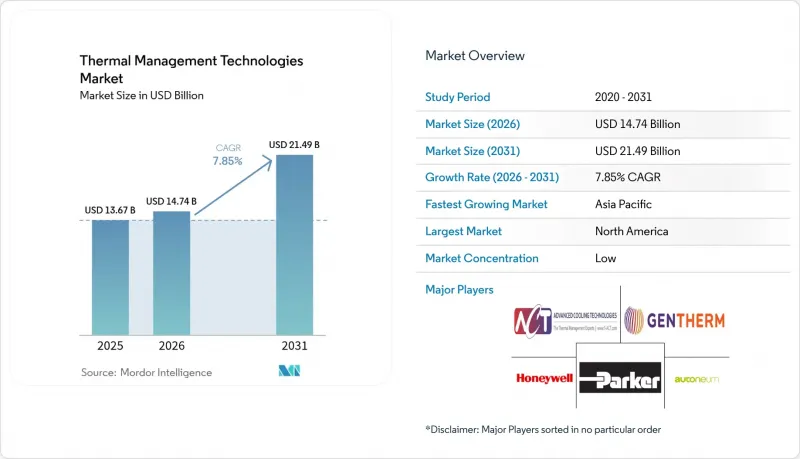
Mordor Intelligence에 의하면, 열관리 기술 시장 규모는 2025년에 136억 7,000만 달러로 평가되었고, 2026년 147억 4,000만 달러에서 2031년까지 214억 9,000만 달러에 이를 것으로 예측되며, 예측 기간(2026-2031년) CAGR은 7.85%를 나타낼 전망입니다.
본 보고서는 제품 유형별(소프트웨어, 하드웨어 등), 냉각 기술별(공랭식, 수랭식 등), 소재별(금속계 : Al·Cu, 비금속계 : 세라믹·흑연·폴리머 등), 최종 이용 산업별(컴퓨터 및 데이터센터, 소비자용 전자기기 등), 그리고 지역별로 분류되어 있습니다. 시장 전망은 달러 기준으로 제시되어 있습니다.
세계의 열관리 기술 시장 동향 및 인사이트
고성능 컴퓨팅 기기에 대한 수요 증가
AI 및 그래픽 처리를 목적으로 하는 프로세서는 현재 400W를 초과하는 열 설계 전력(TDP)을 기록하고 있으며, 기존의 공랭식 핀으로는 대응할 수 없기 때문에 더 높은 대류 계수를 실현하는 액체 순환 시스템으로의 전환이 촉진되고 있습니다. 트랜지스터의 고밀도 적층, 온칩 가속기, 팬이 없는 케이스에 수납된 엣지 박스 등으로 인해 유량을 실시간으로 조정하는 소프트웨어 정의형 냉각에 대한 수요가 더욱 높아지고 있습니다. 양자 시스템은 서브켈빈급 환경을 필요로 함으로써 장벽을 더욱 높이며, IT와 극저온 공학의 경계를 모호하게 만들고 있습니다. 에너지 소비량에 관한 규제로 인해 CIO에게는 전력 소비와 가동 시간의 균형을 맞추는 예측형 열 관리 시스템을 도입할 경제적 인센티브가 생기고 있습니다. 이러한 요인들이 결합되어 냉각 서브시스템의 대수와 랙당 부품 비용을 모두 증가시키며, 열관리 기술 시장을 견인하고 있습니다.
EV 배터리 열관리 기술의 급속한 보급
사각형 및 원통형 셀에 배관된 액체 루프를 통해 팩의 온도를 15-35°C라는 좁은 범위 내로 유지함으로써, 열 폭주를 방지하면서 용량 유지율을 극대화하고 있습니다. 고체 화학 성분의 채택으로 발열 프로파일이 변화함에 따라, 각 OEM 업체들은 방열판의 형상과 냉각액의 점도에 대해 재고해야 할 필요에 직면해 있습니다. 내장된 알고리즘은 현재 운전 스타일, 주변 기상 조건, 급속 충전 전류를 분석하여 핫스팟을 미연에 방지하고 보증 기간을 연장하고 있습니다. 한때 서버에만 국한되었던 침지식 솔루션이, 더 가벼운 배관을 요구하는 서킷용 EV를 위해 시제품 개발이 진행되고 있습니다. 새로운 플랫폼이 등장할 때마다 열관리 기술 시장은 자동차 설계 주기에 깊이 침투하고 있으며, 배터리 냉각은 단순한 범용 부품에서 핵심적인 차별화 요인으로 변모하고 있습니다.
2상 침지액에 대한 신뢰성 우려
운영 담당자들은 미션 크리티컬 기판을 순환하는 유전체 침지액 내의 화학적 열화나 입자상 오염 물질의 혼입에 대해 여전히 경계심을 가지고 있습니다. 교체 주기 및 유체 조절 장치의 비용으로 인해 운영 경비는 예상보다 급격히 상승하고 있습니다. 보험 인수사나 보증 제공업체는 아직 결정적인 고장률 데이터를 공개하지 않고 있어, 이로 인해 포춘 500대 기업의 IT 팀은 신중한 태도를 보이고 있습니다. 폐기에 관한 환경 규제 또한 복잡해지고 있어, 이는 주류로의 채택을 지연시키고 열관리 기술 시장의 단기적인 성장을 억제하고 있습니다.
부문 분석
하드웨어는 여전히 열관리 기술 시장의 기반을 이루고 있으며, 2025년에는 매출의 58.05%를 차지할 것으로 예상되며, 히트 싱크, 베퍼 챔버, 리퀴드 블록, 인터페이스 패드 등을 포괄합니다. 그러나 소프트웨어 오케스트레이션 부문이 기록한 9.05%의 연평균 성장률(CAGR)은 이미 도입된 냉각 자산에서 더 많은 성능을 끌어내는 데이터 기반 최적화로 전환되고 있음을 시사합니다. AI 기반 펌웨어는 열 특성을 학습하고 펌프 속도나 팬 회전수를 선제적으로 조정함으로써 전력 소비와 소음을 대폭 줄입니다. 이러한 기술이 대규모로 도입됨에 따라 OEM의 이익률이 높아지고, 최종 사용자의 총 소유 비용(TCO)이 절감되며, 열관리 기술 시장의 확대로 이어지는 도입의 선순환이 강화됩니다.
스타트업 기업들은 핫스팟의 이동을 실시간으로 매핑하는 머신 비전 센서를 통합하고, 그 데이터를 신경망에 공급함으로써 밀리초 단위로 기류 벡터를 조정하고 있습니다. 계면 재료도 마찬가지로 진화하고 있으며, 그래핀을 첨가한 페이스트는 전도성 면에서 기존 그리스를 훨씬 능가합니다. 더 스마트한 코드와 우수한 표면의 시너지 효과로 복합적인 이점이 창출됩니다. 접합부의 온도 저하는 신뢰성 지표를 향상시켜, 더 엄격한 설계 요구 사항과 경량 방열 구조를 가능하게 합니다. 이러한 각 진전이 누적되어, 소비자용 기기, 전기차(EV) 배터리 팩, 산업용 자동화 셀 전반에 걸쳐 열관리 기술 시장 규모를 확대되고 있습니다.
공랭식 어셈블리는 범용성과 낮은 초기 비용에 힘입어 2025년 매출의 47.10%를 차지했습니다. 그럼에도 불구하고, 베퍼 챔버, 히트파이프, 침지 프레임에 이르는 2상 냉각 솔루션은 2031년까지 연평균 성장률(CAGR) 8.86%를 나타낼 것으로 예측되며, 메가와트급 데이터센터에서 기존 랙 쿨러 시장 점유율을 빼앗고 있습니다. DTC(Direct-to-Chip) 플레이트는 유로 길이를 단축하고 열유속 임계값을 높임으로써 랙 전체의 설치 면적을 축소합니다. 하이엔드 워크스테이션 및 엣지 AI 박스의 경우, 하이브리드 루프가 워크로드 강도에 따라 공기 모드와 액체 모드를 전환하여, 팬을 과도하게 대형화하지 않고도 열 설계 요건을 충족시킵니다.
액침 냉각조는 가장 가파른 열 구배를 실현하지만, 설비 투자(CAPEX) 및 위험에 대한 우려로 인해 여전히 시험실 이외의 도입은 제한적입니다. 한편, 열전 모듈은 효율 저하보다 정밀한 온도 제어가 우선시되는 분야, 예를 들어 LiDAR 교정 장치나 위성 통신용 위상 배열 등에서 틈새 용도로 채택이 확대되고 있습니다. 이러한 선택의 폭이 넓어짐에 따라 설계자는 시스템을 적절한 규모로 설계할 수 있게 되었으며, 이는 열관리 기술 시장의 성장 궤도를 더욱 공고히 하고 있습니다.
지역별 분석
북미는 2025년에 전 세계 매출의 39.35%를 차지했습니다. 이는 클라우드 대기업들의 하이퍼스케일 시설 확장과 차세대 배터리 냉각 프로젝트에 자금을 지원하는 넉넉한 전기차(EV) 인센티브에 힘입은 결과입니다. 반도체 팹 및 연구시설의 밀집된 네트워크 덕분에 기술 발견에서 상용화에 이르는 피드백 루프가 단축되어, 이 지역은 특허 및 파일럿 라인 측면에서 계속해서 선두를 달리고 있습니다. 정책 입안자들이 에너지 자립과 데이터 주권을 중시함에 따라, 액체 냉각 방식을 활용한 데이터센터 개조에 대한 투자가 강화되고 있으며, 이는 열관리 기술 시장의 기초 수요를 뒷받침하고 있습니다.
한편, 아시아태평양은 2031년까지 8.58%라는 가장 높은 연평균 성장률(CAGR)을 보일 것으로 전망됩니다. 이는 중국, 한국, 대만이 첨단 냉각 기술을 조립 라인에 직접 통합하여 애프터마켓에서의 개조를 불필요하게 만들었기 때문입니다. 중국 연안 지역의 배터리 기가팩토리 건설에 따라 수 킬로미터에 달하는 냉각수 통로와 수 메가톤 규모의 흑연 시트가 투입되는 한편, 선전과 서울의 휴대전화 OEM 업체들은 AI 기능을 강화한 플래그십 모델을 위해 마이크로 블로어의 채택을 최적화하고 있습니다. 이와 병행하여 진행되는 5G 네트워크 밀도 향상으로 인해, 각각 전용으로 설계된 콜드플레이트를 갖춘 수천 대의 무선 유닛이 추가되면서 열관리 기술 시장의 지역별 수요를 끌어올리고 있습니다.
유럽에서는 성숙한 자동차 공급망과 전기차(EV) 구동계 및 산업용 모터에 고효율 열 관리 하드웨어 도입을 촉진하는 적극적인 탄소 감축 규제가 균형을 이루고 있습니다. 이 대륙의 항공우주 및 방위 산업 생태계에서는 고고도 드론 및 위성용 항공전자 장비를 위해 세라믹 및 열전식 키트가 지정되어, 고수익성의 틈새 시장이 확대되고 있습니다. 북유럽 국가에서 새롭게 등장한 데이터센터 클러스터는 주변 기온이 낮은 환경에서 운영되고 있지만, 결로 위험을 감수하지 않고 자연 냉각을 활용하기 위해서는 여전히 스마트 제어 시스템이 필요합니다. 이러한 동향으로 인해 전 세계 열관리 기술 시장에서 규제에 의한 유럽의 확고한 역할이 확립되고 있습니다.
기타 혜택 :
- 엑셀 형식 시장 예측(ME) 시트
- 3개월간의 애널리스트 지원
자주 묻는 질문
목차
제1장 서론
제2장 조사 방법
제3장 주요 요약
제4장 시장 구도
제5장 시장 규모 및 성장 예측
제6장 경쟁 구도
제7장 시장 기회 및 향후 전망
AJY 26.09.07According to Mordor Intelligence, the thermal management technologies market size was valued at USD 13.67 billion in 2025 and estimated to grow from USD 14.74 billion in 2026 to reach USD 21.49 billion by 2031, at a CAGR of 7.85% during the forecast period (2026-2031).
This report is Segmented by Product Type (Software, Hardware, and More), Cooling Technology (Air Cooling, Liquid Cooling, and More), Material (Metal-Based Al Cu, Non-Metal Ceramic Graphite Polymer, and More), End-Use Industry (Computers and Data Centers, Consumer Electronics, and More), and Geography. The Market Forecasts are Provided in Terms of Value USD.
Global Thermal Management Technologies Market Trends and Insights
Growing Demand for High-Performance Computing Devices
Processors aimed at AI and graphics workloads now post thermal design power numbers above 400 W, overwhelming legacy air fins and pushing operators toward liquid loops that deliver higher convective coefficients. Denser transistor stacking, on-chip accelerators, and edge boxes packed into fan-less enclosures intensify the hunt for software-defined cooling that modulates flow rates on the fly. Quantum systems raise the bar further by requiring sub-Kelvin environments that blur lines between IT and cryogenics. Regulatory energy caps give CIOs a financial incentive to adopt predictive thermal orchestration that balances power draw against uptime. Together these factors lift the thermal management technologies market by expanding both the unit count of cooling subsystems and the bill of materials per rack.
Surging Adoption of EV Battery Thermal Management
Liquid loops threaded through prismatic and cylindrical cells keep pack temperatures inside the narrow 15-35 °C window that maximizes capacity retention while averting thermal runaway. Solid-state chemistries change heat generation profiles, forcing OEMs to rethink plate geometries and coolant viscosities. Embedded algorithms now parse driving style, ambient weather, and fast-charge currents to pre-empt hotspots, extending warranty cycles. Immersion solutions, once confined to servers, are being prototyped for track-oriented EVs seeking lighter plumbing. Each new platform pushes the thermal management technologies market deeper into automotive design cycles, turning battery cooling from a commodity into a core differentiator.
Reliability Concerns Over Two-Phase Immersion Fluids
Operators remain wary of chemical degradation and particulate contamination in dielectric baths that circulate around mission-critical boards. Replacement cycles and fluid conditioning equipment drive operating expenses higher than anticipated. Insurance underwriters and warranty providers have yet to publish definitive failure-rate data, contributing to a cautious stance among Fortune-500 IT teams. Environmental regulations on disposal add another layer of complexity, slowing mainstream adoption and trimming near-term growth for the thermal management technologies market.
Other drivers and restraints analyzed in the detailed report include:
- Miniaturization of Electronics Increasing Heat Flux
- 5G Rollout Driving Advanced Thermal Solutions
- High Cost of Advanced PCMs and Graphite Composites
For complete list of drivers and restraints, kindly check the Table Of Contents.
Segment Analysis
Hardware still underpins the thermal management technologies market with 58.05% revenue in 2025, spanning heat sinks, vapor chambers, liquid blocks, and interface pads. Yet the 9.05% CAGR logged by software orchestration layers signals a pivot toward data-driven optimization that ekes out more capacity from installed cooling assets. AI-based firmware now learns thermal signatures and pre-emptively tunes pump speed or fan rpm, slashing power draw and noise. At scale, these functions widen margins for OEMs and reduce total cost of ownership for end users, reinforcing the adoption loop that enlarges the thermal management technologies market.
Start-ups are integrating machine-vision sensors that map hotspot migration in real time, feeding neural nets that adjust airflow vectors within milliseconds. Interface materials are likewise evolving, with graphene-doped pastes outclassing legacy greases by an order of magnitude in conductivity. The interplay between smarter code and better surfaces yields compound gains: lower junction temperatures boost reliability metrics, permitting tighter design envelopes and lighter thermal envelopes. Each increment rolls up to expand thermal management technologies market size across consumer devices, EV packs, and industrial automation cells.
Air-based assemblies delivered 47.10% of 2025 turnover, buoyed by universal compatibility and low upfront cost. Even so, two-phase solutions, spanning vapor chambers, heat pipes, and immersion frames, are on pace for a 8.86% CAGR to 2031, stealing share from legacy rack coolers in megawatt-class data halls. Direct-to-chip plates cut fluid path length and raise heat-flux thresholds, shrinking total rack footprint. For premium workstations and edge AI boxes, hybrid loops toggle between air and liquid modes based on workload intensity, ensuring thermal compliance without oversizing fans.
Immersion baths promise the steepest thermal gradient, yet capex and perceived risk still limit deployment beyond test labs. Meanwhile, thermoelectric modules find niche adoption where pinpoint temperature control outweighs efficiency penalties, such as lidar calibration units and sat-com phased arrays. Collectively, the widening palette of options lets designers right-size systems, reinforcing the growth arc of the thermal management technologies market.
Complete Report Scope:
- By Product Type
- Software
- Hardware
- Substrate
- Interface
- By Cooling Technology
- Air Cooling
- Liquid Cooling
- Two-Phase Cooling
- Hybrid Cooling
- Thermoelectric Cooling
- By Material
- Metal-Based (Al, Cu)
- Non-Metal (Ceramic, Graphite, Polymer)
- Phase-Change Materials
- Composites
- By End-Use Industry
- Computers and Data Centers
- Consumer Electronics
- Automotive and EVs
- Telecommunications
- Renewable Energy
- Aerospace and Defense
- Industrial Equipment
- Other End-User Industries
- By Geography
- North America
- South America
- Europe
- Asia Pacific
- Middle East and Africa
Geography Analysis
North America booked 39.35% of global receipts in 2025, powered by hyperscale build-outs from cloud giants and generous EV incentives that bankroll next-generation battery cooling projects. A dense network of semiconductor fabs and research labs shortens the feedback loop between discovery and commercial rollout, keeping the region ahead on patents and pilot lines. Policymaker emphasis on energy independence and data-sovereignty strengthens investment in liquid-based datacenter retrofits, anchoring base demand for the thermal management technologies market.
Asia-Pacific, however, supplies the fastest 8.58% CAGR to 2031 as China, South Korea, and Taiwan integrate advanced cooling directly on the assembly line, eliminating aftermarket retrofits. Battery-gigafactory construction across coastal China pulls in kilometers of coolant channels and megatons of graphite sheets, while handset OEMs in Shenzhen and Seoul refine micro-blower adoption for AI-enhanced flagship phones. Parallel 5G densification adds thousands of radio units, each with bespoke cold plates, lifting regional volumes for the thermal management technologies market.
Europe balances mature automotive supply chains with aggressive carbon-reduction statutes that encourage high-efficiency thermal hardware in EV drivetrains and industrial motors. The continent's aerospace and defense ecosystems specify ceramic and thermoelectric kits for high-altitude drones and satellite avionics, adding high-margin niches. Emerging data-center clusters in the Nordics run colder ambient air, yet still require smart controls to capitalize on free-cooling without risking condensation. These dynamics cement a steady, regulation-driven role for Europe within the global thermal management technologies market.
- Parker-Hannifin Corporation
- Advanced Cooling Technologies, Inc.
- Honeywell International Inc.
- Gentherm Incorporated
- Autoneum Holding AG
- Hydro Extruded Solutions AS (formerly Sapa Extrusions Inc.)
- AllCell Technologies LLC
- Thermacore, Inc.
- Laird Thermal Systems Ltd.
- Pentair plc
- Outlast Technologies LLC
- Boyd Corporation
- Celsia Inc.
- Aavid Thermalloy LLC
- Furukawa Electric Co., Ltd.
- Henkel AG and Co. KGaA
- Rogers Corporation
- 3M Company
- Panasonic Holdings Corporation
- Dow Inc.
- TTM Technologies, Inc.
- CoolIT Systems Inc.
- Delta Electronics, Inc.
- Noctua GmbH
- Sunonwealth Electric Machine Industry Co., Ltd.
Additional Benefits:
- The market estimate (ME) sheet in Excel format
- 3 months of analyst support
TABLE OF CONTENTS
1 INTRODUCTION
- 1.1 Study Assumptions and Market Definition
- 1.2 Scope of the Study
2 RESEARCH METHODOLOGY
3 EXECUTIVE SUMMARY
4 MARKET LANDSCAPE
- 4.1 Market Overview
- 4.2 Market Drivers
- 4.2.1 Growing demand for high-performance computing devices
- 4.2.2 Surging adoption of EV battery thermal management
- 4.2.3 Miniaturization of electronics increasing heat flux
- 4.2.4 5G rollout driving advanced thermal solutions
- 4.2.5 AI data-center sustainability push toward liquid cooling
- 4.2.6 Emerging thermal needs of solid-state batteries
- 4.3 Market Restraints
- 4.3.1 Reliability concerns over two-phase immersion fluids
- 4.3.2 High cost of advanced PCMs and graphite composites
- 4.3.3 Regulatory uncertainty around PFAS-based TIMs
- 4.3.4 Design complexity in ultra-slim devices
- 4.4 Industry Value Chain Analysis
- 4.5 Regulatory Landscape
- 4.6 Technological Outlook
- 4.7 Porter's Five Forces Analysis
- 4.7.1 Bargaining Power of Suppliers
- 4.7.2 Bargaining Power of Consumers
- 4.7.3 Threat of New Entrants
- 4.7.4 Intensity of Competitive Rivalry
- 4.7.5 Threat of Substitutes
- 4.8 Industry Value Chain Analysis
- 4.9 Impact of Macroeconomic Factors on the Market
5 MARKET SIZE AND GROWTH FORECASTS (VALUE)
- 5.1 By Product Type
- 5.1.1 Software
- 5.1.2 Hardware
- 5.1.3 Substrate
- 5.1.4 Interface
- 5.2 By Cooling Technology
- 5.2.1 Air Cooling
- 5.2.2 Liquid Cooling
- 5.2.3 Two-Phase Cooling
- 5.2.4 Hybrid Cooling
- 5.2.5 Thermoelectric Cooling
- 5.3 By Material
- 5.3.1 Metal-Based (Al, Cu)
- 5.3.2 Non-Metal (Ceramic, Graphite, Polymer)
- 5.3.3 Phase-Change Materials
- 5.3.4 Composites
- 5.4 By End-Use Industry
- 5.4.1 Computers and Data Centers
- 5.4.2 Consumer Electronics
- 5.4.3 Automotive and EVs
- 5.4.4 Telecommunications
- 5.4.5 Renewable Energy
- 5.4.6 Aerospace and Defense
- 5.4.7 Industrial Equipment
- 5.4.8 Other End-User Industries
- 5.5 By Geography
- 5.5.1 North America
- 5.5.2 South America
- 5.5.3 Europe
- 5.5.4 Asia Pacific
- 5.5.5 Middle East and Africa
6 COMPETITIVE LANDSCAPE
- 6.1 Market Concentration
- 6.2 Strategic Moves
- 6.3 Market Share Analysis
- 6.4 Company Profiles (includes Global level Overview, Market level overview, Core Segments, Financials as available, Strategic Information, Market Rank/Share for key companies, Products and Services, and Recent Developments)
- 6.4.1 Parker-Hannifin Corporation
- 6.4.2 Advanced Cooling Technologies, Inc.
- 6.4.3 Honeywell International Inc.
- 6.4.4 Gentherm Incorporated
- 6.4.5 Autoneum Holding AG
- 6.4.6 Hydro Extruded Solutions AS (formerly Sapa Extrusions Inc.)
- 6.4.7 AllCell Technologies LLC
- 6.4.8 Thermacore, Inc.
- 6.4.9 Laird Thermal Systems Ltd.
- 6.4.10 Pentair plc
- 6.4.11 Outlast Technologies LLC
- 6.4.12 Boyd Corporation
- 6.4.13 Celsia Inc.
- 6.4.14 Aavid Thermalloy LLC
- 6.4.15 Furukawa Electric Co., Ltd.
- 6.4.16 Henkel AG and Co. KGaA
- 6.4.17 Rogers Corporation
- 6.4.18 3M Company
- 6.4.19 Panasonic Holdings Corporation
- 6.4.20 Dow Inc.
- 6.4.21 TTM Technologies, Inc.
- 6.4.22 CoolIT Systems Inc.
- 6.4.23 Delta Electronics, Inc.
- 6.4.24 Noctua GmbH
- 6.4.25 Sunonwealth Electric Machine Industry Co., Ltd.
7 MARKET OPPORTUNITIES AND FUTURE OUTLOOK
- 7.1 White-space and Unmet-Need Assessment


