

|
시장보고서
상품코드
2099826
홀로그래픽 이미징 시장 : 시장 점유율 분석, 업계 동향 및 통계, 성장 예측(2026-2031년)Holographic Imaging - Market Share Analysis, Industry Trends & Statistics, Growth Forecasts (2026 - 2031) |
||||||
 Mordor Intelligence
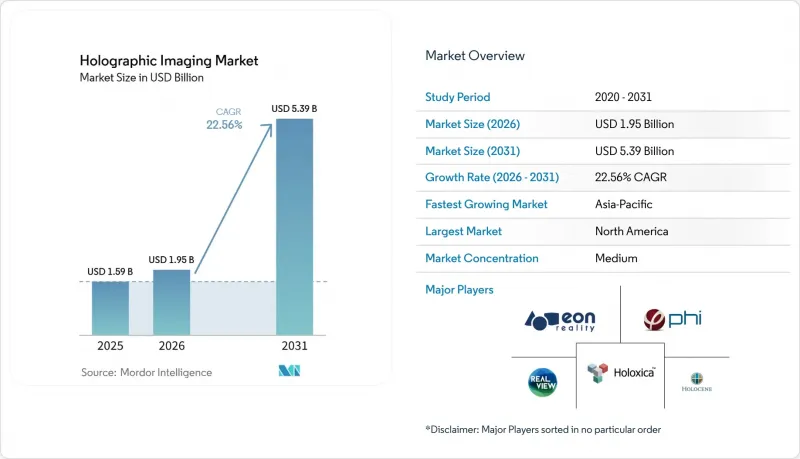
Mordor Intelligence에 의하면, 홀로그래픽 이미징 시장 규모는 2025년 15억 9,000만 달러로 평가되었고, 2026년 19억 5,000만 달러에서 2031년까지 53억 9,000만 달러로 확대될 것으로 예측되며, 2026-2031년 연평균 복합 성장률(CAGR)은 22.56%를 나타낼 전망입니다.
본 보고서는 제공 형태별(하드웨어, 소프트웨어, 서비스), 차원별(2D, 3D 홀로그래픽 이미징), 기술별(디지털, 렌즈리스 등), 용도별(의료용 이미징, 수술 계획 등), 최종 사용자별(병원, 진단실험실, 연구 기관, OEM, 산업 기업, 국방), 지역별(북미, 유럽, 아시아태평양 등)로 분류되어 있습니다. 시장 예측은 금액(달러)으로 표시되어 있습니다.
세계의 홀로그래픽 이미징 시장 동향 및 인사이트
임상 현장에서 비침습적 3D 시각화의 도입 확대
홀로그래픽 재구성을 통해 이미지 확인 시 직접 접촉하지 않고도 해부학적 구조를 입체적으로 시각화할 수 있기 때문에 비침습적 3D 시각화가 주목받고 있습니다. 2025년 5월, 『Nature Communications』에 게재된 다기관 공동 연구에 따르면, AI를 활용한 3D 재구성을 통해 폐 부문 절제술 계획 시, 특히 표준 CT 영상에서 기관지나 혈관 구조가 불분명한 경우 해부학적 변이의 식별 정확도가 향상되는 것으로 나타났습니다. 미국에서는 2025년 9월 4DMedical사의 ‘CT:VQ’ 소프트웨어가 FDA의 510(k) 승인을 획득한 후, 7개월 이내에 주요 6개 대학병원에 도입이 진행되면서 임상 현장에서의 높은 수용도와 보험 급여에 대한 신뢰감을 보여주었습니다. 또한, 심장 카테터 검사실에서도 영상 진단 장치의 위치를 조정하지 않고 복잡한 해부학적 구조를 탐색하기 위한 실시간 3D 홀로그래픽 오버레이의 사용이 시작되었으며, 시스템 가격이 높음에도 불구하고 홀로그래픽 이미징 시장의 임상적 유효성이 더욱 입증되었습니다.
AR, VR 및 공간 컴퓨팅 생태계의 확대
공간 컴퓨팅 생태계는 렌더링이 전용 하드웨어에서 보다 광범위한 혼합현실(MR) 처리 플랫폼으로 전환됨에 따라 홀로그래픽 용도의 보급 장벽을 낮추고 있습니다. 이러한 전환으로 인해 소프트웨어 개발자의 제품 출시 주기가 단축되고, 홀로그래픽 이미징 시장은 소비자용 및 기업용 AR 기기에서 생성된 구성 요소의 규모를 활용할 수 있게 됩니다. Swave Photonics는 AR 스마트 글래스 및 자동차용 디스플레이를 위한 홀로그래픽 확장 현실(XR) 플랫폼 개발을 추진하기 위해 2025년 1월에 2,700만 유로를 조달했으며, 2025년 6월에는 추가로 600만 유로를 확보했습니다. 이는 도파관 기반 홀로그래피에 대한 투자자들의 관심이 여전히 높음을 보여줍니다. 2026년 6월, Nika Optics는 톈진에 연간 생산 능력 100만 대 규모의 자동 홀로그래픽 도파관 생산 라인을 가동했으며, 톈진과 광저우를 합친 생산 능력은 130만 대에 달했습니다. 이를 통해 의료 및 산업용 시스템에 사용되는 도파관 및 광성형 부품의 도입 비용 절감이 촉진될 것입니다.
높은 시스템 비용과 제한된 병원 자본 예산
임상 등급 홀로그래피 플랫폼은 광학 시스템, 컴퓨팅 인프라, 직원 교육, 워크플로우 통합에 막대한 투자가 필요하기 때문에 높은 시스템 비용이 여전히 큰 장벽으로 작용하고 있습니다. 예산상의 과제는 초기 장비 구입에 그치지 않고, 도입 후 2년 동안은 처리 능력 확충이나 PACS 및 EHR 시스템과의 통합에 막대한 지출이 수반될 가능성이 있습니다. 이러한 압박을 배경으로 서비스 분야의 성장이 가속화되고 있습니다. 홀로그래픽 이미징 시장에서 서비스 부문은 연평균 성장률(CAGR) 24.93%로 가장 빠르게 성장하고 있는 분야이며, 각 벤더들은 고객들에게 대규모 일괄 구매에서 매니지드 서비스나 클라우드 기반 구독 모델로의 전환을 촉진하고 있습니다. 그러나 이러한 모델들은 신흥 시장의 과제를 완전히 해결하지는 못하고 있습니다. 신흥 시장에서는 대역폭 제한, 데이터 주권에 관한 규제, 그리고 상환 코드의 부재가 계속해서 조달 결정을 지연시키고 있기 때문입니다.
부문 분석
2025년, 하드웨어는 홀로그래픽 이미징 시장 점유율의 41.65%를 차지했습니다. 이는 신규 도입에 사용되는 임상용 광학 시스템, 공간 광 변조기 및 코히런트 조명 시스템이 자본 집약적이라는 특성을 반영한 것입니다. 병원, 연구소 및 산업 분야의 구매자들은 소프트웨어의 가치를 체감하기 전에 전용 물리적 시스템을 계속해서 필요로 했습니다. 많은 구매자들은 여러 공급업체의 혼합 시스템보다 검증된 구성 요소를 갖춘 풀스택 플랫폼을 선호했습니다. 포토폴리머 기록 매체, 레이저 광원 및 관련 광학 모듈에 대한 수요로 인해 하드웨어는 여전히 조달 결정의 핵심 요소로 남아 있었으나, 구매자들은 수명 주기 비용, 가동률 및 지속적인 지원을 점점 더 중요하게 여기게 되었습니다.
서비스 부문은 가장 빠르게 성장하는 부문으로, 2031년까지 연평균 성장률(CAGR) 24.93%로 확대될 것으로 예측됩니다. 이는 홀로그래픽 이미징 시장이 정기적인 제공 모델로 전환되고 있음을 반영합니다. 관리형 서비스 계약, 클라우드 재구성 구독 및 보정 지원을 통해 공급업체는 막대한 자본 지출에 의존하지 않고 운영 예산으로 비용을 분산할 수 있습니다. 이 모델은 총 소유 비용(TCO)과 워크플로우의 연속성을 기반으로 이미징 기술을 평가하는 병원 시스템과 부합합니다. 소프트웨어는 AI 업데이트, 기능 업그레이드 및 기존 시스템 간의 통합을 통해 이러한 전환을 지원하고 있습니다. 한편, 2026년 5월과 6월에 출하가 시작된 Looking Glass Factory사의 HLD 디스플레이 제품군은 내장형 소프트웨어를 통해 컨텐츠 생성 복잡성이 완화되고 사용 가능한 하드웨어 기반이 확대되었음을 보여주었습니다.
2025년에는 3D 홀로그래픽 이미징이 매출의 69.23%를 차지했으며, 홀로그래픽 이미징 시장에서 주도적인 분야가 되었습니다. 이러한 수요는 의료 영상 진단, 수술 내비게이션 및 산업용 워크플로우에서 깊이 분해능을 갖춘 시각화에 기인한 것으로, 이러한 분야에서는 평면적인 렌더링만으로는 공간적 맥락을 충분히 파악할 수 없습니다. 임상의와 산업 사용자들은 실제 작업 환경에서 복잡한 구조를 더 잘 해석하기 위해 3D 시스템을 선호하여 채택했습니다. 또한, 이 부문의 규모는 보다 제한적인 디스플레이나 보안 용도에 초점을 맞춘 대체 기술에 비해 검증 과정이 더 철저하고 기술적 성숙도도 높다는 점을 반영하고 있습니다.
3D 홀로그래픽 이미징은 가장 빠르게 성장하는 분야이기도 하며, 2031년까지 연평균 성장률(CAGR) 26.67%로 확대될 것으로 예상되어, 최대 규모의 부문이 가장 빠른 속도로 성장세를 보이고 있음을 보여줍니다. 이러한 동향은 홀로그래픽 이미징 시장이 가장 강력한 이용 사례를 뒷받침하는 포맷을 중심으로 심화되고 있음을 보여줍니다. RealView Imaging사가 2026년에 출원한, 구조적 심장 복원 수술에서의 실시간 융합 홀로그래픽 시각화에 관한 특허 출원은 3D 기술이 1초 미만의 수술 수준 렌더링 요구 사항을 충족하기 위해 얼마나 발전했는지를 보여줍니다. 반면, 2D 홀로그래픽 이미징은 보안 라벨, 인증 및 장식용 산업 분야에서 여전히 중요하며, 이러한 분야에서는 저렴한 비용으로 깊이감의 부족을 보완할 수 있습니다.
지역별 분석
북미는 2025년 홀로그래픽 이미징 시장 점유율의 40.56%를 차지했으며, 지역 내 주도적 지위를 유지했습니다. 이 지역은 FDA 승인을 받은 플랫폼, 학술 의료 센터의 밀집된 네트워크, 그리고 기술 공급업체 및 구매자에게 유리한 자금 조달 환경 등의 혜택을 누리고 있습니다. FDA의 승인 절차는 임상적 근거가 명확한 경우 상용화를 가속화했습니다. 그 예로, 4D Medical사의 CT:VQ가 2025년 9월에 510(k) 승인을 획득한 후, 7개월 이내에 미국 내 주요 6개 대학 병원으로 도입이 확대된 것을 들 수 있습니다. 또한 미국에서는 일류 병원에 그치지 않고, 2026년 5월의 상업 계약을 통해 10개 주에 위치한 170곳 이상의 SimonMed 외래 센터에 첨단 영상 기술이 도입되어, 일상적인 외래 진료 현장에서의 보급이 확대되고 있음이 확인되었습니다.
유럽은 홀로그래픽 이미징 시장에서 여전히 2위 지역 블록이며, 독일, 영국, 프랑스가 주요 수요 거점입니다. 독일은 정밀 광학 클러스터를 통해 도입과 공급을 지원하고 있으며, 이를 통해 제조거점의 견고함과 연구 기관 및 산업 사용자 간의 강력한 연계가 이루어졌습니다. EU 의료기기 규정(MDR)에 따라 진단 플랫폼의 상용화까지 소요되는 기간이 12-24개월 연장되었으나, 반면 규제 준수를 거친 후 구매자들의 신뢰는 높아졌습니다. 이러한 동향은 2026년 3월 4DMedical사가 CT:VQ의 CE 마크 인증을 획득하고, 유럽 내 사업 확장을 지원하기 위해 8,300만 호주 달러 규모의 제3자 배정 증자를 발표했을 때 그 중요성이 더욱 부각되었습니다.
아시아태평양은 가장 빠르게 성장한 지역으로, 연평균 성장률(CAGR) 23.56%를 기록하며 지역별 홀로그래픽 이미징 시장 규모에서 가장 강력한 성장세를 보였습니다. 중국은 광학 제조 규모와 AR 및 의료용 홀로그래피에 사용되는 주요 부품에 대한 전략적 지배력 강화를 결합함으로써 중요한 역할을 수행했습니다. 2026년 6월, Nika Optics가 톈진에서 연간 생산 능력 100만 대, 톈진과 광저우를 합쳐 총 130만 대 규모의 자동 도파관 생산 라인을 가동한 것은 이러한 공급 측면의 강점을 여실히 보여주었습니다. 일본과 한국은 반도체 및 포토닉스 생태계를 통해 수요를 뒷받침한 반면, 인도는 도입 초기 단계에 머물러 병원 주도보다는 연구 주도적인 경향이 강했습니다. 중동 및 아프리카 및 남미는 전체적으로 기여도가 낮았으나, GCC 국가들의 병원 현대화와 브라질의 민간 병원 네트워크 덕분에 홀로그래픽 이미징 시장의 장기적인 형성에 중요한 특정 수요 집적지가 형성되었습니다.
기타 혜택 :
- 엑셀 형식 시장 예측(ME) 시트
- 3개월간의 애널리스트 지원
자주 묻는 질문
목차
제1장 서론
제2장 조사 방법
제3장 주요 요약
제4장 시장 구도
제5장 시장 규모 및 성장 예측
제6장 경쟁 구도
제7장 시장 기회 및 향후 전망
AJY 26.08.07According to Mordor Intelligence, the holographic imaging market size is projected to expand from USD 1.59 billion in 2025 and USD 1.95 billion in 2026 to USD 5.39 billion by 2031, registering a CAGR of 22.56% between 2026 to 2031.
This report is Segmented by Offering (Hardware, Software, Services), Dimension (2D, 3D Holographic Imaging), Technology (Digital, Lensless, and More), Application (Medical Imaging, Surgical Planning, and More), End User (Hospitals, Diagnostic Labs, Research Institutes, Oems, Industrial Enterprises, Defense), and Geography (North America, Europe, Asia-Pacific, and More). Market Forecasts are in Value (USD).
Global Holographic Imaging Market Trends and Insights
Rising Adoption of Non-Invasive 3D Visualization in Clinical Settings
Non-invasive 3D visualization is gaining traction as holographic reconstruction gives clinicians a volumetric view of anatomy without requiring direct contact during image review. In May 2025, a multicenter study in Nature Communications showed that AI-driven 3D reconstruction improved the identification of anatomical variants during lung segmentectomy planning, particularly when standard CT views left bronchial and vascular structures unclear. In the United States, FDA 510(k) clearance for 4DMedical's CT:VQ software in September 2025, followed by deployment across six leading academic medical centers within seven months, indicated stronger clinical willingness and reimbursement confidence. Cardiac catheterization labs also started using real-time 3D holographic overlays to navigate complex anatomy without repositioning imaging equipment, strengthening the clinical case for the holographic imaging market despite high system prices.
Expansion of AR, VR, and Spatial Computing Ecosystem
The spatial computing ecosystem is lowering the distribution barrier for holographic applications as rendering increasingly shifts from dedicated hardware to broader mixed-reality processing platforms. This shift shortens launch cycles for software developers and helps the holographic imaging market leverage component scale created by consumer and enterprise AR devices. Swave Photonics raised EUR 27 million in January 2025 and secured an additional EUR 6 million in June 2025 to advance its holographic extended reality platform for AR smart glasses and automotive displays, indicating continued investor interest in waveguide-based holography. In June 2026, Nika Optics launched an automated holographic waveguide line with an annual capacity of 1 million units in Tianjin and a combined 1.3 million units across Tianjin and Guangzhou, supporting lower input costs for waveguides and light-shaping components used in medical and industrial systems.
High System Cost and Limited Hospital Capital Budgets
High system costs remain a significant barrier, as clinical-grade holographic platforms require substantial investment in optics, computing infrastructure, staff training, and workflow integration. The budget challenge extends beyond the initial device purchase, as the first two years of ownership can involve major spending on processing capacity and integration with PACS and EHR systems. This pressure supports the growth of the services segment, the fastest-growing offering in the holographic imaging market at a CAGR of 24.93%, as vendors shift customers from large one-time purchases to managed-service and cloud-based subscription models. However, these models do not fully address challenges in emerging markets, where bandwidth limitations, data-sovereignty regulations, and the lack of reimbursement codes continue to slow procurement decisions.
Other drivers and restraints analyzed in the detailed report include:
- Growing Use in Surgical Planning and Medical Training
- Integration of AI for Image Reconstruction and Interpretation
- Complex Calibration, Data Processing, and Integration Challenges
For complete list of drivers and restraints, kindly check the Table Of Contents.
Segment Analysis
Hardware held 41.65% of the holographic imaging market share in 2025, reflecting the capital-intensive nature of clinical optics, spatial light modulators, and coherent illumination systems used in new deployments. Hospitals, laboratories, and industrial buyers continued to require dedicated physical systems before realizing software value. Many buyers preferred full-stack platforms with validated components over mixed systems from multiple vendors. Demand for photopolymer recording media, laser sources, and related optical modules kept hardware central to procurement decisions, although buyers increasingly prioritized lifecycle cost, uptime, and ongoing support.
Services is the fastest-growing segment and is forecast to advance at a 24.93% CAGR through 2031, reflecting the holographic imaging market's shift toward recurring delivery models. Managed-service contracts, cloud reconstruction subscriptions, and calibration support help vendors distribute costs across operating budgets rather than relying on large capital purchases. This model aligns with hospital systems that assess imaging technology based on total cost of ownership and workflow continuity. Software supports this transition through AI updates, feature upgrades, and integration across installed systems, while Looking Glass Factory's HLD display line, which started shipping in May and June 2026, showed how embedded software reduced content-generation complexity and expanded the usable hardware base.
3D holographic imaging accounted for 69.23% of revenue in 2025, making it the leading dimension in the holographic imaging market. Demand came from depth-resolved visualization in medical imaging, surgical navigation, and industrial workflows, where flat renderings provide limited spatial context. Clinicians and industrial users favored 3D systems because they improved the interpretation of complex structures in real working environments. The segment's scale also reflected stronger validation and technical maturity than alternatives focused on narrower display or security applications.
3D holographic imaging is also the fastest-growing dimension and is expected to expand at a 26.67% CAGR through 2031, showing that the largest segment is also gaining momentum at the fastest rate. This trend indicates that the holographic imaging market is deepening around the format with the strongest use case support. RealView Imaging's 2026 patent application for real-time fused holographic visualization in structural heart repair showed how 3D capability advanced toward sub-second, procedure-level rendering requirements. In comparison, 2D holographic imaging remains relevant in security labels, authentication, and decorative industrial applications, where lower cost can offset the absence of depth.
Complete Report Scope:
- By Offering
- Hardware
- Software
- Services
- By Dimension
- 2D Holographic Imaging
- 3D Holographic Imaging
- By Technology
- Digital Holography
- Lensless Holography
- Laser-Based Holography
- Computer-Generated Holography
- By Application
- Medical Imaging
- Surgical Planning and Navigation
- Medical Education and Training
- Industrial Inspection and Metrology
- Consumer Electronics and Displays
- Research and Academic Imaging
- Others
- By End User
- Hospitals and Clinics
- Diagnostic Laboratories
- Research and Academic Institutes
- Original Equipment Manufacturers
- Industrial Enterprises
- Defense Organizations
- By Geography
- North America
- United States
- Canada
- Mexico
- Europe
- Germany
- United Kingdom
- France
- Italy
- Spain
- Rest of Europe
- Asia-Pacific
- China
- India
- Japan
- Australia
- South Korea
- Rest of Asia-Pacific
- Middle East and Africa
- GCC
- South Africa
- Rest of Middle East and Africa
- South America
- Brazil
- Argentina
- Rest of South America
- North America
Geography Analysis
North America held 40.56% of the holographic imaging market share in 2025, maintaining its regional leadership. The region benefited from FDA-cleared platforms, a dense network of academic medical centers, and stronger capital access for technology vendors and buyers. The FDA pathway accelerated commercialization when clinical evidence was clear, as seen when 4DMedical's CT:VQ received 510(k) clearance in September 2025 and expanded into six major US academic medical centers within seven months. The United States also moved beyond elite hospitals, with a May 2026 commercial agreement placing advanced imaging technology across more than 170 SimonMed outpatient centers in 10 states, indicating broader adoption in routine ambulatory settings.
Europe remained the second-largest regional bloc in the holographic imaging market, with Germany, the United Kingdom, and France serving as the main demand centers. Germany supported adoption and supply through its precision optics clusters, which provided manufacturing depth and strong links between research institutions and industrial users. The EU Medical Device Regulation extended commercialization timelines by 12 to 24 months for diagnostic platforms, while improving purchaser confidence after compliance. This trend gained relevance in March 2026 when 4DMedical received CE Mark certification for CT:VQ and announced an AUD 83 million private placement to support European expansion.
Asia-Pacific was the fastest-growing region and expanded at a CAGR of 23.56%, giving it the strongest momentum in the holographic imaging market size by geography. China played an important role by combining optical manufacturing scale with increasing strategic control over key components used in AR and medical holography. Nika Optics' June 2026 launch of an automated waveguide production line, with an annual capacity of 1 million units in Tianjin and 1.3 million units across Tianjin and Guangzhou, highlighted this supply-side strength. Japan and South Korea supported demand through their semiconductor and photonics ecosystems, while India remained earlier in its adoption path and more research-led than hospital-led. The Middle East and Africa and South America contributed less overall, but GCC hospital modernization and Brazil's private hospital networks created selective demand pockets that remained important to the long-term shape of the holographic imaging market.
- 4DMedical Limited
- Eon Reality Inc.
- Hologram Inc.
- Holoscene, Inc.
- HoloTech Switzerland AG
- Holoxica Limited
- Leia Display Systems, Inc.
- Leia Inc.
- Light Field Lab, Inc.
- Looking Glass Factory, Inc.
- Lyncee Tec SA
- Mach7 Technologies Limited
- MicroCloud Hologram Inc.
- NanoLive SA
- OVIZON 3D, Inc.
- Phase Holographic Imaging AB
- RealView Imaging Ltd.
- REALVIZ SA
- WiMi Hologram Cloud Inc.
- Zebra Imaging, Inc.
Additional Benefits:
- The market estimate (ME) sheet in Excel format
- 3 months of analyst support
TABLE OF CONTENTS
1 INTRODUCTION
- 1.1 Study Assumptions and Market Definition
- 1.2 Scope of the Study
2 RESEARCH METHODOLOGY
3 EXECUTIVE SUMMARY
4 MARKET LANDSCAPE
- 4.1 Market Overview
- 4.2 Market Drivers
- 4.2.1 Rising Adoption of Non-Invasive 3D Visualization in Clinical Workflow
- 4.2.2 Expansion of AR, VR, and Spatial Computing Ecosystems
- 4.2.3 Demand for High-Precision Imaging in Research and Metrology
- 4.2.4 Growing Use in Surgical Planning and Medical Training
- 4.2.5 Integration of AI for Image Reconstruction and Interpretation
- 4.2.6 Miniaturization of Holographic Optics for Portable Devices
- 4.3 Market Restraints
- 4.3.1 High System Cost and Limited Hospital Capital Budgets
- 4.3.2 Complex Calibration, Data Processing, and Integration Requirements
- 4.3.3 Limited Clinical Standardization and Reimbursement Pathways
- 4.3.4 Under-Reported, Fragmented Supply Chain for Specialized Optical Components
- 4.4 Value/Supply Chain Analysis
- 4.5 Technological Outlook
- 4.6 Regulatory Landscape
- 4.7 Porter's Five Forces Analysis
- 4.7.1 Bargaining Power of Suppliers
- 4.7.2 Bargaining Power of Buyers
- 4.7.3 Threat of New Entrants
- 4.7.4 Threat of Substitutes
- 4.7.5 Industry Rivalry
5 MARKET SIZE and GROWTH FORECASTS (VALUE, USD)\
- 5.1 By Offering
- 5.1.1 Hardware
- 5.1.2 Software
- 5.1.3 Services
- 5.2 By Dimension
- 5.2.1 2D Holographic Imaging
- 5.2.2 3D Holographic Imaging
- 5.3 By Technology
- 5.3.1 Digital Holography
- 5.3.2 Lensless Holography
- 5.3.3 Laser-Based Holography
- 5.3.4 Computer-Generated Holography
- 5.4 By Application
- 5.4.1 Medical Imaging
- 5.4.2 Surgical Planning and Navigation
- 5.4.3 Medical Education and Training
- 5.4.4 Industrial Inspection and Metrology
- 5.4.5 Consumer Electronics and Displays
- 5.4.6 Research and Academic Imaging
- 5.4.7 Others
- 5.5 By End User
- 5.5.1 Hospitals and Clinics
- 5.5.2 Diagnostic Laboratories
- 5.5.3 Research and Academic Institutes
- 5.5.4 Original Equipment Manufacturers
- 5.5.5 Industrial Enterprises
- 5.5.6 Defense Organizations
- 5.6 By Geography
- 5.6.1 North America
- 5.6.1.1 United States
- 5.6.1.2 Canada
- 5.6.1.3 Mexico
- 5.6.2 Europe
- 5.6.2.1 Germany
- 5.6.2.2 United Kingdom
- 5.6.2.3 France
- 5.6.2.4 Italy
- 5.6.2.5 Spain
- 5.6.2.6 Rest of Europe
- 5.6.3 Asia-Pacific
- 5.6.3.1 China
- 5.6.3.2 India
- 5.6.3.3 Japan
- 5.6.3.4 Australia
- 5.6.3.5 South Korea
- 5.6.3.6 Rest of Asia-Pacific
- 5.6.4 Middle East and Africa
- 5.6.4.1 GCC
- 5.6.4.2 South Africa
- 5.6.4.3 Rest of Middle East and Africa
- 5.6.5 South America
- 5.6.5.1 Brazil
- 5.6.5.2 Argentina
- 5.6.5.3 Rest of South America
- 5.6.1 North America
6 COMPETITIVE LANDSCAPE
- 6.1 Market Concentration
- 6.2 Market Share Analysis
- 6.3 Company Profiles (includes Global Level Overview, Market Level Overview, Core Segments, Financials as available, Strategic Information, Market Rank/Share, Products and Services, Recent Developments)
- 6.3.1 4DMedical Limited
- 6.3.2 Eon Reality Inc.
- 6.3.3 Hologram Inc.
- 6.3.4 Holoscene, Inc.
- 6.3.5 HoloTech Switzerland AG
- 6.3.6 Holoxica Limited
- 6.3.7 Leia Display Systems, Inc.
- 6.3.8 Leia Inc.
- 6.3.9 Light Field Lab, Inc.
- 6.3.10 Looking Glass Factory, Inc.
- 6.3.11 Lyncee Tec SA
- 6.3.12 Mach7 Technologies Limited
- 6.3.13 MicroCloud Hologram Inc.
- 6.3.14 NanoLive SA
- 6.3.15 OVIZON 3D, Inc.
- 6.3.16 Phase Holographic Imaging AB
- 6.3.17 RealView Imaging Ltd.
- 6.3.18 REALVIZ SA
- 6.3.19 WiMi Hologram Cloud Inc.
- 6.3.20 Zebra Imaging, Inc.
7 MARKET OPPORTUNITIES and FUTURE OUTLOOK
- 7.1 White-Space and Unmet-Need Assessment


