

|
시장보고서
상품코드
2099829
플렉서블 척추 임플란트 시장 : 시장 점유율 분석, 업계 동향 및 통계, 성장 예측(2026-2031년)Flexible Spinal Implants - Market Share Analysis, Industry Trends & Statistics, Growth Forecasts (2026 - 2031) |
||||||
 Mordor Intelligence
Mordor Intelligence에 의하면, 플렉서블 척추 임플란트 시장 규모는 2025년에 39억 5,000만 달러로 평가되었고, 2026년 44억 8,000만 달러에서 2031년까지 70억 6,000만 달러에 이를 것으로 예측되며, 2026-2031년 CAGR 9.51%로 성장할 전망입니다.
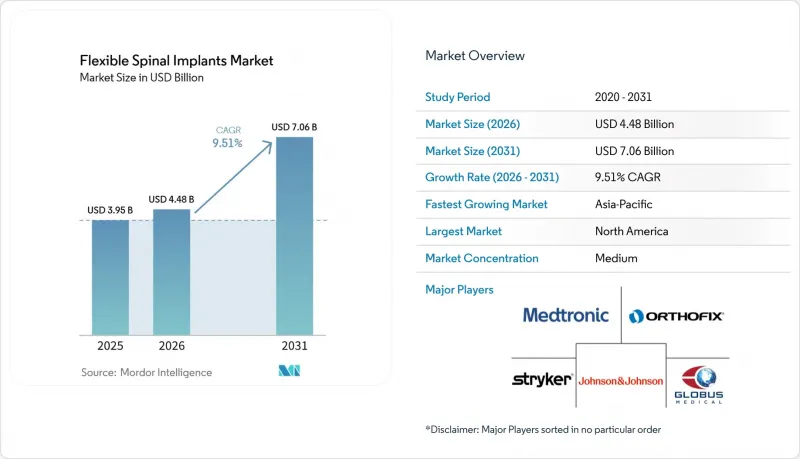
본 보고서는 유형별(후크, 로드, 플레이트 등), 제품 유형별(동적 안정화, 가동성 보존), 소재별(티타늄, PEEK 등), 적응증(요추, 경추, 흉추, 인공 추간판, 변형 교정, 기타), 최종 사용자별(병원, ASC, 척추 전문 클리닉), 지역별(북미, 유럽, 아시아태평양, 기타)로 분류되어 있습니다. 예측치는 금액(달러)으로 표시되어 있습니다.
세계의 플렉서블 척추 임플란트 시장 동향 및 인사이트
고령화에 따른 척추 질환 부담 및 재수술 대기 건수
플렉서블 척추 임플란트 시장은 만성 퇴행성 척추 질환을 앓고 있는 고령 환자 수의 지속적인 증가에 힘입어 성장하고 있으며, 이러한 수요 기반은 예측 기간 동안 유지될 전망입니다. 204개국에 걸친 질병 부담 수치는 고령화에 따라 근골격계 질환이 증가하고 있음을 보여주고 있으며, 이는 안정화, 감압 지원 및 가동성 보존 수술에 사용되는 의료기기의 수술 건수 증가를 직접적으로 뒷받침하고 있습니다. 수요의 두 번째 요인은 재수술 사례에 있습니다. 이는 이전에 경직성 고정술을 받은 많은 환자들이 인접 추간 관절에 가해지는 부하와 장기적인 기계적 제한으로 인해 새로운 시술이 필요한 단계에 도달하고 있기 때문입니다. 이러한 재수술 수요층이 중요한 이유는 재수술에서는 더 정교한 고정법의 선택이 요구되는 경우가 많으며, 이러한 사례에서는 기존의 경직된 구조를 단순히 반복하는 것이 아니라 동적 시스템의 부가가치가 높은 활용이 촉진되기 때문입니다. 이는 플렉서블 척추 임플란트 시장의 수익 구성에도 변화를 가져오고 있습니다. 왜냐하면 시장의 성장은 환자 수 증가뿐만 아니라, 복잡하고 임상적으로 선택의 폭이 넓은 수술의 비율이 높아지고 있는 데 의해서도 형성되고 있기 때문입니다. 그 결과, 수술 건수 증가와 병원의 예산 편성 속도가 일치하지 않는 경우에도 수요는 더욱 깊어지고 지속 가능한 시장이 형성되고 있습니다.
경직성 고정에서 가동성 보존으로의 전환
플렉서블 척추 임플란트 시장은 특정 환자 집단에서 가동성을 보호하고, 경직성 고정에서 나타나는 장기적인 단점을 완화하는 기기로의 명확한 임상적 전환으로부터도 혜택을 받고 있습니다. 2025년에 발표된 증거에 따르면, 연구 대상 코호트에서 동적 고정 시스템은 강성 고정과 비교하여 수술 후 경직도가 낮고, 가동 범위 유지가 양호하며, 척추 기립근의 기능 면에서도 우수한 결과를 보였습니다. 이를 통해 외과의사는 고정 전략을 결정할 때 보다 확고한 근거에 기반한 판단을 내릴 수 있게 됩니다. 장기 추적 조사 문헌에서도 여러 비교 연구를 통해 가동성 보존 수술법이 인접 추간판에서의 재수술률이 더 낮다는 사실이 입증되었으며, 이는 보험사나 의료 제공업체가 수술 후 재수술 위험이나 장기적인 기능에 더 중점을 두게 된 점과 맞물려 중요한 의미를 지닙니다. 수술 전 계획 시스템에 정렬 모델링 및 동적 구조 거동을 통합하는 사례가 늘어남에 따라, 환자와의 상담은 단기적인 안정화뿐만 아니라 기능적 회복에 중점을 두게 되었으며, 이는 플렉서블 척추 임플란트 시장을 비고정술의 선택지로 더욱 밀어붙이는 요인이 되고 있습니다. 이러한 변화는 여전히 선택적인 성격이며, 모든 적응증에서 고정술을 대체하는 것은 아니지만, 경추 및 요추 수술 모두에서 인공 관절 치환술이나 동적 안정화술의 상업적 전망을 넓혀가고 있습니다. 장기적으로는 완전한 가동성 보존 포트폴리오를 보유한 기업이 여전히 강성 임플란트에만 집중하고 있는 기업보다 더 큰 혜택을 누리게 될 것입니다.
임플란트 및 수술 비용의 고가
플렉서블 척추 임플란트 시장은 여전히 수술 비용이라는 명확한 도입 장벽에 직면해 있습니다. 특히, 고급 임플란트, 내비게이션 도구, 로봇 지원이 일상적인 척추 치료 예산 상한선을 크게 초과하는 의료 시스템에서는 이러한 경향이 두드러집니다. 고도의 가동성 보존 시스템은 이미 기기 비용이 고가이지만, 자본 집약적인 지원 기술이 수술 과정에 추가되면 치료 전체의 총비용은 더욱 상승합니다. 이러한 비용 문제는 신흥 성장 지역에서 가장 중요한 문제가 됩니다. 왜냐하면 이러한 시장은 새로운 수술 건수 증가가 예상되는 반면, 가격에 대한 민감도가 가장 높고 지불 기관의 지원도 가장 불안정한 곳이기 때문입니다. 비용 압박은 플렉서블 척추 임플란트 시장 전체에 고르게 분포되어 있는 것은 아닙니다. 성숙한 지역에서는 프리미엄 가격을 더 쉽게 흡수할 수 있는 반면, 성장 속도가 빠른 많은 의료 시스템에서는 여전히 저비용의 기존 고정 방식에 의존하고 있기 때문입니다. 이로 인해 기업들은 전 세계적인 성장을 필요로 하는 한편, 확립된 보험 환급 환경 밖에서는 프리미엄 제품의 수익성이 원활하게 전환될 것이라고 가정할 수 없는 구조적인 긴장이 발생하고 있습니다. 따라서 모듈식 제품 라인, 유연한 가격 체계, 그리고 저비용 의료 현장에 대한 현실적인 진입 경로를 갖춘 공급업체는 높은 평균 판매 가격(ASP)의 기술 번들에만 의존하는 공급업체보다 유리한 입장에 있습니다.
부문 분석
척추 임플란트 시장에서 유형별로는 페디큘러 스크류가 2025년에 매출 점유율 35.31%를 차지하며 여전히 가장 큰 점유율을 유지했습니다. 이는 후방 고정이 수술 안정성의 기반으로 남아 있는 요추, 흉추, 경추의 각 고정 경로에서 페디큘러 스크류가 중심적인 역할을 하고 있음을 반영합니다. 이러한 주도적 지위는 임상적 범용성과 관련이 있습니다. 동일한 스크류 플랫폼을 강성 구조와 동적 구조 모두에 사용할 수 있어, 광범위한 변형, 퇴행성 질환, 외상 수술에 대응할 수 있기 때문입니다. 이러한 폭넓은 적용 범위 덕분에 척추궁 나사는 외과의사의 업무 흐름과 병원의 재고 전략에 깊이 뿌리내리고 있으며, 보다 전문성이 높은 기기 범주에 비해 그 지위가 위협받기 어려운 상황에 있습니다. 전체 수술 건수를 증가시키고 있는 고령화에 따른 질병 부담 또한 이러한 시스템에 대한 수요를 뒷받침하고 있습니다. 치료 방침이 가동성 보존으로 전환되더라도 후방 고정술이 필요한 사례가 여전히 많기 때문입니다. 실제로, 척추궁 나사는 임상적으로 기초적인 역할을 수행하는 동시에 상업적으로도 적응성이 높다는 장점이 있으며, 이것이 바로 이 부문이 플렉서블 척추 임플란트 시장에서 여전히 규모 면에서 핵심 축을 이루고 있는 이유입니다.
로드는 2031년까지 연평균 성장률(CAGR) 10.38%를 기록하며, 유형별로는 가장 빠른 성장세를 보일 것으로 예측됩니다. 이는 소재 혁신과 과도한 부문 강성을 줄여주는 하중 분산 시스템으로의 광범위한 전환을 반영한 것입니다. 이러한 성장의 상당 부분은 인접 수준 주변의 생체역학적 개선을 목적으로 하는 PEEK 및 티타늄-PEEK 하이브리드 설계를 통한 기존 로드 구성의 대체와 관련이 있습니다. 또한, 플렉서블 척추 임플란트 시장에서는 해부학적 구조나 고정 전략의 제약으로 인해 나사 삽입이 어려운 특정 소아 및 흉부 기형 사례에서 후크가 계속해서 사용되고 있습니다. 플레이트는 전경부 고정에서 여전히 중요한 역할을 하고 있는 반면, ALIF, TLIF, PLIF 각 수술에 사용되는 케이지는 골유착성과 영상 진단과의 호환성을 향상시키는 다공성 티타늄 및 하이브리드 소재의 채택을 통해 진화를 거듭하고 있습니다. 스트라이커(Stryker)사의 ‘Spine Guidance 5’ 소프트웨어에 ‘Copilot’ 기능을 결합함으로써 이 분야에 새로운 차원이 더해지고 있습니다. AI를 활용한 나사 경로 지원으로 삽입의 편차가 줄어들고, 임플란트 자체뿐만 아니라 호환 가능한 고정 워크플로우의 가치도 높아지기 때문입니다. 이러한 변화들을 종합해 보면, 플렉서블 척추 임플란트 시장의 제품 구성 변화는 척추궁 나사의 대체에 기인하기보다는 이를 둘러싼 하드웨어의 보다 스마트한 통합에 의해 이루어지고 있음을 알 수 있습니다.
2025년 시점에서 동적 안정화 장치는 플렉서블 척추 임플란트 시장 규모의 45.24%를 차지했으며, 이는 경성 고정으로 인한 완전한 가동 범위 제한을 부과하지 않으면서 척추를 안정화하도록 설계된 시스템이 여전히 가장 큰 수익 기반을 형성하고 있음을 보여줍니다. 이러한 장치는 요추 협착증이나 초기 퇴행성 질환에서 확고한 임상적 입지를 구축하고 있으며, 이러한 사례에서는 외과의사가 보존적 치료와 완전한 관절 고정술 사이의 중간적인 대안을 찾는 경우가 많습니다. 이러한 상업적 강점은 수술 절차에 대한 익숙함에서도 기인합니다. 왜냐하면 동적 시스템은 일부 새로운 관절 성형술 기법보다 오랫동안 외과의사의 의사 결정 과정의 일부로 활용되어 왔기 때문입니다. 북미와 서유럽은 여전히 이 제품 카테고리에서 가장 성숙한 시장인 반면, 일부 신흥 지역의 도입 상황은 교육 기회나 현지 보험 환급 제도에 따라 여전히 좌우되고 있습니다. 이러한 성숙도 덕분에, 새로운 가동성 보존 기술이 향후 큰 주목을 받게 되더라도 동적 안정화는 플렉서블 척추 임플란트 시장에서 안정적인 기반을 유지하고 있습니다.
관절 가동성 보존 장치는 2031년까지 연평균 성장률(CAGR) 10.52%로 확대될 것으로 예측되며, 적절히 선별된 환자에서 기능 향상과 인접 추간 관절에 가해지는 부하 감소가 지속적으로 입증됨에 따라 가장 빠르게 성장하는 제품 카테고리가 되고 있습니다. 2025년 비교 연구에 따르면, 경추 및 요추의 운동 기능 보존술은 기존의 고정술에 비해 가동 범위 측면에서 더 우수한 결과를 가져오고 재수술 경향도 더 양호한 것으로 밝혀졌으며, 이는 외과의사들이 이러한 기기에 대한 신뢰를 더욱 높이고 있습니다. 따라서 플렉서블 척추 임플란트 시장은 비고정 시스템이 더 이상 도입의 주변부에 머무르지 않고, 점점 더 경쟁 전략의 중심을 형성하는 제품 구성으로 전환되고 있습니다. 척추간 임플란트나 추간관절 치환 시스템과 같은 다른 범주는 특히 플랫폼의 폭보다 간편성, 신속성 및 외래 치료에의 적합성이 중시되는 상황에서 여전히 제한적인 역할에 머물러 있습니다. 장기적으로 볼 때, 플렉서블 척추 임플란트 시장에서 성공을 거둘 제품은 단순한 최첨단 기술의 우위에만 의존하는 것이 아니라, 뛰어난 임상 성과와 업무 흐름의 간편성을 겸비한 제품이 될 가능성이 높다고 생각됩니다.
지역별 분석
2025년, 북미는 플렉서블 척추 임플란트 시장 점유율의 41.61%를 차지했으며, 높은 수술 건수, 확립된 보험 환급 제도, 그리고 선진적인 척추 센터의 밀집과 같은 요인들이 맞물려 지역별 1위 자리를 확고히 했습니다. 그중에서도 미국이 해당 지역 시장 점유율의 대부분을 차지하고 있으며, 이는 숙련된 외과의사 확보, 내비게이션 도구의 광범위한 활용, 그리고 외래 척추 치료로의 강력한 전환이 맞물려 실현된 결과입니다. 북미의 플렉서블 척추 임플란트 시장은 제품 인지도 향상을 뒷받침하는 규제 측면의 호재도 누리고 있습니다. 그 예로, 2026년 2월 FDA가 메드트로닉(Medtronic)사의 ‘Stealth AXiS’ 시스템을 승인한 것과, 해당 지역이 많은 첨단 플랫폼에 있어 최초의 상용화 발판 역할을 계속하고 있다는 점을 들 수 있습니다. CMS(미국 의료보험서비스센터)의 정책은 외래 척추 수술에 대한 보험 급여 범위를 확대함으로써 수요를 뒷받침하고 있으며, 이로 인해 ASC(외래수술센터(ASC)) 및 기타 효율적인 선택적 수술 환경에서 임플란트 수요 증가가 촉진되고 있습니다. 캐나다와 멕시코는 규모는 작지만 중요한 수요원으로 자리 잡고 있으며, 캐나다는 공공 예산의 제약을 받기 쉬운 반면, 멕시코는 사립 병원 및 의료 관광에 의한 지원이 더 큰 상황입니다.
유럽은 플렉서블 척추 임플란트 시장에서 계속해서 다음 주요 지역적 버팀목으로 자리 잡고 있습니다. 이는 고령화가 진행되고 외과 의사 수련 체계가 확립된 독일, 프랑스, 영국에 의해 뒷받침되고 있으며, 이들 국가에서는 수술 수요가 안정적입니다. 이 지역은 의료기기에 대한 규제가 엄격하기 때문에 유연성이 있는 임플란트나 가동성을 유지하는 임플란트에 대한 증거 기준이 높습니다. 이로 인해 수명 주기 관리 비용은 상승하지만, 강력한 임상 데이터 세트와 규정 준수 체계를 갖춘 대기업에게는 이점이 되기도 합니다. 독일이 두드러지는 이유는 증거 기반의 보험 급여 제도가 임상적 근거가 충분한 경우 비고정화 기술의 신중한 도입을 뒷받침하고 있기 때문입니다. 스페인, 이탈리아, 북유럽 국가들을 포함한 기타 유럽 국가들에서는 고령화 진행과 로봇 수술 및 내비게이션 지원 수술 역량에 대한 지속적인 투자를 통해 수요가 계속 확대되고 있습니다.
아시아태평양은 2031년까지 연평균 성장률(CAGR) 10.65%를 나타낼 것으로 예측되며, 중국과 인도가 3차 의료 수용 능력과 척추 수술 접근성을 지속적으로 확대함에 따라 플렉서블 척추 임플란트 시장에서 가장 빠르게 성장하는 지역 부문이 될 전망입니다. 이 지역의 성장 요인으로는 대규모 고령 인구 기반에 더해, 주요 대도시권에서 첨단 수술 인프라로의 광범위한 전환을 들 수 있습니다. 중국의 대도시권은 내비게이션 통합형 및 가동성 보존형 수술법이 더 광범위한 병원 네트워크로 보급되기 전, 초기 도입 거점으로 계속 자리매김할 전망입니다. 일본, 한국, 호주에서는 중국이나 인도만큼 도입 증가세가 극적이지는 않지만, 고도의 수술 기준과 보험 환급 제도가 이미 정비되어 있어 보다 안정적이고 고부가가치 수요층을 형성하고 있습니다. 아시아태평양 이외에서는 GCC 국가들이 계속해서 3차 의료 기관 체제 구축을 추진하고 있으며, 남미에서도 의료 제공 체제나 가격 면에서 제품 포지셔닝과 부합하는 지역에서는 선택적인 사업 확대의 여지가 남아 있습니다. 전반적으로 플렉서블 척추 임플란트 시장의 지역별 성장은 고르지 않을 것으로 보이며, 북미가 기술 발전 속도를 주도하고, 유럽이 근거 기반 기준을 형성하며, 아시아태평양이 가장 강력한 판매량 확대를 견인할 것으로 예측됩니다.
기타 혜택 :
- 엑셀 형식 시장 예측(ME) 시트
- 3개월간의 애널리스트 지원
자주 묻는 질문
목차
제1장 서론
제2장 조사 방법
제3장 주요 요약
제4장 시장 구도
제5장 시장 규모 및 성장 예측
제6장 경쟁 구도
제7장 시장 기회 및 향후 전망
AJY 26.08.11According to Mordor Intelligence, the flexible spinal implants market size is projected to be USD 3.95 billion in 2025, USD 4.48 billion in 2026, and reach USD 7.06 billion by 2031, growing at a CAGR of 9.51% from 2026 to 2031.
This report is Segmented by Type (Hooks, Rods, Plates, and More), Product Type (Dynamic Stabilization, Motion Preservation), Material (Titanium, PEEK, and More), Application (Lumbar, Cervical, Thoracic, Artificial Discs, Deformity Correction, Others), End User (Hospitals, Ascs, Specialty Spine Clinics), and Geography (North America, Europe, Asia-Pacific, and More). Forecasts are in Value (USD).
Global Flexible Spinal Implants Market Trends and Insights
Aging Spine Disease Burden And Revision Procedure Backlog
The flexible spinal implants market is being supported by a durable rise in the number of older patients living with chronic degenerative spine disorders, and that demand base is likely to stay in place through the forecast period. The burden figures across 204 countries show that musculoskeletal disease is rising with aging populations, which directly strengthens the procedure pipeline for devices used in stabilization, decompression support, and motion-preserving repair. A second layer of demand comes from revision cases, because many patients who received rigid fusion earlier are now reaching the stage where adjacent segment stress and long-term mechanical limitations require new intervention. That revision pool matters because repeat procedures often call for more nuanced fixation choices, and those cases support higher-value use of dynamic systems rather than a simple repeat of traditional rigid constructs. This also changes revenue mix inside the flexible spinal implants market, because growth is being shaped not only by a larger patient base, but also by a higher share of complex and clinically selective procedures. The result is a market where demand is becoming deeper and more persistent, even when procedure growth and hospital budgeting do not move at the same speed.
Shift From Rigid Fusion Toward Motion Preservation
The flexible spinal implants market is also benefiting from a clear clinical shift toward devices that protect motion and reduce the long-term drawbacks seen with rigid fusion in selected patient groups. Published 2025 evidence showed that dynamic fixation systems produced lower postoperative stiffness, better range of motion preservation, and stronger paraspinal muscle outcomes than rigid fusion in the studied cohort, which gives surgeons a stronger evidence base when deciding between fixation strategies. Long-term review literature also supported lower reoperation rates at adjacent segments for motion-preserving techniques in several follow-up comparisons, which matters because payers and providers are placing more weight on downstream revision risk and long-term function. As more preoperative planning systems incorporate alignment modeling and dynamic construct behavior, the discussion with patients is becoming more focused on functional recovery rather than only on short-term stabilization, and that is helping the flexible spinal implants market move further toward non-fusion options. This shift is still selective and does not replace fusion in every indication, but it is widening the commercial path for arthroplasty and dynamic stabilization across both cervical and lumbar procedures. Over time, companies with complete motion-preservation portfolios should benefit more than companies that remain centered only on rigid hardware.
High Implant And Procedure Cost
The flexible spinal implants market still faces a clear adoption barrier from procedure cost, especially in health systems where premium implants, navigation tools, and robotic support sit well above budget limits for routine spine care. Advanced motion-preserving systems already carry high device costs, and the total episode cost rises further when capital-intensive enabling technologies are added to the procedure stack. That cost issue matters most in emerging growth regions, because those are the markets expected to add new procedure volume, yet they are also the places where price sensitivity is strongest and payer support is least consistent. Cost pressure is not evenly distributed across the flexible spinal implants market, because mature regions can absorb premium pricing more easily while many faster-growing systems still depend on lower-cost conventional fixation pathways. This creates a structural tension where companies need global growth but cannot assume that premium product economics will transfer smoothly outside established reimbursement environments. Vendors with modular product lines, flexible pricing architecture, and a practical path into lower-cost care settings are therefore better positioned than vendors that rely only on high-ASP technology bundles.
Other drivers and restraints analyzed in the detailed report include:
- Expanded Use In Ambulatory Surgical Centers
- Patient-Specific Implant Design And Navigation-Enabled Planning
- Regulatory And Clinical Evidence Burden For Novel Motion-Preserving Devices
For complete list of drivers and restraints, kindly check the Table Of Contents.
Segment Analysis
Pedicle screws retained the largest position in the flexible spinal implants market by type with 35.31% revenue share in 2025, reflecting their central role across lumbar, thoracic, and cervical fixation pathways where posterior instrumentation remains the base of surgical stability. Their leadership is tied to clinical versatility, because the same screw platform can be used with rigid or dynamic constructs and can support a wide range of deformity, degenerative, and trauma procedures. That breadth keeps pedicle screws deeply embedded in surgeon workflow and hospital inventory strategy, which makes them harder to displace than more specialized device categories. The same aging-related disease burden that is increasing overall procedure volumes also reinforces demand for these systems, since posterior fixation often remains necessary even when the broader treatment philosophy shifts toward motion preservation. In practice, pedicle screws benefit from being both clinically foundational and commercially adaptable, which explains why this segment remains the scale anchor inside the flexible spinal implants market.
Rods are projected to record the fastest type-level expansion at a 10.38% CAGR through 2031, which reflects material innovation and a broader move toward load-sharing systems that reduce excessive segment stiffness. Much of this growth is linked to the substitution of conventional rod configurations with PEEK and hybrid titanium-PEEK designs that aim to improve biomechanics around adjacent levels. The flexible spinal implants market is also seeing continued use of hooks in selected pediatric and thoracic deformity cases where anatomy or construct strategy limits screw placement. Plates remain important in anterior cervical fixation, while cages across ALIF, TLIF, and PLIF procedures continue to evolve through porous titanium and hybrid material formats that improve osseointegration and imaging compatibility. Stryker's Spine Guidance 5 software with Copilot adds another layer to this segment, because AI-assisted screw trajectory support reduces placement variability and strengthens the value of compatible fixation workflows rather than only the implant itself. Taken together, these shifts show that the type mix in the flexible spinal implants market is changing less through replacement of pedicle screws and more through smarter integration of the hardware around them.
Dynamic stabilization devices held 45.24% of the flexible spinal implants market size in 2025, which shows that the largest revenue base still sits in systems designed to stabilize the spine without imposing the full motion restriction associated with rigid fusion. These devices have built an established clinical position in lumbar stenosis and early degenerative disease, where surgeons often want a middle path between conservative care and full arthrodesis. Their commercial strength also comes from procedural familiarity, because dynamic systems have been part of surgeon decision-making longer than some of the newer arthroplasty pathways. North America and Western Europe remain the most mature settings for this product category, while adoption in several newer regions is still shaped by training access and local reimbursement design. That maturity gives dynamic stabilization a stable base inside the flexible spinal implants market even as newer motion-preserving technologies attract a larger share of future attention.
Motion preservation devices are projected to expand at a 10.52% CAGR through 2031, making them the fastest-growing product category as evidence continues to support better function and lower adjacent segment stress in appropriately selected patients. Comparative literature in 2025 found that cervical and lumbar motion-preserving procedures often delivered stronger range of motion outcomes and more favorable reoperation patterns than conventional fusion, which supports broader surgeon confidence for these devices. The flexible spinal implants market is therefore moving toward a product mix where non-fusion systems no longer sit at the edge of adoption but increasingly shape center-stage competitive strategy. Other categories such as interspinous implants and facet replacement systems still hold a narrower role, especially where simplicity, speed, and outpatient suitability matter more than full platform breadth. Over time, product winners in the flexible spinal implants market are likely to be those that combine strong clinical outcomes with workflow ease, rather than those that rely only on a premium technology position.
Complete Report Scope:
- By Type
- Hooks
- Rods
- Plates
- Pedicle Screws
- Cages
- Others Types
- By Product Type
- Dynamic Stabilization Devices
- Motion Preservation Devices
- Others Product Types
- By Material
- Titanium
- PEEK
- Stainless Steel
- Other Materials
- By Application
- Lumbar
- Cervical
- Thoracic
- Artificial Discs
- Deformity Correction
- Spinal Fusion Surgery
- Trauma Treatment
- Other Applications
- By End User
- Hospitals
- Ambulatory Surgical Centers
- Specialty Spine Clinics
- Other End Users
- By Geography
- North America
- United States
- Canada
- Mexico
- Europe
- Germany
- United Kingdom
- France
- Italy
- Spain
- Rest of Europe
- Asia-Pacific
- China
- Japan
- India
- Australia
- South Korea
- Rest of Asia-Pacific
- Middle East and Africa
- GCC
- South Africa
- Rest of Middle East and Africa
- South America
- Brazil
- Argentina
- Rest of South America
- North America
Geography Analysis
North America held 41.61% of the flexible spinal implants market share in 2025, giving it the leading regional position through a combination of high procedure volumes, established reimbursement, and dense concentration of advanced spine centers. The United States accounted for the largest part of that regional base because it combines trained surgeon availability, broad use of navigation tools, and a strong shift toward outpatient spine care. The flexible spinal implants market in North America also benefits from regulatory momentum that supports product visibility, as shown by the FDA clearance of Medtronic's Stealth AXiS system in February 2026 and the region's continued role as a first commercialization step for many advanced platforms. CMS policy is reinforcing that demand by widening the outpatient spine reimbursement framework, which strengthens implant pull-through in ASCs and other efficient elective settings. Canada and Mexico add smaller but relevant volumes, with Canada constrained more by public budgeting and Mexico supported more by private hospitals and medical tourism.
Europe remains the next major regional pillar in the flexible spinal implants market, supported by Germany, France, and the United Kingdom where aging populations and established surgeon training keep procedure demand stable. The region's stricter device environment increases the evidence threshold for flexible and motion-preserving implants, which raises lifecycle management costs but also benefits larger companies with stronger clinical datasets and compliance infrastructure. Germany stands out because its evidence-driven reimbursement structure supports measured adoption of non-fusion technologies when clinical support is strong. Other European countries, including Spain, Italy, and the Nordic markets, continue to build demand through aging demographics and ongoing investment in robotic and navigation-assisted surgical capability.
Asia-Pacific is projected to grow at a 10.65% CAGR through 2031, making it the fastest-growing regional segment in the flexible spinal implants market as China and India continue to expand tertiary care capacity and spine surgery access. The region's growth case is strengthened by a large aging population base and by a broader shift toward advanced surgical infrastructure in major urban centers. China's largest city hubs are likely to remain the first point of adoption for navigation-integrated and motion-preserving procedures before those approaches spread into a wider hospital network. Japan, South Korea, and Australia provide a more stable high-value layer of demand where advanced procedure standards and reimbursement support already exist, even if adoption growth is less dramatic than in China or India. Outside Asia-Pacific, GCC countries continue to build tertiary hospital capability, and South America still offers room for selective expansion where provider infrastructure and affordability align with product positioning. Overall, regional growth in the flexible spinal implants market is likely to be uneven, with North America setting the technology pace, Europe shaping the evidence standard, and Asia-Pacific driving the strongest volume expansion.
- ATEC Spine
- ATEC Spine, Inc.
- B. Braun
- Centinel Spine
- Enovis Corporation
- Globus Medical
- Highridge Medical, Inc.
- Johnson & Johnson
- Life Spine
- Medtronic
- NuVasive
- Orthofix
- Paradigm Spine LLC
- SI-BONE, Inc.
- Spineart
- Stryker
Additional Benefits:
- The market estimate (ME) sheet in Excel format
- 3 months of analyst support
TABLE OF CONTENTS
1 Introduction
- 1.1 Study Assumptions & Market Definition
- 1.2 Scope of the Study
2 Research Methodology
3 Executive Summary
4 Market Landscape
- 4.1 Market Overview
- 4.2 Market Drivers
- 4.2.1 Aging Spine Disease Burden And Revision Procedure Backlog
- 4.2.2 Shift From Rigid Fusion Toward Motion Preservation
- 4.2.3 Expanded Use In Ambulatory Surgical Centers
- 4.2.4 Patient-Specific Implant Design And Navigation-Enabled Planning
- 4.2.5 Reimbursement Pull For Procedure Efficiency And Faster Recovery
- 4.2.6 Under-Served Degenerative And Deformity Cases In Emerging Markets
- 4.3 Market Restraints
- 4.3.1 High Implant And Procedure Cost
- 4.3.2 Regulatory And Clinical Evidence Burden For Novel Motion-Preserving Devices
- 4.3.3 Surgeon Learning Curve And Intraoperative Technique Sensitivity
- 4.3.4 Long-Term Durability And Revision Uncertainty For Non-Fusion Constructs
- 4.4 Supply Chain Analysis
- 4.5 Regulatory Landscape
- 4.6 Technological Outlook
- 4.7 Porter's Five Forces Analysis
- 4.7.1 Bargaining Power Of Suppliers
- 4.7.2 Bargaining Power Of Buyers
- 4.7.3 Threat Of New Entrants
- 4.7.4 Threat Of Substitutes
- 4.7.5 Industry Rivalry
5 Market Size & Growth Forecasts (Value, USD)
- 5.1 By Type
- 5.1.1 Hooks
- 5.1.2 Rods
- 5.1.3 Plates
- 5.1.4 Pedicle Screws
- 5.1.5 Cages
- 5.1.6 Others Types
- 5.2 By Product Type
- 5.2.1 Dynamic Stabilization Devices
- 5.2.2 Motion Preservation Devices
- 5.2.3 Others Product Types
- 5.3 By Material
- 5.3.1 Titanium
- 5.3.2 PEEK
- 5.3.3 Stainless Steel
- 5.3.4 Other Materials
- 5.4 By Application
- 5.4.1 Lumbar
- 5.4.2 Cervical
- 5.4.3 Thoracic
- 5.4.4 Artificial Discs
- 5.4.5 Deformity Correction
- 5.4.6 Spinal Fusion Surgery
- 5.4.7 Trauma Treatment
- 5.4.8 Other Applications
- 5.5 By End User
- 5.5.1 Hospitals
- 5.5.2 Ambulatory Surgical Centers
- 5.5.3 Specialty Spine Clinics
- 5.5.4 Other End Users
- 5.6 By Geography
- 5.6.1 North America
- 5.6.1.1 United States
- 5.6.1.2 Canada
- 5.6.1.3 Mexico
- 5.6.2 Europe
- 5.6.2.1 Germany
- 5.6.2.2 United Kingdom
- 5.6.2.3 France
- 5.6.2.4 Italy
- 5.6.2.5 Spain
- 5.6.2.6 Rest of Europe
- 5.6.3 Asia-Pacific
- 5.6.3.1 China
- 5.6.3.2 Japan
- 5.6.3.3 India
- 5.6.3.4 Australia
- 5.6.3.5 South Korea
- 5.6.3.6 Rest of Asia-Pacific
- 5.6.4 Middle East and Africa
- 5.6.4.1 GCC
- 5.6.4.2 South Africa
- 5.6.4.3 Rest of Middle East and Africa
- 5.6.5 South America
- 5.6.5.1 Brazil
- 5.6.5.2 Argentina
- 5.6.5.3 Rest of South America
- 5.6.1 North America
6 Competitive Landscape
- 6.1 Market Concentration
- 6.2 Market Share Analysis
- 6.3 Company Profiles (includes Global Level Overview, Market Level Overview, Core Segments, Financials as available, Strategic Information, Market Rank/Share, Products and Services, Recent Developments)
- 6.3.1 Alphatec Holdings, Inc.
- 6.3.2 ATEC Spine, Inc.
- 6.3.3 B. Braun Melsungen AG
- 6.3.4 Centinel Spine, LLC
- 6.3.5 Enovis Corporation
- 6.3.6 Globus Medical, Inc.
- 6.3.7 Highridge Medical, Inc.
- 6.3.8 Johnson & Johnson
- 6.3.9 Life Spine, Inc.
- 6.3.10 Medtronic plc
- 6.3.11 NuVasive, Inc.
- 6.3.12 Orthofix Medical Inc.
- 6.3.13 Paradigm Spine LLC
- 6.3.14 SI-BONE, Inc.
- 6.3.15 Spineart SA
- 6.3.16 Stryker Corporation
7 Market Opportunities & Future Outlook
- 7.1 White-Space and Unmet-Need Assessment


