

|
시장보고서
상품코드
2114182
척추 임플란트 및 수술 기기 : 시장 점유율 분석, 업계 동향 및 통계, 성장 예측(2026-2031년)Spinal Implants And Surgical Devices - Market Share Analysis, Industry Trends & Statistics, Growth Forecasts (2026 - 2031) |
||||||
 Mordor Intelligence
Mordor Intelligence에 의하면, 척추 임플란트 및 수술 기기 시장 규모는 2025년 135억 7,000만 달러로 평가되었습니다. 2026년에는 142억 3,000만 달러로 확대되어 2026년부터 2031년에 걸쳐 CAGR 4.86%로 성장을 지속하여, 2031년에는 180억 5,000만 달러에 이를 것으로 예측됩니다.
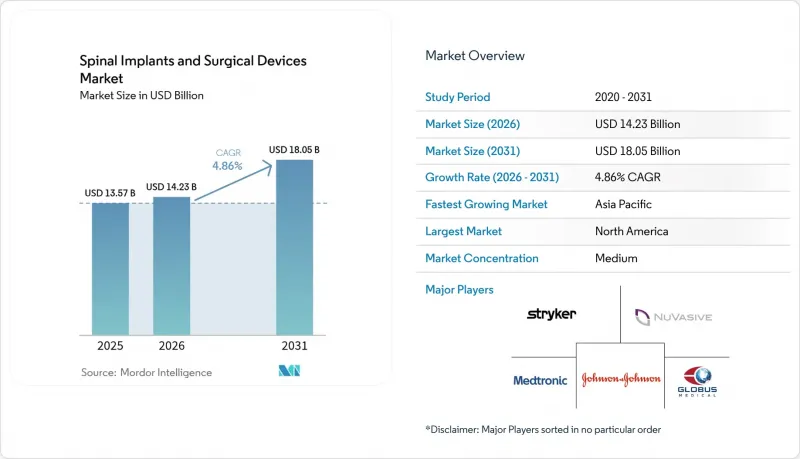
본 보고서는 기술별(척추 고정술 및 척추 유합술, 척추체 압박 골절 치료 등), 제품별(경추 고정 장치 등), 수술 방법별(개복 수술, 최소 침습 수술 등),생체재료별(티타늄 및 티타늄 합금 등), 최종 사용자별(병원, ASC 등) 및 지역별로 분류되어 있습니다. 시장 예측은 금액(달러) 기준으로 제시되어 있습니다.
세계의 척추 임플란트 및 수술 기기 시장 동향과 인사이트
척추 질환 부담 증가와 고령화
세계 평균 수명의 연장으로 인해 척추 퇴행성 질환, 압박 골절, 외상 관련 손상이 지속적으로 증가하고 있습니다. 역학 연구에 따르면, 2060년까지 척추 수술 건수는 80% 증가할 것으로 예측되며, 경피적 치료가 시행되고 있음에도 불구하고 척추체 압박 골절의 경우 이미 척추체 높이가 48.9% 감소한 것으로 나타났습니다. 미국에서 연간 발생하는 척수 손상 건수는 1만 7,000건에 달하며, 중증 사지 마비 환자의 첫해 치료비가 100만 달러를 초과함에 따라 예방 및 재건 치료 솔루션의 중요성이 더욱 커지고 있습니다. 이러한 임상적·경제적 요인으로 인해 수술 건수는 증가하고 적응증 범위는 확대되고 있으며, 보험 보상 당국은 비용 대비 효과가 높은 혁신 기술에 지속적으로 주목하고 있습니다.
척추에 대한 최소 침습 수술의 급속한 보급
내시경 및 튜브식 시술은 외시경을 통한 가시화, 투시, 내비게이션을 결합함으로써 출혈량을 줄이고, 수술 후 통증을 경감시키며, 당일 퇴원을 가능하게 합니다. 예를 들어, 요추 추간판 절제술에서의 경추간공 접근법은 개방형 미세 추간판 절제술에 비해 합병증 발생률이 낮은 것으로 나타났습니다. 외래에서 시행되는 요추 고정술은 입원 환경과 동등한 안전성을 확보하면서도 의료적 합병증이 적고, 보험사의 포괄 지급 승인을 가능하게 하고 있습니다. 이러한 임상적 성과로 인해 척추 전문 외래 센터로의 전환이 가속화되고 있으며, 각 벤더사는 해부학적으로 좁은 경로에 대응할 수 있도록 내비게이션 소프트웨어를 개선해야 하는 상황에 직면해 있습니다.
임플란트 및 내비게이션 시스템의 고액 도입 비용
최고급 로봇 수술 시스템이나 내비게이션 시스템의 도입 비용은 100만 달러를 초과하며, 조사 대상 외과의사의 77%가 가격을 가장 큰 장벽으로 꼽았습니다. 수술당 비용 부담도 큰 과제로 대두되고 있습니다. 요추 추간판 치환술 비용은 2만-7만 달러 범위이며, 척수 자극 요법은 추가 비용을 제외하더라도 5만 달러에 달할 가능성이 있습니다. 연간 유지보수 계약, 직원 교육, 수술실 재설계 등이 총 소유 비용을 끌어올려, 외래수술센터(ASC)나 신흥국에서의 도입 결정을 지연시키고 있습니다.
부문별 분석
2025년에는 척추 고정술 및 고정 기술이 척추 임플란트 및 수술 기기 시장 매출의 53.94%를 차지했습니다. 운동 기능 보존 시스템 분야의 척추 임플란트 및 수술 기기 시장 규모는 연평균 8.41%의 성장률로 확대될 것으로 예상되며, 이는 각 부문별 생체역학 보존에 대한 외과의들의 관심을 반영한 것입니다. 인공 경추 추간판은 고정술에 비해 인접 추간 관절의 퇴행을 완화하는 것으로 입증되었으며, 동적 안정화는 수술 후 뻣뻣함을 완화합니다. 또한, 이 분야에서는 환자의 병태에 맞추어 한 수준에서는 추간판 치환술을, 다른 수준에서는 고정술을 결합한 하이브리드 구조도 채택되고 있습니다. 소형화, 모듈식 플레이트, 다공성 코팅은 현대 케이지의 설계상 개선점을 두드러지게 하고 있습니다. 한편, 컴퓨터를 이용한 나사 경로 계획을 통한 자동화는 고정술의 정확도를 높여, 그 현재의 우위를 더욱 공고히 하고 있습니다.
특정 적응증에서 장기적인 삶의 질(QOL)에 관한 연구가 가동성 보존을 지지하고 있기 때문에 환자의 희망이 이러한 전환을 뒷받침하고 있습니다. 22만 5,000건 이상의 이식 실적을 보유한 ‘Mobi-C’는 2레벨 병변에서 표준 ACDF ‘ZimVie Cervical’과 비교하여 비열등성이 입증되었습니다. 요추 분야에서는 ‘Prodisc L’이 25년 후 재수술률이 1% 미만임을 보여주며, 그 내구성이 입증되었습니다. 이러한 데이터를 바탕으로 각 보험사는 보험 적용 제외 항목을 재검토하고 있으며, 이로 인해 척추 임플란트 및 수술 기기 시장의 보급이 가속화될 가능성이 있습니다.
2025년 시점에서 흉추 및 요추 융합용 기기는 척추 임플란트 및 수술 기기 시장의 40.16%를 차지했으나, 비융합용 기기는 연평균 성장률(CAGR) 8.23%로 성장하고 있습니다. 다공성 및 종판에 대한 적합성을 조절할 수 있는 적층 가공 기술 덕분에 인터바디 케이지가 매출의 주축을 이루고 있습니다. PEEK-티타늄 하이브리드는 뼈에 부착하는 데 필요한 표면 거칠기를 유지하면서 X선 투과성을 개선하고 있어, 척추 임플란트 및 수술 기기 시장에서 인터바디 케이지 시장 규모가 확대될 것으로 예측됩니다. rhBMP-2와 탈회 매트릭스를 결합한 골이식 대체재는 고정 성공률을 높입니다.
적층 가공 기술을 통해 생체 모방형 격자 구조의 개발이 가능해졌습니다. 스트라이커(Stryker)사의 ‘Tritanium TL’ 케이지는 AMagine 기술을 활용하여 해면골의 구조를 재현하고 있습니다. 메드트로닉사의 ‘Adaptix’ 시스템은 Titan nanoLOCK 나노토포그래피를 통합하여 더 높은 인발 강도를 실현하고 있습니다. 척추 자극 장치는 골 형성을 촉진함으로써 이러한 하드웨어의 발전을 보완하고 있으며, 메타분석 결과 대조군의 73.7%에 비해 86.8%의 고정률을 보였습니다.
지역별 분석
2025년, 북미는 척추 임플란트 및 수술 기기 시장에서 매출 점유율 43.78%를 차지하며 시장을 주도했습니다. 견고한 보험 환급 제도, 내비게이션 기술의 조기 도입, 그리고 펠로우십을 수료한 외과 의사의 높은 집중도가 이러한 주도적 지위를 뒷받침하고 있습니다. 메디케어에 의한 외래 척추 수술의 단계적 적용 범위 확대와 FDA의 ‘획기적인 의료기기(Breakthrough Device)’ 지정에 따라 기술이 환자에게 전달되기까지의 기간이 단축되고 있습니다. 메드트로닉과 지멘스 헬스인어즈의 영상 진단 분야 제휴로 대표되는 학계와 산업계의 파트너십은 플랫폼 통합과 서비스 기준 확립으로 이어지고 있습니다.
아시아태평양은 인구 동향과 소득 변화가 수술 유형에 변화를 가져오는 가운데, 7.96%라는 가장 높은 연평균 성장률(CAGR)을 기록하고 있습니다. 중국에서는 수술 건수가 연평균 12.32% 증가하고 있으며, 겨울과 봄에 정점을 보이는 것은 선택적 수술의 예약 습관을 반영합니다. 일본 전국 규모의 JSIS-DB 레지스트리(현재 5,400건)는 치료 성과에 기반한 보험 환급을 가능하게 하고, 의료기기 설계에 정보를 제공합니다. 그러나 격차는 여전히 존재합니다. 인도네시아와 필리핀의 농촌 지역에서는 내비게이션 기술 인프라가 부족하여, 공급업체의 지원 활동과 교육 지원금이 필요합니다.
유럽은 재정적 신중함과 증거에 기반한 도입 사이의 균형을 유지하면서 안정적인 추세를 보이고 있습니다. 유럽 규제 당국이 장기적인 추적 조사를 요구하고 있어 시장 출시까지의 기간이 길어지고 있습니다. 그럼에도 불구하고 독일과 프랑스에서는 보험사가 DRG(진단 관련 그룹) 재편을 지지하고 있어 외래 수술 건수가 증가하고 있습니다. 라틴아메리카 및 중동 및 아프리카는 현재 한 자릿수 수준의 매출만을 차지하고 있으나, 미개척 시장의 성장이 기대되고 있습니다. 아프리카에서는 사례의 96.5%에서 투시 검사가 사용되고 있으며, NGO가 지원하는 외과 의사 연수와 더불어 저비용 내비게이션 솔루션의 발판이 될 것입니다.
기타 혜택 :
- 엑셀 형식 시장 예측(ME) 시트
- 3개월간의 애널리스트 지원
자주 묻는 질문
목차
제1장 서론
제2장 조사 방법
제3장 주요 요약
제4장 시장 구도
제5장 시장 규모 및 성장 예측
제6장 경쟁 구도
제7장 시장 기회 및 향후 전망
KTH 26.08.28According to Mordor Intelligence, the spinal implants and surgical devices market size is expected to grow from USD 13.57 billion in 2025 to USD 14.23 billion in 2026 and is forecast to reach USD 18.05 billion by 2031 at 4.86% CAGR over 2026-2031.
This report is Segmented by Technology (Spinal Fusion and Fixation, Vertebral Compression Fracture Treatment, and More), Product (Cervical Fusion Devices and More), by Type of Surgery (Open Surgery, and Minimally-Invasive Surgery), Biomaterial (Titanium & Titanium-Alloy, and More), End User (Hospitals, Ascs and More) and Geography. The Market Forecasts are Provided in Terms of Value (USD).
Global Spinal Implants And Surgical Devices Market Trends and Insights
High Burden of Spinal Disorders and Aging Population
Global life expectancy gains create a sustained rise in degenerative spine conditions, compression fractures, and trauma-related injuries. Epidemiological studies project an 80% increase in spine surgery volume by 2060, with vertebral compression fractures already showing 48.9% vertebral-height deterioration despite percutaneous treatments. Annual U.S. spinal cord injury incidence stands at 17,000 cases, and first-year costs for high tetraplegia surpass USD 1 million, reinforcing the imperative for preventive and reconstructive solutions. These clinical and economic factors lift procedure counts, broaden indications, and keep reimbursement authorities focused on cost-effective innovations.
Rapid Uptake of Minimally Invasive Procedures for Spine
Endoscopic and tubular techniques combine exoscope visualization, fluoroscopy, and navigation to lower blood loss, reduce postoperative pain, and facilitate same-day discharge. A transforaminal approach for lumbar discectomy, for example, shows lower complication rates than open microdiscectomy. Outpatient lumbar fusion delivers safety comparable to inpatient settings with fewer medical complications, enabling payer endorsement of bundled payments. These clinical outcomes accelerate the shift toward dedicated spine ambulatory centers and push vendors to refine navigation software for constrained anatomical corridors.
High Implant & Navigation Capital Costs
Acquiring a top-tier robotic or navigation suite surpasses USD 1 million, and 77% of surveyed surgeons cite price as the primary barrier. Procedure-level economics also bite: lumbar disc replacement ranges USD 20,000-70,000, and spinal cord stimulation can hit USD 50,000 before add-ons. Annual service contracts, staff training, and OR redesign raise total cost of ownership, delaying procurement decisions in ambulatory centers and emerging nations.
Other drivers and restraints analyzed in the detailed report include:
- Technological Advancement in Spinal Implants and Surgical Devices
- Growing Demand for Outpatient and Ambulatory Spine Surgeries
- Stringent Multi-Jurisdiction Regulatory Approvals
For complete list of drivers and restraints, kindly check the Table Of Contents.
Segment Analysis
Spinal fusion and fixation technologies commanded 53.94% of spinal implants and surgical devices market revenue in 2025. The spinal implants and surgical devices market size for motion-preservation systems is forecast to advance at an 8.41% CAGR, reflecting surgeon interest in preserving segmental biomechanics. Evidence shows artificial cervical discs reduce adjacent-segment degeneration versus fusion, while dynamic stabilization mitigates postoperative stiffness. The field also witnesses hybrid constructs that blend disc arthroplasty at one level and fusion at another, matching patient pathology. Smaller footprints, modular plating, and porous coatings underscore design improvements in contemporary cages. Meanwhile, automation through computer-planned screw trajectories raises fusion accuracy, reinforcing its present dominance.
Patient preferences fuel the transition as long-term quality-of-life studies favor motion preservation for select indications. Mobi-C, with more than 225,000 implants, demonstrates non-inferiority for two-level disease compared with standard ACDF ZimVie Cervical. In the lumbar arena, Prodisc L shows sub-1% reoperation after 25 years, validating durability. These data prompt insurers to revisit coverage exclusions, potentially speeding adoption in the spinal implants and surgical devices market.
Thoracic and lumbar fusion devices provided 40.16% of spinal implants and surgical devices market share in 2025, yet non-fusion counterparts grow at an 8.23% CAGR. Interbody cages headline revenue thanks to additive manufacturing that tailors porosity and endplate fit. The spinal implants and surgical devices market size for interbody cages is projected to rise as PEEK-titanium hybrids address radiolucency while maintaining surface roughness for bone adhesion. Bone graft substitutes combining rhBMP-2 and demineralized matrix inflate fusion probability.
Additive manufacturing unlocks biomimetic lattices; Stryker's Tritanium TL cage uses AMagine to mirror cancellous bone architecture Stryker. Medtronic's Adaptix system integrates Titan nanoLOCK nanotopography to achieve higher pull-out strength. Spine stimulators complement these hardware gains by boosting osteogenesis, posting fusion rates of 86.8% versus 73.7% for controls in meta-analysis.
Complete Report Scope:
- By Technology
- Spinal Fusion & Fixation
- Vertebral Compression Fracture Treatment
- Motion Preservation / Non-fusion
- Spinal Decompression
- By Product
- Thoracic & Lumbar Fusion Devices
- Cervical Fusion Devices
- Interbody Fusion Cages
- Spine Biologics
- Non-fusion Devices
- Vertebral Compression Fracture Treatment Devices
- Spine Bone Stimulators
- By Type of Surgery
- Open Surgery
- Minimally-invasive Surgery
- By Biomaterial
- Titanium & Titanium-Alloy
- PEEK & Carbon-PEEK
- Bio-resorbable Polymers
- Porous 3-D Printed Metals
- By End User
- Hospitals
- Ambulatory Surgical Centers
- Specialty Orthopedic Clinics
- By Geography
- North America
- United States
- Canada
- Mexico
- Europe
- Germany
- United Kingdom
- France
- Italy
- Spain
- Rest of Europe
- Asia-Pacific
- China
- Japan
- India
- Australia
- South Korea
- Rest of Asia-Pacific
- Middle East and Africa
- GCC
- South Africa
- Rest of Middle East and Africa
- South America
- Brazil
- Argentina
- Rest of South America
- North America
Geography Analysis
North America led the spinal implants and surgical devices market with 43.78% revenue share in 2025. Robust reimbursement frameworks, early adoption of navigation, and a high concentration of fellowship-trained surgeons sustain leadership. Medicare's incremental inclusion of outpatient spine procedures and FDA breakthrough device designations shorten the technology-to-patient timeline. Academic-industry partnerships, typified by Medtronic's imaging pact with Siemens Healthineers, integrate platforms and set service benchmarks.
Asia-Pacific posts the highest 7.96% CAGR as demographics and incomes change procedure mix. China logged a 12.32% annual rise in surgeries, with winter and spring peaks reflecting elective scheduling habits. Japan's nationwide JSIS-DB registry, now at 5,400 cases, enables outcome-based reimbursement and informs device design. Yet disparities persist: rural Indonesia and Philippines lack navigation infrastructure, requiring vendor outreach and training grants.
Europe remains steady, balancing fiscal prudence with evidence-based adoption. CE agencies demand long follow-up, thus elongating go-to-market timetables. Still, Germany and France accelerate outpatient volumes as payers endorse DRG realignments. Latin America and Middle East & Africa contribute single-digit revenue today but represent white-space growth: fluoroscopy is used in 96.5% of African cases, offering a springboard for low-cost navigation solutions accompanied by NGO-backed surgeon training.
- Medtronic
- Johnson & Johnson
- Stryker
- NuVasive
- Globus Medical
- ZimVie
- Orthofix
- RTI Surgical
- ATEC Spine
- Spineart
- B. Braun (Aesculap)
- Aurora Spine
- Centinel Spine
- SeaSpine (Orthofix)
- Xtant Medical
- K2M Group (Stryker)
- Spinal Elements
- SI-BONE
- Osseus
- Paradigm Spine
- Premia Spine
Additional Benefits:
- The market estimate (ME) sheet in Excel format
- 3 months of analyst support
TABLE OF CONTENTS
1 Introduction
- 1.1 Study Assumptions and Market Definition
- 1.2 Scope of the Study
2 Research Methodology
3 Executive Summary
4 Market Landscape
- 4.1 Market Overview
- 4.2 Market Drivers
- 4.2.1 High Burden Of Spinal Disorders And Aging Population
- 4.2.2 Rapid Uptake Of Minimally Invasive Procedures For Spine
- 4.2.3 Technological Advancement In Spinal Implants And Surgical Devices
- 4.2.4 Growing Demand For Outpatient And Ambulatory Spine Surgeries
- 4.2.5 AI-Guided Robotic Screw Placement Improving Outcomes
- 4.2.6 Growing Focus And Demand For Customizable 3d Implants
- 4.3 Market Restraints
- 4.3.1 High Implant & Navigation Capital Costs
- 4.3.2 Stringent Multi-Jurisdiction Regulatory Approvals
- 4.3.3 Shortage Of Skilled Spine Surgeons
- 4.3.4 Risk Of Surgical Complications And Implant Failure
- 4.4 Value / Supply-Chain Analysis
- 4.5 Regulatory Landscape
- 4.6 Technology Outlook
- 4.7 Porter's Five Forces Analysis
- 4.7.1 Bargaining Power of Suppliers
- 4.7.2 Bargaining Power of Buyers
- 4.7.3 Threat of New Entrants
- 4.7.4 Threat of Substitutes
- 4.7.5 Intensity of Competitive Rivalry
5 Market Size and Growth Forecasts (Value-USD)
- 5.1 By Technology
- 5.1.1 Spinal Fusion & Fixation
- 5.1.2 Vertebral Compression Fracture Treatment
- 5.1.3 Motion Preservation / Non-fusion
- 5.1.4 Spinal Decompression
- 5.2 By Product
- 5.2.1 Thoracic & Lumbar Fusion Devices
- 5.2.2 Cervical Fusion Devices
- 5.2.3 Interbody Fusion Cages
- 5.2.4 Spine Biologics
- 5.2.5 Non-fusion Devices
- 5.2.6 Vertebral Compression Fracture Treatment Devices
- 5.2.7 Spine Bone Stimulators
- 5.3 By Type of Surgery
- 5.3.1 Open Surgery
- 5.3.2 Minimally-invasive Surgery
- 5.4 By Biomaterial
- 5.4.1 Titanium & Titanium-Alloy
- 5.4.2 PEEK & Carbon-PEEK
- 5.4.3 Bio-resorbable Polymers
- 5.4.4 Porous 3-D Printed Metals
- 5.5 By End User
- 5.5.1 Hospitals
- 5.5.2 Ambulatory Surgical Centers
- 5.5.3 Specialty Orthopedic Clinics
- 5.6 By Geography
- 5.6.1 North America
- 5.6.1.1 United States
- 5.6.1.2 Canada
- 5.6.1.3 Mexico
- 5.6.2 Europe
- 5.6.2.1 Germany
- 5.6.2.2 United Kingdom
- 5.6.2.3 France
- 5.6.2.4 Italy
- 5.6.2.5 Spain
- 5.6.2.6 Rest of Europe
- 5.6.3 Asia-Pacific
- 5.6.3.1 China
- 5.6.3.2 Japan
- 5.6.3.3 India
- 5.6.3.4 Australia
- 5.6.3.5 South Korea
- 5.6.3.6 Rest of Asia-Pacific
- 5.6.4 Middle East and Africa
- 5.6.4.1 GCC
- 5.6.4.2 South Africa
- 5.6.4.3 Rest of Middle East and Africa
- 5.6.5 South America
- 5.6.5.1 Brazil
- 5.6.5.2 Argentina
- 5.6.5.3 Rest of South America
- 5.6.1 North America
6 Competitive Landscape
- 6.1 Market Concentration
- 6.2 Market Share Analysis
- 6.3 Company profiles (includes Global level Overview, Market level overview, Core Segments, Financials as available, Strategic Information, Market Rank/Share for key companies, Products and Services, and Recent Developments)
- 6.3.1 Medtronic plc
- 6.3.2 Johnson & Johnson
- 6.3.3 Stryker Corporation
- 6.3.4 NuVasive Inc.
- 6.3.5 Globus Medical Inc.
- 6.3.6 ZimVie Inc
- 6.3.7 Orthofix Holdings Inc.
- 6.3.8 RTI Surgical Inc.
- 6.3.9 Alphatec Spine Inc.
- 6.3.10 Spineart SA
- 6.3.11 B. Braun (Aesculap)
- 6.3.12 Aurora Spine
- 6.3.13 Centinel Spine
- 6.3.14 SeaSpine (Orthofix)
- 6.3.15 Xtant Medical
- 6.3.16 K2M Group (Stryker)
- 6.3.17 Spinal Elements
- 6.3.18 SI-BONE
- 6.3.19 Osseus
- 6.3.20 Paradigm Spine
- 6.3.21 Premia Spine
7 Market Opportunities and Future Outlook
- 7.1 White-Space and Unmet-Need Assessment


