

|
시장보고서
상품코드
2099831
심장 이식 시장 : 시장 점유율 분석, 업계 동향 및 통계, 성장 예측(2026-2031년)Heart Transplant - Market Share Analysis, Industry Trends & Statistics, Growth Forecasts (2026 - 2031) |
||||||
 Mordor Intelligence
Mordor Intelligence에 의하면, 심장 이식 시장 규모는 2025년 132억 5,000만 달러로 평가되었고, 2026년 145억 4,000만 달러에서 2031년까지 231억 5,000만 달러로 확대될 전망이며, 2026-2031년 CAGR 9.75%를 나타낼 것으로 예측됩니다.
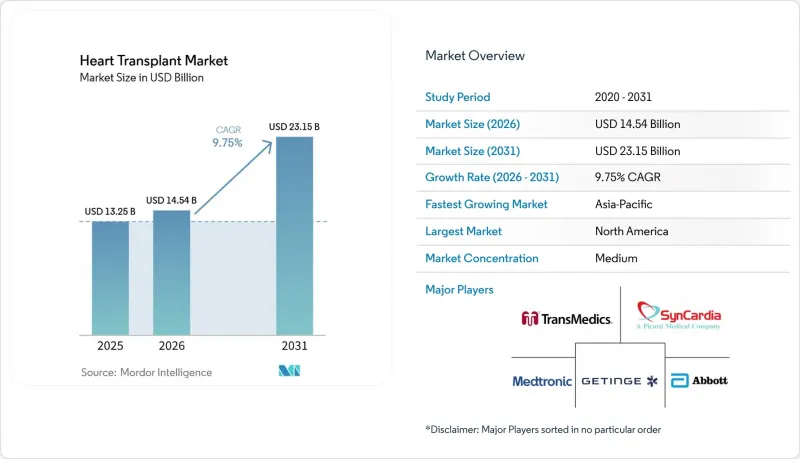
본 보고서는 수술 유형별(인공심장, 심실 보조 장치 등), 이식 유형별(동종 심장 이식, 이종 심장 이식), 용도별(말기 심부전 등), 최종 사용자별(병원 및 전문 클리닉, 심장 연구소 등), 지역별(북미, 유럽 등)로 분류되어 있습니다. 시장 전망은 금액(달러) 기준으로 제시되어 있습니다.
세계의 심장 이식 시장 동향 및 인사이트
말기 심부전의 부담 증가
말기 심부전은 심장 이식 시장의 주요 수요 기반으로 계속 자리 잡고 있습니다. 이는 말기 심부전이 가장 큰 적용 분야인 동시에 말기 환자의 가장 지속적인 공급원이기 때문입니다. 2022년, 미국에서는 심부전으로 인해 42만 5,147명이 사망했으며, 이는 심혈관 질환으로 인한 전체 사망자의 45%를 차지했습니다. 또한, 중소득국 및 중고소득국에서 20세에서 54세 연령대의 유병률이 급속히 증가하고 있어 환자층도 변화하고 있으며, 이로 인해 향후 이식 후보자 기반이 확대되고 있습니다. 2023년에는 허혈성 심장병과 고혈압성 심장병을 합친 것이 전 세계 심부전 원인의 57.1%를 차지하고 있으며, 심장 이식 시장은 여전히 더 광범위한 심혈관 질환의 부담과 밀접하게 관련되어 있습니다. 따라서, 첨단 약물 요법부터 기계적 보조 장치, 이식에 이르기까지 전 과정을 관리하는 프로그램은 복잡한 환자 흐름 속에서 더 큰 점유율을 확보할 수 있는 위치에 있습니다.
상온 관류 및 체외 보존의 보급
장기 보존이 더 이상 좁은 저온 보존 시간대에 국한되지 않게 됨에 따라, 심장 이식 시장은 크게 변화하고 있습니다. TransMedics사는 2026년 2월, 차세대 OCS ‘ENHANCE Heart’ 임상시험에 대해 FDA로부터 IDE(임상시험 승인)의 완전 승인을 획득하고, 대조군용 기기로 ‘제어 저체온 장기 보존 시스템’을 도입했습니다. 이는 첨단 보존 기술이 표준 비교 기준이 되어가고 있음을 보여줍니다. ISHLT 2026에서 발표된 PRESERVE 임상시험 데이터에 따르면, 365일 시점의 생존율은 91.4%였으며, 사례의 73.8%가 기존의 4시간 보존 기간을 초과한 것으로 나타났습니다. 이는 보다 진보된 관류 기술이 채택됨에 따라 이용 가능한 기증자 풀이 확대될 것임을 시사합니다. 조직적인 효과 또한 마찬가지로 중요합니다. 전담 장기 회수 팀을 보유한 이식 센터는 여전히 즉흥적인 외과적 회수 모델에 의존하는 센터보다 신속하고 일관성 있게 대응할 수 있기 때문입니다. 이러한 변화가 진행됨에 따라, 심장 이식 시장에서는 기기의 성능, 물류 및 조달 체계를 단일 운영 모델로 통합할 수 있는 센터나 공급업체가 높이 평가받게 될 것입니다.
뿌리 깊은 기증 심장 부족
심장 이식 시장에서 가장 큰 구조적 제약은 여전히 기증 심장 공급 부족입니다. 미국에서는 2024년에 사상 최다인 4만 8,149건의 장기 이식이 이루어졌으나, 심장 이식 건수는 4,572건에 그쳐 2023년의 4,545건에서 소폭 증가한 것에 불과합니다. 한편, 2026년 3월 기준 심장 이식 대기자 수는 4,037명이었습니다. 또한, 2024년 사망 기증자의 48.2%가 50세 이상이었기 때문에 기증자 품질 평가도 더욱 복잡해지고 있으며, 더 우수한 선별 및 보존 능력의 필요성이 높아지고 있습니다. 영국에서는 2024-2025년 성인 심장 이식 174건이 보고되었으며, 그중 28%가 DCD 기증자에 의한 것이었으나, 총 건수는 여전히 전년 대비 13% 감소한 것으로 나타나, 성숙한 시스템이라 하더라도 절대적인 공급 제한에서 벗어날 수 없음을 보여주고 있습니다. 따라서 심장 이식 시장이 실질적으로 공급 완화를 실현하기 위해서는 DCD 활용 촉진, 보존 시스템 강화, 그리고 이종 이식 등 장기적인 대체 수단에 계속 의존해야할 것입니다.
부문 분석
2025년, 심실 보조 장치(VAD)는 부문의 52.31%를 차지했으며, 수술 유형별 심장 이식 시장에서 1위를 유지했습니다. 이러한 우위는 이식 전까지의 가교 요법으로서의 역할에 더해, 기증자 심장을 즉시 이용할 수 없는 특정 사례에서 영구적인 치료법으로도 기능하고 있음을 반영합니다. 애보트(Abbott)사의 ‘HeartMate 3(HM3)’는 이 지위의 핵심을 계속해서 차지하고 있습니다. 이는 HM3 SWIFT 임상시험을 통해 개흉술이 비열등한 이식 경로로 입증됨에 따라 다양한 수술 환경에서 사용 범위가 확대되었기 때문입니다. 심장 이식 시장의 이 분야에서 현재의 균형은 VAD에 유리하게 작용하고 있습니다. 이는 VAD가 확립된 워크플로우, 임상의의 숙련도 및 이식 후 관리 모델에 부합하기 때문입니다. 이로 인해 기술 구성이 점점 더 경쟁적으로 변해가는 상황에서도 VAD 부문공급업체들은 안정적인 기반을 확보하고 있습니다.
인공심장 시장은 2031년까지 연평균 성장률(CAGR) 11.38%를 나타낼 것으로 예측되며, 심장 이식 시장에서 가장 빠르게 확대되고 있는 수술 분야가 될 것입니다. 이러한 성장 속도는 중증 양심실 부전 환자들에게서 기증자 확보에 대한 직접적인 의존도를 낮춰주는 대안에 대한 수요를 반영하고 있습니다. 2026년 FACS Bulletin에 인용된 10년간의 임상 연구에 따르면, SynCardia사의 TAH를 이식받은 환자의 79%가 이식 시까지 생존한 반면, 다른 가교 요법의 경우 46%에 그쳤습니다. 이는 LVAD 사용이 제한되거나 금기시되는 상황에서 이 카테고리의 가치를 입증하는 것입니다. 양심실 페이싱 및 기타 수술 유형은 여전히 보다 제한적인 임상적 요구를 충족시키는 것으로, 시장 점유율 측면에서 주요 경쟁자가 되기보다는 부수적인 수익원으로 남을 가능성이 높습니다. 향후 심장 이식 시장의 수술 유형 구성은 VAD와 TAH의 조합이 더욱 공고해지는 방향으로 전환될 것으로 예측됩니다. 한쪽은 성숙한 도입 실적을 바탕으로, 다른 한쪽은 충족되지 않은 수요에 의해 주도될 것입니다.
2025년에는 동종 심장 이식이 해당 부문의 76.24%를 차지했으며, 이식 유형별로 보더라도 심장 이식 시장에서 명백한 표준 수술로 자리 잡았습니다. 이러한 주도적 지위는 오랜 기간에 걸친 임상 실무, 외과의사의 폭넓은 숙련도, 그리고 성숙한 이식 시스템 전반에 걸친 등록 데이터의 명확한 가시성에 기반을 두고 있습니다. 2024년 12월까지 1,205명의 수혜자를 대상으로 한 후향적 코호트 분석에 따르면, 표준화된 시설 내 동종 이식 프로토콜 하에서 성인의 1년 생존율은 85%였으며, 이는 치료 성과를 유지하는 데 있어 프로토콜의 엄격한 준수가 수행하는 역할을 뒷받침합니다. 이에 따라 동소성 심장 이식은 프로그램 설계, 보험사의 급여 결정, 그리고 교육 모델에서 계속해서 중심적인 위치를 차지하고 있습니다. 또한 이는 장기 보존 및 배분과 관련된 개선 사항의 상당 부분이 여전히 동소성 워크플로우에 우선적으로 반영되고 있음을 의미합니다.
이소성 심장 이식은 2031년까지 연평균 성장률(CAGR) 10.52%로 확대될 것으로 예측되며, 심장 이식 시장에서 가장 빠르게 성장하는 이식 유형이 되었습니다. 이러한 성장은 중증 폐고혈압이나 기증자와 수혜자의 체격에 현저한 불일치가 있는 환자에게 적용되기 때문이며, 이러한 사례에서는 동종 이식 수술이 초기 위험이 더 높을 가능성이 있습니다. 2024년에 발표된 연구에 따르면, 적절히 선별된 환자의 경우 이소성 이식의 이식 후 4년 생존율이 동소성 이식의 생존율과 통계적으로 차이가 없는 것으로 밝혀졌으며, 이는 해당 수술에 대한 임상적 평가를 높이는 데 기여하고 있습니다. 이러한 변화는 동소성 이식의 주도적 지위를 위협하는 것은 아니지만, 복잡한 상태의 수혜자를 치료하는 프로그램의 임상적 적용 사례를 확대하는 것입니다. 그 결과, 심장 이식 시장은 그렇지 않았다면 치료를 받지 못했을 사례에서 수술 건수를 확대하기 위한 새로운 길을 얻게 될 것입니다.
지역별 분석
2025년, 북미는 세계 시장 점유율의 41.61%를 차지했으며, 심장 이식 시장에서 지역별 1위를 기록하고 있습니다. 미국은 대규모 임상 기반과 확립된 보상 채널에 힘입어, 2024년에 OPTN의 감독 하에 4,572건의 심장 이식을 시행함으로써 계속해서 주요 견인차 역할을 하고 있습니다. 또한, CMS는 2026 회계연도 최종 IPPS 규정에서 MCC를 동반한 심장 이식에 대한 MS-DRG 001의 환급률을 20만 3,923달러로 설정함으로써 중증도가 높은 이식의 경제성을 더욱 강화했습니다. 이 체계는 기증자 물류 관리, 첨단 보존 기술, 그리고 복잡한 수술 후 관리를 대규모로 수행할 수 있는 대형 학술 의료 센터를 지속적으로 우대하는 것입니다. 북미의 심장 이식 시장 규모는 여전히 미국의 수술 건수, 인프라의 충실도, 그리고 의료기기 도입 동향과 밀접하게 연관되어 있습니다.
아시아태평양은 2031년까지 연평균 성장률(CAGR) 10.65%로 확대될 것으로 예측되며, 심장 이식 시장에서 가장 빠르게 성장하는 지역이 될 전망입니다. 중국, 일본, 인도는 각각 다른 출발점에서 수용 능력을 확대하고 있어 계속해서 주요 성장 동력으로 작용하고 있습니다. 중국에서는 병원 역량 강화와 전문의 양성이 진행되고 있으나, 규제에 기반한 투명성이 높은 수술 건수 데이터는 여전히 제한적입니다. 일본에서는 장기 기증 체계 하에서 기증자 확보가 여전히 어려운 상황이며, 이로 인해 대체적인 브리지 전략이나 고도로 전문화된 센터 모델에 대한 관심이 높아지고 있습니다. 인도에서는 대규모 민간 심장 전문 병원과 사망 기증자로부터의 장기 조달 경로 개선을 통해 활동이 착실히 확대되고 있으며, 이 지역은 심장 이식 시장에서 향후 중요한 수요 거점이 될 것입니다.
유럽은 독일, 프랑스, 영국, 스페인을 필두로 여전히 주요 이식 거점으로 자리 잡고 있습니다. 유로트랜스플랜트(Eurotransplant)를 통한 국경을 초월한 협력을 통해 회원 기관 간의 장기 공유가 촉진되고 있지만, 각국의 실적은 여전히 국내 기증자 공급량과 프로그램의 효율성에 좌우되고 있습니다. 영국에서는 2024-2025년 성인 심장 이식 174건이 보고되었으며, 그중 28%가 DCD(뇌사 후 심정지) 기증자에 의한 것이었고, 90일 생존율은 92.9%였습니다. 이는 DCD 및 NRP(비심폐정지) 활용에 있어 프로토콜이 충분히 성숙해 있음을 보여줍니다. 남미, 중동 및 아프리카에서는 여전히 공급 측면의 제약이 있지만, 역량 강화에 대한 투자가 지속되고 있어 현재의 낮은 수준에서 점차 이식 건수가 증가할 것으로 예측됩니다. 이 지역들의 심장 이식 시장은 기증자 시스템의 정비, 보험 환급 지원, 그리고 숙련된 인력 증가에 크게 좌우될 것입니다.
기타 혜택 :
- 엑셀 형식 시장 예측(ME) 시트
- 3개월간의 애널리스트 지원
자주 묻는 질문
목차
제1장 서론
제2장 조사 방법
제3장 주요 요약
제4장 시장 구도
제5장 시장 규모 및 성장 예측
제6장 경쟁 구도
제7장 시장 기회 및 향후 전망
AJY 26.08.07According to Mordor Intelligence, the heart transplant market size is projected to expand from USD 13.25 billion in 2025 and USD 14.54 billion in 2026 to USD 23.15 billion by 2031, registering a CAGR of 9.75% between 2026 to 2031.
This report is Segmented by Surgery Type (Total Artificial Heart, Ventricular Assist Devices, and More), Transplant Type (Orthotopic Heart Transplant, Heterotopic Heart Transplant), Application (End-Stage Heart Failure and More), End User (Hospitals and Specialty Clinics, Cardiac Institutes, and More), and Geography (North America, Europe, and More). The Market Forecasts are Provided in Terms of Value (USD).
Global Heart Transplant Market Trends and Insights
Rising End-Stage Heart Failure Burden
End-stage heart failure remains the main demand base for the heart transplant market because it is the largest application area and the most persistent source of late-stage patients. Heart failure contributed to 425,147 deaths in the United States in 2022, which represented 45% of all cardiovascular deaths. The patient pool is also changing because prevalence is growing faster in the 20 to 54 age band in middle and high-middle SDI countries, which broadens the future transplant candidate base. Ischemic and hypertensive heart disease together accounted for 57.1% of global heart failure etiology in 2023, so the heart transplant market is still closely tied to the larger cardiovascular disease burden. Programs that manage the full path from advanced medical therapy to mechanical support and then transplant are therefore positioned to capture a larger share of complex patient flow.
Wider Use of Normothermic Perfusion and Ex-Vivo Preservation
The heart transplant market is changing materially because organ preservation is no longer limited to a narrow cold-storage window. TransMedics received full FDA IDE approval in February 2026 for its next-generation OCS ENHANCE Heart trial and also introduced its Controlled Hypothermic Organ Preservation System as the control arm device, which shows that advanced preservation is moving toward a standard point of comparison. Data presented for the PRESERVE trial at ISHLT 2026 reported 91.4% survival at day 365 and showed that 73.8% of cases exceeded the traditional 4-hour preservation window, which points to a wider usable donor pool when more advanced perfusion is used. The organizational effect is just as important because transplant centers with dedicated organ recovery teams can move faster and with more consistency than those still depending on ad hoc surgical retrieval models. As this shift continues, the heart transplant market should reward centers and suppliers that can link device performance, logistics, and procurement discipline in one operating model.
Persistent Donor Heart Scarcity
The largest structural restraint in the heart transplant market is still the limited supply of donor hearts. The United States completed a record 48,149 organ transplants in 2024, but heart transplant volume was only 4,572, up very little from 4,545 in 2023, while the heart waiting list stood at 4,037 patients in March 2026. Donor quality is also becoming more complex because 48.2% of deceased donors in 2024 were aged 50 or older, which increases the need for better screening and preservation capability. The United Kingdom reported 174 adult heart transplants in 2024 to 2025, with 28% from DCD donors, but total volume still ran 13% below the prior year, which shows that even mature systems do not escape absolute supply limits. The heart transplant market therefore remains dependent on better DCD use, stronger preservation systems, and longer-term alternatives such as xenotransplantation before supply can loosen in a meaningful way.
Other drivers and restraints analyzed in the detailed report include:
- Greater Adoption of Mechanical Circulatory Support as Bridge-To-Transplant
- AI-Assisted Donor Matching and Graft Risk Stratification
- High Total Episode Cost, Including ICU and Long-Term Immunosuppression
For complete list of drivers and restraints, kindly check the Table Of Contents.
Segment Analysis
Ventricular Assist Devices held 52.31% of the segment in 2025, which kept them in the leading position within the heart transplant market by surgery type. Their lead reflects their role as both a bridge-to-transplant option and, in selected cases, a durable therapy when a donor heart is not immediately available. Abbott's HeartMate 3 remains central to this position because the HM3 SWIFT study supported thoracotomy as a non-inferior implant pathway, which widens use across different surgical settings. The current balance in this part of the heart transplant market favors VADs because they fit established workflows, clinician familiarity, and post-implant care models. This gives suppliers in the VAD category a stable base even as the technology mix becomes more competitive.
Total Artificial Heart is projected to grow at an 11.38% CAGR through 2031, making it the fastest-moving surgery type in the heart transplant market. That pace reflects demand for an option that reduces direct reliance on donor availability in patients with severe biventricular failure. A 10-year clinical study cited in the 2026 FACS Bulletin found that 79% of SynCardia TAH patients survived to transplantation compared with 46% on alternative bridging, which supports the category's value where LVAD use is limited or contraindicated. Biventricular pacing and other surgery types still serve narrower clinical needs, and they are likely to remain secondary revenue contributors rather than major share challengers. Over time, the surgery type mix in the heart transplant market should move toward a stronger VAD and TAH pairing, with one anchored in mature adoption and the other lifted by unmet need.
Orthotopic Heart Transplant commanded 76.24% of the segment in 2025, which made it the clear procedural standard in the heart transplant market by transplant type. Its leadership rests on long-standing clinical practice, broader surgeon familiarity, and strong registry visibility across mature transplant systems. A retrospective cohort analysis of 1,205 recipients through December 2024 reported 1-year adult survival of 85% under a standardized institutional orthotopic protocol, which reinforces the role of protocol discipline in sustaining outcomes. This keeps Orthotopic Heart Transplant at the center of program design, payer coverage decisions, and training models. It also means that most preservation and allocation improvements still flow first into orthotopic workflows.
Heterotopic Heart Transplant is projected to expand at a 10.52% CAGR through 2031, which makes it the faster-growing transplant type in the heart transplant market. Its growth comes from use in patients with severe pulmonary hypertension or marked donor-recipient size mismatch, where orthotopic procedures may carry higher early risk. Research published in 2024 found that heterotopic survival was statistically indistinguishable from orthotopic survival during the first 4 years after transplant in properly selected patients, which has supported a more favorable clinical view of the procedure. This change does not displace orthotopic leadership, but it does widen the clinical use case for programs that treat complex recipients. In turn, the heart transplant market gains an additional route for procedure growth in cases that might otherwise remain unserved.
Complete Report Scope:
- By Surgery Type
- Total Artificial Heart
- Ventricular Assist Devices
- Biventricular Pacing
- Other Surgery Types
- By Transplant Type
- Orthotopic Heart Transplant
- Heterotopic Heart Transplant
- By Application
- End-Stage Heart Failure
- Congenital Heart Disease
- Other Cardiac Conditions
- By End User
- Hospitals and Specialty Clinics
- Cardiac Institutes
- Transplant Centers
- Other End Users
- By Geography
- North America
- United States
- Canada
- Mexico
- Europe
- Germany
- United Kingdom
- France
- Italy
- Spain
- Rest of Europe
- Asia-Pacific
- China
- Japan
- India
- Australia
- South Korea
- Rest of Asia-Pacific
- Middle East and Africa
- GCC
- South Africa
- Rest of Middle East and Africa
- South America
- Brazil
- Argentina
- Rest of South America
- North America
Geography Analysis
North America held 41.61% of the global segment in 2025, which gave it the leading regional position in the heart transplant market. The United States remained the main driver because it performed 4,572 heart transplants in 2024 under OPTN oversight, supported by a large clinical base and established reimbursement channels. CMS also reinforced high-acuity transplant economics when the FY2026 Final IPPS Rule set the MS-DRG 001 reimbursement rate for heart transplant with MCC at USD 203,923. This framework continues to favor large academic centers that can manage donor logistics, advanced preservation, and complex post-operative care at scale. The heart transplant market size in North America remains strongly linked to U.S. procedure volume, infrastructure depth, and device adoption patterns.
Asia-Pacific is projected to expand at a 10.65% CAGR through 2031, making it the fastest-growing geography in the heart transplant market. China, Japan, and India remain the main growth anchors because each is scaling capacity from a different starting point. China is expanding hospital capability and specialist training, though transparent regulated volume data remain limited. Japan continues to face tight donor availability under its organ donation framework, which keeps interest high in alternative bridge strategies and highly specialized center models. India is seeing steady activity growth through large private cardiac hospitals and improved deceased donor procurement pathways, which makes the region an important future demand center in the heart transplant market.
Europe remains a major transplant base, led by Germany, France, the United Kingdom, and Spain. Cross-border coordination through Eurotransplant supports better organ sharing for member systems, while national performance still depends on domestic donor supply and program efficiency. The United Kingdom reported 174 adult heart transplants in 2024 to 2025, with 28% from DCD donors and a 90-day survival rate of 92.9%, which shows strong protocol maturity in DCD and NRP use. South America, the Middle East, and Africa remain more supply constrained, but they are still investing in capability and should add volume from lower current bases over time. The heart transplant market in these regions will depend heavily on donor system development, reimbursement support, and trained workforce growth.
- Abbott Laboratories
- Abiomed
- Astellas Pharma
- Berlin Heart
- BiVACOR
- Roche
- Getinge
- LivaNova
- Medtronic
- SynCardia Systems, LLC (Picard Medical, Inc.)
- Terumo
- Transmedics
Additional Benefits:
- The market estimate (ME) sheet in Excel format
- 3 months of analyst support
TABLE OF CONTENTS
1 Introduction
- 1.1 Study Assumptions & Market Definition
- 1.2 Scope of the Study
2 Research Methodology
3 Executive Summary
4 Market Landscape
- 4.1 Market Overview
- 4.2 Market Drivers
- 4.2.1 Rising End-Stage Heart Failure Burden
- 4.2.2 Aging Donor and Recipient Pool Complexity
- 4.2.3 Wider Use of Normothermic Perfusion and Ex-Vivo Preservation
- 4.2.4 Greater Adoption of Mechanical Circulatory Support as Bridge-To-Transplant
- 4.2.5 AI-Assisted Donor Matching and Graft Risk Stratification
- 4.2.6 CMS and Private Payer Reimbursement Support for Advanced Cardiac Programs
- 4.3 Market Restraints
- 4.3.1 Persistent Donor Heart Scarcity
- 4.3.2 High Total Episode Cost, Including ICU and Long-Term Immunosuppression
- 4.3.3 Workforce Bottlenecks in Perfusion, Procurement, and Transplant Surgery
- 4.3.4 Xenotransplantation and Advanced Preservation Regulatory Uncertainty
- 4.4 Supply Chain Analysis
- 4.5 Regulatory Landscape
- 4.6 Technological Outlook
- 4.7 Porter's Five Forces Analysis
- 4.7.1 Threat of New Entrants
- 4.7.2 Bargaining Power of Suppliers
- 4.7.3 Bargaining Power of Buyers
- 4.7.4 Threat of Substitutes
- 4.7.5 Competitive Rivalry
5 Market Size & Growth Forecasts (Value, USD)
- 5.1 By Surgery Type
- 5.1.1 Total Artificial Heart
- 5.1.2 Ventricular Assist Devices
- 5.1.3 Biventricular Pacing
- 5.1.4 Other Surgery Types
- 5.2 By Transplant Type
- 5.2.1 Orthotopic Heart Transplant
- 5.2.2 Heterotopic Heart Transplant
- 5.3 By Application
- 5.3.1 End-Stage Heart Failure
- 5.3.2 Congenital Heart Disease
- 5.3.3 Other Cardiac Conditions
- 5.4 By End User
- 5.4.1 Hospitals and Specialty Clinics
- 5.4.2 Cardiac Institutes
- 5.4.3 Transplant Centers
- 5.4.4 Other End Users
- 5.5 By Geography
- 5.5.1 North America
- 5.5.1.1 United States
- 5.5.1.2 Canada
- 5.5.1.3 Mexico
- 5.5.2 Europe
- 5.5.2.1 Germany
- 5.5.2.2 United Kingdom
- 5.5.2.3 France
- 5.5.2.4 Italy
- 5.5.2.5 Spain
- 5.5.2.6 Rest of Europe
- 5.5.3 Asia-Pacific
- 5.5.3.1 China
- 5.5.3.2 Japan
- 5.5.3.3 India
- 5.5.3.4 Australia
- 5.5.3.5 South Korea
- 5.5.3.6 Rest of Asia-Pacific
- 5.5.4 Middle East and Africa
- 5.5.4.1 GCC
- 5.5.4.2 South Africa
- 5.5.4.3 Rest of Middle East and Africa
- 5.5.5 South America
- 5.5.5.1 Brazil
- 5.5.5.2 Argentina
- 5.5.5.3 Rest of South America
- 5.5.1 North America
6 Competitive Landscape
- 6.1 Market Concentration
- 6.2 Market Share Analysis
- 6.3 Company Profiles (includes Global Level Overview, Market Level Overview, Core Segments, Financials as available, Strategic Information, Market Rank/Share, Products and Services, Recent Developments)
- 6.3.1 Abbott Laboratories
- 6.3.2 Abiomed, Inc.
- 6.3.3 Astellas Pharma Inc.
- 6.3.4 Berlin Heart GmbH
- 6.3.5 BiVACOR Inc.
- 6.3.6 F. Hoffmann-La Roche Ltd
- 6.3.7 Getinge AB
- 6.3.8 LivaNova PLC
- 6.3.9 Medtronic plc
- 6.3.10 SynCardia Systems, LLC (Picard Medical, Inc.)
- 6.3.11 Terumo Corporation
- 6.3.12 TransMedics, Inc.
7 Market Opportunities and Future Outlook
- 7.1 White-Space and Unmet-Need Assessment


