

|
시장보고서
상품코드
2099846
중동 및 아프리카의 기업 컨텐츠 관리(ECM) 시장 : 시장 점유율 분석, 업계 동향 및 통계, 성장 예측(2026-2031년)Middle East and Africa Enterprise Content Management (ECM) - Market Share Analysis, Industry Trends & Statistics, Growth Forecasts (2026 - 2031) |
||||||
 Mordor Intelligence
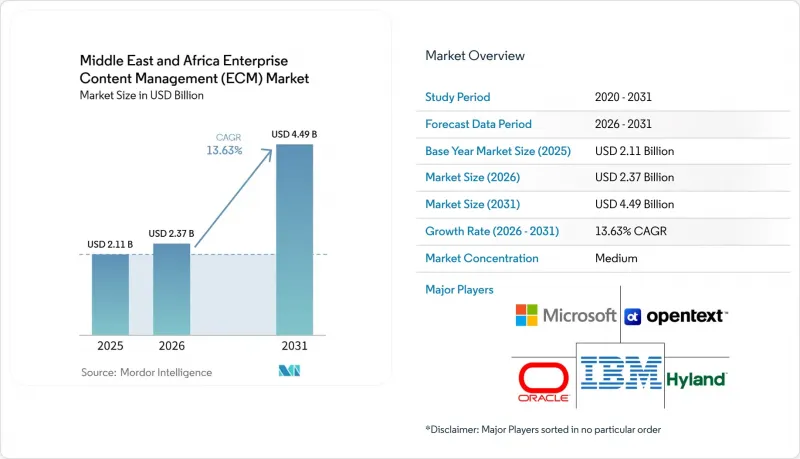
Mordor Intelligence에 의하면, 중동 및 아프리카의 기업 컨텐츠 관리(ECM) 시장 규모는 2025년 21억 1,000만 달러로 평가되었고, 2026년 23억 7,000만 달러에서 2031년까지 44억 9,000만 달러로 확대될 전망이며, 2026-2031년 CAGR 13.63%를 나타낼 것으로 예측됩니다.
본 보고서는 솔루션 유형별(문서 관리 등), 도입 형태별(온프레미스, 클라우드, 하이브리드), 기업 규모별(중소기업(SME) 및 대기업), 최종 사용자 산업별(은행, 금융서비스 및 보험(BFSI), 정부·공공 부문, 의료 등), 그리고 지역별로 분류되어 있습니다. 시장 전망은 금액(달러) 기준으로 제시되어 있습니다.
중동 및 아프리카의 기업 컨텐츠 관리(ECM) 시장 동향 및 인사이트
'클라우드 퍼스트'에 따른 공공 부문 현대화의 급속한 확대
공공 부문 수요는 중동 및 아프리카 기업 컨텐츠 관리(ECM) 시장에서 가장 뚜렷한 성장 채널 중 하나가 되고 있습니다. 이는 정부가 관리형 컨텐츠 플랫폼을 단순한 선택적 오피스 소프트웨어가 아닌 국가 디지털 인프라의 일부로 자리매김하게 되었기 때문입니다. 이러한 추세는 걸프 국가에서 가장 두드러지며, 각 부처는 문서 처리, 아카이브 관리 및 내부 워크플로우 프로세스를 부서 간 확장 가능한 클라우드 지원 환경으로 전환하고 있습니다. 하이랜드(Highland)는 2025년 8월 해당 지역에서의 사업 확장을 통해 현지 파트너를 통해 사우디아라비아의 정부 관련 기관에 ‘컨텐츠 이노베이션 클라우드(Content Innovation Cloud)’를 도입했습니다. 이는 벤더가 레퍼런스 프로젝트를 활용하여 공공 부문에서의 신뢰도를 더욱 높이고 있음을 보여주는 좋은 사례입니다. 이와 유사한 수요 패턴은 아프리카의 공공 기관으로도 확산되고 있으며, 디지털 현대화 프로그램에서는 현지 호스팅 및 보다 단순한 도입 비용 구조가 중요시되고 있습니다. 이는 벤더가 현재 두 가지 서로 다른 구매 환경에 직면해 있음을 의미합니다. 걸프 지역 구매자들은 고도의 자동화와 아랍어 지원을 원하는 반면, 많은 아프리카 공공 기관은 우선 주권 확보, 합리적인 가격, 그리고 워크플로우 관리를 중시하고 있습니다. 그 결과, 공공 조달을 통해 규제 대상 기관 전반에 걸친 단기적인 도입 규모 확대와 장기적인 플랫폼 표준화 모두를 지원하는 시장이 형성되고 있습니다.
규정 준수를 위한 디지털 기록에 대한 수요 증가
중동 및 아프리카의 기업 컨텐츠 관리(ECM) 시장에서 규정 준수는 단순한 지원 요인에서 주요 구매 동기로 변화하고 있습니다. 사우디아라비아의 개인 데이터 보호 제도와 UAE의 연방 개인정보 보호 프레임워크에 따라, 조직은 더욱 엄격한 보존 규정, 접근 거버넌스, 그리고 국경을 넘는 기록 이동에 대한 더 엄격한 관리를 요구받고 있습니다. 이러한 변화가 중요한 이유는 이메일 공유나 관리되지 않는 파일 저장소로는 규제 대상 구매자가 현재 필요로 하는 감사 추적 및 정책 제어를 제공할 수 없기 때문입니다. 두바이 의료 분야의 사례는 이러한 요구 사항이 어떻게 실무에 적용되고 있는지를 보여줍니다. NABIDH 플랫폼은 2024년 11월까지 1,300개 이상의 의료 기관에 걸쳐 950만 건 이상의 환자 기록을 통합하여, 구조화된 상호 운용성과 거버넌스가 적용된 컨텐츠 교환의 중요성을 부각시키고 있습니다. 이와 유사한 압박은 남아프리카공화국의 공공 기관 및 지방 자치 단체에서도 뚜렷하게 나타납니다. 그곳에서는 기록 시스템이 법적 규정 준수 및 서비스 제공 요건에 점점 더 부합하도록 조정되고 있습니다. 그 결과, 구매자들은 플랫폼의 필요성 여부를 묻는 데 그치지 않고, 자신이 속한 부문이나 관할 구역에 적용되는 규정을 가장 적절하게 충족하는 아키텍처를 비교 검토하고 있습니다.
레거시 ERP 및 업무 시스템과의 통합 복잡성
중동 및 아프리카의 기업 컨텐츠 관리(ECM) 시장에서 레거시 ERP 환경은 여전히 신속한 도입의 큰 장벽으로 작용하고 있습니다. 정부 기관, 유틸리티, 에너지, 금융 서비스 등 많은 대규모 조직에서는 현대적인 메타데이터 구조, 워크플로우 오케스트레이션, 혹은 AI 기반 문서 분류를 염두에 두고 설계되지 않은 수년에 걸쳐 구축된 SAP나 Oracle 환경을 여전히 운영하고 있습니다. 이로 인해 마이그레이션 시 실질적인 문제가 발생합니다. 오래된 파일 분류 체계, 프로세스 절차, 접근 정책이 현재의 컨텐츠 모델에 원활하게 매핑되는 경우는 거의 없기 때문입니다. 그 결과, 도입 작업이 대규모로 진행되고 시간이 오래 걸리며 비용도 급증하여, 서비스 비용 증가와 비즈니스 가치 실현 지연을 초래하게 됩니다. 이러한 과제는 특히 산업 분야에서 두드러집니다. 이 분야에서는 엔지니어링 파일, 플랜트 유지보수 기록, 안전 관련 문서 등이 형식과 관리 방식이 서로 다른 여러 레거시 시스템에 분산되어 저장되어 있기 때문입니다. 구매 측이 현대화를 원하더라도, 문서 흐름이 핵심 업무 시스템과 깊이 연결되어 있는 경우 이를 대체하기 어렵기 때문에 단계적으로 전환하는 경우가 많습니다.
부문 분석
2025년 중동 및 아프리카의 기업 컨텐츠 관리(ECM) 시장에서 문서 관리는 26.14%를 차지했으며, 이는 핵심 아카이브의 디지털화 및 기록 수집이 여전히 해당 지역 수요의 대부분을 차지하고 있음을 보여줍니다. 이러한 주도적인 위상은 많은 공공 기관, 은행, 의료 서비스 제공업체가 여전히 방대한 양의 종이 기반 또는 파일 공유 기반 저장소를, 보다 강력한 접근 제어 및 검색 로직을 갖춘 구조화된 시스템으로 전환하고 있다는 사실을 반영합니다. 이집트 통신·정보기술부의 OpenText Extended ECM 도입 사례는 정부가 부처 간 공통 저장소와 표준화된 분류 체계를 모색함에 있어, 문서 관리가 여전히 대규모 공공 부문 프로그램에서 중심적인 역할을 하고 있음을 보여줍니다. 이 이용 사례가 중요한 이유는 조직이 프로세스 자동화, 케이스 플로우 및 더 광범위한 상호 운용성으로 확장하기 전에 중앙 저장소가 종종 첫 번째 거버넌스 대상이 되기 때문입니다. 따라서 장기적인 계획이 훨씬 더 광범위하더라도, 문서 관리는 많은 구매자가 착수하는 출발점으로 남아 있습니다. 문서 관리는 컨텐츠 표준화, 보존 정책의 철저한 이행, 그리고 관리되지 않는 로컬 스토리지로부터의 마이그레이션을 위한 기반을 제공합니다.
워크플로우 및 비즈니스 프로세스 관리는 2031년까지 연평균 성장률(CAGR) 15.82%로 확대될 것으로 예상되며, 이 지역에서 가장 빠르게 성장하는 솔루션 분야가 될 것입니다. 이러한 변화는 특히 승인, 규정 준수 대응, 온보딩, 서비스 제공 분야에서 구매자의 우선순위가 정적 스토리지에서 컨텐츠를 활용한 프로세스 실행으로 이동하고 있음을 시사합니다. 또한, 규제 대상 기관에서는 개인정보 보호 및 거버넌스 규정에 따라 보다 명확한 보존 기간 일정과 정당성을 입증할 수 있는 감사 추적이 요구됨에 따라 기록 관리에 대한 수요도 증가하고 있습니다. 케이스 관리는 의료 및 법무 워크플로우에서 중요성이 커지고 있는 반면, 디지털 자산 관리는 관광, 미디어, 문화 컨텐츠 분야에서 입지를 넓혀가고 있습니다. 또한, 정부 및 기업이 지역 전체에 걸쳐 디지털 서비스 제공과 온라인 상호작용을 지속적으로 확대함에 따라 웹 컨텐츠 관리도 여전히 중요한 위치를 차지하고 있습니다. 이를 종합해 보면, 솔루션 구성 측면에서 시장이 여전히 견고한 리포지토리를 중시하면서도, 이러한 리포지토리를 실제 업무 워크플로우와 연동시키는 벤더를 점점 더 높이 평가하고 있음을 알 수 있습니다.
2025년 중동 및 아프리카의 기업 컨텐츠 관리(ECM) 시장 점유율 중 클라우드가 73.41%를 차지했으며, 2031년까지 연평균 성장률(CAGR) 16.24%라는 최고치를 기록할 것으로 예측됩니다. 이러한 조합은 클라우드가 오늘날의 주요 도입 모델일 뿐만 아니라, 시장의 다른 분야보다 빠르게 성장세를 보이고 있음을 보여줍니다. 그 이유는 확장성이나 인프라 부담 경감 때문만은 아닙니다. 더 큰 이유는 데이터 상주 요건 및 감사 가능성 요건이 충족되는 한, 소버린 클라우드 프레임워크가 규제 대상 부문에 대해 규정 준수를 충족하는 현대적인 도입 경로를 제공한다는 점에 있습니다. 이는 고객이 현지 관리 권한을 포기하지 않으면서도 탄력적인 인프라를 필요로 하는 BFSI(은행 및 금융 및 보험), 정부 기관, 의료, 교육 분야에서 특히 중요한 요소로 작용하고 있습니다. 또한 클라우드는 AI 서비스에 대한 신속한 접근을 가능하게 하여, 지능형 분류, 컨텐츠 검색, 자동화된 워크플로우의 비즈니스 사례를 강화합니다.
중동 및 아프리카의 기업 컨텐츠 관리(ECM) 시장에서 온프레미스 배포가 여전히 일정한 역할을 수행하는 이유는 일부 대규모 산업 및 공공 부문 구매자가 레거시 시스템, 내부 정책, 혹은 운영 기술(OT) 환경에 얽매여 있기 때문입니다. 에너지, 공공 서비스, 제조업 분야에서는 엔지니어링 파일이나 운영 문서를 기존 시스템 근처에 보관해야 하는 경우, 현지 처리가 여전히 중요하게 여겨지고 있습니다. 따라서 하이브리드 배포는 중요한 가교 모델로 자리 잡고 있습니다. 특히, 현지 클라우드 용량이 고르지 않고 조직이 관리 체계와 선택적 확장성을 모두 확보하고자 하는 아프리카 시장에서 이러한 경향은 두드러집니다. 이 경향은 구매자가 단순히 기존 모델과 새로운 모델 중 하나를 선택하고 있는 것이 아니라는 점을 의미하며, 이는 중요한 사항입니다. 오히려 많은 조직이 기밀성이 높은 컨텐츠를 관리된 환경에 배치하는 한편, 워크플로우, 검색, 분석을 보다 유연한 인프라로 이전하는 계층화된 아키텍처를 구축하고 있습니다. 이러한 모델 간 컨텐츠 연동을 지원하는 벤더는 단일 도입 경로를 추진하는 벤더에 비해 우위를 점합니다. 따라서 도입 현황을 살펴보면 클라우드가 시장을 주도하고 있는 것은 분명하지만, 국가나 최종 사용자에 관계없이 적응성이 여전히 매우 중요하다는 점이 확인됩니다.
기타 혜택 :
- 엑셀 형식 시장 예측(ME) 시트
- 3개월간의 애널리스트 지원
자주 묻는 질문
목차
제1장 서론
제2장 조사 방법
제3장 주요 요약
제4장 시장 구도
제5장 시장 개요
제6장 시장 규모 및 성장 예측
제7장 경쟁 구도
제8장 시장 기회 및 향후 전망
AJY 26.08.11According to Mordor Intelligence, the Middle East and Africa Enterprise Content Management (ECM) Market size is projected to expand from USD 2.11 billion in 2025 and USD 2.37 billion in 2026 to USD 4.49 billion by 2031, registering a CAGR of 13.63% between 2026 and 2031.
This report is Segmented by Solution Type (Document Management, and More), Deployment Mode (On-Premises, Cloud, and Hybrid), Enterprise Size (Small and Medium Enterprises (SME), and Large Enterprises), End-User Industry (BFSI, Government and Public Sector, Healthcare, and More), and Geography. The Market Forecasts are Provided in Terms of Value (USD).
Middle East and Africa Enterprise Content Management (ECM) Market Trends and Insights
Rapid Expansion of Cloud-First Public Sector Modernization
Public sector demand has become one of the clearest growth channels for the Middle East and Africa Enterprise Content Management (ECM) Market because governments now treat controlled content platforms as part of national digital infrastructure rather than optional office software. This pattern is most visible in the Gulf, where ministries are moving document handling, archive management, and internal workflow processes into cloud-aligned environments that can scale across departments. Hyland expanded its regional footprint in August 2025 and deployed its Content Innovation Cloud across Saudi government-related organizations through a local partner, demonstrating how vendors are using reference projects to gain broader public-sector credibility. The same demand pattern is also spreading into African public agencies, where digital modernization programs are placing more emphasis on local hosting and simpler deployment economics. This means vendors now face two distinct buying environments: Gulf buyers want advanced automation and Arabic-language capability, while many African agencies focus first on sovereignty, affordability, and workflow control. The effect is a market where public procurement supports both near-term volume and longer-term platform standardization across regulated institutions.
Rising Demand for Compliance-Ready Digital Records
Compliance has moved from a supporting factor to a primary buying trigger for the Middle East and Africa Enterprise Content Management (ECM) Market. Saudi Arabia's personal data protection regime and the UAE's federal privacy framework are pushing organizations toward stronger retention rules, access governance, and tighter control over cross-border record movement. That shift matters because email-based sharing and unmanaged file repositories do not provide the audit trails or policy controls that regulated buyers now need. The healthcare example in Dubai shows how this requirement has become operational, as the NABIDH platform had unified more than 9.5 million patient records across over 1,300 facilities by November 2024, underscoring the importance of structured interoperability and governed content exchange. The same pressure is evident in public agencies and municipalities in South Africa, where record systems are increasingly aligned with legal compliance and service delivery requirements. As a result, buyers are not only asking whether they need a platform, but also comparing which architecture best satisfies the rules that apply to their sector and jurisdiction.
High Integration Complexity with Legacy ERP and Line-Of-Business Systems
Legacy ERP estates remain a major barrier to faster rollouts in the Middle East and Africa Enterprise Content Management (ECM) Market. Many large organizations across government, utilities, energy, and financial services still operate long-standing SAP and Oracle environments that were not designed for modern metadata structures, workflow orchestration, or AI-ready document classification. This creates practical problems during migration because old filing taxonomies, process steps, and access policies rarely map cleanly into current content models. The result is that implementation work can become large, slow, and expensive, thereby increasing service costs and delaying business value realization. The challenge is especially evident in industrial settings, where engineering files, plant maintenance records, and safety documentation reside across multiple legacy systems with different formats and controls. Even when buyers want modernization, they often move in phases because replacing document flows is harder when those flows are deeply tied to core operational systems.
Other drivers and restraints analyzed in the detailed report include:
- AI-Based Document Classification and Retrieval Adoption
- Sovereign Data Hosting Requirements in Regulated Industries
- Uneven Data Residency Infrastructure Across The Region
For complete list of drivers and restraints, kindly check the Table Of Contents.
Segment Analysis
Document management accounted for 26.14% of the Middle East and Africa Enterprise Content Management (ECM) Market in 2025, indicating that core archive digitization and records capture still represent a large part of regional demand. This leadership reflects the fact that many public agencies, banks, and healthcare providers are still migrating large paper-based and file-share-based repositories to structured systems with stronger access controls and retrieval logic. The OpenText Extended ECM deployment for Egypt's Ministry of Communications and Information Technology demonstrates that document management remains central to large public-sector programs when governments seek a common repository and standardized taxonomy across departments. That use case matters because central repositories often become the first governed layer before organizations extend into process automation, case flows, and broader interoperability. Document management, therefore, remains the point where many buyers begin, even when their longer-term plan is much broader. It provides the foundation for content standardization, enforcement of retention policies, and migration away from unmanaged local storage.
Workflow and business process management is forecast to expand at a 15.82% CAGR through 2031, making it the fastest-growing solution area in the region. This change suggests that buyer priorities are shifting from static storage toward content-enabled process execution, especially in approvals, compliance routing, onboarding, and service delivery. Records management demand is also rising because privacy and governance rules now require clearer retention schedules and defensible audit trails in regulated institutions. Case management is gaining relevance in healthcare and legal workflows, while digital asset management is becoming more visible in tourism, media, and cultural content environments. Web content management also remains relevant because governments and enterprises continue to expand digital service delivery and online interaction across the region. Taken together, the solution mix shows a market that still values strong repositories, but increasingly rewards vendors that connect those repositories to live operational workflows.
Cloud accounted for 73.41% of the Middle East and Africa Enterprise Content Management (ECM) Market share in 2025 and is also projected to post the highest CAGR of 16.24% through 2031. This combination shows that cloud is not only the leading deployment model today but is also gaining momentum faster than the rest of the market. The reason is not only scalability or lower infrastructure effort. The stronger reason is that sovereign cloud frameworks now provide regulated sectors with a compliant route to modern deployment, provided data residency and auditability requirements are met. That has been particularly important in BFSI, government, healthcare, and education, where customers want elastic infrastructure without giving up local control. Cloud also enables faster access to AI services, strengthening the business case for intelligent classification, content search, and automated workflows.
On-premises deployment still plays a role in the Middle East and Africa Enterprise Content Management (ECM) Market because some large industrial and public-sector buyers remain tied to legacy systems, internal policies, or operational technology environments. In energy, utilities, and manufacturing, local processing continues to matter where engineering files and operational documentation must remain close to established systems. Hybrid deployment is therefore becoming an important bridge model, especially in African markets where local cloud capacity remains uneven, and organizations want to combine control with selective scalability. That pattern is important because it means buyers are not simply choosing between old and new models. Instead, many are building layered architectures that place sensitive content in controlled environments while moving workflow, search, and analytics into more flexible infrastructure. Vendors that support content federation across these models will hold an advantage over those that push a single deployment path. The deployment picture, therefore, confirms that cloud leads the market, but adaptability still matters strongly across countries and end users.
Complete Report Scope:
- By Solution Type
- Document Management
- Records Management
- Workflow and Business Process Management
- Case Management
- Digital Asset Management
- Web Content Management
- Other Solutions
- By Deployment Mode
- On-Premises
- Cloud
- Hybrid
- By Enterprise Size
- Small and Medium Enterprises (SME)
- Large Enterprises
- By End-User Industry
- BFSI
- Government and Public Sector
- Healthcare
- IT and Telecommunications
- Manufacturing
- Retail
- Media and Entertainment
- Education
- Energy and Utilities
- Other End-User Industries
- By Geography
- Middle East
- Saudi Arabia
- United Arab Emirates
- Turkey
- Qatar
- Rest of Middle East
- Africa
- South Africa
- Egypt
- Nigeria
- Rest of Africa
- Middle East
List of Companies Covered in this Report:
- OpenText Corporation
- Hyland Software, Inc.
- Laserfiche, LLC
- M-Files Oy
- DocuWare GmbH
- SER Group Holding GmbH
- Newgen Software Technologies Limited
- Objective Corporation Limited
- Fabasoft AG
- Box, Inc.
- Egnyte, Inc.
- Systemware, Inc.
- KnowledgeLake, Inc.
- Nuxeo Corporation
- Alfresco Software, Inc.
- Ademero, Inc.
- iManage, LLC
- Onit, Inc.
- Contentstack, Inc.
- Apryse, LLC
- Ricoh Company, Ltd.
Additional Benefits:
- The market estimate (ME) sheet in Excel format
- 3 months of analyst support
TABLE OF CONTENTS
1 INTRODUCTION
- 1.1 Study Assumptions and Market Definition
- 1.2 Scope of the Study
2 RESEARCH METHODOLOGY
3 EXECUTIVE SUMMARY
4 MARKET LANDSCAPE
5 Market Overview
- 5.1 Market Drivers
- 5.1.1 Rapid Expansion of Cloud-First Public Sector Modernization
- 5.1.2 Rising Demand for Compliance-Ready Digital Records
- 5.1.3 AI-Based Document Classification and Retrieval Adoption
- 5.1.4 Sovereign Data Hosting Requirements in Regulated Industries
- 5.1.5 Growth of Cross-Enterprise Workflow Orchestration
- 5.1.6 Increasing Migration From Email-Centric Content Sharing to Controlled ECM Platforms
- 5.2 Market Restraints
- 5.2.1 High Integration Complexity With Legacy ERP and Line-of-Business Systems
- 5.2.2 Uneven Data Residency Infrastructure Across the Region
- 5.2.3 Shortage of ECM Implementation and Governance Talent
- 5.2.4 Budget Sensitivity Among Mid-Market Buyers
- 5.3 Industry Value-Chain Analysis
- 5.4 Regulatory Landscape
- 5.5 Technological Outlook
- 5.6 Impact of Macroeconomic Factors on the Market
- 5.7 Porter's Five Forces Analysis
- 5.7.1 Threat of New Entrants
- 5.7.2 Bargaining Power of Buyers
- 5.7.3 Bargaining Power of Suppliers
- 5.7.4 Threat of Substitutes
- 5.7.5 Intensity of Competitive Rivalry
6 MARKET SIZE AND GROWTH FORECASTS (VALUE)
- 6.1 By Solution Type
- 6.1.1 Document Management
- 6.1.2 Records Management
- 6.1.3 Workflow and Business Process Management
- 6.1.4 Case Management
- 6.1.5 Digital Asset Management
- 6.1.6 Web Content Management
- 6.1.7 Other Solutions
- 6.2 By Deployment Mode
- 6.2.1 On-Premises
- 6.2.2 Cloud
- 6.2.3 Hybrid
- 6.3 By Enterprise Size
- 6.3.1 Small and Medium Enterprises (SME)
- 6.3.2 Large Enterprises
- 6.4 By End-User Industry
- 6.4.1 BFSI
- 6.4.2 Government and Public Sector
- 6.4.3 Healthcare
- 6.4.4 IT and Telecommunications
- 6.4.5 Manufacturing
- 6.4.6 Retail
- 6.4.7 Media and Entertainment
- 6.4.8 Education
- 6.4.9 Energy and Utilities
- 6.4.10 Other End-User Industries
- 6.5 By Geography
- 6.5.1 Middle East
- 6.5.1.1 Saudi Arabia
- 6.5.1.2 United Arab Emirates
- 6.5.1.3 Turkey
- 6.5.1.4 Qatar
- 6.5.1.5 Rest of Middle East
- 6.5.2 Africa
- 6.5.2.1 South Africa
- 6.5.2.2 Egypt
- 6.5.2.3 Nigeria
- 6.5.2.4 Rest of Africa
- 6.5.1 Middle East
7 COMPETITIVE LANDSCAPE
- 7.1 Market Concentration
- 7.2 Strategic Moves
- 7.3 Market Share Analysis
- 7.4 Company Profiles (includes Global Level Overview, Market Level Overview, Core Segments, Financials as Available, Strategic Information, Market Rank/Share for Key Companies, Products and Services, and Recent Developments)
- 7.4.1 OpenText Corporation
- 7.4.2 Hyland Software, Inc.
- 7.4.3 Laserfiche, LLC
- 7.4.4 M-Files Oy
- 7.4.5 DocuWare GmbH
- 7.4.6 SER Group Holding GmbH
- 7.4.7 Newgen Software Technologies Limited
- 7.4.8 Objective Corporation Limited
- 7.4.9 Fabasoft AG
- 7.4.10 Box, Inc.
- 7.4.11 Egnyte, Inc.
- 7.4.12 Systemware, Inc.
- 7.4.13 KnowledgeLake, Inc.
- 7.4.14 Nuxeo Corporation
- 7.4.15 Alfresco Software, Inc.
- 7.4.16 Ademero, Inc.
- 7.4.17 iManage, LLC
- 7.4.18 Onit, Inc.
- 7.4.19 Contentstack, Inc.
- 7.4.20 Apryse, LLC
- 7.4.21 Ricoh Company, Ltd.
8 MARKET OPPORTUNITIES AND FUTURE OUTLOOK
- 8.1 White-Space and Unmet-Need Assessment


