

|
시장보고서
상품코드
2099877
전기강판 시장 : 시장 점유율 분석, 업계 동향 및 통계, 성장 예측(2026-2031년)Electrical Steel - Market Share Analysis, Industry Trends & Statistics, Growth Forecasts (2026 - 2031) |
||||||
 Mordor Intelligence
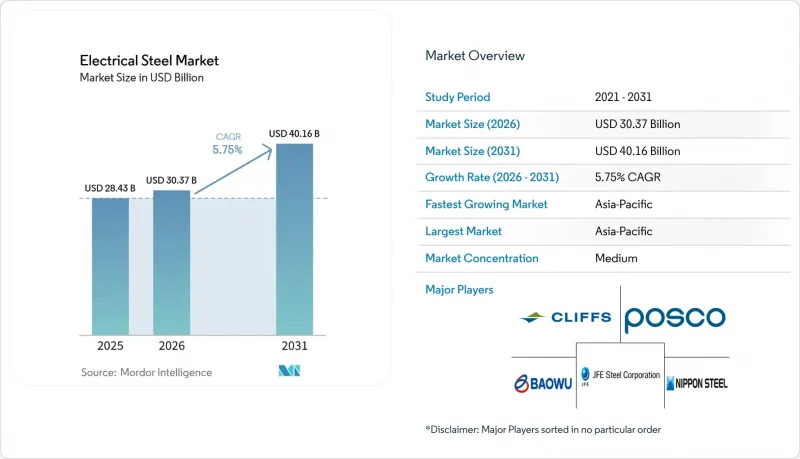
Mordor Intelligence에 의하면, 전기강판 시장 규모는 2025년 284억 3,000만 달러로 평가되었고, 2026년에는 303억 7,000만 달러로 확대될 것으로 추정되고, 2026-2031년 CAGR 5.75%로 성장을 지속할 전망이며, 2031년에는 401억 6,000만 달러에 이를 것으로 예측됩니다.
본 보고서는 제품 유형별(결정립 배향 전기강판 등), 용도별(변압기, 모터 등), 코팅 유형별(무기 코팅, 유기 코팅 등) 및 지역별(아시아태평양, 북미, 유럽, 남미, 중동 및 아프리카)로 분류되어 있습니다. 시장 전망은 금액(달러) 기준으로 제시되어 있습니다.
세계의 전기강판 시장 동향 및 인사이트
운송 및 산업 시스템의 급속한 전동화
전기강판 시장에서는 수요의 변화가 일어나고 있습니다. 이는 전기차(EV) 구동 모터가 불과 몇년전까지 대규모로 사용되던 기존 모터 플랫폼보다 더 얇은 규소강판과 더 엄격한 철손 관리를 필요로 하기 때문입니다. 생산 업체들의 동향도 이러한 변화를 반영하고 있으며, 포스코(POSCO)는 전 세계 자동차 제조업체들과공급 계약을 바탕으로 2025년에는 비결정질 전기강판 수출이 견조한 성장세를 보일 것으로 예측됩니다. 이러한 추세는 자동차 분야에 그치지 않고, 산업용 모터의 업그레이드도 효율 규제 강화에 따라 임의적인 지출에서 예정된 규정 준수 활동으로 전환되고 있습니다. 구매자들이 더 얇은 두께와 더 낮은 철손 사양으로 전환함에 따라, 전기강판 시장은 표준 범용 등급에 대한 의존도를 낮추고, 대신 공정 능력, 코팅 성능 및 야금학적 균일성에 대한 의존도를 높이고 있습니다. 포스코가 2026년 6월 현대자동차 및 제휴 기관과 결성을 예정하고 있는 컨소시엄은 차세대 EV 구동용 고규소 와이드 시트 제품 개발과 관련하여, 전기강판 시장이 현재의 제조 한계에 다다르고 있음을 시사합니다. 주요 제조업체들은 생산량 확대를 추구하는 동시에, 후발 기업들이 규모 확대를 어려워하는 제품군의 확보에도 주력하고 있습니다.
송전망의 현대화와 전력 인프라 확장
송전망에 대한 투자가 전기강판 시장을 뒷받침하고 있습니다. 이는 여러 주요 전력 시스템에서 송전망 증설, 교체 주기, 신뢰성 목표 상향에 따라 변압기 수요가 증가하고 있기 때문입니다. 인도의 경우, 2032년까지 정부 승인을 받은 송전망 투자 계획에 송전선 연장 및 변압기 용량의 대폭 증설이 포함되어 있는 반면, 국내 CRGO 생산량은 여전히 연간 소비량을 크게 밑돌고 있어 공급 부족이 지속되고 있습니다. 이러한 공급 부족을 해소하고, 국내에서 지속되는 공급 부족에 대처하기 위해 설립된 JSW와 JFE의 합작 사업 등, 장기적인 생산 능력 확보를 위한 노력이 진행되고 있습니다. 또한, 전기강판 시장은 유럽과 북미에서 겹치는 교체 수요의 혜택도 받고 있습니다. 이 지역에서는 노후화된 변압기들이 계속 가동되고 있는 반면, 더욱 엄격한 효율성 요건과 복원력 계획이 요구되고 있습니다. 이러한 지역별 수요 변동이 동시에 발생하고 있기 때문에 광범위한 철강 시세가 약세를 보이는 상황에서도 인증된 결정립 배향 전기강판(GOES)을 생산하는 제조업체들은 계속해서 유리한 입지를 유지하고 있습니다.
전기강판 제조 시 높은 에너지 소비
전기강판 시장은 구조적인 비용 문제에 직면해 있습니다. 이는 전기강판 제조에 기존 강판에 비해 훨씬 더 많은 에너지가 필요하기 때문입니다. 비결정립 배향 전기강판의 경우, 1톤당 약 6,500kWh의 에너지가 필요할 수 있어, 전력 가격은 각 지역에서의 가동 경제성을 결정하는 중요한 요인이 되고 있습니다. 이러한 압박은 특히 유럽에서 두드러지며, 높은 전력 비용이 이익률을 압박하고, 이미 수입 압박에 직면해 있는 공장의 가동 중단 요인 중 하나가 되고 있습니다. 실리콘 첨가나 어닐링 조건이 자기 성능에 직접적인 영향을 미치기 때문에 생산자들은 이 문제를 신속하게 해결할 수 없습니다. 그 결과, 야금 특성에 영향을 주지 않으면서 에너지 투입량이나 제조 공정을 변경하는 것은 쉽지 않습니다. 전기강판 시장에서는 전력 비용이 낮은 지역이나 정부의 지원이 강력한 지역에서 생산 능력 확대가 여전히 실현하기 쉬운 상황입니다. 또한, 최종 수요가 견조하게 유지되고 있는 경우에도 시장에서는 지역별 경제 상황에 따라 편차가 나타나는 상태가 지속될 가능성이 있습니다.
부문 분석
비결정립 배향 전기강판은 자동차, 산업용, 가전용 모터 및 적층판으로의 사용에 힘입어 2025년에는 전기강판 시장 점유율의 68.42%를 차지한 것으로 평가되었습니다. 이 부문은 단일 최종 용도 체인이 아닌 여러 모터 구동 시스템에 공급되므로 광범위한 수량 수요의 혜택을 받고 있습니다. 특히 EV 구동 시스템의 경우, 철손 감소가 열 관리 및 주행 거리 향상에 기여하기 때문에 고급 제품 개발은 박판화로 전환되고 있습니다. 아르셀로미탈의 ‘iCARe 420Save’ 플랫폼은 2026년에 두께 0.2mm까지 확대될 전망이며, 고속 전동 구동계에서 더욱 엄격해진 적층 요건을 충족함으로써 이러한 추세를 반영하고 있습니다. 중국 규격 YB/T 6421-2025에 따르면, EV 구동 모터용 고성능 비결정립 배향 전기강판(NGOES)은 코팅 및 재료에 관한 요건이 명확히 정의된 보다 공식적인 제품 등급으로 전환되고 있습니다.
포스코의 비결정 배향 전기강판 수출 호조는 전 세계 자동차 제조업체들이 전동화 플랫폼을 위한 조달 요건을 확대함에 따라, 2025년 내내 프리미엄 등급에 대한 해외 수요가 지속될 것임을 시사합니다. 결정립 배향 전기강판(GOES)은 매출액 면에서는 NGOES에 미치지 못하지만, 2031년까지 연평균 6.24%의 성장이 예상되어 가장 높은 성장률을 보이는 제품 부문이 될 전망입니다. 이러한 성장은 변압기 수요, 송전망 업그레이드 및 교체 수요와 관련이 있으며, 대량 생산되는 NGOES 부문과는 다른 가치 프로파일을 형성하고 있습니다. 이러한 동향은 전기강판 업계의 진화 과정에서 양극화를 보여주고 있으며, NGOES는 모빌리티 및 산업용 분야의 판매량 확대를 통해 성장하는 반면, GOES는 고사양 변압기 용도를 통해 성장하고 있습니다. 이러한 구조는 전기강판 시장에서 단일하고 광범위한 사이클이 아닌, 두 가지 서로 다른 성장 경로를 뒷받침하고 있습니다. 또한, 두 제품군을 모두 취급하는 제조업체에게는 변화하는 최종 용도 패턴 속에서 판매량, 가격 책정, 기술적 차별화의 균형을 맞추기 위한 기반이 됩니다.
지역별 분석
아시아태평양은 2025년에 전기강판 시장 점유율의 54.82%를 차지한 것으로 평가되었으며, 2031년까지 연평균 성장률(CAGR) 6.37%로 성장할 것으로 전망됩니다. 이에 따라 해당 지역은 상당한 규모와 성장 동력을 확보하게 될 것입니다. 아시아태평양의 전기강판 시장은 제강 능력, 변압기 수요, 전기차(EV) 제조, 가전제품 생산, 산업용 모터 활용 등의 요인으로부터 혜택을 받고 있습니다. 중국은 공급망 전반에 걸친 지역 생산 인프라와 전 세계 수출 활동을 뒷받침하고 있어, 이 지위에서 중심적인 역할을 계속 수행하고 있습니다. 인도는 대규모 송전망 투자와 변압기 증설을 통해 시장을 뒷받침하고 있으며, 이는 결정립 배향 전기강판(GOES) 수요를 견인하는 동시에 국내 생산 능력 부족을 여실히 드러내고 있습니다. 한국과 일본은 고급 등급에서의 기술력과 자동차, 산업 장비, 변압기 사용자와 연계된 고성능 공급망을 뒷받침하고 있어, 전기강판 시장에서 여전히 중요한 위치를 차지하고 있습니다.
북미와 유럽을 합쳐도 아시아태평양만큼의 점유율은 차지하지 못하지만, 송전망 설비 및 첨단 전동화 시스템에 대한 수요가 있어 전기강판 시장에서 여전히 중요한 위치를 차지하고 있습니다. 북미에서는 교체 수요와 지속적인 투자가 호재로 작용하며, 변압기용 등급의 소재와 인증을 받은 국내 및 시장 인근 공급에 대한 수요를 뒷받침하고 있습니다. 한편, 유럽에서는 수입품의 점유율이 확대되는 반면, 현지 생산자들이 에너지 비용 상승과 이익률 하락에 직면해 있어 공급 측면에서 압박을 받고 있습니다. 2026년 일부 기간 동안 티센크루프 일렉트리컬 스틸(ThyssenKrupp Electrical Steel)의 이스베르게스 공장이 가동을 중단하게 된 것은 해당 지역이 수입 압력과 비용 상승의 위험에 노출되어 있음을 여실히 보여줍니다. 반면, 아르셀로미탈(ArcelorMittal)의 마르디크(Mardick) 공장 가동 개시는 자동차 및 산업의 전동화와 관련된 비결정립 배향 전기강판(NGOES)에 대한 유럽 수요를 뒷받침하는 것으로, 전기강판 시장에서 상반된 신호를 보내고 있습니다.
남미, 중동 및 아프리카는 절대적인 규모 면에서는 여전히 작지만, 각각 전기강판 시장에 전략적인 수요를 창출하고 있습니다. 남미에서는 변압기 조달이 송전망 밀도 향상 및 광대한 지역에 걸친 전력 공급 체계 강화를 위한 노력과 밀접하게 연관되어 있습니다. 중동에서는 인프라 확충 및 산업 다각화 프로그램에 힘입어 변압기용 결정립 배향 전기강판(GOES)과 모터 구동 시스템용 NGOES의 사용이 촉진되고 있습니다. 남아프리카는 만성적인 공급 능력 부족 속에서 전력 인프라 개보수가 변압기 수요를 뒷받침하고 있어, 전기강판 시장에서 여전히 중요한 위치를 차지하고 있습니다. 고성장 시장이 수입 패턴, 국내 산업에 미치는 영향, 그리고 하류 장비 제조로 전가되는 비용을 재검토함에 따라, 이들 지역 전반에 걸쳐 무역 정책의 영향력이 더욱 커질 가능성이 있습니다.
기타 혜택 :
- 엑셀 형식 시장 예측(ME) 시트
- 3개월간의 애널리스트 지원
자주 묻는 질문
목차
제1장 서론
제2장 조사 방법
제3장 주요 요약
제4장 시장 구도
제5장 시장 규모 및 성장 예측
제6장 경쟁 구도
제7장 시장 기회 및 향후 전망
AJY 26.08.07According to Mordor Intelligence, the electrical steel market size is expected to grow from USD 28.43 billion in 2025 to USD 30.37 billion in 2026 and is forecast to reach USD 40.16 billion by 2031 at 5.75% CAGR over 2026-2031.
This report is Segmented by Product Type (Grain Oriented Electrical Steel and More), Application (Transformers, Motors, and More), Coating Type (Inorganic Coatings, Organic Coatings, and More), and Geography (Asia-Pacific, North America, Europe, South America, and Middle-East and Africa). The Market Forecasts are Provided in Terms of Value (USD).
Global Electrical Steel Market Trends and Insights
Rapid Electrification of Transportation and Industrial Systems
The electrical steel market is experiencing a demand shift, as EV traction motors require thinner silicon steel and tighter loss control than legacy motor platforms used at scale only a few years ago. Producer activity reflects this shift, with POSCO expected to report strong growth in non-oriented electrical steel exports in 2025, supported by supply agreements with global vehicle manufacturers. This trend extends beyond vehicles, as industrial motor upgrades are moving from optional spending to scheduled compliance activity under tighter efficiency regulations. As buyers shift to thinner gauges and lower iron-loss specifications, the electrical steel market is becoming less dependent on standard commodity grades and more dependent on process capability, coating performance, and metallurgical consistency. POSCO's planned June 2026 consortium with Hyundai Motor and partner institutions indicates that the electrical steel market is approaching current manufacturing limits in developing high-silicon wide-sheet products for next-generation EV drives. Leading producers are pursuing higher volumes while working to secure product classes that remain difficult for followers to scale.
Grid Modernization and Power Infrastructure Expansion
Grid spending is supporting the electrical steel market, as transformer demand rises with transmission additions, replacement cycles, and higher reliability targets across several major power systems. India remains undersupplied because government-approved grid investment through 2032 includes large additions in transmission line length and transformer capacity, while domestic CRGO output still trails annual consumption by a wide margin. This gap has led to long-term capacity commitments, including the JSW JFE joint venture formed to address persistent supply tightness in the country. The electrical steel market also benefits from overlapping replacement needs in Europe and North America, where older transformer fleets now operate alongside stricter efficiency expectations and resilience planning. As these regional demand waves occur simultaneously, producers with qualified Grain Oriented Electrical Steel (GOES) output remain well-positioned, even as broader steel cycles soften.
High Energy Consumption in Electrical Steel Manufacturing
The electrical steel market faces a structural cost challenge because electrical steel requires significantly more energy to produce than conventional steel sheet. Non-grain-oriented electrical steel can require around 6,500 kWh per tonne, making power prices a key factor in operating economics across regions. This pressure is particularly evident in Europe, where higher electricity costs have reduced margins and contributed to plant shutdowns already facing import pressure. Producers cannot address this issue quickly because silicon alloying and annealing conditions directly affect magnetic performance. As a result, they cannot easily change energy inputs or process routes without affecting metallurgy. For the electrical steel market, capacity expansion remains more feasible in regions with lower power costs or stronger state support. The market may also continue to record uneven regional economics, even when end-use demand remains strong.
Other drivers and restraints analyzed in the detailed report include:
- Rising Demand for High-Efficiency Motors Driven by Regulatory Mandates
- Renewable Power Integration and Distributed Generation Growth
- Complex Manufacturing Processes and High Capital Intensity
For complete list of drivers and restraints, kindly check the Table Of Contents.
Segment Analysis
Non-grain-oriented electrical steel is expected to account for 68.42% of the electrical steel market share in 2025, supported by its use in automotive, industrial, and appliance motors and laminations. This segment benefits from broad volume demand, as it serves multiple motor-driven systems rather than a single end-use chain. Premium product development is shifting toward thinner gauges, especially in EV drive systems, where low iron loss supports heat control and range performance. ArcelorMittal's iCARe 420Save platform, which is expected to extend to a 0.2 mm gauge in 2026, aligns with this trend by targeting tighter lamination requirements in high-speed electrified drivetrains. The Chinese standard YB/T 6421-2025 indicates that higher-performance non-grain-oriented electrical steel (NGOES) for EV drive motors is moving into a more formal product class with defined coating and material expectations.
POSCO's non-grain-oriented export momentum indicates continued offshore demand for premium grades through 2025, as global automakers broaden sourcing requirements for electrified platforms. Grain-oriented electrical steel (GOES), while smaller in revenue terms, is forecast to grow at 6.24% through 2031, making it the fastest-growing product segment. Its expansion is linked to transformer demand, transmission upgrades, and replacement activity, creating a value profile that differs from the higher-volume NGOES segment. This trend indicates a split in the evolution of the electrical steel industry, with NGOES expanding through volume penetration in mobility and industrial applications, while GOES grows through high-specification transformer applications. This structure supports two separate growth paths within the electrical steel market rather than a single broad-based cycle. It also positions producers with both product families to balance volume, pricing, and technical differentiation across changing end-use patterns.
Complete Report Scope:
- By Product Type
- Grain Oriented Electrical Steel
- Non-Grain Oriented Electrical Steel
- By Application
- Transformers
- Motors
- Generators
- Inductors
- Other Applications
- By Coating Type
- Inorganic Coatings
- Organic Coatings
- Self-Bonding Coatings
- Other Coatings
- By Geography
- Asia-Pacific
- China
- India
- Japan
- South Korea
- Rest of Asia-Pacific
- North America
- United States
- Canada
- Mexico
- Europe
- Germany
- United Kingdom
- France
- Italy
- Russia
- Rest of Europe
- South America
- Brazil
- Argentina
- Rest of South America
- Middle-East and Africa
- Saudi Arabia
- South Africa
- Rest of Middle-East and Africa
- Asia-Pacific
Geography Analysis
Asia-Pacific is expected to hold 54.82% of the electrical steel market share in 2025 and is forecast to grow at a CAGR of 6.37% through 2031, giving the region significant scale and growth momentum. The electrical steel market in Asia-Pacific benefits from steelmaking capacity, transformer demand, EV manufacturing, appliance output, and industrial motor use. China remains central to this position, as the country supports regional production infrastructure and global export activity across the supply chain. India adds support through large grid investments and transformer additions, which drive demand for Grain-Oriented Electrical Steel (GOES) and highlight domestic capacity gaps. South Korea and Japan remain important in the electrical steel market, as they support technical capabilities in premium grades and high-performance supply chains linked to vehicles, industrial equipment, and transformer users.
North America and Europe together account for a smaller share than Asia-Pacific, but they remain important to the electrical steel market due to demand in grid equipment and advanced electrified systems. North America benefits from replacement needs and continued investment, which support demand for transformer-grade materials and qualified domestic or near-market supply. Europe faces supply pressure as imports gain share while local producers manage higher energy costs and weaker margin protection. The thyssenkrupp Electrical Steel shutdown at Isbergues through part of 2026 highlights the region's exposure to import pressure and cost inflation. ArcelorMittal's Mardyck startup presents a different signal in the electrical steel market, as it supports European demand for Non-Grain Oriented Electrical Steel (NGOES) tied to automotive and industrial electrification.
South America, the Middle East, and Africa remain smaller in absolute terms, yet each adds strategic demand to the electrical steel market. In South America, transformer procurement is linked to transmission densification and efforts to strengthen power delivery across large geographic areas. In the Middle East, infrastructure expansion and industrial diversification programs support the use of Grain-Oriented Electrical Steel (GOES) in transformers and NGOES in motor-driven systems. South Africa remains relevant in the electrical steel market, as power infrastructure rehabilitation supports transformer demand amid chronic capacity shortfalls. Trade policy could become more influential across these regions as high-growth markets review import patterns, domestic industry exposure, and cost pass-through into downstream equipment manufacturing.
- Ansteel Group Corporation
- ArcelorMittal
- Baosteel Group Corporation
- China Baowu Steel Group
- China Steel Corporation
- Cleveland-Cliffs Inc.
- JFE Steel Corporation
- JSW Steel Limited
- NIPPON STEEL CORPORATION
- NLMK Group
- POSCO
- Shougang Group
- Taiyuan Iron & Steel (Group) Co. Ltd.,
- thyssenkrupp AG
- voestalpine AG
Additional Benefits:
- The market estimate (ME) sheet in Excel format
- 3 months of analyst support
TABLE OF CONTENTS
1 Introduction
- 1.1 Study Assumptions and Market Definition
- 1.2 Scope of the Study
2 Research Methodology
3 Executive Summary
4 Market Landscape
- 4.1 Market Overview
- 4.2 Market Drivers
- 4.2.1 Rapid Electrification of Vehicle Powertrains
- 4.2.2 Grid Modernization and Transformer Replacement Cycles
- 4.2.3 Rising Demand for High Efficiency Motors in Industrial Automation
- 4.2.4 Renewable Power Integration Requiring Lower Loss Magnetic Cores
- 4.2.5 Stringent Energy Efficiency Regulations Driving Premium Electrical Steel Adoption
- 4.3 Market Restraints
- 4.3.1 High Energy Consumption and Rising Decarbonization Costs
- 4.3.2 Complex Manufacturing Process and High Entry Barriers
- 4.3.3 Increasing Competition from Amorphous and Nanocrystalline Magnetic Materials
- 4.4 Value Chain Analysis
- 4.5 Porter's Five Forces Analysis
- 4.5.1 Threat of New Entrants
- 4.5.2 Bargaining Power of Suppliers
- 4.5.3 Bargaining Power of Buyers
- 4.5.4 Threat of Substitutes
- 4.5.5 Competitive Rivalry
5 Market Size and Growth Forecasts (Value)
- 5.1 By Product Type
- 5.1.1 Grain Oriented Electrical Steel
- 5.1.2 Non-Grain Oriented Electrical Steel
- 5.2 By Application
- 5.2.1 Transformers
- 5.2.2 Motors
- 5.2.3 Generators
- 5.2.4 Inductors
- 5.2.5 Other Applications
- 5.3 By Coating Type
- 5.3.1 Inorganic Coatings
- 5.3.2 Organic Coatings
- 5.3.3 Self-Bonding Coatings
- 5.3.4 Other Coatings
- 5.4 By Geography
- 5.4.1 Asia-Pacific
- 5.4.1.1 China
- 5.4.1.2 India
- 5.4.1.3 Japan
- 5.4.1.4 South Korea
- 5.4.1.5 Rest of Asia-Pacific
- 5.4.2 North America
- 5.4.2.1 United States
- 5.4.2.2 Canada
- 5.4.2.3 Mexico
- 5.4.3 Europe
- 5.4.3.1 Germany
- 5.4.3.2 United Kingdom
- 5.4.3.3 France
- 5.4.3.4 Italy
- 5.4.3.5 Russia
- 5.4.3.6 Rest of Europe
- 5.4.4 South America
- 5.4.4.1 Brazil
- 5.4.4.2 Argentina
- 5.4.4.3 Rest of South America
- 5.4.5 Middle-East and Africa
- 5.4.5.1 Saudi Arabia
- 5.4.5.2 South Africa
- 5.4.5.3 Rest of Middle-East and Africa
- 5.4.1 Asia-Pacific
6 Competitive Landscape
- 6.1 Market Concentration
- 6.2 Strategic Moves
- 6.3 Market Share (%)/Ranking Analysis
- 6.4 Company Profiles (includes Global Overview, Market Overview, Core Segments, Financials as available, Strategic Information, Products and Services, and Recent Developments)
- 6.4.1 Ansteel Group Corporation
- 6.4.2 ArcelorMittal
- 6.4.3 Baosteel Group Corporation
- 6.4.4 China Baowu Steel Group
- 6.4.5 China Steel Corporation
- 6.4.6 Cleveland-Cliffs Inc.
- 6.4.7 JFE Steel Corporation
- 6.4.8 JSW Steel Limited
- 6.4.9 NIPPON STEEL CORPORATION
- 6.4.10 NLMK Group
- 6.4.11 POSCO
- 6.4.12 Shougang Group
- 6.4.13 Taiyuan Iron & Steel (Group) Co. Ltd.,
- 6.4.14 thyssenkrupp AG
- 6.4.15 voestalpine AG
7 Market Opportunities and Future Outlook
- 7.1 White-Space and Unmet-Need Assessment


