|
시장보고서
상품코드
2099884
자궁선근증 치료 시장 : 시장 점유율 분석, 업계 동향 및 통계, 성장 예측(2026-2031년)Adenomyosis Treatment - Market Share Analysis, Industry Trends & Statistics, Growth Forecasts (2026 - 2031) |
||||||
 Mordor Intelligence
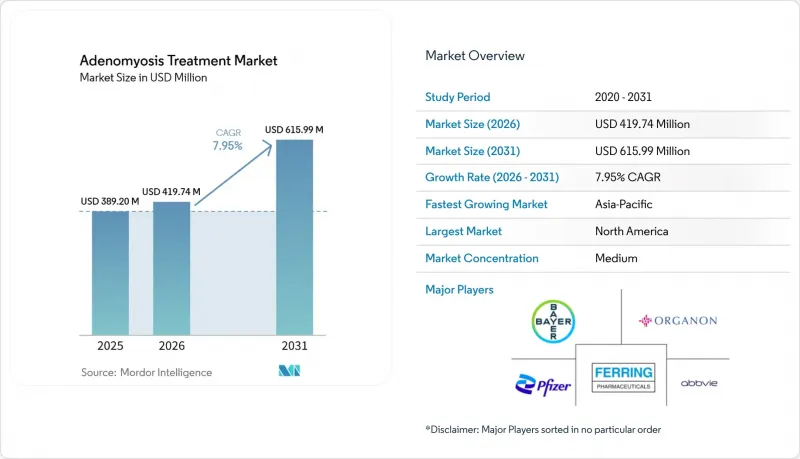
Mordor Intelligence에 의하면, 자궁선근증 치료 시장 규모는 2025년 3억 8,920만 달러로 평가되었고, 2026년 4억 1,974만 달러에서 2031년까지 6억 1,599만 달러로 확대될 것으로 예측되며, 2026-2031년 연평균 복합 성장률(CAGR)은 7.95%를 나타낼 전망입니다.
본 보고서는 치료법별(항염증제, 호르몬제, 자궁적출술, 기타), 질환 유형별(확산성 자궁선근증, 국소성 자궁선근증), 최종 사용자별(병원, 전문 산부인과 센터, 외래수술센터(ASC), 불임 치료 클리닉, 기타), 지역별(북미, 유럽, 아시아태평양, 기타)로 분류되어 있습니다. 시장 전망은 금액(달러)으로 제시되어 있습니다.
세계의 자궁선근증 치료 시장 동향 및 인사이트
그동안 진단이 미흡했던 사례의 진단 건수 증가
자궁선근증 치료 시장은 진단 방식의 변화로 인해 혜택을 보고 있습니다. 이는 자궁선근증이 오랫동안 정기적인 외래 검사를 통해 확인되는 것이 아니라, 자궁 적출술 후에야 비로소 확인되는 경우가 많았기 때문입니다. 현재 ‘자궁 형태학적 초음파 평가 기준(Morphological Uterus Sonographic Assessment)’에 부합하는 경질 초음파 검사 프로토콜을 통해 일상적인 산부인과 진료 현장에서 비침습적 진단이 더욱 실용화되고 있으며, 이에 따라 기존에 파악되었던 환자 수를 넘어 치료 가능한 환자층이 확대되고 있습니다. 이는 선근증 치료 시장에 있어 중요한 의미를 지닙니다. 왜냐하면 많은 국가에서 보고되는 유병률이 낮다는 것은 질환의 부담이 낮음을 나타내는 것이 아니라, 오히려 검출률이 낮고 영상 진단 워크플로우에 일관성이 없음을 나타내는 경우가 많기 때문입니다. 체계적인 영상 진단 교육이 보급되고, 지방 도시에서도 산부인과 초음파 진단 인프라에 대한 접근성이 개선됨에 따라, 증상이 있는 많은 여성들이 수년 동안 치료를 받지 못한 채 지내지 않고 더 조기에 치료를 시작하게 될 것입니다. 이러한 상업적 영향은 중요합니다. 왜냐하면 주요 치료법의 획기적인 발전이 이루어지기 전이라 하더라도, 기존 사례를 보다 정확하게 식별하는 것만으로도 치료 건수 증가는 지속될 수 있기 때문입니다. 따라서, 특히 현재의 진단률이 실제 증상의 부담을 아직 따라잡지 못하고 있는 지역에서는 자궁선근증 치료 시장이 처방 건수만으로 추측되는 것보다 더 견고한 기반을 갖추고 있습니다.
임신 기능 보존형 호르몬 요법의 보급
자궁선근증 치료 시장이 확대되고 있는 또 다른 이유는 경구용 GnRH 길항제가 즉시 근치 수술을 받지 않고 증상 조절을 희망하는 여성들의 장기적인 호르몬 요법 방식을 변화시키고 있기 때문입니다. 기존 GnRH 작용제 사용과 비교하여, 새로운 길항제는 에스트로겐을 보다 세밀하게 조절할 수 있어 치료 기간을 장기화할 수 있게 되었으며, 치료를 지속할 수 있는 여성층이 확대되고 있습니다. 2025년에 실시된 엘라고릭스와 애드백 요법을 병용한 제3상 임상시험 분석 결과, 60개월 동안 골밀도가 안정적으로 유지된 것으로 보고되었으며, 이를 통해 폐경 전 여성의 장기 호르몬 요법 사용에 따른 위험에 대한 논의가 크게 개선되었습니다. 안전한 치료 기간이 길어짐에 따라 치료 지속률이 높아지고, 의사가 증상 조절에서 보다 체계적인 질환 관리로 치료를 단계적으로 진행하려는 의욕도 높아지기 때문에 자궁선근증 치료 시장은 그 혜택을 보고 있습니다. 이러한 추세는 아시아에서도 점점 더 중요해지고 있습니다. 이는 키세이가 해당 화합물에 대한 규제상의 진전을 바탕으로 2025년 3월 일본에서 자궁내막증 및 자궁선근증을 대상으로 한 린자고릭스의 제3상 임상시험을 시작한 데서 알 수 있듯이, 해당 지역의 개발 활동이 유럽 및 미국의 프로그램과 수렴되고 있음을 보여주기 때문입니다. 그 결과, 호르몬 요법이 더 이상 수술 전의 단기적인 가교 수단으로만 자리매김하는 것이 아니라, 불임에 대한 배려를 중시하는 보다 광범위한 치료 경로가 확립되고 있습니다.
질환 특이적 치료 지침 및 표준화된 치료 경로의 부재
자궁선근증 치료 시장은 여전히 근본적인 구조적 제약에 직면해 있습니다. 주요 시장에서 자궁선근증에 특화된 적응증을 가진 약물이 존재하지 않으며, 호르몬 요법의 사용은 여전히 대부분 적응증 외로 이루어지고 있기 때문입니다. 2025년에 수행된 체계적 문헌고찰 및 네트워크 메타분석에 따르면, 이용 가능한 무작위 대조 시험의 전체 증거를 통해 볼 때 치료법의 우선순위에 일관성이 보이지 않았으며, 통증, 출혈 또는 자궁 크기 감소 중 어느 것에 중점을 두느냐에 따라 치료 결과가 달라진다는 사실이 밝혀졌습니다. 이러한 불확실성으로 인해 선근증 치료 시장은 둔화되고 있습니다. 치료 순서가 표준화되지 않은 경우, 일반 산부인과 전문의는 치료 시작이나 강화를 주저할 가능성이 있기 때문입니다. 2025년에 개정된 독일의 S2k 지침에서는 영상 진단을 우선시하는 진단 방식과 보다 개인화된 치료 순서로 전환할 것을 제안했으나, 의료 현장에서의 광범위한 보급은 여전히 보험사 및 일선 진료 현장이 이러한 권고 사항을 어느 정도 신속하게 수용하느냐에 달려 있습니다. 질환에 특화된 보다 명확한 진료 경로가 널리 정착되기 전까지는 치료 선택지 자체가 이용 가능하더라도 선근증 치료 시장에서는 의료기관 간 도입 상황에 편차가 나타나는 상태가 지속될 가능성이 높습니다. 이러한 제약은 치료 시작률, 보험 급여에 관한 협의, 그리고 고비용 또는 장기적인 치료 계획에 대한 신뢰감에 동시에 영향을 미치기 때문에 특히 중요한 점입니다.
부문 분석
2025년, 호르몬 제제는 자궁선근증 치료 시장 규모의 47.14%를 차지했으며, 이는 일상 진료에서 프로게스틴, 복합 경구 피임약 및 새로운 GnRH 수용체 길항제가 널리 사용되고 있음을 반영합니다. 자궁선근증 치료 시장에서 이러한 주도적인 지위는 의사가 시술적 개입이나 근치적 수술을 고려하기 전에 약물 요법이 종종 첫 번째 체계적인 선택지로 남아 있다는 사실에 기인합니다. 디에노게스트는 1일 1회 투여, 반복 사용을 가능하게 하는 우수한 내약성, 그리고 의사의 익숙함이 결합되어 처방에서 계속해서 확고한 위치를 유지하고 있습니다. 2025년 동일한 네트워크 메타분석에서는 3개월 및 6개월 시점에서 디에노게스트가 자궁선근증에 수반되는 골반통에 대해 가장 효과적인 호르몬 요법임이 확인되어 이러한 경향이 뒷받침되었습니다. LNG-IUS 또한 전신적인 에스트로겐 억제를 최소화하면서 장기적인 증상 관리를 제공하며, 여러 임상 현장에서 가이드라인에 따른 지지를 유지하고 있어 이 부문에서 중요한 위치를 계속 차지하고 있습니다.
항염증제는 자궁선근증 치료 시장에서 가장 빠르게 성장하고 있는 치료법으로, 2031년까지 연평균 성장률(CAGR)이 8.77%를 나타낼 것으로 전망됩니다. 이는 주로 급성 증상 완화를 목적으로 하는 병용 요법으로 널리 사용되고 있기 때문입니다. 이러한 역할은 보험 급여 지연, 의사의 선호도, 혹은 내분비 요법에 대한 환자의 주저로 인해 호르몬제 접근이 제한되는 경우에 특히 중요해집니다. 자궁 적출술은 여전히 자궁선근증 치료 시장에서 안정적인 위치를 차지하고 있습니다. 하지만 불임을 피할 수 있는 치료법이나 자궁 보존 요법의 선택지가 이전보다 더 광범위한 치료 경로를 포괄하게 되면서 그 역할은 축소되고 있습니다. 즉, 자궁 적출술은 출산을 마친 여성이나 보존적 치료를 여러 번 시도했음에도 효과를 얻지 못한 여성에게 점점 더 제한적으로 시행되고 있습니다. '기타' 범주에도 주목할 필요가 있습니다. 자궁내막증에 따른 불임을 대상으로 한 닌테다니브의 등록 임상시험 등 개발 파이프라인의 동향을 통해, 자궁내막증 치료 업계가 단순한 증상 억제를 넘어선 작용기전의 검증을 시작하고 있음을 보여주기 때문입니다.
지역별 분석
2025년, 북미는 자궁선근증 치료 시장 점유율의 38.12%를 차지했으며, 금액 기준으로 가장 큰 기여를 한 지역이 되었습니다. 이 지역이 자궁선근증 치료 시장에서 차지하는 위상은 호르몬제에 대한 확립된 보험 환급 경로, 탄탄한 여성 건강 분야의 소개 네트워크, 그리고 이 질환을 조기에 인식하고 관리할 수 있는 전문 진료소가 밀집된 기반을 반영하고 있습니다. 미국은 여전히 주요 국가로 자리 잡고 있습니다. 이는 GnRH 길항제의 장기적 안전성에 대한 증거가, 특히 장기간 치료 사용과 관련하여 보험사 및 처방 의사의 신뢰를 강화하고 있기 때문입니다.
유럽은 자궁선근증 치료 시장에서 여전히 2위 지역 블록이며, 국가별로 보험 환급 및 치료 도입 상황이 크게 다르기 때문에 더 복잡한 구조를 보이고 있습니다. 독일은 2025년 6월 린자고릭스에 관한 G-BA 결의안이 보여주듯이, 의료 기술 평가 결정 및 가격 심사가 새로운 호르몬 요법의 임상 도입을 좌우하기 때문에 매우 큰 역할을 하고 있습니다. 또한, 갱신된 독일의 S2k 가이드라인도 영상 진단을 통한 확정 진단 및 게스타겐 우선 치료 순서를 지지하고 있습니다. 이는 치료의 표준화에 기여하는 한편, 비교 대상 약물에 대한 기대가 여전히 엄격한 지역에서는 최첨단 치료법의 조기 도입을 지연시킬 가능성이 있습니다. 따라서 이 지역 전체에서 자궁선근증 치료 시장은 미충족 수요에 의해서만 형성되기보다는 가이드라인의 일관성이 얼마나 신속하게 일상적인 보험 급여 및 처방 행태로 이어지는지에 따라 좌우되는 경향이 있습니다.
아시아태평양은 자궁선근증 치료 시장에서 가장 빠르게 성장하고 있는 지역으로, 2031년까지 연평균 성장률(CAGR)이 9.16%를 나타낼 것으로 전망됩니다. 이는 대규모 환자층, 점차 성숙해 가는 호르몬 요법 프로토콜, 그리고 민간 의료 및 3차 의료에 대한 투자 증가에 힘입은 결과입니다. 일본이 중요한 이유는 키세이 제약이 자궁내막증 및 자궁선근증을 대상으로 한 린자고릭스의 제3상 임상시험을 비롯해 여러 GnRH 길항제 프로그램이 동시에 진행되고 있어, 이로 인해 해당 지역의 치료 범위가 확대되고 있기 때문입니다. 중국에서는 자궁내막증 및 자궁선근증 전문 진료 센터의 설립과 비교적 높은 HIFU 보급률에 힘입어 성장이 뒷받침되고 있으며, 이로 인해 자궁선근증 치료 시장의 시술 측면에서 많은 서유럽 국가들보다 더 견고한 기반이 구축되고 있습니다.
기타 혜택 :
- 엑셀 형식 시장 예측(ME) 시트
- 3개월간의 애널리스트 지원
자주 묻는 질문
목차
제1장 서론
제2장 조사 방법
제3장 주요 요약
제4장 시장 구도
제5장 시장 규모 및 성장 예측
제6장 경쟁 구도
제7장 시장 기회 및 향후 전망
AJY 26.08.07According to Mordor Intelligence, the adenomyosis treatment market size is projected to expand from USD 389.20 million in 2025 and USD 419.74 million in 2026 to USD 615.99 million by 2031, registering a CAGR of 7.95% between 2026 to 2031.
This report is Segmented by Genetic Mutation (Anti-Inflammatory Drugs, Hormone Medications, Hysterectomy, and Others), by Disease Type (Diffuse Adenomyosis, Focal Adenomyosis), by End User (Hospitals, Specialty Gynecology Centers, Ambulatory Surgical Centers, Fertility Clinics, and Others), and Geography (North America, Europe, Asia-Pacific, and More). The Market Forecasts are Provided in Terms of Value (USD).
Global Adenomyosis Treatment Market Trends and Insights
Rising Diagnostic Detection of Previously Underdiagnosed Cases
The adenomyosis treatment market is gaining from a diagnosis shift because adenomyosis was long identified after hysterectomy rather than through routine outpatient workup. Transvaginal ultrasound protocols aligned with the Morphological Uterus Sonographic Assessment criteria are now making non-invasive diagnosis more practical in everyday gynecology settings, which is widening the treatable patient pool beyond historically recognized volumes. This matters for the adenomyosis treatment market because low reported prevalence in many countries does not signal low burden; it more often signals low detection and inconsistent imaging workflows. As structured imaging training spreads and secondary cities gain better access to gynecological ultrasound infrastructure, more symptomatic women are likely to enter treatment earlier rather than remain untreated for years. The commercial effect is important because growth in treated volumes can continue even before any major therapy breakthrough arrives, simply through better identification of existing cases. That is why the adenomyosis treatment market has stronger underlying support than prescription counts alone might suggest, especially where current diagnosis rates still trail real-world symptom burden.
Fertility-Preserving Hormonal Therapy Adoption
The adenomyosis treatment market is also advancing because oral GnRH antagonists are changing the profile of long-term hormonal management for women who want symptom control without immediate definitive surgery. Compared with older GnRH agonist use, newer antagonists allow more controlled estrogen management, which supports longer treatment duration and broadens the group of women who can remain on therapy. A 2025 phase 3 analysis of elagolix with add-back therapy reported stable bone mineral density across 60 months, and that materially improves the risk discussion around prolonged hormonal use in premenopausal women. The adenomyosis treatment market benefits because longer safe treatment windows can raise both therapy persistence and physician willingness to escalate from symptomatic control to more structured disease management. This dynamic is becoming more relevant in Asia as well, since Kissei initiated a Phase III linzagolix trial for endometriosis and adenomyosis in Japan in March 2025 after regulatory progress around the compound, showing that regional development activity is converging with Western programs. The result is a broader fertility-aware treatment pathway in which hormonal therapy is no longer framed only as a short bridge before surgery.
Lack of Disease-Specific Treatment Guidelines and Standardized Pathways
The adenomyosis treatment market still faces a basic structural limit because no drug carries a regulatory label specifically for adenomyosis in major markets, and hormonal use remains largely off-label. A 2025 systematic review and network meta-analysis found no harmonized treatment ranking across the available randomized evidence, with outcomes varying depending on whether the focus was pain, bleeding, or uterine size reduction. That uncertainty slows the adenomyosis treatment market because general gynecologists may hesitate to initiate or escalate therapy when treatment sequencing is not standardized. Germany's updated S2k guidance in 2025 moved practice toward imaging-first diagnosis and more personalized sequencing, but broader community adoption still depends on how quickly payers and routine practice absorb those recommendations. Until clearer disease-specific pathways are widely embedded, the adenomyosis treatment market is likely to continue showing uneven uptake across providers, even where therapeutic options themselves are available. This restraint is especially important because it affects initiation rates, reimbursement discussions, and confidence in higher-cost or longer-duration therapy plans at the same time.
Other drivers and restraints analyzed in the detailed report include:
- Shift Toward Uterus-Sparing Minimally Invasive Procedures
- AI-Assisted Pelvic Imaging Triage and Phenotyping
- Symptom Recurrence After Conservative Therapy
For complete list of drivers and restraints, kindly check the Table Of Contents.
Segment Analysis
Hormone Medications held 47.14% of the adenomyosis treatment market size in 2025, reflecting the deep use of progestins, combined oral contraceptives, and newer GnRH receptor antagonists across routine care. This leading position in the adenomyosis treatment market rests on the fact that medical therapy often remains the first structured option before physicians consider procedural intervention or definitive surgery. Dienogest continues to hold a strong prescribing position because it combines once-daily dosing with a tolerability profile that supports repeat use and physician familiarity. The same 2025 network meta-analysis reinforced that preference by identifying dienogest as the most effective hormone therapy for adenomyosis-associated pelvic pain at 3 and 6 months. LNG-IUS remains an important part of the segment as well because it offers long-acting symptom control with limited systemic estrogen suppression and retains guideline support across multiple clinical settings.
Anti-Inflammatory Drugs are the fastest-growing treatment type in the adenomyosis treatment market, with an 8.77% CAGR through 2031, largely because they remain widely used as co-prescriptions for acute symptom relief. Their role is especially relevant where reimbursement delays, physician preference, or patient hesitation around endocrine treatment constrain access to hormonal agents. Hysterectomy still occupies a stable place in the adenomyosis treatment market. Still, its role has narrowed because fertility-preserving and uterus-sparing options now cover more of the treatment pathway than before. That means hysterectomy is increasingly reserved for women who have completed childbearing or for those whose conservative care has failed after multiple attempts. The Others category also deserves attention because pipeline activity, such as the registered nintedanib trial for adenomyosis-associated infertility, shows that the adenomyosis treatment industry is beginning to test mechanisms that go beyond symptom suppression.
Complete Report Scope:
- Anti-Inflammatory Drugs
- Hormone Medications
- Hysterectomy
- Others (Antifibrinolytics, Analgesics, etc.)
- By Disease Type
- Diffuse Adenomyosis
- Focal Adenomyosis
- By End User
- Hospitals
- Specialty Gynecology Centers
- Ambulatory Surgical Centers
- Fertility Clinics
- Others (Academic and Research Institutes, Homecare Settings, etc.)
- By Geography
- North America
- United States
- Canada
- Mexico
- Europe
- Germany
- United Kingdom
- France
- Italy
- Spain
- Rest of Europe
- Asia-Pacific
- China
- Japan
- India
- Australia
- South Korea
- Rest of Asia-Pacific
- Middle East and Africa
- GCC
- South Africa
- Rest of Middle East and Africa
- South America
- Brazil
- Argentina
- Rest of South America
- North America
Geography Analysis
North America held 38.12% of the adenomyosis treatment market share in 2025, making it the largest regional contributor by value. The region's position in the adenomyosis treatment market reflects established reimbursement pathways for hormonal agents, strong women's health referral networks, and a dense base of specialty practices that can recognize and manage the condition earlier. The United States remains the key country because long-term safety evidence for GnRH antagonists has strengthened payer and prescriber confidence, especially around extended treatment use.
Europe remains the second-largest regional bloc in the adenomyosis treatment market and shows a more mixed structure because reimbursement and treatment adoption differ materially across countries. Germany plays an outsized role because health technology assessment decisions and pricing review shape how newer hormonal therapies enter practice, as shown by the June 2025 G-BA resolution on linzagolix. The updated German S2k guidance also supports imaging-confirmed diagnosis and gestagen-first sequencing, which helps standardize care but can slow early uptake of premium therapy where comparator expectations remain strict. Across the wider region, the adenomyosis treatment market is therefore shaped less by unmet need alone and more by how quickly guideline alignment turns into routine reimbursement and prescribing behavior.
Asia-Pacific is the fastest-growing region in the adenomyosis treatment market, with a 9.16% CAGR through 2031, driven by large patient pools, maturing hormonal protocols, and rising private and tertiary care investment. Japan is important because multiple GnRH antagonist programs are progressing at the same time, including Kissei's Phase III work for linzagolix in endometriosis and adenomyosis, which strengthens the region's therapeutic depth. China supports growth through dedicated endometriosis and adenomyosis care centers and comparatively strong HIFU adoption, which gives the procedural side of the adenomyosis treatment market a stronger footing than in many Western settings.
- Abbott Laboratories
- Abbvie
- AstraZeneca
- Bayer
- Bristol-Myers Squibb
- Eli Lilly and Company
- Ferring Pharmaceuticals
- GE HealthCare Technologies Inc.
- Hologic
- Ipsen
- Johnson & Johnson
- Medtronic
- Merck
- Novartis
- Organon and Co.
- Pfizer
- Sanofi
- Siemens Healthineers
- Takeda Pharmaceuticals
- Teva Pharmaceutical Industries
Additional Benefits:
- The market estimate (ME) sheet in Excel format
- 3 months of analyst support
TABLE OF CONTENTS
1 INTRODUCTION
- 1.1 Study Assumptions and Market Definition
- 1.2 Scope of the Study
2 RESEARCH METHODOLOGY
3 EXECUTIVE SUMMARY
4 MARKET LANDSCAPE
- 4.1 Market Overview
- 4.2 Market Drivers
- 4.2.1 Rising Diagnostic Detection of Previously Underdiagnosed Cases
- 4.2.2 Fertility-Preserving Hormonal Therapy Adoption
- 4.2.3 Shift Toward Uterus-Sparing Minimally Invasive Procedures
- 4.2.4 Expansion of Specialty Women's Health Referral Networks
- 4.2.5 AI-Assisted Pelvic Imaging Triage and Phenotyping
- 4.2.6 Outpatient Care Migration for Symptom Control Pathways
- 4.3 Market Restraints
- 4.3.1 Lack of Disease-Specific Treatment Guidelines and Standardized Pathways
- 4.3.2 Symptom Recurrence After Conservative Therapy
- 4.3.3 Limited Access to Specialized Gynecology and Interventional Capacity
- 4.3.4 High Cost and Fertility Trade-Offs of Procedural Interventions
- 4.4 Supply Chain Analysis
- 4.5 Regulatory Landscape
- 4.6 Technological Outlook
- 4.7 Porter's Five Forces Analysis
- 4.7.1 Threat of New Entrants
- 4.7.2 Bargaining Power of Suppliers
- 4.7.3 Bargaining Power of Buyers
- 4.7.4 Threat of Substitutes
- 4.7.5 Industry Rivalry
5 MARKET SIZE AND GROWTH FORECASTS (VALUE, USD)
- 5.1 Anti-Inflammatory Drugs
- 5.1.1 Hormone Medications
- 5.1.2 Hysterectomy
- 5.1.3 Others (Antifibrinolytics, Analgesics, etc.)
- 5.2 By Disease Type
- 5.2.1 Diffuse Adenomyosis
- 5.2.2 Focal Adenomyosis
- 5.3 By End User
- 5.3.1 Hospitals
- 5.3.2 Specialty Gynecology Centers
- 5.3.3 Ambulatory Surgical Centers
- 5.3.4 Fertility Clinics
- 5.3.5 Others (Academic and Research Institutes, Homecare Settings, etc.)
- 5.4 By Geography
- 5.4.1 North America
- 5.4.1.1 United States
- 5.4.1.2 Canada
- 5.4.1.3 Mexico
- 5.4.2 Europe
- 5.4.2.1 Germany
- 5.4.2.2 United Kingdom
- 5.4.2.3 France
- 5.4.2.4 Italy
- 5.4.2.5 Spain
- 5.4.2.6 Rest of Europe
- 5.4.3 Asia-Pacific
- 5.4.3.1 China
- 5.4.3.2 Japan
- 5.4.3.3 India
- 5.4.3.4 Australia
- 5.4.3.5 South Korea
- 5.4.3.6 Rest of Asia-Pacific
- 5.4.4 Middle East and Africa
- 5.4.4.1 GCC
- 5.4.4.2 South Africa
- 5.4.4.3 Rest of Middle East and Africa
- 5.4.5 South America
- 5.4.5.1 Brazil
- 5.4.5.2 Argentina
- 5.4.5.3 Rest of South America
- 5.4.1 North America
6 COMPETITIVE LANDSCAPE
- 6.1 Market Concentration
- 6.2 Market Share Analysis
- 6.3 Company Profiles (includes Global Level Overview, Market Level Overview, Core Segments, Financials as available, Strategic Information, Market Rank/Share, Products and Services, Recent Developments)
- 6.3.1 Abbott Laboratories
- 6.3.2 AbbVie Inc.
- 6.3.3 AstraZeneca plc
- 6.3.4 Bayer AG
- 6.3.5 Bristol-Myers Squibb Company
- 6.3.6 Eli Lilly and Company
- 6.3.7 Ferring B.V.
- 6.3.8 GE HealthCare Technologies Inc.
- 6.3.9 Hologic, Inc.
- 6.3.10 Ipsen Pharma
- 6.3.11 Johnson and Johnson
- 6.3.12 Medtronic plc
- 6.3.13 Merck KGaA
- 6.3.14 Novartis AG
- 6.3.15 Organon and Co.
- 6.3.16 Pfizer Inc.
- 6.3.17 Sanofi S.A.
- 6.3.18 Siemens Healthineers AG
- 6.3.19 Takeda Pharmaceutical Company Limited
- 6.3.20 Teva Pharmaceutical Industries Ltd.
7 MARKET OPPORTUNITIES AND FUTURE OUTLOOK
- 7.1 White-Space and Unmet-Need Assessment