

|
시장보고서
상품코드
2099907
종양학용 소프트웨어 의료기기(SaMD) 시장 : 점유율 분석, 업계 동향 및 통계, 성장 예측(2026-2031년)Software As A Medical Device (SaMD) For Oncology - Market Share Analysis, Industry Trends & Statistics, Growth Forecasts (2026 - 2031) |
||||||
 Mordor Intelligence
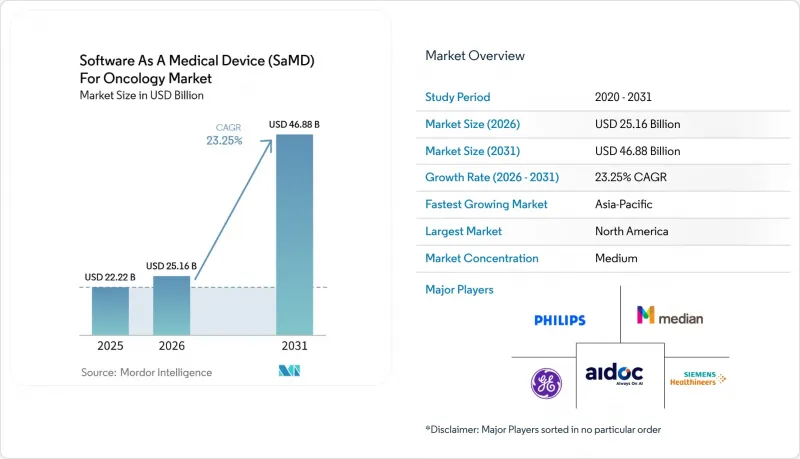
Mordor Intelligence에 의하면, 종양학용 소프트웨어 의료기기(SaMD) 시장 규모는 2025년 222억 2,000만 달러, 2026년 251억 6,000만 달러에서 2031년까지 468억 8,000만 달러로 확대되어 2026년부터 2031년까지 CAGR 23.25%를 나타낼 것으로 예측됩니다.
본 보고서는 용도(스크리닝, 진단·트리아지, 치료 계획, 모니터링 등), 기술(머신러닝, 컴퓨터 비전, 자연어 처리, 예측 분석), 최종 사용자(병원, 진단 검사 기관, 제약 기업, 학술 기관), 도입 형태(클라우드 기반, On-Premise형), 지역(북미, 유럽, 아시아태평양, 중동 및 아프리카, 남미)별로 분류되어 있습니다. 예측치는 금액(달러)으로 표시되어 있습니다.
전 세계 종양학용 소프트웨어 의료기기(SaMD) 시장 동향 및 인사이트
AI를 활용한 암 분류 및 의사결정 지원의 활용 확대
종양학용 소프트웨어 의료기기(SaMD) 시장에서는 방사선과 및 병리학의 워크플로우에 직접 통합된 임상 의사결정 지원 도구로부터 단기적인 수요가 발생하고 있습니다. 2025년 『JAMA Network Open』지에 발표된, FDA 승인을 받은 AI 의료기기 소프트웨어 제품 222건을 대상으로 한 분석에 따르면, 510(k) 절차가 상용화를 위한 주요 경로로 자리 잡고 있으며, 높은 성능에 대한 기대를 유지하면서 도입을 가속화하는 데 기여하고 있는 것으로 나타났습니다. Aidoc사의 CARE 기반 모델 및 동사의 광범위한 임상 AI 이니셔티브를 통해, 구매자들이 단일 기능 도구에서 하나의 시스템으로 여러 가지 분류 업무를 관리할 수 있는 플랫폼으로 전환하고 있음이 드러났습니다. 이러한 동향은 중요한 의미를 지닙니다. 병원이 단일 영상 진단 시스템만을 운영하는 경우는 드물기 때문에 특정 알고리즘만을 제공하는 벤더보다 플랫폼 벤더가 통합이 용이하며, 부서 단위의 개별 구매보다 대규모 기업 거래를 촉진하기 때문입니다.
암 조기 발견 및 위험도 계층화에 대한 수요 증가
종양학용 소프트웨어 의료기기(SaMD) 시장은 단일 암 검진에서 보다 광범위한 다중 암 검출 프로그램으로의 전환에 힘입어 성장세를 보이고 있습니다. GRAIL사는 기존의 ‘획기적 의료기기 지정(Breakthrough Device Designation)’에 근거하여, 2026년 1월 다중 암 조기 검출 검사 ‘Galleri’의 시판 전 승인(PMA) 신청서를 FDA에 제출했습니다. 2026년 ASCO 연례 총회에서 PATHFINDER 2 임상시험 결과가 발표되었으며, 미국 예방의료서비스작업반(USPSTF)이 권장하는 선별검사에 ‘Galleri’를 추가함으로써 암 검출률이 7배 이상 향상된 것으로 나타났습니다. 또한, NHS-Galleri 임상시험에서는 사전에 지정된 12가지 암에 대해, 선별검사 시작 후 3년 차에 4기 암 진단이 25% 감소한 것으로 보고되었습니다. 이러한 프로그램이 확대됨에 따라 의료 제공업체에게는 검사 결과 전달, 전화 응대, 라우팅, 추적 및 후속 조치 조정을 위한 소프트웨어가 필요하게 됩니다. 이를 통해 검사 키트와 소프트웨어가 서로 다른 채널을 통해 판매되더라도 조기 발견은 지속적인 수요의 원동력이 될 것입니다.
암 치료용 소프트웨어의 보험 급여에 관한 파편화
종양학용 소프트웨어 의료기기(SaMD) 시장은 제품 승인 및 임상 사용의 진전에 급여 규정이 따라가지 못하고 있어 여전히 큰 상업적 장벽에 직면해 있습니다. 암 치료용 소프트웨어 공급업체는 시장 진입 후에도 국가 차원이나 보험사 차원에서의 협상을 관리해야 하는 경우가 많습니다. 미국에서는 AI를 활용한 디지털 병리학 및 다종 암 조기 발견 워크플로우에 대한 코딩 및 지급 처리가 불균일하여, 대규모 의료 시스템 이외의 도입이 제한되고 있습니다. GRAIL사의 ‘Galleri’ 프로세스는 계속 늘어나는 임상적 근거와 대규모 스크리닝 도입에 필요한 지급 확실성 사이의 격차를 여실히 드러내고 있습니다.
부문 분석
2025년, 진단 및 분류는 종양학용 소프트웨어 의료기기(SaMD) 시장 점유율의 35.45%를 차지하며, 매출 기준 최대 응용 분야가 되었습니다. 이 부문은 방사선과 및 병리과에서의 검사 지연이 환자 흐름과 치료 일정에 직접적인 영향을 미치고 있었기 때문에 시급한 임상적 요구에 대응하는 것이었습니다. Paige사의 ‘PanCancer Detect’는 2025년 4월 FDA의 획기적 의료기기(Breakthrough Device) 지정을 받아, 조직의 유형나 해부학적 부위에 관계없이 의심스러운 소견을 지적하는 도구의 가치가 부각되었습니다. 또한, 진단 및 분류 도구는 기존의 영상 판독 워크플로우에 적합하기 때문에 별도의 심사 절차가 필요한 소프트웨어보다 신속하게 도입할 수 있게 되었습니다.
종양학용 소프트웨어 의료기기(SaMD) 시장 중, 선별 검사 및 조기 발견 분야 시장 규모는 2031년까지 연평균 성장률(CAGR) 16.93%로 확대될 것으로 예측되며, 가장 빠르게 성장하는 응용 분야가 될 전망입니다. 이러한 성장은 다종 암 조기 발견 프로그램, AI 지원 유방촬영술, 그리고 저선량 CT 스크리닝 워크플로우가 더욱 광범위하게 도입되고 있는 것과 관련이 있습니다. Tempus사는 2026년 1월에 'Paige Predict'를 출시했습니다. 이 플랫폼은 표준 H&E 염색 슬라이드를 분석하여, 본래라면 별도의 분자 검사가 필요했을 조직을 활용해 16가지 암에 대한 123개의 바이오마커를 예측합니다. 이번 출시는 진단, 병리 지원, 치료법 선택이 동일한 소프트웨어 기반을 통해 점점 더 긴밀하게 연계되고 있음을 보여주었습니다.
2025년에는 머신러닝과 딥러닝이 매출의 41.23%를 차지하며, 종양학용 소프트웨어 의료기기(SaMD) 시장의 핵심 기술 기반으로 자리매김했습니다. 이 부문은 영상 진단 분야의 딥러닝 기법과 바이오마커 및 유전체 분석 분야의 새로운 트랜스포머 기반 접근 방식에 의해 뒷받침되었습니다. 대규모 모델이 동일한 학습 기반을 바탕으로 여러 하위 작업을 지원하게 됨에 따라, 구매자들은 특화형 알고리즘과 기반 모델형 플랫폼 간의 차이를 더욱 명확히 인식하게 되었습니다. Philips는 2025년, Ibex Medical Analytics와의 제휴를 확대하여 AI를 활용한 병리 워크플로우를 강화하고, 이미 도입된 시스템에서 소프트웨어의 가치를 더욱 끌어내는 데 주력했습니다.
컴퓨터 비전 및 이미지 AI는 2031년까지 연평균 성장률(CAGR) 19.67%를 나타낼 것으로 예측되며, 가장 빠르게 성장하는 기술 분야가 될 것입니다. 이러한 성장은 디지털 병리학 및 방사선 의학 분야에서 하드웨어 중심의 구매에서 지속적인 소프트웨어 구독 및 추론 서비스로의 전환을 반영합니다. 비정형 암 진료 기록에는 여전히 중요한 임상 세부 정보가 포함되어 있기 때문에 자연어 처리는 임상시험 매칭 및 구조화된 보고서 작성에 있어 더욱 유용해졌습니다. 예측 분석 및 위험 점수 산정 시장 규모는 여전히 작았으나, SOPHiA GENETICS의 ‘Digital Twins’와 같은 제품은 유전체 데이터와 임상 데이터를 결합하여 소프트웨어가 치료 반응 가능성을 모델링하기 시작했음을 보여주었습니다.
지역별 분석
2025년, 북미는 종양학용 소프트웨어 의료기기(SaMD) 시장 점유율의 41.52%를 차지하며, 지역별로는 단연 선두 자리를 차지했습니다. 이 지역은 성숙한 FDA 승인 절차, 강력한 벤처 캐피털 및 전략적 자본의 지원, 그리고 임상 현장에서 소프트웨어 구독에 익숙한 의료 시스템 등의 혜택을 누리고 있었습니다. 2026년 6월에 발간된 방사선 의학 분야의 머신러닝 기반 정량적 영상 진단 소프트웨어에 관한 연방 관보의 최종 명령은 주요 시장 부문에 대해 보다 명확한 규제 기반을 제공했습니다. Lunit사는 2026년 4월, 북미와 남미 전역에서 330곳 이상의 선별 검사 시설을 운영하며 연간 약 100만 건의 유방촬영 검사를 실시하고 있다고 보고했는데, 이는 승인된 종양학 AI 도구가 인구 규모 수준의 활용 단계로 접어들고 있음을 보여줍니다.
유럽은 독일, 영국, 프랑스의 확립된 암 의료 네트워크에 힘입어 종양학용 소프트웨어 의료기기(SaMD) 시장에서 여전히 2위의 규모를 유지했습니다. 이 지역에서는 임상적으로 검증된 도구에 대한 강력한 수요와 더욱 엄격한 규정 준수 문화가 맞물려 진입 장벽이 높아지는 한편, 만반의 준비를 갖춘 공급업체에게는 유리한 환경이 조성되었습니다. 2026년에 발표된 NHS-Galleri 임상시험 결과는 소프트웨어 기반 다중 암 검진 프로세스의 중요한 시험장으로서 영국의 역할을 강화했습니다. 유럽은 수익 기반뿐만 아니라 규제 및 공중보건 관련 결정이 타 지역의 도입 기준에 미치는 영향력 덕분에 계속해서 중요한 위치를 차지하고 있습니다.
아시아태평양은 2031년까지 연평균 성장률(CAGR) 17.56%를 나타낼 것으로 예측되며, 종양학용 소프트웨어 의료기기(SaMD) 시장에서 가장 두드러진 성장을 보일 지역 부문이 될 전망입니다. 이 지역은 암 치료 수요 증가, 디지털 헬스 투자 확대, 그리고 활발한 현지 개발자 생태계에 힘입어 비교적 낮은 도입 기반에서 지속적으로 성장하고 있습니다. 병원 및 검사 기관은 제한된 전문의 인력 속에서 증가하는 진단 건수를 관리하기 위해 이러한 도구를 도입하고 있습니다. 주요 시장 이외의 지역에서는 중동 및 아프리카가 여전히 초기 단계에 있지만, 현대화 프로그램과 병원 차원의 도입을 통해 가시적인 수요가 발생하기 시작하고 있습니다.
기타 혜택:
- 엑셀 형식 시장 예측(ME) 시트
- 3개월간의 애널리스트 지원
자주 묻는 질문
목차
제1장 서론
제2장 조사 방법
제3장 주요 요약
제4장 시장 구도
제5장 시장 규모와 성장 예측
제6장 경쟁 구도
제7장 시장 기회와 향후 전망
JHS 26.08.11According to Mordor Intelligence, the software as a medical device for oncology market size is projected to expand from USD 22.22 billion in 2025 and USD 25.16 billion in 2026 to USD 46.88 billion by 2031, registering a CAGR of 23.25% between 2026 to 2031.
This report is Segmented by Application (Screening, Diagnosis and Triage, Treatment Planning, Monitoring, and More), Technology (ML, Computer Vision, NLP, Predictive Analytics), End User (Hospitals, Diagnostic Labs, Pharma, Academic Institutes), Deployment (Cloud-Based, On-Premise), and Geography (North America, Europe, Asia-Pacific, MEA, South America). Forecasts are in Value (USD).
Global Software As A Medical Device (SaMD) For Oncology Market Trends and Insights
Growing Use of AI-Based Cancer Triage and Decision Support
The Software as a Medical Device (SaMD) for oncology market is generating near-term demand from clinical decision support tools embedded directly within radiology and pathology workflows. A 2025 JAMA Network Open analysis of 222 FDA-cleared AI medical device software products showed that the 510(k) pathway had become the primary route to commercialization, helping accelerate deployment while maintaining high performance expectations. Aidoc's CARE foundation model and its broader clinical AI initiatives showed that buyers were shifting from single-use tools to platforms capable of managing multiple triage tasks through one system. This trend is significant because hospitals rarely operate a single imaging stack, making integration easier for platform vendors than for narrow algorithm suppliers and supporting larger enterprise deals over isolated department-level purchases.
Rising Need for Earlier Cancer Detection and Risk Stratification
The Software as a Medical Device (SaMD) for oncology market is gaining momentum from the shift from single-cancer screening to broader multi-cancer detection programs. GRAIL submitted the Premarket Approval application for its Galleri multi-cancer early detection test to the FDA in January 2026 under its existing Breakthrough Device Designation. At the 2026 ASCO Annual Meeting, PATHFINDER 2 results showed that Galleri increased cancer detection by more than sevenfold when added to U.S. Preventive Services Task Force-recommended screenings, while the NHS-Galleri trial reported a 25% reduction in Stage IV cancer diagnoses in the third screening year across 12 pre-specified cancer types. As these programs expand, providers need software for test result delivery, call handling, routing, tracking, and follow-up coordination, making early detection a durable demand driver even when assays and software are sold through different channels.
Fragmented Reimbursement for Oncology Software Claims
The Software as a Medical Device (SaMD) for oncology market still faces a major commercial hurdle because reimbursement rules have not kept pace with product approvals and clinical use. Oncology software vendors often must manage country-level or payer-level negotiations even after market entry. In the United States, uneven coding and payment treatment for AI-assisted digital pathology and multi-cancer early detection workflows limits adoption beyond large health systems. GRAIL's Galleri process has highlighted the gap between growing clinical evidence and the payment certainty required for large-scale screening adoption.
Other drivers and restraints analyzed in the detailed report include:
- Expansion of Multimodal Oncology Data Platforms
- Hospital Demand for Workflow Automation in Imaging, Pathology, and Genomics
- High Clinical Validation Burden Across Tumor Types and Geographies
For complete list of drivers and restraints, kindly check the Table Of Contents.
Segment Analysis
Diagnosis and Triage held 35.45% of the Software as a Medical Device (SaMD) for oncology market share in 2025, making it the largest application area in revenue terms. The segment addressed an immediate clinical need, as radiology and pathology backlogs directly affected patient flow and treatment timelines. Paige PanCancer Detect received FDA Breakthrough Device Designation in April 2025, underscoring the value of tools that flag suspicious findings across tissue types and anatomic sites. Diagnosis and triage tools also fit existing reading workflows, which supported faster adoption than software requiring a separate review pathway.
The Software as a Medical Device (SaMD) for oncology market size for Screening and Early Detection is projected to expand at a 16.93% CAGR through 2031, making it the fastest-growing application segment. Growth is linked to multi-cancer early detection programs, AI-assisted mammography, and low-dose CT screening workflows moving toward wider deployment. Tempus launched Paige Predict in January 2026, and the platform analyzed standard H&E slides to predict 123 biomarkers across 16 cancer types using tissue that would otherwise require separate molecular assays. This launch showed how diagnosis, pathology support, and therapy selection were becoming increasingly connected through the same software base.
Machine Learning and Deep Learning represented 41.23% of revenue in 2025 and remained the core technology base for the Software as a Medical Device (SaMD) for oncology market. The segment remained anchored by deep learning methods in imaging review and newer transformer-based approaches in biomarker and genomic interpretation. Buyers drew a clearer distinction between narrow algorithms and foundation-model-style platforms, as larger models supported several downstream tasks from the same training base. Philips expanded its partnership with Ibex Medical Analytics in 2025 to strengthen AI-enabled pathology workflows and capture more software value on installed systems.
Computer Vision and Imaging AI is projected to grow at a 19.67% CAGR through 2031, making it the fastest-rising technology area. This growth reflects the shift in digital pathology and radiology from hardware-led purchases toward recurring software subscriptions and inference services. Natural Language Processing became more useful in trial matching and structured reporting, as unstructured oncology notes continued to contain important clinical details. Predictive Analytics and Risk Scoring remained smaller, but products such as SOPHiA GENETICS Digital Twins showed how software was beginning to model likely treatment response using combined genomic and clinical inputs.
Complete Report Scope:
- By Application
- Screening and Early Detection
- Diagnosis and Triage
- Treatment Planning and Therapy Selection
- Monitoring, Recurrence, and Response Assessment
- Clinical Trial Matching and Patient Stratification
- Pathology and Molecular Analysis Support
- By Technology
- Machine Learning and Deep Learning
- Computer Vision and Imaging AI
- Natural Language Processing
- Predictive Analytics and Risk Scoring
- By End User
- Hospitals and Cancer Centers
- Diagnostic Laboratories
- Pharmaceutical and Biotechnology Companies
- Academic and Research Institutes
- By Deployment Mode
- Cloud-Based
- On-Premise
- By Geography
- North America
- United States
- Canada
- Mexico
- Europe
- Germany
- United Kingdom
- France
- Italy
- Spain
- Rest of Europe
- Asia-Pacific
- China
- India
- Japan
- Australia
- South Korea
- Rest of Asia-Pacific
- Middle East and Africa
- GCC
- South Africa
- Rest of Middle East and Africa
- South America
- Brazil
- Argentina
- Rest of South America
- North America
Geography Analysis
North America held 41.52% of the Software as a Medical Device (SaMD) for oncology market share in 2025, making it the clear regional leader. The region benefited from a mature FDA pathway, strong venture and strategic capital support, and health systems familiar with software subscriptions in clinical settings. The Federal Register final order issued in June 2026 for radiological machine learning-based quantitative imaging software provided a clearer regulatory base for a key market segment. Lunit reported more than 330 screening sites and approximately 1 million annual mammography screenings across the Americas in April 2026, showing that cleared oncology AI tools were moving into population-scale use.
Europe remained the second-largest region in the Software as a Medical Device (SaMD) for oncology market, supported by established oncology care networks in Germany, the United Kingdom, and France. The region combined strong demand for clinically validated tools with a stricter compliance culture, raising barriers to entry while favoring well-prepared vendors. The NHS-Galleri trial results presented in 2026 strengthened the United Kingdom's role as an important test bed for software-enabled multi-cancer screening pathways. Europe remained important due to its revenue base and the influence of its regulatory and public health decisions on deployment standards in other regions.
Asia-Pacific is projected to grow at a 17.56% CAGR through 2031, making it the fastest-growing regional segment in the Software as a Medical Device (SaMD) for oncology market. The region is expanding from a lower installed base, supported by rising cancer care demand, growing digital health investment, and active local developer ecosystems. Hospitals and laboratories are adopting these tools to manage higher diagnostic volumes amid limited specialist capacity. Outside the major markets, the Middle East and Africa remain at an earlier stage, but modernization programs and hospital-level deployments are beginning to create measurable demand.
- Aidoc Medical Ltd.
- Caris Life Sciences, Inc.
- DeepBio Inc.
- Exact Sciences
- GE HealthCare Technologies Inc.
- GRAIL, Inc.
- Ibex Medical Analytics Ltd.
- Koninklijke Philips
- Lunit
- Median Technologies
- Nucleix Ltd.
- Oncora Medical, Inc.
- Paige.AI, Inc.
- PathAI, Inc.
- Roche
- Siemens Healthineers
- SOPHiA GENETICS SA
- Tempus AI, Inc.
- Viz.ai, Inc.
- Volpara Health Technologies Limited
Additional Benefits:
- The market estimate (ME) sheet in Excel format
- 3 months of analyst support
TABLE OF CONTENTS
1 INTRODUCTION
- 1.1 Study Assumptions and Market Definition
- 1.2 Scope of the Study
2 RESEARCH METHODOLOGY
3 EXECUTIVE SUMMARY
4 MARKET LANDSCAPE
- 4.1 Market Overview
- 4.2 Market Drivers
- 4.2.1 Growing Use of AI-Based Cancer Triage and Decision Support
- 4.2.2 Regulatory Preference for SaMD With Traceable Clinical Evidence
- 4.2.3 Expansion of Multimodal Oncology Data Platforms
- 4.2.4 Hospital Demand for Workflow Automation in Imaging, Pathology, and Molecular Oncology
- 4.2.5 Rising Need for Earlier Cancer Detection and Risk Stratification
- 4.2.6 Increasing Use of Software to Support Precision Oncology and Therapy Selection
- 4.3 Market Restraints
- 4.3.1 Fragmented Reimbursement for Oncology Software Claims
- 4.3.2 High Clinical Validation Burden Across Tumor Types and Geographies
- 4.3.3 Data Access Constraints Across Imaging, Pathology, and Genomics Silos
- 4.3.4 Compliance Complexity Due to Evolving AI and Medical Device Regulations
- 4.4 Value Chain and Supply Chain Analysis
- 4.5 Regulatory Landscape
- 4.6 Technological Outlook
- 4.7 Porter's Five Forces Analysis
- 4.7.1 Bargaining Power of Buyers
- 4.7.2 Bargaining Power of Suppliers
- 4.7.3 Threat of New Entrants
- 4.7.4 Threat of Substitutes
- 4.7.5 Industry Rivalry
5 MARKET SIZE AND GROWTH FORECASTS (VALUE, USD)
- 5.1 By Application
- 5.1.1 Screening and Early Detection
- 5.1.2 Diagnosis and Triage
- 5.1.3 Treatment Planning and Therapy Selection
- 5.1.4 Monitoring, Recurrence, and Response Assessment
- 5.1.5 Clinical Trial Matching and Patient Stratification
- 5.1.6 Pathology and Molecular Analysis Support
- 5.2 By Technology
- 5.2.1 Machine Learning and Deep Learning
- 5.2.2 Computer Vision and Imaging AI
- 5.2.3 Natural Language Processing
- 5.2.4 Predictive Analytics and Risk Scoring
- 5.3 By End User
- 5.3.1 Hospitals and Cancer Centers
- 5.3.2 Diagnostic Laboratories
- 5.3.3 Pharmaceutical and Biotechnology Companies
- 5.3.4 Academic and Research Institutes
- 5.4 By Deployment Mode
- 5.4.1 Cloud-Based
- 5.4.2 On-Premise
- 5.5 By Geography
- 5.5.1 North America
- 5.5.1.1 United States
- 5.5.1.2 Canada
- 5.5.1.3 Mexico
- 5.5.2 Europe
- 5.5.2.1 Germany
- 5.5.2.2 United Kingdom
- 5.5.2.3 France
- 5.5.2.4 Italy
- 5.5.2.5 Spain
- 5.5.2.6 Rest of Europe
- 5.5.3 Asia-Pacific
- 5.5.3.1 China
- 5.5.3.2 India
- 5.5.3.3 Japan
- 5.5.3.4 Australia
- 5.5.3.5 South Korea
- 5.5.3.6 Rest of Asia-Pacific
- 5.5.4 Middle East and Africa
- 5.5.4.1 GCC
- 5.5.4.2 South Africa
- 5.5.4.3 Rest of Middle East and Africa
- 5.5.5 South America
- 5.5.5.1 Brazil
- 5.5.5.2 Argentina
- 5.5.5.3 Rest of South America
- 5.5.1 North America
6 COMPETITIVE LANDSCAPE
- 6.1 Market Concentration
- 6.2 Market Share Analysis
- 6.3 Company Profiles (includes Global Level Overview, Market Level Overview, Core Segments, Financials as available, Strategic Information, Market Rank/Share, Products and Services, Recent Developments)
- 6.3.1 Aidoc Medical Ltd.
- 6.3.2 Caris Life Sciences, Inc.
- 6.3.3 DeepBio Inc.
- 6.3.4 Exact Sciences Corporation
- 6.3.5 GE HealthCare Technologies Inc.
- 6.3.6 GRAIL, Inc.
- 6.3.7 Ibex Medical Analytics Ltd.
- 6.3.8 Koninklijke Philips N.V.
- 6.3.9 Lunit Inc.
- 6.3.10 Median Technologies
- 6.3.11 Nucleix Ltd.
- 6.3.12 Oncora Medical, Inc.
- 6.3.13 Paige.AI, Inc.
- 6.3.14 PathAI, Inc.
- 6.3.15 Roche Holding AG
- 6.3.16 Siemens Healthineers AG
- 6.3.17 SOPHiA GENETICS SA
- 6.3.18 Tempus AI, Inc.
- 6.3.19 Viz.ai, Inc.
- 6.3.20 Volpara Health Technologies Limited
7 MARKET OPPORTUNITIES AND FUTURE OUTLOOK
- 7.1 White Space and Unmet Need Assessment


