

|
시장보고서
상품코드
2113503
헬스케어 IT 통합 : 시장 점유율 분석, 업계 동향과 통계, 성장 예측(2026-2031년)Global Healthcare IT Integration - Market Share Analysis, Industry Trends & Statistics, Growth Forecasts (2026 - 2031) |
||||||
 Mordor Intelligence
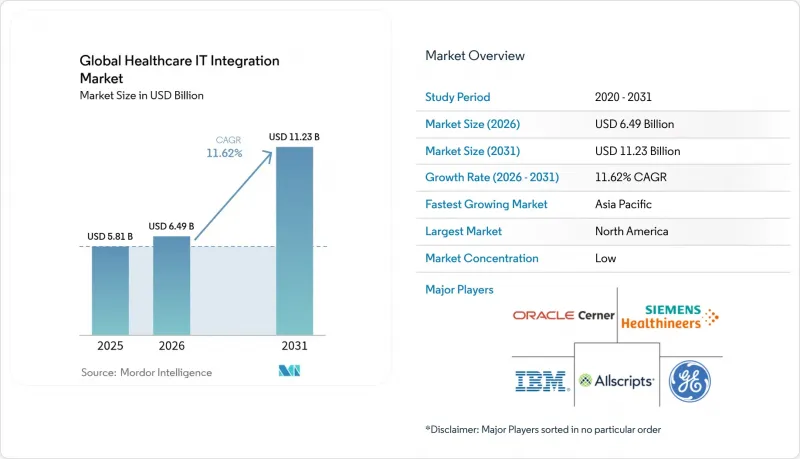
Mordor Intelligence에 따르면 세계의 헬스케어 IT 통합 시장 규모는 2025년 58억 1,000만 달러에서 2026년에는 64억 9,000만 달러로 확대되고, 2026년부터 2031년까지 CAGR 11.62%를 기록하며 2031년에는 112억 3,000만 달러에 달할 것으로 예측됩니다.
본 보고서에서는 업계를 제품·서비스별, 도입 형태별(온프레미스, 클라우드 기반, 하이브리드), 용도별(병원 인터페이스/EHR 통합, 의료기기 통합 등), 최종사용자별(병원·진료소, 진단·영상 진단 센터 등), 및 지역별(북미, 유럽, 아시아태평양 등)으로 분류하고 있습니다. 시장 예측은 금액(달러) 기준으로 제시되어 있습니다.
세계 헬스케어 IT 통합 시장의 동향 및 인사이트
미국 ONC 및 EU EHDS에 의해 의무화된 FHIR 기반 API로의 전환
2026년 1월에 발효되는 ONC의 최종 규정 및 2025년 3월부터 시행되고 있는 EHDS 규정에 따라, 보험사,의료 제공자, 벤더는 FHIR 리소스를 기반으로 한, 환자가 승인한 실시간 데이터 흐름을 지원해야 할 의무가 부과됨에 따라, 인터페이스 엔진 업데이트, API 관리 및 시맨틱 매핑 도구에 대한 설비 투자가 가속화되고 있습니다. 2024년 기준으로 조직의 67%가 이미 FHIR API를 운영 중이기 때문에 헬스케어 IT 통합 시장은 레거시 HL7v2 피드를 세분화된 FHIR 엔티티로 매핑해야 하는 가파른 학습 곡선을 극복해야 하며, 성숙한 북미 시장에서도 전문가에 대한 수요가 증가하고 있습니다. 규정을 준수하지 못하는 의료 제공자는 금전적 제재나 전략적 불이익을 입을 위험이 있으므로, EHR 공급업체와 틈새 시장 통합업체 간의 제휴가 촉진되며, 전환을 가속화하는 도구와 적합성 테스트 프레임워크를 공동 개발하는 움직임이 나타나고 있습니다.
원격 환자 모니터링 프로그램에 따른 다중 시스템 통합 수요
보험사가 원격 환자 모니터링(RPM) 및 재택 병원 모델에 대한 보상을 시행함에 따라 수요가 급증하고 있습니다. 미국에서는 약 5,000만 명의 환자가 RPM 기기를 이용하고 있으며, 모니터링 데이터가 EHR 워크플로우에 통합되면 치료 성과가 현저히 향상됩니다. 구체적으로, 통합되지 않은 환경과 비교했을 때 재입원율이 38% 감소했습니다. 데이터 흐름은 현재 웨어러블 기기, 스마트폰 앱, 클라우드 분석을 아우르고 있으며, 헬스케어 IT 통합 시장은 기기에서 EHR로의 오케스트레이션, 알림 라우팅, 그리고 시간 경과에 따른 기록 보완의 핵심으로 자리 잡고 있습니다. 미리 구축된 EHR 커넥터와 FHIR 우선 아키텍처를 갖춘 벤더는 구매 후보 목록에서 상위권을 차지하는 반면, 병원 측은 기기 데이터가 품질 보고 지표와 일치하도록 보장하기 위해 기술적 실사 기준을 강화하고 있습니다.
아프리카의 HL7/FHIR 전문가 인력 부족
아프리카의 공공 및 민간 의료 서비스 제공자들은 HL7 및 FHIR의 의미론에 정통한 통합 엔지니어 인재 풀이 제한적이어서 중요한 프로젝트에서 6-12개월의 지연을 겪고 있습니다(healthtechafrica.org). 원격 컨설팅만으로는 이러한 부족 현상을 부분적으로만 해소할 수 있으며, 현장에서의 변경 관리 및 인프라 구축 작업은 여전히 필수적입니다. 이러한 인력 부족은 인건비 상승과 가동 시작 일정 지연을 초래하며, 역량 개발 프로그램이 성숙해지기 전까지는 해당 의료 IT 통합 시장의 규모를 축소시키는 결과를 낳을 것입니다. 나미비아 등 신흥국의 e-헬스 전략에서는 인증 프로그램을 확대하기 위한 인재 육성 보조금이 편성되어 있습니다.
부문 분석
2025년, 서비스 부문은 헬스케어 IT 통합 시장의 56.98% 점유율을 차지했으며, 이러한 수준은 크로스 플랫폼 상호 운용성 프로젝트가 지식 집약적이라는 사실을 뒷받침합니다. 자문팀은 워크플로우 매핑, 인터페이스 사양 작성, 검증 스크립트 실행, 연중무휴 24시간 지원 데스크 운영을 수행하고 있으며, 이 모든 작업은 기성 기술의 범위를 뛰어넘는 것입니다. FHIR 규제로 인해 산출물 요구 사항이 엄격해지고, 멀티 벤더 생태계가 지속적인 거버넌스를 필요로함에 따라 이러한 서비스의 비중은 앞으로도 계속될 것으로 예상됩니다. 대규모 의료 시스템에서는 가동 시간 보장 및 규제 감사에 대한 대응을 확약하는 관리형 통합 계약에 증가하는 운영 예산을 할당하고 있습니다.
‘제품’ 부문은 인터페이스 엔진, API 게이트웨이, 디바이스 연결 소프트웨어가 로우코드 설계 스튜디오를 채택함에 따라 연평균 성장률(CAGR) 13.05%로 성장하여, 전체 헬스케어 IT 통합 시장의 규모 확대를 상회할 것으로 예측됩니다. Infor Cloverleaf만 해도 미국 병원의 3분의 1에서 하루 3억 건 이상의 트랜잭션을 처리하고 있으며, 이는 최신 엔진이 스크립트에 의존하던 기존의 브로커를 대체하고 있음을 보여줍니다. 사전 검증된 FHIR 구현 가이드가 번들로 제공되는 클라우드 기반 툴체인은 중규모 병원의 진입 장벽을 낮추고 있습니다. 그러나 제품의 성공은 구성을 맞춤화하고 데이터 거버넌스를 보장하는 서비스 파트너에 달려 있으며, 이는 두 부문의 성장 경로가 밀접하게 연결되어 있음을 뒷받침합니다.
2025년에는 온프레미스 배포가 헬스케어 IT 통합 시장의 61.78%를 차지했으며, 랜섬웨어 위협이 고조되는 가운데 병원들이 보호 대상 건강 정보에 대한 자율적인 관리와 네트워크 세분화 전략을 직접 파악하는 것을 우선시하고 있음이 부각되고 있습니다. 정보 유출에 대한 막대한 벌금으로 인해 최고정보 보안책임자(CISO)는 미션 크리티컬한 통합 엔진을 조직의 방화벽 내에 유지하고, 메시지 분석을 위해 맞춤형 하드웨어를 활용한 가속화를 병행하도록 권장받고 있습니다. 따라서 클라우드 도입이 진행되고 있음에도 불구하고, 온프레미스 모델과 관련된 헬스케어 IT 통합 시장의 규모는 여전히 크습니다.
클라우드 호스팅형 통합은 비용 효율적인 확장성, 트랜잭션 트래픽의 피크 시간에 대응하는 탄력적인 컴퓨팅 능력, 그리고 사전 인증된 규정 준수 청사진을 바탕으로 연평균 성장률(CAGR) 12.22%를 기록하고 있습니다. 하이브리드형도 활발해지고 있어, 임상 메시지의 라우팅과 저장은 온프레미스에서 수행하면서, 2차 사용 사례에서는 클라우드 분석을 활용할 수 있게 되었습니다. Parallels사의 2025년 조사에 따르면, 기업의 86%가 경제적 균형을 맞추기 위해 워크로드의 선택적 온프레미스 복귀를 시범적으로 실시하고 있는 것으로 나타났습니다. Tier 3 데이터센터를 보유하지 않은 지방 의료 제공자의 경우, 견고하게 구축된 헬스케어 전용 클라우드는 FHIR 샌드박스 환경을 제공하고 가동 시작까지의 주기를 단축함으로써 헬스케어 IT 통합 시장 전체의 확대에 기여하고 있습니다.
지역별 분석
2025년, 북미는 헬스케어 IT 통합 시장의 42.95%를 차지하고 있으며, 이는 성숙한 EHR 생태계, 엄격한 연방 정부 규제, 그리고 활발한 M&A 파이프라인에 힘입은 결과입니다. ONC(국립보건정보기술조정국)의 상호운용성 및 사전 승인에 관한 규정은 2027년까지 규제 확실성을 확립하고, 지불자와 의료 제공자 모두에게 실시간 사전 승인 데이터 공유(mahealthdata.org)를 실현하기 위한 인터페이스 엔진 업그레이드를 의무화하고 있습니다. 동시에, 지불 기관과 의료 제공자 간의 통합 프로젝트가 청구 데이터와 임상 데이터 통합에 대한 수요를 불러일으키며 지역적 성장을 촉진하고 있습니다.
아시아태평양은 2031년까지 연평균 성장률(CAGR)이 14.12%로 가장 빠르게 성장하고 있는 지역입니다. 일본, 인도, 호주의 정부 주도 디지털화 전략을 통해 광대역 의료 네트워크, EHR 도입 및 모바일 트리아지 플랫폼에 자금이 투입되고 있습니다. 현지 벤더들은 세계 인터페이스 분야의 선도 기업들과 제휴하여 FHIR 프로파일을 다양한 문자 체계로 현지화함으로써, 도시 및 외딴 지역의 진료소에서 헬스케어 IT 통합 시장을 활성화하고 있습니다. 모바일 우선 진료 모델과 소비자의 높은 앱 이용률이 원격 진료, 약국 배송, 만성 질환 관리 코칭 서비스를 거의 실시간으로 연결하는 API 마켓플레이스의 발전을 뒷받침하고 있습니다.
유럽의 동향은 ‘유럽 건강 데이터 공간(European Health Data Space)’ 규제에 의해 형성되고 있으며, 이 규제는 EU 회원국 전체의 전자건강기록(EHR) 상호운용성과 환자 데이터 이동성을 조화시키는 것입니다. 10년 동안 110억 유로의 비용 절감이 예상됨에 따라, 각국의 프로젝트에서는 레거시 시스템을 공통 프레임워크에 통합하기 위한 노력이 진행되고 있습니다. 각 벤더사는 동의 관리 모듈이나 다국어 코딩 사전을 자사 제품에 통합해야 하며, 이에 따라 범유럽적 원격 전문 진료 네트워크를 축으로 한 헬스케어 IT 통합 시장의 타겟 부문이 확대되고 있습니다. 신흥 시장인 중동 및 남미에서는 스마트 병원 도입에 대한 강한 의지가 나타나고 있으나, 레거시 HIS에 대한 종속성이나 기술 인력 확보의 불균형으로 인해 확산에 제약이 따르고 있습니다.
기타 혜택:
- 엑셀 형식의 시장 예측(ME) 시트
- 3개월간의 애널리스트 지원
자주 묻는 질문
목차
제1장 소개
제2장 조사 방법
제3장 주요 요약
제4장 시장 구도
제5장 시장 규모와 성장 예측
제6장 경쟁 구도
제7장 시장 기회와 향후 전망
KSM 26.08.25According to Mordor Intelligence, the global healthcare IT integration market size is expected to grow from USD 5.81 billion in 2025 to USD 6.49 billion in 2026 and is forecast to reach USD 11.23 billion by 2031 at 11.62% CAGR over 2026-2031.
This report Segments the Industry Into by Product & Services, by Deployment (on-Premises, Cloud-Based and Hybrid), by Application (Hospital Interface / EHR Integration, Medical Device Integration and More) by End User (Hospitals & Clinics, Diagnostic & Imaging Centers, and More), and Geography (North America, Europe, Asia-Pacific and More). The Market Forecasts are Provided in Terms of Value (USD).
Global Healthcare IT Integration Market Trends and Insights
Transition to FHIR-based APIs Mandated by US ONC & EU EHDS
The ONC final rule taking effect January 2026 and the EHDS regulation in force since March 2025 compel payers, providers, and vendors to support real-time, patient-authorized data flows built on FHIR resources, accelerating capital outlays for interface engine refreshes, API management, and semantic mapping tools. With 67% of organizations already running FHIR APIs in 2024, the Healthcare IT Integration market must absorb a steep learning curve in mapping legacy HL7v2 feeds to granular FHIR entities, promoting specialist demand even in mature North American settings. Providers unable to comply risk financial penalties and strategic disadvantages, prompting alliances between EHR vendors and niche integrators to co-develop migration accelerators and conformance testing frameworks.
Multi-system Integration Demand from Remote Patient Monitoring Programs
Demand surges as payers reimburse for remote patient monitoring (RPM) and hospital-at-home models. Nearly 50 million US patients use RPM devices, and outcomes improve markedly when monitoring feeds are embedded in EHR workflows-readmissions drop 38% compared with non-integrated deployments . Data flows now span wearables, smartphone apps, and cloud analytics, placing the Healthcare IT Integration market at the core of device-to-EHR orchestration, alert routing, and longitudinal record enrichment. Vendors with pre-built EHR connectors and FHIR-first architectures rank higher on purchasing shortlists, while hospitals tighten technical due-diligence criteria to ensure device data harmonize with quality-reporting metrics.
Implementation Talent Shortage for HL7/FHIR Specialists in Africa
African public and private providers confront delays of 6-12 months on critical projects due to a limited pool of integration engineers versed in HL7 and FHIR semantics healthtechafrica.org. Remote consulting alleviates only part of the gap, because onsite change-management and infrastructure work remain essential. The shortage raises labor costs, stretches go-live schedules, and reduces the addressable Healthcare IT Integration market until capacity-building programs mature. Emerging national eHealth strategies, such as Namibia's, earmark workforce development grants to expand certification programs.
Other drivers and restraints analyzed in the detailed report include:
- Device Integration Needs in Smart Operating Rooms across Middle East
- Increasing Need of Electronic Health Records and Other Healthcare IT Solutions
- Cyber-security Compliance Costs under GDPR & HIPAA Escalate Integration TCO
For complete list of drivers and restraints, kindly check the Table Of Contents.
Segment Analysis
Services captured 56.98% of Healthcare IT Integration market share in 2025, a level that underlines the knowledge-intensive character of cross-platform interoperability projects. Advisory teams conduct workflow mapping, build interface specifications, run validation scripts, and maintain 24/7 support desks, all of which exceed the scope of off-the-shelf technology. This services heft is expected to persist as FHIR regulations tighten deliverables and as multi-vendor ecosystems demand continuous governance. Large health systems allocate rising operational budgets to managed-integration contracts that guarantee uptime and regulatory audit readiness.
The Products segment is forecast to grow 13.05% CAGR, outpacing overall Healthcare IT Integration market size expansion as interface engines, API gateways, and device-connect software adopt low-code design studios. Infor Cloverleaf alone processes more than 300 million daily transactions across one-third of US hospitals, illustrating how modern engines take over legacy script-heavy brokers. Cloud-based toolchains bundled with pre-validated FHIR implementation guides lower entry thresholds for mid-tier hospitals. Nevertheless, product success remains contingent on service partners who customize configurations and ensure data governance, reinforcing the intertwined growth paths of both segments.
On-premise deployments held 61.78% of Healthcare IT Integration market in 2025, underscoring hospitals' preference for sovereign control over protected health information and direct grasp of network segmentation strategies amid escalating ransomware threats. High breach penalties incentivize chief information security officers to keep mission-critical integration engines behind institutional firewalls, coupled with custom hardware acceleration for message parsing. The Healthcare IT Integration market size attached to on-premise models, therefore, remains material even as cloud adoption climbs.
Cloud-hosted integration is gaining a 12.22% CAGR on the back of cost-effective scaling, elastic compute for peak transaction traffic, and pre-certified compliance blueprints. Hybrid patterns flourish, allowing clinical message routing and storage on-premise while leveraging cloud analytics for secondary use cases. Parallels' 2025 survey reveals 86% of enterprises experimenting with selective workload repatriation to strike an economic balance. For rural providers without Tier 3 data centers, hardened healthcare clouds now provide FHIR sandbox environments that shorten go-live cycles, broadening the total Healthcare IT Integration market.
Complete Report Scope:
- By Component
- Products
- Integration Engines
- Device Integration Software
- iPaaS / API Management Platforms
- EHR / HIE Interface Modules
- Services
- Implementation & Integration
- Support & Maintenance
- Consulting & Training
- Products
- By Deployment Mode
- On-premise
- Cloud-based
- Hybrid
- By Application
- Hospital Interface / EHR Integration
- Medical Device Integration
- Lab System Integration
- Pharmacy Integration
- Revenue Cycle & Claims Integration
- Population Health & Analytics Integration
- Others
- By End User
- Hospitals & Clinics
- Diagnostic & Imaging Centers
- Payers & TPAs
- Pharmacies
- Others
- By Geography
- North America
- United States
- Canada
- Mexico
- Europe
- Germany
- United Kingdom
- France
- Italy
- Spain
- Rest of Europe
- Asia-Pacific
- China
- Japan
- India
- South Korea
- Australia
- Rest of Asia
- Middle East and Africa
- GCC
- South Africa
- Rest of Middle East and Africa
- South America
- Brazil
- Argentina
- Rest of South America
- North America
Geography Analysis
North America occupied 42.95% of the Healthcare IT Integration market in 2025, supported by mature EHR ecosystems, rigorous federal mandates, and active M&A pipelines. The ONC Interoperability and Prior Authorization rule anchors regulatory certainty by 2027, compelling both payers and providers to upgrade interface engines for real-time prior-approval data sharing mahealthdata.org. Concurrently, payer-provider convergence projects inject demand for claims-clinical fusion, reinforcing regional growth.
Asia-Pacific is the fastest-expanding territory with a 14.12% CAGR through 2031. Government-backed digitization strategies in Japan, India, and Australia fund broadband health networks, EHR rollouts, and mobile triage platforms. Local vendors collaborate with global interface leaders to localize FHIR profiles in multiple scripts, elevating the Healthcare IT Integration market across urban and remote clinics. Mobile-first care models and high consumer app engagement spur API marketplaces that connect teleconsultation, pharmacy delivery, and chronic-care coaching services in near real time.
Europe's trajectory is shaped by the European Health Data Space regulation, which harmonizes EHR interoperability and patient data portability across EU member states. Anticipated cost savings of EUR 11 billion over 10 years motivate national projects to align legacy systems with the common framework. Vendors must embed consent-management modules and multilingual coding dictionaries into their offerings, expanding addressable Healthcare IT Integration market segments around pan-European tele-specialty networks. Emerging Middle East and South American markets show healthy appetites for smart-hospital inclusion, yet legacy HIS lock-in and uneven skill availability temper roll-outs.
- Oracle
- Lyniate
- Infor
- Epic Systems
- Intersystems
- GE Healthcare
- Koninklijke Philips
- IBM
- Siemens Healthineers
- Allscripts Healthcare Solutions (Altera)
- NextGen Healthcare
- Redox
- Orion Health
- Meditech
- Optum
- Connexall
- Dedalus Group
- Rhapsody Health Solutions
- Qvera
- iNTERFACEWARE
- Change Healthcare
Additional Benefits:
- The market estimate (ME) sheet in Excel format
- 3 months of analyst support
TABLE OF CONTENTS
1 Introduction
- 1.1 Study Assumptions & Market Definition
- 1.2 Scope of the Study
2 Research Methodology
3 Executive Summary
4 Market Landscape
- 4.1 Market Overview
- 4.2 Market Drivers
- 4.2.1 Transition to FHIR-based APIs Mandated by US ONC & EU EHDS
- 4.2.2 Multi-system Integration Demand from Remote Patient Monitoring Programs
- 4.2.3 Increasing Need of Electronic Health Records and Other Healthcare IT Solutions
- 4.2.4 Device Integration Needs in Smart Operating Rooms across Middle East
- 4.2.5 Payer-Provider Convergence Requiring Seamless Claims-Clinical Data Fusion in US
- 4.2.6 Surge in M&A Spurring Interface Engine Replacement Cycles in North America
- 4.3 Market Restraints
- 4.3.1 Implementation Talent Shortage for HL7/FHIR Specialists in Africa
- 4.3.2 Cyber-security Compliance Costs under GDPR & HIPAA Escalate Integration TCO
- 4.3.3 Vendor-Locked Legacy HIS Architectures in Public Hospitals across South America
- 4.3.4 ROI Ambiguity for Cross-Platform Integration in Small Physician Practices
- 4.4 Supply-Chain Analysis
- 4.5 Regulatory Outlook
- 4.6 Technological Outlook
- 4.7 Porter's Five Forces
- 4.7.1 Threat of New Entrants
- 4.7.2 Bargaining Power of Suppliers
- 4.7.3 Bargaining Power of Buyers
- 4.7.4 Threat of Substitutes
- 4.7.5 Industry Rivalry
5 Market Size & Growth Forecasts (Value)
- 5.1 By Component
- 5.1.1 Products
- 5.1.1.1 Integration Engines
- 5.1.1.2 Device Integration Software
- 5.1.1.3 iPaaS / API Management Platforms
- 5.1.1.4 EHR / HIE Interface Modules
- 5.1.2 Services
- 5.1.2.1 Implementation & Integration
- 5.1.2.2 Support & Maintenance
- 5.1.2.3 Consulting & Training
- 5.1.1 Products
- 5.2 By Deployment Mode
- 5.2.1 On-premise
- 5.2.2 Cloud-based
- 5.2.3 Hybrid
- 5.3 By Application
- 5.3.1 Hospital Interface / EHR Integration
- 5.3.2 Medical Device Integration
- 5.3.3 Lab System Integration
- 5.3.4 Pharmacy Integration
- 5.3.5 Revenue Cycle & Claims Integration
- 5.3.6 Population Health & Analytics Integration
- 5.3.7 Others
- 5.4 By End User
- 5.4.1 Hospitals & Clinics
- 5.4.2 Diagnostic & Imaging Centers
- 5.4.3 Payers & TPAs
- 5.4.4 Pharmacies
- 5.4.5 Others
- 5.5 By Geography
- 5.5.1 North America
- 5.5.1.1 United States
- 5.5.1.2 Canada
- 5.5.1.3 Mexico
- 5.5.2 Europe
- 5.5.2.1 Germany
- 5.5.2.2 United Kingdom
- 5.5.2.3 France
- 5.5.2.4 Italy
- 5.5.2.5 Spain
- 5.5.2.6 Rest of Europe
- 5.5.3 Asia-Pacific
- 5.5.3.1 China
- 5.5.3.2 Japan
- 5.5.3.3 India
- 5.5.3.4 South Korea
- 5.5.3.5 Australia
- 5.5.3.6 Rest of Asia
- 5.5.4 Middle East and Africa
- 5.5.4.1 GCC
- 5.5.4.2 South Africa
- 5.5.4.3 Rest of Middle East and Africa
- 5.5.5 South America
- 5.5.5.1 Brazil
- 5.5.5.2 Argentina
- 5.5.5.3 Rest of South America
- 5.5.1 North America
6 Competitive Landscape
- 6.1 Market Concentration
- 6.2 Market Share Analysis
- 6.3 Company Profiles {(includes Global level Overview, Market level overview, Core Segments, Financials as available, Strategic Information, Market Rank/Share for key companies, Products & Services, and Recent Developments)}
- 6.3.1 Oracle Cerner
- 6.3.2 Lyniate
- 6.3.3 Infor
- 6.3.4 Epic Systems Corporation
- 6.3.5 InterSystems Corporation
- 6.3.6 GE Healthcare
- 6.3.7 Philips Healthcare
- 6.3.8 IBM Corporation
- 6.3.9 Siemens Healthineers
- 6.3.10 Allscripts Healthcare Solutions (Altera)
- 6.3.11 NextGen Healthcare
- 6.3.12 Redox
- 6.3.13 Orion Health
- 6.3.14 MEDITECH
- 6.3.15 Optum
- 6.3.16 Connexall
- 6.3.17 Dedalus Group
- 6.3.18 Rhapsody Health Solutions
- 6.3.19 Qvera
- 6.3.20 iNTERFACEWARE
- 6.3.21 Change Healthcare
7 Market Opportunities & Future Outlook
- 7.1 White-space & Unmet-Need Assessment


