

|
시장보고서
상품코드
2099926
호흡기 병원체 검사 키트 시장 : 시장 점유율 분석, 업계 동향 및 통계, 성장 예측(2026-2031년)Respiratory Pathogen Testing Kits - Market Share Analysis, Industry Trends & Statistics, Growth Forecasts (2026 - 2031) |
||||||
 Mordor Intelligence
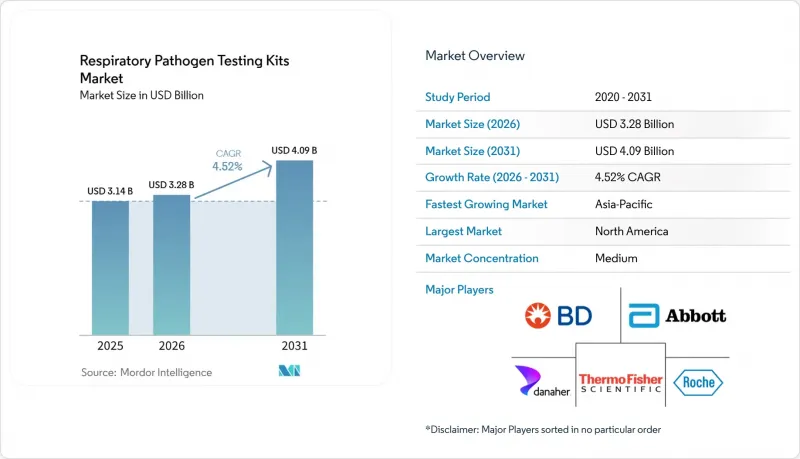
Mordor Intelligence에 의하면, 호흡기 병원체 검사 키트 시장 규모는 2025년 31억 4,000만 달러로 평가되었고, 2026년에는 32억 8,000만 달러로 확대될 것으로 추정되고, 2031년까지 40억 9,000만 달러에 이를 것으로 예상되며, 2026-2031년 CAGR 4.52%로 성장할 전망입니다.
본 보고서는 제품 유형별(RT-PCR, 신속 항원 검사, 멀티플렉스 패널, ELISA 등), 기술별(NAAT, 면역 분석법, 등온 증폭법, NGS, 기타), 검체 유형별(비인두 면봉, 타액, 가래), 최종 사용자별(병원, 검사실, 진료소, 재택 간호), 지역별(북미, 유럽, 아시아태평양, 기타)로 분류되어 있습니다. 시장 전망은 금액(달러)으로 표시되어 있습니다.
세계의 호흡기 병원체 검사 키트 시장 동향 및 인사이트
호흡기 감염증의 부담 증가와 증후군 검사 도입 확대
호흡기 병원체 검사 키트 시장은 인플루엔자, RSV, SARS-CoV-2 및 세균성 동반 병원체의 복합적인 부담으로 인해 계속해서 혜택을 받고 있습니다. 이는 호흡기 질환 발생 건수가 감소하지 않고, 연령대별 환자 구성이 변화하고 있기 때문입니다. RSV 및 인플루엔자의 부담은 고령층으로 더욱 뚜렷하게 이동하고 있으며, 이로 인해 증상 중복이 여전히 흔한 많은 급성 하기도 질환 사례에서 단일 표적 검사의 신뢰성이 저하되고 있습니다. 따라서 병원 및 의료진은 5-25종의 병원체를 동시에 검출함으로써 초진 시 진단 불확실성을 줄일 수 있다는 점을 고려하여, 증후군별 검사 패널을 일상적인 검사 의뢰 절차에 점차 도입하고 있습니다. 2025년에 실시된 소아 대상 연구에서도 다중 분자 검사가 병원체 특정 속도를 향상시키고, 적절한 격리 조치를 지원하며, 병원 내 감염 위험 감소에 기여한 것으로 나타났으며, 계절적인 환자 급증에 대응하는 의료 기관에게 있어 도입 근거가 더욱 강화되고 있습니다. 또한, 2026년 WHO의 역학 보고서에서는 병원체의 유행 패턴 변화와 혼합 병원체의 활동이 지적되었으며, 한 번의 검사로 여러 주요 병원체를 검출할 수 있는 검사법의 실용적 가치가 높아지고 있습니다. 이것이 호흡기 병원체 검사 키트 시장에서 기존의 반사 검사로의 회귀가 아닌, 특정 병원체에 초점을 맞춘 다중 검사 형식에 대한 수요가 지속되고 있는 이유입니다.
기관에 의한 감시 및 팬데믹 대응 프로그램의 확대
호흡기 병원체 검사 키트 시장은 지속적인 공중보건 조달 기반에 의해서도 뒷받침되고 있습니다. 이는 각국 정부가 검사실의 대응 능력을 일시적인 긴급 대응이 아닌 지속적인 역량으로 자금을 지원하고 있기 때문입니다. 2026년 WHO PIP 프레임워크 및 관련 대비 노력은 특히 북미나 유럽에 비해 검사 실시 빈도가 여전히 낮은 동남아시아, 아프리카, 라틴아메리카에서 호흡기 감시 지출이 다년간의 프로그램으로 체계화되고 있음을 보여줍니다. 이는 중요한 점입니다. 지속적인 감시 예산은 검사 키트 및 시약의 정기적인 구매를 유도할 뿐만 아니라, 입찰 주기를 통해 안정적인 납품과 품질에 대한 문서화를 유지할 수 있는 공급업체에 보상을 제공하기 때문입니다. 또한, 많은 공중보건 현장에서 시약에 대한 지속적인 계약이 장비의 일시적인 도입보다 중요해짐에 따라 공급업체의 전략도 변화하고 있습니다. 검사실 품질 기준과 연계된 인증 요건은 아시아태평양 및 중동 전역에서 점점 더 중요해지고 있으며, 이로 인해 기관의 입찰에 참여를 희망하는 공급업체의 진입 장벽이 높아지고 있습니다. 그 결과, 호흡기 병원체 검사 키트 시장은 단기적인 환자 검사 수요와 마찬가지로 공공 검사실의 현대화에 의해서도 크게 형성되고 있습니다.
가격에 민감한 시장에서 검사당 높은 비용
호흡기 병원체 검사 키트 시장은 저소득 국가나 가격에 민감한 의료 시스템에서 여전히 엄격한 비용 대비 효과의 장벽에 직면해 있습니다. 이는 광범위한 분자 멀티플렉스 패널의 비용이 소규모 지역 의료기관의 일일 진단 예산을 초과할 가능성이 있기 때문입니다. 이러한 요인이 도입을 제한하는 것은 임상적 가치가 불분명하기 때문이 아니라, 공공 조달 담당자가 패널의 광범위한 검사 범위와 기본적인 검사 서비스 전반에 걸친 더 광범위한 검사량 수요 간의 균형을 맞추어야 하기 때문입니다. 이러한 불일치는 첨단 다중 검사법의 개발이 고소득 시장의 기대에 의해 형성되는 반면, 아시아태평양, 중동, 남미 일부와 같이 병원 예산이 여전히 훨씬 더 빠듯한 지역에서 가장 두드러지게 나타납니다. 따라서 PCR이 더 우수한 분석 성능을 발휘하는 경우에도, 일부 환경에서는 실용적인 관점에서 저비용 방식이 계속해서 우선시되고 있습니다. 그 결과, 생산 비용이 낮고 현지 입찰 요건에 부합하는 지역 제조업체는 공공 부문 계약에서 다국적 기업보다 유리한 입지를 차지할 수 있습니다. 이로 인해 호흡기 병원체 검사 키트 시장은 임상적 수요뿐만 아니라 구매력에 의해서도 시장 세분화가 이루어지는 상태가 지속되고 있습니다.
부문 분석
2025년, RT-PCR 키트는 호흡기 병원체 검사 키트 시장에서 45.31%의 점유율을 차지했으며, 이러한 우위는 규제 당국의 높은 인지도, 광범위한 진단 대상 범위, 그리고 검증된 분자진단의 민감도에 대한 병원 검사실의 신뢰를 반영한 것입니다. 이 부문은 결과의 신뢰성, 표준화된 워크플로우, 그리고 규정 준수에 대한 기대가 일상적인 분자 호흡기 검사를 지속적으로 뒷받침하고 있는 인증된 병원 환경에 깊이 뿌리내리고 있습니다. 또한, RT-PCR 키트는 확립된 도입 기반의 혜택을 받고 있으며, 플랫폼이 이미 병원 네트워크의 일부인 경우 시약에 대한 지속적인 수요를 유지하는 데 도움이 되고 있습니다. 따라서 호흡기 병원체 검사 키트 시장은 특히 연중 다양한 호흡기 질환 사례를 처리하는 중앙 검사실에서 RT-PCR을 핵심 판매량 카테고리로 계속해서 의존하고 있습니다. 신속 항원 검사 키트는 특히 병원체의 상세한 동정보다 편의성이나 워크플로우 시간 단축이 중시되는 신속한 결과가 요구되는 환경에서 여전히 중요한 위치를 차지하고 있습니다.
멀티플렉스 호흡기 패널은 2026-2031년 연평균 성장률(CAGR) 6.38%를 나타낼 것으로 예측됩니다. 이는 임상의들이 A형 및 B형 인플루엔자, RSV, SARS-CoV-2, 그리고 특정 세균성 동반 병원체를 한 번에 검출할 수 있는 단일 실행(single-run) 형식을 점점 더 선호하고 있기 때문입니다. 이러한 성장은 대학병원을 넘어 지역 병원 및 응급 의료 네트워크로까지 확산되고 있으며, 이로 인해 호흡기 증후군 검사의 상업적 기반이 확대되고 있습니다. DFA 키트 및 ELISA 키트는 계속해서 보다 제한적인 이용 사례에 머물고 있습니다. DFA는 소아 호흡기 질환 검사에서 일정한 입지를 유지하고 있으며, ELISA는 여전히 배치 처리 방식의 참조 검사실 업무에 적합합니다. 등온 증폭 키트도 주목을 받고 있는데, 실온에서 조작이 가능하기 때문에 자원이 제한된 환경에서 물류상의 장벽을 일부 완화할 수 있기 때문입니다. 또한, 2025년 조사에서는 타액 검체를 이용한 다중 항목 RT-LAMP가 단일 튜브 형식으로 임상적으로 유의미한 검출 성능을 달성한 것으로 나타났습니다. CLIA 준수 분자진단 플랫폼이 분산형 의료 현장으로 확대됨에 따라, 분자진단에 대한 접근이 더 이상 고도로 전문화된 검사실 환경에 국한되지 않게 되었기 때문에 독립형 DFA의 이용 사례는 더 큰 압박에 직면하고 있습니다.
NAAT는 2025년에 57.24%의 점유율을 차지하며 호흡기 병원체 검사 키트 시장에서 다른 기술을 크게 앞서고 있으며, 이러한 위상은 오랜 기간에 걸친 임상적 검증, 견고한 도입 기반에 의한 지원, 그리고 병원 검사실에서의 확고한 활용을 반영합니다. 이 기술은 민감도, 익숙한 워크플로우, 그리고 호흡기 질환의 모든 이용 사례에서 임상의들의 폭넓은 수용을 모두 갖추고 있어 여전히 지지를 받고 있습니다. 면역 분석법은 2위 시장 점유율을 차지하고 있으며, 특히 검사실 외부 환경이나 신속한 검사 과정에 적합한 신속 항원 검사 분야에서 활용되고 있습니다. 또한, 등온 증폭법도 완전한 중앙 검사실의 기능보다는 조작의 간편성과 낮은 인프라 요구 사항이 중시되는 상황에서 그 중요성을 계속해서 높여가고 있습니다. 호흡기 병원체 검사 키트 업계에서 이러한 기술의 조합은 일상적인 진단에서는 여전히 실적이 입증된 분자진단법이 선호되는 한편, 운영상의 필요에 따라 더 신속하거나 복잡성이 낮은 대안 수단의 여지가 유지되고 있음을 보여줍니다.
차세대 염기서열 분석(NGS)은 2026-2031년 연평균 성장률(CAGR) 7.52%를 나타낼 것으로 예측되지만, 그 역할은 여전히 독특합니다. 왜냐하면 현재 NGS의 가장 큰 가치는 표준적인 1차 환자 진단이 아니라, 감시, 균주 특성 분석 및 집단 발생 조사에 있기 때문입니다. 2026년 연구에 따르면, NGS 호흡기 바이러스 패널은 보다 상세한 유형 분류 및 역학 조사를 지원함으로써 RT-PCR을 보완하고 있으며, 이는 공중 보건 및 고급 미생물학 분야에서의 도입 근거를 강화하고 있습니다. 보다 시급한 상업적 움직임으로는 표적형 NGS로의 전환이 진행되고 있습니다. 이는 병원 측이 패널 PCR과 완전한 메타유전체 시퀀싱 사이에서 저비용이며 신속한 가교 역할을 할 수 있는 기법을 찾고 있기 때문입니다. 2025년 비교 연구에 따르면, 타겟형 NGS는 메타유전체 접근법과 동등한 전반적인 양성률을 보임과 동시에 워크플로가 간소하고 비용 부담도 낮은 것으로 밝혀졌으며, 이는 병원 미생물학 부서의 기술 선정에 박차를 가하고 있습니다. 호흡기 병원체 검사 키트 업계에서 NGS는 이를 통해 의미 있는 성장 궤도를 유지하고 있지만, NAAT가 가진 광범위한 임상 적용 범위에 비하면 여전히 보다 전문적인 위치에 머물러 있습니다.
지역별 분석
2025년, 북미는 43.61%의 점유율을 차지했으며, 이 지역은 호흡기 병원체 검사 키트 시장에서 주도적인 위치를 확립했습니다. 이는 미국에서 검사 실시 빈도가 높고, 확립된 보험 환급 경로, 그리고 성숙한 기관의 조달 체계가 결합되어 있기 때문입니다. 또한, 이 지역은 분자진단 시스템의 광범위한 도입 실적에 더해, 호흡기 검사가 예외적인 유행 기간에만 국한되지 않고 일상적인 계절 관리에 통합되어 있는 의료 환경의 혜택도 받고 있습니다. 캐나다와 멕시코는 전국적인 검사 기관 네트워크와 계절별 감시 프로그램을 통해 지역 매출에 기여했으나, 1인당 검사 빈도는 미국보다 낮았습니다. 2025년 12월 Medline사와 Beacon Health System사 간에 체결된 주요 공급업체 검사 기관 계약은 여러 병원을 대상으로 한 계약이 병원 시스템 전체의 기존 공급 관계를 어떻게 강화할 수 있는지를 보여주었습니다.
유럽은 계속해서 2위 지역 규모를 유지하고 있으며, 독일, 영국, 프랑스가 호흡기 병원체 검사 키트 시장의 지역 수요 대부분을 차지하고 있습니다. 이 지역에서는 대규모 병원 시스템, 체계적인 검사실 조달, 그리고 강력한 검증 패키지를 갖춘 공급업체를 평가하는 규제 환경을 통해 고도의 호흡기 진단이 지속적으로 뒷받침되고 있습니다. IVDR(체외진단용 의료기기 규정) 요건으로 인해 호흡기 패널 접근과 관련된 문서화 부담이 증가하고 있으며, 이로 인해 보다 상세한 임상적 근거를 제시하고 인증 기관과의 협력을 원활하게 진행할 수 있는 제조업체에게 우위가 주어지고 있습니다. 프랑스, 이탈리아, 스페인도 상당한 판매량을 차지하고 있으며, 스페인의 CerTest Biotec 사례는 이 지역 내 제조 시장 진입이 대형 다국적 공급업체에만 국한되지 않음을 보여줍니다.
아시아태평양은 2026-2031년 연평균 성장률(CAGR) 7.65%를 나타낼 것으로 예측되며, 호흡기 병원체 검사 키트 시장에서 가장 빠르게 성장하는 지역 블록이 되어 수요 증가의 가장 중요한 원동력이 될 전망입니다. 중국과 인도는 양국 모두 국내 진단 역량을 구축하고, 진화하는 규제 및 등록 체계를 통해 시장 접근성을 확보하고 있어 이러한 확장의 중심적인 역할을 하고 있습니다. 중국 내 국산 체외진단용 검사 키트(IVD) 승인 절차는 현지 개발자의 상품화 기간을 단축하는 데 도움이 되고 있으며, 이로 인해 수입 제품에 대한 경쟁 압력이 강화되고 있습니다. 또한, 인도에서 수입 검사 키트에 대한 보다 엄격한 등록 접근 방식은 해외 공급업체들이 현지 파트너십 및 국내 생산 경로를 모색하도록 촉진하고 있습니다. 일본과 한국은 여전히 이 지역의 중요한 혁신 거점이며, Seegene이나 Kogene Biotech와 같은 한국 기업들은 광범위한 항목을 포괄하는 다항목 호흡기 패널 검사 키트 개발에서 존재감을 드러내고 있습니다. 남미, 중동 및 아프리카는 절대적인 규모 면에서는 여전히 작지만, 공중보건 시스템이 참조 실험실의 역량을 확대하고 있는 한편, 호흡기 병원체의 동시 유행이 지속되면서 다중 병원체 검사의 필요성이 더욱 높아지고 있어 전략적으로 중요한 지역으로 부상하고 있습니다.
기타 혜택 :
- 엑셀 형식 시장 예측(ME) 시트
- 3개월간의 애널리스트 지원
자주 묻는 질문
목차
제1장 서론
제2장 조사 방법
제3장 주요 요약
제4장 시장 구도
제5장 시장 규모 및 성장 예측
제6장 경쟁 구도
제7장 시장 기회 및 향후 전망
AJY 26.08.07According to Mordor Intelligence, the respiratory pathogen testing kits market size is expected to increase from USD 3.14 billion in 2025 to USD 3.28 billion in 2026 and reach USD 4.09 billion by 2031, growing at a CAGR of 4.52% over 2026-2031.
This report is Segmented by Product Type (RT PCR, Rapid Antigen, Multiplex Panels, ELISA, and More), Technology (NAAT, Immunoassays, Isothermal Amplification, NGS, Other), Sample Type (Nasopharyngeal Swabs, Saliva, Sputum), End User (Hospitals, Labs, Clinics, Home Care), and Geography (North America, Europe, Asia-Pacific, and More). The Market Forecasts are Provided in Value (USD).
Global Respiratory Pathogen Testing Kits Market Trends and Insights
Rising Burden of Respiratory Infections and Syndromic Testing Adoption
The respiratory pathogen testing kits market continues to benefit from the combined burden of influenza, RSV, SARS-CoV-2, and bacterial co-pathogens, because the volume of respiratory illness is not fading and the affected patient mix is changing across age groups. RSV and influenza burden has shifted more visibly toward older adults, and that makes single-target testing less reliable in many acute lower respiratory presentations where overlapping symptoms remain common. Hospitals and care teams are therefore moving syndromic panels into routine ordering pathways, because simultaneous detection across 5 to 25 pathogens reduces diagnostic uncertainty during the first clinical encounter. A 2025 pediatric study also showed that multiplex molecular testing improved the speed of pathogen identification, supported better isolation practice, and helped reduce hospital transmission risk, which makes the procurement case stronger for institutions that are managing seasonal surges. WHO epidemiological reporting in 2026 also indicated changing circulation patterns and mixed-pathogen activity, which increases the practical value of assays that can capture more than one likely pathogen in a single run. This is why the respiratory pathogen testing kits market is seeing sustained pull for focused multiplex formats rather than a return to older reflex-testing pathways.
Expansion of Institutional Surveillance and Pandemic Preparedness Programs
The respiratory pathogen testing kits market is also being supported by a durable public health procurement layer, because governments are funding laboratory readiness as an ongoing capability rather than as a temporary emergency response. The WHO PIP Framework and related readiness work in 2026 show that respiratory surveillance spending is being organized across multi-year programs, especially in Southeast Asia, Africa, and Latin America, where testing intensity still trails North America and Europe. This matters because recurring surveillance budgets create repeat purchasing for kits and reagents, and they also reward suppliers that can maintain stable delivery and quality documentation across tender cycles. It also changes vendor strategy, since recurring reagent agreements become more important than one-time instrument placements in many public health settings. Accreditation expectations tied to laboratory quality standards are becoming more relevant across Asia-Pacific and the Middle East, which raises the entry threshold for suppliers that want to participate in institutional tenders. As a result, the respiratory pathogen testing kits market is being shaped as much by public laboratory modernization as by near-term patient testing demand.
High Per-Test Cost in Price-Sensitive Markets
The respiratory pathogen testing kits market still faces a hard affordability ceiling in lower-income and price-sensitive systems, because the cost of broad molecular multiplex panels can exceed the daily diagnostic budget of smaller district facilities. This limits adoption not because the clinical value is unclear, but because public procurement teams must balance panel depth against broader volume needs across basic testing services. The mismatch is strongest in regions where advanced multiplex development is shaped by high-income market expectations, while hospital budgets remain far tighter in parts of Asia-Pacific, the Middle East, and South America. That is why practical use in some settings continues to favor lower-cost formats even when PCR would offer better analytical performance. The result is that regional manufacturers with lower production costs and stronger local tender alignment can be better positioned than multinationals in public sector contracts. This keeps the respiratory pathogen testing kits market segmented by purchasing power as much as by clinical need.
Other drivers and restraints analyzed in the detailed report include:
- Shift Toward Point-of-Care and Decentralized Testing
- Multiplex Panel Convergence and Workflow Standardization
- Reimbursement Gaps for Non-Hospital Testing
For complete list of drivers and restraints, kindly check the Table Of Contents.
Segment Analysis
RT PCR Kits held 45.31% of the respiratory pathogen testing kits market share in 2025, and that lead reflected regulatory familiarity, broad diagnostic coverage, and the confidence hospital labs place in validated molecular sensitivity. This segment remains deeply embedded in accredited hospital environments where result reliability, standardized workflows, and compliance expectations continue to support routine molecular respiratory testing. RT PCR Kits also benefit from established installed bases, which helps preserve recurring reagent demand once a platform is already part of a hospital network. The respiratory pathogen testing kits market therefore continues to rely on RT PCR as its core volume category, especially in central laboratories that process mixed respiratory case loads throughout the year. Rapid Antigen Kits remained important in faster-turnaround settings, especially where convenience and short workflow time carry more weight than deeper pathogen resolution.
Multiplex Respiratory Panels are projected to grow at a 6.38% CAGR from 2026 to 2031, because clinicians increasingly prefer a single-run format that can detect influenza A and B, RSV, SARS-CoV-2, and selected bacterial co-pathogens together. This growth is moving beyond academic medical centers and into community hospitals and urgent care networks, which expands the commercial base for respiratory syndromic testing. DFA Kits and ELISA Kits continue to serve narrower use cases, with DFA retaining some presence in pediatric respiratory workups and ELISA still fitting batch-style reference laboratory activity. Isothermal Amplification Kits are also gaining attention because ambient-temperature operation can reduce some logistical barriers in resource-limited settings, and 2025 research showed that multiplex RT-LAMP on saliva specimens achieved clinically relevant detection performance in a single-tube format. As CLIA-oriented molecular platforms expand across decentralized settings, standalone DFA use cases face more pressure because molecular access is no longer limited to highly specialized lab environments.
NAAT held 57.24% share in 2025, giving it the clear lead across technologies in the respiratory pathogen testing kits market, and that position reflects long clinical validation, strong installed base support, and institutionalized use in hospital laboratories. The technology is still favored because it combines sensitivity, workflow familiarity, and broad clinician acceptance across respiratory use cases. Immunoassay formats held the second-largest position, especially in rapid antigen applications that fit non-laboratory settings and faster testing pathways. Isothermal Amplification also continues to build relevance where simpler operation and lower infrastructure needs matter more than full central laboratory capability. Within the respiratory pathogen testing kits industry, this technology mix shows that routine diagnosis still favors proven molecular methods, while operational needs continue to preserve room for faster or lower-complexity alternatives.
Next-Generation Sequencing is projected to grow at a 7.52% CAGR from 2026 to 2031, but its role remains distinct because its strongest current value sits in surveillance, strain characterization, and outbreak investigation rather than in standard front-line patient diagnosis. A 2026 study showed that NGS respiratory virus panels complement RT-PCR by supporting deeper typing and epidemiological investigation, which strengthens the case for public health and advanced microbiology settings. The more immediate commercial movement is toward targeted NGS, because hospitals want a lower-cost and faster bridge between panel PCR and full metagenomic sequencing. A 2025 comparison study found that targeted NGS produced overall positivity rates comparable to metagenomic approaches with a simpler workflow and lower cost burden, which is helping drive technology selection in hospital microbiology departments. Within the respiratory pathogen testing kits industry, this keeps NGS on a growth path that is meaningful, but still more specialized than the broad clinical footprint held by NAAT.
Complete Report Scope:
- By Product Type
- RT PCR Kits
- Rapid Antigen Kits
- Multiplex Respiratory Panels
- DFA Kits
- ELISA Kits
- Isothermal Amplification Kits
- By Technology
- NAAT
- Immunoassays
- Isothermal Amplification
- Next-Generation Sequencing
- Other Technologies
- By Sample Type
- Nasopharyngeal Swabs
- Oropharyngeal Swabs
- Saliva
- Sputum
- Other Sample Types
- By End User
- Hospitals
- Diagnostic Laboratories
- Clinics and Urgent Care Centers
- Home Care Settings
- Other End Users
- By Geography
- North America
- United States
- Canada
- Mexico
- Europe
- Germany
- United Kingdom
- France
- Italy
- Spain
- Rest of Europe
- Asia-Pacific
- China
- Japan
- India
- Australia
- South Korea
- Rest of Asia-Pacific
- Middle East and Africa
- GCC
- South Africa
- Rest of Middle East and Africa
- South America
- Brazil
- Argentina
- Rest of South America
- North America
Geography Analysis
North America held 43.61% share in 2025, and that gave the region the leading position in the respiratory pathogen testing kits market because the United States combines high testing intensity, established reimbursement pathways, and mature institutional procurement structures. The region also benefits from a broad installed base of molecular systems and a healthcare environment where respiratory testing is integrated into routine seasonal management rather than reserved only for exceptional outbreak periods. Canada and Mexico contributed to regional revenue through national laboratory networks and seasonal surveillance programs, although per-capita testing intensity remained below the United States. A December 2025 prime vendor laboratory agreement between Medline and Beacon Health System also showed how multi-hospital contracting can reinforce incumbent supply relationships across hospital systems.
Europe remained the second-largest geography, with Germany, the United Kingdom, and France accounting for much of regional demand in the respiratory pathogen testing kits market. The region continues to support advanced respiratory diagnostics through large hospital systems, structured laboratory procurement, and a regulatory environment that rewards suppliers with strong validation packages. IVDR requirements have raised the documentation burden for respiratory panel access, which gives an advantage to manufacturers that can support deeper clinical evidence and smoother notified body engagement. France, Italy, and Spain also contributed meaningful volume, and Spain's CerTest Biotec showed that regional manufacturing participation is not limited to large multinational suppliers.
Asia-Pacific is projected to grow at a 7.65% CAGR from 2026 to 2031, making it the fastest-growing regional block in the respiratory pathogen testing kits market and the most important source of incremental demand growth. China and India are central to that expansion because both are building domestic diagnostic capacity and shaping market access through evolving regulatory and registration frameworks. China's pathway for domestically manufactured IVD assays is helping shorten commercialization timelines for local developers, and this is increasing competitive pressure on imported products. India's tighter registration approach for imported assays is also encouraging foreign suppliers to consider local partnerships and domestic manufacturing pathways. Japan and South Korea remain important innovation hubs within the region, and South Korean companies such as Seegene and Kogene Biotech are visible in broad-spectrum multiplex respiratory panel development. South America and the Middle East and Africa remain smaller in absolute size, yet they are strategically important because public health systems are expanding reference laboratory capability while respiratory co-circulation continues to reinforce the need for multi-pathogen testing.
- Abbott Laboratories
- Altona Diagnostics GmbH
- Beckton Dickinson
- bioMerieux
- Bio-Rad Laboratories
- Cepheid
- CerTest Biotec, S.L.
- Danaher
- DiaSorin
- Roche
- Hologic
- Meridian Bioscience, Inc.
- QIAGEN
- QuidelOrtho
- R-Biopharm
- Seegene
- Siemens Healthineers
- Thermo Fisher Scientific
Additional Benefits:
- The market estimate (ME) sheet in Excel format
- 3 months of analyst support
TABLE OF CONTENTS
1 Introduction
- 1.1 Study Assumptions & Market Definition
- 1.2 Scope of the Study
2 Research Methodology
3 Executive Summary
4 Market Landscape
- 4.1 Market Overview
- 4.2 Market Drivers
- 4.2.1 Rising Burden of Respiratory Infections and Syndromic Testing Adoption
- 4.2.2 Expansion of Institutional Surveillance and Pandemic Preparedness Programs
- 4.2.3 Shift Toward Point-of-Care and Decentralized Testing
- 4.2.4 Multiplex Panel Convergence and Workflow Standardization
- 4.2.5 Hospital Consolidation and Enterprise Reagent Contracting
- 4.2.6 Cloud-Connected Respiratory Diagnostics for Real-Time Surveillance
- 4.3 Market Restraints
- 4.3.1 High Per-Test Cost in Price-Sensitive Markets
- 4.3.2 Reimbursement Gaps for Non-Hospital Testing
- 4.3.3 Complex Multiplex Validation and Regulatory Clearance Timelines
- 4.3.4 Cold-Chain and Reagent-Supply Concentration Risk
- 4.4 Supply-Chain Analysis
- 4.5 Regulatory Landscape
- 4.6 Technological Outlook
- 4.7 Porter's Five Forces Analysis
- 4.7.1 Threat of New Entrants
- 4.7.2 Bargaining Power of Suppliers
- 4.7.3 Bargaining Power of Buyers
- 4.7.4 Threat of Substitutes
- 4.7.5 Industry Rivalry
5 Market Size & Growth Forecasts (Value, USD)
- 5.1 By Product Type
- 5.1.1 RT PCR Kits
- 5.1.2 Rapid Antigen Kits
- 5.1.3 Multiplex Respiratory Panels
- 5.1.4 DFA Kits
- 5.1.5 ELISA Kits
- 5.1.6 Isothermal Amplification Kits
- 5.2 By Technology
- 5.2.1 NAAT
- 5.2.2 Immunoassays
- 5.2.3 Isothermal Amplification
- 5.2.4 Next-Generation Sequencing
- 5.2.5 Other Technologies
- 5.3 By Sample Type
- 5.3.1 Nasopharyngeal Swabs
- 5.3.2 Oropharyngeal Swabs
- 5.3.3 Saliva
- 5.3.4 Sputum
- 5.3.5 Other Sample Types
- 5.4 By End User
- 5.4.1 Hospitals
- 5.4.2 Diagnostic Laboratories
- 5.4.3 Clinics and Urgent Care Centers
- 5.4.4 Home Care Settings
- 5.4.5 Other End Users
- 5.5 By Geography
- 5.5.1 North America
- 5.5.1.1 United States
- 5.5.1.2 Canada
- 5.5.1.3 Mexico
- 5.5.2 Europe
- 5.5.2.1 Germany
- 5.5.2.2 United Kingdom
- 5.5.2.3 France
- 5.5.2.4 Italy
- 5.5.2.5 Spain
- 5.5.2.6 Rest of Europe
- 5.5.3 Asia-Pacific
- 5.5.3.1 China
- 5.5.3.2 Japan
- 5.5.3.3 India
- 5.5.3.4 Australia
- 5.5.3.5 South Korea
- 5.5.3.6 Rest of Asia-Pacific
- 5.5.4 Middle East and Africa
- 5.5.4.1 GCC
- 5.5.4.2 South Africa
- 5.5.4.3 Rest of Middle East and Africa
- 5.5.5 South America
- 5.5.5.1 Brazil
- 5.5.5.2 Argentina
- 5.5.5.3 Rest of South America
- 5.5.1 North America
6 Competitive Landscape
- 6.1 Market Concentration
- 6.2 Market Share Analysis
- 6.3 Company Profiles (includes Global Level Overview, Market Level Overview, Core Segments, Financials as available, Strategic Information, Market Rank/Share, Products and Services, Recent Developments)
- 6.3.1 Abbott Laboratories
- 6.3.2 Altona Diagnostics GmbH
- 6.3.3 Becton, Dickinson and Company
- 6.3.4 bioMerieux SA
- 6.3.5 Bio-Rad Laboratories, Inc.
- 6.3.6 Cepheid
- 6.3.7 CerTest Biotec, S.L.
- 6.3.8 Danaher Corporation
- 6.3.9 DiaSorin S.p.A.
- 6.3.10 F. Hoffmann-La Roche Ltd
- 6.3.11 Hologic, Inc.
- 6.3.12 Meridian Bioscience, Inc.
- 6.3.13 QIAGEN N.V.
- 6.3.14 QuidelOrtho Corporation
- 6.3.15 R-Biopharm AG
- 6.3.16 Seegene Inc.
- 6.3.17 Siemens Healthineers AG
- 6.3.18 Thermo Fisher Scientific Inc.
7 Market Opportunities and Future Outlook
- 7.1 White-Space and Unmet-Need Assessment


