

|
시장보고서
상품코드
2099934
잔디용 생물학적 방제제 시장 : 점유율 분석, 업계 동향 및 통계, 성장 예측(2026-2031년)Turf Grass Biocontrol Agents - Market Share Analysis, Industry Trends & Statistics, Growth Forecasts (2026 - 2031) |
||||||
 Mordor Intelligence
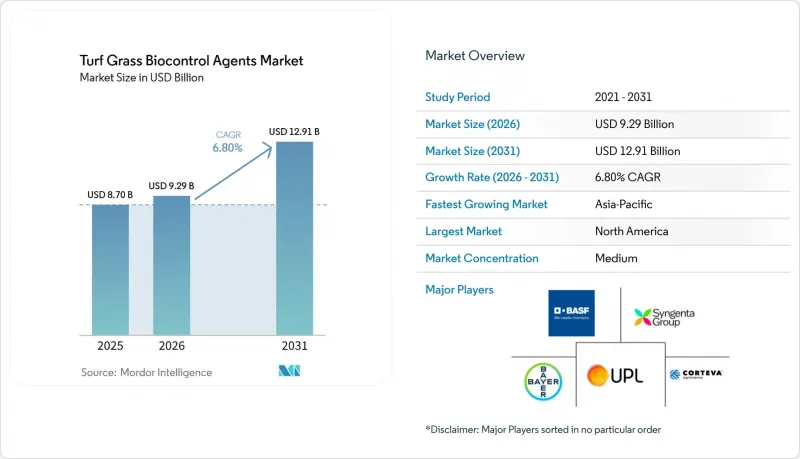
Mordor Intelligence에 의하면, 잔디용 생물학적 방제제 시장 규모는 2025년에 87억 달러로 평가되었고 2026년 92억 9,000만 달러에서 2031년까지 129억 1,000만 달러에 이를 것으로 예측되며, 예측 기간(2026-2031년) CAGR은 6.80%를 나타낼 전망입니다.
본 보고서는 생물학적 방제제의 유형(미생물, 거대생물, 생화학, 식물 추출물), 용도(골프장, 스포츠 경기장, 조경 등), 제형(액체, 과립, 분말, 캡슐화 및 현탁액), 그리고 지역(북미, 남미, 유럽, 아시아태평양, 중동 및 아프리카)별로 분류되어 있습니다. 본 보고서에서는 금액(달러) 기준의 전망을 제시하고 있습니다.
전 세계 잔디용 생물학적 방제제 시장 동향 및 인사이트
잔류물이 적은 잔디용 자재에 대한 규제 강화 추세
잔디용 생물학적 방제제 시장에서 규제는 단순한 배경 요인에서 직접적인 구매 촉진요인으로 그 위상이 변화하고 있습니다. 유럽의 정책으로 인해 기존 화학 농약의 사용 여지가 좁아지면서, 통합 해충 관리(IPM) 목표에 부합하는 생물학적 프로그램의 가치가 높아지고 있습니다. 미국에서는 환경보호청(EPA)이 일부 저위험 바이오 농약에 대해 등록 심사 절차의 합리화를 제안하고 있으며, 이로 인해 신규 생물제제의 상업적 전망이 개선되고 있습니다. 이는 잔디 관리자들이 병해 방제 계획을 저해하지 않으면서 규제를 준수할 수 있는 해결책을 종종 필요로 하기 때문에 중요한 의미를 지닙니다. 그 결과, 잔디용 생물학적 방제제 시장은 생물학적 제제를 단순한 자발적인 지속가능성 향상 수단이 아닌 실질적인 요건으로 인식하게 된 사업자들로부터 지지를 얻고 있습니다.
합성 잔디용 살균제에서 생물학적 방제 프로그램으로의 전환 주기
잔디용 생물학적 방제제 시장은 기존 살균제 프로그램의 내성 문제로도 뒷받침되고 있습니다. 달러 스팟 병에 대한 연구 개발 및 현장 논의에 따르면, Clarireedia 속 균류는 주요 살균제 계열 전반에 걸쳐 내성을 발달시킬 가능성이 있어, 관리되는 잔디에서 로테이션 전략의 필요성이 부각되고 있습니다. 이러한 추세는 도입 방식에 변화를 가져오고 있으며, 많은 잔디 관리자들은 보다 광범위한 생물학적 방제 프로그램으로 전환하기 전에 먼저 생물학적 제제의 탱크 믹스부터 도입하고 있습니다. 이러한 단계적인 전환을 통해 위험이 완화되며, 관리 책임자는 익숙한 살포 일정 속에서 적합성, 시기, 일관성을 검증할 수 있게 됩니다. 장기적으로는 합성 제품이 전면적으로 금지되지 않더라도, 이러한 접근 방식을 통해 잔디용 생물학적 방제제 시장은 계속 확대될 가능성이 높습니다.
기존 화학 농약과 비교한 현장 효과의 편차
성능의 편차는 여전히 잔디용 생물학적 방제제 시장에서 가장 뚜렷한 제약 요인으로 남아 있습니다. 잔디용 생물학적 방제제에 대한 조사에 따르면, 특히 이용 빈도가 높은 장소에서는 토양 온도, 자외선 노출, 건조 스트레스, 토양 다짐, 토양 pH에 따라 현장에서의 결과가 변동할 가능성이 있습니다. 이는 사소한 병해 발생이라도 수익, 평판, 현장 사용 일정에 영향을 미칠 수 있으므로, 고급 시설에서 특히 중요한 문제가 됩니다. 따라서 잔디 관리자들은 생물학적 제제 프로그램을 매우 높은 시각적·성능적 기준과 비교 검토하고 있습니다. 일관성이 더욱 향상될 때까지는 이 문제가 잔디용 생물학적 방제제 시장의 일부에서 도입의 걸림돌로 남아 있을 것입니다.
부문 분석
2025년 기준, 미생물계 생물방제제는 잔디용 생물방제제 시장의 52.6%를 차지하며, 병해, 해충, 토양 건강 등 각 용도에 걸쳐 가장 폭넓은 기능 부문을 형성했습니다. 이 부문은 2031년까지 연평균 성장률(CAGR) 11.6%로 확대될 것으로 예측되며, 이는 잔디용 생물학적 방제제 시장 전체의 성장 속도를 크게 상회하는 수치입니다. 이러한 우위는 트리코데르마, 바실러스, 보베리아 바시아나 등, 엽면 살포 및 뿌리 주변 처리 프로그램 모두에 걸쳐 활용되는 광범위한 미생물 덕분입니다. 또한, 미생물 제제는 윤작, 탱크 믹스, 혹은 장기적인 계절 계획에 활용할 수 있어 예방적 관리 일정에 쉽게 통합할 수 있다는 특징도 있습니다.
생화학적 생물방제제 시장 규모는 여전히 작지만, 잔류물이 없고 취급 특성이 더 예측하기 쉬운 제품을 요구하는 고급 잔디 환경에서 그 존재감을 높이고 있습니다. 주로 곤충 병원성 선충으로 구성된 거시생물학적 방제제는 그 유효성이 충분히 입증된 황금딱정벌레 유충 및 관련 토양 해충 방제 프로그램에서 안정적인 역할을 계속 수행하고 있습니다. 식물 추출물 및 천연 화합물 제품은 여전히 가장 규모가 작은 부문이지만, 일부 규제 경로에서 규제 대응이 비교적 용이하고, 저잔류성 방제 수단에 대한 관심이 높아지는 데서 혜택을 보고 있습니다. 메탈리디움속과 헤테로라브디티스속을 조합하여 실시한 프로그램을 통해 흰개미의 치사율이 95% 이상에 달했다는 조사 결과에 비추어 볼 때, 잔디용 생물학적 방제제 업계는 단일 제제의 사용에서 복합 프로그램으로 전환되고 있음을 시사하고 있습니다.
지역별 분석
2025년, 북미는 잔디용 생물학적 방제제 시장 점유율의 34.7%를 차지하며 1위를 유지했습니다. 이러한 우위는 확립된 전문가용 잔디 관리 인프라, 성숙한 생물제제 유통 채널, 그리고 견고한 저위험 바이오 농약 규제 체계에 기인합니다. 미국 환경보호청(EPA)이 제안하고 있는 저위험 바이오 농약에 관한 규제 합리화를 통해 해당 지역의 제품 공급이 유지될 것으로 전망됩니다. 북미는 꾸준한 성장이 예상되지만, 시장이 이미 성숙기에 접어들었기 때문에 성장률은 세계 평균을 밑돌 것으로 전망됩니다. 유럽에서는 규제 측면의 지원과 고급 잔디에 대한 투자 확대를 원동력으로 성장이 예상됩니다. 지침 2009/128/CE는 농약 사용량 감축과 통합 해충 관리(IPM) 실천 강화를 지속적으로 추진하고 있으며, 전문 잔디 관리 분야에서 생물 유래 제품이 장기적으로 수행해야 할 역할을 더욱 명확히 하고 있습니다. 또한, 잔디 업계에서 지속 가능하고 친환경적인 솔루션에 대한 수요가 증가함에 따라 이 지역의 성장이 더욱 가속화되고 있습니다.
아시아태평양은 잔디용 생물학적 방제제 시장에서 가장 빠른 성장이 예상되는 지역으로, 2031년까지 연평균 성장률(CAGR)은 8.3%로 예측됩니다. 이러한 성장은 중국, 일본, 호주의 골프장 개발, 스포츠 시설 건설 증가, 그리고 화학약품 사용을 줄인 관리 방식으로의 전환에 힘입고 있습니다. 이 지역의 급속한 도시화와 중산층 증가는 고품질 잔디 관리가 필요한 골프장이나 스포츠 시설 등 레저 시설에 대한 투자를 촉진하고 있습니다. 또한, 이 지역의 각국 정부는 지속 가능한 농업 및 조경 기법을 추진하고 있으며, 이는 생물학적 방제제의 도입을 더욱 촉진하고 있습니다. 게다가 화학 농약에 비해 생물학적 방제제가 환경과 건강에 주는 이점에 대한 인식이 높아지는 것도 시장 성장을 견인하고 있습니다. 인도나 동남아시아 국가 등 생물학적 방제제 도입이 아직 초기 단계에 있는 신흥 시장의 존재는 시장 관계자들에게 큰 성장 기회가 되고 있습니다.
중동에서는 사우디아라비아와 아랍에미리트(UAE)에서 골프장 및 고급 스포츠 시설 건설 프로젝트가 지속되고 있으며, 고온과 물 부족으로 인해 통합적인 잔디 관리 프로그램의 중요성이 높아지고 있어 시장 확대가 예상됩니다. 아프리카의 경우, 콜드체인 물류 및 전문 유통 분야의 과제로 인해 성장 속도는 완만해질 것으로 예측됩니다. 그러나 스포츠 시설 및 골프장 개발에 따른 수요가 점차 증가함에 따라, 해당 지역 시장 성장이 뒷받침될 것으로 전망됩니다. 지속 가능한 노력에 대한 관심이 높아지고 현지 유통 네트워크가 정비됨에 따라, 아프리카의 물류 관련 과제는 점차 해소되어 꾸준한 시장 성장의 길이 열릴 것으로 예측됩니다.
기타 혜택:
- 엑셀 형식 시장 예측(ME) 시트
- 3개월간의 애널리스트 지원
자주 묻는 질문
목차
제1장 서론
제2장 조사 방법
제3장 주요 요약
제4장 시장 구도
제5장 시장 규모와 성장 예측
제6장 경쟁 구도
제7장 시장 기회와 향후 전망
JHS 26.08.11According to Mordor Intelligence, the turf grass biocontrol agents market size was valued at USD 8.70 billion in 2025 and estimated to grow from USD 9.29 billion in 2026 to reach USD 12.91 billion by 2031, at a CAGR of 6.80% during the forecast period (2026-2031).
This report is Segmented by Type of Biocontrol Agent (Microbial, Macrobiological, Biochemical, and Plant Extract), Application (Golf Courses, Sports Fields, Landscaping, and More), Formulation (Liquid, Granular, Powder, and Encapsulated and Suspension), and Geography (North America, South America, Europe, Asia-Pacific, and Middle East and Africa). The Report Offers Forecasts in Terms of Value (USD).
Global Turf Grass Biocontrol Agents Market Trends and Insights
Rising Regulatory Preference for Low-Residue Turf Inputs
The turfgrass biocontrol agents market is seeing a shift in regulation from a background factor to a direct purchasing driver. European policy is narrowing the room for conventional chemistry and raising the value of biological programs that fit integrated pest management goals. In the United States, the Environmental Protection Agency is proposing a streamlined registration review process for several low-risk biopesticides, which improves the commercial outlook for new biological products. This matters because turf managers often need a solution that can stay inside compliance rules without disrupting disease control plans. As a result, the turf grass biocontrol agents market is gaining support from operators who now treat biologicals as a practical requirement rather than a voluntary sustainability upgrade.
Replacement Cycle From Synthetic Turf Fungicides to Biological Programs
The turfgrass biocontrol agents market is also supported by resistance issues in conventional fungicide programs. Research and field discussions on dollar spot indicate that Clarireedia spp. can develop resistance across important fungicide classes, underscoring the need for rotation strategies in managed turf. That pattern changes adoption behavior because many turf managers now start with biological tank mixes before moving into broader biological programs. This stepwise shift reduces risk and lets superintendents test fit, timing, and consistency inside familiar spray schedules. Over time, that approach is likely to keep expanding the turfgrass biocontrol agents market, even without a full ban on synthetic products.
Inconsistent Field Performance Versus Conventional Chemistries
Performance variability remains the clearest restraint in the turf grass biocontrol agents market. Research on turf biologicals shows that field results can shift with soil temperature, ultraviolet exposure, desiccation stress, compaction, and soil pH, especially on high-traffic surface. That matters more in premium venues because even limited disease expression can affect revenue, reputation, and field scheduling. Turf managers therefore compare biological programs against a very high visual and performance standard. Until consistency improves further, this issue will continue to slow adoption in parts of the turf grass biocontrol agents market.
Other drivers and restraints analyzed in the detailed report include:
- Growth in Golf Course and Sports Field Stewardship Budgets
- Rising Disease Pressure From Climate Volatility and Heat Stress
- Higher Application Discipline and Timing Requirements
For complete list of drivers and restraints, kindly check the Table Of Contents.
Segment Analysis
Microbial biocontrol agents accounted for 52.6% of the turf grass biocontrol agents market in 2025 and represented the broadest functional segment across disease, pest, and soil health uses. The segment is projected to expand at a 11.6% CAGR through 2031, well above the overall pace of the turf grass biocontrol agents market. This lead stems from the wide range of organisms, including Trichoderma, Bacillus, and Beauveria bassiana, across both foliar and root-zone programs. The category is also easier to build into preventive schedules because microbial products can be used in rotation, in tank mixes, or in longer seasonal plans.
Biochemical biocontrol agents remain smaller, but they are gaining ground in premium turf settings that want residue-free products with more predictable handling characteristics. Macrobiological control agents, mainly entomopathogenic nematodes, keep a stable role in white grub and related soil pest programs where their efficacy is well understood. Plant extract and natural compound products remain the smallest type segment, but they benefit from a simpler regulatory fit in some pathways and from growing interest in low-residue tools. Research showing more than 95% white grub mortality from a sequenced Metarhizium and Heterorhabditis program indicates that the turf grass biocontrol agents industry is moving toward combination programs rather than single-agent use
Complete Report Scope:
- By Type of Biocontrol Agent
- Microbial Biocontrol Agents
- Macrobiological Control Agents
- Biochemical Biocontrol Agents
- Plant Extract and Natural Compound Biocontrols
- By Application
- Golf Courses
- Sports Fields
- Landscaping and Residential Lawns
- Sod Farms
- Public Parks and Institutional Grounds
- By Formulation
- Liquid Formulations
- Granular Formulations
- Powder Formulations
- Encapsulated and Suspension Formulations
- By Geography
- North America
- United States
- Rest of North America
- South America
- Brazil
- Rest of South America
- Europe
- Germany
- United Kingdom
- France
- Russia
- Rest of Europe
- Asia-Pacific
- China
- India
- Japan
- Australia
- Rest of Asia-Pacific
- Middle East and Africa
- Middle East
- Saudi Arabia
- United Arab Emirates
- Turkey
- Rest of Middle East
- Africa
- South Africa
- Nigeria
- Rest of Africa
- Middle East
- North America
Geography Analysis
North America accounted for 34.7% of the turf grass biocontrol agents market share in 2025, maintaining its leading position. This dominance is attributed to a well-established professional turf infrastructure, mature biological product distribution channels, and a robust low-risk biopesticide regulatory framework. The Environmental Protection Agency's proposed streamlining of regulations for low-risk biopesticides is projected to sustain product availability in the region. While North America is projected to grow steadily, its growth rate is anticipated to be slower than the global average due to its already mature market. Europe is projected to experience growth driven by regulatory support and increased investment in premium turf. Directive 2009/128/CE continues to promote reduced pesticide usage and stronger integrated pest management practices, providing biological products with a clearer long-term role in professional turf management. The region's growth is further supported by the rising demand for sustainable and environmentally friendly solutions in the turf industry.
The Asia-Pacific region is forecast to be the fastest-growing market for turf grass biocontrol agents, with a projected CAGR of 8.3% through 2031. This growth is supported by the development of golf courses in China, Japan, and Australia, increased construction of sports fields, and a shift toward lower-chemical maintenance practices. The region's rapid urbanization and growing middle-class population are driving investments in recreational facilities, including golf courses and sports complexes, which require high-quality turf management. Governments in the region are also promoting sustainable agricultural and landscaping practices, further encouraging the adoption of biocontrol agents. Additionally, increasing awareness of the environmental and health benefits of biocontrol agents over chemical pesticides is driving market growth. The presence of emerging markets such as India and Southeast Asian countries, where the adoption of biocontrol agents is still in its nascent stage, presents significant growth opportunities for market players.
The Middle East is projected to expand as golf and premium sports venue projects continue in Saudi Arabia and the UAE, where heat and water stress enhance the importance of integrated turf management programs. Africa is forecast to grow at a slower pace due to challenges in cold-chain logistics and specialty distribution. However, gradual demand from sports venues and golf course development is projected to support market growth in the region. The increasing focus on sustainable practices and the development of local distribution networks are projected to gradually address the logistical challenges in Africa, paving the way for steady market growth.
- Bayer AG
- BASF SE
- UPL Limited
- Corteva Agriscience
- Koppert Biological Systems B.V.
- Certis USA LLC
- Biobest Group NV
- FMC Corporation
- Nufarm Limited
- Valen Biosciences LLC
- BioWorks, Inc.
- Lallemand Inc.
- AMVAC Chemical Corporation
- SePRO Corporation
Additional Benefits:
- The market estimate (ME) sheet in Excel format
- 3 months of analyst support
TABLE OF CONTENTS
1 Introduction
- 1.1 Study Assumption and Market Definition
- 1.2 Scope of the Study
2 Research Methodology
3 Executive Summary
4 Market Landscape
- 4.1 Market Overview
- 4.2 Market Drivers
- 4.2.1 Rising regulatory preference for low-residue turf inputs
- 4.2.2 Replacement cycle from synthetic turf fungicides to biological programs
- 4.2.3 Growth in golf course and sports field stewardship budgets
- 4.2.4 Rising disease pressure from climate volatility and heat stress
- 4.2.5 Microbial strain innovation, shelf-life, and formulation advances
- 4.2.6 Precision turf monitoring improves biological product timing
- 4.3 Market Restraints
- 4.3.1 Inconsistent field performance versus conventional chemistries
- 4.3.2 Higher application discipline and timing requirements
- 4.3.3 Shorter shelf life and cold-chain sensitivity for some live agents
- 4.3.4 Fragmented registration pathways across turf uses and countries
- 4.4 Regulatory Landscape
- 4.5 Technological Outlook
- 4.6 Porter's Five Forces Analysis
- 4.6.1 Bargaining Power of Suppliers
- 4.6.2 Bargaining Power of Buyers
- 4.6.3 Threat of New Entrants
- 4.6.4 Threat of Substitute Products
- 4.6.5 Intensity of Competitive Rivalry
5 Market Size and Growth Forecasts (Value)
- 5.1 By Type of Biocontrol Agent
- 5.1.1 Microbial Biocontrol Agents
- 5.1.2 Macrobiological Control Agents
- 5.1.3 Biochemical Biocontrol Agents
- 5.1.4 Plant Extract and Natural Compound Biocontrols
- 5.2 By Application
- 5.2.1 Golf Courses
- 5.2.2 Sports Fields
- 5.2.3 Landscaping and Residential Lawns
- 5.2.4 Sod Farms
- 5.2.5 Public Parks and Institutional Grounds
- 5.3 By Formulation
- 5.3.1 Liquid Formulations
- 5.3.2 Granular Formulations
- 5.3.3 Powder Formulations
- 5.3.4 Encapsulated and Suspension Formulations
- 5.4 By Geography
- 5.4.1 North America
- 5.4.1.1 United States
- 5.4.1.2 Rest of North America
- 5.4.2 South America
- 5.4.2.1 Brazil
- 5.4.2.2 Rest of South America
- 5.4.3 Europe
- 5.4.3.1 Germany
- 5.4.3.2 United Kingdom
- 5.4.3.3 France
- 5.4.3.4 Russia
- 5.4.3.5 Rest of Europe
- 5.4.4 Asia-Pacific
- 5.4.4.1 China
- 5.4.4.2 India
- 5.4.4.3 Japan
- 5.4.4.4 Australia
- 5.4.4.5 Rest of Asia-Pacific
- 5.4.5 Middle East and Africa
- 5.4.5.1 Middle East
- 5.4.5.1.1 Saudi Arabia
- 5.4.5.1.2 United Arab Emirates
- 5.4.5.1.3 Turkey
- 5.4.5.1.4 Rest of Middle East
- 5.4.5.2 Africa
- 5.4.5.2.1 South Africa
- 5.4.5.2.2 Nigeria
- 5.4.5.2.3 Rest of Africa
- 5.4.5.1 Middle East
- 5.4.1 North America
6 Competitive Landscape
- 6.1 Market Concentration
- 6.2 Strategic Moves
- 6.3 Market Share Analysis
- 6.4 Company Profiles (Includes Global level Overview, Market-level Overview, Core Segments, Financials as Available, Strategic Information, Market Rank/Share for Key Companies, Products and Services, and Recent Developments)
- 6.4.1 Bayer AG
- 6.4.2 BASF SE
- 6.4.3 UPL Limited
- 6.4.4 Corteva Agriscience
- 6.4.5 Koppert Biological Systems B.V.
- 6.4.6 Certis USA LLC
- 6.4.7 Biobest Group NV
- 6.4.8 FMC Corporation
- 6.4.9 Nufarm Limited
- 6.4.10 Valen Biosciences LLC
- 6.4.11 BioWorks, Inc.
- 6.4.12 Lallemand Inc.
- 6.4.13 AMVAC Chemical Corporation
- 6.4.14 SePRO Corporation


