|
시장보고서
상품코드
2099956
피부 생검 기기 시장 : 시장 점유율 분석, 업계 동향 및 통계, 성장 예측(2026-2031년)Skin Biopsy Devices - Market Share Analysis, Industry Trends & Statistics, Growth Forecasts (2026 - 2031) |
||||||
 Mordor Intelligence
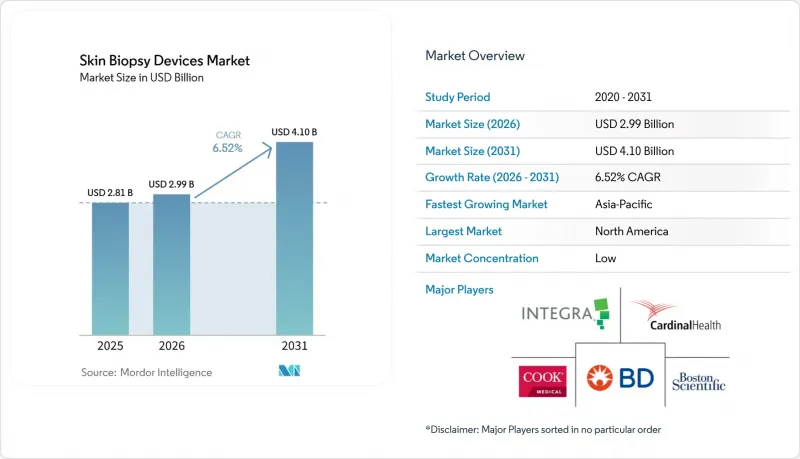
Mordor Intelligence에 의하면, 피부 생검 기기 시장 규모는 2025년 28억 1,000만 달러로 평가되었고, 2026년에는 29억 9,000만 달러로 확대될 것으로 추정되고, 2031년까지 41억 달러에 이를 것으로 예상되며, 2026-2031년 CAGR 6.52%로 성장할 전망입니다.
본 보고서는 유형별(쉐이브식, 펀치식, 절제식, 절개식, 바늘식), 기기별(펀치, 바늘, 집게, 가이드 시스템, 생검 건, 부속품), 적응증별(피부암, 광선각화증, 피부염, 건선, 감염증), 최종 사용자별(병원, 피부과 클리닉, 진단실험실, ASC), 지역별(북미, 유럽, 아시아태평양, 기타)로 분류되어 있습니다. 예측치는 금액(달러)으로 표시되어 있습니다.
세계의 피부 생검 기기 시장 동향 및 인사이트
증가하는 피부암 및 악성 흑색종의 부담
악성 흑색종 발병률 증가는 여전히 피부 생검 기기 시장에 있어 가장 지속적인 구조적 성장 동력으로 작용하고 있습니다. GLOBOCAN 2024의 추정에 따르면, 전 세계적으로 33만 7,969건의 신규 악성 흑색종 사례와 5만 8,398명의 사망이 보고되었으며, 유럽에서만 15만 781건으로 전 세계 발생 건수의 44.6%를 차지했습니다. 또한, IARC는 2025년 5월 전 세계 흑색종 사례의 80% 이상이 자외선 노출에 기인한다고 보고했으며, 이로 인해 고령화가 진행되고 야외 활동이 많은 인구층에서 향후 사례 수의 추이를 예측하기가 더욱 쉬워졌습니다. WHO의 『2026년 세계 암 현황 보고서』에 따르면, 많은 의료 시스템에서 환자 수 증가가 진단 능력 확대를 앞지르고 있으며, 영상 진단만으로는 진단 격차를 메울 수 없는 경우 생검을 통한 확정 진단의 역할이 더욱 중요해지고 있습니다. 이로 인해 피부 생검 기기 시장에서 생검용 기구는 단순한 옵션 업그레이드가 아닌 핵심 임상 기기로서의 위상을 유지하고 있습니다. 또한 이는 수요가 기술 도입이나 조달 주기뿐만 아니라 질병 부담 그 자체에 의해 뒷받침되고 있음을 의미합니다.
저침습적 피부과 진단으로의 전환
피부 생검 기기 시장에서 환자의 선호도와 진료소의 경제성이라는 두 가지 측면에서 침습성이 낮은 생검 기술로의 전환이 진행되고 있습니다. 『Frontiers in Medicine』 저널의 2025년 총설에서는 펀치 생검이나 바늘 생검 기법을 통해 마취의 필요성이 줄어들고, 상처 면적이 축소되며, 1회의 외래 진료로 여러 부위의 검체를 채취할 수 있게 됨에 따라, 1회 진료당 기기 사용 횟수가 증가할 것이라고 지적하고 있습니다. 『Egyptian Journal of Medicine』지의 2025년 연구에 따르면, 2.5mm 펀치 생검이라도 더 큰 펀치에 비해 환자의 불편감을 줄이면서도 진단에 충분한 조직을 채취할 수 있는 것으로 밝혀졌습니다. 2026년 4월에 출시된 Harpera사의 마이크로 생검 펀치는 봉합이 필요 없고 회복 시간을 단축하는 서브mm 단위의 샘플링으로, 설계의 최전선이 어떻게 진화하고 있는지를 보여줍니다. 또한 소형 기기는 부속품 및 소모품에 대한 지속적인 수요를 창출하여 피부 생검 기기 시장을 더욱 견인하고 있습니다. 생검 기기에 적용되는 비교적 접근하기 쉬운 510(k) 승인 절차는 기업이 더 혁신적인 규제 경로를 거치는 경우보다 신속하게 설계를 개선하여 시장에 출시할 수 있도록 해줍니다.
높은 시술비 및 수술 후 비용 부담
피부 생검 기기 시장에서 시술의 비용 대비 효과는 여전히 시술 전환을 저해하는 중요한 제약 요인으로 남아 있습니다. 병리 검사비를 합산하면 1회 생검에 드는 비용은 종종 400달러를 초과합니다. 또한, CPT 88305에 따른 병리 검사 평균 비용은 182달러이며, 여러 병변을 검사할 경우 즉시 여러 건의 별도 청구서가 발생하게 됩니다. 2024년 『Journal of the American Academy of Dermatology』지의 분석에 따르면, 병리 검사 비용에 대한 환급 압박이 강해지는 반면, 환자의 본인 부담금은 오히려 증가하고 있으며, 이는 비용에 민감한 의료 기관의 부담을 더욱 가중시키고 있는 것으로 나타났습니다. 남미 및 동남아시아 일부 지역에서는 본인 부담금이 여전히 직접적인 이용 장벽으로 작용하여, 임상적 필요성이 있음에도 불구하고 실제 이용이 억제되고 있습니다. 게다가 예산 압박에 직면한 의료 시스템에서는 고비용의 유도 시스템이나 디지털 병리 플랫폼보다 소모품 보충을 우선시하는 경향이 있어, 설비 투자에 대한 마찰이 또 다른 과제로 대두되고 있습니다. 이 때문에 저소득 국가에서는 피부 생검 기기 시장이 판매 수량에 크게 좌우되는 반면, 선진국에서는 지불 주체 측의 정책 변경에 영향을 받기 쉬운 양상을 보이고 있습니다.
부문 분석
2025년, 펀치 생검은 피부 생검 기기 시장 규모의 34.31%를 차지했으며, 피부 생검 기기 시장에서 주요 시술 유형으로 자리매김했습니다. 이러한 위상은 염증성 피부 질환, 비흑색종 피부암, 그리고 전층 샘플링이 필요한 진단이 불분명한 병변 등 광범위한 임상 용도로 활용되고 있음을 반영합니다. 이 기법은 한 번의 천자로 표피, 진피 및 표재성 피하 조직을 채취할 수 있으므로, 병변의 구조가 진단상 중요한 경우에도 임상적으로 유용합니다. 이러한 실용적인 다용도성 덕분에 일상적인 피부과 진료부터 의심스러운 병변에 대한 정밀 검사에 이르기까지 반복적으로 사용되고 있습니다.
바늘 생검은 가장 빠르게 성장하는 유형이며, 이 범주의 피부 생검 기기 시장 규모는 2031년까지 연평균 성장률(CAGR) 10.38%로 확대될 것으로 예측됩니다. 이러한 성장은 병원 수준의 영상 진단 인프라에 의존하지 않고도 임상의가 더 깊은 부위의 피부나 피하 병변에 도달할 수 있게 해주는 초음파 유도 기술의 성숙과 밀접한 관련이 있습니다. 2025년 IEEE EMBC에서 발표된, 상처 봉합을 동시에 수행하는 자동 펀치 생검 기기에 관한 논문도 피부 생검 기기 업계에서 특히 사용 편의성과 신속한 처리가 중시되는 분야에서 시술의 자동화가 진행되고 있음을 보여줍니다. 쉐이브 생검은 표재성 병변에 대해서는 여전히 유용하지만, 보다 확실한 조직병리학적 진단을 위해 전층 생검을 선호하는 임상의가 늘어나고 있어 그 위상이 위협받고 있습니다. 절제 생검 및 절개 생검은 작은 의심 병변이나 더 큰 병변에 대해 계속해서 특정한 역할을 수행하게 될 것이며, 그 비율은 흑색종의 병기 분류 및 시술에 대한 보험 환급과 밀접하게 연관되어 있을 것입니다.
생검용 펀치 및 큐렛은 2025년 시장 규모의 33.44%를 차지했으며, 사용에 익숙하고 비용이 저렴하며 일회용 제품으로 대량 사용되고 있기 때문에 피부 생검 기기 시장에서 중심적인 위치를 계속 차지하고 있습니다. 이들은 일상적인 진료 워크플로우에 적합하며, 첨단 플랫폼과 달리 설비 투자 예산이나 전문적인 교육에 의존하지 않기 때문에 수요 기반이 견고하게 유지되고 있습니다. 피부 생검 기기 시장의 이 분야는 정기적인 재고 보충 주기의 혜택도 받고 있어, 이를 통해 유통업체 및 제조업체에 안정적인 수익원을 제공합니다. 그 결과, 혁신에 대한 관심이 높아지더라도 단순한 기기에 대한 기본적인 수요는 견조한 추세를 보이고 있습니다.
가이드 시스템은 2031년까지 연평균 성장률(CAGR)이 9.52%에 달할 전망이며, 피부 생검 기기 시장에서 가장 빠르게 성장하고 있는 기기 카테고리입니다. 이는 피부 생검 기기 시장에서 영상 확인을 통한 시술 및 시술자를 지원하는 시술로의 전환을 반영합니다. 20 MHz를 초과하는 고주파 초음파는 피부 평가에 점점 더 많이 활용되고 있으며, 2025년에 발표된 연구를 통해 피부 외과 수술 및 병변 특성 평가에서의 그 가치가 입증되었습니다. 2026년 초음파 검사에 관한 연구에서는 자기 바늘 내비게이션 기능을 갖추고 평균 정밀도가 서브mm급인 ‘HUMaN’ 휴대용 초음파 시스템이 소개되었습니다. 이는 피부 생검 기기 시장의 진화에 따라 현장 진료(point-of-care)에서의 안내 옵션이 더욱 확대될 것임을 시사합니다. 가이드의 정확도 향상은 시술자 간 편차를 줄이고 검체의 적절성을 높입니다. 이는 진료소가 워크플로우의 복잡성을 크게 증가시키지 않으면서도 더 신뢰할 수 있는 샘플링을 추구하는 데 있어 중요한 요소가 됩니다. 또한, 피부 생검 기기 업계 전반에서 추적 가능성과 워크플로우 문서화가 점점 더 중요해지고 있는 만큼, 검체 처리와 관련된 액세서리 및 소모품도 계속해서 주목받고 있습니다.
지역별 분석
2025년, 북미는 피부 생검 기기 시장의 38.61% 점유율을 차지했으며, 해당 시장에서 가장 큰 기여를 한 지역이 되었습니다. 이 지역은 확립된 보험 환급 제도, 밀집된 외래수술센터(ASC) 네트워크, 그리고 매우 높은 피부암 진단률의 혜택을 받고 있습니다. CMS는 외래수술센터(ASC)에서의 시술에 대한 2026년 지급액을 750.50달러로 설정했으며, 이는 외래 환경에서의 시술 경제성과 의료기기 조달이 지속될 수 있도록 뒷받침하고 있습니다. 또한, 미국 FDA는 2026년 4월, 흑색종용 광학 진단 기기를 클래스 III에서 특별 관리 대상인 클래스 II로 재분류했습니다. 이를 통해 확인을 위한 생검에 여전히 의존하는 보조 도구에 대해 보다 실용적인 510(k) 승인 경로가 열렸습니다. 캐나다에서는 의학적으로 필요한 생검 시술에 대한 보험 적용으로 시장의 안정성이 확보되고 있는 반면, 멕시코에서는 민간 피부과 진료 채널의 역할이 확대되고 있습니다.
유럽은 피부 생검 기기 시장에서 여전히 2위 지역 블록이며, 전 세계 흑색종 발생 건수에서 차지하는 비중이 가장 높습니다. GLOBOCAN 2024에 따르면, 유럽에서는 15만 781건의 흑색종 신규 사례가 보고되었으며, 이는 전 세계 발생 건수의 44.6%에 해당합니다. 이러한 높은 질병 부담이 독일, 영국, 프랑스, 이탈리아, 스페인에서 수요를 뒷받침하고 있으며, 아일랜드 등 시장의 원격 피부과 진료에 대한 정책 지원은 사례가 생검 과정으로 이어지는 흐름을 개선할 가능성이 있습니다. 한편, 의료기기의 규정 준수 절차가 엄격해짐에 따라 규제 대응 능력이 뛰어난 대기업이 유리해지고, 중소 전문 제조업체의 경우 시장 진입이 어려워지고 있습니다.
아시아태평양은 가장 빠르게 성장하는 지역 클러스터이며, 피부 생검 기기 시장 규모는 2031년까지 연평균 성장률(CAGR) 10.65%로 확대될 것으로 예측됩니다. 이 지역은 중국, 인도, 호주, 일본, 한국에 의해 주도되고 있으며, 각국은 공립 병원, 민간 의료, 전문 의료 서비스의 다양한 조합을 통해 피부과 진료 체계를 확충하고 있습니다. 호주의 경우 흑색종 발병률이 높아 생검 수요가 안정적으로 유지되고 있습니다. 한편, 중국에서는 기존의 공립병원 외에도 더 폭넓은 검체 채취 거점이 나타나고 있습니다. 중동 및 아프리카는 절대적인 규모 면에서는 여전히 작지만, GCC 국가들의 의료 확대에 따라 외래 피부과 진료 수용 능력이 꾸준히 증가하고 있습니다. 남미는 브라질과 아르헨티나가 주도하고 있으며, 이들 국가에서는 여전히 진단 지연이 나타나고 있어 조기 발견 및 조직 확인 절차를 강화할 여지가 남아 있습니다.
기타 혜택 :
- 엑셀 형식 시장 예측(ME) 시트
- 3개월간의 애널리스트 지원
자주 묻는 질문
목차
제1장 서론
제2장 조사 방법
제3장 주요 요약
제4장 시장 구도
제5장 시장 규모 및 성장 예측
제6장 경쟁 구도
제7장 시장 기회 및 향후 전망
AJY 26.08.07According to Mordor Intelligence, the skin biopsy devices market size is expected to increase from USD 2.81 billion in 2025 to USD 2.99 billion in 2026 and reach USD 4.10 billion by 2031, growing at a CAGR of 6.52% over 2026-2031.
This report is Segmented by Type (Shave, Punch, Excisional, Incisional, Needle), Device (Punches, Needles, Forceps, Guidance Systems, Biopsy Guns, Accessories), Indication (Skin Cancer, Actinic Keratosis, Dermatitis, Psoriasis, Infection), End User (Hospitals, Dermatology Clinics, Diagnostic Labs, Ascs), and Geography (North America, Europe, Asia-Pacific, and More). Forecasts in Terms of Value (USD).
Global Skin Biopsy Devices Market Trends and Insights
Rising Skin Cancer And Melanoma Burden
Escalating melanoma incidence remains the most durable structural support for the skin biopsy devices market. GLOBOCAN 2024 estimated 337,969 new melanoma cases worldwide and 58,398 deaths, with Europe alone accounting for 150,781 cases, or 44.6% of global incidence. IARC also reported in May 2025 that more than 80% of global melanoma cases were attributable to ultraviolet radiation exposure, which makes future case generation more predictable across aging and outdoor-exposed populations. The WHO Global Status Report on Cancer 2026 said rising case volumes are outpacing diagnostic capacity in many health systems, which strengthens the role of biopsy-based confirmation when imaging alone cannot close the diagnostic gap. This keeps biopsy tools positioned as core clinical instruments rather than optional upgrades within the skin biopsy devices market. It also means that demand is being supported by disease burden itself, not only by technology adoption or procurement cycles.
Shift Toward Minimally Invasive Dermatology Diagnostics
Patient preference and clinic economics are both moving procedures toward smaller-footprint biopsy techniques in the skin biopsy devices market. A 2025 review in Frontiers in Medicine noted that punch and needle methods reduce anesthesia needs, limit wound area, and allow multi-site sampling during a single outpatient visit, which supports higher per-encounter device use. A 2025 study in the Egyptian Journal of Medicine found that 2.5 mm punch biopsies still produced diagnostically sufficient tissue while reducing patient discomfort compared with larger punches. The April 2026 launch of the Harpera microbiopsy punch showed how the design frontier is moving toward sub-millimeter sampling that avoids sutures and shortens recovery time. Smaller instruments also create a recurring demand stream for accessories and consumables, which adds another layer of support to the skin biopsy devices market. A relatively accessible 510(k) pathway for biopsy instruments further helps companies bring iterative design improvements to market faster than they could through a more novel regulatory route.
High Procedure And Post-Procedure Cost Burden
Procedure affordability remains a meaningful constraint on procedure conversion in the skin biopsy devices market. The cost of a single biopsy encounter often exceeds USD 400 once pathology charges are added, and pathology under CPT 88305 averaged USD 182, which means multi-lesion visits can quickly produce several separate charges. A 2024 Journal of the American Academy of Dermatology analysis found reimbursement pressure on pathology costs while patient out-of-pocket burden moved in the opposite direction, which reinforces the strain on cost-sensitive settings. In South America and parts of Southeast Asia, out-of-pocket payment still acts as a direct access barrier, which suppresses actual utilization even when clinical need is present. Capital spending friction adds another layer, because health systems under budget pressure often favor consumable restocking over higher-cost guidance systems or digital pathology platforms. This makes the skin biopsy devices market more volume-sensitive in lower-income settings and more exposed to payer policy changes in developed ones.
Other drivers and restraints analyzed in the detailed report include:
- AI-Assisted Pathology And Digital Slide Review Adoption
- Rising Ambulatory Dermatology And Outpatient Biopsy Volumes
- Limited Specialist Capacity For Biopsy And Histopathology
For complete list of drivers and restraints, kindly check the Table Of Contents.
Segment Analysis
Punch biopsy accounted for 34.31% of the skin biopsy devices market size in 2025, which made it the leading procedure type in the skin biopsy devices market. Its position reflects broad clinical use across inflammatory dermatoses, non-melanoma skin cancers, and uncertain lesions that require full-thickness sampling. The technique captures epidermis, dermis, and superficial subcutis in a single pass, which keeps it clinically useful when lesion architecture matters to diagnosis. That practical versatility supports repeat use across both routine dermatology visits and more suspicious lesion workups.
Needle biopsy is the fastest-growing type, with skin biopsy devices market size for this category projected to expand at a 10.38% CAGR through 2031. Growth is tied to maturing ultrasound guidance that helps clinicians reach deeper skin and subcutaneous lesions without relying on hospital-grade imaging infrastructure. The 2025 IEEE EMBC publication on an automatic punch biopsy device with simultaneous wound closure also showed that procedure automation is moving forward within the skin biopsy devices industry, especially in areas where ease of use and faster turnover matter. Shave biopsy remains useful for superficial lesions, but it faces pressure as clinicians increasingly favor full-thickness sampling for more definitive histopathology. Excisional and incisional biopsy will continue to serve specific roles for small suspicious lesions and larger lesions, and their mix will remain closely linked to melanoma staging and procedural reimbursement.
Biopsy punches and curettes represented 33.44% of 2025 value, which kept them at the core of the skin biopsy devices market because they are familiar, low-cost, and used in large disposable volumes. Their demand base remains durable because they fit routine clinic workflows and do not depend on capital budgets or specialized training in the same way as advanced platforms. This part of the skin biopsy devices market also benefits from regular replenishment cycles, which gives distributors and manufacturers a steady revenue stream. As a result, even when attention shifts to innovation, the underlying unit demand for simple instruments remains firm.
Guidance systems are the fastest-growing device category at a 9.52% CAGR through 2031, reflecting the move toward image-confirmed and operator-supportive procedures in the skin biopsy devices market. High-frequency ultrasound above 20 MHz is increasingly used for skin evaluation, and published work in 2025 reinforced its value in dermatologic surgery and lesion characterization. A 2026 Ultrasonography study described the HUMaN handheld ultrasound system with magnetic needle navigation and sub-millimeter mean accuracy, which points to more point-of-care guidance options as the skin biopsy devices market evolves. Better guidance reduces operator variability and improves specimen adequacy, which matters when clinics want more reliable sampling without adding major workflow complexity. Accessories and consumables linked to specimen handling also remain attractive, because traceability and workflow documentation are becoming more important across the skin biopsy devices industry.
Complete Report Scope:
- By Type
- Shave Biopsy
- Punch Biopsy
- Excisional Biopsy
- Incisional Biopsy
- Needle Biopsy
- By Device
- Biopsy Punches and Curettes
- Biopsy Needles
- Biopsy Forceps
- Guidance Systems
- Needle-Based Biopsy Guns
- Biopsy Accessories and Consumables
- By Indication
- Skin Cancer
- Actinic Keratosis
- Dermatitis
- Psoriasis
- Skin Infection
- Other Indications
- By End User
- Hospitals
- Dermatology Clinics
- Diagnostic Laboratories
- Ambulatory Surgical Centers
- Other End Users
- By Geography
- North America
- United States
- Canada
- Mexico
- Europe
- Germany
- United Kingdom
- France
- Italy
- Spain
- Rest of Europe
- Asia-Pacific
- China
- Japan
- India
- Australia
- South Korea
- Rest of Asia-Pacific
- Middle East and Africa
- GCC
- South Africa
- Rest of Middle East and Africa
- South America
- Brazil
- Argentina
- Rest of South America
- North America
Geography Analysis
North America held 38.61% of the skin biopsy devices market share in 2025, which made it the largest regional contributor to the skin biopsy devices market. The region benefits from established reimbursement structures, a dense ambulatory surgical center network, and a very high burden of skin cancer diagnosis. CMS set the 2026 payment rate for ambulatory surgical center procedures at USD 750.50, which supports continued procedural economics and device procurement in outpatient settings. The U.S. FDA also reclassified optical diagnostic devices for melanoma from Class III to Class II under special controls in April 2026, which opens a more practical 510(k) pathway for adjunctive tools that will still rely on confirmatory biopsy. Canada adds stability through coverage for medically necessary biopsy procedures, while Mexico is expanding the role of private dermatology channels.
Europe remains the second-largest regional block in the skin biopsy devices market and carries the highest share of global melanoma incidence. GLOBOCAN 2024 showed that Europe accounted for 150,781 new melanoma cases, equal to 44.6% of global incidence. This high disease burden supports demand across Germany, the United Kingdom, France, Italy, and Spain, while teledermatology policy support in markets such as Ireland can improve how cases move into biopsy pathways. At the same time, tighter medical device compliance processes favor larger firms with stronger regulatory capacity and make market access harder for smaller specialists.
Asia-Pacific is the fastest-growing regional cluster, with skin biopsy devices market size projected to expand at a 10.65% CAGR through 2031. The region is being driven by China, India, Australia, Japan, and South Korea, although each country is scaling dermatology capacity through a different mix of public hospitals, private care, and specialty services. Australia's high melanoma exposure profile supports consistent biopsy demand, while China is seeing a broader set of specimen collection points beyond traditional public hospitals. The Middle East and Africa remain smaller in absolute size, but GCC healthcare expansion is steadily adding outpatient dermatology capacity. South America is being led by Brazil and Argentina, where delayed diagnosis still leaves room for stronger early detection and tissue confirmation pathways.
- AccuTec, Inc.
- Beckton Dickinson
- Boston Scientific
- Cardinal Health
- Conmed
- Cook Group
- Danaher
- DTR Medical Ltd
- Gallini Srl
- Innovia Medical
- Integra LifeSciences
- KAI Group
- Danaher
- Medline Industries
- Merit Medical Systems
- Olympus
- Sklar Instruments
Additional Benefits:
- The market estimate (ME) sheet in Excel format
- 3 months of analyst support
TABLE OF CONTENTS
1 Introduction
- 1.1 Study Assumptions and Market Definition
- 1.2 Scope of the Study
2 Research Methodology
3 Executive Summary
4 Market Landscape
- 4.1 Market Overview
- 4.2 Market Drivers
- 4.2.1 Rising Skin Cancer and Melanoma Burden
- 4.2.2 Shift Toward Minimally Invasive Dermatology Diagnostics
- 4.2.3 AI-Assisted Pathology and Digital Slide Review Adoption
- 4.2.4 Rising Ambulatory Dermatology and Outpatient Biopsy Volumes
- 4.2.5 Teledermatology-Enabled Biopsy Triage and Referral Capture
- 4.3 Market Restraints
- 4.3.1 High Procedure and Post-Procedure Cost Burden
- 4.3.2 Limited Specialist Capacity for Biopsy and Histopathology
- 4.3.3 Variable Reimbursement and Device Procurement Friction
- 4.4 Supply Chain Analysis
- 4.5 Regulatory Landscape
- 4.6 Technological Outlook
- 4.7 Porter's Five Forces Analysis
- 4.7.1 Threat of New Entrants
- 4.7.2 Bargaining Power of Suppliers
- 4.7.3 Bargaining Power of Buyers
- 4.7.4 Threat of Substitutes
- 4.7.5 Competitive Rivalry
5 Market Size & Growth Forecasts (Value, USD)
- 5.1 By Type
- 5.1.1 Shave Biopsy
- 5.1.2 Punch Biopsy
- 5.1.3 Excisional Biopsy
- 5.1.4 Incisional Biopsy
- 5.1.5 Needle Biopsy
- 5.2 By Device
- 5.2.1 Biopsy Punches and Curettes
- 5.2.2 Biopsy Needles
- 5.2.3 Biopsy Forceps
- 5.2.4 Guidance Systems
- 5.2.5 Needle-Based Biopsy Guns
- 5.2.6 Biopsy Accessories and Consumables
- 5.3 By Indication
- 5.3.1 Skin Cancer
- 5.3.2 Actinic Keratosis
- 5.3.3 Dermatitis
- 5.3.4 Psoriasis
- 5.3.5 Skin Infection
- 5.3.6 Other Indications
- 5.4 By End User
- 5.4.1 Hospitals
- 5.4.2 Dermatology Clinics
- 5.4.3 Diagnostic Laboratories
- 5.4.4 Ambulatory Surgical Centers
- 5.4.5 Other End Users
- 5.5 By Geography
- 5.5.1 North America
- 5.5.1.1 United States
- 5.5.1.2 Canada
- 5.5.1.3 Mexico
- 5.5.2 Europe
- 5.5.2.1 Germany
- 5.5.2.2 United Kingdom
- 5.5.2.3 France
- 5.5.2.4 Italy
- 5.5.2.5 Spain
- 5.5.2.6 Rest of Europe
- 5.5.3 Asia-Pacific
- 5.5.3.1 China
- 5.5.3.2 Japan
- 5.5.3.3 India
- 5.5.3.4 Australia
- 5.5.3.5 South Korea
- 5.5.3.6 Rest of Asia-Pacific
- 5.5.4 Middle East and Africa
- 5.5.4.1 GCC
- 5.5.4.2 South Africa
- 5.5.4.3 Rest of Middle East and Africa
- 5.5.5 South America
- 5.5.5.1 Brazil
- 5.5.5.2 Argentina
- 5.5.5.3 Rest of South America
- 5.5.1 North America
6 Competitive Landscape
- 6.1 Market Concentration
- 6.2 Market Share Analysis
- 6.3 Company Profiles (includes Global Level Overview, Market Level Overview, Core Segments, Financials as available, Strategic Information, Market Rank/Share, Products and Services, Recent Developments)
- 6.3.1 AccuTec, Inc.
- 6.3.2 Becton, Dickinson and Company
- 6.3.3 Boston Scientific Corporation
- 6.3.4 Cardinal Health, Inc.
- 6.3.5 ConMed Corporation
- 6.3.6 Cook Medical LLC
- 6.3.7 Danaher Corporation
- 6.3.8 DTR Medical Ltd
- 6.3.9 Gallini Srl
- 6.3.10 Innovia Medical
- 6.3.11 Integra LifeSciences Holdings Corporation
- 6.3.12 KAI Group
- 6.3.13 Leica Biosystems Nussloch GmbH
- 6.3.14 Medline Industries, LP
- 6.3.15 Merit Medical Systems, Inc.
- 6.3.16 Olympus Corporation
- 6.3.17 Sklar Instruments
7 Market Opportunities and Future Outlook
- 7.1 White-Space and Unmet-Need Assessment