

|
시장보고서
상품코드
2099970
소매 기업 컨텐츠 관리(ECM) 시장 : 시장 점유율 분석, 업계 동향 및 통계, 성장 예측(2026-2031년)Retail Enterprise Content Management (ECM) - Market Share Analysis, Industry Trends & Statistics, Growth Forecasts (2026 - 2031) |
||||||
 Mordor Intelligence
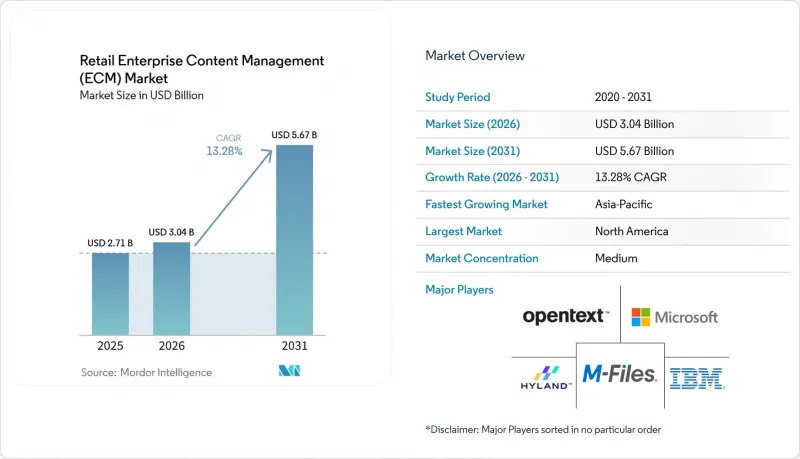
소매 기업 컨텐츠 관리(ECM) 시장 규모는 2025년 27억 1,000만 달러로 평가되었고, 2026년 30억 4,000만 달러에서 2031년까지 56억 7,000만 달러로 확대될 것으로 예측되며, 2026-2031년 연평균 복합 성장률(CAGR)은 13.28%를 나타낼 전망입니다.
본 보고서는 솔루션 유형별(문서 관리, 기록 관리, 워크플로우 및 비즈니스 프로세스 관리, 케이스 관리, 디지털 자산 관리 등), 도입 형태별(온프레미스, 클라우드, 하이브리드), 기업 규모별(중소기업(SME) 및 대기업), 그리고 지역별로 분류되어 있습니다. 시장 전망은 금액(달러) 기준으로 제시되어 있습니다.
세계의 소매 기업 컨텐츠 관리(ECM) 시장 동향 및 인사이트
옴니채널 소매에서 컨텐츠의 복잡성
옴니채널 운영은 소매 기업 컨텐츠 관리(ECM) 시장에서 가장 강력한 수요 동인으로 계속 작용하고 있습니다. 이는 채널이 추가될 때마다 팀이 관리해야 하는 자산, 기록, 승인 및 수정 건수가 증가하기 때문입니다. 소매업체는 더 이상 단일 제품 페이지나 단일 캠페인 파일만 게시하는 것이 아닙니다. 마켓플레이스, 자사 전자상거래 사이트, 오프라인 매장, 파트너 네트워크 전반에 걸쳐 정확성을 유지해야 하는 채널별 수많은 버전을 관리하고 있습니다. 제품 문구, 이미지, 가격 정보, 공개 문구를 지역별로 신속하고 일관되게 업데이트해야 하는 경우, 이 운영 모델은 더욱 어려워집니다. EU의 AI법으로 인해 그 장벽은 더욱 높아지고 있습니다. AI 기반 컨텐츠 시스템을 활용하는 소매업체는 컨텐츠의 출처와 투명성에 대해 더욱 강력한 관리를 유지해야 하며, 이는 거버넌스가 철저히 적용된 리포지토리 및 감사 가능한 워크플로우에 대한 수요를 직접적으로 촉진하고 있습니다. 또한 아마존은 디지털 서비스법(Digital Services Act)의 의무와 관련된 신뢰성 및 안전성 시스템에 대한 2024년 투자액이 10억 달러 이상에 달할 것이라고 보고했는데, 이는 컨텐츠 거버넌스가 더 이상 단순한 백오피스 업무가 아니라 비즈니스 관리상의 과제로 다루어지고 있음을 보여줍니다.
AI를 활용한 메타데이터 및 태그 지정 자동화
AI를 활용한 메타데이터 보강은 소매 기업의 엔터프라이즈 컨텐츠 관리(ECM) 시장의 경제성을 향상시키고 있습니다. 이는 소매업체가 수작업을 최소화하면서도 대량의 컨텐츠를 분류하고 검색할 수 있게 되기 때문입니다. 이는 제품 문서, 공급업체 파일, 캠페인 자산, 승인 이력 등이 대량으로 다양한 형식으로 유입되는 소매 환경에서 특히 중요합니다. M-Files는 2026년 6월, ‘Metadata Agent’를 통해 이 분야를 강화했습니다. 이 에이전트는 문서 가져오기 시 분류, 명명, 태그 지정, 설명을 제안할 뿐만 아니라 레거시 컨텐츠의 일괄 보강도 지원합니다. 이에 이어 IBM도 2026년 6월 ‘IBM Content Cortex Essentials Edition’을 출시했습니다. 이 제품에는 문서의 자동 분석 및 분류를 수행하는 ‘Navigator Core Agent’가 포함되어 있어, 거버넌스가 적용된 환경 내에서 에이전트형 컨텐츠 워크플로우를 쉽게 도입할 수 있게 됩니다. 이러한 도구가 성숙해짐에 따라, 소매 기업 컨텐츠 관리(ECM) 시장에서는 특히 더 신속한 색인 생성, 더 정확한 검색, 그리고 더 신뢰할 수 있는 감사 지원을 필요로 하는 소매업체에게 자동화 도입의 중요성이 점점 더 커지고 있습니다.
PIM, DAM, CMS, ERP 스택에 걸친 통합의 복잡성
소매 기업의 엔터프라이즈 컨텐츠 관리(ECM) 시장에서 통합은 여전히 가장 큰 장벽으로 남아 있습니다. 이는 소매업체가 ECM을 단독으로 도입하는 경우가 거의 없기 때문입니다. 대부분의 프로젝트에서는 거버넌스가 적용된 컨텐츠를 제품 정보 시스템, 디지털 자산 라이브러리, 커머스 플랫폼, 컨텐츠 관리 도구, 그리고 이미 실제 운영을 지원하고 있는 ERP 환경과 연동해야 합니다. 2025년 11월 OpenText가 획득한 SAP S/4HANA Cloud Public Edition 인증은 기업 고객의 컨텐츠 플랫폼 도입에 있어 패키지형 ERP와의 연동이 얼마나 중요해지고 있는지를 보여줍니다. 2026년 6월 마이크로소프트가 출시한 ‘Dynamics 365 Commerce MCP’ 역시 이러한 압박을 반영하고 있습니다. 소매업체들은 상품 검색, 재고 현황, 가격 책정 로직 및 관련 컨텐츠가 독립된 모듈이 아닌, 연동된 흐름 속에서 기능하기를 점점 더 기대하고 있기 때문입니다. 이러한 연동이 불충분할 경우, 도입 일정이 장기화되고 수작업이 재개되며, 소매 업계의 엔터프라이즈 컨텐츠 관리(ECM) 시장에서 비즈니스 사례의 타당성을 입증하기 어려워집니다.
부문 분석
2025년에는 문서 관리가 솔루션 유형별 최대 점유율(28.19%)을 차지했습니다. 이는 규정 준수 관련 파일, 공급업체 기록, 제품 문서 및 법적 컨텐츠가 여전히 소매 기업 컨텐츠 관리(ECM) 시장의 핵심 워크로드를 형성하고 있음을 보여줍니다. 소매업체는 라벨링 기록, 감사 파일, 청구 내역, 계약서 아카이브를 검색 및 설명 책임을 보장할 수 있는 방식으로 보관해야 하므로 계속해서 문서 관리에 의존하고 있습니다. 규제 대상 문서는 국경을 초월한 소매 업무에서 여전히 필수적이기 때문에 이러한 주도적 지위는 레거시 시스템의 관성이라기보다는 적극적인 업무상의 필요를 반영한 것입니다. 또한 소매업에서 승인, 클레임 확인, 내부 검토에는 여전히 구조화된 라우팅과 보존 기간 설정이 필요하기 때문에 기록 관리, 워크플로우 및 비즈니스 프로세스 관리도 계속해서 중요하게 여겨지고 있습니다.
디지털 자산 관리(DAM)는 2031년까지 연평균 성장률(CAGR) 13.96%를 나타낼 것으로 예측되며, 이는 소매 ECM 시장에서 리치 미디어가 얼마나 빠르게 확대되고 있는지를 보여줍니다. 소매업체들은 현재 수작업으로 반복적인 수정을 거치지 않고도 채널 간에 자유롭게 활용할 수 있는 승인된 이미지, 동영상, 캠페인 컨텐츠, 소셜 커머스 자산을 필요로 하고 있습니다. 어도비는 자사의 컨텐츠 공급망 솔루션을 도입한 조직에서 자산 재사용 효율이 30% 향상되고, 컨텐츠 및 디지털 경험 관리에 소요되는 시간이 70% 단축되었다고 보고하고 있으며, 이는 자산 거버넌스 강화가 생산성 향상으로 이어진다는 사실을 뒷받침합니다. DAM의 기능이 문서 거버넌스 및 퍼블리싱 워크플로우에 가까워짐에 따라, 소매 업계의 엔터프라이즈 컨텐츠 관리(ECM) 시장은 단순한 파일 저장에서 협업 기반의 컨텐츠 운영으로 전환되고 있습니다.
지역별 분석
2025년, 북미는 소매 기업 컨텐츠 관리(ECM) 시장 규모의 38.73%를 차지했으며, 전 세계 수요에서 가장 큰 점유율을 기록했습니다. 미국은 대규모 소매 기업, 성숙한 클라우드 도입 현황, 그리고 방대한 멀티채널 컨텐츠 양을 모두 갖추고 있어 여전히 해당 지역의 주요 수익원으로 자리 잡고 있습니다. 캐나다에서는 기업의 디지털화가 진전되면서 성장세가 가속화되고 있으며, 캐나다 통계청은 2025년 6월, 지난 12개월 동안 기업 내 AI 활용률이 전년 동기 6.1%에서 12.2%에 달했다고 보고했습니다. 이러한 변화는 AI를 활용한 소매 워크플로우에서 검색, 분류, 재사용이 용이한 컨텐츠 환경에 대한 수요를 뒷받침하고 있습니다. 멕시코 및 남미 지역 전체는 현재 시장 규모는 여전히 작지만, 시장 전반에 걸쳐 보다 표준화된 컨텐츠 거버넌스를 추구하는 다국적 소매 기업의 지역 진출로 인해 혜택을 보고 있습니다.
아시아태평양은 2026년 기준 소매 기업 컨텐츠 관리(ECM) 시장에서 가장 빠르게 성장하는 지역으로, 2031년까지 연평균 성장률(CAGR)이 13.51%를 나타낼 것으로 예측됩니다. 이러한 성장은 해당 지역의 대규모 전자상거래 거래량, 급변하는 채널 형태, 그리고 강력한 현지화 요구가 복합적으로 작용하여 추진되고 있으며, 아시아태평양은 전 세계 ECM 도입의 최전선에 위치해 있습니다. 중국, 인도, 동남아시아, 일본, 한국, 호주의 소매업체들은 기록의 정확성과 함께 공개 속도 또한 중요한 상업 환경 속에서 사업을 전개하고 있습니다. 이에 따라 거버넌스를 훼손하지 않으면서도 시장별 차이에 대응할 수 있는 관리된 상품 컨텐츠, 재사용 가능한 디지털 자산 및 워크플로우 시스템에 대한 수요가 증가하고 있습니다. 또한, 이 지역에는 사업 범위를 확대함에 따라 보다 체계적인 컨텐츠 운영 체제를 구축하고 있는 다수의 제조업체와 D2C(소비자 직접 판매) 브랜드가 존재한다는 점도 시장 성장에 긍정적인 요인으로 작용하고 있습니다.
유럽은 규제 밀도가 높은 것이 특징이며, 이로 인해 소매 기업 컨텐츠 관리(ECM) 시장에는 규정 준수를 중심으로 한 견고한 수요 기반이 형성되어 있습니다. EU의 AI법은 AI 관련 컨텐츠 프로세스에서 추적 가능성과 투명성에 대한 기대를 높이고 있으며, 거버넌스가 확립된 저장소 및 감사 가능한 워크플로우에 대한 관심을 더욱 높이고 있습니다. 2025년 1월부터 시행되는 독일의 전자 청구서 발행 의무화 제도는 ECM 기능과 잘 어울리는 문서 처리를 수반하는 새로운 요건을 추가하는 것입니다. 중동에서는 디지털 상거래의 광범위한 확장을 통해 투자가 진행되고 있는 반면, 아프리카는 여전히 초기 단계에 있으며, 소매 업무 및 디지털 문서 관리 관행을 체계화해 나가고 있는 시장이 도입을 주도하고 있습니다.
기타 혜택 :
- 엑셀 형식 시장 예측(ME) 시트
- 3개월간의 애널리스트 지원
자주 묻는 질문
목차
제1장 서론
제2장 조사 방법
제3장 주요 요약
제4장 시장 구도
제5장 시장 규모 및 성장 예측
제6장 경쟁 구도
제7장 시장 기회 및 향후 전망
AJY 26.08.11According to Mordor Intelligence, the retail enterprise content management (ECM) market size is projected to expand from USD 2.71 billion in 2025 and USD 3.04 billion in 2026 to USD 5.67 billion by 2031, registering a CAGR of 13.28% between 2026 and 2031.
This report is Segmented by Solution Type (Document Management, Records Management, Workflow and Business Process Management, Case Management, Digital Asset Management, and More), Deployment Mode (On-Premises, Cloud, and Hybrid), Enterprise Size (Small and Medium Enterprises (SME), and Large Enterprises), and Geography. The Market Forecasts are Provided in Terms of Value (USD).
Global Retail Enterprise Content Management (ECM) Market Trends and Insights
Omnichannel Retail Content Complexity
Omnichannel operations remain the strongest demand trigger for the retail enterprise content management (ECM) market because every added channel raises the number of assets, records, approvals, and revisions that teams must control. Retailers are no longer publishing a single product page or a single campaign file, and they are managing many channel-specific versions that must stay accurate across marketplaces, owned commerce sites, stores, and partner networks. This operating model becomes harder when product claims, images, pricing references, and disclosure language must be updated quickly and consistently across regions. The EU AI Act raises the bar further because retailers using AI-supported content systems must maintain stronger control over content provenance and transparency, which directly supports demand for governed repositories and auditable workflows. Amazon also reported more than USD 1 billion of 2024 investment in trust and safety systems tied to its Digital Services Act obligations, which shows that content governance is now treated as a business control issue rather than only a back-office task.
AI-Assisted Metadata and Tagging Automation
AI-based metadata enrichment is improving the economics of the retail enterprise content management (ECM) market because retailers can classify and retrieve high volumes of content with less manual work. This matters in retail environments where product documentation, supplier files, campaign assets, and approval trails arrive in large volumes and in mixed formats. M-Files expanded this area in June 2026 with its Metadata Agent, which suggests document classification, naming, tagging, and description at ingestion and also supports bulk enrichment of legacy content. IBM followed in June 2026 with IBM Content Cortex Essentials Edition, which includes a Navigator Core Agent for automated document analysis and classification, making agentic content workflows easier to deploy inside governed environments. As these tools mature, the retail enterprise content management (ECM) market is gaining a stronger automation case, especially for retailers that need faster indexing, cleaner retrieval, and more reliable audit support.
Integration Complexity Across PIM, DAM, CMS, and ERP Stacks
Integration remains the heaviest brake on the retail enterprise content management (ECM) market because retailers rarely deploy ECM in isolation. Most projects must connect governed content with product information systems, digital asset libraries, commerce platforms, content management tools, and ERP environments that already support live operations. OpenText's SAP S/4HANA Cloud Public Edition certification in November 2025 shows how important packaged ERP linkage has become for content platform adoption in enterprise accounts. Microsoft's June 2026 Dynamics 365 Commerce MCP release also reflects the same pressure, because retailers increasingly expect product discovery, inventory availability, pricing logic, and related content to work in connected flows rather than stand-alone modules. When those links are weak, deployment timelines stretch, manual work returns, and the business case for the retail enterprise content management (ECM) market becomes harder to defend.
Other drivers and restraints analyzed in the detailed report include:
- Retail Compliance and Audit Trail Requirements
- Product Information and Digital Asset Governance Convergence
- High Change Management Burden in Store and Field Teams
For complete list of drivers and restraints, kindly check the Table Of Contents.
Segment Analysis
Document management held the largest solution type share at 28.19% in 2025, which shows that compliance files, supplier records, product documentation, and legal content still form the core workload of the retail enterprise content management (ECM) market. Retailers continue to depend on document control because labeling records, audit files, invoicing trails, and contract archives must be stored in ways that support retrieval and accountability. This leadership reflects an active operating need rather than legacy inertia, since regulated documentation remains essential across cross-border retail operations. Records Management, Workflow, and Business Process Management also stay relevant because retail approvals, claims checks, and internal reviews still require structured routing and retention.
Digital asset management is projected to grow at a 13.96% CAGR through 2031, which shows how quickly rich media has expanded inside the retail enterprise content management (ECM) market. Retailers now need approved images, video, campaign content, and social commerce assets that can move across channels without repeated manual correction. Adobe reported a 30% increase in asset reuse efficiency and a 70% reduction in time spent managing content and digital experiences for organizations using its content supply chain solutions, which supports the productivity case for stronger asset governance. As DAM capabilities move closer to document governance and publishing workflows, the retail enterprise content management industry is shifting from file storage toward coordinated content operations.
Complete Report Scope:
- By Solution Type
- Document Management
- Records Management
- Workflow and Business Process Management
- Case Management
- Digital Asset Management
- Web Content Management
- Other Solutions
- By Deployment Mode
- On-Premises
- Cloud
- Hybrid
- By Enterprise Size
- Small and Medium Enterprises (SME)
- Large Enterprises
- By Geography
- North America
- United States
- Canada
- Mexico
- South America
- Brazil
- Argentina
- Rest of South America
- Europe
- United Kingdom
- Germany
- France
- Rest of Europe
- Asia-Pacific
- China
- Japan
- India
- South Korea
- Australia
- Rest of Asia-Pacific
- Middle East and Africa
- Middle East
- United Arab Emirates
- Saudi Arabia
- Rest of Middle East
- Africa
- South Africa
- Kenya
- Rest of Africa
- Middle East
- North America
Geography Analysis
North America held 38.73% of the retail enterprise content management (ECM) market size in 2025, giving the region the largest share of global demand. The United States remains the main regional revenue center because it combines large enterprise retailers, mature cloud adoption, and heavy multichannel content volume. Canada adds momentum through rising enterprise digitization, and Statistics Canada reported in June 2025 that AI use among businesses reached 12.2% over the prior 12 months, up from 6.1% a year earlier. That shift supports demand for content environments that are easier to search, classify, and reuse in AI-supported retail workflows. Mexico and the wider South America region remain smaller in current value terms, but they are benefiting from regional expansion by multinational retailers that want more standardized content governance across markets.
Asia-Pacific enters 2026 as the fastest-growing region in the retail enterprise content management (ECM) market, with a projected CAGR of 13.51% through 2031. This growth is driven by the region's combination of large e-commerce volumes, fast-moving channel formats, and strong localization needs, positioning Asia-Pacific at the forefront of ECM adoption globally. Retailers in China, India, Southeast Asia, Japan, South Korea, and Australia are operating in commerce environments where speed of publishing matters as much as accuracy of records. This raises demand for controlled product content, reusable digital assets, and workflow systems that can support market-specific variations without losing governance. The region also benefits from a large base of manufacturers and direct-to-consumer brands that are building more formal content operations as they expand their reach.
Europe is defined by regulatory density, which gives the retail enterprise content management (ECM) market a strong compliance-led demand base. The EU AI Act raises expectations around traceability and transparency for AI-related content processes, which supports stronger interest in governed repositories and auditable workflows. Germany's mandatory e-invoicing regime from January 2025 adds another document-heavy requirement that aligns well with ECM capabilities. The Middle East is investing through broader digital commerce build-outs, while Africa remains earlier stage, with adoption led by markets that are formalizing retail operations and digital documentation practices.
- OpenText Corporation
- IBM Corporation
- Hyland Software, Inc.
- M-Files Corporation
- Box, Inc.
- DocuWare GmbH
- Laserfiche, Inc.
- Alfresco Software, Inc.
- SER Group
- Fabasoft AG
- KnowledgeLake, Inc.
- Objective Corporation Limited
- Datamatics Global Services Limited
- Microsoft Corporation
- Oracle Corporation
- SAP SE
- Adobe Inc.
- Zoho Corporation Pvt. Ltd.
- Egnyte, Inc.
- Newgen Software Technologies Limited
- Everteam
- iManage
- eFileCabinet
Additional Benefits:
- The market estimate (ME) sheet in Excel format
- 3 months of analyst support
TABLE OF CONTENTS
1 INTRODUCTION
- 1.1 Study Assumptions and Market Definition
- 1.2 Scope of the Study
2 RESEARCH METHODOLOGY
3 EXECUTIVE SUMMARY
4 MARKET LANDSCAPE
- 4.1 Market Overview
- 4.2 Market Drivers
- 4.2.1 Omnichannel Retail Content Complexity
- 4.2.2 AI Assisted Metadata and Tagging Automation
- 4.2.3 Retail Compliance and Audit Trail Requirements
- 4.2.4 Product Information and Digital Asset Governance Convergence
- 4.2.5 Retailer Demand for Faster Campaign Localization
- 4.2.6 Shift to Cloud Native Content Operations
- 4.3 Market Restraints
- 4.3.1 Integration Complexity Across PIM, DAM, CMS, and ERP Stacks
- 4.3.2 High Change Management Burden in Store and Field Teams
- 4.3.3 Content Security and Brand Leakage Risks in Distributed Retail Networks
- 4.3.4 Rising Total Cost of Ownership for Multi-Channel Content Governance
- 4.4 Industry Value-Chain Analysis
- 4.5 Regulatory Landscape
- 4.6 Technological Outlook
- 4.7 Impact of Macroeconomic Factors on the Market
- 4.8 Porter's Five Forces Analysis
- 4.8.1 Threat of New Entrants
- 4.8.2 Bargaining Power of Buyers
- 4.8.3 Bargaining Power of Suppliers
- 4.8.4 Threat of Substitutes
- 4.8.5 Intensity of Competitive Rivalry
5 MARKET SIZE AND GROWTH FORECASTS (VALUE)
- 5.1 By Solution Type
- 5.1.1 Document Management
- 5.1.2 Records Management
- 5.1.3 Workflow and Business Process Management
- 5.1.4 Case Management
- 5.1.5 Digital Asset Management
- 5.1.6 Web Content Management
- 5.1.7 Other Solutions
- 5.2 By Deployment Mode
- 5.2.1 On-Premises
- 5.2.2 Cloud
- 5.2.3 Hybrid
- 5.3 By Enterprise Size
- 5.3.1 Small and Medium Enterprises (SME)
- 5.3.2 Large Enterprises
- 5.4 By Geography
- 5.4.1 North America
- 5.4.1.1 United States
- 5.4.1.2 Canada
- 5.4.1.3 Mexico
- 5.4.2 South America
- 5.4.2.1 Brazil
- 5.4.2.2 Argentina
- 5.4.2.3 Rest of South America
- 5.4.3 Europe
- 5.4.3.1 United Kingdom
- 5.4.3.2 Germany
- 5.4.3.3 France
- 5.4.3.4 Rest of Europe
- 5.4.4 Asia-Pacific
- 5.4.4.1 China
- 5.4.4.2 Japan
- 5.4.4.3 India
- 5.4.4.4 South Korea
- 5.4.4.5 Australia
- 5.4.4.6 Rest of Asia-Pacific
- 5.4.5 Middle East and Africa
- 5.4.5.1 Middle East
- 5.4.5.1.1 United Arab Emirates
- 5.4.5.1.2 Saudi Arabia
- 5.4.5.1.3 Rest of Middle East
- 5.4.5.2 Africa
- 5.4.5.2.1 South Africa
- 5.4.5.2.2 Kenya
- 5.4.5.2.3 Rest of Africa
- 5.4.5.1 Middle East
- 5.4.1 North America
6 COMPETITIVE LANDSCAPE
- 6.1 Market Concentration
- 6.2 Strategic Moves
- 6.3 Market Share Analysis
- 6.4 Company Profiles (includes Global Level Overview, Market Level Overview, Core Segments, Financials as available, Strategic Information, Market Rank/Share, Products and Services, Recent Developments)
- 6.4.1 OpenText Corporation
- 6.4.2 IBM Corporation
- 6.4.3 Hyland Software, Inc.
- 6.4.4 M-Files Corporation
- 6.4.5 Box, Inc.
- 6.4.6 DocuWare GmbH
- 6.4.7 Laserfiche, Inc.
- 6.4.8 Alfresco Software, Inc.
- 6.4.9 SER Group
- 6.4.10 Fabasoft AG
- 6.4.11 KnowledgeLake, Inc.
- 6.4.12 Objective Corporation Limited
- 6.4.13 Datamatics Global Services Limited
- 6.4.14 Microsoft Corporation
- 6.4.15 Oracle Corporation
- 6.4.16 SAP SE
- 6.4.17 Adobe Inc.
- 6.4.18 Zoho Corporation Pvt. Ltd.
- 6.4.19 Egnyte, Inc.
- 6.4.20 Newgen Software Technologies Limited
- 6.4.21 Everteam
- 6.4.22 iManage
- 6.4.23 eFileCabinet
7 MARKET OPPORTUNITIES AND FUTURE OUTLOOK
- 7.1 White-Space and Unmet-Need Assessment
- 7.2 Product Content Governance For Marketplace Heavy Retailers
- 7.3 Retail Media Content Workflow Orchestration
- 7.4 Headless Commerce Content Operations


