

|
시장보고서
상품코드
2100019
체외형 페이스메이커 시장 : 점유율 분석, 업계 동향 및 통계, 성장 예측(2026-2031년)External Pacemakers - Market Share Analysis, Industry Trends & Statistics, Growth Forecasts (2026 - 2031) |
||||||
 Mordor Intelligence
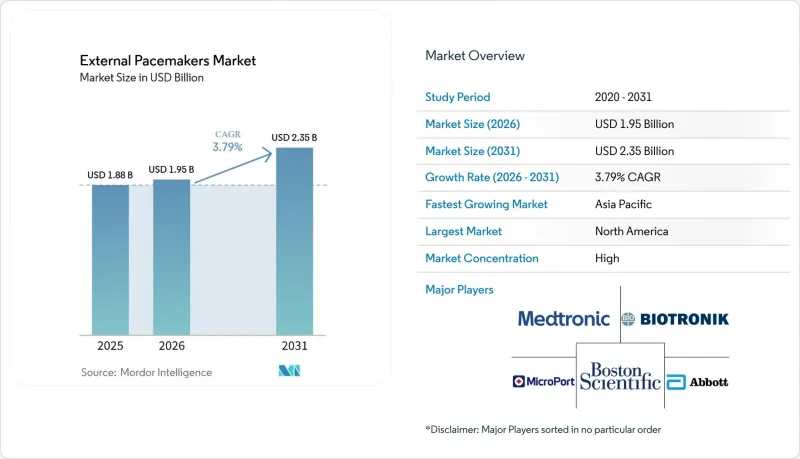
Mordor Intelligence에 의하면, 체외형 페이스메이커 시장 규모는 2025년 18억 8,000만 달러에서 2026년에는 19억 5,000만 달러로 확대되어 2026년부터 2031년까지 CAGR 3.79%로 성장을 지속하여, 2031년에는 23억 5,000만 달러에 이를 것으로 예측됩니다.
본 보고서는 박동 조절 방식(경피식, 경정맥식(일시적), 기타), 모드(단실형 및 이중실형), 최종 사용자(병원·심장 센터, 외래수술센터(ASC), 기타), 지역(북미, 유럽, 아시아태평양, 중동 및 아프리카, 남미)별로 분류되어 있습니다. 시장 전망은 금액(미 달러) 기준으로 제시되어 있습니다.
전 세계 체외형 페이스메이커 시장 동향 및 인사이트
일시적인 페이싱이 필요한 심장 수술 및 구조적 심장 수술 건수가 증가하고 있습니다.
일시적인 제너레이터 지원을 받은 TAVR 환자의 76%는 1개월 후 영구형 기기 사용을 피하고 있으며, 이로 인해 영구형 기기 이식률은 2.4%로 감소하여 사례당 2만 3,588달러의 비용 절감으로 이어지고 있습니다. 이러한 경제적 이점은 특히 비용 효율성을 중시하는 의료 시스템에서 체외형 페이스메이커 시장의 가치 제안을 강화하고 있습니다.
부문 분석
경정맥형 플랫폼은 캡처 신뢰성과 확립된 임상적 숙련도를 바탕으로 2025년 체외형 페이스메이커 시장 점유율의 37.12%를 차지했습니다. 이에 상응하는 매출액은 2025년 체외형 페이스메이커 시장 규모 약 6억 9,790만 달러에 해당합니다. 경피형 기기는 초기 응급 사용에서 주류를 이루지만, 불편감으로 인해 삽입 시간은 몇 시간으로 제한됩니다. 심외막 리드는 여전히 외과적 틈새 분야에 머물러 있지만, 개흉술 후에는 확실한 캡처를 실현합니다. 새롭게 ‘일시적·영구적’으로 분류된 리드는 감염률이 2.5%, 탈락률이 1.7%로, 수 일에 걸친 지원에 대한 신뢰성을 높이고 있습니다.
수요는 실시간 포착 임계값을 보고하는 혈역학 센서가 통합된 시스템으로 이동하고 있으며, 이를 통해 중환자실 의사는 형광 투시 검사를 수행하지 않고도 출력을 미세 조정할 수 있게 됩니다. 주요 공급업체들은 이러한 단계적 업그레이드를 활용하여 비용 중심의 신규 진출기업들로부터 시장 점유율을 지키고 있으며, 이는 체외형 페이스메이커 시장이 기능 혁신에 의존하고 있음을 여실히 보여주고 있습니다.
지역별 분석
북미는 유리한 보험 환급 정책, 많은 심장 수술 건수, 리드리스 플랫폼의 급속한 보급에 힘입어 2025년 매출의 38.12%를 차지했습니다. AI를 활용한 예측 분석을 통해 미국의 의료 기관은 중환자실(ICU) 입원 기간을 단축할 수 있게 되었으며, 이로 인해 체외형 페이스메이커 시장의 의료경제적 타당성이 더욱 강화되고 있습니다. 캐나다에서는 주 정부의 자금 배분 재검토에 따라 체외형 페이스메이커가 DRG(진단 관련 그룹) 지급 체계에 포함되면서 시장이 확대되고 있습니다. 한편, 멕시코의 IMSS(멕시코 사회보험원) 제도에서는 경피적 키트를 갖춘 이동식 관상동맥 치료 유닛에 대한 자금 지원이 이루어지고 있습니다.
유럽은 두 번째로 큰 시장 점유율을 차지하고 있습니다. 프랑스와 독일은 무균성을 해치지 않으면서 환경에 미치는 영향을 줄이는 의료기기 재처리 제도의 시범 도입을 통해 지속가능성을 추구하고 있습니다. 영국의 NHS는 중환자실(ICU) 병상을 확보하기 위해, 전극선 삽입 후 24시간 이내에 스텝다운 병동으로 이송하는 클라우드 대시보드의 시범 운영을 진행하고 있습니다. 이탈리아와 스페인의 병원에서는 코로나19로 인한 봉쇄 기간 동안 영구적 이식 건수가 48.2% 감소했으나, 응급 페이스메이커 이식 건수는 비교적 견조한 추세를 보였습니다.
아시아태평양은 연평균 성장률(CAGR) 4.59%로 가장 빠른 성장세를 보이고 있습니다. 일본은 리드리스형 일시적 제너레이터의 보험 적용을 선도적으로 도입했으며, 중국에서는 2급 도시의 카테터실 수가 계속해서 급증하고 있습니다. 인도의 전국 구급차 현대화 프로그램에서는 모든 차량에 체외형 페이스메이커용 패드를 장착하여 농촌 지역의 접근성을 확대되고 있습니다. 한국, 호주, 싱가포르에서는 고령화가 진행되는 인구 구조와 신속한 심장 치료가 필요한 의료 관광 흐름이 체외형 맥박조율기 시장의 성장을 뒷받침하고 있습니다.
라틴아메리카 및 중동 및 아프리카는 아직 발전 단계에 있지만, 미래가 기대되고 있습니다. 브라질의 SUS(공공 의료 제도)는 현지 조립을 촉진하기 위해 단가 상한제를 시범 도입하고 있는 반면, 사우디아라비아는 ‘비전 2030’의 일환으로 선진적인 심장 의료 센터에 자금을 지원하고 있습니다. 이러한 프로그램들은 직원 교육 및 공급망상의 장벽이 해소된다면 도입을 가속화할 가능성이 있습니다.
기타 혜택:
- 엑셀 형식 시장 예측(ME) 시트
- 3개월간의 애널리스트 지원
자주 묻는 질문
목차
제1장 서론
제2장 조사 방법
제3장 주요 요약
제4장 시장 구도
제5장 시장 규모 및 성장 예측(금액, 2024-2030년)
제6장 경쟁 구도
제7장 시장 기회와 향후 전망
JHS 26.08.11According to Mordor Intelligence, the external pacemaker market size is expected to grow from USD 1.88 billion in 2025 to USD 1.95 billion in 2026 and is forecast to reach USD 2.35 billion by 2031 at 3.79% CAGR over 2026-2031.
This report is Segmented by Pacing Type (Transcutaneous, Transvenous (Temporary), and More), by Modality (single Chamber and Dual Chamber), End-User (Hospitals & Cardiac Centers, Ambulatory Surgical Centers, and Other More), and Geography (North America, Europe, Asia-Pacific, Middle East and Africa, and South America). The Market Forecasts are Provided in Terms of Value (USD)
Global External Pacemakers Market Trends and Insights
Growing Volume of Cardiac & Structural-Heart Surgeries Requiring Temporary Pacing
Seventy-six percent of TAVR patients supported with a temporary generator avoid permanent devices one month later, cutting the permanent implant rate to 2.4% and saving USD 23,588 per case. This economic benefit strengthens the external pacemaker market's value proposition, particularly in cost-sensitive health systems.
Other drivers and restraints analyzed in the detailed report include:
- Rising Prevalence of Transient Bradyarrhythmias & CVD
- Technological Upgrades in Dual-Chamber & Connected External Pacemakers
- Expansion of Emergency-Medical & Ambulance Fleets Equipped with Pacing Capability
- High Device Cost & Patchy Reimbursement
- Infection & Lead-Related Complication Risk
For complete list of drivers and restraints, kindly check the Table Of Contents.
Segment Analysis
Transvenous platforms secured 37.12% of the external pacemaker market share in 2025, with capture reliability and well-established clinical familiarity. Corresponding revenue equaled roughly USD 697.9 million of the 2025 external pacemaker market size. Transcutaneous devices dominate early emergency usage, but discomfort restricts dwell time to hours. Epicardial wires remain a surgical niche yet offer definitive capture post-sternotomy. Newly branded "temporary-permanent" leads show 2.5% infection and 1.7% dislodgement rates, improving confidence for multiday support.
Demand is shifting toward systems with integrated hemodynamic sensors that report real-time capture thresholds, helping intensivists fine-tune output without fluoroscopy. Major suppliers leverage these incremental upgrades to safeguard share against cost-focused entrants, underscoring the external pacemaker market's reliance on feature innovation.
Complete Report Scope:
- By Pacing Type
- Transcutaneous
- Transvenous (Temporary)
- Epicardial
- Esophageal
- By Modality
- Single-Chamber
- Dual-Chamber
- By End User
- Hospitals & Cardiac Centers
- Ambulatory Surgical Centers
- Emergency Medical Services
- Military Field Hospitals
- By Geography
- North America
- United States
- Canada
- Mexico
- Europe
- Germany
- United Kingdom
- France
- Italy
- Spain
- Rest of Europe
- Asia-Pacific
- China
- Japan
- India
- South Korea
- Australia
- Rest of Asia-Pacific
- South America
- Brazil
- Argentina
- Rest of South America
- Middle East and Africa
- GCC
- South Africa
- Rest of Middle East and Africa
- North America
Geography Analysis
North America captured 38.12% of 2025 revenue, driven by favorable reimbursement policies, large cardiac surgery volumes, and rapid adoption of leadless platforms. AI-driven predictive analytics help U.S. centers shorten ICU dwell times, reinforcing the external pacemaker market's health-economic case. Canada advances through provincial funding adjustments that now bundle external pacing into DRG payments, while Mexico's IMSS system funds mobile coronary units equipped with transcutaneous kits.
Europe accounts for the second-largest share. France and Germany pursue sustainability by piloting device re-processing schemes that lower environmental impact without compromising sterility. The United Kingdom's NHS trials cloud dashboards for step-down unit transfer within 24 hours of lead insertion, aiming to free ICU beds. Italian and Spanish hospitals recorded a 48.2% fall in permanent implants during COVID-19 lockdowns, yet emergency pacing volumes stayed comparatively resilient.
Asia-Pacific boasts the fastest growth at 4.59% CAGR. Japan pioneered reimbursements for leadless temporary generators, and China's cath-lab count keeps multiplying in tier-2 cities. India's national ambulance upgrade program equips every vehicle with external pacing pads, broadening rural access. South Korea, Australia and Singapore contribute with ageing demographics and medical-tourism flows that rely on quick-turnaround cardiac procedures to fuel the external pacemaker market.
Latin America and the Middle East & Africa remain nascent yet promising. Brazil's SUS is piloting unit-price caps to stimulate local assembly, while Saudi Arabia funds advanced cardiac centers under Vision 2030. These programs could accelerate adoption once staff training and supply-chain barriers ease.
- Medtronic
- Abbott Laboratories
- Boston Scientific
- BIOTRONIK
- Osypka Medical
- Zoll Medical
- Stryker (Physio-Control)
- Pacetronix
- Cook Group
- Lepu Medical
- MicroPort CRM
- LivaNova
- Shree Pacetronix
- Oscor
- Inomed Medizintechnik
- Shenzhen Mindray Bio-Medical
- Nihon Kohden
- Fukuda Denshi
- Vector Medical
- BIOTRONIK
Additional Benefits:
- The market estimate (ME) sheet in Excel format
- 3 months of analyst support
TABLE OF CONTENTS
1 Introduction
- 1.1 Study Assumptions & Market Definition
- 1.2 Scope of the Study
2 Research Methodology
3 Executive Summary
4 Market Landscape
- 4.1 Market Overview
- 4.2 Market Drivers
- 4.2.1 Rising prevalence of transient bradyarrhythmias & CVD
- 4.2.2 Growing volume of cardiac & structural-heart surgeries requiring temporary pacing
- 4.2.3 Technological upgrades in dual-chamber & connected external pacemakers
- 4.2.4 Expansion of emergency-medical & ambulance fleets equipped with pacing capability (EMS, aeromedical)
- 4.2.5 AI-enabled remote monitoring platforms accelerating early discharge programs
- 4.2.6 Military field-medicine adoption for far-forward care in conflict zones
- 4.3 Market Restraints
- 4.3.1 High device cost & patchy reimbursement outside Tier-1 hospitals
- 4.3.2 Infection & lead-related complication risk vs. drug therapy alternatives
- 4.3.3 Supply-chain fragility for lithium-iodine batteries & critical ICs
- 4.3.4 Shrinking dwell-time as leadless implantables gain traction
- 4.4 Supply-Chain Analysis
- 4.5 Regulatory Landscape
- 4.6 Technological Outlook
- 4.7 Porter's Five Forces
- 4.7.1 Threat of New Entrants
- 4.7.2 Bargaining Power of Suppliers
- 4.7.3 Bargaining Power of Buyers
- 4.7.4 Threat of Substitute Products
- 4.7.5 Competitive Rivalry
5 Market Size & Growth Forecasts (Value, 2024-2030)
- 5.1 By Pacing Type
- 5.1.1 Transcutaneous
- 5.1.2 Transvenous (Temporary)
- 5.1.3 Epicardial
- 5.1.4 Esophageal
- 5.2 By Modality
- 5.2.1 Single-Chamber
- 5.2.2 Dual-Chamber
- 5.3 By End User
- 5.3.1 Hospitals & Cardiac Centers
- 5.3.2 Ambulatory Surgical Centers
- 5.3.3 Emergency Medical Services
- 5.3.4 Military Field Hospitals
- 5.4 By Geography
- 5.4.1 North America
- 5.4.1.1 United States
- 5.4.1.2 Canada
- 5.4.1.3 Mexico
- 5.4.2 Europe
- 5.4.2.1 Germany
- 5.4.2.2 United Kingdom
- 5.4.2.3 France
- 5.4.2.4 Italy
- 5.4.2.5 Spain
- 5.4.2.6 Rest of Europe
- 5.4.3 Asia-Pacific
- 5.4.3.1 China
- 5.4.3.2 Japan
- 5.4.3.3 India
- 5.4.3.4 South Korea
- 5.4.3.5 Australia
- 5.4.3.6 Rest of Asia-Pacific
- 5.4.4 South America
- 5.4.4.1 Brazil
- 5.4.4.2 Argentina
- 5.4.4.3 Rest of South America
- 5.4.5 Middle East and Africa
- 5.4.5.1 GCC
- 5.4.5.2 South Africa
- 5.4.5.3 Rest of Middle East and Africa
- 5.4.1 North America
6 Competitive Landscape
- 6.1 Market Concentration
- 6.2 Market Share Analysis
- 6.3 Company Profiles (includes Global level Overview, Market level overview, Core Segments, Financials as available, Strategic Information, Market Rank/Share for key companies, Products & Services, and Recent Developments)
- 6.3.1 Medtronic
- 6.3.2 Abbott Laboratories
- 6.3.3 Boston Scientific Corporation
- 6.3.4 BIOTRONIK
- 6.3.5 Osypka Medical
- 6.3.6 Zoll Medical
- 6.3.7 Stryker (Physio-Control)
- 6.3.8 Pacetronix
- 6.3.9 Cook Medical
- 6.3.10 Lepu Medical
- 6.3.11 MicroPort CRM
- 6.3.12 LivaNova
- 6.3.13 Shree Pacetronix
- 6.3.14 Oscor
- 6.3.15 Inomed Medizintechnik
- 6.3.16 Shenzhen Mindray Bio-Medical
- 6.3.17 Nihon Kohden
- 6.3.18 Fukuda Denshi
- 6.3.19 Vector Medical
- 6.3.20 Biotronik SE & Co. KG
7 Market Opportunities & Future Outlook
- 7.1 White-space & Unmet-Need Assessment


