|
시장보고서
상품코드
2122719
심장 페이스메이커 : 시장 점유율 분석, 업계 동향 및 통계, 성장 예측(2026-2031년)Global Cardiac Pacemakers - Market Share Analysis, Industry Trends & Statistics, Growth Forecasts (2026 - 2031) |
||||||
 Mordor Intelligence
Mordor Intelligence에 의하면, 심장 페이스메이커 시장 규모는 2025년 48억 4,000만 달러로 평가되었습니다. 2026년에는 50억 1,000만 달러로 확대되어 2026-2031년에 걸쳐 CAGR 3.49%로 성장을 지속하여, 2031년에는 59억 5,000만 달러에 이를 것으로 예측됩니다.

본 보고서는 제품 유형(이식형 심박조율기, 리드리스형 심박조율기, 기타), 기술(단실형 기술, 이중실형 기술, 기타), 최종 사용자(병원·심장 센터, 외래수술센터(ASC), 기타), 지역(북미, 유럽, 아시아태평양, 기타)별로 분류되어 있습니다. 시장 예측은 금액(달러) 기준으로 제시되어 있습니다.
세계의 심장 페이스메이커 시장 동향 및 인사이트
서맥성 부정맥 및 심장 차단 유병률 증가
역학 연구에 따르면, 세계 인구의 고령화와 심혈관 질환 위험 요인의 광범위한 존재를 배경으로, 방실 차단 사례 수는 41% 증가하여 2020년 37만 8,816명에서 2060년까지 53만 5,076명으로 늘어날 것으로 예측됩니다. 임상 등록부에 따르면, 완전 방실 차단은 영구형 심박조율기의 적응증 중 76%를 차지하고 있으며, 모든 제품 범주에 걸쳐 지속적인 수요가 예상됩니다. 2000년부터 2022년에 걸쳐 심방세동의 평생 위험이 24.2%에서 30.9%로 상승함에 따라, 전도 장애가 동반되는 사례가 증가하여 심박조율기 치료 대상 환자층이 더욱 확대되고 있습니다. 또한, 고령자의 동맥 부전 증후군과 관련된 사망률도 상승하고 있어, 적시 개입의 필요성이 부각되고 있습니다. 생존 데이터는 심박조율기의 유효성을 뒷받침하고 있으며, 중증 서맥 코호트에서 심박조율기 치료를 받은 환자의 생존율은 치료를 받지 않은 환자에 비해 2.7배 더 높습니다.
고령화의 진행
2050년까지 미국 성인의 61%가 심혈관 질환에 걸릴 것으로 예측되며, 이는 심장 페이스메이커 시장을 뒷받침하는 구조적 호재를 더욱 강화할 것입니다. 85세 이상 코호트는 이미 미국 내 이식 수술의 40% 이상을 차지하고 있으며, 2060년까지 3배로 증가할 전망입니다. 결과 분석에 따르면, 전도계 심박조율기는 연령대에 관계없이 동등한 유효성을 유지하고 있어, 고령자에서의 시술 위험에 대한 우려를 불식시키고 있습니다. 이에 대응하여 의료 기관들은 노인 심장학 부서를 정비하고, 허약한 환자를 위한 기기 선정을 최적화하고 있습니다. 특히 감염 위험을 줄일 수 있는 리드리스형 기기가 주목받고 있습니다. 장기 요양의 관점에서 지불 기관과 임상의들의 선호는 수명이 길고 유지 관리 부담이 적은 시스템으로 점점 더 기울고 있습니다.
저소득 지역의 의료기기 고비용 문제
2,500-3,000달러에 달하는 단가는 신흥 경제국에서 많은 환자를 치료에서 배제하고 있습니다. 이들 국가의 이식률은 100만 명당 4대에 그치는 반면, 선진국인 프랑스의 경우 100만 명당 782대에 달할 전망입니다. 이러한 비용 장벽으로 인해 매년 약 100만 명의 예방 가능한 사망이 발생하고 있으며, 자원이 제한된 환경에서는 적응증이 있는 환자의 27%가 치료를 받지 못한 채 남아 있습니다. 의료기기 재사용 프로그램은 새로운 임플란트와 동등한 안전성이 보고되고 있지만, 규제상의 주저함이나 문화적 저항에 직면해 있습니다. 정부의 입찰, 자선 기부, 단계적 가격 책정을 통해 어느 정도 완화되고는 있지만, 지속 가능한 해결책은 근본적인 비용 혁신, 현지 조립, 공급망 합리화에 달려 있습니다. 범아프리카 심장학회(Pan-African Cardiology Society)의 의료기기 재사용 이니셔티브는 규제 당국, 임상 전문가, 산업계 이해관계자가 협력함으로써 무엇을 달성할 수 있는지를 여실히 보여주고 있습니다.
부문별 분석
2025년에는 이식형 시스템이 매출의 63.78%를 차지하며, 광범위한 임상 적응증에서 확고한 입지를 구축하고 있음이 드러났습니다(ihrs.co.in). 그러나 리드리스 모델은 5.42%라는 가장 높은 연평균 성장률(CAGR)을 기록하고 있으며, 합병증 위험이 낮은 최소 침습적 치료법을 선호하는 의사들의 경향으로 인해 기존 모델 시장 점유율을 서서히 잠식하고 있습니다. 단순한 서맥의 경우 단일실형 이식형 장치가 여전히 표준으로 자리 잡고 있지만, 복잡한 방실 장애의 경우 이중실형 구성이 주류를 이루고 있습니다. 양심실 재동기화 페이싱은 전도 지연을 동반한 심부전 환자군을 대상으로 하며, 이는 특수한 환자군이기는 하지만 하드웨어 설계의 소형화가 진행됨에 따라 혜택을 받고 있습니다. 일시적 및 체외형 페이스메이커는 급성 수술 후나 응급 상황의 요구를 충족시키며, 영구적 이식이 가능해질 때까지 치료의 연속성을 보장하고 있습니다.
리드리스 제품의 확대는 심장 페이스메이커 시장의 구조적 전환점을 보여주고 있으며, 애보트(Abbott)사의 AVEIR DR 임상시험에서 나타난 98.3%의 수술 성공률과 97%의 동기화율이라는 데이터에 힘입고 있습니다. 폼 팩터의 소형화, 배터리 성능 향상, 회수성 개선이 맞물려 가치를 높이는 한편, 노스웨스턴 대학의 용해형 장치는 미래의 소아 환자나 단기 사용에서의 가능성을 시사하고 있습니다(sciencenews.org). 가치 기반 의료에 대한 압박이 커지는 가운데, 보험사들은 포켓이나 리드와 관련된 재수술의 불필요화를 환영하고 있으며, 리드리스 기술은 평생 관점에서 비용 대비 효과가 높은 선택지로 자리매김하고 있습니다.
지역별 분석
북미는 정교한 보험자 체계, 높은 사회적 인지도, AI를 활용한 원격 모니터링의 조기 도입에 힘입어 2025년에도 38.22%의 점유율을 차지하며 최대의 수익원으로 자리 잡았습니다(cms.gov). 메디케어(Medicare)가 심박조율기 리드 및 실시간 모니터링에 대한 개별 결제를 통해 기술 보급을 뒷받침하는 한편, FDA의 패스트트랙(Fast Track) 제도는 듀얼 챔버 리드리스 시스템이나 예측 분석 엔진과 같은 획기적인 기술의 신속한 상용화를 촉진하고 있습니다. 캐나다와 멕시코의 공공 의료 프로그램은 가치 기반 조달을 중시하는 일괄 입찰을 통해 접근성을 확대하고 있으며, 제조업체들에게 단순한 정가가 아닌 전체 수명 주기에 걸친 경제성을 제시하도록 촉구하고 있습니다.
유럽에서는 통일된 환급 제도와 유럽심장학회(ESC) 등 단체가 제시하는 강력한 임상 지침의 영향력을 활용하여 진료 기준의 균일화를 추진하고 있습니다. 독일, 프랑스, 영국은 견고한 전기생리학 네트워크와 높은 1인당 진단율 덕분에 이식 건수에서 선두를 차지하고 있습니다. 브렉시트로 인해 무역 서류 처리 과정에서 마찰이 발생하고 있지만, 병행되는 규제 체계 덕분에 CE 마크를 획득한 심박조율기는 계속해서 승인되고 있어 환자들의 접근성이 보장되고 있습니다. 중기적으로는 EU 의료기기 규정(MDR)에 따라 더욱 철저한 시판 후 조사가 요구됨에 따라, 규정 준수 부담으로 인해 중소 제조업체들은 제휴를 맺을 수밖에 없거나 시장에서 철수하게 될 것으로 예측됩니다.
아시아태평양은 고령화, 도시 지역의 생활습관병, 심장용 의료기기에 대한 보험 적용을 확대하려는 정부의 이니셔티브에 힘입어 2031년까지 연평균 성장률(CAGR) 5.45%라는 가장 높은 성장률을 보이고 있습니다. 중국에서는 개혁된 국가약품감독관리국(NMPA)의 절차에 따라 외국산 의료기기의 승인 절차가 신속화되고 있는 한편, 수량 기준 조달 프로그램을 통해 가격 협상이 이루어지면서 도입 기반 보급률이 확대되고 있습니다(cisema.com). 인도에서는 비용 측면의 장벽에 직면해 있지만, 민관 협력을 통한 저소득층 의료 지원으로 인해 특히 2급 도시에서 이식 건수가 증가하는 추세입니다(pubmed.ncbi.nlm.nih.gov). 일본과 한국에서는 국민건강보험 제도와 기술에 정통한 전문의의 존재로 인해 1인당 이식률이 높은 수준을 유지하고 있습니다. 한편, 호주와 싱가포르는 AI를 활용한 선별 검사 프로그램의 지역적 실증의 장으로 기능하고 있습니다.
중동 및 아프리카는 도입 건수 면에서는 뒤처져 있지만, 심장 질환의 부담이 증가하고 공중보건 시책이 비감염성 질환 관리로 무게중심을 옮기고 있어 잠재적인 기회를 내포하고 있습니다. 사우디아라비아와 아랍에미리트에서는 정부 주도의 입찰을 통해 최신 심박조율기 기술에 예산이 배정되고 있으며, 사하라 이남 지역에서는 자선 단체의 의료기기 재사용 프로그램 덕분에 대기자 명단이 줄어들고 있습니다(heart). 라틴아메리카에서는 브라질과 멕시코가 전기생리학 역량을 현대화하고 있는 반면, 소규모 경제권에서는 환율 변동에 어려움을 겪고 있어 수입 자금 조달이 어려워지는 등 진척 상황은 제각각입니다.
기타 혜택
- 엑셀 형식 시장 예측(ME) 시트
- 3개월간의 애널리스트 지원
자주 묻는 질문
목차
제1장 서론
제2장 조사 방법
제3장 주요 요약
제4장 시장 구도
제5장 시장 규모 및 성장 예측
제6장 경쟁 구도
제7장 시장 기회 및 향후 전망
KTH 26.09.08According to Mordor Intelligence, the cardiac pacemaker market size is expected to grow from USD 4.84 billion in 2025 to USD 5.01 billion in 2026 and is forecast to reach USD 5.95 billion by 2031 at 3.49% CAGR over 2026-2031.
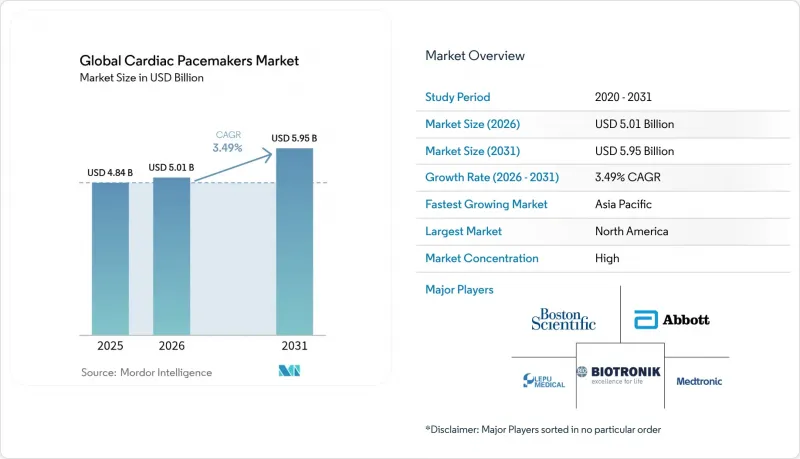
This report is Segmented by Product Type (Implantable Pacemakers, Leadless Pacemakers and More), by Technology (Single Chamber Technology, Dual Chamber Technology and More), by End User (Hospitals & Cardiac Centers, Ambulatory Surgical Centers and More) and Geography (North America, Europe, Asia-Pacific and More). The Market Forecasts are Provided in Terms of Value (USD).
Global Cardiac Pacemakers Market Trends and Insights
Rising Prevalence of Bradyarrhythmia & Heart Block
Epidemiological studies project atrioventricular block cases to climb 41%, moving from 378,816 individuals in 2020 to 535,076 by 2060, propelled by an aging global population and widespread cardiovascular risk factors. Complete heart block constitutes 76% of permanent pacemaker indications in clinical registries, ensuring persistent demand across all product classes. Concomitant rises in atrial fibrillation-from a 24.2% to 30.9% lifetime risk between 2000 and 2022-further expand the candidate pool for pacing therapy as conduction disorders supervene. Mortality tied to sick sinus syndrome has also climbed among seniors, highlighting the need for timely intervention. Survival data underscore pacemaker benefit, with paced patients experiencing 2.7-fold higher survival than untreated counterparts in severe bradycardia cohorts.
Growing Elderly Population
Cardiovascular disease is forecast to affect 61% of US adults by 2050, reinforcing the structural tailwind behind the cardiac pacemaker market. The >=85-year cohort already represents over 40% of US implants and is on track to triple by 2060. Outcome analyses reveal that conduction-system pacing maintains equivalent efficacy across age groups, debunking concerns over geriatric procedural risk. Health systems respond by building geriatric cardiology units and refining device selection for frail patients, with leadless options showing particular appeal in reducing infection risk. Long-term care considerations increasingly guide payer and clinician preference toward systems offering longevity and low maintenance demands.
High Device Cost in Low-Income Regions
Unit prices of USD 2,500-3,000 lock many patients out of treatment in emerging economies, where implant rates hover at 4 devices per million compared with 782 per million in developed France heart.. Cost barriers translate into an estimated 1 million preventable deaths each year, and 27% of indicated patients in resource-limited settings remain untreated. Device reuse programs report safety parity with new implants but face regulatory hesitancy and cultural resistance . Government tenders, philanthropic donations, and tiered pricing bring some relief, yet sustainable solutions depend on fundamental cost innovation, local assembly, and supply chain rationalization. The Pan-African Society of Cardiology's device reuse initiative highlights what can be achieved when regulatory, clinical, and industry stakeholders align heart.
Other drivers and restraints analyzed in the detailed report include:
- Advancements in MRI-Conditional & Leadless Devices
- AI-Driven Pacemaker Programming Platforms
- Device-Related Complications & Recalls
For complete list of drivers and restraints, kindly check the Table Of Contents.
Segment Analysis
Implantable systems captured 63.78% revenue in 2025, underscoring their entrenched position across broad clinical indications ihrs.co.in. However, leadless models post the highest 5.42% CAGR and are eroding share as physicians gravitate toward minimally invasive options with lower complication profiles. Single-chamber implantables remain standard for straightforward bradycardia, whereas dual-chamber configurations dominate complex atrioventricular conditions. Biventricular resynchronization pacing serves heart-failure cohorts with conduction delays, a specialized group yet one that benefits from increasingly compact hardware designs. Temporary and external pacemakers fill acute postoperative or emergency gaps, ensuring continuity of care until permanent implantation is feasible.
Leadless expansion marks a structural pivot within the cardiac pacemaker market, buoyed by data showing 98.3% procedural success and 97% synchronization in Abbott's AVEIR DR trial. Form-factor reductions, battery gains, and retrieval enhancements collectively sharpen value, while Northwestern University's dissolvable devices hint at future pediatric and short-term opportunities sciencenews.org. As value-based care pressures intensify, payers welcome the elimination of pocket- and lead-related revisions, positioning leadless technology as a cost-effective choice over a lifetime horizon.
Complete Report Scope:
- By Product Type
- Implantable Pacemakers
- Single Chamber Implantable
- Dual Chamber Implantable
- Biventricular / CRT-P
- Leadless Pacemakers
- Leadless PacemakersExternal / Temporary Pacemakers
- External / Temporary Pacemakers
- Implantable Pacemakers
- By Technology
- Single Chamber Technology
- Dual Chamber Technology
- Cardiac Resynchronization Therapy (CRT-P)
- Leadless Technology
- Rate-Responsive Pacemakers
- By End User
- Hospitals & Cardiac Centers
- Ambulatory Surgical Centers
- Homecare Settings
- Academic & Research Institutes
- By Geography
- North America
- United States
- Canada
- Mexico
- Europe
- Germany
- United Kingdom
- France
- Italy
- Spain
- Russia
- Rest of Europe
- Asia-Pacific
- China
- Japan
- India
- South Korea
- Australia
- Rest of Asia-Pacific
- Middle East and Africa
- GCC
- South Africa
- Rest of Middle East and Africa
- South America
- Brazil
- Argentina
- Rest of South America
- North America
Geography Analysis
North America remains the leading revenue generator, holding 38.22% share in 2025, anchored by sophisticated payer frameworks, high public awareness, and early adoption of AI-enabled remote monitoring cms.gov. Medicare's separate payments for pacing leads and real-time monitoring sustain technology uptake, while FDA fast-track pathways foster rapid commercialization of breakthroughs such as dual-chamber leadless systems and predictive analytics engines. Canadian and Mexican public health programs are widening access through bulk tenders that favor value-based procurement, nudging manufacturers to present lifecycle economics rather than sticker price alone.
Europe leverages cohesive reimbursement systems and strong clinical guideline influence from entities such as the European Society of Cardiology, driving homogeneity in practice standards. Germany, France, and the United Kingdom lead implantation volumes thanks to robust electrophysiology networks and high per-capita diagnostic rates. Brexit has introduced trade documentation friction, but parallel regulatory frameworks continue to recognize CE-marked pacemakers, ensuring patient access. Over the medium term, EU Medical Device Regulation (MDR) will demand deeper post-market surveillance, pushing smaller manufacturers to partner or exit due to compliance overhead.
Asia-Pacific provides the fastest 5.45% CAGR to 2031, propelled by aging demographics, urban lifestyle disease, and government initiatives that expand cardiac device reimbursement. China's reformed National Medical Products Administration (NMPA) process expedites foreign device approvals, while its volume-based procurement program negotiates prices down, enlarging installed base penetration cisema.com. India confronts cost obstacles yet shows rising implant numbers as public-private partnerships fund indigent care, especially in tier-2 cities pubmed.ncbi.nlm.nih.gov. Japan and South Korea sustain high per-capita implant rates due to universal coverage and tech-savvy specialists, while Australia and Singapore act as regional testbeds for AI-driven screening programs.
The Middle East and Africa trail in volume but offer latent opportunity as cardiac disease burden climbs and public health policies pivot toward noncommunicable disease management. Government-led tenders in Saudi Arabia and the United Arab Emirates allocate budget for modern pacing technologies, and philanthropic device reuse programs are reducing waitlists in sub-Saharan regions heart. Latin America shows mixed progress as Brazil and Mexico modernize their electrophysiology capacity while smaller economies wrestle with currency volatility that complicates import financing.
- Medtronic
- Abbott Laboratories
- Boston Scientific
- BIOTRONIK
- MicroPort
- LivaNova
- Lepu Medical
- Shree Pacetronix
- Cook Group
- OSYPKA
- Medico S.p.A.
- Integer Holdings
- Zoll Medical
- Nihon Kohden
- Braile Biomedica
- Cardiaccs ApS
- EBR Systems
- Hunan Huacheng Medical
- Mindray
- PharMed Srl
Additional Benefits:
- The market estimate (ME) sheet in Excel format
- 3 months of analyst support
TABLE OF CONTENTS
1 Introduction
- 1.1 Study Assumptions & Market Definition
- 1.2 Scope of the Study
2 Research Methodology
3 Executive Summary
4 Market Landscape
- 4.1 Market Overview
- 4.2 Market Drivers
- 4.2.1 Rising prevalence of bradyarrhythmia & heart block
- 4.2.2 Growing elderly population
- 4.2.3 Advancements in MRI-conditional & leadless devices
- 4.2.4 AI-driven pacemaker programming platforms
- 4.2.5 Reimbursement expansion for remote monitoring
- 4.2.6 Emerging-market governmental tender programs
- 4.3 Market Restraints
- 4.3.1 High device cost in low-income regions
- 4.3.2 Device-related complications & recalls
- 4.3.3 Supply-chain shortage of tantalum & semiconductors
- 4.3.4 Evolving cybersecurity compliance burden
- 4.4 Value / Supply-Chain Analysis
- 4.5 Regulatory Landscape
- 4.6 Technological Outlook
- 4.7 Porter's Five Forces
- 4.7.1 Threat of New Entrants
- 4.7.2 Bargaining Power of Suppliers
- 4.7.3 Bargaining Power of Buyers
- 4.7.4 Threat of Substitutes
- 4.7.5 Competitive Rivalry
5 Market Size & Growth Forecasts (Value)
- 5.1 By Product Type
- 5.1.1 Implantable Pacemakers
- 5.1.1.1 Single Chamber Implantable
- 5.1.1.2 Dual Chamber Implantable
- 5.1.1.3 Biventricular / CRT-P
- 5.1.2 Leadless Pacemakers
- 5.1.2.1 Leadless PacemakersExternal / Temporary Pacemakers
- 5.1.3 External / Temporary Pacemakers
- 5.1.1 Implantable Pacemakers
- 5.2 By Technology
- 5.2.1 Single Chamber Technology
- 5.2.2 Dual Chamber Technology
- 5.2.3 Cardiac Resynchronization Therapy (CRT-P)
- 5.2.4 Leadless Technology
- 5.2.5 Rate-Responsive Pacemakers
- 5.3 By End User
- 5.3.1 Hospitals & Cardiac Centers
- 5.3.2 Ambulatory Surgical Centers
- 5.3.3 Homecare Settings
- 5.3.4 Academic & Research Institutes
- 5.4 By Geography
- 5.4.1 North America
- 5.4.1.1 United States
- 5.4.1.2 Canada
- 5.4.1.3 Mexico
- 5.4.2 Europe
- 5.4.2.1 Germany
- 5.4.2.2 United Kingdom
- 5.4.2.3 France
- 5.4.2.4 Italy
- 5.4.2.5 Spain
- 5.4.2.6 Russia
- 5.4.2.7 Rest of Europe
- 5.4.3 Asia-Pacific
- 5.4.3.1 China
- 5.4.3.2 Japan
- 5.4.3.3 India
- 5.4.3.4 South Korea
- 5.4.3.5 Australia
- 5.4.3.6 Rest of Asia-Pacific
- 5.4.4 Middle East and Africa
- 5.4.4.1 GCC
- 5.4.4.2 South Africa
- 5.4.4.3 Rest of Middle East and Africa
- 5.4.5 South America
- 5.4.5.1 Brazil
- 5.4.5.2 Argentina
- 5.4.5.3 Rest of South America
- 5.4.1 North America
6 Competitive Landscape
- 6.1 Market Concentration
- 6.2 Strategic Moves
- 6.3 Market Share Analysis
- 6.4 Company Profiles (includes Global level Overview, Market level overview, Core Segments, Financials as available, Strategic Information, Market Rank/Share for key companies, Products & Services, and Recent Developments)
- 6.4.1 Medtronic plc
- 6.4.2 Abbott Laboratories
- 6.4.3 Boston Scientific Corporation
- 6.4.4 Biotronik SE & Co. KG
- 6.4.5 MicroPort Scientific Corporation
- 6.4.6 LivaNova PLC
- 6.4.7 Lepu Medical Technology Co., Ltd.
- 6.4.8 Shree Pacetronix Ltd.
- 6.4.9 Cook Medical LLC
- 6.4.10 Osypka AG
- 6.4.11 Medico S.p.A.
- 6.4.12 Integer Holdings Corporation
- 6.4.13 Zoll Medical Corporation
- 6.4.14 Nihon Kohden Corporation
- 6.4.15 Braile Biomedica
- 6.4.16 Cardiaccs ApS
- 6.4.17 EBR Systems Inc.
- 6.4.18 Hunan Huacheng Medical
- 6.4.19 Mindray Medical International Ltd.
- 6.4.20 PharMed Srl
7 Market Opportunities & Future Outlook
- 7.1 White-space & Unmet-Need Assessment