|
시장보고서
상품코드
2100020
주사용 항당뇨병약 시장 : 시장 점유율 분석, 업계 동향 및 통계, 성장 예측(2026-2031년)Injectable Anti-Diabetic Drugs - Market Share Analysis, Industry Trends & Statistics, Growth Forecasts (2026 - 2031) |
||||||
 Mordor Intelligence
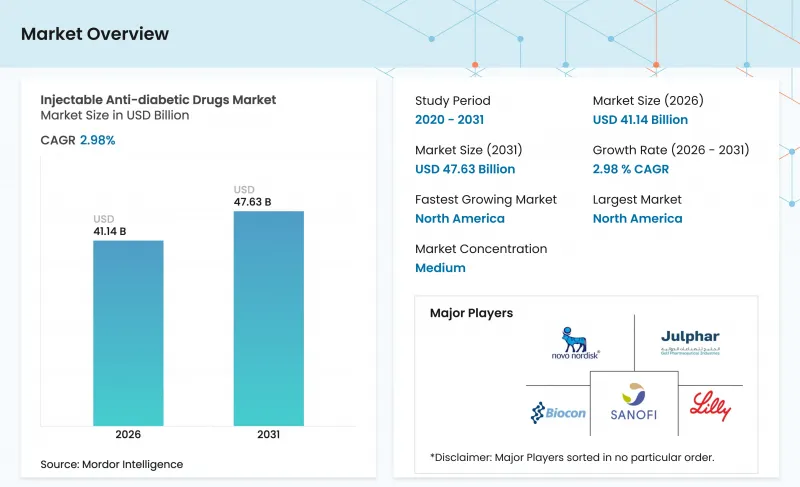
Mordor Intelligence에 의하면, 주사용 항당뇨병약 시장 규모는 2025년 399억 5,000만 달러로 평가되었고, 2026년에는 411억 4,000만 달러로 확대될 것으로 추정되고, 2026-2031년 CAGR 2.98%로 성장을 지속할 전망이며, 2031년에는 476억 3,000만 달러에 이를 것으로 예측됩니다.
본 보고서는 약물 분류별(인슐린(기저형/장시간 작용형, 기타), GLP-1 수용체 작용제), 당뇨병 유형별(1형 당뇨병, 2형 당뇨병), 유통 채널별(병원 약국, 소매 약국, 온라인 약국), 연령대별(성인, 고령자, 소아), 지역별(북미, 유럽, 기타)로 분류되어 있습니다. 시장 전망은 금액(달러) 기준으로 제시되어 있습니다.
세계의 주사용 항당뇨병약 시장 동향 및 인사이트
당뇨병 및 비만 유병률 증가
세계 당뇨병 유병률은 2021년 6.1%에서 2050년에는 9.8%를 나타낼 것으로 예측되며, 환자의 80%는 개발도상국에 거주하고 있습니다. 중국에서는 이미 2억 3,300만 명의 당뇨병 환자가 보고되었으며, 이는 인구의 15.88%에 해당하지만, 이러한 추세가 지속된다면 21세기 중반까지 그 비율은 29.1%에 달할 가능성이 있습니다. 아시아 지역 특유의 표현형에서는 서유럽 국가에 비해 BMI 기준치가 낮더라도 당뇨병이 발병하기 때문에 질병의 초기 단계에서 주사제 수요가 증가하고 있습니다. 동남아시아만 해도 2045년까지 환자 수가 8,000만 명에서 1억 5,100만 명으로 증가할 것으로 예상되며, 이는 주사용 항당뇨병약 시장의 지속적인 판매량 잠재력을 뒷받침하는 것입니다.
주 1회 투여 주사제의 등장
EU, 캐나다, 호주에서 인슐린 ‘이코덱’이 승인됨에 따라, 반감기 196시간의 기저 인슐린이 등장했습니다. 이는 데글루덱과 동등한 일일 효능을 유지하면서 주사 빈도를 7회에서 1회로 줄여주는 것입니다. 환자 만족도는 향상되었으나, 1형 당뇨병 환자의 경우 저혈당 발작 빈도가 높아지는 경향이 나타나, 신중한 용량 조절의 필요성이 부각되고 있습니다. IcoSema나 일라이 릴리(Eli Lilly)사의 efsitora alfa와 같은 파이프라인 제품들은 기저 인슐린과 세마글루티드와 같은 이점을 융합하는 것을 목표로 하고 있으며, 개발 중인 트리플 작용제는 보다 광범위한 대사 조절을 약속하고 있습니다. 이러한 혁신은 치료 선택의 폭을 넓혀 주사용 항당뇨병약 시장에서 기존 치료법에서 전환에 따른 성장을 가속하고 있습니다.
브랜드 GLP-1 아날로그의 높은 비용
GLP-1 수용체 작용제의 연간 비용은 1만 2,000달러에 육박하며, 임상적 효과가 명확한 경우에도 경제적 장벽이 되고 있습니다. 경쟁 제품의 출시로 인해 가격은 하락하기는커녕 오히려 상승하고 있으며, 2031년 이후 제네릭 의약품이 등장하기 전까지는 대폭적인 가격 인하를 기대하기 어렵습니다. 브라질에서는 2026년 특허 만료를 계기로 세마글루티드의 제네릭 도입을 위한 준비가 진행되고 있지만, 미국에서는 릴라글루티드의 첫 번째 제네릭 의약품이 막 승인된 상태입니다. 바이오시밀러의 보급이 더욱 확대되기 전까지는 가격 탄력성이 높은 ‘주사용 항당뇨병약 시장’ 부문에서 가격 민감도가 판매량 증가를 억제할 것으로 보입니다.
부문 분석
인슐린은 2025년 주사용 항당뇨병약 시장에서 59.12%의 점유율을 유지했으며, 이는 혈당 조절에 있어 인슐린이 수행하는 기초적인 역할을 반영합니다. 그러나 지속형 아날로그가 기존의 인간 유래 제제 시장을 잠식하고, 신흥 지역에서 바이오시밀러 경쟁이 확대됨에 따라 매출액은 완만한 성장에 그치고 있습니다. 주 1회 투여 인슐린 ‘이코덱’의 출시는 판매량 증가세를 둔화시킬 가능성은 있으나, 매출을 끌어올릴 수 있는 프리미엄 틈새 시장을 창출하고 있습니다. 초속효성 식후 인슐린은 현재 식후 혈당 관리 분야에서 점유율을 확대하고 있지만, 인슐린 투여량을 줄여주는 인크레틴 계열 체중 관리 약물과의 경쟁에 직면해 있습니다.
GLP-1 수용체 작용제 부문은 성장의 원동력이 되고 있으며, 2031년까지 연평균 성장률(CAGR) 3.74%로 확대될 것으로 전망됩니다. 세마글루티드와 틸제파티드는 강력한 체중 감량 효과를 무기로 시장을 주도하고 있으며, 일시적인 공급 부족에도 불구하고 당뇨병과 비만의 동반 질환에 대한 병용 요법의 채택을 촉진하고 있습니다. 여러 수용체를 표적으로 하는 2세대 약물은 효능을 높이는 동시에 투여 간격을 연장하는 것을 목표로 하고 있습니다. 심혈관 질환에 대한 적응증 확대가 진행됨에 따라 GLP-1 제제는 더욱 광범위한 대사 솔루션으로 진화하며, 주사용 항당뇨병약 시장에 대한 영향력을 더욱 강화하고 있습니다.
2025년 시점에서 2형 당뇨병은 주사용 항당뇨병약 시장 규모의 80.05%를 차지했으며, 성인 발병형 질환이 팬데믹 수준의 규모에 달했음을 여실히 보여주고 있습니다. 유병률의 점진적 증가와, 특히 GLP-1 제제를 중심으로 한 주사제의 조기 도입이 시장 규모의 안정성을 뒷받침하고 있습니다. 2형 당뇨병 환자를 대상으로 새로 승인된 자동 기초·추가 투여 시스템은 치료 요법을 간소화하여 기술에 익숙한 계층에서의 채택을 촉진하고 있습니다.
1형 당뇨병은 시장 규모는 작지만, 펌프 및 센서 생태계, 주 1회 투여 기저 인슐린, 그리고 근치적 세포 치료 파이프라인이 기대감을 불러일으키며 연평균 성장률(CAGR) 3.79%로 다소 빠른 속도로 성장하고 있습니다. 췌도 세포 이식이나 유전자 편집을 통한 저면역 접근법에 대한 임상시험은 미래의 변혁을 시사하고 있지만, 단기적인 수익은 주사용 항당뇨병약 시장을 확대시키는 프리미엄 커넥티드 기기에서 비롯되고 있습니다.
지역별 분석
북미는 2025년 매출의 40.05%를 차지한 것으로 평가되었으며, 이는 최첨단 제품 출시, 광범위한 보험 제도, 그리고 국내 생산 확대에 힘입은 결과입니다. 인슐린 ‘이코덱(Ikodec)’은 예상되는 미국 시장 진출에 앞서 캐나다 보건부의 승인을 획득한 반면, FDA는 2형 당뇨병 환자를 위한 자동 투여 시스템을 승인하여 규제 당국의 유연한 태도를 엿볼 수 있습니다. 두 주에서 총 90억 달러가 넘는 투자를 통해 충전 및 마무리 생산 능력은 두 배로 증가했으나, 지불 기관의 면밀한 검토 및 사전 승인 요건이 성장세를 둔화시키고 있습니다.
아시아태평양은 연평균 성장률(CAGR) 3.72%로 가장 빠르게 성장하는 지역이며, 이러한 성장 궤도는 중국의 2억 3,300만 명에 달하는 당뇨병 환자와 인도의 현지 제약 기업을 장려하는 지원 정책에 의해 주도되고 있습니다. 노보노르디스크와 인도네시아 바이오파마 간의 제휴 등 지역 간 제조 제휴는 비용 절감 전략을 추진하고 접근성 향상에 기여하고 있습니다. 낮은 BMI 임계값에서 당뇨병이 발병하는 특유의 표현형 요인과 도시 지역의 중산층 확대가 주사용 항당뇨병약 시장 전체 수요를 더욱 부추기고 있습니다.
유럽에서는 바이오시밀러 인슐린의 승인 및 유럽의약품청(EMA)의 지침 개정을 통해 경쟁력 있는 가격 책정과 기술 통합이 촉진되어 안정적인 성장이 지속되고 있습니다. GLP-1 제제공급 부족에 대응하여 생산 규모를 확대하고 미용 목적의 적응증 외 사용을 억제하는 등 협력적인 조치를 통해 치료제 공급이 확보되고 있습니다. 사노피와 노보노르디스크의 유럽 대륙 시설에 대한 투자가 공급망의 기반을 공고히 하는 한편, 신흥 시장인 라틴아메리카와 중동에서는 아시아의 현지화 모델을 모방함으로써 가격 격차를 해소하기 위한 노력이 진행되고 있습니다.
기타 혜택 :
- 엑셀 형식 시장 예측(ME) 시트
- 3개월간의 애널리스트 지원
자주 묻는 질문
목차
제1장 서론
제2장 조사 방법
제3장 주요 요약
제4장 시장 구도
제5장 시장 규모 및 성장 예측
제6장 경쟁 구도
제7장 시장 기회 및 향후 전망
AJYAccording to Mordor Intelligence, the injectable anti-Diabetic drugs market size is expected to grow from USD 39.95 billion in 2025 to USD 41.14 billion in 2026 and is forecast to reach USD 47.63 billion by 2031 at 2.98% CAGR over 2026-2031.
This report is Segmented by Drug Class (Insulin [Basal/Long-acting, and More], GLP-1 Receptor Agonists), Diabetes Type (Type-1 Diabetes, Type-2 Diabetes), Distribution Channel (Hospital Pharmacies, Retail Pharmacies, Online Pharmacies), Age Group (Adults, Geriatric, Pediatric), and Geography (North America, Europe, and More). The Market Forecasts are Provided in Terms of Value (USD).
Global Injectable Anti-Diabetic Drugs Market Trends and Insights
Rising Diabetes & Obesity Prevalence
Global diabetes prevalence climbed from 6.1% in 2021 to a projected 9.8% by 2050, with 80% of patients living in developing countries. China already reports 233 million diabetics, equating to 15.88% of its population, and that figure could reach 29.1% by mid-century if trends persist. Regional phenotypes in Asia develop diabetes at lower BMI thresholds than Western peers, pushing demand for injectables at earlier disease stages. Southeast Asia alone is expected to see cases rise from 80 million to 151 million by 2045, underscoring sustained volume potential for the Injectable Anti-Diabetic Drugs Market.
Launch of Once-Weekly Injectable Therapies
Insulin icodec's approvals in the EU, Canada and Australia introduced a 196-hour half-life basal insulin that matches daily degludec efficacy while trimming injection frequency from seven to one . Patient satisfaction scores improve, though Type-1 users register higher hypoglycemic episodes, highlighting the need for careful titration. Pipeline assets such as IcoSema and Eli Lilly's efsitora alfa aim to blend basal insulin with semaglutide-like benefits, while triple-agonists under development promise broader metabolic control. These innovations widen therapeutic choice and spur switch-over growth within the Injectable Anti-Diabetic Drugs Market.
High Cost of Branded GLP-1 Analogues
GLP-1 receptor agonists list near USD 12,000 annually, creating affordability hurdles even where clinical benefits are clear. Competitive launches have raised rather than lowered prices, and meaningful reductions are unlikely until generics appear after 2031. Brazil is preparing for semaglutide copycats once patents lapse in 2026, while the United States has only just seen its first generic liraglutide approval. Until broader biosimilar penetration materializes, price sensitivity will temper volumes in price-elastic segments of the Injectable Anti-Diabetic Drugs Market.
Other drivers and restraints analyzed in the detailed report include:
- Favourable Reimbursement in OECD Markets
- Dual GIP/GLP-1 Agonist Pipeline Momentum
- Cold-Chain & Last-Mile Logistics Gaps
For complete list of drivers and restraints, kindly check the Table Of Contents.
Segment Analysis
Insulin retained 59.12% of Injectable Anti-Diabetic Drugs Market share in 2025, reflecting its bedrock role in glycemic control. Revenue, however, advances gently as long-acting analogs cannibalize older human formulations and biosimilar competition spreads across emerging regions. Weekly insulin icodec's rollout adds a premium niche that may slow volume but raise value. Ultra-rapid prandial insulins now carve share within post-meal management, yet they face overlap with incretin-based weight management options that reduce insulin dose requirements.
The GLP-1 receptor agonist segment represents the growth engine, expanding at 3.74% CAGR through 2031. Semaglutide and tirzepatide lead with strong weight-loss efficacy, driving dual diabetes-obesity adoption despite temporary supply shortages. Second-generation assets targeting multiple receptors aim to elevate efficacy while prolonging dosing intervals. As cardiovascular-label expansions arrive, GLP-1s evolve into broader metabolic solutions, amplifying their influence on the Injectable Anti-Diabetic Drugs Market.
Type-2 diabetes constituted 80.05% of the Injectable Anti-Diabetic Drugs Market size in 2025, underlining the pandemic-like scale of adult-onset disease. Incremental prevalence gains and earlier initiation of injectables, especially GLP-1s, underpin volume stability. Automated basal-bolus dosing systems newly cleared for Type-2 users simplify regimens, encouraging uptake among tech-literate populations.
Type-1 diabetes, while smaller, grows marginally faster at 3.79% CAGR as pump-sensor ecosystems, weekly basal insulins and curative cell therapies pipeline create optimism. Clinical trials for islet cell replacement and gene-edited hypo-immune approaches suggest future disruption, yet near-term revenue stems from premium connected devices that extend the Injectable Anti-Diabetic Drugs Market.
Complete Report Scope:
- By Drug Class
- Insulin
- Basal/Long-acting
- Bolus/Fast-acting
- Traditional Human
- Combination
- Biosimilar
- GLP-1 Receptor Agonists
- Dulaglutide
- Exenatide
- Liraglutide
- Lixisenatide
- Semaglutide
- Insulin
- By DiabetesType
- Type-1 Diabetes
- Type-2 Diabetes
- By Distribution Channel
- Hospital Pharmacies
- Retail Pharmacies
- Online Pharmacies
- By Age Group
- Adults
- Geriatric
- Pediatric
- By Geography
- North America
- United States
- Canada
- Mexico
- Europe
- Germany
- United Kingdom
- France
- Italy
- Spain
- Rest of Europe
- Asia-Pacific
- China
- Japan
- India
- Australia
- South Korea
- Rest of Asia-Pacific
- Middle East and Africa
- GCC
- South Africa
- Rest of Middle East and Africa
- South America
- Brazil
- Argentina
- Rest of South America
- North America
Geography Analysis
North America retained 40.05% of revenue in 2025, bolstered by leading-edge launches, extensive insurance frameworks and domestic production expansion. Insulin icodec secured Health Canada approval ahead of anticipated U.S. entry, while the FDA green-lit automated dosing systems for Type-2 users, reflecting regulatory openness. Investment totaling over USD 9 billion across two states is doubling fill-finish capacity, yet payer scrutiny and prior authorizations dampen growth momentum.
Asia-Pacific is the fastest-growing region at a 3.72% CAGR, a trajectory driven by China's 233 million diabetics and supportive policy in India that incentivizes local drug makers. Regional manufacturing collaborations, such as Novo Nordisk's tie-up with Bio Farma in Indonesia, drive cost-down strategies and boost access. Unique phenotypic factors that ignite diabetes at lower BMI thresholds and the expansion of urban middle-income groups further catalyze demand across the Injectable Anti-Diabetic Drugs Market.
Europe maintains stable expansion as biosimilar insulin approvals and EMA guideline updates foster competitive pricing and technological integration. Coordinated responses to GLP-1 shortages, including production scale-ups and discouragement of cosmetic off-label use, protect therapy availability. Investments by Sanofi and Novo Nordisk in continental facilities anchor supply chains, while emerging Latin American and Middle Eastern markets replicate Asia's localization model to bridge affordability gaps.
- Novo Nordisk
- Eli Lilly and Company
- Sanofi
- Biocon
- Pfizer
- Julphar
- AstraZeneca
- Amgen
- Amylin Pharma
- Zealand Pharma
- Boehringer Ingelheim
- Hanmi Pharmaceutical
- Tonghua Dongbao
- Gan & Lee
- Wockhardt
- Celltrion
- Ypsomed
- Insulet Corp
- Medtronic
- Beckton Dickinson
- Hikma Pharma
- Mylan-Viatris
Additional Benefits:
- The market estimate (ME) sheet in Excel format
- 3 months of analyst support
TABLE OF CONTENTS
1 Introduction
- 1.1 Study Assumptions & Market Definition
- 1.2 Scope of the Study
2 Research Methodology
3 Executive Summary
4 Market Landscape
- 4.1 Market Overview
- 4.2 Market Drivers
- 4.2.1 Rising Diabetes & Obesity Prevalence
- 4.2.2 Launch Of Once-Weekly Injectable Therapies
- 4.2.3 Favourable Reimbursement in OECD Markets
- 4.2.4 Dual GIP/GLP-1 Agonist Pipeline Momentum
- 4.2.5 On-Body Wearable/Connected Injector Adoption
- 4.2.6 Localised Insulin Manufacturing in Ems
- 4.3 Market Restraints
- 4.3.1 High Cost of Branded GLP-1 Analogues
- 4.3.2 Cold-Chain & Last-Mile Logistics Gaps
- 4.3.3 Supply Squeeze from Weight-Loss Off-Label Use
- 4.3.4 Shift Of R&D Capital Toward Oral/Gene Options
- 4.4 Regulatory Landscape
- 4.5 Porters Five Forces Analysis
- 4.5.1 Bargaining Power of Suppliers
- 4.5.2 Bargaining Power of Buyers
- 4.5.3 Threat of New Entrants
- 4.5.4 Threat of Substitutes
- 4.5.5 Competitive Rivalry
5 Market Size & Growth Forecasts (Value, USD)
- 5.1 By Drug Class
- 5.1.1 Insulin
- 5.1.1.1 Basal/Long-acting
- 5.1.1.2 Bolus/Fast-acting
- 5.1.1.3 Traditional Human
- 5.1.1.4 Combination
- 5.1.1.5 Biosimilar
- 5.1.2 GLP-1 Receptor Agonists
- 5.1.2.1 Dulaglutide
- 5.1.2.2 Exenatide
- 5.1.2.3 Liraglutide
- 5.1.2.4 Lixisenatide
- 5.1.2.5 Semaglutide
- 5.1.1 Insulin
- 5.2 By DiabetesType
- 5.2.1 Type-1 Diabetes
- 5.2.2 Type-2 Diabetes
- 5.3 By Distribution Channel
- 5.3.1 Hospital Pharmacies
- 5.3.2 Retail Pharmacies
- 5.3.3 Online Pharmacies
- 5.4 By Age Group
- 5.4.1 Adults
- 5.4.2 Geriatric
- 5.4.3 Pediatric
- 5.5 By Geography
- 5.5.1 North America
- 5.5.1.1 United States
- 5.5.1.2 Canada
- 5.5.1.3 Mexico
- 5.5.2 Europe
- 5.5.2.1 Germany
- 5.5.2.2 United Kingdom
- 5.5.2.3 France
- 5.5.2.4 Italy
- 5.5.2.5 Spain
- 5.5.2.6 Rest of Europe
- 5.5.3 Asia-Pacific
- 5.5.3.1 China
- 5.5.3.2 Japan
- 5.5.3.3 India
- 5.5.3.4 Australia
- 5.5.3.5 South Korea
- 5.5.3.6 Rest of Asia-Pacific
- 5.5.4 Middle East and Africa
- 5.5.4.1 GCC
- 5.5.4.2 South Africa
- 5.5.4.3 Rest of Middle East and Africa
- 5.5.5 South America
- 5.5.5.1 Brazil
- 5.5.5.2 Argentina
- 5.5.5.3 Rest of South America
- 5.5.1 North America
6 Competitive Landscape
- 6.1 Market Concentration
- 6.2 Market Share Analysis
- 6.3 Company Profiles (includes Global level Overview, Market level overview, Core Segments, Financials as available, Strategic Information, Market Rank/Share for key companies, Products & Services, and Recent Developments)
- 6.3.1 Novo Nordisk
- 6.3.2 Eli Lilly
- 6.3.3 Sanofi
- 6.3.4 Biocon
- 6.3.5 Pfizer
- 6.3.6 Julphar
- 6.3.7 AstraZeneca
- 6.3.8 Amgen
- 6.3.9 Amylin Pharma
- 6.3.10 Zealand Pharma
- 6.3.11 Boehringer Ingelheim
- 6.3.12 Hanmi Pharmaceutical
- 6.3.13 Tonghua Dongbao
- 6.3.14 Gan & Lee
- 6.3.15 Wockhardt
- 6.3.16 Celltrion
- 6.3.17 Ypsomed
- 6.3.18 Insulet Corp
- 6.3.19 Medtronic
- 6.3.20 BD
- 6.3.21 Hikma Pharma
- 6.3.22 Mylan-Viatris
7 Market Opportunities & Future Outlook
- 7.1 White-space & Unmet-need Assessment