

|
시장보고서
상품코드
2100044
신장 질환용 케토아날로그 시장 : 시장 점유율 분석, 업계 동향 및 통계, 성장 예측(2026-2031년)Ketoanalogues For Kidney Diseases - Market Share Analysis, Industry Trends & Statistics, Growth Forecasts (2026 - 2031) |
||||||
 Mordor Intelligence
Mordor Intelligence에 의하면, 신장 질환용 케토아날로그 시장 규모는 2025년에 2억 4,934만 달러로 평가되었고, 2026년 2억 6,759만 달러에서 2031년까지 3억 8,104만 달러에 이를 것으로 예측되며, 예측 기간(2026-2031년) CAGR은 7.32%입니다.
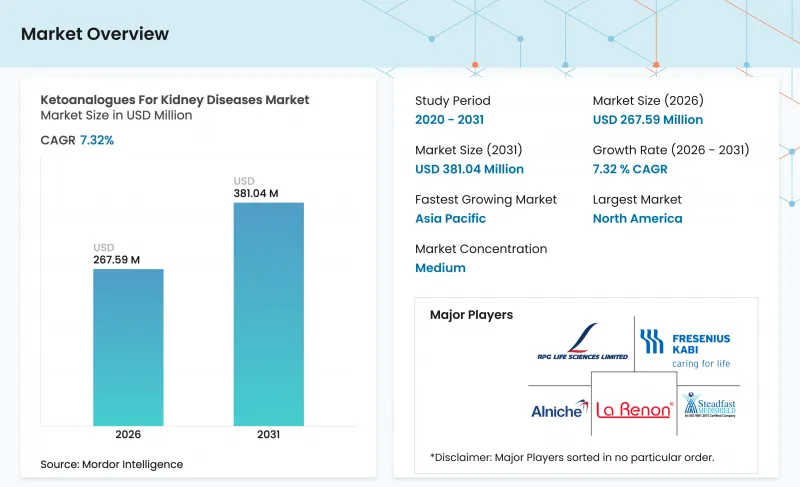
본 보고서는 제품 유형별(케토아날로그 정제, 케토아날로그 과립, 케토산 소포장), 제형별(단일 성분 케토아날로그, 케토아날로그+비타민/미네랄), 만성 신장 질환(CKD)의 병기별(3기, 4기, 기타), 유통 채널별(병원 약국, 기타), 지역별(북미, 유럽, 기타)로 분류되어 있습니다. 시장 전망은 금액(달러) 기준으로 제시되어 있습니다.
세계의 신장 질환용 케토아날로그 시장 동향 및 인사이트
만성 신장 질환(CKD) 유병률 증가
8억 명 이상이 CKD를 앓고 있으며, 당뇨병 환자나 고혈압 환자의 경우 발병이 말기 단계에 집중되는 경향이 나타납니다. 선진국의 인구 고령화가 수요를 뒷받침하는 한편, 생활 습관의 변화와 진단 기술의 향상으로 인해 아시아 지역의 환자 수가 증가하고 있습니다. 현재 의료 제도 시산에 따르면, 투석 시작을 불과 6개월만 늦추더라도 환자 1인당 4만 5,000달러 이상의 비용 절감으로 이어진다고 알려져 있어, 이에 따라 조기 식이요법 개입이 촉진되고 있습니다. 이에 따라 보험사들은 급여 설계를 재검토하여 케토 아날로그를 예방 조치로 급여 대상에 포함시키고 있으며, 이는 신장 질환용 케토아날로그 시장의 성장 궤도를 더욱 가속화하고 있습니다. 또한 이러한 역학적 현실로 인해 1차 진료 의사는 관리 영양사와 협력하여 신장내과로 의뢰되기 훨씬 이른 단계에서 영양 요법을 시작하도록 권장받고 있습니다.
케토스테릴과 동종 아날로그 제제에 대한 보험 적용 범위 확대
메디케어와 유럽의 여러 보험사는 2024년에 케토 아날로그 제제를 보험 적용 대상으로 인정함으로써, 오랫동안 지속되어 온 비용상의 장벽을 제거했습니다. 비용-효용 분석에 따르면, 조기 투석 시작과 비교했을 때 QALY(질 조정 생존년)당 증분 비용-효과 비율은 5만 달러 이하로, 일반적인 보험사의 기준을 충족합니다. 급여 코드가 적용됨에 따라 의사가 환자에게 고액의 청구서를 발행할 것을 우려할 필요가 없어졌기 때문에 처방량이 급증했습니다. 또한 청구 코드의 통합으로 업무 처리 주기가 단축되어, 이전에는 틈새 처방으로 여겨지던 것이 표준 전자건강기록의 입력 항목이 되었습니다. 이러한 연쇄반응으로 인해 증거의 순환이 강화됩니다. 즉, 사용량 증가가 등록부에 반영되어 투석이 필요 없는 생존 기간의 연장이 기록되기 때문입니다.
많은 국가에서 환자의 본인 부담금이 고액이며
의료용 식품이 보험 적용 대상이 아닌 지역에서는 월 200-400달러의 소매 가격이 여전히 감당하기 어려운 수준입니다. 태국이나 대만의 환자들은 케토 아날로그 제품에 가구 소득의 10% 이상을 지출하고 있으며, 소득이 감소하면 치료를 중단할 수밖에 없는 경우가 적지 않습니다. 이러한 경제적 부담의 격차로 인해 명확한 임상적 가치가 있음에도 불구하고 판매량은 부진한 상태입니다. 투석에는 보조금을 지급하면서도 영양 요법에는 지급하지 않는 정부는 예산상의 딜레마에 직면해 있습니다. 현재 시범 사업으로 시행되고 있는 포괄 정산 모델에서는 조기 상환이 실제로 신장 질환 관련 총 의료비를 절감할 수 있는지 여부가 검증되고 있습니다.
부문 분석
2025년 시점에서 신장 질환용 케토아날로그 시장의 정제 제형 점유율은 58.21%를 차지했으며, 이는 의료진이 고정 용량을 선호하고 환자가 고형 제제에 익숙하다는 점을 뒷받침합니다. 과립제는 소아 투여나 연하 장애가 있는 고령 환자에게도 투여가 가능하다는 점에서 2031년까지 8.12%라는 가장 높은 연평균 성장률(CAGR)을 달성할 것으로 예상되며, 제약사가 충분히 관리되지 않은 하위 집단 수요를 확보할 수 있는 좋은 기회가 되고 있습니다. 정제는 1회 투여당 비용이 낮고 안정성 데이터도 탄탄하다는 장점이 있어, 조달 팀이 검증된 보관 기간을 우선시하는 병원의 조제 목록에서 그 입지를 확고히 하고 있습니다. 한편, 과립제는 액체에 잘 녹기 때문에 임상 직원이 아닌 간병인에 의존하는 재택 간호 투여 체계를 지원하며, 신장 질환용 케토아날로그 시장이 지역 의료 현장에 확산되는 데 일조하고 있습니다. 현재 진행 중인 연구 개발에서는 과립 제제의 맛 가림 및 분산 속도 향상에 중점을 두고 있으며, 기호성을 해치지 않으면서 정제와 동등한 편의성을 실현함으로써 사용자 경험 측면에서 향후 융합이 시사되고 있습니다.
세 번째 제형인 케토산 소포장은 맞춤형 조제나 액제 조제 분야에서 틈새 시장 위치를 유지하고 있으나, 규모의 경제성은 부족합니다. 체중에 따른 투여가 필수적인 경우, 소아 신장 전문의들은 소포장을 높이 평가했습니다. 각 제약사는 소포 공급을 확대할지, 아니면 그 생산량을 개선된 과립 기술로 전환할지 검토하고 있습니다. 전환이 성공하면 제조 라인이 간소화되고 설비 가동률이 향상되며, 간접적으로 원료 공급 충격 시 정제 생산의 내성이 향상될 것입니다.
단일 아미노산 아날로그는 2025년 매출의 66.74%를 차지했으며, 이는 빈번한 검사 모니터링을 바탕으로 비타민 및 미네랄 보충을 개별화하고자 하는 처방 의사의 의향을 반영한 것입니다. 복합 제품은 복약 부담을 줄임으로써 연평균 성장률(CAGR) 8.37%를 달성하고 있습니다. 하나의 캡슐로 케토 아날로그와 일반적인 미량 영양소 결핍을 모두 해결할 수 있기 때문입니다. 병원에서는 처방 건수가 줄어들어 조제 및 복약 순응도 추적이 효율화되므로, 외래 환자의 초기 치료에 복합 제품의 SKU를 채택하는 경향이 강해지고 있습니다. 일부 신장내과 전문의는 고정 비율의 비타민 제제가 고인산혈증 관리를 복잡하게 만들 것을 우려하여, 상태가 안정된 환자에게만 복합 제품을 처방하고 있습니다. 각 제조업체는 영양소 간의 상호작용을 방지하기 위해 마이크로캡슐화 기술을 채택하고 있으며, 안정성 검사 결과 습도가 높은 열대 지역에서도 2년의 보관 기간이 확인됨에 따라 판매 지역이 확대되고 있습니다.
규제 절차는 다릅니다. 유효 성분을 조합한 의약품은 일반적으로 의료용 식품에 해당하는 제품보다 더 엄격한 임상 검사가 요구됩니다. 전 세계 승인을 목표로 하는 기업들은 대개 먼저 단일 성분 제품을 출시하고, 지역별 데이터가 위험-이익 평가를 충족한 단계에서 복합 제품을 추가합니다. 이러한 순서를 통해 초기 수익을 확보하는 동시에 의사의 인지도를 높이고, 이후 복합 제품의 채택을 촉진함으로써 신장 질환용 케토아날로그 시장의 성장 곡선을 뒷받침하고 있습니다.
지역별 분석
2025년, 북미는 전 세계 매출의 37.88%를 차지했습니다. 이는 메디케어(Medicare)의 보험 적용, 신장 전문의의 높은 밀도, 강력한 영양사 네트워크에 힘입은 결과입니다. 미국의 학술 기관들은 지속적으로 실세계 근거를 발표하고 있으며, 이를 통해 케토아날로그가 치료 채널에 더욱 정착하고 있습니다. 캐나다의 단일 지불자 모델에서는 주(州) 처방약 목록을 통해 케토아날로그가 보험 적용을 받고 있으나, 지역별 적용 범위에 격차가 있어 환자들이 보험 적용을 받기 위해 다른 지역으로 이동하는 사례가 나타나고 있습니다. 원격의료의 보급으로 국경을 넘는 전자상거래가 가속화되고 있으며, 미국에 기반을 둔 온라인 약국의 서비스 범위가 캐나다의 지방 지역까지 확대되고 있습니다.
유럽의 상황은 다양합니다. 독일과 프랑스에서는 오랜 기간에 걸친 영양 조사 프로그램 덕분에 병원 내 도입이 견조한 반면, 이탈리아에서는 공립 병원에 통합된 PLADO 클리닉을 통해 외래 환자 보급률에서 선두를 달리고 있습니다. 남부 경제권에서는 의약품 예산이 부족하고 복합제 도입이 지연되고 있어, 신장 질환용 케토아날로그 시장의 성장은 완만해지고 있습니다. 영국은 브렉시트 이후 MHRA(의약품 및 의료제품 규제청)의 규정을 준수하고 있지만, EMA(유럽의약품청)의 신청 서류와 대체로 일관성을 유지하고 있어 제조업체의 중복 업무를 방지하고 있습니다. 국민보건서비스(NHS)의 디지털화 이니셔티브에 따라 택배 배송 모델이 활성화되고 있어, 지역 간 접근성 격차를 줄일 가능성이 있습니다.
아시아태평양은 2031년까지 연평균 성장률(CAGR)이 9.42%에 달할 것으로 전망되며, 가장 빠르게 성장하는 시장입니다. 중국과 인도는 만성 신장 질환(CKD) 환자 수가 방대하며, 보험 가입률도 향상되고 있습니다. 중국 지방 정부의 입찰에서는 자원이 부족한 지역에서 투석을 대체할 비용 효율적인 대안으로 이미 케토 아날로그가 채택되고 있습니다. 일본의 고령화 사회가 수요를 뒷받침하고 있으며, 특수 의료용 식품(FFSMU) 체계가 규제 부담을 경감시키고 있습니다. 탄탄한 온라인 식료품 판매 인프라를 갖춘 한국에서는 약국과 연계된 시장을 통해 소비자들 사이에서 빠르게 보급되고 있습니다. 한편, 호주의 신장 전문의들은 현지산 식물성 단백질과 케토 아날로그 보충제를 결합한 원주민 커뮤니티용 영양 지원 프로그램을 시범적으로 시행하고 있으며, 이는 문화적 적응 가능성을 보여주고 있습니다.
라틴아메리카와 중동에서는 환급 제도가 세분화되어 있어 보급률은 중간 수준에 그치고 있지만, 재해 다발 지역에서 케토 아날로그를 공급하는 인도적 지원 활동이 지속되면서 그 혜택을 받고 있습니다. 브라질과 튀르키예의 지역 제조업체들은 수입 관세와 리드 타임을 줄이기 위해 현지 합성을 계획하고 있습니다. 이것이 성공하면 2030년까지 이들 지역은 순수입국에서 신흥 수출 거점으로 전환되어 신장 질환용 케토아날로그 시장의 입지를 더욱 확대할 가능성이 있습니다.
기타 혜택
- 엑셀 형식 시장 예측(ME) 시트
- 3개월간의 애널리스트 지원
자주 묻는 질문
목차
제1장 서론
제2장 조사 방법
제3장 주요 요약
제4장 시장 구도
제5장 시장 규모 및 성장 예측
제6장 경쟁 구도
제7장 시장 기회 및 향후 전망
AJY 26.08.11According to Mordor Intelligence, the ketoanalogues for kidney diseases market size was valued at USD 249.34 million in 2025 and estimated to grow from USD 267.59 million in 2026 to reach USD 381.04 million by 2031, at a CAGR of 7.32% during the forecast period (2026-2031).
This report is Segmented by Product Type (Ketoanalogue Tablets, Ketoanalogue Granules, Ketoacid Sachets), Formulation (Stand-Alone Ketoanalogues, Ketoanalogues + Vitamins/Minerals), Stage of CKD (Stage 3, Stage 4, and More), Distribution Channel (Hospital Pharmacies, and More), and Geography (North America, Europe, and More). The Market Forecasts are Provided in Terms of Value (USD).
Global Ketoanalogues For Kidney Diseases Market Trends and Insights
Rising prevalence of chronic kidney disease (CKD)
More than 800 million people live with CKD, and incidence skews toward late-stage disease in diabetics and hypertensive patients. An ageing demographic in industrialised economies sustains demand, while lifestyle change and better diagnostics lift Asian caseloads. Health systems now calculate that delaying dialysis by even six months saves over USD 45,000 per patient, prompting earlier dietary intervention. Payers therefore revisit benefit designs to include ketoanalogues as a preventive line item, amplifying the ketoanalogues for kidney diseases market growth trajectory. This epidemiological reality also pushes primary care physicians to collaborate with dietitians so that nutrition therapy begins well before referral to nephrology.
Broader reimbursement of Ketosteril & class analogues
Medicare and several European insurers classified ketoanalogues as reimbursable in 2024, erasing a historic cost barrier. Cost-utility studies show incremental cost-effectiveness ratios below USD 50,000 per QALY relative to early dialysis start, satisfying common payer thresholds. Once coverage codes went live, prescription volume jumped because physicians no longer feared sticker shock for patients. Harmonised billing codes also shorten administrative cycles, turning formerly niche prescriptions into standard electronic medical record prompts. This cascade strengthens evidence loops, as higher usage feeds registries that document longer dialysis-free survival.
High out-of-pocket cost for patients in many countries
Monthly retail prices ranging from USD 200-400 remain prohibitive where insurance does not cover medical foods. Patients in Thailand and Taiwan spend more than 10% of household income on ketoanalogues, often discontinuing therapy when wages dip. Such affordability gaps depress unit sales despite clear clinical value. Governments that subsidise dialysis yet not nutrition face budget paradoxes; pilot bundled-payment models now test whether early reimbursement actually lowers total renal spend.
Other drivers and restraints analyzed in the detailed report include:
- Inclusion of ketoanalogues in 2023-24 KDOQI & ERBP dietary guidelines
- Growing evidence from RCTs/meta-analyses supporting delayed dialysis
- Limited prescriber & dietitian familiarity with ketoanalogues
For complete list of drivers and restraints, kindly check the Table Of Contents.
Segment Analysis
Tablet formulations held 58.21% of the ketoanalogues for kidney diseases market share in 2025, underscoring clinician preference for fixed dosing and patient familiarity with solid forms. Granules deliver the strongest 8.12% CAGR to 2031 by addressing paediatric dosing and dysphagic elderly patients, positioning manufacturers to capture underserved subgroups. Tablets benefit from lower cost-per-dose and robust stability data, cementing their role in hospital formularies where procurement teams prioritise proven shelf life. Granules, however, dissolve easily into liquids, supporting home-care regimens that rely on caregivers rather than clinical staff, helping the ketoanalogues for kidney diseases market reach community settings. Active R&D focuses on taste-masking and faster dispersion for granules to match tablet convenience without sacrificing palatability, signalling future convergence in user experience.
A third format, ketoacid sachets, maintains a niche profile for customised compounding or liquid preparations but lacks scale economies. Paediatric nephrologists nevertheless value sachets when weight-based dosing is pivotal. Manufacturers weigh whether to broaden sachet availability or migrate those volumes to improved granule technology. Successful migration would simplify manufacturing lines and enhance capacity utilisation, indirectly improving tablet output resilience during raw-material shocks.
Stand-alone amino-acid analogues controlled 66.74% of 2025 revenue, reflecting prescriber desire to individualise vitamin and mineral supplementation based on frequent lab monitoring. Combination products achieve an 8.37% CAGR due to simplified pill burden; one capsule covers both ketoanalogues and common micronutrient deficits. Hospitals increasingly adopt combination SKUs for outpatient starters because fewer units streamline dispensing and adherence tracking. Still, some nephrologists worry that fixed-ratio vitamins complicate hyperphosphataemia management, so they reserve combinations for stable patients. Manufacturers employ micro-encapsulation to prevent nutrient interaction, and stability studies now support two-year shelf life even in humid tropics, expanding geographic reach.
Regulatory pathways differ: drugs with combined active ingredients usually demand more rigorous trials than medical-food equivalents. Firms seeking global registrations often launch stand-alone first, then add combinations once regional data satisfy risk/benefit assessments. This sequencing protects early revenue while building physician familiarity that later boosts combination uptake, reinforcing the ketoanalogues for kidney diseases market expansion curve.
Complete Report Scope:
- By Product Type
- Ketoanalogue Tablets
- Ketoanalogue Granules
- Ketoacid Sachets
- By Formulation
- Stand-alone Ketoanalogues
- Ketoanalogues + Vitamins / Minerals
- By Stage of CKD
- Stage 3 CKD
- Stage 4 CKD
- Stage 5 (Pre-dialysis)
- By Distribution Channel
- Hospital Pharmacies
- Retail Pharmacies
- Online Pharmacies
- By Geography
- North America
- United States
- Canada
- Mexico
- Europe
- Germany
- United Kingdom
- France
- Italy
- Spain
- Rest of Europe
- Asia-Pacific
- China
- India
- Japan
- South Korea
- Australia
- Rest of Asia-Pacific
- South America
- Brazil
- Argentina
- Rest of South America
- Middle East and Africa
- GCC
- South Africa
- Rest of Middle East and Africa
- North America
Geography Analysis
North America held 37.88% of global revenue in 2025, anchored by Medicare reimbursement, high nephrologist density and strong dietitian networks. United States academic centres publish continual real-world evidence, further entrenching ketoanalogues in care pathways. Canada's single-payer model reimburses ketoanalogues through provincial formularies, though regional coverage disparities prompt patient travel to obtain subsidised supply. Telehealth adoption accelerates cross-border e-commerce, enlarging reach of US-based online pharmacies into rural Canadian locales.
Europe offers a heterogenous landscape: Germany and France post robust hospital uptake owing to long-standing nutrition research programmes, while Italy leads outpatient penetration through PLADO clinics embedded in public hospitals. Southern economies face tighter drug budgets, slowing combination-product rollout and thereby moderating ketoanalogues for kidney diseases market growth. The UK adheres to post-Brexit MHRA rules but remains largely aligned with EMA dossiers, averting duplication for manufacturers. Home-delivery models flourish under National Health Service digital initiatives, potentially narrowing regional access gaps.
Asia-Pacific is the fastest-growing theatre at 9.42% CAGR to 2031. China and India feature massive CKD bases and improving insurance penetration; provincial Chinese tenders already include ketoanalogues as cost-effective alternatives to dialysis in under-resourced counties. Japan's ageing society sustains volume, and its food-for-special-medical-use (FFSMU) framework eases regulatory burden. South Korea, with robust online grocery infrastructures, showcases rapid consumer adoption through pharmacy-linked marketplaces. Meanwhile, Australian nephrologists pilot indigenous-community nutrition outreach that integrates locally sourced plant proteins with ketoanalogue supplementation, demonstrating cultural adaptation possibilities.
Latin America and the Middle East register moderate uptake due to fragmented reimbursement but benefit from ongoing humanitarian initiatives that supply ketoanalogues in disaster-prone regions. Regional producers in Brazil and Turkey plan to localise synthesis to cut import duties and lead times; success could turn these geographies from net importers into emerging export hubs by 2030, further broadening the ketoanalogues for kidney diseases market footprint.
- Fresenius
- B. Braun
- Julphar (Gulf Pharmaceutical Industries)
- Fagron
- Ajinomoto Co., Inc.
- Tonghua Dongbao Pharmaceutical Co., Ltd.
- Sichuan Kelun Pharmaceutical
- Zhejiang Tianrui Pharmaceutical Co., Ltd.
- Hunan Wuzhi Pharmaceuticals
- Chiral Pharma Corporation
- Renal Tech International
- Avanscure Lifesciences
- Synergen Healthcare
- Beijing Fresenius Kabi Pharmaceutical
- Navita Pharma
- Kibion AB
- Hebei Langfang Pharmaceutical
- Omecal Nutraceuticals
- PharmaVitae
- Jubilant Group
Additional Benefits:
- The market estimate (ME) sheet in Excel format
- 3 months of analyst support
TABLE OF CONTENTS
1 Introduction
- 1.1 Study Assumptions & Market Definition
- 1.2 Scope of the Study
2 Research Methodology
3 Executive Summary
4 Market Landscape
- 4.1 Market Overview
- 4.2 Market Drivers
- 4.2.1 Rising prevalence of chronic kidney disease (CKD)
- 4.2.2 Broader reimbursement of Ketosteril & class analogues
- 4.2.3 Inclusion of ketoanalogues in 2023-24 KDOQI & ERBP dietary guidelines
- 4.2.4 Growing evidence from RCTs/meta-analyses supporting delayed dialysis
- 4.2.5 Surge in plant-dominant low-protein diet (PLADO) programmes
- 4.2.6 Dialysis-supply shocks driving physicians toward diet therapeutics
- 4.3 Market Restraints
- 4.3.1 High out-of-pocket cost for patients in many countries
- 4.3.2 Limited prescriber & dietitian familiarity with ketoanalogues
- 4.3.3 Regulatory classification ambiguity (drug vs. food for special use)
- 4.3.4 Shortage of keto-acid raw materials affecting production scale-up
- 4.4 Value / Supply-Chain Analysis
- 4.5 Regulatory Landscape
- 4.6 Technological Outlook
- 4.7 Porter's Five Forces
- 4.7.1 Threat of New Entrants
- 4.7.2 Bargaining Power of Suppliers
- 4.7.3 Bargaining Power of Buyers
- 4.7.4 Threat of Substitute Products
- 4.7.5 Competitive Rivalry
- 4.8 Pricing Analysis
5 Market Size & Growth Forecasts (Value)
- 5.1 By Product Type
- 5.1.1 Ketoanalogue Tablets
- 5.1.2 Ketoanalogue Granules
- 5.1.3 Ketoacid Sachets
- 5.2 By Formulation
- 5.2.1 Stand-alone Ketoanalogues
- 5.2.2 Ketoanalogues + Vitamins / Minerals
- 5.3 By Stage of CKD
- 5.3.1 Stage 3 CKD
- 5.3.2 Stage 4 CKD
- 5.3.3 Stage 5 (Pre-dialysis)
- 5.4 By Distribution Channel
- 5.4.1 Hospital Pharmacies
- 5.4.2 Retail Pharmacies
- 5.4.3 Online Pharmacies
- 5.5 By Geography
- 5.5.1 North America
- 5.5.1.1 United States
- 5.5.1.2 Canada
- 5.5.1.3 Mexico
- 5.5.2 Europe
- 5.5.2.1 Germany
- 5.5.2.2 United Kingdom
- 5.5.2.3 France
- 5.5.2.4 Italy
- 5.5.2.5 Spain
- 5.5.2.6 Rest of Europe
- 5.5.3 Asia-Pacific
- 5.5.3.1 China
- 5.5.3.2 India
- 5.5.3.3 Japan
- 5.5.3.4 South Korea
- 5.5.3.5 Australia
- 5.5.3.6 Rest of Asia-Pacific
- 5.5.4 South America
- 5.5.4.1 Brazil
- 5.5.4.2 Argentina
- 5.5.4.3 Rest of South America
- 5.5.5 Middle East and Africa
- 5.5.5.1 GCC
- 5.5.5.2 South Africa
- 5.5.5.3 Rest of Middle East and Africa
- 5.5.1 North America
6 Competitive Landscape
- 6.1 Market Concentration
- 6.2 Market Share Analysis
- 6.3 Company Profiles (includes Global level Overview, Market level overview, Core Segments, Financials as available, Strategic Information, Market Rank/Share for key companies, Products & Services, and Recent Developments)
- 6.3.1 Fresenius Kabi AG
- 6.3.2 B. Braun SE
- 6.3.3 Julphar (Gulf Pharmaceutical Industries)
- 6.3.4 Fagron NV
- 6.3.5 Ajinomoto Co., Inc.
- 6.3.6 Tonghua Dongbao Pharmaceutical Co., Ltd.
- 6.3.7 Sichuan Kelun Pharmaceutical Co., Ltd.
- 6.3.8 Zhejiang Tianrui Pharmaceutical Co., Ltd.
- 6.3.9 Hunan Wuzhi Pharmaceuticals
- 6.3.10 Chiral Pharma Corporation
- 6.3.11 Renal Tech International
- 6.3.12 Avanscure Lifesciences
- 6.3.13 Synergen Healthcare
- 6.3.14 Beijing Fresenius Kabi Pharmaceutical
- 6.3.15 Navita Pharma
- 6.3.16 Kibion AB
- 6.3.17 Hebei Langfang Pharmaceutical
- 6.3.18 Omecal Nutraceuticals
- 6.3.19 PharmaVitae
- 6.3.20 Jubilant Life Sciences
7 Market Opportunities & Future Outlook
- 7.1 White-space & Unmet-Need Assessment


