

|
시장보고서
상품코드
2100246
웹 개발 시장 : 시장 점유율 분석, 업계 동향 및 통계, 성장 예측(2026-2031년)Web Development - Market Share Analysis, Industry Trends & Statistics, Growth Forecasts (2026 - 2031) |
||||||
 Mordor Intelligence
Mordor Intelligence에 의하면, 웹 개발 서비스 시장 규모는 2025년에 806억 달러로 평가되었고, 2026년 877억 5,000만 달러에서 2031년까지 1,341억 7,000만 달러에 이를 것으로 예측되며, 예측 기간(2026-2031년) CAGR은 8.87%를 나타낼 전망입니다.
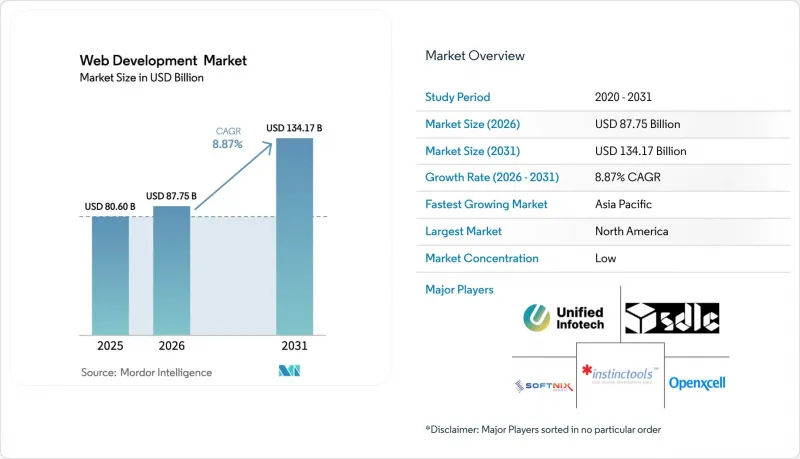
본 보고서는 유형별(웹사이트, 웹 앱 등), 기업 규모별(중소기업, 대기업), 최종 사용자 업종별(소매 및 전자상거래, IT 및 통신 등), 기술 스택별(헤드리스 CMS/컴포저블, API 퍼스트, 서버리스 등), 도입 모델별(클라우드 기반, 온프레미스, 하이브리드), 지역별로 분류되어 있습니다. 시장 예측은 금액(달러) 기준으로 제시되어 있습니다.
세계의 웹 개발 시장 동향 및 인사이트
전자상거래 및 옴니채널의 급속한 성장
2024년 성수기 서비스 중단으로 하루 만에 수백만 달러의 매출 손실이 발생한 것을 계기로, 소매업체들은 현재 사이트의 신뢰성을 단순한 유지보수상의 우려 사항이 아닌 성장의 원동력으로 인식하고 있습니다. 주요 소매업체들은 핵심 결제 흐름을 중단하지 않고 검색, 장바구니, 결제와 같은 개별 서비스를 교체할 수 있는 ‘컴포저블 커머스’를 도입하여 출시 주기를 몇 주에서 며칠로 단축하고 있습니다. 소매 업계의 사례 연구에 따르면, 적절하게 설계된 프로그레시브 웹 앱(PWA)은 모바일 전환율을 4배까지 끌어올릴 수 있는 것으로 나타나, 의사결정자들이 웹 개발을 직접적인 수익원으로 간주하는 이유를 뒷받침하고 있습니다. 주문, 로열티, 주문 처리 데이터가 단일 스택을 통해 흐르면서 플랫폼의 확장성은 경영진이 중시하는 지표가 되었으며, 이는 웹 개발 서비스 시장에 대한 수요를 더욱 높이고 있습니다.
기업의 디지털 전환 예산
디지털 네이티브 경쟁사와 동등한 고객 경험을 확보해야 한다는 경영진의 시급한 과제로 인해, 재량적 IT 지출이 억제되는 상황에서도 웹 관련 예산은 유지되고 있습니다. 전 세계 시스템 통합 업체들은 AI, 데이터 패브릭, 디자인 기능을 단일 계약에 통합한 다년 계약의 매니지드 서비스 프로젝트를 수주하며 예측 가능한 수익원을 확보하고 있습니다. 현재 포춘 500대 기업의 전형적인 고객은 기술 예산의 두 자릿수 비율을 웹 관련 사업에 할당하고 있으며, 클라우드 리팩토링 및 개인정보 보호 중심 아키텍처에 대한 전문 지식을 요구하고 있습니다. 이러한 우선순위가 웹 개발 서비스 시장에서 프리미엄 가격 책정력을 뒷받침하고 있습니다.
크로스 브라우저 및 디바이스의 파편화
브라우저 간에 CSS나 JavaScript의 동작에 일관성이 없어 품질 보증(QA) 주기가 장기화되고, 폴리필(대체 구현)을 사용할 수밖에 없습니다. 이로 인해 페이로드 크기가 비대해져 호스팅 비용이 상승하고 있습니다. Safari나 Internet Explorer에서는 레이아웃상의 문제가 나타나 조건부 스타일시트의 사용이 필요하지만, 자동 테스트 환경을 갖추지 못한 팀에게는 큰 부담이 됩니다. 모바일 분야에서는 수백 가지에 달하는 화면 크기와 칩셋의 다양성으로 인해 성능 조정이 복잡해지고 있으며, 이러한 파편화는 더욱 심각해지고 있습니다. 중소기업은 추가 작업 시간을 감당할 수 없어 그 영향을 크게 받고 있으며, 웹 개발 서비스 도입이 위축되고 있습니다.
부문 분석
기존 웹 애플리케이션을 포괄하는 부문은 러기드 서버사이드 렌더링 스택에 의존하는 확립된 엔터프라이즈 워크플로우 덕분에 2025년에도 매출의 57.35%를 유지했습니다. 이러한 우위는 기준 연도의 웹 개발 서비스 시장 규모 462억 달러에 반영되었습니다. 한편, 프로그레시브 웹 앱(PWA)은 연평균 성장률(CAGR) 13.45%로 확대되고 있어 그 격차를 빠르게 좁힐 것으로 예측됩니다. PWA는 별도의 네이티브 빌드가 필요 없도록 함으로써 총 소유 비용(TCO)을 절감하는 동시에, 푸시 알림 및 오프라인 캐시 기능을 제공하여 사용자 참여도를 높입니다. 소매 및 여행 업계의 초기 도입 기업들은 고객이 앱을 재설치하지 않고도 세션을 재개할 수 있게 됨에 따라 이탈률이 감소하고 있다고 보고하고 있습니다. 한편, 로우코드 사이트 빌더는 브로셔 형식의 페이지를 원하는 소규모 기업을 계속해서 끌어들이고 있지만, 엔터프라이즈 수준의 보안, 규정 준수 또는 여러 지역에 걸친 트래픽 요구 사항을 충족시키는 경우는 거의 없습니다.
PWA의 성공 사례는 경영진 사이에서 큰 반향을 일으키고 있습니다. 각 브랜드는 사이트를 서비스 워커 지원 아키텍처로 전환한 후 두 자릿수의 매출 증가를 보고하고 있습니다. 기술 벤더들은 현재 헤드리스 CMS 라이선스에 턴키 방식의 PWA 가속기를 번들로 제공하여 도입 기간을 수개월에서 수주로 단축하고 있습니다. 그 결과, 전문 서비스 파트너들은 예측 가능한 예산과 성과를 약속하는 ‘PWA in a box’형 서비스를 패키지로 구성하고 있으며, 이는 웹 개발 서비스 시장에 더욱 활기를 불어넣고 있습니다.
대기업들은 수백 개에 달하는 마이크로사이트와 현지화된 포털에 걸친 세계 확장을 외부에 위탁하고 있어, 2025년 매출의 62.40%를 차지하며 웹 개발 서비스 시장 점유율로 503억 달러에 달할 전망입니다. 또한, 다층적인 보안 평가, 컨텐츠 거버넌스, 멀티 클라우드의 내결함성도 필요로 하며, 이러한 요구 사항은 Tier 1 통합 업체가 가장 적절하게 충족시킵니다. 반면, 중소기업은 더 빠른 성장세를 보이고 있으며, 초기 투자를 3분의 1로 줄여주는 SaaS 툴킷과 종량제 클라우드에 힘입어 연평균 성장률(CAGR) 10.85%로 확대되고 있습니다. 중소기업은 서버 패치 적용이 필요 없고, 사용량에 따른 요금 체계의 혜택을 누릴 수 있는 서버리스 백엔드를 중시하고 있어, 제한된 자금을 마케팅 비용으로 전환할 수 있게 되었습니다.
저비용으로 실험할 수 있다는 점은 경쟁의 공정성을 높입니다. 직원 20명의 소매업체라도 API를 통해 사전 학습된 모델의 라이선스를 취득함으로써, 몇 주 만에 AI를 활용한 채팅 주문 기능을 출시하는 것도 가능합니다. 이 계층에 서비스를 제공하는 벤더들은 표준화된 템플릿 라이브러리와 매니지드 호스팅 번들을 갖추고 있어, 대기업 수준의 가동률을 대기업과 같은 오버헤드 없이 실현하고 있습니다. 이러한 동향으로 인해 웹 개발 서비스 시장에서 고객 규모에 관계없이 균형 잡힌 성장이 보장되고 있습니다.
지역별 분석
2025년, 북미는 전 세계 매출의 39.40%를 차지했습니다. 이는 전통 있는 기업들이 하이퍼스케일러로부터 제공받은 풍부한 클라우드 크레딧을 바탕으로 적극적인 현대화 프로그램을 추진했기 때문입니다. 고객들은 현지 규제의 명확성과 풍부한 인재 풀을 중시하고 있으며, 이를 통해 AI-as-a-Service(AaaS) 서비스를 활용한 신속한 실험이 가능해졌습니다. 미국에서만도 고객이 레거시 포털의 리플랫폼화를 클라우드 비용, 보안, DevSecOps를 대규모로 관리하는 단일 서비스 파트너에게 위탁하는 9자리 규모의 계약이 여러 건 체결되었습니다. 캐나다의 적극적인 이민 수용 정책은 고숙련 개발자를 현지 딜리버리 센터로 유입시킴으로써 이러한 추세를 보완하고, 웹 개발 서비스 시장공급을 강화하고 있습니다.
아시아태평양은 연평균 성장률(CAGR) 17.05%를 기록하며 지역별 가장 빠른 성장세를 보이고 있습니다. 인도는 랙 용량을 두 배로 늘리고 국내 트래픽 지연을 줄이기 위한 수십억 달러 규모의 데이터센터 투자를 바탕으로 성장의 견인차 역할을 하고 있습니다. 인도에서 구축된 디지털 공공 인프라(DPI) API의 부상으로 결제, 신원 확인, 문서 보관의 도입이 용이해지면서 스타트업 기업의 진입 장벽이 낮아지고 있습니다. 이러한 기업들은 규정 준수를 충족하는 프론트엔드 구축을 외부 대행사에 위탁하고 있습니다. 중국에서는 GDP에서 디지털 경제가 차지하는 비중을 높이기 위한 정부의 청사진이 AI 중심의 상거래 플랫폼에 대한 공공 인센티브를 활성화하여, 로우코드, 헤드리스, 엣지 렌더링 아키텍처에 정통한 벤더에 대한 지출을 유도하고 있습니다. AI 테스트베드 지원금 프로그램의 뒷받침을 받는 일본의 ‘사회 5.0’ 정책은 접근성 기준을 준수하는 기업용 포털에 대한 새로운 수요를 창출하며, 관련 수익원을 다각화하고 있습니다. 유럽에서는 GDPR(EU 개인정보보호규정) 개정과 포용적인 사용자 여정을 의무화하는 새로운 접근성 지침을 배경으로, 한 자릿수 중반대의 꾸준한 성장이 예상됩니다. 기업들은 지역 내 호스팅 데이터 스토어와 감사 추적을 중시하고 있어, 소버린 클라우드 호스팅과 WCAG 3.0을 준수하는 턴키 솔루션을 결합한 벤더에게 새로운 기회가 생기고 있습니다. 기타 지역 중 라틴아메리카는 브라질의 전자상거래 성장세에 힘입고 있는 반면, 걸프협력회의(GCC)의 일부 회원국에서는 웹 대시보드를 통해 시민 서비스를 통합하는 ‘스마트 시티’ 구축에 자금을 투자하고 있습니다. 이러한 각 지역의 동향이 어우러져 전 세계적으로 다각화된 웹 개발 서비스 시장을 뒷받침하고 있습니다.
기타 혜택 :
- 엑셀 형식 시장 예측(ME) 시트
- 3개월간의 애널리스트 지원
자주 묻는 질문
목차
제1장 서론
제2장 조사 방법
제3장 주요 요약
제4장 시장 구도
제5장 시장 규모 및 성장 예측
제6장 경쟁 구도
제7장 시장 기회 및 향후 전망
AJY 26.08.07According to Mordor Intelligence, the web development services market size was valued at USD 80.6 billion in 2025 and estimated to grow from USD 87.75 billion in 2026 to reach USD 134.17 billion by 2031, at a CAGR of 8.87% during the forecast period (2026-2031).
This report is Segmented by Type (Website, Web App and More), Enterprises (SMEs, Large Enterprises), End-User Vertical (Retail and E-Commerce, IT and Telecom and More), Technology Stack(Headless CMS / Composable, API-First and Serverless and More), Deployment Model (Cloud-Based, On-Premise and Hybrid) and Geography. The Market Forecasts are Provided in Terms of Value (USD).
Global Web Development Market Trends and Insights
E-commerce & Omnichannel Boom
Retailers now regard site reliability as a growth lever rather than a maintenance concern after peak-season outages erased millions in one-day revenue losses in 2024. Leading merchants are adopting composable commerce to swap individual services-search, cart, payments-without disrupting the core checkout flow, trimming release cycles from weeks to days. Retail case studies show that well-designed Progressive Web Apps can lift mobile conversion rates fourfold, reinforcing why decision makers view web development as a direct revenue driver. With ordering, loyalty, and fulfillment data flowing through a single stack, platform extensibility becomes a boardroom metric, further raising demand for the web development services market.
Enterprise Digital-Transformation Budgets
C-suite urgency around customer-experience parity with digital-native competitors keeps web budgets intact even when discretionary IT spending tightens. Global systems integrators are winning multi-year managed-services deals that embed AI, data fabric, and design capabilities in one contract, locking in predictable fee streams. The typical Fortune 500 client now allocates double-digit share of its tech budget to web-facing initiatives, seeking expertise in cloud refactoring and privacy-centric architecture. Those priorities sustain premium pricing power inside the web development services market.
Cross-Browser / Device Fragmentation
Inconsistent CSS and JavaScript behavior across browsers extends QA cycles and forces polyfills that bloat payload sizes, driving up hosting bills. Safari and Internet Explorer display layout quirks that require conditional stylesheets, burdensome for teams lacking automated test rigs. Fragmentation escalates on mobile where hundreds of screen sizes and chipset variants complicate performance tuning. SMEs feel the pinch because they cannot absorb added hours, tempering uptake for web development services.
Other drivers and restraints analyzed in the detailed report include:
- Mobile-First & PWA Adoption
- AI-Powered Chatbots & Personalization
- Global Talent Shortage & Rising Developer Costs
For complete list of drivers and restraints, kindly check the Table Of Contents.
Segment Analysis
The segment that groups classic web applications retained 57.35% revenue in 2025 thanks to entrenched enterprise workflows that rely on robust server-rendered stacks. That dominance translated into USD 46.2 billion of the web development services market size in the base year. Progressive Web Apps, however, expanded at 13.45% CAGR and are projected to narrow the gap rapidly. PWAs lower total cost of ownership by eliminating separate native builds while delivering push notifications and offline caching that heighten engagement. Early adopters within retail and travel note that bounce rates fall when customers can resume sessions without reinstalling apps. In parallel, low-code site builders keep attracting micro-enterprises seeking brochure-style pages, yet they rarely satisfy security, compliance, or multi-region traffic needs at the enterprise tier.
PWA success stories resonate across boardrooms: brands report double-digit revenue lifts after converting sites to service-worker-enabled architectures. Technology vendors are now bundling turnkey PWA accelerators with headless CMS licenses, compressing deployment from months to weeks. As a result, professional-services partners are packaging "PWA in a box" offerings that promise predictable budgets and outcomes, adding fuel to the web development services market.
Large corporations commanded 62.40% of 2025 billings, equal to USD 50.3 billion of web development services market share, because they outsource global rollouts that span hundreds of microsites and localized portals. They also require multilayer security assessments, content governance, and multi-cloud resilience-needs best met by tier-one integrators. Yet small and medium enterprises are the faster mover, expanding at 10.85% CAGR on the back of SaaS toolkits and pay-as-you-go cloud that cut initial outlays by a third. SMEs prize serverless back-ends for eliminating server patching and benefiting from usage-linked pricing, freeing scarce capital for marketing spend.
The ability to experiment cheaply levels the playing field: a 20-employee retailer can launch AI-assisted chat ordering capability in weeks by licensing pretrained models through an API. Vendors serving this cohort assemble standardized template libraries and managed-hosting bundles that deliver enterprise-grade uptime without enterprise overhead. These dynamics ensure balanced growth across client sizes within the web development services market.
Complete Report Scope:
- By Type
- Website
- Web Application
- Progressive Web App (PWA)
- Low-/No-Code Site Builder
- By Enterprise Size
- Small and Medium-sized Enterprises (SMEs)
- Large Enterprises
- By End-user Vertical
- Retail and E-commerce
- BFSI
- Healthcare and Life Sciences
- IT and Telecom
- Media and Entertainment
- Government and Public Sector
- Education
- Travel and Hospitality
- By Technology Stack
- Front-end Framework (React, Angular, Vue)
- Back-end Framework (Node, Django, .NET)
- Headless CMS / Composable
- API-first and Serverless
- By Deployment Model
- Cloud-based
- On-premise
- Hybrid
- By Geography
- North America
- United States
- Canada
- Mexico
- South America
- Brazil
- Argentina
- Rest of South America
- Europe
- Germany
- United Kingdom
- France
- Spain
- Italy
- Rest of Europe
- Asia-Pacific
- China
- India
- Japan
- South Korea
- Australia
- Rest of Asia-Pacific
- Middle East
- Israel
- Saudi Arabia
- United Arab Emirates
- Turkey
- Rest of Middle East
- Africa
- South Africa
- Egypt
- Nigeria
- Rest of Africa
- North America
Geography Analysis
North America safeguarded 39.40% of global billings in 2025 as entrenched enterprises pursued aggressive modernization programs underpinned by generous cloud credits from hyperscalers. Clients value local regulatory clarity and broad talent pools, allowing rapid experimentation with AI-as-a-Service offerings. The United States alone saw multiple nine-figure deals where customers outsourced legacy portal re-platforming to a single services partner who manages cloud costs, security, and DevSecOps at scale. Canada's immigration-friendly policies complement that dynamic by channeling high-skill developers into local delivery centers, reinforcing supply for the web development services market.
Asia-Pacific represents the fastest regional climb with a 17.05% CAGR. India anchors growth following multibillion-dollar data-center commitments that double rack capacity and reduce latency for domestic traffic. The rise of India-built Digital Public Infrastructure APIs makes onboarding payments, identity, and document storage straightforward, lowering entry barriers for startups who then contract external agencies to build compliant front-ends. In China, official blueprints to lift the digital-economy share of GDP unlock public incentives for AI-centric commerce platforms, channeling spend toward vendors versed in low-code, headless, and edge-rendered architectures. Japan's national Society 5.0 policy, backed by subsidy programs for AI testbeds, injects fresh demand for accessibility-compliant corporate portals, diversifying addressable revenue. Europe delivers steady mid-single-digit growth on the back of GDPR refinements and new accessibility directives that mandate inclusive user journeys. Enterprises put a premium on host-in-region data stores and audit trails, spawning opportunities for vendors that bundle sovereign-cloud hosting with turnkey WCAG-3.0 remediation. Elsewhere, Latin America benefits from Brazilian e-commerce momentum, while select Gulf Cooperation Council states fund "smart city" rollouts that integrate citizen services via web dashboards. Together these pockets sustain a globally diversified web development services market.
- Accenture
- Cognizant
- Tata Consultancy Services (TCS)
- IBM
- Infosys
- Capgemini
- Wipro
- EPAM Systems
- ThoughtWorks
- Globant
- Endava
- HCLTech
- SoftServe
- LTI-Mindtree
- Valtech
- Unified Infotech
- SDLC Corporation
- OpenXcell
- Plavno
- KitRUM
- PageTraffic
- 9thCO
- Instinctools GmbH
- Softnix Infotech
Additional Benefits:
- The market estimate (ME) sheet in Excel format
- 3 months of analyst support
TABLE OF CONTENTS
1 INTRODUCTION
- 1.1 Study Assumptions and Market Definition
- 1.2 Scope of the Study
2 RESEARCH METHODOLOGY
3 EXECUTIVE SUMMARY
4 MARKET LANDSCAPE
- 4.1 Market Overview
- 4.2 Market Drivers
- 4.2.1 E-commerce and omnichannel boom
- 4.2.2 Enterprise digital-transformation budgets
- 4.2.3 Mobile-first and PWA adoption
- 4.2.4 AI-powered chatbots and personalization
- 4.2.5 Headless CMS and composable architecture surge
- 4.2.6 Accessibility regulation (WCAG 3.0) deadlines
- 4.3 Market Restraints
- 4.3.1 Cross-browser/device fragmentation
- 4.3.2 Global talent shortage and rising developer costs
- 4.3.3 Data-privacy compliance overhead (GDPR, CPRA)
- 4.3.4 Sustainability pressure and web-carbon audits
- 4.4 Regulatory Landscape
- 4.5 Technological Outlook
- 4.6 Porter's Five Forces Analysis
- 4.6.1 Bargaining Power of Suppliers
- 4.6.2 Bargaining Power of Consumers
- 4.6.3 Threat of New Entrants
- 4.6.4 Threat of Substitutes
- 4.6.5 Intensity of Rivalry
- 4.7 Macroeconomic Impact Assessment
- 4.8 Investment Analysis
5 MARKET SIZE AND GROWTH FORECASTS (VALUE)
- 5.1 By Type
- 5.1.1 Website
- 5.1.2 Web Application
- 5.1.3 Progressive Web App (PWA)
- 5.1.4 Low-/No-Code Site Builder
- 5.2 By Enterprise Size
- 5.2.1 Small and Medium-sized Enterprises (SMEs)
- 5.2.2 Large Enterprises
- 5.3 By End-user Vertical
- 5.3.1 Retail and E-commerce
- 5.3.2 BFSI
- 5.3.3 Healthcare and Life Sciences
- 5.3.4 IT and Telecom
- 5.3.5 Media and Entertainment
- 5.3.6 Government and Public Sector
- 5.3.7 Education
- 5.3.8 Travel and Hospitality
- 5.4 By Technology Stack
- 5.4.1 Front-end Framework (React, Angular, Vue)
- 5.4.2 Back-end Framework (Node, Django, .NET)
- 5.4.3 Headless CMS / Composable
- 5.4.4 API-first and Serverless
- 5.5 By Deployment Model
- 5.5.1 Cloud-based
- 5.5.2 On-premise
- 5.5.3 Hybrid
- 5.6 By Geography
- 5.6.1 North America
- 5.6.1.1 United States
- 5.6.1.2 Canada
- 5.6.1.3 Mexico
- 5.6.2 South America
- 5.6.2.1 Brazil
- 5.6.2.2 Argentina
- 5.6.2.3 Rest of South America
- 5.6.3 Europe
- 5.6.3.1 Germany
- 5.6.3.2 United Kingdom
- 5.6.3.3 France
- 5.6.3.4 Spain
- 5.6.3.5 Italy
- 5.6.3.6 Rest of Europe
- 5.6.4 Asia-Pacific
- 5.6.4.1 China
- 5.6.4.2 India
- 5.6.4.3 Japan
- 5.6.4.4 South Korea
- 5.6.4.5 Australia
- 5.6.4.6 Rest of Asia-Pacific
- 5.6.5 Middle East
- 5.6.5.1 Israel
- 5.6.5.2 Saudi Arabia
- 5.6.5.3 United Arab Emirates
- 5.6.5.4 Turkey
- 5.6.5.5 Rest of Middle East
- 5.6.6 Africa
- 5.6.6.1 South Africa
- 5.6.6.2 Egypt
- 5.6.6.3 Nigeria
- 5.6.6.4 Rest of Africa
- 5.6.1 North America
6 COMPETITIVE LANDSCAPE
- 6.1 Market Concentration
- 6.2 Strategic Moves
- 6.3 Market Share Analysis
- 6.4 Company Profiles (includes Global level Overview, Market level overview, Core Segments, Financials as available, Strategic Information, Market Rank/Share for key companies, Products and Services, and Recent Developments)
- 6.4.1 Accenture
- 6.4.2 Cognizant
- 6.4.3 Tata Consultancy Services (TCS)
- 6.4.4 IBM
- 6.4.5 Infosys
- 6.4.6 Capgemini
- 6.4.7 Wipro
- 6.4.8 EPAM Systems
- 6.4.9 ThoughtWorks
- 6.4.10 Globant
- 6.4.11 Endava
- 6.4.12 HCLTech
- 6.4.13 SoftServe
- 6.4.14 LTI-Mindtree
- 6.4.15 Valtech
- 6.4.16 Unified Infotech
- 6.4.17 SDLC Corporation
- 6.4.18 OpenXcell
- 6.4.19 Plavno
- 6.4.20 KitRUM
- 6.4.21 PageTraffic
- 6.4.22 9thCO
- 6.4.23 Instinctools GmbH
- 6.4.24 Softnix Infotech
7 MARKET OPPORTUNITIES AND FUTURE OUTLOOK
- 7.1 White-space and Unmet-Need Assessment


