
|
시장보고서
상품코드
2125646
하드웨어 방화벽 시장 : 시장 점유율 분석, 업계 동향 및 통계, 성장 예측(2026-2031년)Hardware Firewall - Market Share Analysis, Industry Trends & Statistics, Growth Forecasts (2026 - 2031) |
||||||
 Mordor Intelligence
하드웨어 방화벽 시장 규모는 2026년 252억 8,000만 달러로 추정되고, 2031년까지 416억 2,000만 달러로 확대될 전망이며, 2026-2031년 CAGR 10.49%를 나타낼 것으로 예측됩니다.
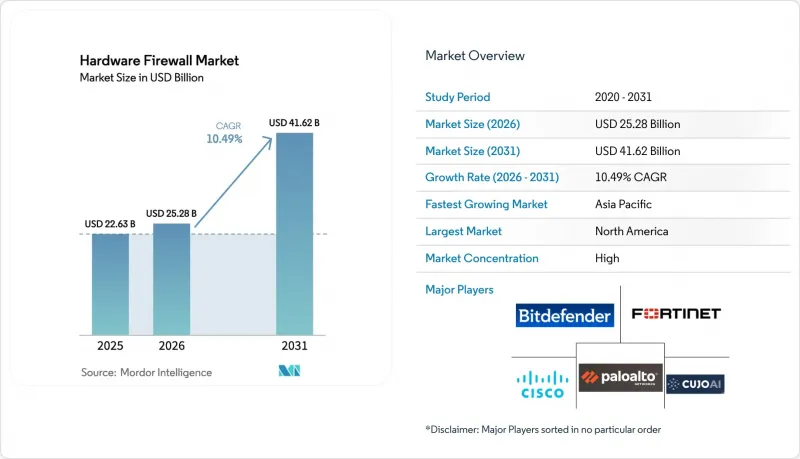
본 보고서는 구성 요소별(디바이스/시스템 및 서비스), 조직 규모별(중소기업 및 대기업), 최종 사용자 산업별(은행, 금융서비스 및 보험(BFSI), 의료, 제조, 정부·국방, IT 및 통신, 소매 및 전자상거래, 기타), 방화벽 유형별(패킷 필터링, 회선 수준 게이트웨이, 애플리케이션 수준/프록시, 기타), 지역별로 분류되어 있습니다. 시장 예측은 금액(달러) 기준으로 제시되어 있습니다.
세계의 하드웨어 방화벽 시장 동향 및 인사이트
다중 벡터형 사이버 공격의 고도화로 인해 ASIC을 통한 고속 검사가 필수적
랜섬웨어, 분산 서비스 거부(DDoS), 공급망 침해를 결합한 다중 벡터형 침입은 2025년 상반기에 보고된 기업 침해 사례의 68%를 차지할 정도로 증가했습니다. x86 프로세서에서 작동하는 시그니처 기반 엔진은 네트워크, 용도, 엔드포인트의 각 스트림에 걸친 지표를 라인 속도로 상관 분석할 수 없기 때문에 공격자는 감지를 회피하기 위해 프로토콜 간에 페이로드를 분할하는 경우가 많습니다. 전용 검사용 실리콘은 패턴 매칭 및 행동 분석 처리를 오프로드하여, 합의된 서비스 수준을 저해하지 않으면서 초당 4,000만 패킷의 검사를 가능하게 합니다. 2025년 1월 NIST 지침에서는 연방 정부의 제로 트러스트 도입을 위한 하드웨어 기반 보증이 공식적으로 규정되었으며, 공공 부문 조달에 대한 ASIC 요건이 명시되었습니다. 그 결과, 자체적으로 칩을 설계하는 벤더는 상용 실리콘에 의존하는 경쟁사보다 18개월 앞서 나가고 있습니다.
연방 정부 및 중요 인프라 네트워크에 대한 정부의 제로 트러스트 의무화
대통령령 제14028호 및 행정관리예산국(OMB)의 M-22-09 각서에 따라, 미국의 민간 기관은 2027 회계연도까지 제로 트러스트 성숙도를 달성해야 합니다. 이 지침은 위치 기반 신뢰를 금지하고 세션별 암호학적 검증을 의무화하고 있지만, 이러한 기능은 높은 처리량 환경에서는 소프트웨어 방화벽으로는 구현하기 어렵습니다. 파이프라인 사업자, 철도 사업자 및 유럽의 중요 인프라 사업자는 TSA 및 NIS2 규정에 따라 유사한 기한에 직면해 있습니다. 2026 회계연도 미국 연방 사이버 보안 예산의 63%는 2027년 2분기까지 지출되어야 하기 때문에 각 기관은 하드웨어 조달을 앞당기고 있으며, 이미 FedRAMP High 인증을 획득한 공급업체를 우선적으로 선정하고 있습니다.
‘서비스형 방화벽(FaaS)’으로의 급속한 전환이 온프레미스형 하드웨어 수요를 잠식하고 있습니다.
2025년에는 클라우드 기반 검사 서비스가 기업의 신규 보안 지출의 22%를 차지하여 전년 대비 8포인트 증가했습니다. 사용자 수가 50명 미만인 소규모 사무실에서는 사용자 1인당 월 약 8달러의 요금 체계가 2,000달러짜리 어플라이언스를 3년간 소유하는 주기보다 훨씬 저렴하다는 인식이 확산되고 있습니다. Palo Alto Networks의 보고서에 따르면, 2025 회계연도 신규 고객의 41%가 클라우드 기반 검사를 선택하고 있으며, 5,000달러 미만 가격대의 하드웨어 출하량은 현재 연간 약 8%의 속도로 감소하고 있습니다. 다만, 이러한 시장 잠식은 비대칭적입니다. 데이터센터의 코어나 지연 시간에 민감한 OT(운영 기술) 사이트에서는 여전히 온프레미스형 어플라이언스가 필수적입니다. 따라서 다년간의 하드웨어 리스와 클라우드 관리를 결합한 번들 계약이 기존 벤더를 위한 리스크 헤지 전략으로 부상하고 있습니다.
부문 분석
디바이스 및 시스템 부문의 하드웨어 방화벽 시장 규모는 2025년에 161억 3,000만 달러에 달하여 총 매출의 71.29%를 차지했습니다. 절대액으로는 우위를 유지하고 있지만, 갱신 예산이 설치, 정책 조정, 연중무휴 24시간 모니터링을 포괄하는 서비스로 이동함에 따라 하드웨어의 성장세는 둔화되고 있습니다. 중소기업의 경우, 사내 사이버 보안 팀이 부족한 탓에 전문 서비스 부가율이 70%를 넘었으며, 2025년에는 어플라이언스 1대당 평균 14건의 중대한 펌웨어 패치가 적용되었습니다. 대기업의 구매 담당자들은 복잡한 멀티 클라우드 도입을 턴키 프로젝트로 다루는 경향이 강해지고 있으며, 하드웨어 임대와 세트로 구성된 3년간의 매니지드 서비스 계약을 체결하고 있습니다.
대조적으로, 서비스 부문의 연평균 성장률(CAGR) 11.40%는 규정 준수의 복잡성이 증가하고 있으며, 전 세계적으로 340만 명에 달하는 사이버 보안 인력 부족을 반영하고 있습니다. HIPAA의 암호화 요건을 충족하기 위해 방화벽을 도입하는 의료 네트워크의 경우, 도입하는 어플라이언스 1대당 8만 달러의 비용에 비해 전문 서비스에 12만 달러를 지출하는 경우가 많으며, 이는 컨설팅, 통합, 사고 대응 비용이 물리적 장비 비용을 초과할 가능성이 있음을 보여줍니다. 예측 기간 동안 북미 및 서유럽에서는 정기 서비스 수익이 기기 수익과 동등한 수준에 도달할 것으로 예상되며, 이는 여전히 섀시 출하량에 매출 총이익률을 의존하고 있는 공급업체들에게 전략적 전환점이 될 것입니다.
2025년 출하 대수 기준으로 차세대 플랫폼은 하드웨어 방화벽 시장 점유율의 58.85%를 차지했으나, AI 가속형 및 테라비트급 모델은 연평균 성장률(CAGR) 11.98%로 성장할 전망입니다. AI 최적화 모델의 하드웨어 방화벽 시장 규모는 2026년 약 35억 달러에서 2031년까지 61억 달러 이상으로 확대될 것으로 예측됩니다. 통신 사업자와 하이퍼스케일 기업은 이미 암호화 트래픽이 페이로드의 95%를 초과하고 있으며, CPU 의존형 엔진에서는 처리량이 현저히 저하되고 있기 때문에 조기 도입자로 나서고 있습니다. 2025년 3월에 출시된 포티넷의 ‘FortiGate 4800F’는 지연 시간을 2마이크로초 미만으로 억제하면서도 초당 1.2테라비트의 검사 완료된 트래픽을 처리함으로써 이러한 비약적인 진화를 여실히 보여주었습니다.
저비용 AI 코프로세서로 인해 가격 차이가 줄어들고 있으며, 테라비트급 어플라이언스와 기존 NGFW 어플라이언스 간의 가격 차이는 매년 약 18%씩 줄어들고 있습니다. 상태 비저장형 패킷 필터링 장치는 저예산 OT 게이트웨이나 소규모 사무실에서만 살아남고 있는 반면, 통합 위협 관리(UTM) 장치는 고객이 엔드포인트, 이메일, 웹 필터를 네트워크 검사에서 분리함에 따라 시장 점유율을 잃어가고 있습니다. 용도 레벨 프록시나 서킷 게이트웨이는 규제 기준이 순수한 처리량보다 우선시되는 트레이딩 플로어나 에어 갭이 적용된 방어 엔클레이브와 같이, 틈새 시장이자 높은 신뢰성이 요구되는 환경에서 여전히 사용되고 있습니다.
지역별 분석
2025년, 북미는 전 세계 매출의 38.39%를 차지한 것으로 평가되었으며, 그 배경에는 대통령령 14028에 기반한 조달 및 파이프라인 보안에 관한 지침이 있었습니다. 미국만으로도 이 지역 수요의 4분의 3 가까이를 차지하고 있으며, 암호 모듈의 리드 타임을 단축하는 실리콘 제조의 국내 복귀의 혜택을 받고 있습니다. 캐나다의 통신 사업자들도 마찬가지로 ‘중요 사이버 시스템 보호법’에 따라 엣지 사이트의 업데이트를 진행하고 있으며, 한편 과달라하라와 몬테레이에 위치한 멕시코의 조립 거점은 라틴아메리카에 관세 없는 장비를 공급하고 있습니다.
유럽은 전 세계 매출의 26%를 차지했으며, NIS2 지침이 규정 준수를 주도하는 업데이트 주기를 촉진하고 있습니다. 독일은 유럽 전체 지출의 31%를 차지하며, 산업용 OT 백본에서 하드웨어를 통한 세분화를 권장하는 ‘IT-Grundschutz’ 지침에 따라 유럽을 선도했습니다. 2025년에 발표된 영국 국가사이버보안센터(NCSC)의 지침은 1만 건 이상의 고객 기록을 취급하는 조직에 하드웨어 방화벽 도입을 구체적으로 권장하고 있으며, 이로 인해 대상 시장은 영국 기업의 약 87%까지 확대되었습니다.
아시아태평양은 가장 빠르게 성장하는 시장이며, 2031년까지 연평균 성장률(CAGR)은 11.91%로 예측됩니다. 중국의 ‘이중 순환’ 계획에서는 국산 방화벽용 반도체에 자금이 지원되고 있는 반면, 인도의 42억 달러 규모 ‘디지털 인디아’ 프로그램을 통해 60만 개의 마을에 안전한 광대역 인프라가 구축되고 있습니다. 일본과 한국은 고밀도 5G 코어를 지원하는 테라비트급 플랫폼에 있어 여전히 고부가가치 시장으로 남아 있습니다. 중동에서는 사우디아라비아의 스마트 시티 ‘NEOM’ 건설을 필두로, 2025년에 사이버 보안에 37억 달러를 배정하고 있습니다. 한편, 아프리카는 전 세계 매출의 3%에 그치고 있지만, 남아프리카공화국의 ‘중요 인프라 보호법’과 관련된 국지적인 성장이 나타나고 있습니다.
기타 혜택 :
- 엑셀 형식 시장 예측(ME) 시트
- 3개월간의 애널리스트 지원
자주 묻는 질문
목차
제1장 서론
제2장 조사 방법
제3장 주요 요약
제4장 시장 구도
제5장 시장 규모 및 성장 예측
제6장 경쟁 구도
제7장 시장 기회 및 향후 전망
AJY 26.09.15According to Mordor Intelligence, the hardware firewall market size is projected to expand from USD 25.28 billion in 2026 to reach USD 41.62 billion by 2031, registering a 10.49% CAGR over 2026-2031.
This report is Segmented by Component (Device/System, and Services), Organization Size (SMEs, and Large Enterprises), End-User Industry (BFSI, Healthcare, Manufacturing, Government and Defense, IT and Telecom, Retail and E-Commerce, and More), Firewall Type (Packet-Filtering, Circuit-Level Gateways, Application-Level/Proxy, and More), and Geography. Market Forecasts are Provided in Terms of Value (USD).
Global Hardware Firewall Market Trends and Insights
Increasing Sophistication of Multi-Vector Cyber-Attacks Necessitating ASIC-Accelerated Inspection
Multi-vector incursions blending ransomware, distributed-denial-of-service, and supply-chain compromise climbed to 68% of reported enterprise breaches in the first half of 2025. Signature-based engines running on x86 processors are unable to correlate indicators across network, application, and endpoint streams at line rate, so attackers often fragment payloads across protocols to evade detection. Dedicated inspection silicon now offloads pattern matching and behavioral analytics, enabling 40 million packet inspections per second without breaching agreed service levels. A January 2025 NIST guideline formalized hardware-rooted attestation for federal zero-trust deployments, codifying ASIC requirements for public-sector procurements. Vendors with in-house chip design therefore enjoy an 18-month lead over peers that depend on merchant silicon.
Government Zero-Trust Mandates for Federal and Critical-Infrastructure Networks
Executive Order 14028, together with the Office of Management and Budget's M-22-09 memo, obliges U.S. civilian agencies to attain zero-trust maturity by fiscal 2027. The directive bans location-based trust and compels per-session cryptographic validation, a capability that software firewalls struggle to deliver under high throughput. Pipeline operators, railway carriers, and European critical-infrastructure entities face similar timelines under TSA and NIS2 rules. Because 63% of fiscal-2026 U.S. federal cybersecurity budgets must be spent by second-quarter 2027, agencies are front-loading hardware procurements and favoring vendors already cleared under FedRAMP High.
Rapid Shift to Firewall-as-a-Service Cannibalizing On-Prem Hardware Demand
Cloud-delivered inspection captured 22% of new enterprise security spend in 2025, up eight points year over year. Small offices with fewer than 50 users find per-seat pricing near USD 8 per month materially cheaper than a three-year ownership cycle for a USD 2,000 appliance. Palo Alto Networks reported that 41% of its new customers in fiscal-2025 chose cloud inspection, and hardware unit shipments in the sub-USD 5,000 tier are now falling at roughly 8% annually. The cannibalization is asymmetric, though: data-center cores and latency-sensitive OT sites still mandate on-prem appliances. Bundled cloud management with multi-year hardware leases has therefore emerged as a hedge strategy for incumbent vendors.
Other drivers and restraints analyzed in the detailed report include:
- Edge Computing and 5G Densification Requiring Distributed Micro-Firewall Nodes
- Reshoring Incentives and Tariffs Spurring Domestic Appliance Production
- Supply-Chain Volatility for Network-Processing Chips
For complete list of drivers and restraints, kindly check the Table Of Contents.
Segment Analysis
The hardware firewall market size for the device and system segment reached USD 16.13 billion in 2025, equating to 71.29% of total revenue. Despite dominance in absolute dollars, hardware growth is moderating as refresh budgets shift toward services that wrap installation, policy tuning, and 24/7 monitoring. Professional-service attach rates topped 70% among small and medium-sized enterprises, where internal cyber teams are scarce and firmware patches averaged 14 critical updates per appliance in 2025. Enterprise buyers increasingly treat complex multi-cloud rollouts as turnkey projects, awarding three-year managed-service agreements bundled with hardware rentals.
By contrast, the service segment's 11.40% CAGR reflects rising compliance complexity and a 3.4-million-person global cybersecurity talent shortfall. Health-care networks installing firewalls to meet HIPAA encryption mandates frequently spend USD 120,000 on professional services for every USD 80,000 box deployed, illustrating how advisory, integration, and incident-response fees can eclipse physical gear. Over the forecast horizon, recurring service revenue is positioned to equalize with device revenue in North America and Western Europe, creating a strategic pivot point for suppliers whose gross margins still depend on chassis shipments.
Next-generation platforms held a 58.85% hardware firewall market share in shipments during 2025, yet AI-accelerated and terabit-class models are on track for an 11.98% CAGR. The hardware firewall market size for AI-optimized variants is projected to climb from roughly USD 3.5 billion in 2026 to more than USD 6.1 billion by 2031. Telecom carriers and hyperscale's are first adopters because encrypted traffic already exceeds 95% of their payloads, crippling throughput on CPU-bound engines. Fortinet's FortiGate 4800F, launched in March 2025, illustrated the step-change by moving 1.2 terabits per second of inspected traffic while keeping latency under two microseconds.
Lower-cost AI coprocessors are compressing price premiums, trimming the delta between terabit-class and traditional NGFW appliances by about 18% each year. Stateless packet-filtering boxes survive only in low-budget OT gateways and small offices, while unified-threat-management (UTM) devices are losing share as customers decouple endpoint, email, and web filters from network inspection. Application-level proxies and circuit gateways persist in niche, high-assurance environments such as trading floors and air-gapped defense enclaves where regulatory norms trump raw throughput.
Complete Report Scope:
- By Component
- Device / System
- Services (Installation, Support, Managed)
- By Organization Size
- Small and Medium-Sized Enterprises (SMEs)
- Large Enterprises
- By End-User Industry
- BFSI
- Healthcare
- Manufacturing
- Government and Defense
- IT and Telecom
- Retail and E-Commerce
- Education
- By Firewall Type
- Packet-Filtering Firewalls
- Circuit-Level Gateways
- Application-Level / Proxy Firewalls
- Unified Threat Management (UTM)
- Next-Generation Firewalls (NGFW)
- AI-Accelerated / Terabit-Class Firewalls
- By Geography
- North America
- United States
- Canada
- Mexico
- South America
- Brazil
- Argentina
- Rest of South America
- Europe
- United Kingdom
- Germany
- France
- Italy
- Spain
- Netherlands
- Rest of Europe
- Asia-Pacific
- China
- Japan
- South Korea
- India
- ASEAN
- Rest of Asia-Pacific
- Middle East
- Saudi Arabia
- United Arab Emirates
- Turkey
- Rest of Middle East
- Africa
- South Africa
- Nigeria
- Kenya
- Rest of Africa
- North America
Geography Analysis
North America contributed 38.39% of global revenue in 2025, underpinned by Executive Order 14028 procurements and pipeline-security directives. The United States alone represented nearly three-quarters of regional demand and benefits from reshored silicon fabrication that shortens lead times for cryptographic modules. Canadian carriers are likewise refreshing edge sites under the Critical Cyber Systems Protection Act, while Mexican assembly hubs in Guadalajara and Monterrey supply tariff-free units to Latin America.
Europe accounted for 26% of worldwide sales, with the NIS2 Directive catalysing a compliance-driven refresh cycle. Germany led European spend at 31% of the regional total, leaning on IT-Grundschutz guidelines that favour hardware segmentation for industrial OT backbones. The United Kingdom's National Cyber Security Centre guidance issued in 2025 specifically recommends hardware firewalls for entities handling more than 10,000 customer records, widening the addressable market to roughly 87% of U.K. businesses.
Asia-Pacific is the fastest-growing theater, projected at an 11.91% CAGR through 2031. China's dual-circulation plan funds indigenous firewall silicon, while India's USD 4.2 billion Digital India program extends secure broadband to 600,000 villages. Japan and South Korea remain high-value markets for terabit-class platforms serving dense 5G cores. The Middle East earmarked USD 3.7 billion for cybersecurity in 2025, headlined by Saudi Arabia's NEOM smart-city buildout, whereas Africa lags at 3% of global revenue but shows pockets of growth tied to South Africa's Critical Infrastructure Protection Act.
- Fortinet Inc.
- Palo Alto Networks Inc.
- Cisco Systems Inc.
- Check Point Software Technologies Ltd.
- Juniper Networks Inc.
- Huawei Technologies Co. Ltd.
- Barracuda Networks Inc.
- SonicWall Inc.
- WatchGuard Technologies Inc.
- Sophos Ltd.
- F5 Inc.
- Forcepoint LLC
- Hillstone Networks Co. Ltd.
- TopSec Technology Group Inc.
- AhnLab Inc.
- Ubiquiti Inc.
- Netgate (Electric Sheep Fencing LLC)
- CUJO LLC
- Bitdefender SRL
- Zscaler Inc.
- Array Networks Inc.
- Sangfor Technologies Inc.
- Stormshield (Airbus CyberSecurity)
Additional Benefits:
- The market estimate (ME) sheet in Excel format
- 3 months of analyst support
TABLE OF CONTENTS
1 INTRODUCTION
- 1.1 Study Assumptions and Market Definition
- 1.2 Scope of the Study
2 RESEARCH METHODOLOGY
3 EXECUTIVE SUMMARY
4 MARKET LANDSCAPE
- 4.1 Market Overview
- 4.2 Market Drivers
- 4.2.1 Increasing Sophistication of Multi-Vector Cyber-Attacks Necessitating ASIC-Accelerated Inspection
- 4.2.2 Government Zero-Trust Mandates for Federal and Critical-Infrastructure Networks
- 4.2.3 Edge-Computing and 5G Densification Requiring Distributed Micro-Firewall Nodes
- 4.2.4 Reshoring Incentives and Tariffs Spurring Domestic Appliance Production
- 4.2.5 SD-WAN Replacement of MPLS Driving Hardware NGFW Refresh Cycles
- 4.2.6 Falling AI-Coprocessor Costs Enabling Mid-Market Terabit-Class Appliances
- 4.3 Market Restraints
- 4.3.1 Rapid Shift to Firewall-as-a-Service Cannibalising On-Prem Hardware Demand
- 4.3.2 Supply-Chain Volatility for Network-Processing Chips
- 4.3.3 Privacy-Driven Limits on Encrypted-Traffic Inspection
- 4.3.4 Rising Energy Costs of High-Throughput Appliances
- 4.4 Industry Value-Chain Analysis
- 4.5 Regulatory Landscape
- 4.6 Technological Outlook
- 4.7 Impact of Macroeconomic Factors on the Market
- 4.8 Porter's Five Forces Analysis
- 4.8.1 Bargaining Power of Suppliers
- 4.8.2 Bargaining Power of Buyers
- 4.8.3 Threat of New Entrants
- 4.8.4 Threat of Substitute Products
- 4.8.5 Intensity of Competitive Rivalry
5 MARKET SIZE AND GROWTH FORECASTS (VALUE)
- 5.1 By Component
- 5.1.1 Device / System
- 5.1.2 Services (Installation, Support, Managed)
- 5.2 By Organization Size
- 5.2.1 Small and Medium-Sized Enterprises (SMEs)
- 5.2.2 Large Enterprises
- 5.3 By End-User Industry
- 5.3.1 BFSI
- 5.3.2 Healthcare
- 5.3.3 Manufacturing
- 5.3.4 Government and Defense
- 5.3.5 IT and Telecom
- 5.3.6 Retail and E-Commerce
- 5.3.7 Education
- 5.4 By Firewall Type
- 5.4.1 Packet-Filtering Firewalls
- 5.4.2 Circuit-Level Gateways
- 5.4.3 Application-Level / Proxy Firewalls
- 5.4.4 Unified Threat Management (UTM)
- 5.4.5 Next-Generation Firewalls (NGFW)
- 5.4.6 AI-Accelerated / Terabit-Class Firewalls
- 5.5 By Geography
- 5.5.1 North America
- 5.5.1.1 United States
- 5.5.1.2 Canada
- 5.5.1.3 Mexico
- 5.5.2 South America
- 5.5.2.1 Brazil
- 5.5.2.2 Argentina
- 5.5.2.3 Rest of South America
- 5.5.3 Europe
- 5.5.3.1 United Kingdom
- 5.5.3.2 Germany
- 5.5.3.3 France
- 5.5.3.4 Italy
- 5.5.3.5 Spain
- 5.5.3.6 Netherlands
- 5.5.3.7 Rest of Europe
- 5.5.4 Asia-Pacific
- 5.5.4.1 China
- 5.5.4.2 Japan
- 5.5.4.3 South Korea
- 5.5.4.4 India
- 5.5.4.5 ASEAN
- 5.5.4.6 Rest of Asia-Pacific
- 5.5.5 Middle East
- 5.5.5.1 Saudi Arabia
- 5.5.5.2 United Arab Emirates
- 5.5.5.3 Turkey
- 5.5.5.4 Rest of Middle East
- 5.5.6 Africa
- 5.5.6.1 South Africa
- 5.5.6.2 Nigeria
- 5.5.6.3 Kenya
- 5.5.6.4 Rest of Africa
- 5.5.1 North America
6 COMPETITIVE LANDSCAPE
- 6.1 Market Concentration
- 6.2 Strategic Moves
- 6.3 Market Share Analysis
- 6.4 Company Profiles (includes Global Level Overview, Market Level Overview, Core Segments, Financials as available, Strategic Information, Market Rank/Share, Products and Services, Recent Developments)
- 6.4.1 Fortinet Inc.
- 6.4.2 Palo Alto Networks Inc.
- 6.4.3 Cisco Systems Inc.
- 6.4.4 Check Point Software Technologies Ltd.
- 6.4.5 Juniper Networks Inc.
- 6.4.6 Huawei Technologies Co. Ltd.
- 6.4.7 Barracuda Networks Inc.
- 6.4.8 SonicWall Inc.
- 6.4.9 WatchGuard Technologies Inc.
- 6.4.10 Sophos Ltd.
- 6.4.11 F5 Inc.
- 6.4.12 Forcepoint LLC
- 6.4.13 Hillstone Networks Co. Ltd.
- 6.4.14 TopSec Technology Group Inc.
- 6.4.15 AhnLab Inc.
- 6.4.16 Ubiquiti Inc.
- 6.4.17 Netgate (Electric Sheep Fencing LLC)
- 6.4.18 CUJO LLC
- 6.4.19 Bitdefender SRL
- 6.4.20 Zscaler Inc.
- 6.4.21 Array Networks Inc.
- 6.4.22 Sangfor Technologies Inc.
- 6.4.23 Stormshield (Airbus CyberSecurity)
7 MARKET OPPORTUNITIES AND FUTURE OUTLOOK
- 7.1 White-Space and Unmet-Need Assessment