

|
시장보고서
상품코드
2100251
미국의 악성 흑색종 진단 및 치료제 시장 : 시장 점유율 분석, 업계 동향 및 통계, 성장 예측(2026-2031년)United States Melanoma Diagnostics and Therapeutics - Market Share Analysis, Industry Trends & Statistics, Growth Forecasts (2026 - 2031) |
||||||
 Mordor Intelligence
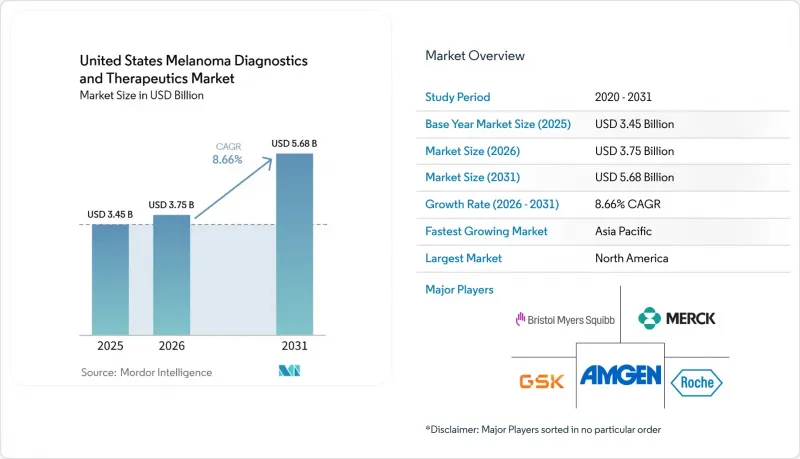
Mordor Intelligence에 의하면, 미국의 악성 흑색종 진단 및 치료제 시장 규모는 2025년에 34억 5,000만 달러로 평가되었고, 2026년 37억 5,000만 달러에서 2031년까지 56억 8,000만 달러에 이를 것으로 예측되며, 예측 기간(2026-2031년) CAGR은 8.66%를 나타낼 전망입니다.
본 보고서는 제품 유형별(진단(피부경 검사 장치 등), 치료(화학요법 등)), 질병 병기별(한계성, 국소성, 원격 전이), 환자 연령대별(18-44세, 45-64세, 65세 이상), 최종 사용자별(병원 및 클리닉, 암 전문 의료 센터, 기타)로 분류되어 있습니다. 시장 전망은 금액(달러) 기준으로 제시되어 있습니다.
미국의 악성 흑색종 진단 및 치료제 시장 동향과 인사이트
면역요법 및 표적요법의 도입
미국의 악성 흑색종 진단 및 치료제 시장은 진행기 및 보조요법 분야에서 체크포인트 억제제와 표적요법의 병용이 더욱 보편화됨에 따라 형성되고 있습니다. 2024년 12월 FDA가 니볼루맙과 히알루로니다제-nvhy를 승인함에 따라, 정맥 주사에 대한 의존도를 낮추고 외래 투여를 더욱 촉진하는 피하 투여 옵션이 추가되었습니다. BRAF 및 MEK 억제제의 병용 요법은 돌연변이 양성 환자에게 여전히 중요하며, 보다 광범위한 PD-1 기반 치료 경로와 병행하여 표적 치료제로서의 활용이 지속되고 있습니다. 생존 기간이 연장됨에 따라 만성 치료를 받는 환자군이 더 장기간에 걸쳐 치료를 지속하게 되며, 이에 따라 처방전 갱신, 모니터링, 전문 의료 센터에서의 진료 활동이 증가하고 있습니다.
분자진단 및 AI를 활용한 진단 워크플로우의 확대
미국의 악성 흑색종 진단 및 치료제 시장은 진단 워크플로우의 정확도 향상과 확장성 증대에 따라 지속적으로 발전하고 있습니다. 2025년 『Nature Communications』에 게재된 연구에 따르면, 설명 가능한 AI(Explainable AI)를 도입함으로써 피부과 의사의 진단 정확도가 표준 AI를 사용했을 때의 79.9%에서 82.7%로 향상되었으며, 경험 수준에 관계없이 성능 향상이 확인되었습니다. 2025년 『Nature Medicine』지에 게재된 연구에 따르면, PanDerm 모델이 조기 흑색종 감지에서 12명의 임상의보다 10.2% 더 높은 정확도를 보였으며, 초기 영상 검사에서 흑색종의 77.5%를 식별한 반면, AI의 지원을 받지 않은 임상의의 경우 32.6%에 그쳤다고 보고되었습니다. 분자 모니터링 분야에서도 개선이 진행되고 있습니다. 이는 종양 정보를 반영한 ctDNA 접근법이 면역관문억제제에 대한 반응 예측이나 진행기 질환에서의 재발 조기 발견에 있어 신뢰할 수 있는 가치를 입증하고 있기 때문입니다. 이러한 워크플로우의 개선을 통해 치료 방침이 결정되기 전에, 임상적으로 판단이 내려지지 않은 병변의 상당수가 정식 진단 심사로 넘어가게 되어, 생검을 통한 확정 진단 및 병기 분류 건수가 증가하고 있습니다.
고도 치료 과정의 높은 총비용
미국의 악성 흑색종 진단 및 치료제 시장은 여전히 고도 종양 의료 비용이라는 명확한 성장 한계에 직면해 있습니다. 2024년 JMCP 연구에 따르면, 미국 내 흑색종 치료의 총 직접 비용은 연간 135억 5,000만 달러에 달했으며, 이는 새로운 치료법이 더 널리 보급되기 전부터 이미 지출 규모가 얼마나 큰지를 보여줍니다. 동 조사에 따르면, 처방약은 환자 1인당 비용의 18.27%를 차지했으며, 바이오의약품 및 세포 치료가 치료 채널에 더욱 통합됨에 따라 그 비율은 상승할 전망입니다. 미국 내 항암 치료비 총액은 2023년 990억 달러였으며, 2028년까지 1,800억 달러에 달할 것으로 예측됩니다. 이에 따라 암 치료 보험 적용 목록 전반에 걸쳐 지불 주체에 대한 부담은 계속해서 커질 것으로 보입니다. 메디케어 파트 D의 본인 부담 상한액 2,000달러는 2025년 이후 환자의 경제적 부담을 줄이는 데 도움이 되겠지만, 고비용의 바이오의약품 및 세포 치료가 더욱 보급되는 상황에서 병원이나 지불 기관이 직면한 예산상의 압박을 해소해 주지는 못할 것입니다.
부문 분석
2025년 미국의 악성 흑색종 진단 및 치료제 시장 규모 중 치료 부문이 75.31%를 차지했으며, 매출액 측면에서는 이 카테고리가 진단 부문을 크게 상회했습니다. 이러한 차이는 진단 절차나 진단 기기에 비해 체크포인트 억제제 및 BRAF·MEK 병용 요법의 가격이 높다는 점을 반영합니다. PD-1을 표적으로 하는 치료법이 여러 흑색종 치료 상황에서 표준 치료법으로 계속 자리 잡고 있기 때문에 면역 요법은 여전히 치료 부문에서 가장 큰 기여 요인으로 남아 있습니다. 또한, 진행성 피부 흑색종 사례의 상당수에서 BRAF V600 변이가 확인되므로 표적 치료도 중요한 역할을 수행하고 있으며, 변이에 따른 치료 채널에 대한 수요가 유지되고 있습니다. 치료 대상 환자층의 확대와 진행성 질환에 대한 새로운 선택지로 세포 치료가 추가됨에 따라, 미국 악성 흑색종 진단 및 치료제 산업의 치료 부문은 2031년까지 연평균 성장률(CAGR) 9.38%로 확대될 것으로 예측됩니다.
나머지 수익 기반을 차지하는 진단 부문은 AI를 활용한 병변 평가의 보급과 분자 수준에서의 추적 관찰 빈도 증가에 힘입어 성장을 이어가고 있습니다. 피부경검은 일상적인 피부과 업무 흐름에 적합하며, 생검을 통한 확정 진단 전 병변의 조기 선별을 지원하기 때문에 여전히 주요 초기 진단 도구로서의 위상을 유지하고 있습니다. AI를 활용한 시스템은 현재 더욱 견고한 임상적 근거를 확보하고 있으며, PanDerm 및 설명 가능한 AI에 관한 연구에서는 조기 흑색종 검출에 있어 측정 가능한 개선과 균형 잡힌 진단 정확도가 입증되었습니다. 생검 기기 및 액체 생검 도구 역시 그 중요성이 커지고 있습니다. 이는 의심스러운 병변이나 진행기 환자가 공식적인 확정 진단, 분자 병기 분류, 치료 반응 모니터링 단계로 넘어가는 경우가 늘어나고 있기 때문입니다.
2025년에는 국소성 흑색종이 매출의 48.24%를 차지했으며, 미국 흑색종 진단 및 치료 시장에서 가장 큰 병기 부문이 되었습니다. 이러한 상황은 진단된 흑색종 사례의 77%가 국소성이며, 국소성 질환의 5년 생존율이 100%임을 보여주는 SEER 데이터와 일치합니다. 국소성 사례 수가 많기 때문에 피부 검사, 피부경 검사, 절제, 병리 검사, 수술 후 특정 보조 요법에 대한 수요가 견조하게 유지되고 있습니다. 또한, 절제된 고위험 병변에 대해서는 보조 요법으로서의 PD-1 억제제나 병용 요법이 유효하기 때문에 국소 진행기 질환도 치료 측면에서 중요한 가치를 제공합니다. 공개된 RELATIVITY-098 연구 결과는 절제된 3기 및 4기 흑색종에 대한 보조 요법으로 니볼루맙과 레라트리맙의 병용 요법이 계속해서 사용될 것임을 더욱 뒷받침하고 있습니다.
원격 전이 병기는 2031년까지 연평균 성장률(CAGR) 10.52%를 나타낼 것으로 예측되며, 이에 따라 미국 악성 흑색종 진단 및 치료제 시장에서 가장 빠르게 성장하는 병기 부문이 될 것입니다. 이 단계의 성장은 더욱 고강도 치료 요법의 꾸준한 도입, 추적 관찰 기간의 연장, 선행 치료 후 세포 요법의 추가로 뒷받침되고 있습니다. 2024년 리필레우셀(Refileucel)의 FDA 승인으로 절제 불가능하거나 전이성 흑색종에 대한 치료 선택지가 확대되었으며, 전문적인 투여가 필요한 복잡한 치료와 관련된 새로운 수익원이 추가되었습니다.
기타 혜택
- 엑셀 형식 시장 예측(ME) 시트
- 3개월간의 애널리스트 지원
자주 묻는 질문
목차
제1장 서론
제2장 조사 방법
제3장 주요 요약
제4장 시장 구도
제5장 시장 규모 및 성장 예측
제6장 경쟁 구도
제7장 시장 기회 및 향후 전망
AJY 26.08.11According to Mordor Intelligence, the United States melanoma diagnostics and Therapeutics Market size was valued at USD 3.45 billion in 2025 and is estimated to grow from USD 3.75 billion in 2026 to reach USD 5.68 billion by 2031, at a CAGR of 8.66% during the forecast period (2026-2031).
This report is Segmented by Product Type (Diagnostics [Dermatoscopy Devices and More], Therapeutics [Chemotherapy and More]), Stage of Disease (Localized, Regional, Distant), Patient Age Group (18-44 Years, 45-64 Years, 65 Years and Above), and End User (Hospitals and Clinics, Cancer Specialty Centers, and More). The Market Forecasts are Provided in Terms of Value (USD).
United States Melanoma Diagnostics and Therapeutics Market Trends and Insights
Adoption of Immunotherapy and Targeted Therapy
The United States Melanoma Diagnostics and Therapeutics Market is being shaped by deeper use of checkpoint inhibitors and targeted therapy combinations across advanced and adjuvant care settings. The FDA approval of nivolumab and hyaluronidase-nvhy in December 2024 added a subcutaneous option that reduces infusion dependence and supports more outpatient administration. BRAF and MEK inhibitor combinations remain important for mutation-positive patients and continue to support targeted use alongside broader PD-1-based therapy pathways. As survival lengthens, a larger chronic-treatment cohort remains in care longer, which increases repeat prescribing, monitoring, and specialist center activity.
Expansion of Molecular and AI-Assisted Diagnostic Workflows
The United States Melanoma Diagnostics and Therapeutics Market is also advancing because diagnostic workflows are becoming more accurate and more scalable. A 2025 study in Nature Communications found that explainable AI improved dermatologist balanced diagnostic accuracy to 82.7% from 79.9% with standard AI, with performance gains seen across experience levels. A separate 2025 Nature Medicine study reported that the PanDerm model outperformed 12 clinicians in early-stage melanoma detection by 10.2% and identified 77.5% of melanomas at first imaging compared with 32.6% for clinicians without AI support. Molecular monitoring is also improving because tumour-informed ctDNA approaches are showing reliable value in predicting immune checkpoint inhibitor response and spotting relapse earlier in advanced disease. These workflow gains raise confirmed biopsy and staging volumes because more clinically uncertain lesions move into formal diagnostic review before treatment decisions are made.
High Total Cost of Advanced Therapy Courses
The United States Melanoma Diagnostics and Therapeutics Market still faces a clear growth limit from the cost of advanced oncology care. A 2024 JMCP study reported that total direct melanoma care expenditure in the United States reached USD 13.55 billion annually, which shows how large the spending base already is before wider use of newer modalities. The same study found that prescription medicines represented 18.27% of per-patient costs, and that share is likely to rise as biologics and cellular therapies move further into care pathways. Broader U.S. anticancer therapy spending was USD 99 billion in 2023 and is projected to reach USD 180 billion by 2028, which keeps payer pressure high across oncology formularies. The Medicare Part D out-of-pocket cap of USD 2,000 helps patient affordability from 2025 onward, but it does not remove the budget pressure hospitals and payers face when high-cost biologics and cellular therapies scale further.
Other drivers and restraints analyzed in the detailed report include:
- Regulatory Momentum for Novel Oncology Modalities
- Rising Melanoma Incidence and Earlier Case Identification
- Prior Authorization and Reimbursement Friction
For complete list of drivers and restraints, kindly check the Table Of Contents.
Segment Analysis
Therapeutics accounted for 75.31% of the United States Melanoma Diagnostics and Therapeutics market size in 2025, which kept this category well ahead of diagnostics in revenue terms. That lead reflects the higher pricing of checkpoint inhibitors and BRAF and MEK combination regimens compared with diagnostic procedures and devices. Immunotherapy remained the largest therapeutic contributor because PD-1 based regimens continue to define standard care across multiple melanoma settings. Targeted therapy also holds an important role because BRAF V600 mutations are present in a large share of advanced cutaneous melanoma cases, which sustains demand for mutation-linked treatment pathways. The therapeutics side of the United States Melanoma Diagnostics and Therapeutics industry is projected to advance at a 9.38% CAGR through 2031 as the treated pool broadens and cell therapy adds another option for advanced disease.
Diagnostics represented the remaining revenue base and are rising with the spread of AI-supported lesion evaluation and more frequent molecular follow-up. Dermoscopy remains the primary front-end tool because it fits routine dermatology workflows and supports early lesion triage before biopsy confirmation. AI-enhanced systems now have stronger clinical backing, with PanDerm and explainable AI studies showing measurable gains in early-stage melanoma detection and balanced diagnostic accuracy. Biopsy devices and liquid biopsy tools are also gaining importance because more suspicious lesions and more advanced-stage patients are moving into formal confirmation, molecular staging, and treatment-response monitoring pathways.
Localized melanoma accounted for 48.24% of revenue in 2025, and that made it the largest stage segment in the United States Melanoma Diagnostics and Therapeutics Market. This position aligns with SEER data showing that 77% of diagnosed melanoma cases are localized and that the 5-year survival rate for localized disease is 100%. High localized case volumes support steady demand for skin examination, dermoscopy, excision, pathology review, and selected adjuvant management after surgery. Regional-stage disease also contributes meaningful treatment value because adjuvant PD-1 therapy and combination regimens are active in resected higher-risk disease. Published RELATIVITY-098 results further support ongoing use of nivolumab plus relatlimab in the adjuvant setting for resected Stage III and IV melanoma.
Distant-stage disease is projected to grow at a 10.52% CAGR through 2031, which makes it the fastest-rising stage segment in the United States Melanoma Diagnostics and Therapeutics Market. Growth at this stage is being supported by a steady flow of higher-intensity regimens, longer follow-up windows, and the addition of cellular therapy after prior lines of care. The FDA approval of lifileucel in 2024 expanded treatment options for unresectable or metastatic melanoma and added a new revenue stream tied to complex specialist delivery.
Complete Report Scope:
- By Product Type
- Diagnostics
- Dermatoscopy Devices
- Biopsy Devices
- Other Diagnostics
- Therapeutics
- Chemotherapy
- Targeted Therapy
- Immunotherapy
- Other Therapeutics
- Diagnostics
- By Stage of Disease
- Localized
- Regional
- Distant
- By Patient Age Group
- 18 to 44 Years
- 45 to 64 Years
- 65 Years and Above
- By End User
- Hospitals and Clinics
- Cancer Specialty Centers
- Ambulatory Surgical Centers
- Other End Users
List of Companies Covered in this Report:
- Abbvie
- Amgen
- AstraZeneca
- Bristol-Myers Squibb
- DermTech, Inc.
- Eli Lilly and Company
- Roche
- Genentech
- GlaxoSmithKline
- Guardant Health, Inc.
- Incyte
- Iovance Biotherapeutics
- Merck
- Natera, Inc.
- Novartis
- Pfizer
- Quest Diagnostics
- Regeneron Pharmaceuticals
Additional Benefits:
- The market estimate (ME) sheet in Excel format
- 3 months of analyst support
TABLE OF CONTENTS
1 Introduction
- 1.1 Study Assumptions & Market Definition
- 1.2 Scope of the Study
2 Research Methodology
3 Executive Summary
4 Market Landscape
- 4.1 Market Overview
- 4.2 Market Drivers
- 4.2.1 Rising Melanoma Incidence and Earlier Case Identification
- 4.2.2 Adoption of Immunotherapy and Targeted Therapy
- 4.2.3 Expansion of Molecular and AI-Assisted Diagnostic Workflows
- 4.2.4 Regulatory Momentum for Novel Oncology Modalities
- 4.2.5 Decentralized Biopsy and Laboratory Testing Pathways
- 4.3 Market Restraints
- 4.3.1 High Total Cost of Advanced Therapy Courses
- 4.3.2 Prior Authorization and Reimbursement Friction
- 4.3.3 Toxicity Monitoring and Treatment Discontinuation Risk
- 4.4 Supply Chain Analysis
- 4.5 Regulatory Landscape
- 4.6 Technological Outlook
- 4.7 Porter's Five Forces Analysis
- 4.7.1 Bargaining Power of Suppliers
- 4.7.2 Bargaining Power of Buyers
- 4.7.3 Threat of New Entrants
- 4.7.4 Threat of Substitutes
- 4.7.5 Industry Rivalry
5 Market Size & Growth Forecasts (Value, USD)
- 5.1 By Product Type
- 5.1.1 Diagnostics
- 5.1.1.1 Dermatoscopy Devices
- 5.1.1.2 Biopsy Devices
- 5.1.1.3 Other Diagnostics
- 5.1.2 Therapeutics
- 5.1.2.1 Chemotherapy
- 5.1.2.2 Targeted Therapy
- 5.1.2.3 Immunotherapy
- 5.1.2.4 Other Therapeutics
- 5.1.1 Diagnostics
- 5.2 By Stage of Disease
- 5.2.1 Localized
- 5.2.2 Regional
- 5.2.3 Distant
- 5.3 By Patient Age Group
- 5.3.1 18 to 44 Years
- 5.3.2 45 to 64 Years
- 5.3.3 65 Years and Above
- 5.4 By End User
- 5.4.1 Hospitals and Clinics
- 5.4.2 Cancer Specialty Centers
- 5.4.3 Ambulatory Surgical Centers
- 5.4.4 Other End Users
6 Competitive Landscape
- 6.1 Market Concentration
- 6.2 Market Share Analysis
- 6.3 Company Profiles (includes Global Level Overview, Market Level Overview, Core Segments, Financials as available, Strategic Information, Market Rank/Share, Products and Services, Recent Developments)
- 6.3.1 AbbVie Inc.
- 6.3.2 Amgen Inc.
- 6.3.3 AstraZeneca PLC
- 6.3.4 Bristol-Myers Squibb Company
- 6.3.5 DermTech, Inc.
- 6.3.6 Eli Lilly and Company
- 6.3.7 F. Hoffmann-La Roche Ltd.
- 6.3.8 Genentech, Inc.
- 6.3.9 GSK plc
- 6.3.10 Guardant Health, Inc.
- 6.3.11 Incyte Corporation
- 6.3.12 Iovance Biotherapeutics
- 6.3.13 Merck & Co., Inc.
- 6.3.14 Natera, Inc.
- 6.3.15 Novartis AG
- 6.3.16 Pfizer Inc.
- 6.3.17 Quest Diagnostics Incorporated
- 6.3.18 Regeneron Pharmaceuticals, Inc.
7 Market Opportunities & Future Outlook
- 7.1 White-Space and Unmet-Need Assessment


