

|
시장보고서
상품코드
2100256
CMS 시장 : 시장 점유율 분석, 업계 동향 및 통계, 성장 예측(2026-2031년)CMS - Market Share Analysis, Industry Trends & Statistics, Growth Forecasts (2026 - 2031) |
||||||
 Mordor Intelligence
에 의하면, CMS 시장 규모는 2025년에 309억 1,000만 달러로 평가되었고, 2026년 332억 8,000만 달러에서 2031년까지 481억 7,000만 달러에 이를 것으로 예측되며, 예측 기간(2026-2031년) CAGR은 7.68%를 나타낼 전망입니다.
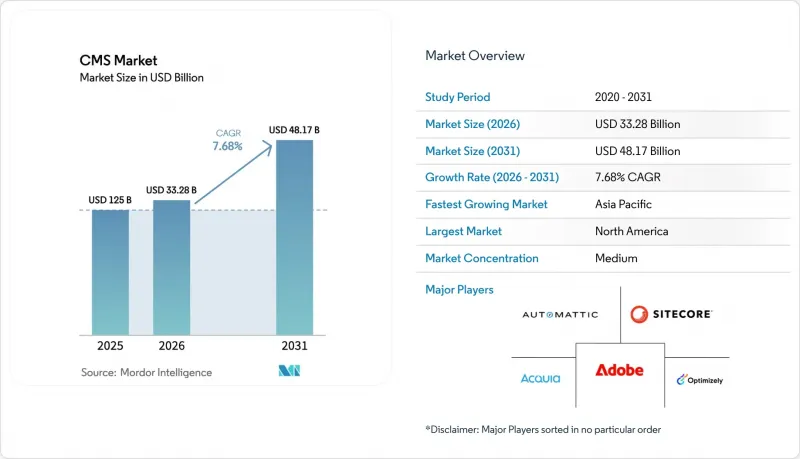
본 보고서는 구성 요소별(소프트웨어 및 서비스), 유형별(웹 컨텐츠 관리, 엔터프라이즈 컨텐츠 관리, 기타), 도입 형태별(온프레미스, 클라우드, 하이브리드), 기업 규모별(대기업, 중소기업), 최종 사용자 산업별(은행, 금융서비스 및 보험(BFSI), 헬스케어 및 생명과학, 소매 및 전자상거래, IT 및 통신, 기타), 지역별로 분류되어 있습니다.
세계의 CMS 시장 동향 및 인사이트
전자상거래의 부상과 옴니채널 소매의 급성장
소매업체와 B2B 판매업체는 현재 웹, 모바일, 소셜 미디어, 매장 내 디스플레이 간에 상품 데이터, 가격, 프로모션 정보를 실시간으로 동기화하고 있습니다. 고도화된 워크플로우를 통해 기존 플랫폼에서는 관리가 어려웠던 다수의 이해관계자가 참여하는 승인 프로세스나 복잡한 카탈로그를 처리할 수 있게 되었습니다. 소셜 커머스를 이용하는 소비자가 늘어나는 가운데, 실시간 일관성은 고객 신뢰도, 구매 금액, 고객 유지율 향상으로 이어지고 있으며, 옴니채널 기능은 CMS 시장에서 필수적인 선정 기준이 되고 있습니다.
컴포저블 아키텍처에 적용된 클라우드 네이티브 CMS 도입
기업들은 거버넌스를 유지하면서 각 부문에서 최고의 도구를 통합하는 'API 퍼스트' 시스템을 우선시하고 있습니다. Sitecore의 XM Cloud는 2024년에 매출을 두 배로 늘리며, 마케터가 시각적 편집기를 계속 사용할 수 있는 동시에 개발자에게 유연한 배포 API를 제공하는 플랫폼에 대한 수요가 높음을 입증하고 있습니다. 업그레이드 가속화, 자동 확장, 세계 CDN은 인프라 비용을 절감하여 클라우드의 우위를 더욱 공고히 하고 있습니다.
레거시 스택에서 마이그레이션하는 데 따르는 초기 비용
기업의 플랫폼 마이그레이션에는 42만 달러 이상의 비용이 소요될 수 있으며, 최대 18개월 동안 기존 시스템과 신규 시스템을 병행하여 운영해야 합니다. 컨텐츠 모델, 맞춤형 모듈, 직원의 기술 재구축 및 재교육이 필요하기 때문에 지연은 비용 증가를 초래하며, ROI의 손익분기점이 당초 비즈니스 케이스를 크게 상회하게 됩니다.
부문 분석
2025년 CMS 시장 규모에서 소프트웨어가 61.75%를 차지했으나, 기업들이 마이그레이션 로드맵, 맞춤형 통합, 거버넌스 프레임워크를 필요로 함에 따라 전문 서비스는 연평균 성장률(CAGR) 16.02%로 성장을 지속하고, 있습니다. 자문 서비스와 관리형 서비스는 기업이 온프레미스에서 클라우드로 전환하고, 컨텐츠와 커머스 엔진을 통합하며, 직원을 재교육하는 것을 지원합니다. Clarks와 같은 소매업체들이 컴포저블 아키텍처와 파트너사의 전문 지식을 활용하여 9개월 이내에 51개국을 대상으로 한 커머스 사이트를 출시함에 따라, 클라우드 전환 프로젝트가 급증했습니다.
구현 전문가들은 API 우선 도입 붐도 활용하여, CMS를 마케팅 기술(MarTech), 고객 데이터 플랫폼(CDP), 디지털 자산 관리(DAM)와 연동시키는 헤드리스형 설계안을 수립하고 있습니다. 일회성 도입에서 지속적인 최적화로 전환됨에 따라 성과 기반 관리 서비스가 확대되고 있으며, 여기에는 성능 튜닝, 보안 패치 적용, AI를 활용한 컨텐츠 테스트 등이 포함됩니다. 이러한 지속적인 업무는 벤더와 고객 간의 장기적인 관계를 공고히 하고, 예산 주기를 통해 CMS 시장의 회복력을 유지하고 있습니다.
웹 컨텐츠 관리 시장 점유율은 41.05%를 유지했지만, 옴니채널의 필요성으로 인해 헤드리스 플랫폼은 연평균 성장률(CAGR) 18.85%로 성장을 지속하고 있습니다. 디커플링된 모델을 통해 마케터는 WYSIWYG(보이는 대로 편집) 방식을 통한 컨텐츠 제작을 지속할 수 있으며, 개발자는 웹, 모바일, IoT, 키오스크 등의 엔드포인트에 컨텐츠를 배포할 수 있습니다. 지연 시간이나 확장성이 전환율에 영향을 미치는 소매 및 미디어 산업에서는 기업들이 결합형 스택을 모든 프론트엔드에 컨텐츠를 공급하는 API 허브로 대체하고 있습니다.
이러한 헤드리스화의 물결은 보완적인 디지털 자산 관리(DAM) 및 마이크로서비스에 대한 수요를 촉진하고 있습니다. CoreMedia와 같은 벤더에 따르면, 고객 기업들은 통합된 자산 허브를 통해 소셜 미디어, 마켓플레이스, 매장 내 스크린에 걸쳐 있는 수백만 개의 시각적 자산을 관리하고 있다고 합니다. 컴포저블 커머스가 확산됨에 따라 헤드리스 CMS 솔루션이 표준 선택지로 자리 잡으면서, 레거시 플랫폼은 API 개조를 강요받거나 고객 이탈을 초래할 위험에 직면해 있습니다.
지역별 분석
북미는 2025년 매출의 35.85%를 차지하며 계속해서 주도적인 위치를 유지했습니다. 성숙한 벤더 생태계와 넉넉한 IT 예산 덕분에 헤드리스 방식에 AI를 통합한 스택으로의 신속한 전환이 가능해졌습니다. 주 차원의 개인정보 보호법으로 인해, 유럽에서 볼 수 있는 것과 같은 엄격한 국경 간 제약 없이 동의 획득 및 현지화 모듈에 대한 수요가 증가하고 있습니다.
아시아태평양은 인도네시아, 필리핀, 베트남의 두 자릿수 전자상거래 성장에 힘입어 연평균 성장률(CAGR) 14.52%로 CMS 시장에서 가장 빠르게 성장하고 있습니다. 기업들은 모바일 우선 템플릿을 기반으로 한 다국어·다통화 지원 컨텐츠 게시가 필요하며, 이는 해당 지역 전반에 걸쳐 헤드리스 CMS 도입을 가속화하고 있습니다.
유럽은 성숙한 시장이지만 여전히 큰 규모를 유지하고 있습니다. GDPR(EU 개인정보보호규정) 및 새로 제정되고 있는 AI 관련 법에 따라 거버넌스 기능이 통합되고, 로컬 호스팅 옵션을 갖춘 플랫폼의 도입이 진행되고 있습니다. 라틴아메리카, 중동 및 아프리카의 점유율은 작지만, 아랍어 현지화, 이슬람 금융 컨텐츠 전송, 정부 기관의 디지털화 투자가 증가함에 따라 향후 CMS 시장 확대를 위한 기반이 마련되고 있습니다.
기타 혜택
- 엑셀 형식 시장 예측(ME) 시트
- 3개월간의 애널리스트 지원
자주 묻는 질문
목차
제1장 서론
제2장 조사 방법
제3장 주요 요약
제4장 시장 구도
제5장 시장 규모 및 성장 예측
제6장 경쟁 구도
제7장 시장 기회 및 향후 동향
AJY 26.08.11According to Mordor Intelligence, the CMS market size was valued at USD 30.91 billion in 2025 and estimated to grow from USD 33.28 billion in 2026 to reach USD 48.17 billion by 2031, at a CAGR of 7.68% during the forecast period (2026-2031).
This report is Segmented by Component (Software, and Services), Type (Web Content Management, Enterprise Content Management, and More), Deployment (On-Premise, Cloud, and Hybrid), Enterprise Size (Large Enterprises, Small and Medium-Sized Enterprises), End-User Industry (BFSI, Healthcare and Life Sciences, Retail and ECommerce, IT and Telecom, and More), and Geography.
Global CMS Market Trends and Insights
Rise of eCommerce and Omnichannel Retail Boom
Retailers and B2B sellers now synchronize product data, pricing and promotions across web, mobile, social and in-store displays in real time. Advanced workflows support multi-stakeholder approvals and complex catalogs that legacy platforms struggle to manage. As more consumers adopt social commerce, real-time consistency drives customer trust, basket size and retention, making omnichannel capability an essential selection criterion in the CMS market.
Cloud-native CMS Adoption for Composable Architecture
Enterprises are prioritizing API-first systems that integrate best-of-breed tools while preserving governance. Sitecore's XM Cloud doubled its revenue in 2024, underscoring demand for platforms that let marketers keep visual editors while giving developers flexible delivery APIs . Faster upgrades, auto-scaling and global CDNs also cut infrastructure costs, reinforcing cloud dominance.
Up-front Migration Costs from Legacy Stacks
Enterprise re-platforming can exceed USD 420,000 and require dual-running old and new systems for up to 18 months. Delays amplify spend because content models, custom modules and staff skills must all be rebuilt or retrained, pushing ROI breakeven well beyond initial business cases .
Other drivers and restraints analyzed in the detailed report include:
- Generative-AI Plug-ins Elevating Personalization
- Rapid Localization Demand from Emerging-Market Brands
- Data-privacy and Sovereignty Compliance Burden
For complete list of drivers and restraints, kindly check the Table Of Contents.
Segment Analysis
The CMS market size for software stood at 61.75% in 2025, but professional services are registering a 16.02% CAGR as firms need migration roadmaps, custom integrations and governance frameworks. Advisory and managed services help enterprises shift from on-premise to cloud, integrate content with commerce engines and retrain staff. Cloud migration engagements surged after retailers such as Clarks launched a 51-country commerce site within nine months by leveraging composable architecture and partner expertise.
Implementation specialists also capitalize on API-first adoption waves, designing headless blueprints that connect CMS with martech, CDP and DAM. As continuous optimization replaces one-time rollouts, outcome-based managed services grow, covering performance tuning, security patching and AI-based content testing. This recurring work anchors long-term vendor-client relationships and keeps the CMS market resilient during budget cycles.
Web content management maintained 41.05% share, yet headless platforms clock a 18.85% CAGR thanks to omnichannel imperatives. Decoupled models let marketers keep WYSIWYG authoring while developers serve content to web, mobile, IoT and kiosk endpoints. In retail and media, where latency and scalability affect conversion, businesses replace coupled stacks with API hubs that feed any front-end.
The headless wave boosts demand for complementary Digital Asset Management and micro-services. Vendors such as CoreMedia report clients managing millions of visual assets across social, marketplace and in-store screens through unified asset hubs. As composable commerce proliferates, headless CMS market solutions become default choices, pushing legacy platforms to retrofit APIs or risk churn.
Complete Report Scope:
- By Component
- Software
- Services
- By Type
- Web Content Management (WCM)
- Enterprise Content Management (ECM)
- Headless / API-First CMS
- Digital Asset Management (DAM)
- Document Management System (DMS)
- eCommerce CMS
- By Deployment Mode
- On-premise
- Cloud
- Hybrid
- By Enterprise Size
- Large Enterprises
- Small and Medium-sized Enterprises (SMEs)
- By End-user Industry
- BFSI
- Healthcare and Life Sciences
- Retail and eCommerce
- IT and Telecom
- Media and Entertainment
- Education
- Government and Public Sector
- Manufacturing
- Others
- By Geography
- North America
- United States
- Canada
- Mexico
- South America
- Brazil
- Argentina
- Rest of South America
- Europe
- Germany
- United Kingdom
- France
- Italy
- Spain
- Russia
- Rest of Europe
- Asia-Pacific
- China
- Japan
- India
- South Korea
- Australia and New Zealand
- Rest of Asia-Pacific
- Middle East and Africa
- Middle East
- Saudi Arabia
- United Arab Emirates
- Turkey
- Rest of Middle East
- Africa
- South Africa
- Nigeria
- Egypt
- Rest of Africa
- Middle East
- North America
Geography Analysis
North America sustained leadership with 35.85% revenue in 2025. A mature vendor ecosystem and sizable IT budgets enable rapid upgrades to headless, AI-infused stacks. State-level privacy laws spark demand for consent and localization modules without the stringent cross-border constraints seen in Europe.
Asia-Pacific is the CMS market's fastest riser at 14.52% CAGR, underpinned by double-digit eCommerce expansion in Indonesia, the Philippines and Vietnam. Enterprises need multi-language, multi-currency publishing backed by mobile-first templates, which accelerates headless CMS adoption across the region.
Europe remains sizeable though mature. GDPR and emerging AI Acts drive uptake of platforms with built-in governance and local hosting options. Latin America and the Middle East and Africa hold smaller shares but record growing investments in Arabic localization, Islamic finance content flows and government digitization, paving the way for future CMS market traction.
- Adobe Inc.
- Automattic Inc.
- Sitecore Holding II A/S
- Optimizely Inc.
- Acquia Inc.
- OpenText Corporation
- Oracle Corporation
- Microsoft Corporation
- Squarespace Inc.
- Contentful GmbH
- Kentico Software s.r.o.
- Magnolia International Ltd.
- Crownpeak Technology Inc.
- HubSpot Inc. (CMS Hub)
- Liferay Inc.
- Progress Software Corp. (Sitefinity)
- ConcreteCMS Inc.
- Contentstack
- Duda Inc.
- Wix.com Ltd.
- Alfresco Software Ltd. (Hyland)
- Nuxeo SA (Hyland)
- Bloomreach Inc.
- Umbraco HQ ApS
- Prismic IO Inc.
- Sanity AS
Additional Benefits:
- The market estimate (ME) sheet in Excel format
- 3 months of analyst support
TABLE OF CONTENTS
1 INTRODUCTION
- 1.1 Market Definition and Study Assumptions
- 1.2 Scope of the Study
2 RESEARCH METHODOLOGY
3 EXECUTIVE SUMMARY
4 MARKET LANDSCAPE
- 4.1 Market Overview
- 4.2 Market Drivers
- 4.2.1 Rise of eCommerce and Omnichannel Retail Boom
- 4.2.2 Cloud-native CMS Adoption for Composable Architecture
- 4.2.3 Generative-AI Plug-ins Elevating Personalization (under-reported)
- 4.2.4 Rapid Localization Demand from Emerging-Market Brands (under-reported)
- 4.2.5 API-first integrations with commerce engines
- 4.2.6 Low-code CMS accelerators for SMEs
- 4.3 Market Restraints
- 4.3.1 Up-front Migration Costs from Legacy Stacks
- 4.3.2 Data-privacy and Sovereignty Compliance Burden
- 4.3.3 Shortage of Headless-CMS Skilled Developers (under-reported)
- 4.3.4 Escalating technical debt in unsupported legacy CMS versions
- 4.4 Value / Supply-Chain Analysis
- 4.5 Evaluation of Critical Regulatory Framework
- 4.6 Impact Assessment of Key Stakeholders
- 4.7 Technological Outlook
- 4.8 Porter's Five Forces Analysis
- 4.8.1 Bargaining Power of Suppliers
- 4.8.2 Bargaining Power of Consumers
- 4.8.3 Threat of New Entrants
- 4.8.4 Threat of Substitutes
- 4.8.5 Intensity of Competitive Rivalry
- 4.9 Impact of Macro-economic Factors
5 MARKET SIZE AND GROWTH FORECASTS (VALUE)
- 5.1 By Component
- 5.1.1 Software
- 5.1.2 Services
- 5.2 By Type
- 5.2.1 Web Content Management (WCM)
- 5.2.2 Enterprise Content Management (ECM)
- 5.2.3 Headless / API-First CMS
- 5.2.4 Digital Asset Management (DAM)
- 5.2.5 Document Management System (DMS)
- 5.2.6 eCommerce CMS
- 5.3 By Deployment Mode
- 5.3.1 On-premise
- 5.3.2 Cloud
- 5.3.3 Hybrid
- 5.4 By Enterprise Size
- 5.4.1 Large Enterprises
- 5.4.2 Small and Medium-sized Enterprises (SMEs)
- 5.5 By End-user Industry
- 5.5.1 BFSI
- 5.5.2 Healthcare and Life Sciences
- 5.5.3 Retail and eCommerce
- 5.5.4 IT and Telecom
- 5.5.5 Media and Entertainment
- 5.5.6 Education
- 5.5.7 Government and Public Sector
- 5.5.8 Manufacturing
- 5.5.9 Others
- 5.6 By Geography
- 5.6.1 North America
- 5.6.1.1 United States
- 5.6.1.2 Canada
- 5.6.1.3 Mexico
- 5.6.2 South America
- 5.6.2.1 Brazil
- 5.6.2.2 Argentina
- 5.6.2.3 Rest of South America
- 5.6.3 Europe
- 5.6.3.1 Germany
- 5.6.3.2 United Kingdom
- 5.6.3.3 France
- 5.6.3.4 Italy
- 5.6.3.5 Spain
- 5.6.3.6 Russia
- 5.6.3.7 Rest of Europe
- 5.6.4 Asia-Pacific
- 5.6.4.1 China
- 5.6.4.2 Japan
- 5.6.4.3 India
- 5.6.4.4 South Korea
- 5.6.4.5 Australia and New Zealand
- 5.6.4.6 Rest of Asia-Pacific
- 5.6.5 Middle East and Africa
- 5.6.5.1 Middle East
- 5.6.5.1.1 Saudi Arabia
- 5.6.5.1.2 United Arab Emirates
- 5.6.5.1.3 Turkey
- 5.6.5.1.4 Rest of Middle East
- 5.6.5.2 Africa
- 5.6.5.2.1 South Africa
- 5.6.5.2.2 Nigeria
- 5.6.5.2.3 Egypt
- 5.6.5.2.4 Rest of Africa
- 5.6.5.1 Middle East
- 5.6.1 North America
6 COMPETITIVE LANDSCAPE
- 6.1 Market Concentration
- 6.2 Strategic Moves
- 6.3 Market Share Analysis
- 6.4 Company Profiles (includes Global level Overview, Market level overview, Core Segments, Financials as available, Strategic Information, Market Rank/Share for key companies, Products and Services, and Recent Developments)
- 6.4.1 Adobe Inc.
- 6.4.2 Automattic Inc.
- 6.4.3 Sitecore Holding II A/S
- 6.4.4 Optimizely Inc.
- 6.4.5 Acquia Inc.
- 6.4.6 OpenText Corporation
- 6.4.7 Oracle Corporation
- 6.4.8 Microsoft Corporation
- 6.4.9 Squarespace Inc.
- 6.4.10 Contentful GmbH
- 6.4.11 Kentico Software s.r.o.
- 6.4.12 Magnolia International Ltd.
- 6.4.13 Crownpeak Technology Inc.
- 6.4.14 HubSpot Inc. (CMS Hub)
- 6.4.15 Liferay Inc.
- 6.4.16 Progress Software Corp. (Sitefinity)
- 6.4.17 ConcreteCMS Inc.
- 6.4.18 Contentstack
- 6.4.19 Duda Inc.
- 6.4.20 Wix.com Ltd.
- 6.4.21 Alfresco Software Ltd. (Hyland)
- 6.4.22 Nuxeo SA (Hyland)
- 6.4.23 Bloomreach Inc.
- 6.4.24 Umbraco HQ ApS
- 6.4.25 Prismic IO Inc.
- 6.4.26 Sanity AS
7 MARKET OPPORTUNITIES AND FUTURE TRENDS
- 7.1 White-space and Unmet-need Assessment


