

|
시장보고서
상품코드
2100262
OSS BSS 시장 : 시장 점유율 분석, 업계 동향 및 통계, 성장 예측(2026-2031년)OSS BSS - Market Share Analysis, Industry Trends & Statistics, Growth Forecasts (2026 - 2031) |
||||||
 Mordor Intelligence
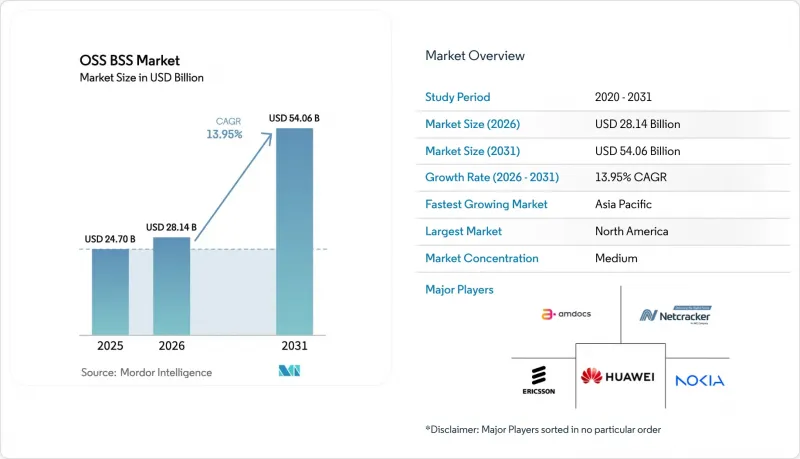
Mordor Intelligence에 의하면, OSS BSS 시장 규모는 2025년에 247억 달러로 평가되었고, 2026년 281억 4,000만 달러에서 2031년까지 540억 6,000만 달러에 이를 것으로 예측되며, 예측 기간(2026-2031년) CAGR은 13.95%를 나타낼 전망입니다.
본 보고서는 솔루션 서비스별, 도입 형태별(온프레미스, 클라우드 기반), 기업 규모별(대기업, 중소기업), 산업별(IT 및 통신, 은행, 금융서비스 및 보험(BFSI), 미디어 및 엔터테인먼트, 소매 및 전자상거래, 기타), 지역별로 분류되어 있습니다.
세계의 OSS BSS 시장 동향 및 인사이트
클라우드 네이티브 OSS/BSS 플랫폼의 채택 확대
마이크로서비스와 컨테이너화는 운영상의 민첩성을 재정의하고 있으며, 통신 사업자가 몇 달이 아닌 며칠 만에 새로운 서비스를 출시할 수 있게 해줍니다. 가트너(Gartner)는 2025년까지 디지털 워크로드의 95%가 클라우드 네이티브 인프라에서 운영될 것으로 예측했습니다. 선행 도입 기업들의 보고에 따르면, 스케일아웃형 클러스터는 과도한 리소스 할당 없이도 수요 급증에 대응할 수 있어 총 소유 비용(TCO)이 절감되었다고 합니다. 그러나 통신 사업자의 57%가 DevOps 및 쿠버네티스 오케스트레이션 분야의 기술 부족을 지적하고 있으며, 이로 인해 매니지드 서비스 및 벤더의 교육 프로그램에 대한 수요가 증가하고 있습니다.
5G의 급속한 확산과 네트워크 슬라이싱의 수익화
통신 사업자들은 네트워크 슬라이싱을 기반으로 한 차별화된 서비스 계층에 기대를 걸고 있으며, 저지연·고처리량 이용 사례에 대해 프리미엄 가격 책정을 실현하고자 하고 있습니다. 의료, 제조, 자동차 각 부문이 초기 도입자로 나서면서, 통합된 OSS/BSS 시장 솔루션 내에서의 동적 과금, 정책, 보증 기능에 대한 필요성이 더욱 커지고 있습니다.
레거시 스택에서 전환 및 통합에 드는 막대한 비용
플랫폼을 전면적으로 개편하는 데는 수억 달러의 비용이 소요되며, 5년 이상 걸리는 경우도 있습니다. 많은 레거시 워크플로는 하드코딩되어 있어, 세심한 데이터 매핑과 직원 재교육이 필요합니다. 맥킨지의 조사에 따르면, 최고 성과 기업들은 ‘리프트 앤 시프트(lift-and-shift)’ 방식이 아닌 엔드투엔드 현대화를 추구하고 있으며, IT 혁신과 프로세스 재설계를 연계함으로써 비용 절감과 민첩성 향상이라는 이점을 누리고 있습니다.
부문 분석
2025년, ‘솔루션’ 부문은 OSS BSS 시장 점유율의 62.40%를 차지했으며, 통신 사업자의 운영에 필수적인 코어 카탈로그, 과금, 어슈어런스 플랫폼을 제공했습니다. 그러나 '서비스' 부문은 2031년까지 연평균 성장률(CAGR) 14.85%를 나타낼 것으로 예측되며, OSS BSS 시장 전체를 상회하는 속도로 성장할 것으로 전망됩니다. 컨버전트 빌링 도입, 클라우드 네이티브로의 전환, AI 모델 튜닝에는 전문적인 지식이 필요하지만, 많은 통신 사업자는 사내에 그러한 노하우를 보유하고 있지 않습니다. 정책, 과금, 분석에 걸친 통합 프로젝트는 OSS BSS 시장 규모에서 점점 더 큰 비중을 차지하고 있는 반면, 매니지드 서비스 계약은 KPI 달성을 보장하고 통신 사업자가 제품 혁신에 집중할 수 있도록 지원하고 있습니다.
전문 서비스 제공업체들은 DevOps 툴체인, 레퍼런스 아키텍처, 성과 기반 SLA를 패키지화하고 있습니다. 2025년 2월에 발표된 Infovista와 CSG의 제휴는 벤더들이 각자의 강점 및 정책 제어, 자동화된 보증, 고객 데이터 동기화를 결합함으로써 도입 기간을 단축하고 서비스 신뢰성을 향상시키는 방법을 보여줍니다. 도입 규모가 확대됨에 따라 지속적인 최적화 및 AI 훈련 서비스가 서비스 전문 기업에게 장기적인 수익원의 기반이 될 것으로 보입니다.
2025년에도 온프레미스형 시스템은 OSS/BSS 시장 규모의 57.65%를 차지했으며, 이는 미션 크리티컬 스택을 엄격하게 관리해 온 통신 사업자의 전통을 반영하고 있습니다. 그러나 퍼블릭 클라우드와 하이브리드 클라우드는 자본 지출(Capex)을 운영 비용(OpEx)으로 전환하는 유연한 종량제 요금 모델 덕분에 2031년까지 연평균 성장률(CAGR) 17.55%를 나타낼 것으로 예측됩니다. 클라우드 리소스를 활용하는 통신 사업자들은 서비스 출시 주기가 수개월에서 수주로 단축되었다고 보고하고 있으며, 또한 탄력적인 클러스터를 통해 이용이 저조한 시간대의 유휴 용량을 방지하고 있습니다.
멀티 클라우드 전략은 워크로드를 서로 다른 지역에 분산함으로써 벤더 종속성을 완화하고, 데이터 주권에 관한 규제 요건에도 대응합니다. 카탈로그, 과금, CRM 모듈이 사전에 통합된 SaaS 기반 BSS 제품군은 막대한 초기 통합 비용 없이 엔터프라이즈급 신뢰성을 제공합니다. 클라우드 호스팅형 OSS BSS 플랫폼을 조기에 도입한 기업들은 오픈 API를 통해 파트너 온보딩이 가속화되고 5G 네트워크 슬라이스의 수익화가 용이해졌습니다고 평가하고 있으며, OSS BSS 시장에서 클라우드의 전략적 역할이 더욱 강화되고 있습니다.
지역별 분석
북미는 5G의 조기 구축, 잘 갖춰진 광섬유 백본, 서비스 품질(QoS) 향상을 장려하는 규제 환경의 뒷받침을 받아 2025년에는 매출의 34.45%를 차지하며 시장을 선도했습니다. 많은 지역 통신 사업자들은 지원 센터와 네트워크 운영 허브에 AI를 도입하고 있으며, 48%는 이미 AI를 활용하여 고객 경험을 향상시키고 있습니다. 하이퍼스케일 데이터센터의 구축과 명확하게 정의된 보안 프레임워크 덕분에 클라우드로의 전환이 가속화되고 있으며, 이를 통해 통신 사업자들은 의료 및 물류 등 산업용 네트워크 슬라이스를 수익화할 수 있게 되었습니다.
아시아태평양은 2031년까지 연평균 성장률(CAGR)이 19.10%에 달할 전망이며, 가장 빠른 성장이 예상됩니다. 중국, 인도, 일본, 한국에서는 야심 찬 디지털 경제 계획에 따라 전국 규모의 5G 및 광섬유 네트워크 구축이 진행되고 있습니다. 클라우드 네이티브 OSS BSS 아키텍처를 통해 통신 사업자는 방대한 가입자 기반을 관리하고, 계층화된 기업용 서비스 제공을 시작할 수 있게 됩니다. 신흥 시장에서는 자본 측면의 제약을 극복하기 위해 SaaS 라이선싱을 활용하는 반면, 선진국에서는 고도화된 네트워크 슬라이스 오케스트레이션 및 AI를 활용한 품질 보증에 주력하고 있습니다.
유럽은 엄격한 데이터 개인정보 보호 규제와 주권형 클라우드 생태계 추진을 통해 OSS BSS 시장에서 여전히 큰 영향력을 유지하고 있습니다. 통신 사업자들은 가격 규제나 경쟁사들의 과도한 네트워크 확충으로 인한 이익 압박에 직면해 있으며, 이는 인프라 공유 및 부가가치형 파트너십 추진으로 이어지고 있습니다. EU의 ‘디지털 데케이드(Digital Decade)’ 정책은 상호 운용 가능한 API 우선 솔루션을 추진하고 있으며, 국경을 초월한 규정 준수 요건을 충족하는 유연한 OSS BSS 스택에 대한 수요를 견인하고 있습니다. 지방 지역의 광대역 및 제조업용 프라이빗 5G에 대한 투자로 인해 플랫폼 도입은 꾸준히 증가할 전망입니다.
기타 혜택
- 엑셀 형식 시장 예측(ME) 시트
- 3개월간의 애널리스트 지원
자주 묻는 질문
목차
제1장 서론
제2장 조사 방법
제3장 주요 요약
제4장 시장 구도
제5장 시장 규모 및 성장 예측
제6장 경쟁 구도
제7장 시장 기회 및 향후 동향
AJY 26.08.11According to Mordor Intelligence, the OSS BSS market size was valued at USD 24.70 billion in 2025 and estimated to grow from USD 28.14 billion in 2026 to reach USD 54.06 billion by 2031, at a CAGR of 13.95% during the forecast period (2026-2031).
This report is Segmented by (Solutions, Services), Deployment (On-Premise, Cloud-Based), Enterprise Size (Large Enterprises, Small and Medium-Sized Enterprises), Industry Vertical (IT and Telecom, BFSI, Media and Entertainment, Retail and E-Commerce, and More), and Geography.
Global OSS BSS Market Trends and Insights
Growing adoption of cloud-native OSS/BSS platforms
Microservices and containerization are redefining operational agility, allowing operators to spin up new services in days rather than months. Gartner projects that 95% of digital workloads will reside on cloud-native foundations by 2025. Early movers report lower total cost of ownership as scale-out clusters handle demand spikes without overprovisioning. However, 57% of carriers cite skills gaps in DevOps and Kubernetes orchestration, prompting heightened demand for managed services and vendor training programs .
Rapid 5G rollout and network-slice monetization
Operators are banking on differentiated service tiers built on network slicing to unlock premium pricing for low-latency and high-throughput use cases. Healthcare, manufacturing, and automotive segments are early adopters, reinforcing the need for dynamic charging, policy, and assurance functions inside converged OSS BSS market solutions.
High migration and integration costs from legacy stacks
Full-scale platform renewal can reach hundreds of millions of USD and stretch over five years. Many legacy workflows are hard-coded, demanding painstaking data mapping and staff retraining. A McKinsey study finds top performers pursue end-to-end modernization instead of "lift-and-shift" moves, aligning IT transformation with process redesign to capture cost and agility benefits.
Other drivers and restraints analyzed in the detailed report include:
- Customer-experience analytics investments by CSPs
- AI-driven autonomous network operations
- Multi-cloud security and compliance complexities
For complete list of drivers and restraints, kindly check the Table Of Contents.
Segment Analysis
The Solutions tier generated 62.40% OSS BSS market share in 2025, supplying core catalog, charging, and assurance platforms essential for telco operations. However, Services are projected to log a 14.85% CAGR through 2031, outpacing the overall OSS BSS market. Convergent billing rollouts, cloud-native migrations, and AI-model tuning require specialised expertise that most carriers lack in-house. Integration projects that span policy, charging, and analytics now account for a growing slice of the OSS BSS market size, while managed-services contracts guarantee KPIs and free operators to focus on product innovation.
Professional-service providers bundle DevOps toolchains, reference architectures, and outcome-based SLAs. The Infovista-CSG partnership announced in February 2025 shows how vendors combine strengths-policy control, automated assurance, and customer-data synchronisation-to shorten deployment and improve service reliability. As implementations scale, recurring optimisation and AI training services will underpin long-term revenue streams for service specialists.
On-premise systems still held 57.65% of the OSS BSS market size in 2025, reflecting the telco tradition of maintaining tight control over mission-critical stacks. Yet public and hybrid clouds are forecast to post an 17.55% CAGR through 2031, thanks to flexible pay-as-you-go models that convert capex to opex. Operators leveraging cloud resources report launch cycles shrinking from months to weeks, while elastic clusters prevent idle capacity during off-peak hours.
Multi-cloud strategies mitigate vendor lock-in and address sovereignty mandates by distributing workloads across different regions. SaaS-based BSS suites with pre-integrated catalog, charging, and CRM modules deliver enterprise-grade reliability without heavy up-front integration fees. Early adopters of cloud-hosted OSS BSS platforms credit open APIs for faster partner onboarding and easier monetisation of 5G network slices, reinforcing the cloud's strategic role in the OSS BSS market.
Complete Report Scope:
- By Component
- Solutions
- Services
- By Deployment Mode
- On-Premise
- Cloud-Based
- By Enterprise Size
- Large Enterprises
- Small and Medium Enterprises
- By Industry Vertical
- IT and Telecom
- BFSI
- Media and Entertainment
- Retail and E-commerce
- Government and Public Sector
- Other Industry Verticals
- By Geography
- North America
- United States
- Canada
- Mexico
- South America
- Brazil
- Argentina
- Rest of South America
- Europe
- Germany
- United Kingdom
- France
- Italy
- Spain
- Russia
- Rest of Europe
- Asia-Pacific
- China
- Japan
- India
- South Korea
- Australia and New Zealand
- Rest of Asia-Pacific
- Middle East and Africa
- Middle East
- Saudi Arabia
- UAE
- Turkey
- Rest of Middle East
- Africa
- South Africa
- Nigeria
- Kenya
- Rest of Africa
- Middle East
- North America
Geography Analysis
North America led with 34.45% revenue in 2025, driven by early 5G rollouts, deep fibre backbones, and a regulatory climate rewarding quality-of-service improvements. Many regional carriers deploy AI in support centres and network-operations hubs-48% already leverage AI for better customer experiences . Cloud migrations are accelerated by hyperscale data-centre footprints and well-defined security frameworks, allowing operators to monetise slices for industries such as healthcare and logistics.
Asia-Pacific is poised to deliver the fastest growth, with a 19.10% CAGR through 2031. China, India, Japan, and South Korea are deploying nationwide 5G and fibre networks under ambitious digital-economy plans. Cloud-native OSS BSS architectures help carriers manage massive subscriber bases and launch tiered enterprise offerings. Emerging markets leverage SaaS licensing to overcome capital constraints, while developed nations focus on advanced network-slice orchestration and AI-driven assurance.
Europe maintains meaningful influence in the OSS BSS market owing to strict data-privacy rules and a push for sovereign cloud ecosystems. Operators face profit-pressure from price regulation and competitive overbuilds, prompting infrastructure-sharing and value-added partnerships. The EU Digital Decade policy promotes interoperable, API-first solutions, driving demand for flexible OSS BSS stacks that satisfy cross-border compliance. Investments in rural broadband and private-5G for manufacturing will sustain steady platform adoption.
- Amdocs Limited
- Huawei Technologies Co., Ltd.
- Telefonaktiebolaget LM Ericsson
- Nokia Corporation
- Netcracker Technology Corporation
- Oracle Corporation
- IBM Corporation
- Cisco Systems, Inc.
- CSG Systems International, Inc.
- Accenture plc
- Comviva Technologies Ltd.
- Subex Limited
- Optiva Inc.
- Whale Cloud Technology Co., Ltd.
- NMSWorks Software Pvt. Ltd.
- Tridens d.o.o.
- TelcoDR Inc.
- AsiaInfo Technologies Limited
- Hewlett Packard Enterprise Company
- Tecnotree Corporation
- Sigma Systems (Hansen Technologies)
- Mavenir Systems, Inc.
Additional Benefits:
- The market estimate (ME) sheet in Excel format
- 3 months of analyst support
TABLE OF CONTENTS
1 INTRODUCTION
- 1.1 Market Definition and Study Assumptions
- 1.2 Scope of the Study
2 RESEARCH METHODOLOGY
3 EXECUTIVE SUMMARY
4 MARKET LANDSCAPE
- 4.1 Market Overview
- 4.2 Market Drivers
- 4.2.1 Growing adoption of cloud-native OSS/BSS platforms
- 4.2.2 Rapid 5G rollout driving network-slicing monetization
- 4.2.3 Rising demand for convergent billing and IoT monetization
- 4.2.4 Customer-experience analytics investments by CSPs
- 4.2.5 AI-driven autonomous network operations
- 4.2.6 Telco-to-TechCo transformation budgets for unified stacks
- 4.3 Market Restraints
- 4.3.1 High migration and integration costs from legacy stacks
- 4.3.2 Multi-cloud security and compliance complexities
- 4.3.3 Shortage of telco-grade AI/ML talent
- 4.3.4 Vendor lock-in risk from supplier consolidation
- 4.4 Value / Supply-Chain Analysis
- 4.5 Evaluation of Critical Regulatory Framework
- 4.6 Technological Outlook
- 4.7 Porter's Five Forces Analysis
- 4.7.1 Bargaining Power of Suppliers
- 4.7.2 Bargaining Power of Consumers
- 4.7.3 Threat of New Entrants
- 4.7.4 Threat of Substitutes
- 4.7.5 Intensity of Competitive Rivalry
- 4.8 Impact Assessment of Key Stakeholders
- 4.9 Impact of Macroeconomic Factors
5 MARKET SIZE AND GROWTH FORECASTS (VALUE)
- 5.1 By Component
- 5.1.1 Solutions
- 5.1.2 Services
- 5.2 By Deployment Mode
- 5.2.1 On-Premise
- 5.2.2 Cloud-Based
- 5.3 By Enterprise Size
- 5.3.1 Large Enterprises
- 5.3.2 Small and Medium Enterprises
- 5.4 By Industry Vertical
- 5.4.1 IT and Telecom
- 5.4.2 BFSI
- 5.4.3 Media and Entertainment
- 5.4.4 Retail and E-commerce
- 5.4.5 Government and Public Sector
- 5.4.6 Other Industry Verticals
- 5.5 By Geography
- 5.5.1 North America
- 5.5.1.1 United States
- 5.5.1.2 Canada
- 5.5.1.3 Mexico
- 5.5.2 South America
- 5.5.2.1 Brazil
- 5.5.2.2 Argentina
- 5.5.2.3 Rest of South America
- 5.5.3 Europe
- 5.5.3.1 Germany
- 5.5.3.2 United Kingdom
- 5.5.3.3 France
- 5.5.3.4 Italy
- 5.5.3.5 Spain
- 5.5.3.6 Russia
- 5.5.3.7 Rest of Europe
- 5.5.4 Asia-Pacific
- 5.5.4.1 China
- 5.5.4.2 Japan
- 5.5.4.3 India
- 5.5.4.4 South Korea
- 5.5.4.5 Australia and New Zealand
- 5.5.4.6 Rest of Asia-Pacific
- 5.5.5 Middle East and Africa
- 5.5.5.1 Middle East
- 5.5.5.1.1 Saudi Arabia
- 5.5.5.1.2 UAE
- 5.5.5.1.3 Turkey
- 5.5.5.1.4 Rest of Middle East
- 5.5.5.2 Africa
- 5.5.5.2.1 South Africa
- 5.5.5.2.2 Nigeria
- 5.5.5.2.3 Kenya
- 5.5.5.2.4 Rest of Africa
- 5.5.5.1 Middle East
- 5.5.1 North America
6 COMPETITIVE LANDSCAPE
- 6.1 Market Concentration
- 6.2 Strategic Moves
- 6.3 Market Share Analysis
- 6.4 Company Profiles (includes Global level Overview, Market level overview, Core Segments, Financials as available, Strategic Information, Market Rank/Share for key companies, Products and Services, and Recent Developments)
- 6.4.1 Amdocs Limited
- 6.4.2 Huawei Technologies Co., Ltd.
- 6.4.3 Telefonaktiebolaget LM Ericsson
- 6.4.4 Nokia Corporation
- 6.4.5 Netcracker Technology Corporation
- 6.4.6 Oracle Corporation
- 6.4.7 IBM Corporation
- 6.4.8 Cisco Systems, Inc.
- 6.4.9 CSG Systems International, Inc.
- 6.4.10 Accenture plc
- 6.4.11 Comviva Technologies Ltd.
- 6.4.12 Subex Limited
- 6.4.13 Optiva Inc.
- 6.4.14 Whale Cloud Technology Co., Ltd.
- 6.4.15 NMSWorks Software Pvt. Ltd.
- 6.4.16 Tridens d.o.o.
- 6.4.17 TelcoDR Inc.
- 6.4.18 AsiaInfo Technologies Limited
- 6.4.19 Hewlett Packard Enterprise Company
- 6.4.20 Tecnotree Corporation
- 6.4.21 Sigma Systems (Hansen Technologies)
- 6.4.22 Mavenir Systems, Inc.
7 MARKET OPPORTUNITIES AND FUTURE TRENDS
- 7.1 White-space and Unmet-need Assessment


