|
시장보고서
상품코드
2100265
웹사이트 빌더 시장 : 시장 점유율 분석, 업계 동향 및 통계, 성장 예측(2026-2031년)Website Builders - Market Share Analysis, Industry Trends & Statistics, Growth Forecasts (2026 - 2031) |
||||||
 Mordor Intelligence
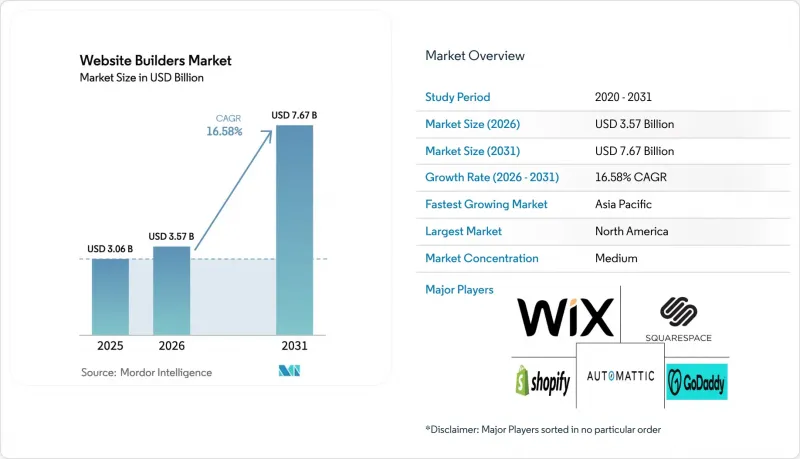
Mordor Intelligence에 의하면, 2026년 웹사이트 빌더 시장 규모는 35억 7,000만 달러로 추정되고, 2025년 30억 6,000만 달러에서 확대해, 2031년에는 76억 7,000만 달러에 이를 것으로 예측됩니다.
2026-2031년 연평균 성장률(CAGR) 16.58%로 성장할 것으로 전망됩니다.
본 보고서는 빌더 유형별(PC용 웹사이트 빌더 및 모바일용 웹사이트 빌더), 도입 형태별(클라우드 및 온프레미스), 최종 사용자별(개인 및 기업), 가격대별(프리미엄, 구독(월 15달러 미만) 등), 그리고 지역별로 분류되어 있습니다. 시장 전망은 금액(달러)으로 표시됩니다.
세계의 웹사이트 빌더 시장 동향 및 인사이트
중소기업 주도의 전자상거래 스토어 개설 급증
인도의 GeM 포털은 2023 회계연도 동안 조달액 기준 240억 달러를 돌파했으며, 이는 공공 부문의 성장세가 중소기업의 온라인 진출을 뒷받침하고 있음을 보여줍니다. 온라인 식료품 및 패션에 대한 수요가 증가함에 따라 지역 판매업체들은 턴키 방식의 스토어를 원하고 있으며, 웹사이트 빌더는 현재 설정 시간을 단축하기 위해 결제, 배송, 세무 모듈을 패키지로 제공합니다. B2B 구매자들도 셀프 서비스형 포털로 전환하고 있어, 플랫폼의 적용 범위는 순수한 소매업을 넘어 확대되고 있습니다. 2022년에 개설된 신규 사이트 중 2급 및 3급 도시가 41.5%라는 큰 비중을 차지하고 있어, 대상 수요가 대도시권을 훨씬 넘어 확산되고 있음을 입증하고 있습니다. 시장을 선도하는 기업들은 이러한 성장 지역을 위해 템플릿을 재구성하고, 인쇄 회사와 제휴하여 언어, 세제, 물류 기능을 현지 상황에 맞게 최적화하고 있습니다.
모바일 우선 인터넷 보급
모바일 인터넷의 보급은 웹사이트 빌더의 아키텍처 요구 사항을 변화시키고 있습니다. 2023년 기준, 아시아태평양에는 18억 명의 모바일 가입자가 있으며, 이는 전체 인구의 63%를 차지했습니다. 모바일 기술은 해당 지역의 GDP의 5.3%(8,800억 달러)에 기여하고 약 1,300만 개의 일자리를 뒷받침하고 있어, 모바일에 최적화된 웹 존재감이 경제적으로 필수적임을 보여줍니다. 5G 기술 및 오픈 게이트웨이 API로의 전환을 통해 연결 솔루션이 강화되어, 더욱 정교한 모바일 웹사이트 기능이 가능해집니다. 모바일 플랫폼에 생성형 AI를 통합하면 고객 서비스와 업무 효율성이 향상되며, AI를 활용한 모바일 웹사이트 빌더에 새로운 기회를 가져다줍니다. 경제 성장과 디지털 포용에서 모바일 생태계가 차지하는 역할은 ‘모바일 우선’ 웹사이트 빌더를 신흥 시장 비즈니스의 필수 인프라로 자리매김하게 하고 있습니다.
데이터 개인정보 보호 및 사이버 보안에 대한 우려
GDPR(EU 개인정보보호규정) 및 CCPA에서는 세밀한 동의 관리가 요구되고 있으며, 각 빌더 업체들은 쿠키 배너, DPA 템플릿, 정보 유출 경고 흐름의 통합을 강요받고 있습니다. Enzuzo와 같은 플랫폼은 현재 법적 정책 생성 기능을 대시보드에 직접 통합하고 있습니다. 제로 트러스트 아키텍처 도입으로 인해 중소기업의 예산이 빠듯한 상황에서 보안 최소 기준을 충족하는 데 드는 비용이 증가하면서 가격 정책 유지가 어려워지고 있습니다. 악의적인 공격자가 SaaS 사이트의 인증 정보를 노리는 사례가 증가하고 있어, 벤더들은 다단계 인증(MFA) 및 AI 기반 이상 감지 기능을 추가하고 있습니다. 소규모 신규 진출기업들은 이러한 보안 대책에 필요한 자금 조달에 어려움을 겪을 가능성이 있어, 웹사이트 빌더 시장에서의 통합 움직임이 가속화될 것입니다.
부문 분석
PC용 웹사이트 빌더는 2025년에 매출의 63.12%를 차지했으며, 풍부한 기능 범위, 대행사용 도구, 멀티 스토어 지원을 통해 웹사이트 빌더 시장의 기반을 지탱하고 있습니다. 그러나 많은 지역에서 스마트폰 사용 시간이 데스크톱을 앞지르는 가운데, 모바일용 빌더는 2031년까지 연평균 성장률(CAGR) 17.43%로 점유율을 확대되고 있습니다. 반응형 템플릿은 현재 기본적으로 제공되며, 음성 조작을 통한 디자인 위저드가 모바일 중심 사업자의 사이트 공개 속도를 높이고 있습니다. Wegic사만 해도 230개국에서 60만 건 이상의 모바일 대응 사이트를 구축하고 있어, 신규 진출기업들의 급속한 성장을 여실히 보여주고 있습니다. 기존 PC 플랫폼에서도 어댑티브 캔버스나 원탭 레이아웃 전환 기능이 점점 더 많이 채택되고 있어, 기기 구분이 모호해지고 옴니채널이 정착되는 융합의 조짐이 보입니다.
스마트폰, 태블릿, 노트북을 아우르는 원활한 편집에 대한 수요로 인해 각 벤더사는 편집 상태를 지속적으로 저장하는 클라우드 호스팅형 에디터로 전환하고 있으며, 이러한 변화가 웹사이트 빌더 시장 전체의 확장을 뒷받침하고 있습니다. 여러 브레이크포인트에서의 실시간 미리보기, 이미지 자동 압축 처리, 스크립트의 지연 로딩(레이지 로딩)을 통해 운영자는 구글의 'Core Web Vitals' 기준을 충족할 수 있게 됩니다. 캐주얼 크리에이터의 이탈률을 낮게 유지하면서도 세밀한 CSS 제어를 원하는 대행사까지 만족시키기 위해서는 플랫폼의 심도 있는 기능과 단순한 UI가 공존해야 합니다. 이는 향후 제품의 양극화가 진행될 것임을 시사합니다.
클라우드 솔루션은 2025년 매출의 81.08%를 차지했으며, 웹사이트 빌더 시장에서 압도적인 존재감을 보이고 있습니다. SaaS 모델은 호스팅, SSL, CDN, 업데이트를 번들로 제공하여 중소기업(SMB)의 유지보수 업무 부담을 줄여줍니다. 엣지 컴퓨팅의 발전으로 자원이 방문자에게 가까워짐에 따라 지연 시간이 단축되고 SEO 점수가 향상됩니다. 서버리스 백엔드는 플래시 세일 시 비용 효율적인 확장을 가능하게 하며, 이는 전자상거래 사용자에게 큰 매력으로 작용하고 있습니다. 데이터 거주지 규제가 적용되는 업계에서는 온프레미스 도입이 여전히 남아 있지만, 향후 투자 계획은 분명히 클라우드 오케스트레이션 쪽으로 기울고 있습니다.
Netlify의 Gatsby 인수가 보여주듯이, 컴포저블 웹 설계가 지지를 얻고 있으며, 개발자는 필요에 따라 전자상거래, 검색, 인증 서비스를 교체할 수 있게 되었습니다. 이러한 모듈형 접근 방식은 기능 제공을 가속화하는 동시에 기술적 부채를 억제합니다. 플러그인 심사를 효율화하고 보안 스캔을 철저히 수행하는 제공업체는 특히 범위 확장이나 숨겨진 비용을 우려하는 기술에 익숙하지 않은 구매자에게 신뢰 측면에서 우위를 점하고 있습니다. 그 결과, 클라우드는 여전히 혁신의 중심이며, 웹사이트 빌더 시장에서의 점유율은 계속해서 확대될 것이 확실합니다.
지역별 분석
북미는 2025년 매출의 38.25%를 차지했으며, 기능 출시 및 파트너 생태계의 벤치마크로서의 위상을 유지하고 있습니다. 신용카드 보급률이 높고 고속 광대역 인프라가 잘 갖춰져 있어 프리미엄 서비스의 업셀링에 유리한 조건이 되고 있습니다. AI 도입은 전 세계 출시보다 앞서 이 지역에서 시작되는 경우가 많아, 로드맵 방향성에 대한 이 지역의 영향력을 강화하고 있습니다. 그러나 소규모 기업 시장이 포화 상태에 이르렀기 때문에 벤더들은 성장을 유지하기 위해 특정 산업에 특화된 틈새 시장이나 성과 연동형 가격 책정을 추구하고 있습니다.
아시아태평양은 향후 확장을 견인할 원동력이며, 2031년까지 연평균 성장률(CAGR) 18.76%를 나타낼 것으로 예측됩니다. 모바일 우선 행동 양식, 51%에 달하는 모바일 인터넷 이용률, 그리고 정부의 디지털화 추진 정책이 이용 확대를 뒷받침하고 있습니다. 싱가포르의 AI 보조금이나 인도의 ONDC 네트워크와 같은 공공 프로그램은 사업자들이 신속하게 온라인화를 추진하도록 장려하고 있습니다. 현지 결제 게이트웨이, 다국어 지원 결제 절차, 낮은 대역폭에서도 작동하는 테마 등은 국제적인 벤더들 시장 적응을 뒷받침하는 한편, 지역 스타트업들은 문화적 뉘앙스를 활용하여 정면 경쟁을 펼치고 있습니다. 이러한 동향으로 인해 아시아태평양은 웹사이트 빌더 시장이 그 확장성을 입증하는 매우 중요한 무대가 되고 있습니다.
유럽에서는 규정 준수에 따른 수요가 큰 비중을 차지하고 있습니다. GDPR(EU 개인정보보호규정)이 기능의 우선순위를 결정하는 요인으로 계속 작용하고 있으며, 탄소 배출량 산정이 경영진의 주목을 받으면서 친환경 호스팅에 대한 노력의 중요성이 높아지고 있습니다. 데이터 주체의 요청에 대응하는 자동화 도구나 재생에너지로 가동되는 서버를 제공하는 빌더는 프리미엄 위치를 확고히 하고 있습니다. 라틴아메리카, 중동 및 아프리카는 규모는 작지만, 인터넷 보급률 상승과 소셜 커머스의 파급 효과로 인해 두 자릿수 성장률을 기록하고 있습니다. 통신 사업자 및 미디어 플레이어과의 전략적 제휴는 해당 지역에서 신뢰를 구축하고 보급을 촉진하여, 웹사이트 빌더 시장의 지리적으로 균형 잡힌 성장 궤도를 확보하고 있습니다.
기타 혜택 :
- 엑셀 형식 시장 예측(ME) 시트
- 3개월간의 애널리스트 지원
자주 묻는 질문
목차
제1장 서론
제2장 조사 방법
제3장 주요 요약
제4장 시장 구도
제5장 시장 규모 및 성장 예측(금액, 2020-2030년)
제6장 경쟁 구도
제7장 시장 기회 및 향후 전망
AJYAccording to Mordor Intelligence, website builders market size in 2026 is estimated at USD 3.57 billion, growing from 2025 value of USD 3.06 billion with 2031 projections showing USD 7.67 billion, growing at 16.58% CAGR over 2026-2031.
This report is Segmented by Builder Type (PC Website Builders and Mobile Website Builders), Deployment (cloud and On-Premises), End User (Individuals and Businesses), Pricing Tier (Freemium, Subscription (Less Than USD (15 / Month)), and More), and by Geography. The Market Forecasts are Provided in Terms of Value (USD).
Global Website Builders Market Trends and Insights
Surge in SMB-driven E-commerce Storefront Launches
India's GeM portal surpassed USD 24 billion in procurement value during FY 2023, signalling public-sector momentum that nudges SMBs online. Rising online grocery and fashion demand pushes regional merchants to seek turnkey stores, and website builders now package payment, shipping and tax modules to shorten setup time. B2B buyers also shift to self-service portals, expanding platform scope beyond pure retail. Tier-II and Tier-III cities contributed a sizeable 41.5% share of new sites in 2022, proving addressable demand extends well outside metros. Market leaders re-tool templates and partner presses to localize language, tax and logistics features for these growth pockets.
Mobile-first Internet Penetration
Mobile internet adoption transforms website builder architecture requirements, with the Asia-Pacific region hosting 1.8 billion mobile subscribers representing 63% of the population as of 2023. Mobile technologies contributed 5.3% to the region's GDP, amounting to USD 880 billion, while supporting approximately 13 million jobs, demonstrating the economic imperative for mobile-optimized web presence. The shift toward 5G technologies and Open Gateway APIs enhances connectivity solutions, enabling more sophisticated mobile website functionalities. Generative AI integration in mobile platforms improves customer service and operational efficiency, creating opportunities for AI-powered mobile website builders. The mobile ecosystem's role in economic growth and digital inclusion positions mobile-first website builders as critical infrastructure for emerging market businesses.
Data-privacy and cybersecurity concerns
GDPR and CCPA demand granular consent controls, driving builders to embed cookie banners, DPA templates and breach-alert flows. Platforms like Enzuzo now integrate legal policy generators directly into dashboards. Zero-Trust architecture adoption lifts baseline security spend just as SMB budgets tighten, making price points harder to defend. Malicious actors increasingly target SaaS site credentials, prompting vendors to add MFA and AI anomaly detection. Smaller entrants may struggle to fund these safeguards, amplifying consolidation forces inside the website builders market.
Other drivers and restraints analyzed in the detailed report include:
- Low-/No-Code Adoption in Digital Transformation
- AI-generated Site Design and Content Creation
- Intense competition from open-source CMS
For complete list of drivers and restraints, kindly check the Table Of Contents.
Segment Analysis
PC website builders retained 63.12% revenue in 2025, anchoring the website builders market through robust feature breadth, agency tools and multistore support. Yet mobile builders are carving share at an 17.43% CAGR through 2031 as smartphone usage eclipses desktop time in many regions. Responsive templates now open by default, and voice-led design wizards hasten launch for mobile-centric merchants. Wegic alone has created over 600,000 mobile-ready sites in 230 nations, highlighting crop growth among new entrants. Traditional PC platforms increasingly adopt adaptive canvases and one-tap layout swaps, foreshadowing a convergence where device labels fade and omnichannels remain.
Demand for seamless editing across phone, tablet and laptop steers vendors to cloud-hosted editors that save state continuously, a shift that reinforces the broader website builders market. Live preview on multiple breakpoints, auto-compress image handling, and lazy-load scripts help operators satisfy Google Core Web Vitals thresholds. Platform depth must now coexist with lean UIs to keep churn low among casual creators while satisfying agencies that demand granular CSS control, signaling product bifurcation ahead.
Cloud solutions held 81.08% of 2025 revenue, placing a commanding stamp on the website builders market. SaaS models bundle hosting, SSL, CDN and updates, relieving SMBs of upkeep tasks. Edge computing advances move assets closer to visitors, trimming latency and lifting SEO scores. Serverless back-ends unlock cost-efficient scaling during flash sales, a key draw for e-commerce users. On-premises installs linger in regulated sectors where data residency rules prevail, but roadmap investment tilts clearly toward cloud orchestration.
Composable web designs are gaining favor as Netlify's acquisition of Gatsby demonstrates, letting developers swap commerce, search and auth services on demand. This module approach accelerates feature delivery while curbing technical debt. Providers that streamline plug-in vetting and enforce security scans create trust advantages, especially for non-technical buyers wary of scope creep and hidden fees. Consequently, cloud remains the gravitational center of innovation, ensuring its share within the website builders market size continues to climb.
Complete Report Scope:
- By Builder Type
- PC Website Builders
- Mobile Website Builders
- By Deployment
- Cloud
- On-Premises
- By End User
- Individuals
- Businesses
- By Pricing Tier
- Freemium
- Subscription USD (50 / mo)
- By Geography
- North America
- United States
- Canada
- Mexico
- South America
- Brazil
- Argentina
- Rest of South America
- Europe
- United Kingdom
- Germany
- France
- Italy
- Spain
- Russia
- Rest of Europe
- Asia-Pacific
- China
- India
- Japan
- South Korea
- Australia and New Zealand
- Southeast Asia
- Rest of Asia-Pacific
- Middle East and Africa
- Middle East
- Saudi Arabia
- United Arab Emirates
- Turkey
- Rest of Middle East
- Africa
- South Africa
- Nigeria
- Kenya
- Rest of Africa
- Middle East
- North America
Geography Analysis
North America generated 38.25% of 2025 revenue and remains a benchmark for feature launches and partner ecosystems. Mature credit-card penetration and fast broadband create fertile ground for premium upsells. AI rollouts debut in this region before global release, reinforcing its influence on roadmap direction. Yet saturation among micro-businesses leads vendors to pursue vertical niches and performance-linked pricing to sustain growth.
Asia-Pacific is the engine of future expansion, posting a projected 18.76% CAGR to 2031. Mobile-first behavior, a 51% mobile internet share, and supportive government digital agendas fuel uptake. Public programs such as Singapore's AI grants and India's ONDC network incentivize merchants to get online swiftly. Local payment gateways, multilingual checkout flows and low-bandwidth themes help international vendors adapt, while regional startups leverage cultural nuance to compete head-to-head. These dynamics position Asia-Pacific as the pivotal theatre where the website builders market proves its scalability.
Europe occupies a large, compliance-driven slice of demand. GDPR continues to shape feature priorities, and eco-hosting commitments gain weight as carbon accounting gains board-room visibility. Builders that deliver automated data-subject request tools and renewable-powered servers earn premium positioning. Latin America and the Middle East and Africa, although smaller, clock double-digit uptake thanks to rising internet penetration and social-commerce spill-overs. Strategic alliances with telecom operators and media houses facilitate trust and distribution in these regions, ensuring a geographically balanced trajectory for the website builders market.
- Wix.com Inc.
- Automattic Inc. (WordPress.com)
- Squarespace, Inc.
- Shopify Inc.
- GoDaddy Inc.
- Weebly (Block, Inc.)
- Duda Inc.
- Webflow, Inc.
- Zyro (Hostinger)
- Strikingly, Inc.
- Jimdo GmbH
- Site123 Ltd.
- Webnode AG
- Yola Inc.
- IONOS SE (1and1)
- Ecwid Inc.
- BigCommerce Holdings Inc. (Page Builder)
- PageCloud Inc.
- HubSpot Inc. (CMS Hub)
- Mono Solutions ApS
Additional Benefits:
- The market estimate (ME) sheet in Excel format
- 3 months of analyst support
TABLE OF CONTENTS
1 INTRODUCTION
- 1.1 Study Assumptions and Market Definition
- 1.2 Scope of the Study
2 RESEARCH METHODOLOGY
3 EXECUTIVE SUMMARY
4 MARKET LANDSCAPE
- 4.1 Market Overview
- 4.2 Market Drivers
- 4.2.1 Surge in SMB-driven e-commerce storefront launches
- 4.2.2 Mobile-first internet penetration
- 4.2.3 Low-/no-code adoption in digital transformation
- 4.2.4 AI-generated site design and content creation
- 4.2.5 Google Core Web Vitals optimisation push
- 4.2.6 Rise of headless/JAMstack builders
- 4.3 Market Restraints
- 4.3.1 Data-privacy and cybersecurity concerns
- 4.3.2 Intense competition from open-source CMS
- 4.3.3 Rising total cost of ownership of SaaS add-ons
- 4.3.4 Saturation of micro-business user base in mature economies
- 4.4 Value Chain Analysis
- 4.5 Regulatory Landscape
- 4.6 Technological Outlook
- 4.7 Porter's Five Forces Analysis
- 4.7.1 Bargaining Power of Suppliers
- 4.7.2 Bargaining Power of Buyers
- 4.7.3 Threat of New Entrants
- 4.7.4 Threat of Substitutes
- 4.7.5 Intensity of Competitive Rivalry
- 4.8 Investment and Funding Trends
5 MARKET SIZE AND GROWTH FORECASTS (VALUE, 2020-2030)
- 5.1 By Builder Type
- 5.1.1 PC Website Builders
- 5.1.2 Mobile Website Builders
- 5.2 By Deployment
- 5.2.1 Cloud
- 5.2.2 On-Premises
- 5.3 By End User
- 5.3.1 Individuals
- 5.3.2 Businesses
- 5.4 By Pricing Tier
- 5.4.1 Freemium
- 5.4.2 Subscription <USD (15 / mo)
- 5.4.3 Subscription USD (15-50 / mo)
- 5.4.4 Enterprise >USD (50 / mo)
- 5.5 By Geography
- 5.5.1 North America
- 5.5.1.1 United States
- 5.5.1.2 Canada
- 5.5.1.3 Mexico
- 5.5.2 South America
- 5.5.2.1 Brazil
- 5.5.2.2 Argentina
- 5.5.2.3 Rest of South America
- 5.5.3 Europe
- 5.5.3.1 United Kingdom
- 5.5.3.2 Germany
- 5.5.3.3 France
- 5.5.3.4 Italy
- 5.5.3.5 Spain
- 5.5.3.6 Russia
- 5.5.3.7 Rest of Europe
- 5.5.4 Asia-Pacific
- 5.5.4.1 China
- 5.5.4.2 India
- 5.5.4.3 Japan
- 5.5.4.4 South Korea
- 5.5.4.5 Australia and New Zealand
- 5.5.4.6 Southeast Asia
- 5.5.4.7 Rest of Asia-Pacific
- 5.5.5 Middle East and Africa
- 5.5.5.1 Middle East
- 5.5.5.1.1 Saudi Arabia
- 5.5.5.1.2 United Arab Emirates
- 5.5.5.1.3 Turkey
- 5.5.5.1.4 Rest of Middle East
- 5.5.5.2 Africa
- 5.5.5.2.1 South Africa
- 5.5.5.2.2 Nigeria
- 5.5.5.2.3 Kenya
- 5.5.5.2.4 Rest of Africa
- 5.5.5.1 Middle East
- 5.5.1 North America
6 COMPETITIVE LANDSCAPE
- 6.1 Market Concentration
- 6.2 Strategic Moves
- 6.3 Market Share Analysis
- 6.4 Company Profiles (includes Global level Overview, Market level overview, Core Segments, Financials as available, Strategic Information, Market Rank/Share, Products and Services, Recent Developments)
- 6.4.1 Wix.com Inc.
- 6.4.2 Automattic Inc. (WordPress.com)
- 6.4.3 Squarespace, Inc.
- 6.4.4 Shopify Inc.
- 6.4.5 GoDaddy Inc.
- 6.4.6 Weebly (Block, Inc.)
- 6.4.7 Duda Inc.
- 6.4.8 Webflow, Inc.
- 6.4.9 Zyro (Hostinger)
- 6.4.10 Strikingly, Inc.
- 6.4.11 Jimdo GmbH
- 6.4.12 Site123 Ltd.
- 6.4.13 Webnode AG
- 6.4.14 Yola Inc.
- 6.4.15 IONOS SE (1and1)
- 6.4.16 Ecwid Inc.
- 6.4.17 BigCommerce Holdings Inc. (Page Builder)
- 6.4.18 PageCloud Inc.
- 6.4.19 HubSpot Inc. (CMS Hub)
- 6.4.20 Mono Solutions ApS
7 MARKET OPPORTUNITIES AND FUTURE OUTLOOK
- 7.1 White-space and Unmet-Need Assessment