

|
시장보고서
상품코드
2100502
줄기세포 시장 : 시장 점유율 분석, 업계 동향과 및 통계, 성장 예측(2025-2030년)Stem Cell - Market Share Analysis, Industry Trends & Statistics, Growth Forecasts (2025 - 2030) |
||||||
 Mordor Intelligence
Mordor Intelligence에 의하면, 줄기세포 시장은 2025년에 171억 3,000만 달러로 평가되었고, 2030년까지 298억 8,000만 달러에 이를 것으로 예측되며, CAGR은 11.77%로 추이할 전망입니다.
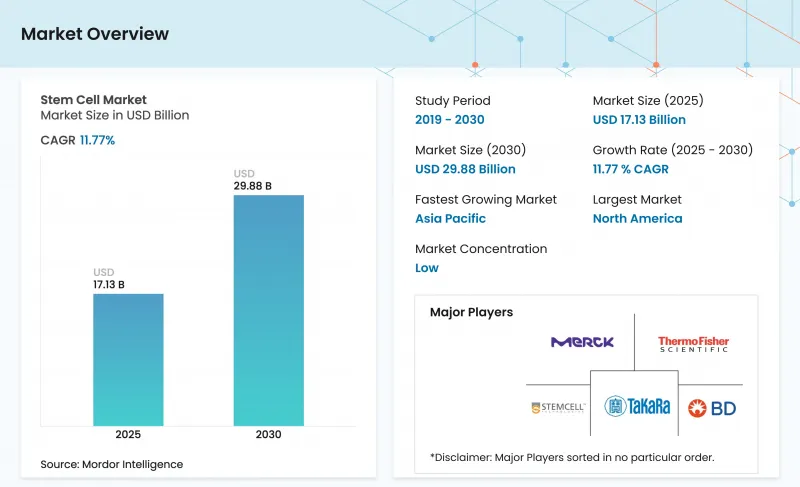
본 보고서는 제품 유형별(성체 줄기세포, 인간 배아 줄기세포, 유도 만능 줄기세포, 기타), 용도별(신경 질환, 정형외과 치료, 기타), 치료 유형별(동종 줄기세포 치료, 기타), 최종 사용자별(학술·연구 기관, 병원·외과 센터, 기타), 지역별로 분류되어 있습니다. 시장 규모와 전망은 금액(달러) 기준으로 제시되어 있습니다.
세계의 줄기세포 시장 동향 및 인사이트
만성 질환 및 퇴행성 질환으로 인한 높은 부담
인구 고령화로 인해 재생의학에 대한 수요가 증가하고 있습니다. 파킨슨병 환자 수는 2050년까지 2,520만 명에 달할 것으로 예측되며, 그 증가분의 89%는 인구 고령화에 기인한 것으로 전망됩니다. 중간엽 줄기세포(MSC)는 염증을 완화하고, 조직 파괴를 억제하며, 회복을 촉진하기 때문에 만성 질환 관리에 있어 비용 대비 효과가 높은 수단으로 자리매김하고 있습니다. 의료 제도에서는 고액의 장기 요양을 미룰 수 있는 치료법으로 예산을 재분배하고 있으며, 이로 인해 MSC 기반 제품의 조달이 증가하고 줄기세포 시장이 강화되고 있습니다.
급속히 확대되는 재생의학 파이프라인
4,000건 이상의 유전자, 세포, RNA 치료법이 개발 중이며, 2024년 초에는 1상 임상시험 프로그램이 11% 증가했습니다. CRISPR 편집 기술은 CAR-T의 성능을 향상시켜 자가면역 질환에 대한 적응증 확대를 가능하게 하고 있습니다. AI를 활용한 분석 기술로 세포 표현형 분석이 자동화되어, 제품 출하 전 검사에 소요되는 시간이 며칠에서 몇 시간으로 단축되었습니다. 임상적 근거도 확대되고 있습니다. 망막 세포 이식을 통해 유의미한 시력 회복이 확인되었으며, iPS 세포 유래 조직 모델은 1형 당뇨병에서 유망한 혈당 조절 효과를 보였습니다. 이러한 진보로 인해 대상 환자층이 확대되면서 줄기세포 시장 전망이 밝아지고 있습니다.
안전성과 유효성에 관한 불확실성
다능성 세포 유형의 경우, 종양 형성 능력과 면역원성이 여전히 주요 우려 사항으로 남아 있습니다. 로트 간 편차가 효능 측정을 복잡하게 만들고 있어, 규제 당국은 감독 체제를 강화해야 하는 상황에 직면해 있습니다. 연구팀은 숙주 조직에 통합되면서도 NK 세포의 감지를 회피하는 면역 회피 기능을 갖춘 이식편을 개발했습니다. 세포 치료에 대한 FDA의 권한을 인정한 제9순회항소법원의 판결은 규정 준수 의무를 명확히 했으나, 개발 기간을 장기화시킬 가능성이 있습니다.
부문 분석
성체 줄기세포는 충분히 입증된 안전성 실적과 폭넓은 치료 적응증 덕분에 2024년 줄기세포 시장 점유율의 55.0%를 차지했습니다. MSC(중간엽 줄기세포)에 특화된 품질 관리 지침에 따라 현재 효능 측정이 표준화되어 임상 현장에서의 광범위한 활용이 촉진되고 있습니다. 정형외과, 심장, 면역학 분야의 각 프로그램이 성숙해짐에 따라 성체 줄기세포 제품 시장 규모는 꾸준히 확대될 것으로 예측됩니다. 한편, iPS 세포는 재프로그래밍 효율 향상과 GMP 생산 능력 확대에 힘입어 연평균 성장률(CAGR) 10.43%로 성장하고 있습니다. 아스펜 뉴로사이언스(Aspen Neuroscience)는 2025년 1월, 파킨슨병 치료제 ‘ANPD001’의 제조를 자동화하여, 폐쇄형 시스템을 통한 워크플로우가 자가 유래 세포의 리드타임을 단축할 수 있음을 입증했습니다. VSEL은 기형종 위험이 없는 다계열 분화 능력을 갖추고 있어 주목을 받고 있습니다(frontiersin.org). 투자자들의 관심은 면역 회피를 위해 설계된 ‘오프더쉘프’ iPS 세포주로 이동하고 있으며, 2030년까지 지속적인 자본 유입이 예상됩니다.
동결 보호제 칵테일의 발전으로 해동 후 세포 사멸이 감소하고 있으며, 성체 줄기세포와 iPSC 유래 세포 모두에서 생존율이 향상되고 있습니다. 규제 당국은 통일된 출하 규격을 권장하고 있으며, 이에 따라 두 제품군 간의 비용 격차는 점차 축소될 것으로 보입니다. 이러한 혁신이 일상적인 진료에 통합됨에 따라, 특히 맞춤형 치료의 신속한 확대가 요구되는 부문에서 줄기세포 시장의 활용 사례는 점차 통합될 것으로 예측됩니다.
2024년, 줄기세포 시장 규모의 23.0%를 정형외과 부문이 차지했으며, 이는 MSC(중간엽 줄기세포) 주사가 퇴행성 관절염의 통증 점수를 개선하고 척추 고정술을 촉진한다는 증거에 뒷받침되고 있습니다. MSC 치료는 재생의학을 활용한 정형외과 치료법 중 가장 높은 통증 완화 지수를 기록했습니다. 고령화에 따라 관절 복원 수요가 증가하고 있어, 이 부문은 계속해서 견조한 성장세를 보일 전망입니다. 한편, 신경 질환 부문은 연평균 성장률(CAGR) 11.23%로 성장할 전망입니다. 도파민 작용성 뉴런의 대체와 관련된 진전으로 인해 파킨슨병 환자 집단에서 측정 가능한 운동 기능 개선이 이루어지고 있습니다. 혈뇌장벽 통과 기술의 향상과 면역 회피형 세포주 개발로 인해 알츠하이머병 및 뇌졸중에 대한 임상 파이프라인이 확대되고 있습니다. 심혈관계 프로그램도 마찬가지로 확대되고 있으며, Cellipont의 cGMP 파트너십은 심장 전구세포 공급을 목표로 하고 있습니다.
임상시험의 다양성도 높아지고 있습니다. 혈액암은 여전히 이식 건수의 주류를 차지하고 있지만, 당뇨병에 대한 β세포 대체 요법은 2상 임상시험 단계에 접어들었습니다. 이러한 동향들이 어우러져 균형 잡힌 용도 구성을 강화하고, 줄기세포 시장 전체의 지속적인 수익 성장을 뒷받침하고 있습니다.
기타 혜택
- 엑셀 형식 시장 예측(ME) 시트
- 3개월간의 애널리스트 지원
자주 묻는 질문
목차
제1장 서론
제2장 조사 방법
제3장 주요 요약
제4장 시장 구도
제5장 시장 규모 및 성장 예측
제6장 경쟁 구도
제7장 시장 기회 및 향후 전망
AJY 26.08.11According to Mordor Intelligence, the stem cell market stands at USD 17.13 billion in 2025 and is projected to reach USD 29.88 billion by 2030, advancing at an 11.77% CAGR.
This report is Segmented by Product Type (Adult Stem Cell, Human Embryonic Cell, Induced Pluripotent Stem Cell, and More), Application (Neurological Disorders, Orthopedic Treatments, and More), Treatment Type (Allogeneic Stem Cell Therapy and More), End User (Academic and Research Institutes, Hospitals and Surgical Centers and More) and Geography. The Market and Forecasts are Provided in Terms of Value (USD).
Global Stem Cell Market Trends and Insights
High Burden of Chronic and Degenerative Diseases
Aging demographics are magnifying demand for regenerative options. Parkinson's disease is forecast to affect 25.2 million people by 2050, with population aging driving 89% of the increase.Mesenchymal stem cells (MSCs) reduce inflammation, inhibit tissue breakdown, and spur repair, positioning them as cost-effective tools for chronic disease management. Health systems are reallocating budgets toward therapies that can defer expensive long-term care, reinforcing procurement of MSC-based products and fortifying the stem cell market.
Rapidly Expanding Regenerative-Medicine Pipeline
More than 4,000 gene, cell, and RNA therapies are in development, and Phase I programs climbed 11% in early 2024. CRISPR editing is boosting CAR-T performance and opening autoimmune indications. AI-enabled analytics now automate cell phenotyping, trimming release testing from days to hours. Clinical evidence is broadening: retinal cell transplants restored meaningful visual acuity, and iPSC-derived constructs demonstrated promising glycemic control in type 1 diabetes. These advances expand addressable populations, lifting the stem cell market outlook.
Safety and Efficacy Uncertainties
Tumorigenicity and immunogenicity remain central concerns for pluripotent cell types. Batch variability complicates potency assays, prompting regulators to reinforce oversight. Research groups have engineered immune-cloaked grafts that evade NK-cell detection while integrating into host tissue. A Ninth Circuit ruling affirming FDA authority over cell therapies clarifies compliance obligations but may lengthen timelines.
Other drivers and restraints analyzed in the detailed report include:
- Favorable Regulatory Acceleration Pathways
- Rising Penetration of Cord-Blood/Tissue Banking
- Restrictive Reimbursement Policies
For complete list of drivers and restraints, kindly check the Table Of Contents.
Segment Analysis
Adult stem cells held 55.0% of stem cell market share in 2024 owing to a well-documented safety record and broad therapeutic latitude. MSC-specific quality control guidelines now standardize potency assays, supporting widespread clinical use. The stem cell market size for adult stem-cell products is projected to grow steadily as orthopedic, cardiac, and immunological programs mature. Conversely, iPSCs are advancing at a 10.43% CAGR, propelled by improved reprogramming efficiency and expanding GMP capacity. Aspen Neuroscience automated production of ANPD001 for Parkinson's disease in January 2025, demonstrating how closed-system workflows can compress autologous lead times. VSELs are gaining attention for multi-lineage potential without teratoma risk frontiersin.org. Investor focus is shifting toward off-the-shelf iPSC lines engineered for immune evasion, indicating sustained capital inflows through 2030.
Advances in cryoprotectant cocktails are reducing post-thaw apoptosis, enhancing viability across both adult and iPSC derivatives. Regulatory bodies encourage harmonized release specifications, which will gradually narrow the cost gap between the two product classes. As these innovations integrate into routine practice, the stem cell market will likely see convergence in use cases, particularly where personalized therapies must scale quickly.
Orthopedic indications represented 23.0% of the stem cell market size in 2024, anchored by evidence that MSC injections improve pain scores in osteoarthritis and promote spinal fusion. MSC therapy recorded the highest pain-reduction coefficient among regenerative orthopedic options.The segment remains resilient as an aging population drives demand for joint repair. Neurological disorders, however, are on track to grow at an 11.23% CAGR. Progress in dopaminergic neuron replacement has yielded measurable motor gains in Parkinson's cohorts. Enhanced blood-brain barrier crossing techniques and immune-cloaked cell lines are widening the clinical pipeline for Alzheimer's disease and stroke. Cardiovascular programs are similarly expanding; Cellipont's cGMP partnership targets cardiac progenitor cell supply.
Clinical trial diversity is rising. Hematologic cancers continue to anchor transplant volumes, while beta-cell replacement for diabetes is entering Phase II evaluation. Together, these trends reinforce a balanced application mix, supporting continuous revenue growth across the stem cell market.
Complete Report Scope:
- By Product Type
- Adult Stem Cells
- Mesenchymal Stem Cells
- Hematopoietic Stem Cells
- Neural Stem Cells
- Human Embryonic Stem Cells
- Induced Pluripotent Stem Cells (iPSCs)
- Very Small Embryonic-like Stem Cells
- Other Product Types (e.g., Cancer Stem Cells)
- Adult Stem Cells
- By Application
- Neurological Disorders
- Orthopedic Treatments
- Oncology Disorders
- Cardiovascular and Myocardial Infarction
- Diabetes and Metabolic Disorders
- Wounds and Burns
- Other Applications
- By Treatment Type
- Allogeneic Stem Cell Therapy
- Autologous Stem Cell Therapy
- Syngeneic Stem Cell Therapy
- By End User
- Academic & Research Institutes
- Hospitals and Surgical Centers
- Pharmaceutical and Biotechnology Companies
- Stem Cell Banks and Cryopreservation Facilities
- Contract Development and Manufacturing Organizations (CDMOs)
- Geography
- North America
- United States
- Canada
- Mexico
- Europe
- Germany
- United Kingdom
- France
- Italy
- Spain
- Rest of Europe
- Asia-Pacific
- China
- Japan
- India
- South Korea
- Australia
- Rest of Asia-Pacific
- Middle East & Africa
- GCC
- South Africa
- Rest of Middle East & Africa
- South America
- Brazil
- Argentina
- Rest of South America
- North America
List of Companies Covered in this Report:
- ATCC
- Thermo Fisher Scientific
- Merck
- Stem Cell Technologies
- Takara Bio
- Miltenyi Biotec
- Pluri Inc.
- AllCells
- International Plastics
- ReNeuron Group
- Bio-Techne Corp.
- Gamida Cell Ltd.
- Fate Therapeutics Inc.
- Cynata Therapeutics
- BioRestorative Therapies Inc.
- BrainStorm Cell
- Lineage Cell Therapeutics
- Regenexx LLC
- Orchard Therapeutics plc
- Mesoblast
- Athersys
- Medipost Co. Ltd.
- PromoCell
Additional Benefits:
- The market estimate (ME) sheet in Excel format
- 3 months of analyst support
TABLE OF CONTENTS
1 Introduction
- 1.1 Study Assumptions and Market Definition
- 1.2 Scope of the Study
2 Research Methodology
3 Executive Summary
4 Market Landscape
- 4.1 Market Overview
- 4.2 Market Drivers
- 4.2.1 High Burden of Chronic and Degenerative Diseases
- 4.2.2 Rapidly Expanding Regenerative-Medicine Pipeline
- 4.2.3 Favorable Regulatory Acceleration Pathways
- 4.2.4 Rising Penetration of Public and Private Cord-blood/Tissue Banking and Personalized-Medicine Programs
- 4.2.5 Technology Breakthroughs Enabling Off-the-Shelf Therapies
- 4.2.6 Intesifying Colloboration Among Market Players for Innovation and Development in The Field
- 4.3 Market Restraints
- 4.3.1 Safety and Efficacy Uncertainties Associated with Therapies
- 4.3.2 Restrictive Reimbursement Policies
- 4.3.3 Manufacturing Scale Challenges and High Cost of Products and Procedures
- 4.3.4 Ethical and Policy Divergence Due to Persistent Moral Concerns
- 4.4 Value / Supply-Chain Analysis
- 4.5 Regulatory Outlook
- 4.6 Technological Outlook
- 4.7 Porter's Five Forces Analysis
- 4.7.1 Threat of New Entrants
- 4.7.2 Bargaining Power of Buyers
- 4.7.3 Bargaining Power of Suppliers
- 4.7.4 Threat of Substitutes
- 4.7.5 Intensity of Competitive Rivalry
5 Market Size and Growth Forecasts (Value-USD)
- 5.1 By Product Type
- 5.1.1 Adult Stem Cells
- 5.1.1.1 Mesenchymal Stem Cells
- 5.1.1.2 Hematopoietic Stem Cells
- 5.1.1.3 Neural Stem Cells
- 5.1.2 Human Embryonic Stem Cells
- 5.1.3 Induced Pluripotent Stem Cells (iPSCs)
- 5.1.4 Very Small Embryonic-like Stem Cells
- 5.1.5 Other Product Types (e.g., Cancer Stem Cells)
- 5.1.1 Adult Stem Cells
- 5.2 By Application
- 5.2.1 Neurological Disorders
- 5.2.2 Orthopedic Treatments
- 5.2.3 Oncology Disorders
- 5.2.4 Cardiovascular and Myocardial Infarction
- 5.2.5 Diabetes and Metabolic Disorders
- 5.2.6 Wounds and Burns
- 5.2.7 Other Applications
- 5.3 By Treatment Type
- 5.3.1 Allogeneic Stem Cell Therapy
- 5.3.2 Autologous Stem Cell Therapy
- 5.3.3 Syngeneic Stem Cell Therapy
- 5.4 By End User
- 5.4.1 Academic & Research Institutes
- 5.4.2 Hospitals and Surgical Centers
- 5.4.3 Pharmaceutical and Biotechnology Companies
- 5.4.4 Stem Cell Banks and Cryopreservation Facilities
- 5.4.5 Contract Development and Manufacturing Organizations (CDMOs)
- 5.5 Geography
- 5.5.1 North America
- 5.5.1.1 United States
- 5.5.1.2 Canada
- 5.5.1.3 Mexico
- 5.5.2 Europe
- 5.5.2.1 Germany
- 5.5.2.2 United Kingdom
- 5.5.2.3 France
- 5.5.2.4 Italy
- 5.5.2.5 Spain
- 5.5.2.6 Rest of Europe
- 5.5.3 Asia-Pacific
- 5.5.3.1 China
- 5.5.3.2 Japan
- 5.5.3.3 India
- 5.5.3.4 South Korea
- 5.5.3.5 Australia
- 5.5.3.6 Rest of Asia-Pacific
- 5.5.4 Middle East & Africa
- 5.5.4.1 GCC
- 5.5.4.2 South Africa
- 5.5.4.3 Rest of Middle East & Africa
- 5.5.5 South America
- 5.5.5.1 Brazil
- 5.5.5.2 Argentina
- 5.5.5.3 Rest of South America
- 5.5.1 North America
6 Competitive Landscape
- 6.1 Market Concentration
- 6.2 Strategic Moves
- 6.3 Market Share Analysis
- 6.4 Company profiles (includes Global level Overview, Market level overview, Core Segments, Financials as available, Strategic Information, Market Rank/Share for key companies, Products and Services, and Recent Developments)
- 6.4.1 ATCC
- 6.4.2 Thermo Fisher Scientific Inc.
- 6.4.3 Merck KGaA
- 6.4.4 STEMCELL Technologies
- 6.4.5 Takara Bio Inc.
- 6.4.6 Miltenyi Biotec
- 6.4.7 Pluri Inc.
- 6.4.8 AllCells LLC
- 6.4.9 International Stem Cell Corp.
- 6.4.10 ReNeuron Group plc
- 6.4.11 Bio-Techne Corp.
- 6.4.12 Gamida Cell Ltd.
- 6.4.13 Fate Therapeutics Inc.
- 6.4.14 Cynata Therapeutics Ltd
- 6.4.15 BioRestorative Therapies Inc.
- 6.4.16 BrainStorm Cell Therapeutics
- 6.4.17 Lineage Cell Therapeutics
- 6.4.18 Regenexx LLC
- 6.4.19 Orchard Therapeutics plc
- 6.4.20 Mesoblast Ltd
- 6.4.21 Athersys Inc.
- 6.4.22 Medipost Co. Ltd.
- 6.4.23 PromoCell GmbH
7 Market Opportunities and Future Outlook
- 7.1 White-space and Unmet-Need Assessment


