

|
시장보고서
상품코드
2100527
감염 감시 솔루션 시장 : 시장 점유율 분석, 업계 동향 및 통계, 성장 예측(2026-2031년)Infection Surveillance Solutions - Market Share Analysis, Industry Trends & Statistics, Growth Forecasts (2026 - 2031) |
||||||
 Mordor Intelligence
Mordor Intelligence에 의하면, 감염 감시 솔루션 시장 규모는 2025년 9억 1,000만 달러로 평가되었고, 2026년에는 10억 3,000만 달러로 확대될 것으로 추정되고, 2026-2031년 CAGR 13.05%로 성장을 지속할 전망이며, 2031년에는 19억 달러에 이를 것으로 예측됩니다.
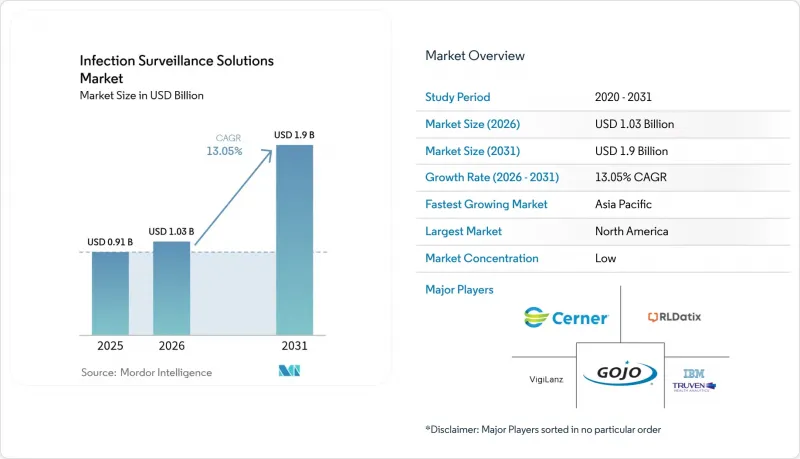
본 보고서는 유형별(수술 부위 감염, 혈류 감염, 카테터 관련 요로 감염, 인공호흡기 관련 폐렴), 제공 방식별(소프트웨어 및 서비스), 배포 모델별(온프레미스·클라우드), 최종 사용자별(병원, 장기 요양 시설, 외래수술센터(ASC) 등), 지역별로 분류되어 있습니다. 시장 전망은 금액(달러) 기준으로 제시되어 있습니다.
세계의 감염 감시 솔루션 시장 동향 및 인사이트
병원 내 감염 발생률 상승과 엄격한 규제
의료 관련 감염(HAI)은 미국 병원에 연간 250억-450억 달러의 비용을 발생시키고 있으며, 감시 시스템에 대한 투자는 경제적 필수가 되었습니다. CMS(미국 의료보험서비스센터)는 2025 회계연도 규정 세트에서 카테터 관련 요로감염 및 중심정맥카테터 관련 감염에 대한 새로운 품질 지표를 확정했습니다. 또한, 유럽 헬스 데이터 스페이스(European Health Data Space)에서는 2029년까지 27개 회원국 전체에서 표준화된 감염병 보고가 의무화될 예정입니다. 독일 의료기관의 사례는 그 효과를 여실히 보여주고 있습니다. 병원 내 감염을 단 1건만 예방해도 12일분의 추가 입원 일수를 피할 수 있으며, 390-650유로의 추가 수익이 예상됩니다. 제재 조치가 엄격해지는 가운데, 감염 감시 솔루션 시장은 더 이상 선택 사항이 아닌 필수적인 인프라로 자리 잡고 있습니다.
정부의 제재 및 환급 제도 개혁
CMS(미국 의료보험서비스센터)의 ‘병원 내 감염 감축 프로그램’에서는 성적이 최하위 4분위에 속하는 병원에 대해 지급액의 1% 삭감을 부과하고 있어, 수익을 감염 지표와 직접 연계하고 있습니다. 2024년 11월부터 시행되는 새로운 참여 규정에 따라 호흡기 질환에 대한 주간 보고 의무가 확대됨에 따라, 의료 기관은 보고를 자동화할 수밖에 없으며, 그렇지 않을 경우 메디케어로부터의 지급을 받지 못하게 됩니다. 일본의 유사한 제도에서는 인증된 전자건강기록(EHR)과 감시 시스템의 연동이 보상액 인상의 조건으로 설정되어 있습니다. ‘제재 또는 지급’이라는 역학 관계로 인해 급성기 및 급성기 후 의료 현장을 불문하고 감염 감시 솔루션 도입에 대한 예측 가능한 수요가 발생하고 있습니다.
소규모 시설의 고액 초기 비용
기본적인 EMR 도입에는 여전히 의료 종사자 1인당 1만 3,100달러가 필요하며, 모든 기능을 갖춘 감시 시스템을 도입하면 연간 5만 달러가 추가로 소요되므로 지방 병원 입장에서는 부담스러운 금액입니다. 그렇지만, 병원 내 감염 예방 및 진료비 적정 청구를 통해 5년간의 순이익은 8만 6,400달러에 달할 전망입니다. 현재 심의 중인 미국 법안은 지방 병원의 도입을 지원하는 것을 목적으로 하고 있으며, 한편 클라우드 기반 SaaS(Software-as-a-Service) 서비스는 비용을 이용량에 따라 조정할 수 있어 감염증 감시 솔루션 시장 진입을 용이하게 하고 있습니다.
부문 분석
2025년에는 수술 부위 감염이 4억 7,000만 달러 시장 규모를 차지했으며, 감염 감시 솔루션 시장에서 가장 큰 점유율을 기록했습니다. CMS(미국 의료보험센터)의 제재 제도 및 공개 보고 제도에 따라 수술 관련 지표는 경영진의 대시보드에 지속적으로 표시되고 있으며, 주술기 모니터링 모듈에 대한 투자가 유지되고 있습니다. AI를 활용한 영상 및 생체 신호 분석 도구는 현재 상처 악화를 몇 시간 이내에 감지할 수 있게 되어, 규정 준수 향상과 재입원 위험 감소에 기여하고 있습니다. 대조적으로, 혈류 감염은 시장 규모는 작지만, 머신러닝을 통한 패혈증 예측 모델에 지속적인 생리학적 데이터 스트림이 공급되고 있어 13.45%라는 가장 높은 연평균 성장률(CAGR)을 기록하고 있습니다. 검증 연구를 통해 사망률이 26% 감소하는 것으로 입증됨에 따라, 혈류 모니터링용 감염 모니터링 솔루션 시장 규모는 2031년까지 4억 4,000만 달러에 달할 것으로 예측됩니다. 카테터 관련 요로 감염이나 인공호흡기 관련 폐렴 등 기타 부문에서는 기기 사용 현황 점검 및 준수 알림을 실시간으로 제공하는 병상용 대시보드가 활용되고 있습니다.
임상적 우선순위의 차이가 공급업체의 로드맵을 좌우하고 있습니다. 수술 부위용 모듈에서는 수술실 일정 연동 및 항생제 예방 투여 타이머가 중시되는 반면, 혈류 감염용 모듈은 실시간 검사 배양 결과 및 항생제 적정 사용 관리 도구를 중심으로 전개되고 있습니다. 새롭게 등장하고 있는 전장 유전체 시퀀싱과의 연동을 통해 경계가 모호해지며, 감염 유형별로 병원체의 계통을 중첩하여 표시하는 통합 대시보드가 가능해질 것입니다. 그럼에도 불구하고 2031년까지는 병원이 개별 분석 패키지에 대한 라이선스를 취득할 것으로 예상되며, 감염 감시 솔루션 시장은 계속해서 유형별 수익원을 창출해 나갈 것입니다.
소프트웨어 플랫폼은 2025년에 총 매출의 67.25%를 차지한 것으로 평가되었으며, 의료 시스템이 통합형 EHR 플러그인을 선호하는 경향이 있어 계속해서 대부분의 RFP(제안 요청서)의 핵심을 이루고 있습니다. 시장을 선도하는 기업들은 감염 관리 팀이 프로그래머의 지원 없이도 경보 임계값을 조정할 수 있도록 로우코드 구성에 대한 투자를 확대되고 있습니다. 한편, 의료 기관 측에서 규칙 조정, 보고서 작성, AI 모델 재학습을 외부에 위탁하는 경향이 강해짐에 따라 서비스 매출은 14.2%라는 더 빠른 속도로 성장하고 있습니다. 매니지드 서비스 제공업체들은 연중무휴 24시간 모니터링, 규제 업데이트, 분석 인력을 패키지로 묶어 자원이 제한적인 세이프티넷 병원에 어필하고 있습니다. 그 결과, 서비스 기반 감염 감시 솔루션 시장 규모는 2031년까지 6억 8,000만 달러에 육박할 가능성이 있으며, 기존의 ‘제품 대 서비스’라는 구분이 점차 모호해지고 있습니다.
벤더들의 전략으로는 HAI(병원 내 감염) 벤치마크 실적에 따라 월 이용료가 변동되는 성과 연계형 계약을 패키지화하는 움직임이 점점 더 강해지고 있습니다. 이러한 변화로 인해 병원의 대차대조표에서 리스크가 제거되는 동시에, 공급업체에게는 지속적인 수익이 보장됩니다. 앞으로 ‘플랫폼+서비스’형 구독 모델로의 전환이 더욱 가속화되어, 감염 감시 솔루션 시장 전체에서 롱테일 가치 확보가 확고해질 것으로 예측됩니다.
지역별 분석
북미는 2025년 매출의 37.60%를 차지했습니다. 이는 모든 급성기 의료시설에 대해 인증된 전자 감시 시스템의 유지를 의무화하는 NHSN(전미 병원 감염 감시 네트워크)에 대한 보고 의무와 CMS(미국 의료보험·의료서비스센터)의 환급 조치에 힘입은 결과입니다. 2024년 11월에 시행된 연방 규정에 따라 병원은 매주 COVID-19, 인플루엔자, RSV 감염자 수를 업로드해야 하며, 이로 인해 자동화 플랫폼에 대한 수요가 확고해지고 있습니다. 미국의 주요 통합 의료 네트워크(IDN)에서 주목받고 있는 AI 시범 프로젝트는 동종 업계의 도입을 촉진하고, 예산 위원회에 대한 ROI(투자 수익률) 산정을 뒷받침하고 있습니다.
아시아태평양은 일본, 중국, 한국이 클라우드 네이티브 도입을 통해 기존 아키텍처를 획기적으로 혁신하고 있어, 2031년까지의 연평균 성장률(CAGR)이 13.1%로 가장 높습니다. 일본의 초고령화 사회는 노동 부담을 줄여주는 모니터링 시스템의 가치 제안을 더욱 높이고 있는 반면, 중국에서는 하향식 디지털화 추진을 통해 2급 도시에서도 전자건강기록(EHR) 노드에 대한 자금 지원이 이루어지고 있습니다. 원격의료 및 재택병원 모델에 대한 사모펀드(PE)의 유입은 감염 감시 솔루션 시장을 더욱 확대시키고 있습니다. 이는 원격 진료 워크플로우에서도 여전히 감염 위험 감시가 필요하기 때문입니다.
유럽에서는 ‘유럽 건강 데이터 공간(EHDS)’을 배경으로 꾸준한 진전이 나타나고 있습니다. EHDS는 2029년까지 상호 운용 가능한 전자건강기록(EHR)과 국경을 초월한 감염병 보고를 의무화하고 있으며, 이 기한으로 인해 조달 주기가 가속화되고 있습니다. 엄격한 GDPR(EU 개인정보보호규정)(일반 데이터 보호 규정)의 규정에 따라, 익명화 기능과 안전한 처리 구역을 통합한 플랫폼에 대한 수요가 증가하고 있으며, EU 10개국에서 시행되고 있는 ‘폐수와 유전체 분석을 결합한’ 시범 사업은 병원체 모니터링에 대한 해당 지역의 통합적이고 다중 모드 접근 방식을 입증하고 있습니다.
기타 혜택 :
- 엑셀 형식 시장 예측(ME) 시트
- 3개월간의 애널리스트 지원
자주 묻는 질문
목차
제1장 서론
제2장 조사 방법
제3장 주요 요약
제4장 시장 구도
제5장 시장 규모 및 성장 예측
제6장 경쟁 구도
제7장 시장 기회 및 향후 전망
AJY 26.08.11According to Mordor Intelligence, the infection surveillance solutions market size is expected to grow from USD 0.91 billion in 2025 to USD 1.03 billion in 2026 and is forecast to reach USD 1.9 billion by 2031 at 13.05% CAGR over 2026-2031.
This report is Segmented by Type (Surgical-Site Infections, Blood-Stream Infections, Catheter-Associated UTIs, and Ventilator-Associated Pneumonia), Offering (Software and Services), Deployment Model (On-Premise and Cloud), End User (Hospitals, Long-Term Care Facilities, Ambulatory Surgery Centers, and More), and Geography. The Market Forecasts are Provided in Terms of Value (USD).
Global Infection Surveillance Solutions Market Trends and Insights
Rising Incidence of HAIs and Stringent Regulation
Healthcare-associated infections cost U.S. hospitals USD 25-45 billion a year, making surveillance investment an economic imperative. CMS finalized fresh quality measures for catheter-associated UTIs and central-line infections in its FY 2025 rule set, and the European Health Data Space will require standardized infection reporting across 27 member states by 2029. German facilities illustrate the payoff: preventing a single nosocomial episode can avoid 12 added bed-days and generate EUR 390-650 in incremental revenue. As penalties tighten, the infection surveillance solutions market becomes non-discretionary infrastructure.
Government Penalties and Reimbursement Reforms
CMS's Hospital-Acquired Condition Reduction Program imposes 1% payment cuts on the worst-performing quartile of hospitals, linking revenue directly to infection metrics. New participation rules effective November 2024 extend mandatory weekly respiratory-illness uploads, forcing institutions to automate reporting or forfeit Medicare dollars. Parallel frameworks in Japan attach reimbursement uplifts to certified EHR and surveillance connectivity. The penalty-or-pay dynamic generates predictable demand for infection surveillance solutions market deployments across acute and post-acute settings.
High Up-Front Costs for Smaller Facilities
Basic EMR deployments still demand USD 13,100 per provider and full-featured surveillance can add USD 50,000 annually-tough numbers for rural hospitals. Nonetheless, five-year net benefits reach USD 86,400 via avoided HAIs and charge capture. Pending U.S. legislation aims to subsidize rural adoption, while cloud Software-as-a-Service offerings align spend with usage, easing entry into the infection surveillance solutions market.
Other drivers and restraints analyzed in the detailed report include:
- Rapid EHR Adoption Enabling Seamless Data Feeds
- Migration to Cloud-Based Surveillance Platforms
- Clinical Workflow Resistance to New IT Systems
For complete list of drivers and restraints, kindly check the Table Of Contents.
Segment Analysis
Surgical-site infections contributed USD 0.47 billion in 2025, representing the largest slice of the infection surveillance solutions market. CMS penalty structures and public reporting keep surgical metrics in executive dashboards, sustaining investment in perioperative surveillance modules. AI-augmented image and vital-sign analyzers now flag wound deterioration within hours, enhancing compliance and trimming readmission risks. In contrast, blood-stream infections generated a smaller base but clock the highest 13.45% CAGR thanks to continuous physiological data streams that feed machine-learning sepsis predictors. The infection surveillance solutions market size for blood-stream monitoring is projected to hit USD 0.44 billion by 2031 as validation studies prove 26% mortality reduction. Other categories such as catheter-associated UTIs and ventilator-associated pneumonia benefit from device usage audits and bedside dashboards that push adherence reminders in real time.
Clinical priority differences steer vendor road maps. Surgical-site modules emphasize operating-room scheduling links and antimicrobial prophylaxis timers, while blood-stream modules pivot around real-time lab cultures and antibiotic stewardship tools. Emerging whole-genome sequencing tie-ins will likely blur boundaries, enabling unified dashboards that overlay pathogen lineage on infection type. Still, hospitals are expected to license separate analytic bundles through 2031, ensuring the infection surveillance solutions market continues to generate type-specific revenue streams.
Software platforms delivered 67.25% of overall revenue in 2025 and continue to anchor most RFPs due to health systems' preference for integrated EHR plug-ins. Market leaders invest in low-code configurations so infection-control teams can tweak alert thresholds without programmer support. Yet services revenue rises at a faster 14.2% clip as facilities outsource rule tuning, report generation, and AI model retraining. Managed-service providers package 24/7 monitoring, regulatory updates, and analytics talent, appealing to resource-strained safety-net hospitals. As a result, the infection surveillance solutions market size attributable to services may near USD 0.68 billion by 2031, blurring the classic product-versus-services distinction.
Vendor strategies increasingly bundle outcome-based contracts in which monthly fees flex with performance on HAI benchmarks. That shift moves risk off hospital balance sheets while guaranteeing recurring revenue for suppliers. Expect further migration toward platform-plus-service subscriptions, solidifying long-tail value capture across the infection surveillance solutions market.
Complete Report Scope:
- By Type
- Surgical-Site Infections
- Blood-Stream Infections
- Catheter-Associated UTIs
- Ventilator-Associated Pneumonia
- By Offering
- Software
- Services
- By Deployment Model
- On-Premise
- Cloud
- By End User
- Hospitals
- Long-term Care Facilities
- Ambulatory Surgery Centers
- Public-Health and Reference Labs
- By Geography
- North America
- United States
- Canada
- Mexico
- Europe
- Germany
- United Kingdom
- France
- Italy
- Spain
- Rest of Europe
- Asia-Pacific
- China
- Japan
- India
- South Korea
- Australia
- Rest of Asia-Pacific
- South America
- Brazil
- Argentina
- Rest of South America
- Middle East and Africa
- Middle East
- Saudi Arabia
- United Arab Emirates
- Turkey
- Rest of Middle East
- Africa
- South Africa
- Egypt
- Nigeria
- Rest of Africa
- Middle East
- North America
Geography Analysis
North America generated 37.60% of 2025 revenue, underpinned by mandatory NHSN reporting and CMS reimbursement levers that compel every acute-care facility to maintain certified electronic surveillance. Federal rules effective November 2024 now require hospitals to upload weekly COVID-19, influenza, and RSV counts, cementing demand for automated platforms. High-profile AI pilots across leading U.S. IDNs stimulate peer adoption and validate ROI calculations for budget committees.
Asia-Pacific records the highest 13.1% CAGR through 2031 as Japan, China, and South Korea leapfrog legacy architectures with cloud-native deployments. Japan's super-aged demographics amplify the value proposition for labor-saving surveillance, while China's top-down digitization funds EHR nodes even in tier-2 cities. Private equity flows into telehealth and hospital-at-home models further expand the infection surveillance solutions market because remote-care workflows still require infection-risk oversight.
Europe advances steadily on the back of the European Health Data Space. EHDS mandates interoperable EHRs and cross-border infection reporting by 2029, a deadline accelerating procurement cycles. Strict GDPR rules elevate demand for platforms with embedded anonymization and secure-processing zones, and wastewater-plus-genomic pilots across 10 EU nations showcase the region's integrated, multi-modal approach to pathogen monitoring.
- Becton, Dickinson and Company
- Cerner Corporation
- Wolters Kluwer N.V. (Sentri7)
- Premier Inc. (Theradoc)
- IBM Corporation (Truven)
- VigiLanz Corporation
- Epic Systems Corporation
- RL Datix Ltd
- Baxter International Inc. (ICNet)
- Gojo Industries Inc.
- Ecolab Inc.
- Ocean Health Systems (Multiprac)
- Inovalon (VigiLanz)
- PINC AI
- Meditech Surveillance
- SafetySpect
- PDI Healthcare
- 6sense (BioFire Link)
Additional Benefits:
- The market estimate (ME) sheet in Excel format
- 3 months of analyst support
TABLE OF CONTENTS
1 INTRODUCTION
- 1.1 Study Assumptions and Market Definition
- 1.2 Scope of the Study
2 RESEARCH METHODOLOGY
3 EXECUTIVE SUMMARY
4 MARKET LANDSCAPE
- 4.1 Market Overview
- 4.2 Market Drivers
- 4.2.1 Rising incidence of HAIs and stringent regulation
- 4.2.2 Government penalties and reimbursement reforms
- 4.2.3 Rapid EHR adoption enabling seamless data feeds
- 4.2.4 Migration to cloud-based surveillance platforms
- 4.2.5 AI-driven predictive analytics for antimicrobial stewardship
- 4.2.6 Real-time syndromic surveillance against emerging pathogens
- 4.3 Market Restraints
- 4.3.1 High up-front costs for smaller facilities
- 4.3.2 Clinical workflow resistance to new IT systems
- 4.3.3 Interoperability gaps across disparate data standards
- 4.3.4 Heightened cyber-security and privacy concerns for cloud
- 4.4 Value Chain Analysis
- 4.5 Regulatory Landscape
- 4.6 Technological Outlook
- 4.7 Porter's Five Forces Analysis
- 4.7.1 Bargaining Power of Suppliers
- 4.7.2 Bargaining Power of Consumers
- 4.7.3 Threat of New Entrants
- 4.7.4 Threat of Substitute Products
- 4.7.5 Intensity of Competitive Rivalry
- 4.8 Assessment of the Impact of Macroeconomic Trends on the Market
5 MARKET SIZE AND GROWTH FORECASTS (VALUE)
- 5.1 By Type
- 5.1.1 Surgical-Site Infections
- 5.1.2 Blood-Stream Infections
- 5.1.3 Catheter-Associated UTIs
- 5.1.4 Ventilator-Associated Pneumonia
- 5.2 By Offering
- 5.2.1 Software
- 5.2.2 Services
- 5.3 By Deployment Model
- 5.3.1 On-Premise
- 5.3.2 Cloud
- 5.4 By End User
- 5.4.1 Hospitals
- 5.4.2 Long-term Care Facilities
- 5.4.3 Ambulatory Surgery Centers
- 5.4.4 Public-Health and Reference Labs
- 5.5 By Geography
- 5.5.1 North America
- 5.5.1.1 United States
- 5.5.1.2 Canada
- 5.5.1.3 Mexico
- 5.5.2 Europe
- 5.5.2.1 Germany
- 5.5.2.2 United Kingdom
- 5.5.2.3 France
- 5.5.2.4 Italy
- 5.5.2.5 Spain
- 5.5.2.6 Rest of Europe
- 5.5.3 Asia-Pacific
- 5.5.3.1 China
- 5.5.3.2 Japan
- 5.5.3.3 India
- 5.5.3.4 South Korea
- 5.5.3.5 Australia
- 5.5.3.6 Rest of Asia-Pacific
- 5.5.4 South America
- 5.5.4.1 Brazil
- 5.5.4.2 Argentina
- 5.5.4.3 Rest of South America
- 5.5.5 Middle East and Africa
- 5.5.5.1 Middle East
- 5.5.5.1.1 Saudi Arabia
- 5.5.5.1.2 United Arab Emirates
- 5.5.5.1.3 Turkey
- 5.5.5.1.4 Rest of Middle East
- 5.5.5.2 Africa
- 5.5.5.2.1 South Africa
- 5.5.5.2.2 Egypt
- 5.5.5.2.3 Nigeria
- 5.5.5.2.4 Rest of Africa
- 5.5.5.1 Middle East
- 5.5.1 North America
6 COMPETITIVE LANDSCAPE
- 6.1 Market Concentration
- 6.2 Strategic Moves
- 6.3 Market Share Analysis
- 6.4 Company Profiles (includes Global level Overview, Market level overview, Core Segments, Financials as available, Strategic Information, Market Rank/Share, Products and Services, Recent Developments)
- 6.4.1 Becton, Dickinson and Company
- 6.4.2 Cerner Corporation
- 6.4.3 Wolters Kluwer N.V. (Sentri7)
- 6.4.4 Premier Inc. (Theradoc)
- 6.4.5 IBM Corporation (Truven)
- 6.4.6 VigiLanz Corporation
- 6.4.7 Epic Systems Corporation
- 6.4.8 RL Datix Ltd
- 6.4.9 Baxter International Inc. (ICNet)
- 6.4.10 Gojo Industries Inc.
- 6.4.11 Ecolab Inc.
- 6.4.12 Ocean Health Systems (Multiprac)
- 6.4.13 Inovalon (VigiLanz)
- 6.4.14 PINC AI
- 6.4.15 Meditech Surveillance
- 6.4.16 SafetySpect
- 6.4.17 PDI Healthcare
- 6.4.18 6sense (BioFire Link)
7 MARKET OPPORTUNITIES AND FUTURE OUTLOOK
- 7.1 White-space and Unmet-need Assessment


