

|
시장보고서
상품코드
2100544
부유식 원유 생산저장하역설비(FPSO) 시장 : 점유율 분석, 업계 동향 및 통계, 성장 예측(2026-2031년)Floating Production Storage and Offloading (FPSO) - Market Share Analysis, Industry Trends & Statistics, Growth Forecasts (2026 - 2031) |
||||||
 Mordor Intelligence
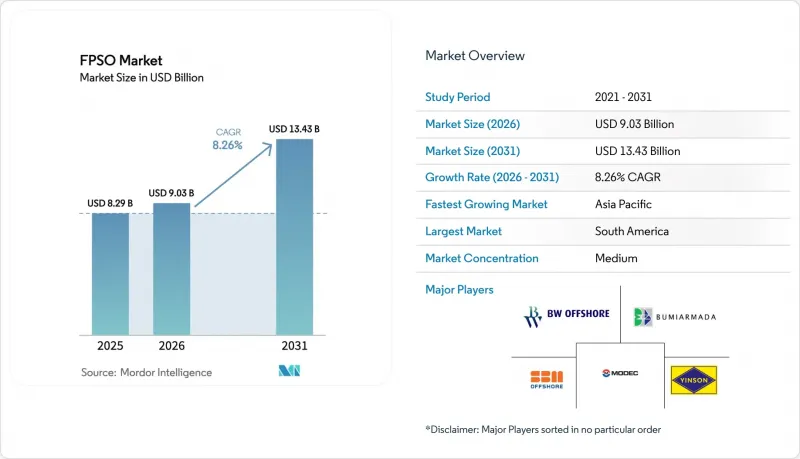
부유식 원유 생산저장하역설비(FPSO) 시장 규모는 2025년에 82억 9,000만 달러로 평가되었고 2026년 90억 3,000만 달러에서 2031년까지 134억 3,000만 달러에 이를 것으로 추정되고 있어 예측 기간(2026-2031년) CAGR은 8.26%를 나타낼 전망입니다.
본 보고서는 유형별(개조 유조선 및 전용 건조), 선체 유형별(이중 선체 및 단일 선체), 추진 방식별(자항식 FPSO 및 예인식 FPSO), 수심별(얕은 해역, 깊은 해역, 초심해역), 저장 용량별(100만 배럴 미만, 100만-200만 배럴, 200만 배럴 이상), 처리 능력(원유용 FPSO, 가스용 FPSO, 하이브리드), 지역(북미, 유럽, 아시아태평양, 기타)별로 분류되어 있습니다.
전 세계 부유식 원유 생산저장하역설비(FPSO) 시장 동향 및 인사이트
팬데믹 이후 심해 프로젝트의 최종 투자 결정(FID) 회복
페트로브라스는 2025년에 총액 180억 달러 상당의 프리솔트층용 FPSO 4척의 건설을 승인했습니다. 한편, 엑슨모빌은 가이아나의 스타브로크 블록에서 일일 25만 배럴의 처리 능력을 갖춘 유닛 3기의 건설을 승인했습니다. 이는 2020년부터 2021년까지 전 세계적으로 7건의 계약이 체결되었던 상황과 현저한 대조를 이룹니다. 사전 설계된 선체 프로그램을 통해 의사결정 주기가 36개월에서 24개월로 단축되어, 계약업체의 초기 단계 현금 흐름 전망이 개선되었습니다. 모듈식 탑사이드(topside)는 향후 탄소 포집 장치를 추가할 수 있는 공간을 확보하여, 현재 예산과 향후 규제 준수의 균형을 맞추고 있습니다. 손익분기점이 배럴당 35-40달러 수준에 위치해 있어, 심해 유전은 가격 변동으로부터 운영사의 수익성을 보호합니다. 그 결과 발생한 수주 잔고는 2028년까지 조선소의 가동률을 보장하며, 부유식 원유 생산저장하역설비(FPSO) 시장에 대한 신뢰를 뒷받침하고 있습니다.
육상 매장량의 고갈로 인해 설비 투자가 해양으로 이동
성숙기에 접어든 육상 유전들은 현재 연간 6-8%의 감산 추세를 보이고 있으며, 생산량이 향후 20년간 정체될 것으로 예상되는 해양 광구로 자본이 이동하고 있습니다. 사우디 아람코는 2023년 22%에서 2028년까지 업스트림 부문 지출의 35%를 해상 자산에 할당할 방침입니다. 셰브론의 멕시코만 FPSO는 이미 해당 회사의 총 생산량의 18%를 차지하고 있어, 이러한 전환이 영구적인 것임을 뒷받침하고 있습니다. 페트로나스도 이에 발맞추어, 고정식 플랫폼 도입이 경제성이 떨어지는 1억 배럴 미만의 한계 유전을 대상으로 3기의 FPSO를 발주했습니다. 이러한 투자처 전환으로 인해 육상 셰일 생산의 효율이 향상되고 있음에도 불구하고, 부유식 원유 생산저장하역설비(FPSO) 시장의 장기적인 수요는 유지되고 있습니다.
고액의 초기 설비 투자(CAPEX)와 긴 리드타임
전용으로 건조된 유닛에는 15억-35억 달러의 비용과 4-5년의 건설 기간이 필요하며, 이는 소규모 운영사의 재무 상황에 큰 부담이 되고 있습니다. 기존 선박을 개조하여 FPSO로 전환할 경우 비용을 6억-12억 달러로 절감할 수 있지만, 그래도 30-36개월이 소요되므로 프로젝트는 상품 가격 변동 및 금리 상승 위험에 노출됩니다. 금리 상승으로 인해 2025년에는 가중평균자본비용이 7.5%에서 9.2%로 상승했습니다. 철강 가격 변동으로 인해 도급업체는 가격 상승 조항을 채택할 수밖에 없게 되어 예산 수립이 더욱 복잡해지고 있습니다. 이러한 동향으로 인해 단기적인 성장은 둔화되고 있지만, 리스 모델이 이러한 장벽을 부분적으로 상쇄하고 있습니다.
부문 분석
개조 유조선은 설비 투자를 30-40% 절감할 수 있다는 점과 리드타임이 12-18개월로 짧다는 장점 덕분에, 2025년 부유식 원유 생산저장하역설비(FPSO) 시장 규모에서 매출의 65.1%를 차지했습니다. 단동선 해체가 가속화됨에 따라 VLCC 공급이 부족해지고 있어 향후 개조는 억제될 전망이지만, 기존 선박의 재배치로 인해 단기적인 수요는 계속해서 견조한 추세를 보이고 있습니다. 연평균 성장률(CAGR) 9.7%로 확대되고 있는 전용 설계 선체는 개조 선박으로는 경제적으로 대응할 수 없는 2,000톤을 초과하는 초심해 구조 하중을 충족합니다. 페트로브라스의 ‘Mero-5’는 수심 2,200미터에서의 운항을 실현하기 위해 강화된 선체와 350만 배럴의 저장 용량을 결합한 것으로, 신조선의 필요성을 보여주고 있습니다.
중기적으로는 SBM 오프쇼어의 ‘Fast4Ward’와 같은 하이브리드형 접근 방식이 주목받고 있습니다. 이는 중국에서 표준화된 선체를 제조한 후 상부 구조를 맞춤 제작하는 방식으로, 신조선의 견고성과 개조 속도를 융합하여 부유식 원유 생산저장하역설비(FPSO) 시장에서의 기술적 주도권을 유지하는 것을 목표로 하고 있습니다.
단동체 구조의 유닛은 여전히 운항 중인 선단의 58.9%를 차지하고 있지만, 유류 유출에 대한 보호 강화를 의무화하는 IMO(국제해사기구) 및 북해 규제의 영향으로 이중동체 구조의 FPSO는 연평균 9.4%의 속도로 증가하고 있습니다. 쉘(Shell)사의 ‘펭귄스(Penguins)’ 재개발 프로젝트에서는 12%의 추가 비용이 발생함에도 불구하고, 보험료 절감과 환경 책임 경감을 이유로 이중 선체 구조가 채택되었습니다. BW 오프쇼어사가 ‘폴보’호에서 시행한 것처럼, 구형 단일 선체에 이중 바닥판을 사후 장착하는 개조는 대체가 의무화될 때까지의 잠정적인 해결책이 됩니다. 보험사들은 현재 민감한 해역에서 운항하는 단일 선체에 대해 15-20%의 추가 보험료를 부과하고 있으며, 이로 인해 부유식 원유 생산저장하역설비(FPSO) 시장의 구조적 전환이 더욱 가속화되고 있습니다.
또한, 이중 선체의 빈 공간에는 밸러스트 시스템이 설치되어 있어, 이를 통해 연간 약 10일간의 악천후로 인한 가동 중단 일수를 줄일 수 있습니다. 이는 가동률에 연동된 일당 수입에 의존하는 임대 및 운영(Lease & Operate) 방식의 계약업체에게 매력적인 운영상의 이점이 됩니다.
지역별 분석
남미는 2025년 부유식 원유 생산저장하역설비(FPSO) 시장 매출의 33.3%를 차지했습니다. 그 중심은 브라질로, 18척의 가동 중인 FPSO가 하루 210만 배럴을 생산하고 있으며, 손익분기점은 배럴당 35-40달러 수준입니다. 가이아나는 2024년부터 2025년까지 FPSO 3척을 추가하고, 2027년까지 일일 80만 배럴 생산을 목표로 하고 있어, 이로 인해 지역별 순위에 변화가 생기고 있습니다. 현지 조달 규정에 따라 예산은 10-15% 증가하지만, 브라질 조선소 전체를 통해 4만 5,000명공급망이 형성되어 있습니다.
아시아태평양은 가장 성장이 두드러진 지역으로, 2031년까지 연평균 9.9%의 성장률이 예상됩니다. 페트로나스는 각각 매장량이 1억 5,000만 배럴 미만인 랑 레바, 림바욘, 제룬 프로젝트를 수주하여 재배치 가능한 설비를 활용해 운영할 예정입니다. 호주의 ‘바로사’ FPSO에는 사이클론을 견딜 수 있는 분리형 터렛이 추가되었습니다. 한편, 인도는 뭄바이 하이에서 첫 심해용 유닛을 가동하며 사업 다각화를 보여주었습니다. 중국의 국영 기업인 CNOOC는 국내 조선소를 통해 비용 면에서의 우위를 유지하고 있지만, 기술 이전의 제약으로 인해 이 회사의 유닛이 해외에서 경쟁하는 경우는 거의 없습니다.
중동 및 아프리카는 2025년 총 가치의 22%를 차지했습니다. ADNOC의 28억 달러 규모 사워 가스용 FPSO는 산성 가스 주입 기술을 채택하여 연간 230만 톤의 CO2를 격리하고 있으며, UAE의 넷제로 계획과 긴밀히 연계되어 있습니다. 나이지리아의 봉가 사우스웨스트(Bonga Southwest)와 앙골라의 중기 프로젝트인 아고고(Agogo)는 성숙한 분지에서 발생하는 갱신 수요의 대표적인 사례입니다. 북미와 유럽은 매출의 18%를 차지하고 있으며, 멕시코만 및 노르웨이 북해의 운영사들은 엄격한 환경 규제 하에서 탄소 포집 대응 사양으로 전환하고 있습니다.
기타 혜택:
- 엑셀 형식 시장 예측(ME) 시트
- 3개월간의 애널리스트 지원
자주 묻는 질문
목차
제1장 서론
제2장 조사 방법
제3장 주요 요약
제4장 시장 구도
제5장 시장 규모와 성장 예측
제6장 경쟁 구도
제7장 시장 기회와 향후 전망
JHS 26.08.11According to Mordor Intelligence, the floating production storage and Offloading (FPSO) Market size was valued at USD 8.29 billion in 2025 and is estimated to grow from USD 9.03 billion in 2026 to reach USD 13.43 billion by 2031, at a CAGR of 8.26% during the forecast period (2026-2031).
This report is Segmented by Type (Converted Tanker and Purpose-Built), Hull Type (Double Hull and Single Hull), Propulsion (Self-Propelled FPSO and Towed FPSO), Water Depth (Shallow Water, Deep Water, and Ultra-Deep Water), Storage Capacity (Below 1 Mn Bbl, 1 To 2 Mn Bbl, and Above 2 Mn Bbl), Processing Capability (Oil FPSO, Gas FPSO, and Hybrid), and Geography (North America, Europe, Asia-Pacific, and More).
Global Floating Production Storage and Offloading (FPSO) Market Trends and Insights
Post-Pandemic Rebound in Deep-Water Project FIDs
Petrobras sanctioned four pre-salt FPSOs in 2025 valued at USD 18 billion, while ExxonMobil approved three 250,000 bpd units in Guyana's Stabroek block - in stark contrast to the seven global awards during 2020-2021. Pre-engineered hull programs trimmed decision cycles from 36 months to 24 months and improved early cash-flow visibility for contractors. Modular topsides preserve space to add carbon-capture units later, balancing current budgets with future regulatory compliance. With break-even costs near USD 35-40 per barrel, deep-water plays shield operator economics from price swings. The resulting backlog secures fabrication yards through 2028 and underpins confidence in the Floating Production Storage and Offloading (FPSO) Market.
Depleting Onshore Reserves Shifting CAPEX Offshore
Mature onshore reservoirs now decline 6-8% annually, steering capital toward offshore prospects where plateau profiles run 20 years. Saudi Aramco intends to devote 35% of upstream spending to offshore assets by 2028, up from 22% in 2023. Chevron's Gulf of Mexico FPSOs already provide 18% of its total production, underscoring the permanence of this pivot. Petronas followed suit, awarding three FPSOs for marginal fields under 100 million barrels that cannot justify fixed platforms. The redirection sustains long-cycle demand in the Floating Production Storage and Offloading (FPSO) Market even as onshore shale efficiency improves.
High Upfront CAPEX and Long Lead Times
Purpose-built units demand USD 1.5-3.5 billion and four-to-five-year execution windows, weighing on small operators' balance sheets. Conversions reduce cost to USD 600 million-1.2 billion but still span 30-36 months, exposing projects to commodity swings and rising interest rates that lifted weighted-average capital costs from 7.5% to 9.2% in 2025. Steel-price volatility pushed contractors to adopt escalation clauses, adding complexity to budgeting. These dynamics moderate near-term growth, but leasing models partly offset the barrier.
Other drivers and restraints analyzed in the detailed report include:
- Turn-Key Lease Models Lowering Operator CAPEX
- Redeployable Midsize Units Unlocking Marginal Fields
- Oil-Price Volatility Dampening FIDs
For complete list of drivers and restraints, kindly check the Table Of Contents.
Segment Analysis
Converted tankers captured 65.1% of 2025 revenue within the Floating Production Storage and Offloading (FPSO) Market size thanks to 30-40% capex savings and 12-18-month lead-time advantages. Tightening VLCC supply as single-hull scrapping accelerates, restraining future conversions, yet redeployments of existing units keep near-term demand vibrant. Purpose-built hulls, expanding at a 9.7% CAGR, satisfy ultra-deepwater structural loads above 2,000 tonnes that conversions cannot economically meet. Petrobras' Mero-5 demonstrates newbuild necessity, pairing a reinforced hull and 3.5 million-barrel storage to operate at 2,200 m water depth.
In the medium term, hybrid approaches such as SBM Offshore's Fast4Ward, which fabricates standardized hulls in China before topside customization, aim to blend newbuild integrity with conversion speed, sustaining technological momentum in the Floating Production Storage and Offloading (FPSO) Market.
Single-hull units still represent 58.9% of the installed fleet, but double-hull FPSOs are growing 9.4% annually under IMO and North Sea regulations that require enhanced spill protection. Shell's Penguins redevelopment selected a double-hull despite a 12% premium, citing insurance savings and lower environmental liability. Retrofitting older single-hulls with double-bottom plating, as BW Offshore did on Polvo, offers a bridge solution until replacement becomes mandatory. Insurers now add 15-20% surcharges for single-hulls in sensitive areas, reinforcing a structural pivot in the Floating Production Storage and Offloading (FPSO) Market.
Double-hull void spaces also house ballast systems that cut weather downtime by roughly 10 days annually, an operational edge attractive to lease-and-operate contractors who depend on uptime-indexed day rates.
Complete Report Scope:
- By Type
- Converted Tanker
- Purpose-built (Newbuild)
- By Hull Type
- Double Hull
- Single Hull
- By Propulsion
- Self-Propelled FPSO
- Towed FPSO
- By Water Depth
- Shallow Water
- Deep Water
- Ultra-deep Water
- By Storage Capacity
- Below 1 Mn Bbl
- 1 to 2 Mn Bbl
- Above 2 Mn Bbl
- By Processing Capability
- Oil FPSO
- Gas FPSO
- Hybrid (Oil and Gas)
- By Geography
- North America
- United States
- Canada
- Mexico
- Europe
- Germany
- United Kingdom
- Spain
- France
- Italy
- Norway
- Netherlands
- Russia
- Rest of Europe
- Asia-Pacific
- China
- India
- Japan
- South Korea
- Malaysia
- Singapore
- Australia
- Rest of Asia-Pacific
- South America
- Brazil
- Argentina
- Colombia
- Rest of South America
- Middle East and Africa
- Saudi Arabia
- United Arab Emirates
- Qatar
- South Africa
- Egypt
- Algeria
- Rest of Middle East and Africa
- North America
Geography Analysis
South America generated 33.3% of the 2025 Floating Production Storage and Offloading (FPSO) Market revenue, led by Brazil's 18 active units producing 2.1 million bpd at break-even costs near USD 35-40 per barrel. Guyana added three FPSOs between 2024-2025 and targets 800,000 bpd by 2027, reshaping regional rankings. Local-content rules inflate budgets by 10-15% but cultivate a 45,000-person supply chain across Brazilian yards.
Asia-Pacific is the fastest-growing territory, rising 9.9% annually to 2031. Petronas awarded Lang Lebah, Limbayong, and Jerun, each with under 150 million-barrel reserves, serviced by redeployable units. Australia's Barossa FPSO adds cyclone-proof disconnectable turrets, while India commissioned its first deep-water unit in Mumbai High, signaling diversification. China's state-owned CNOOC maintains cost advantages through domestic yards, yet its units seldom compete abroad due to technology-transfer constraints.
The Middle East and Africa collectively delivered 22% of the 2025 value. ADNOC's USD 2.8 billion sour-gas FPSO incorporates acid-gas injection to sequester 2.3 million t CO2 annually, dovetailing with the UAE's net-zero program. Nigeria's Bonga South-West and Angola's mid-life Agogo projects exemplify replacement demand in maturing basins. North America and Europe held 18% of revenue as Gulf of Mexico and Norwegian North Sea operators pivot toward carbon-capture-ready specifications under stringent environmental frameworks.
- FPSO Contractors
- FPSO Operators
Additional Benefits:
- The market estimate (ME) sheet in Excel format
- 3 months of analyst support
TABLE OF CONTENTS
1 Introduction
- 1.1 Study Assumptions & Market Definition
- 1.2 Scope of the Study
2 Research Methodology
3 Executive Summary
4 Market Landscape
- 4.1 Market Overview
- 4.2 Market Drivers
- 4.2.1 Post-pandemic rebound in deep-water project FIDs
- 4.2.2 Depleting on-shore reserves shifting CAPEX offshore
- 4.2.3 Turn-key lease models lowering operator CAPEX
- 4.2.4 Redeployable midsize units unlocking marginal fields
- 4.2.5 CCS-ready FPSO designs meeting Scope-1 targets
- 4.2.6 Gas-focused FPSOs monetising stranded gas
- 4.3 Market Restraints
- 4.3.1 High upfront CAPEX & long lead times
- 4.3.2 Oil-price volatility dampening FIDs
- 4.3.3 Dry-dock scarcity for life-extension conversions
- 4.3.4 Local-content mandates inflating costs
- 4.4 Supply-Chain Analysis
- 4.5 Regulatory Landscape
- 4.6 Technological Outlook
- 4.7 Porter's Five Forces
- 4.7.1 Bargaining Power of Suppliers
- 4.7.2 Bargaining Power of Buyers
- 4.7.3 Threat of New Entrants
- 4.7.4 Threat of Substitutes
- 4.7.5 Intensity of Rivalry
5 Market Size & Growth Forecasts
- 5.1 By Type
- 5.1.1 Converted Tanker
- 5.1.2 Purpose-built (Newbuild)
- 5.2 By Hull Type
- 5.2.1 Double Hull
- 5.2.2 Single Hull
- 5.3 By Propulsion
- 5.3.1 Self-Propelled FPSO
- 5.3.2 Towed FPSO
- 5.4 By Water Depth
- 5.4.1 Shallow Water
- 5.4.2 Deep Water
- 5.4.3 Ultra-deep Water
- 5.5 By Storage Capacity
- 5.5.1 Below 1 Mn Bbl
- 5.5.2 1 to 2 Mn Bbl
- 5.5.3 Above 2 Mn Bbl
- 5.6 By Processing Capability
- 5.6.1 Oil FPSO
- 5.6.2 Gas FPSO
- 5.6.3 Hybrid (Oil and Gas)
- 5.7 By Geography
- 5.7.1 North America
- 5.7.1.1 United States
- 5.7.1.2 Canada
- 5.7.1.3 Mexico
- 5.7.2 Europe
- 5.7.2.1 Germany
- 5.7.2.2 United Kingdom
- 5.7.2.3 Spain
- 5.7.2.4 France
- 5.7.2.5 Italy
- 5.7.2.6 Norway
- 5.7.2.7 Netherlands
- 5.7.2.8 Russia
- 5.7.2.9 Rest of Europe
- 5.7.3 Asia-Pacific
- 5.7.3.1 China
- 5.7.3.2 India
- 5.7.3.3 Japan
- 5.7.3.4 South Korea
- 5.7.3.5 Malaysia
- 5.7.3.6 Singapore
- 5.7.3.7 Australia
- 5.7.3.8 Rest of Asia-Pacific
- 5.7.4 South America
- 5.7.4.1 Brazil
- 5.7.4.2 Argentina
- 5.7.4.3 Colombia
- 5.7.4.4 Rest of South America
- 5.7.5 Middle East and Africa
- 5.7.5.1 Saudi Arabia
- 5.7.5.2 United Arab Emirates
- 5.7.5.3 Qatar
- 5.7.5.4 South Africa
- 5.7.5.5 Egypt
- 5.7.5.6 Algeria
- 5.7.5.7 Rest of Middle East and Africa
- 5.7.1 North America
6 Competitive Landscape
- 6.1 Market Concentration
- 6.2 Strategic Moves (M&A, Partnerships, PPAs)
- 6.3 Market Share Analysis (Market Rank/Share for key companies)
- 6.4 Company Profiles (includes Global level Overview, Market level overview, Core Segments, Financials as available, Strategic Information, Products & Services, and Recent Developments)
- 6.4.1 FPSO Contractors
- 6.4.1.1 SBM Offshore N.V.
- 6.4.1.2 Modec Inc.
- 6.4.1.3 BW Offshore Ltd.
- 6.4.1.4 Yinson Holdings Bhd.
- 6.4.1.5 Bumi Armada Bhd.
- 6.4.1.6 Saipem SpA
- 6.4.1.7 Keppel Offshore & Marine Ltd.
- 6.4.1.8 Samsung Heavy Industries Co. Ltd.
- 6.4.1.9 China Offshore Oil Engineering Co.
- 6.4.1.10 Bluewater Holding BV
- 6.4.1.11 Teekay Corp.
- 6.4.1.12 Petrofac Ltd.
- 6.4.1.13 MISC Berhad
- 6.4.1.14 COSCO Shipping Heavy Industry
- 6.4.2 FPSO Operators
- 6.4.2.1 Petrobras
- 6.4.2.2 CNOOC Ltd.
- 6.4.2.3 TotalEnergies SE
- 6.4.2.4 ExxonMobil Corp.
- 6.4.2.5 Chevron Corp.
- 6.4.2.6 Shell plc
- 6.4.2.7 BP plc
- 6.4.2.8 Equinor ASA
- 6.4.2.9 Petronas
- 6.4.2.10 ADNOC
- 6.4.1 FPSO Contractors
7 Market Opportunities & Future Outlook
- 7.1 White-space & Unmet-need Assessment


