

|
시장보고서
상품코드
2100560
휴먼 머신 인터페이스 시장 : 점유율 분석, 업계 동향 및 통계, 성장 예측(2026-2031년)Human Machine Interface - Market Share Analysis, Industry Trends & Statistics, Growth Forecasts (2026 - 2031) |
||||||
 Mordor Intelligence
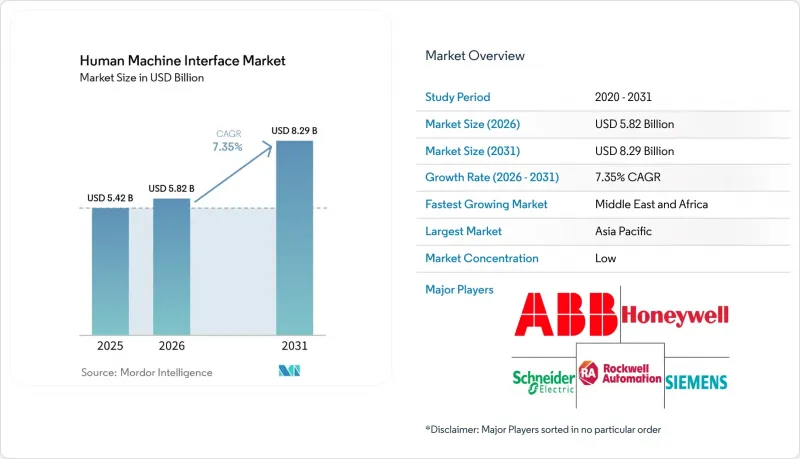
휴먼 머신 인터페이스(HMI) 시장 규모는 2026년에 58억 2,000만 달러로 추정되고 있어 2025년 54억 2,000만 달러에서 확대해, 2031년에는 82억 9,000만 달러에 이를 것으로 예측됩니다.
2026년부터 2031년까지 연평균 성장률(CAGR) 7.35%로 성장할 것으로 전망됩니다.
본 보고서는 제공 형태(하드웨어, 소프트웨어 등), 인터페이스 기술(터치스크린, 누름 버튼/키패드 등), 구성(임베디드형 HMI, 독립형 HMI 등), 최종 사용자 산업(자동차, 식품 및 음료 등) 및 지역별로 분류되어 있습니다. 시장 전망은 금액(달러)으로 표시되어 있습니다.
세계 휴먼 머신 인터페이스(HMI) 시장 동향 및 인사이트
인더스트리 4.0 도입 가속화
인더스트리 4.0의 추진에 따라 HMI는 수동적인 디스플레이에서 벗어나, 센서, MES, ERP의 데이터를 통합하여 상황 인식형 대시보드로 집약하는 데이터 주도형 명령 허브로 변모하고 있습니다. 많은 공장에서는 작업자가 HMI를 사용하여 협업 로봇(코봇)을 제어하고, 배치 변경을 조정하며, 예측 유지보수 워크플로를 시작하고 있습니다. 2025년 MDPI 조사에 따르면, 인더스트리 5.0이 협업 로봇을 중시하고 있다는 점이 강조되었으며, 사람과 기계의 원활한 협업에는 직관적인 HMI가 필수적이라고 지적되고 있습니다. 지멘스는 자사의 Senseye 플랫폼이 AI를 활용한 이상 알림을 통해 한 유제품 시설에서 비용이 많이 드는 가동 중단을 방지했다고 보고하며, 커넥티드 HMI의 구체적인 ROI를 입증하고 있습니다.
OT와 IT의 사이버 보안 요구 사항 통합
원격 연결 및 엔터프라이즈 클라우드와의 연동으로 인해 레거시 제어 패널이 현대적인 공격 표면에 노출됨에 따라, 제로 트러스트 아키텍처로의 전환이 촉진되고 있습니다. 유럽연합(EU)의 NIS2 지침은 중요 인프라 운영자에게 모든 HMI 노드에서 엄격한 인증 및 역할 기반 제어를 채택할 것을 의무화하고 있습니다. 텔레포니카 테크(Telefonica Tech)는 다단계 인증과 지속적인 검증이 빠르게 인터페이스의 기본 기능으로 자리 잡고 있음을 강조하고 있습니다. 각 벤더사는 현재 이러한 요구 사항을 충족하기 위해 보안 부팅, 서명된 펌웨어 및 암호화 프로토콜을 통합하고 있습니다.
오래된 레거시 PLC의 도입 실적
구형 컨트롤러에는 최신 프로토콜이 탑재되어 있지 않아 통합에 장애물이 발생하고 있습니다. 공장 측은 오랫동안 사용해 온 자산을 철거하고 교체하는 것을 주저하고 있으며, 대신 프로토콜 게이트웨이를 중첩하여 도입함으로써 비용과 복잡성을 증가시키고 있습니다. 『Food Engineering』지는 독자 사양의 버스가 최신 OPC UA나 MQTT 프레임워크와 충돌할 때 버전 관리상의 과제가 발생한다고 지적하고 있습니다.
부문 분석
2025년 HMI 시장에서 하드웨어가 56.30%를 차지했습니다. 이는 견고한 패널, 산업용 PC, 엣지 게이트웨이가 여전히 미션 크리티컬한 역할을 수행하고 있기 때문입니다. 텍사스 기기(Texas Instruments)는 결정론적 제어와 예측 분석의 균형을 맞추기 위해 임베디드 AI로의 전환이 진행되고 있음을 확인했습니다. 연평균 성장률(CAGR) 10.94%로 확대되고 있는 서비스 분야는 통합, 사이버 보안 강화 및 지속적인 교육에 대한 수요 증가를 반영하고 있습니다. 『Control Global』지는 공급업체들이 일회성 프로젝트에서 인터페이스 최적화를 목표로 하는 구독 모델 기반의 라이프사이클 파트너십으로 전환하고 있다고 지적하고 있습니다.
하드웨어의 진화로 인해 현재는 모듈식 보드와 클래스 I, 디비전 2 구역 인증을 획득한 고휘도 디스플레이가 주류를 이루고 있습니다. 각 벤더사는 핫스왑이 가능한 SSD 베이와 현장에서 업그레이드가 가능한 CPU를 통합하여 제품 수명 연장을 도모하고 있습니다. 한편, 매니지드 서비스 팀은 원격 UX 감사 실시, 중대한 취약점에 대한 패치 적용, 신기능 활용을 위한 운영자 재교육을 수행하고 있으며, 이러한 추세에 따라 2031년까지 서비스 수익이 HMI 시장 전체의 약 3분의 1에 달할 것으로 예측됩니다.
2025년, 터치스크린은 HMI 시장의 70.40%를 계속 차지했습니다. 이는 장갑을 착용한 상태에서도 조작이 가능한 정전용량식 레이어와 화학 강화 유리가 가혹한 플랜트 환경의 요구 사항을 충족하기 때문입니다. 멀티터치 제스처는 특히 배치 전환 시 탐색 시간을 단축하고 오류율을 낮춥니다. 그러나 AR/VR 인터페이스는 연평균 성장률(CAGR) 17.62%라는 가장 빠른 속도로 확대되고 있으며, 운영자와의 상호작용 패러다임을 혁신하고 있습니다. XR 기반 로봇 프로그래밍에 관한 MDPI 연구에 따르면, 기존 펜던트 방식에 비해 시운전이 신속해지고 가동 중단 시간이 단축된 것으로 보고되었습니다.
AR 탑재 헤드셋은 공간 오버레이 기능을 제공하여, 기술자가 숨겨진 배관, 토크 목표값 또는 실시간 분석 데이터를 시각화할 수 있게 합니다. 자동차 OEM 각사는 클레이 모델링을 대체하는 몰입형 설계 검토를 실시하여 컨셉 루프를 단축하고 있습니다. 게임 엔진과 산업용 데이터의 이러한 상호 융합은 공간 컴퓨팅 제어실로 가는 길을 열어주며, 2031년까지 HMI 시장 규모에서 점유율 확대로 이어질 가능성이 있습니다.
지역별 분석
2025년, 아시아태평양은 37.60%의 점유율로 HMI 시장을 주도했습니다. 중국의 도입 대수는 1,825만 대를 넘어섰으며, 스마트 팩토리 도입 확대에 따라 92억 8,000만 위안(13억 9,000만 달러)의 수익을 창출했습니다. 일본과 한국에서는 차세대 OLED 패널의 상용화가 진행되고 있는 반면, 인도에서는 생산 연계형 인센티브 제도를 통해 제약 업계 및 내구재 분야의 자동화 도입이 촉진되고 있습니다. 델타 일렉트로닉스(Delta Electronics) 등 지역 공급업체들은 현지 생산을 확대하고 있어, 비용 경쟁력이 있는 패널에 대한 접근성이 넓어지고 있습니다.
중동 및 아프리카는 연평균 성장률(CAGR) 9.25%로 가장 높은 성장률을 기록하고 있습니다. 사우디아라비아의 ‘비전 2030’과 UAE의 ‘오퍼레이션 3,000억’ 계획에서는 석유화학, 물류, 재생에너지 분야의 디지털 공장 투자가 진행되고 있습니다. ‘퓨처 매뉴팩처링 아프리카 컨퍼런스’에서는 AI를 활용한 품질 관리 및 자동화를 위한 인력 역량 강화가 주목받고 있으며, 이는 대규모 프로젝트 파이프라인이 지속적으로 확대되고 있음을 시사합니다.
북미에서는 리쇼어링(국내 복귀)에 대한 우대 조치와 확립된 산업용 소프트웨어 생태계가 호재로 작용하고 있습니다. Inductive Automation사의 ‘Ignition’과 같은 플랫폼은 무제한 라이선싱 방식을 채택함으로써, 여러 거점으로의 확장에 따른 총 소유 비용(TCO)을 절감하고 있습니다. CISA 가이드라인 등의 사이버 보안 규제로 인해 시큐어 부트(Secure Boot)를 지원하는 HMI 도입이 촉진되면서, 국방 및 중요 인프라 분야 시장 수요가 더욱 공고해지고 있습니다.
유럽은 엄격한 규제와 지속가능성 분야에서의 리더십을 바탕으로 HMI 시장에서 여전히 큰 점유율을 유지하고 있습니다. NIS2 및 에코디자인 규정의 준수는 에너지 효율이 뛰어나고 IEC 62443 인증을 획득한 패널의 선정을 뒷받침하고 있습니다. 지멘스가 디지털 센터 확장을 위해 유럽에 20억 달러를 투자한 것은 인간 중심의 저탄소 산업에서 유럽이 주도권을 잡으려는 의지를 뒷받침합니다.
기타 혜택:
- 엑셀 형식 시장 예측(ME) 시트
- 3개월간의 애널리스트 지원
자주 묻는 질문
목차
제1장 서론
제2장 조사 방법
제3장 주요 요약
제4장 시장 구도
제5장 시장 규모와 성장 예측
제6장 경쟁 구도
제7장 시장 기회와 향후 전망
JHS 26.08.11According to Mordor Intelligence, human machine interface market size in 2026 is estimated at USD 5.82 billion, growing from 2025 value of USD 5.42 billion with 2031 projections showing USD 8.29 billion, growing at 7.35% CAGR over 2026-2031.
This report is Segmented by Offering (Hardware, Software and More), Interface Technology (Touchscreen, Push-Button / Keypad and More), Configuration (Embedded HMI, Stand-Alone HMI and More), End-User Industry (Automotive, Food & Beverage and More), and Geography. The Market Forecasts are Provided in Terms of Value (USD).
Global Human Machine Interface Market Trends and Insights
Accelerated Industry 4.0 adoption
Industry 4.0 programs transform HMIs from passive displays into data-driven command hubs that aggregate sensor, MES, and ERP feeds into context-aware dashboards. In many plants, operators now use HMIs to orchestrate co-bots, coordinate batch changes, and launch predictive maintenance workflows. A 2025 MDPI study highlights Industry 5.0's emphasis on collaborative robots, noting that intuitive HMIs are essential for seamless human-machine teamwork. Siemens reported its Senseye platform prevented costly downtime at a dairy facility through AI-enabled anomaly alerts, demonstrating tangible ROI for connected HMIs.
Convergence of OT-IT cybersecurity requirements
Remote connectivity and enterprise cloud links expose legacy panels to modern attack surfaces, prompting a move toward Zero Trust Architecture. The European Union's NIS2 directive compels critical-infrastructure operators to adopt strict authentication and role-based controls on every HMI node. Telefonica Tech underscores that multi-factor authentication and continuous verification are quickly becoming baseline interface functions. Vendors now embed secure boot, signed firmware, and encrypted protocols to satisfy these mandates.
Persistent legacy PLC installed base
Older controllers lack modern protocols, creating integration hurdles. Plants hesitate to rip and replace mature assets, instead layering protocol gateways that add cost and complexity. Food Engineering notes version-control headaches when proprietary buses clash with modern OPC UA or MQTT frameworks.
Other drivers and restraints analyzed in the detailed report include:
- Edge-AI enabling predictive UX
- Low-code/no-code HMI configuration tools
- Supply-chain volatility for specialty semiconductors
For complete list of drivers and restraints, kindly check the Table Of Contents.
Segment Analysis
Hardware generated 56.30% of the HMI market in 2025 as rugged panels, industrial PCs, and edge gateways remain mission critical. Texas Instruments confirms a pivot toward embedded AI to balance deterministic control with predictive analytics. The services segment, advancing at 10.94% CAGR, reflects mounting demand for integration, cybersecurity hardening, and continuous training. Control Global observes suppliers shifting from one-off projects to lifecycle partnerships with subscription models for interface optimization.
Hardware evolution now favours modular boards, and high brightness displays certified for Class I, Division 2 zones. Vendors integrate hot-swap SSD bays and field-upgradeable CPUs to extend lifespan. Meanwhile, managed services teams conduct remote UX audits, patch critical vulnerabilities, and retrain operators to exploit new features, a dynamic expected to lift service revenues to nearly one third of overall HMI market size by 2031.
Touchscreens retained 70.40% of the HMI market in 2025 because glove-friendly capacitive layers and chemically strengthened glass satisfy harsh-plant demands. Multi-touch gestures shorten navigation time and cut error rates, especially in batch changeovers. Yet AR/VR interfaces are scaling fastest at 17.62% CAGR, reshaping operator interaction paradigms. An MDPI study on XR-based robot programming reported faster commissioning and lower downtime than traditional pendant methods.
AR-equipped headsets provide spatial overlays, letting technicians visualize hidden piping, torque targets, or live analytics. Automotive OEMs run immersive design reviews that replace clay modelling and shorten concept loops. This cross-pollination of gaming engines and industrial data paves the way for spatial computing control rooms, potentially capturing an expanded share of HMI market size through 2031.
Complete Report Scope:
- By Offering
- Hardware
- HMI Panels
- Industrial PCs
- Software
- Configuration / Programming
- Services
- Hardware
- By Interface Technology
- Touchscreen
- Push-button / Keypad
- Gesture-based
- Voice-controlled
- AR / VR-assisted
- By End-User Industry
- Automotive
- Food and Beverage
- Packaging
- Pharmaceutical
- Oil and Gas
- Metal and Mining
- Energy and Utilities
- Aerospace and Defense
- Semiconductors and Electronics
- Other End Users
- By Configuration
- Embedded HMI
- Stand-alone HMI
- Distributed / Remote HMI
- By Geography
- North America
- United States
- Canada
- Mexico
- Europe
- Germany
- United Kingdom
- France
- Italy
- Russia
- Rest of Europe
- Asia-Pacific
- China
- Japan
- India
- South Korea
- Rest of Asia-Pacific
- Middle East and Africa
- Saudi Arabia
- United Arab Emirates
- Turkey
- South Africa
- Rest of Middle East and Africa
- South America
- Brazil
- Argentina
- Rest of South America
- North America
Geography Analysis
Asia-Pacific led the HMI market with 37.60% share in 2025. Chinese installations surpassed 18.25 million units, generating revenue of CNY 9.28 billion (USD 1.39 billion) amid a climb in smart-factory rollouts. Japan and South Korea continue to commercialize next-gen OLED panels, while India's production-linked incentives propel automation uptake in pharmaceuticals and consumer durables. Regional suppliers such as Delta Electronics are scaling local manufacturing, widening access to cost-competitive panels.
The Middle East and Africa registers the highest growth at 9.25% CAGR. Vision 2030 initiatives in Saudi Arabia and the UAE's Operation 300bn plan are investing in digital plants for petrochemicals, logistics, and renewables. The Future Manufacturing Africa Conference spotlights AI-driven quality control and workforce upskilling for automation, signalling sustained large-project pipelines.
North America benefits from reshoring incentives and an established industrial-software ecosystem. Platforms like Ignition by Inductive Automation employ unlimited licensing to cut total cost of ownership for multi-site rollouts. Cybersecurity regulations such as CISA guidelines fuel adoption of secure-boot HMIs, further solidifying market demand across defence and critical-infrastructure verticals.
Europe maintains a sizeable slice of the HMI market on the back of regulatory rigor and sustainability leadership. Compliance with NIS2 and eco-design mandates drives preference for energy-efficient, IEC 62443-certified panels. Siemens' USD 2 billion European investment into digital-center expansions underscores the continent's determination to lead in human-centric, low-carbon industry.
- ABB Ltd
- Honeywell International Inc.
- Rockwell Automation, Inc.
- Mitsubishi Electric Corporation
- Schneider Electric SE
- Emerson Electric Co.
- GE Vernova (Industrial Automation)
- Texas Instruments Inc.
- Yokogawa Electric Corporation
- Siemens AG
- Robert Bosch GmbH
- Eaton Corporation plc
- Advantech Co., Ltd.
- Delta Electronics, Inc.
- Beijer Electronics Group
- Omron Corporation
- Parker Hannifin Corporation
- Phoenix Contact GmbH
- Red Lion Controls (Spectris)
- Moxa Inc.
Additional Benefits:
- The market estimate (ME) sheet in Excel format
- 3 months of analyst support
TABLE OF CONTENTS
1 INTRODUCTION
- 1.1 Study Assumptions and Market Definition
- 1.2 Scope of the Study
2 RESEARCH METHODOLOGY
3 EXECUTIVE SUMMARY
4 MARKET LANDSCAPE
- 4.1 Market Overview
- 4.2 Market Drivers
- 4.2.1 Accelerated Industry 4.0 adoption
- 4.2.2 Convergence of OT-IT cybersecurity requirements
- 4.2.3 Edge-AI enabling predictive UX
- 4.2.4 Expansion of low-code/no-code HMI configuration tools
- 4.2.5 Energy-efficiency mandates for industrial displays
- 4.2.6 5G-enabled ultra-low-latency remote HMI
- 4.3 Market Restraints
- 4.3.1 Persistent legacy PLC installed base
- 4.3.2 Supply-chain volatility for specialty semiconductors
- 4.3.3 Fragmented UX standards across regions
- 4.3.4 Escalating OT-focused ransomware costs
- 4.4 Value / Supply-Chain Analysis
- 4.5 Regulatory Landscape
- 4.6 Technological Outlook
- 4.7 Porters Five Forces
- 4.7.1 Bargaining Power of Suppliers
- 4.7.2 Bargaining Power of Buyers
- 4.7.3 Threat of New Entrants
- 4.7.4 Threat of Substitutes
- 4.7.5 Intensity of Competitive Rivalry
5 MARKET SIZE AND GROWTH FORECASTS (VALUE)
- 5.1 By Offering
- 5.1.1 Hardware
- 5.1.1.1 HMI Panels
- 5.1.1.2 Industrial PCs
- 5.1.2 Software
- 5.1.2.1 Configuration / Programming
- 5.1.3 Services
- 5.1.1 Hardware
- 5.2 By Interface Technology
- 5.2.1 Touchscreen
- 5.2.2 Push-button / Keypad
- 5.2.3 Gesture-based
- 5.2.4 Voice-controlled
- 5.2.5 AR / VR-assisted
- 5.3 By End-User Industry
- 5.3.1 Automotive
- 5.3.2 Food and Beverage
- 5.3.3 Packaging
- 5.3.4 Pharmaceutical
- 5.3.5 Oil and Gas
- 5.3.6 Metal and Mining
- 5.3.7 Energy and Utilities
- 5.3.8 Aerospace and Defense
- 5.3.9 Semiconductors and Electronics
- 5.3.10 Other End Users
- 5.4 By Configuration
- 5.4.1 Embedded HMI
- 5.4.2 Stand-alone HMI
- 5.4.3 Distributed / Remote HMI
- 5.5 By Geography
- 5.5.1 North America
- 5.5.1.1 United States
- 5.5.1.2 Canada
- 5.5.1.3 Mexico
- 5.5.2 Europe
- 5.5.2.1 Germany
- 5.5.2.2 United Kingdom
- 5.5.2.3 France
- 5.5.2.4 Italy
- 5.5.2.5 Russia
- 5.5.2.6 Rest of Europe
- 5.5.3 Asia-Pacific
- 5.5.3.1 China
- 5.5.3.2 Japan
- 5.5.3.3 India
- 5.5.3.4 South Korea
- 5.5.3.5 Rest of Asia-Pacific
- 5.5.4 Middle East and Africa
- 5.5.4.1 Saudi Arabia
- 5.5.4.2 United Arab Emirates
- 5.5.4.3 Turkey
- 5.5.4.4 South Africa
- 5.5.4.5 Rest of Middle East and Africa
- 5.5.5 South America
- 5.5.5.1 Brazil
- 5.5.5.2 Argentina
- 5.5.5.3 Rest of South America
- 5.5.1 North America
6 COMPETITIVE LANDSCAPE
- 6.1 Market Concentration
- 6.2 Strategic Moves
- 6.3 Market Share Analysis
- 6.4 Company Profiles (includes Global level Overview, Market level overview, Core Segments, Financials as available, Strategic Information, Market Rank/Share for key companies, Products and Services, and Recent Developments)
- 6.4.1 ABB Ltd
- 6.4.2 Honeywell International Inc.
- 6.4.3 Rockwell Automation, Inc.
- 6.4.4 Mitsubishi Electric Corporation
- 6.4.5 Schneider Electric SE
- 6.4.6 Emerson Electric Co.
- 6.4.7 GE Vernova (Industrial Automation)
- 6.4.8 Texas Instruments Inc.
- 6.4.9 Yokogawa Electric Corporation
- 6.4.10 Siemens AG
- 6.4.11 Robert Bosch GmbH
- 6.4.12 Eaton Corporation plc
- 6.4.13 Advantech Co., Ltd.
- 6.4.14 Delta Electronics, Inc.
- 6.4.15 Beijer Electronics Group
- 6.4.16 Omron Corporation
- 6.4.17 Parker Hannifin Corporation
- 6.4.18 Phoenix Contact GmbH
- 6.4.19 Red Lion Controls (Spectris)
- 6.4.20 Moxa Inc.
7 MARKET OPPORTUNITIES AND FUTURE OUTLOOK
- 7.1 White-space and Unmet-Need Assessment


