

|
시장보고서
상품코드
2120696
북미의 휴먼 머신 인터페이스 : 시장 점유율 분석, 업계 동향과 통계, 성장 예측(2026-2031년)North America Human Machine Interface - Market Share Analysis, Industry Trends & Statistics, Growth Forecasts (2026 - 2031) |
||||||
 Mordor Intelligence
북미의 휴먼 머신 인터페이스(HMI) 시장 규모는 2026년에 661억 3,000만 달러로 추정되며, 2025년 622억 1,000만 달러에서 확대될 전망입니다.
또한, 2031년 시장 규모는 897억 9,000만 달러에 달할 것으로 예측되며, 2026년부터 2031년까지 연평균 성장률(CAGR) 6.31%로 성장할 것으로 전망됩니다.
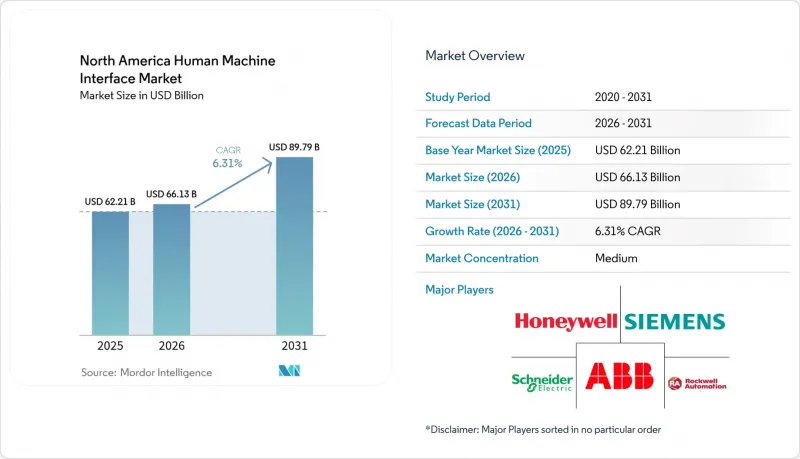
본 보고서는 기술별(프로그래머블 로직 컨트롤러, SCADA 등), 구성요소별(통신 부문, 제어 장치 등), 인터페이스별(터치스크린, 키패드 등), 최종사용자 산업별(자동차, 석유·가스 등), 국가별(미국, 캐나다)로 분류되어 있습니다. 시장 규모 및 전망은 달러로 표시되어 있습니다.
북미 휴먼 머신 인터페이스 시장의 동향 및 인사이트
미국 내 이산 제조업에서 인더스트리 4.0 도입이 확대되면서 커넥티드 기계 인터페이스에 대한 수요가 증가하고 있습니다
자동차, 전자, 소비재 각 생산 라인의 공장장들은 현재 PLC 로직, MES 트랜잭션, 품질 분석을 단일 HMI 아래에서 통합하는 ‘싱글 데이터 패브릭(Single Data Fabric)’ 전략을 추진하고 있습니다. 2025년 헤르메스상을 수상한 지멘스의 ‘Industrial Copilot’은 생성형 AI를 통합하여 엔지니어링에 소요되는 시간을 단축하는 동시에 코드의 견고성을 높이고 있습니다. 포드는 루이빌 조립 공장 전체에 소프트웨어 정의형 ‘SIMATIC Automation Workstation’을 도입하여, 생산 셀 재구성을 며칠이 아닌 몇 시간 만에 완료할 수 있게 했습니다. 중규모 수탁 제조업체의 유사한 도입 사례는 고정 기능 패널에서 예측 유지보수 및 에너지 최적화를 지원하는 확장 가능한 소프트웨어 중심 HMI로의 구조적 전환을 보여줍니다. 이러한 업그레이드는 북미의 휴먼 머신 인터페이스 시장의 잠재 고객 기반을 직접 확대하는 것입니다.
OSHA 및 NIST에 의한 사이버-물리 시스템 규정 준수 의무화가 HMI 업그레이드를 촉진
규제 당국은 현재 보안 조치가 불충분한 HMI를 안전상의 위험으로 간주하고 있습니다. OSHA의 시정 권고에는 NIST SP 800-82의 대책이 언급되어 있으며, 제약 및 화학 업계의 사업자들은 원격 액세스 지점의 보안 강화와 다단계 인증 도입을 강요받고 있습니다. 2024년 CISA의 권고에서는 널리 도입된 운영자 스테이션의 SQL 인젝션 취약점이 지적되었으며, 기업들은 지원이 종료된 버전의 사용을 중단해야 하는 상황에 직면해 있습니다. 규정 위반으로 인한 비용은 현대화 예산을 훨씬 초과하며, 자본은 암호화 프로토콜 및 역할 기반 접근 제어에 재투자되고 있습니다. IEC 62443 표준을 준수하는 패널을 사전 인증한 공급업체들은 북미의 전체 휴먼 머신 인터페이스 시장에서 시장 평균을 상회하는 성장을 보고하고 있습니다.
레거시 HMI 통신 프로토콜에 뿌리 깊게 남아 있는 취약점
CISA의 2025년판 카탈로그에서는 패치가 적용되지 않은 단말기에서 원격 코드 실행을 가능하게 하는 Modbus-TCP 및 DNP3의 취약점이 강조되어, 플랜트의 OT 위험에 대한 이사회 차원의 심사가 더욱 엄격해지고 있습니다. 북미의 많은 시설은 여전히 ‘에어 갭’이라는 환상에 의존하고 있기 때문에 새롭게 공개되는 익스플로잇이 나올 때마다 노후화된 패널 교체 계획이 가속화되고 있습니다. 그러나 기존 설비의 배선 복잡성에 더해 송전선 중단을 단계적으로 실시해야 할 필요성 때문에 완전한 전환은 지연되고 있습니다.
부문 분석
2025년 북미의 프로그래머블 로직 컨트롤러(PLC)용 휴먼 머신 인터페이스(HMI) 시장 규모는 169억 8,000만 달러에 달했으며, 총 지출에서 차지하는 점유율은 27.30%를 유지했습니다. MES 플랫폼은 규모는 작지만 2031년까지 연평균 9.12%의 성장률을 보일 것으로 예상되며, 이는 폐쇄 루프 품질 관리 및 실시간 원가 계산으로의 전환을 반영한 것입니다. 각 벤더들은 모션,안전, 엣지 분석 기능을 차세대 PLC에 통합하여 캐비닛의 설치 면적을 줄이는 동시에 엔터프라이즈 클라우드로의 데이터 처리량을 확대하고 있습니다. 전자 산업의 조기 도입 기업들은 PLC 태그와 MES 대시보드를 통합한 결과, 불량률을 12% 이상 줄이는 데 성공했습니다. 한편, 프로세스 산업에서는 SCADA 및 DCS 솔루션이 여전히 확고한 입지를 유지하고 있지만, CFO가 설비 투자(Capex)를 운영비(OpEx)로 전환하는 구독 모델을 우선시함에 따라 클라우드 호스팅형 HMI 소프트웨어의 판매량이 영구 라이선스를 넘어섰습니다. 이러한 기술의 융합으로 인해 각 기술은 서로 경쟁하기보다는 상호 운용성을 유지하며, 북미의 휴먼 머신 인터페이스(HMI) 시장의 모든 계층에서 점진적인 성장을 뒷받침하고 있습니다.
현재 PLM 데이터와 운영자 인터페이스를 연동하는 프로젝트가 증가함에 따라, 설계 변경 사항이 현장에 즉시 반영되고 있습니다. 자동차 OEM 각사는 CAD 수정 내용이 HMI의 작업 지시서에 자동으로 반영됨으로써 설계 변경 적용에 소요되는 시간이 2일 단축되었다고 밝혔습니다. TSN 기반의 오픈 소스 OPC UA가 공통 프로토콜로 보급되면서 맞춤형 미들웨어 비용을 18% 절감하고 있습니다. 이러한 발전은 전반적으로 제조업체들이 북미 HMI 시장을 단순히 패널 수로만 판단하는 것이 아니라, 데이터를 구체적인 재무 성과로 전환하는 능력을 바탕으로 평가하고 있음을 보여줍니다.
터치스크린 패널은 검증된 IP-65 등급의 하우징과 범용 예비 부품 생태계 덕분에 2025년 북미 HMI 시장에서 25.50%의 점유율을 유지했습니다. 한편, 프라이빗 5G가 성숙해짐에 따라 모바일 및 웨어러블 인터페이스는 연평균 8.97%의 성장률로 확대될 전망입니다. 항공우주 조립 공장의 초기 도입 사례에 따르면, 검사원이 토크 사양 및 허용 오차를 오버레이로 표시하는 AR 지원 스마트글라스를 사용함으로써, 첫 제품 승인까지 걸리는 시간이 30% 단축되었습니다. 산업용 PC에는 현재 NVIDIA의 GPU가 탑재되어 있어 비전 애플리케이션을 장치에서 직접 실행할 수 있으므로 별도의 서버가 필요하지 않습니다. 키패드형 모델은 폭발 위험이 있는 구역이나 장갑을 착용하는 작업 현장에서 촉각 피드백을 통해 오작동을 방지하기 위해 여전히 중요한 역할을 하고 있습니다. 음성 제어형 HMI는 점차 보급되고 있지만, 금속 성형 라인에서는 배경 소음이 여전히 장벽으로 작용하고 있습니다.
하이브리드 도입 형태가 일반화되고 있습니다. 중앙 패널이 안전 인터록을 제어하는 한편, 작업자는 중요도가 낮은 조정을 위해 태블릿을 휴대합니다. 이를 통해 형성되는 인터페이스의 메시 구조는 중복성을 통해 가동 시간을 향상시킵니다. 패널에 장애가 발생하더라도 인증된 모바일 단말기를 통해 라인을 조그(jog) 방식으로 조작할 수 있습니다. 이러한 구성은 조달 범위를 넓히고, 전체 디바이스 제품군에 걸친 사이버 보안 인증의 중요성을 높이며, 북미의 휴먼 머신 인터페이스 시장에서 공급업체 간의 차별화를 강화합니다.
기타 혜택:
- 엑셀 형식의 시장 예측(ME) 시트
- 3개월간의 애널리스트 지원
자주 묻는 질문
목차
제1장 소개
제2장 조사 방법
제3장 주요 요약
제4장 시장 구도
제5장 시장 규모와 성장 예측
제6장 경쟁 구도
제7장 시장 기회와 향후 전망
KSM 26.09.02According to Mordor Intelligence, the North America human machine interface market size in 2026 is estimated at USD 66.13 billion, growing from 2025 value of USD 62.21 billion with 2031 projections showing USD 89.79 billion, growing at 6.31% CAGR over 2026-2031.
This report is Segmented by Technology (Programmable Logic Controller, SCADA and More), Component (Communication Segment, Control Device and More), Interface (Touchscreen, Keypad and More), End-User Industry (Automotive, Oil and Gas and More), and Country (United States, Canada). Market Size and Forecasts are Provided in USD.
North America Human Machine Interface Market Trends and Insights
Increasing Industry 4.0 adoption in U.S. discrete manufacturing driving demand for connected machine interfaces
Plant managers in automotive, electronics, and packaged-goods lines now pursue single data fabric strategies that unify PLC logic, MES transactions, and quality analytics under one HMI umbrella. Siemens' Industrial Copilot, honored with the 2025 Hermes Award, embeds generative AI that cuts engineering hours while boosting code robustness. Ford integrated the software-defined SIMATIC Automation Workstation across Louisville assembly to reconfigure production cells within hours, not days. Similar deployments across mid-sized contract manufacturers indicate a structural shift from fixed-function panels to scalable, software-centric HMIs that support predictive maintenance and energy optimization. These upgrades directly enlarge the addressable base of the North America human machine interface market.
OSHA and NIST cyber-physical compliance mandates boosting HMI upgrades
Regulators now treat unsecured HMIs as safety risks. OSHA citations reference NIST SP 800-82 controls, compelling pharmaceutical and chemical operators to harden remote-access points and implement multi-factor authentication. CISA advisories in 2024 flagged SQL injection flaws in widely deployed operator stations, pushing firms to retire unsupported versions. The cost of non-compliance dwarfs modernization budgets, shunting capital toward encrypted protocols and role-based access. Vendors that pre-certify panels to IEC 62443 standards report above-market growth across the North America human machine interface market.
Persistent vulnerabilities in legacy HMI communication protocols
CISA's 2025 catalog highlights modbus-TCP and DNP3 weaknesses that permit remote code execution on unpatched terminals, intensifying board-level scrutiny of plant OT risk. Because many North American facilities still rely on air-gap illusions, each newly disclosed exploit accelerates plans to replace aging panels. However, complexity of brown-field wiring, combined with the need to stage line outages, slows full migration.
Other drivers and restraints analyzed in the detailed report include:
- Retrofitting aging process plants in U.S. Gulf Coast and Alberta oil sands
- Deployment of private 5G networks enabling real-time HMI in smart factories
- Acute shortage of OT-IT integration talent inflating implementation timelines
For complete list of drivers and restraints, kindly check the Table Of Contents.
Segment Analysis
The North America human machine interface market size for Programmable Logic Controllers stood at USD 16.98 billion in 2025 and retained a 27.30% share of total spending. MES platforms, although smaller, will grow 9.12% annually to 2031, reflecting a pivot toward closed-loop quality and real-time costing. Vendors integrate motion, safety, and edge analytics into new PLC generations, compressing cabinet footprint while expanding data throughput to enterprise clouds. Early adopters in electronics witness scrap reductions above 12% after unifying PLC tags with MES dashboards. While SCADA and DCS solutions maintain strongholds in process industries, cloud-hosted HMI software outsells perpetual licenses as CFOs prioritize subscription models that convert capex to opex. This technology convergence keeps technologies interoperating rather than cannibalizing, sustaining incremental growth in every layer of the North America human machine interface market.
A growing subset of projects now marries PLM data with operator interfaces so that engineering changes flow instantly to the shop floor. Automotive OEMs cite reductions of two days per engineering change roll-out when CAD revisions automatically populate HMI work instructions. Open-source OPC UA over TSN gains traction as common protocol, trimming custom middleware costs by 18%. Collectively, these advances underline how manufacturers judge the North America human machine interface market not simply on panel counts but on the capacity to convert data into actionable financial outcomes.
Touch-screen panels preserved 25.50% of the North America human machine interface market in 2025 due to their proven IP-65 housings and universal spare-parts ecosystems. Yet mobile and wearable interfaces will compound 8.97% per year as private 5G matures. Early roll-outs at aerospace assembly plants indicate 30% faster first-piece approvals when inspectors use AR-enabled smart glasses that overlay torque specs and tolerances. Industrial PCs now ship with NVIDIA GPUs, letting vision apps run directly on-device and eliminating separate servers. Keypad models stay relevant in explosive or gloved-hand zones, where tactile affirmations prevent mis-clicks. Voice-controlled HMIs inch forward, although background noise remains a barrier in metal-forming lines.
Hybrid deployments become common: a central panel governs safety interlocks while operators carry tablets for non-critical adjustments. The resulting interface mesh boosts uptime through redundancy; if a panel fails, the line can still be jogged from a certified mobile unit. Such configurations widen procurement scope and elevate the profile of cybersecurity certifications that span device families, reinforcing vendor differentiation across the North America human machine interface market.
Complete Report Scope:
- By Technology
- Programmable Logic Controller (PLC)
- Supervisory Control and Data Acquisition (SCADA)
- Enterprise Resource Planning (ERP)
- Distributed Control System (DCS)
- Human Machine Interface (HMI) Software
- Product Lifecycle Management (PLM)
- Manufacturing Execution System (MES)
- Other Technologies
- By Interface Type
- Touch-Screen Operator Panels
- Industrial PCs (Panel and Box)
- Keypad / Function-Key HMIs
- Mobile and Wearable HMIs
- Voice- and AR-Enabled HMIs
- By Component
- Communication Segment
- Control Device
- Machine Vision Systems
- Robotics
- Sensors
- Other Components
- By End-User Industry
- Automotive
- Oil and Gas
- Chemical and Petrochemical
- Pharmaceutical
- Food and Beverage
- Metals and Mining
- Other Industries
- By Country
- United States
- Canada
List of Companies Covered in this Report:
- ABB Ltd.
- Emerson Electric Company
- Fanuc Corporation
- General Electric Company
- Honeywell International Inc.
- Mitsubishi Electric Corporation
- Robert Bosch GmbH
- Rockwell Automation Inc.
- Schneider Electric SE
- Siemens AG
- Texas Instruments Incorporated
- Yokogawa Electric Corporation
- Omron Corporation
- Advantech Co., Ltd.
- Beijer Electronics Group
- Red Lion Controls (Spectris plc)
- Maple Systems Inc.
- BandR Industrial Automation GmbH (ABB Group)
- Phoenix Contact GmbH and Co. KG
- Keyence Corporation
- Parker Hannifin Corporation
- Eaton Corporation plc
- Lenze SE
Additional Benefits:
- The market estimate (ME) sheet in Excel format
- 3 months of analyst support
TABLE OF CONTENTS
1 INTRODUCTION
- 1.1 Study Assumptions and Market Definition
- 1.2 Scope of the Study
2 RESEARCH METHODOLOGY
3 EXECUTIVE SUMMARY
4 MARKET LANDSCAPE
- 4.1 Market Overview
- 4.2 Market Drivers
- 4.2.1 Increasing Industry 4.0 adoption in U.S. discrete manufacturing driving demand for connected machine interfaces
- 4.2.2 OSHA and NIST cyber-physical compliance mandates boosting HMI upgrades
- 4.2.3 Retrofitting ageing process plants in U.S. Gulf Coast and Alberta oil sands
- 4.2.4 Deployment of private 5G networks enabling real-time HMI in smart factories
- 4.2.5 Multilingual workforce requirements accelerating bilingual HMI panel adoption
- 4.2.6 Expansion of North American EV battery gigafactories requiring advanced interface solutions
- 4.3 Market Restraints
- 4.3.1 Persistent vulnerabilities in legacy HMI communication protocols raising cybersecurity concerns
- 4.3.2 Acute shortage of OT-IT integration talent inflating implementation timelines
- 4.3.3 Semiconductor supply disruptions causing controller and display lead-time spikes
- 4.3.4 Stringent FDA re-validation costs discouraging frequent upgrades in pharma plants
- 4.4 Value / Supply-Chain Analysis
- 4.5 Regulatory and Technological Outlook
- 4.6 Porter's Five Forces Analysis
- 4.6.1 Bargaining Power of Suppliers
- 4.6.2 Bargaining Power of Buyers
- 4.6.3 Threat of New Entrants
- 4.6.4 Threat of Substitutes
- 4.6.5 Intensity of Competitive Rivalry
- 4.7 Investment Analysis (Capital Expenditure Trends in Smart Manufacturing Interfaces)
5 MARKET SIZE AND GROWTH FORECASTS (VALUE)
- 5.1 By Technology
- 5.1.1 Programmable Logic Controller (PLC)
- 5.1.2 Supervisory Control and Data Acquisition (SCADA)
- 5.1.3 Enterprise Resource Planning (ERP)
- 5.1.4 Distributed Control System (DCS)
- 5.1.5 Human Machine Interface (HMI) Software
- 5.1.6 Product Lifecycle Management (PLM)
- 5.1.7 Manufacturing Execution System (MES)
- 5.1.8 Other Technologies
- 5.2 By Interface Type
- 5.2.1 Touch-Screen Operator Panels
- 5.2.2 Industrial PCs (Panel and Box)
- 5.2.3 Keypad / Function-Key HMIs
- 5.2.4 Mobile and Wearable HMIs
- 5.2.5 Voice- and AR-Enabled HMIs
- 5.3 By Component
- 5.3.1 Communication Segment
- 5.3.2 Control Device
- 5.3.3 Machine Vision Systems
- 5.3.4 Robotics
- 5.3.5 Sensors
- 5.3.6 Other Components
- 5.4 By End-User Industry
- 5.4.1 Automotive
- 5.4.2 Oil and Gas
- 5.4.3 Chemical and Petrochemical
- 5.4.4 Pharmaceutical
- 5.4.5 Food and Beverage
- 5.4.6 Metals and Mining
- 5.4.7 Other Industries
- 5.5 By Country
- 5.5.1 United States
- 5.5.2 Canada
6 COMPETITIVE LANDSCAPE
- 6.1 Market Concentration
- 6.2 Strategic Moves
- 6.3 Market Share Analysis
- 6.4 Company Profiles (includes Global level Overview, Market level overview, Core Segments, Financials as available, Strategic Information, Market Rank/Share for key companies, Products and Services, and Recent Developments)
- 6.4.1 ABB Ltd.
- 6.4.2 Emerson Electric Company
- 6.4.3 Fanuc Corporation
- 6.4.4 General Electric Company
- 6.4.5 Honeywell International Inc.
- 6.4.6 Mitsubishi Electric Corporation
- 6.4.7 Robert Bosch GmbH
- 6.4.8 Rockwell Automation Inc.
- 6.4.9 Schneider Electric SE
- 6.4.10 Siemens AG
- 6.4.11 Texas Instruments Incorporated
- 6.4.12 Yokogawa Electric Corporation
- 6.4.13 Omron Corporation
- 6.4.14 Advantech Co., Ltd.
- 6.4.15 Beijer Electronics Group
- 6.4.16 Red Lion Controls (Spectris plc)
- 6.4.17 Maple Systems Inc.
- 6.4.18 BandR Industrial Automation GmbH (ABB Group)
- 6.4.19 Phoenix Contact GmbH and Co. KG
- 6.4.20 Keyence Corporation
- 6.4.21 Parker Hannifin Corporation
- 6.4.22 Eaton Corporation plc
- 6.4.23 Lenze SE
7 MARKET OPPORTUNITIES AND FUTURE OUTLOOK
- 7.1 White-space and Unmet-Need Assessment


