

|
시장보고서
상품코드
2100565
여성용 피임법 시장 : 점유율 분석, 업계 동향 및 통계, 성장 예측(2026-2031년)Female Contraceptives - Market Share Analysis, Industry Trends & Statistics, Growth Forecasts (2026 - 2031) |
||||||
 Mordor Intelligence
여성용 피임법 시장 규모는 2026년에 249억 2,000만 달러로 추정되고 있어 2025년 230억 9,000만 달러에서 확대해, 2031년에는 364억 7,000만 달러에 이를 것으로 예측됩니다.
2026년부터 2031년까지 연평균 성장률(CAGR) 7.92%로 성장할 것으로 전망됩니다.
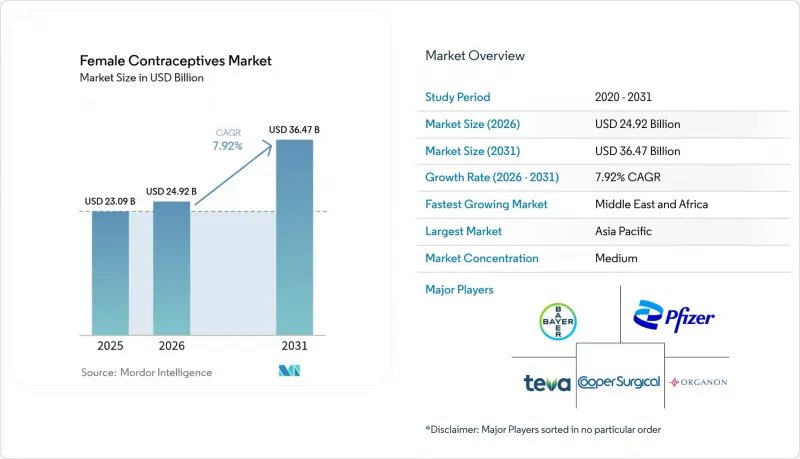
본 보고서는 제품 카테고리(피임약 및 피임 기구), 호르몬 유형(에스트로겐 단독, 프로게스테론 단독 등), 작용 지속 시간(단시간 작용형 및 LARC), 연령대(15-19세 등), 유통 채널(병원 약국 등), 최종 사용자(가정용 및 임상용), 그리고 지역별로 분류되어 있습니다. 시장 규모 및 전망은 금액(달러) 기준으로 제시되어 있습니다.
전 세계 여성용 피임법 시장 동향 및 인사이트
선진적이고 혁신적인 피임법에 대한 수요 증가
호르몬이 포함되지 않은 피임법에 대한 관심이 가속화되고 있습니다. 2025년 2월, MIUDELLA가 FDA 승인을 획득하면서 출혈과 통증을 줄이면서도 99%의 유효성을 유지하는 저구리 함유 IUD가 도입되었습니다. 임상 개발 파이프라인도 이러한 추세를 뒷받침하고 있으며, 장벽 작용과 국소 약물 전달을 결합한 Ovaprene의 3상 임상시험 결과가 2025년에 발표될 전망입니다. 연구 개발(R&D) 분야에서는 삽입 편의성 향상과 부작용 감소를 목표로 폴리머 코팅 및 합금 개량을 추진하고 있습니다. 이러한 가치 제안은 효과적이면서도 내분비계에 영향을 미치지 않는 대안을 찾는 여성들의 공감을 불러일으키며, 기존 호르몬 계열 제품에서 수요가 이동하는 결과를 낳고 있습니다. 이에 따라 의료기기 제조업체들은 구리 및 폴리머 기반 플랫폼에 더 많은 자본 예산을 할당하고 있으며, 이는 여성용 피임법 시장 내 해당 부문의 지속적인 확장을 시사합니다.
인지도 제고 및 접근성 확대를 위한 정부 및 시장 관계자들의 노력
민관 협력을 통해 피임 수단에 대한 자금 부족 문제가 점차 해소되고 있습니다. 2024년 유엔 총회에서 기부국들은 2030년까지 15억 달러에 달할 것으로 예상되는 전 세계 피임 자금 부족에 대응하여 3억 5,000만 달러를 기부하겠다고 약속했습니다. 게이츠 재단은 2030년까지 매년 2억 8,000만 달러를 혁신적인 기술 및 지역 사회 대상 프로그램에 지원하고 있습니다. 그 초기 성과는 우간다에서 나타나고 있으며, 청소년을 대상으로 한 생식 건강 통합 캠페인을 통해 25-49세 여성 사이에서 예상치 못하게 피임기구 이용률이 향상되었습니다. 이러한 노력은 특히 자원이 제한된 지역에서 여성용 피임법 시장 전체의 장기적인 성장을 뒷받침하는 기반이 되고 있습니다.
피임법 보급과 관련된 종교적, 사회적, 윤리적 과제
일부 지역에서는 문화적 규범이 피임법 보급을 저해하고 있습니다. 『2023년 중동·북아프리카(MENA) 가족 계획 정책 아틀라스』에 따르면, 중동 및 북아프리카에서 15-49세 여성의 15%가 사회적 제약으로 인해 여전히 미충족 수요가 있는 것으로 나타났습니다. 2025년 에티오피아에서 실시된 조사에 따르면, 농촌 지역 여성은 도시 지역의 동세대 여성에 비해 LARCs(장기 작용형 피임법)를 이용할 확률이 53% 낮은 것으로 나타났습니다. 미국에서는 ‘프로젝트 2025’에 따라 제안된 정책 전환으로 인해 4,800만 명의 이용자에 대한 무료 응급 피임약 제공이 제한될 가능성이 있습니다. 이러한 역풍을 극복하고 여성용 피임법 시장의 성장 궤도를 유지하기 위해서는 문화적 배경을 세심하게 고려한 인식 제고 활동이 필요합니다.
부문 분석
2025년, 여성용 피임법 시장에서 피임 기구가 67.85%의 점유율을 차지하고 있으며, 그 중심에는 99%의 유효성을 자랑하고 유지 관리 부담도 적은 자궁 내 피임 시스템이 있습니다. 'MIUDELLA'는 구리 사용량을 줄이면서도 유효성을 유지하는 혁신적인 제품에 대한 수요가 높음을 보여주고 있습니다. 이 부문은 출혈을 줄여주는 폴리머 코팅에 대한 지속적인 투자의 혜택을 받고 있으며, 처음 사용하는 사용자들 사이에서 수용도가 확대되고 있습니다. 피임약은 규모는 작지만, 제제 제조업체들이 투여량을 최적화하고 방출 프로파일을 연장함에 따라 2031년까지 연평균 성장률(CAGR) 7.97%로 성장하고 있습니다. 최초의 시판용 프로게스틴 정제가 등장함에 따라 소매 채널이 확대되었으며, 경구 피임약은 여성용 피임법 시장에서 더 빠른 시장 점유율 확대를 보일 것으로 전망됩니다.
첨단 질 내 링이나 오바프렌(Ovaprene)과 같은 비호르몬계 후보 제품들은 새로운 하위 부문을 개척할 태세를 갖추고 있습니다. 제약 기업들은 서방형 매트릭스를 활용하여 투여 간격을 단축하고, 복약 순응도를 높이고 있습니다. 이러한 혁신 기술이 결합되어 약리학적 통제력을 유지하면서도 의료기기와 비교했을 때의 편의성 격차를 해소할 것으로 기대됩니다. 이에 따라 각 기업이 여성용 피임법 시장에서 두 가지 투여 형태에 걸쳐 사업을 전개함에 따라 경쟁이 심화되고 있습니다.
2025년에는 에스트로겐·프로게스테론 복합제가 매출의 50.65%를 차지했습니다. 이러한 제제는 오랜 임상 분석과 예측 가능한 월경 패턴 덕분에 의사들로부터 두터운 지지를 받고 있는 것이 특징입니다. 그러나 에스트로겐이 금기인 여성에 대한 안전성과 새롭게 등장한 서방형 주사제의 부상에 힘입어, 프로게스테론 단독 제제는 연평균 성장률(CAGR) 8.52%로 확대되고 있습니다. 사야나 프레스(Sayana Press)사의 유통 파트너십은 저소득 시장에 3억 2,000만 회분을 공급하는 것을 목표로 하고 있습니다. 이 계획을 통해 의료 서비스가 충분히 제공되지 않는 지역의 여성용 피임법 시장 규모가 확대될 가능성이 있습니다.
부작용이 없는 피임법에 대한 수요에 힘입어, 비호르몬 요법에 대한 연구가 계속되고 있습니다. 초기 구리 합금 피임기구나 살정제를 이용한 장벽법은 구체적인 진전을 보이고 있습니다. 이러한 대체 수단은 제조업체에게 여성용 피임법 시장 내 제품 라인업의 다양화를 도모하는 동시에 법적 책임 위험을 헤지할 여지를 제공합니다.
지역별 분석
2025년, 아시아태평양은 31.95%의 점유율로 여성용 피임법 시장을 주도했습니다. 정부 주도의 가족 계획 캠페인, 출산율 감소, 그리고 여성 디지털 헬스 생태계의 부상이 이러한 주도적 위치를 뒷받침하고 있습니다. 중국과 인도가 공급 규모를 확대하는 한편, 일본과 한국에서는 결혼 연령이 높아지는 계층을 중심으로 LARCs의 보급이 진행되고 있습니다. 원격의료의 보급은 급속히 진행되고 있으며, 여성 디지털 헬스 분야는 2034년까지 연평균 성장률(CAGR) 20.54%로 확대될 것으로 예측됩니다.
북미는 성숙한 보험 적용 범위와 유연한 규제의 뒷받침을 받아 2위를 차지했습니다. 약사의 처방 권한 확대에 따라 접근 거점이 늘어나며, 지방 이용자들에게도 혜택이 돌아가고 있습니다. 미국에서는 1,900만 명의 여성이 여전히 피임 수단을 구하기 어려운 지역에 거주하고 있지만, 원격의료 및 OTC(일반의약품) 선택지를 통해 여성용 피임법 시장의 격차는 서서히 줄어들고 있습니다. 유럽에서는 보험 환급 체계가 견고하지만, 선호되는 피임법에는 편차가 보입니다. 북부 시장에서는 LARCs가 주류를 이루는 경향이 있는 반면, 남유럽에서는 경구 피임약이 여전히 주류를 유지하고 있습니다.
중동 및 아프리카는 2031년까지 연평균 성장률(CAGR) 9.12%로 가장 빠르게 성장하고 있습니다. 알제리와 튀니지에서는 지원적인 법적 체계가 마련되어 있습니다. ‘Merck for Mothers’는 모바일 정보 서비스를 통해 830만 명의 아프리카 여성에게 정보를 제공합니다. 아랍에미리트(UAE)는 피임 기구 부문이 2022년부터 2030년 사이에 두 배로 증가할 것으로 예상되어 상업적 잠재력을 보여주고 있습니다. 보수적인 지역에서는 여전히 사회적 규범이 보급을 저해하고 있지만, 도시화와 교육 수준 향상으로 인해 여성 피임법 시장 확대를 뒷받침하는 진보적인 사고방식이 촉진되고 있습니다.
기타 혜택:
- 엑셀 형식 시장 예측(ME) 시트
- 3개월간의 애널리스트 지원
자주 묻는 질문
목차
제1장 서론
제2장 조사 방법
제3장 주요 요약
제4장 시장 구도
제5장 시장 규모와 성장 예측
제6장 경쟁 구도
제7장 시장 기회와 향후 전망
JHS 26.08.11According to Mordor Intelligence, the female contraceptive market size in 2026 is estimated at USD 24.92 billion, growing from 2025 value of USD 23.09 billion with 2031 projections showing USD 36.47 billion, growing at 7.92% CAGR over 2026-2031.
This report is Segmented by Product Category (Contraceptive Drugs and Contraceptive Devices), Hormone Type (Estrogen-Only, Progestrone-Only, and More), Duration of Action (Short-Acting Methods and LARC), Age Group (15-19 Years and More), Distribution Channel (Hospital Pharmacies and More), End-User (Home and Clinical Use), and Geography. The Market and Forecasts are Provided in Terms of Value (USD).
Global Female Contraceptives Market Trends and Insights
Growing Preference for Advanced and Innovative Contraceptives
Momentum for hormone-free contraception is accelerating. MIUDELLA received FDA clearance in February 2025, introducing a lower-copper IUD that maintains 99% efficacy while reducing bleeding and pain. Clinical pipelines support the trend, with Ovaprene's Phase 3 trial read-out expected in 2025, combining barrier action and local drug delivery. R&D is targeting polymer coatings and alloy modifications to ease insertion and limit adverse events. The value proposition resonates with women seeking effective yet endocrine-neutral options, shifting demand away from legacy hormonal products. Device makers are therefore allocating larger capital budgets to copper and polymer-based platforms, signalling sustained expansion for this segment of the female contraceptive market.
Government and Market-Player Initiatives for Awareness and Access
Public-private coalitions are narrowing the contraceptive funding deficit. During the 2024 UN General Assembly, donors pledged USD 350 million toward the global contraceptive financing gap, projected at USD 1.5 billion by 2030. The Gates Foundation is contributing USD 280 million annually for innovative technologies and community programs through 2030. Early results are evident in Uganda, where integrated youth reproductive-health campaigns unexpectedly boosted uptake among women aged 25-49 years. Such commitments underpin long-term growth across the female contraceptive market, particularly in resource-limited regions.
Religious, Social and Ethical Issues for Contraceptive Adoption
Cultural norms restrict uptake in several regions. The Family Planning Policy Atlas MENA 2023 indicates that 15% of women aged 15-49 in the Middle East and North Africa still have unmet contraceptive needs due to social constraints. A 2025 Ethiopian study found rural women 53% less likely to use LARCs than urban peers. In the United States, proposed policy shifts under Project 2025 could curtail free emergency contraception for 48 million users. Such headwinds demand culturally nuanced outreach to sustain the female contraceptive market trajectory.
Other drivers and restraints analyzed in the detailed report include:
- Increasing Trend of Tele-Prescribing and Telehealth
- Investment by Market Players in Low-Cost Implants
- Product Liability Litigation and Side-Effect Risks
For complete list of drivers and restraints, kindly check the Table Of Contents.
Segment Analysis
Devices held 67.85% of female contraceptive market share in 2025, anchored by intrauterine systems that deliver 99% efficacy alongside low maintenance. MIUDELLA showcases the appetite for innovations that cut copper load yet preserve effectiveness. The segment benefits from sustained investments in polymer coatings that reduce bleeding, broadening acceptance among first-time users. Contraceptive drugs, while smaller, are rising at an 7.97% CAGR through 2031 as formulators refine dosing and extend release profiles. The first OTC progestin pill has expanded retail reach, positioning oral agents for faster gains inside the female contraceptive market size.
Advanced vaginal rings and non-hormonal candidates like Ovaprene are poised to open new sub-segments. Drug developers are leveraging sustained-release matrices to shorten dosing gaps and improve adherence. Together, these innovations are expected to close the convenience gap with devices while retaining pharmacological control. Competitive intensity is therefore increasing as firms straddle both modalities within the female contraceptive market.
Combined estrogen-progesterone products accounted for 50.65% revenue in 2025. Their long clinical history and predictable bleeding patterns reinforce physician preference. However, progesterone-only options are expanding at an 8.52% CAGR, driven by safety for women with estrogen contraindications and emerging prolonged-release injectables. Sayana Press distribution partnerships aim to supply 320 million doses to low-income markets. That plan could lift the female contraceptive market size in underserved areas.
Research into non-hormonal pathways continues, propelled by demand for side-effect-free contraception. Early copper-alloy devices and spermicidal barriers represent tangible progress. These alternatives give manufacturers scope to hedge against liability exposure while diversifying offerings in the female contraceptive market.
Complete Report Scope:
- By Product Category
- Contraceptive Drugs
- Oral Contraceptives
- Combined Pills
- Progestin-Only Pills
- Contraceptive Injections
- Topical Contraceptives
- Spermicides
- Oral Contraceptives
- Contraceptive Devices
- Female Condoms
- Diaphragms & Cervical Caps
- Vaginal Rings
- Contraceptive Sponges
- Sub-Dermal Implants
- Intra-Uterine Devices (IUD)
- Copper IUDs
- Hormonal IUDs
- Contraceptive Drugs
- By Hormone Type
- Estrogen-Only
- Progesterone-Only
- Combined (E+P)
- By Duration of Action
- Short-Acting Methods
- Long-Acting Reversible Contraceptives (LARC)
- By Age Group
- 15-19 Years
- 20-29 Years
- 30-39 Years
- 40+ Years
- By Distribution Channel
- Hospital Pharmacies
- Retail Pharmacies
- Online and DTC Platforms
- Community / Fertility Clinics
- By End-User Setting
- Home Use
- Clinical Use
- Geography
- North America
- United States
- Canada
- Mexico
- Europe
- Germany
- United Kingdom
- France
- Italy
- Spain
- Rest of Europe
- Asia-Pacific
- China
- Japan
- India
- Australia
- South Korea
- Rest of Asia-Pacific
- Middle East and Africa
- GCC
- South Africa
- Rest of Middle East and Africa
- South America
- Brazil
- Argentina
- Rest of South America
- North America
Geography Analysis
Asia-Pacific led the female contraceptive market with 31.95% share in 2025. Government-backed family-planning campaigns, falling fertility rates, and the rise of women's digital health ecosystems underpin leadership. China and India supply scale, while Japan and South Korea broaden uptake of LARCs among late-marrying populations. Telehealth penetration is growing quickly, with the women's digital health sector forecast to expand at 20.54% CAGR to 2034.
North America ranks second aided by mature insurance coverage and regulatory flexibility. Pharmacist prescribing authority has multiplied access points, benefiting rural users. Contraceptive deserts persist for 19 million US women, but telehealth and OTC options are gradually shrinking gaps in the female contraceptive market. Europe exhibits strong reimbursement yet heterogeneity in preferred methods. Northern markets tend toward LARCs while Southern Europe maintains oral dominance.
The Middle East and Africa region is the fastest-growing with a 9.12% CAGR to 2031. Algeria and Tunisia showcase supportive legal frameworks. Merck for Mothers has reached 8.3 million African women through mobile information services. The UAE exemplifies commercial promise as its contraceptive device segment is set to double between 2022 and 2030. Social norms still restrain adoption in conservative areas, yet rising urbanization and education catalyze progressive attitudes that favour female contraceptive market expansion.
- Bayer
- Organon
- Pfizer
- The Cooper Companies
- Teva Pharmaceutical Industries
- Agile Therapeutics Inc.
- Viatris
- Lupin Pharmaceuticals Ltd.
- Mayer Laboratories
- Amneal Pharmaceuticals
- Reckitt Benckiser Group
- Johnson & Johnson
- Chemring Group plc (AngelCare)
- Mona Lisa
- Pregna International Ltd.
- Glenmark Pharmaceuticals
- DKT International
- Gedeon Richter Polska Sp. z o.o.
- HLL Lifecare Ltd.
- Cupid Ltd.
Additional Benefits:
- The market estimate (ME) sheet in Excel format
- 3 months of analyst support
TABLE OF CONTENTS
1 Introduction
- 1.1 Study Assumptions and Market Definition
- 1.2 Scope of the Study
2 Research Methodology
3 Executive Summary
4 Market Landscape
- 4.1 Market Overview
- 4.2 Market Drivers
- 4.2.1 Growing Preference for Advanced and Innovative Contraceptives Such as Hormone-Free Copper IUDs
- 4.2.2 Government and Market Players Initiatives To Increase Awaarenss and Access of Feamle Contraceptives
- 4.2.3 Increasing Trend of Tele-Prescribing and Tele-health
- 4.2.4 Investment by Market Players in Low-Cost Implants
- 4.2.5 HPV-Linked Cancer Risk Awareness Accelerating Barrier-Method Adoption
- 4.2.6 Regulatory Green-Light for Over-The-Counter (OTC) Daily Oral Contraceptive Pills
- 4.3 Market Restraints
- 4.3.1 Religious, Social and Ethical Issues for Adoption of Various Contraceptives Such as IUDs etc.
- 4.3.2 Product Liability Litigation and Risks od Side Effects such as Hormonal Pills/ Implants
- 4.3.3 Regulatory Challenges Coupled with Limited Insurance Coverage
- 4.3.4 Supply-Chain Fragility for Key Hormonal APIs
- 4.4 Value / Supply-Chain Analysis
- 4.5 Regulatory and Technological Outlook
- 4.6 Porter's Five Forces Analysis
- 4.6.1 Bargaining Power of Suppliers
- 4.6.2 Bargaining Power of Buyers
- 4.6.3 Threat of New Entrants
- 4.6.4 Threat of Substitutes
- 4.6.5 Intensity of Competitive Rivalry
5 Market Size and Growth Forecasts (Value-USD)
- 5.1 By Product Category
- 5.1.1 Contraceptive Drugs
- 5.1.1.1 Oral Contraceptives
- 5.1.1.1.1 Combined Pills
- 5.1.1.1.2 Progestin-Only Pills
- 5.1.1.2 Contraceptive Injections
- 5.1.1.3 Topical Contraceptives
- 5.1.1.4 Spermicides
- 5.1.1.1 Oral Contraceptives
- 5.1.2 Contraceptive Devices
- 5.1.2.1 Female Condoms
- 5.1.2.2 Diaphragms & Cervical Caps
- 5.1.2.3 Vaginal Rings
- 5.1.2.4 Contraceptive Sponges
- 5.1.2.5 Sub-Dermal Implants
- 5.1.2.6 Intra-Uterine Devices (IUD)
- 5.1.2.6.1 Copper IUDs
- 5.1.2.6.2 Hormonal IUDs
- 5.1.1 Contraceptive Drugs
- 5.2 By Hormone Type
- 5.2.1 Estrogen-Only
- 5.2.2 Progesterone-Only
- 5.2.3 Combined (E+P)
- 5.3 By Duration of Action
- 5.3.1 Short-Acting Methods
- 5.3.2 Long-Acting Reversible Contraceptives (LARC)
- 5.4 By Age Group
- 5.4.1 15-19 Years
- 5.4.2 20-29 Years
- 5.4.3 30-39 Years
- 5.4.4 40+ Years
- 5.5 By Distribution Channel
- 5.5.1 Hospital Pharmacies
- 5.5.2 Retail Pharmacies
- 5.5.3 Online and DTC Platforms
- 5.5.4 Community / Fertility Clinics
- 5.6 By End-User Setting
- 5.6.1 Home Use
- 5.6.2 Clinical Use
- 5.7 Geography
- 5.7.1 North America
- 5.7.1.1 United States
- 5.7.1.2 Canada
- 5.7.1.3 Mexico
- 5.7.2 Europe
- 5.7.2.1 Germany
- 5.7.2.2 United Kingdom
- 5.7.2.3 France
- 5.7.2.4 Italy
- 5.7.2.5 Spain
- 5.7.2.6 Rest of Europe
- 5.7.3 Asia-Pacific
- 5.7.3.1 China
- 5.7.3.2 Japan
- 5.7.3.3 India
- 5.7.3.4 Australia
- 5.7.3.5 South Korea
- 5.7.3.6 Rest of Asia-Pacific
- 5.7.4 Middle East and Africa
- 5.7.4.1 GCC
- 5.7.4.2 South Africa
- 5.7.4.3 Rest of Middle East and Africa
- 5.7.5 South America
- 5.7.5.1 Brazil
- 5.7.5.2 Argentina
- 5.7.5.3 Rest of South America
- 5.7.1 North America
6 Competitive Landscape
- 6.1 Market Concentration
- 6.2 Strategic Moves
- 6.3 Market Share Analysis
- 6.4 Company profiles (includes Global level Overview, Market level overview, Core Segments, Financials as available, Strategic Information, Market Rank/Share for key companies, Products and Services, and Recent Developments)
- 6.4.1 Bayer AG
- 6.4.2 Organon & Co.
- 6.4.3 Pfizer Inc.
- 6.4.4 CooperSurgical Inc.
- 6.4.5 Teva Pharmaceutical Industries Ltd.
- 6.4.6 Agile Therapeutics Inc.
- 6.4.7 Viatris
- 6.4.8 Lupin Pharmaceuticals Ltd.
- 6.4.9 Mayer Laboratories Inc.
- 6.4.10 Amneal Pharmaceuticals LLC
- 6.4.11 Reckitt Benckiser Group plc
- 6.4.12 Johnson & Johnson (ETHICON)
- 6.4.13 Chemring Group plc (AngelCare)
- 6.4.14 Mona Lisa NV
- 6.4.15 Pregna International Ltd.
- 6.4.16 Glenmark Pharmaceuticals
- 6.4.17 DKT International
- 6.4.18 Gedeon Richter Polska Sp. z o.o.
- 6.4.19 HLL Lifecare Ltd.
- 6.4.20 Cupid Ltd.
7 Market Opportunities and Future Outlook
- 7.1 White-Space and Unmet-Need Assessment


