

|
시장보고서
상품코드
2100587
납축전지(LAB) 시장 : 점유율 분석, 업계 동향 및 통계, 성장 예측(2026-2031년)Lead-Acid Battery - Market Share Analysis, Industry Trends & Statistics, Growth Forecasts (2026 - 2031) |
||||||
 Mordor Intelligence
Mordor Intelligence에 의하면, 납축전지(LAB) 시장 규모는 2025년 495억 4,000만 달러, 2026년 518억 달러에서 2031년까지 641억 5,000만 달러로 확대되어 2026년부터 2031년까지 연평균 복합 성장률(CAGR)은 4.37%를 나타낼 것으로 예측됩니다.
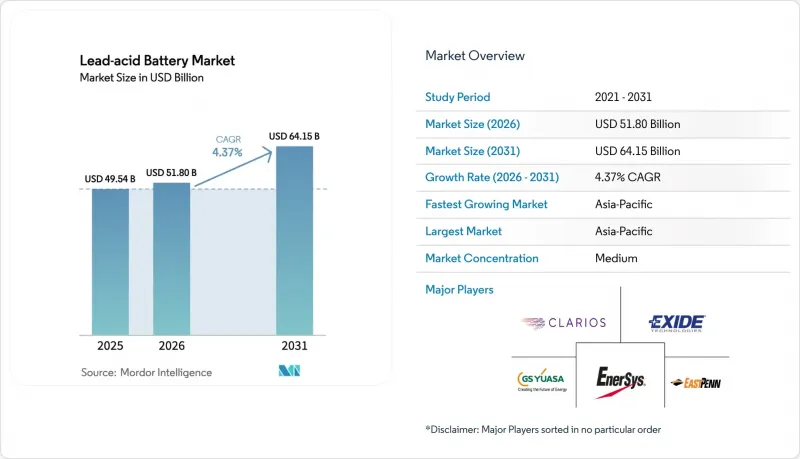
본 보고서는 구조(액체형·VRLA), 용도(SLI·고정형·동력/견인·휴대용·기타), 지역(북미, 유럽, 아시아태평양, 남미, 중동 및 아프리카)별로 분류되어 있습니다. 시장 규모 및 전망은 금액(달러)으로 표시되어 있습니다.
세계 납축전지(LAB) 시장 동향과 인사이트
내연기관(ICE) 차량 보유 대수에 따른 교체 수요는 견조한 추세를 보일 전망
내연기관 차량 및 하이브리드 차량은 향후 10년 이상 전 세계 차량 보유 대수의 대부분을 차지할 것으로 예상되며, 납축전지(LAB)의 안정적인 교체 주기가 확보될 전망입니다. 2025년에는 AGM(흡수성 유리 매트) 배터리를 탑재한 5,000만 대 이상의 차량에서 애프터마켓 교체가 필요해질 것이며, 스타트-스톱 기능의 보급이 확대됨에 따라 이 수치는 더욱 증가할 전망입니다. 중국의 2억 8,000만 대 차량 보유 대수와 인도의 2억 8,000만 대 등록 차량은 열대 기후에서는 평균 4년, 온대 지역에서는 평균 5년의 배터리 수명을 고려할 때 거대한 수요원이 될 것입니다. 유럽에서의 DIN 규격 크기로의 통합은 유통업체의 재고 관리를 간소화하는 한편, 교체 비용을 상승시켜 공급망을 장악하고 있는 기존 기업들에게 이익률 향상 여지를 만들어 주고 있습니다. 이러한 기본적인 요인들로 인해, 전기차의 부상에도 불구하고 납축전지(LAB) 시장은 자동차 애프터마켓에서 확고한 입지를 유지하고 있습니다.
신흥 아시아·아프리카의 통신 네트워크 고밀도화
전력망의 신뢰성이 낮기 때문에 통신 사업자는 기지국의 가동 시간을 확보하기 위해 납축전지(LAB)에 의존할 수밖에 없습니다. 인도의 40만 기 통신 타워에서는 하루 8시간 이상의 정전이 발생하고 있어, 디젤 발전기로 전환되는 시간을 보완하기 위해 정격 300-900암페어시의 배터리 뱅크가 도입되어 있습니다. 사하라 이남 아프리카에서는 기지국의 88%가 Off-grid이거나 불안정한 전력망에 연결되어 있으며, 도난 우려와 과열 위험으로 인해 리튬 이온 배터리 도입이 제한되고 있어 밀폐형 VRLA 배터리가 채택되고 있습니다. 아세안(ASEAN) 국가에서는 연간 최대 1만 5,000기의 기지국이 신설되고 있으며, 낮은 투자 비용과 재활용 용이성이 요구되는 지방 지역에서의 도입에는 납축전지(LAB)가 지정되어 있습니다. 이러한 지속적인 수요 덕분에 도시 지역에서는 리튬 이온 배터리가 주를 이루는 상황에서도 출하량이 꾸준히 증가하고 있습니다.
자동차용 리튬 이온 배터리의 비용 곡선이 70달러/kWh 아래로 떨어짐
리튬 이온 배터리 팩 가격은 2024년에 1kWh당 115달러까지 하락하고, 2026년까지 80달러까지 떨어질 것으로 예측되어, 시동용 및 구동용의 총 소유 비용(TCO) 격차가 해소될 전망입니다. 골드만삭스는 내연기관과의 구동 시스템 전체 비용 평형이 kWh당 80달러에서 달성될 것으로 전망하고 있으며, 이 임계치에 도달함에 따라 전기차 보급이 가속화되고 납산 배터리(SLI)의 애프터마켓이 축소될 것입니다. CATL 및 BYD와 같은 중국 공급업체들은 수직 통합과 규모의 경제를 통해 이미 셀 수준의 비용을 kWh당 75달러 미만으로 억제하고 있어, 납산 배터리 제조업체에 더욱 큰 압박을 가하고 있습니다. 맥킨지는 사업자들이 급속 충전과 높은 에너지 밀도를 우선시함에 따라, 2030년까지 리튬 이온 배터리가 동력용 부문의 60-70%를 차지할 것으로 예측했습니다. 임박한 비용 역전으로 인해 납축전지(LAB)가 기존에 가지고 있던 ‘낮은 초기 비용’이라는 우위는 사라지게 되며, 제조업체들은 대신 수명, 회수 인프라, 규제 준수 측면에서 경쟁을 벌일 수밖에 없게 될 것입니다.
부문 분석
VRLA 배터리는 2025년 매출의 94.57%를 차지하고 있으며, 이 부문은 2031년까지 연평균 5.51%의 성장률로 확대될 것으로 예측됩니다. 프리미엄 AGM 유형은 수명이 20-30% 더 길고, 부분 충전 상태에서의 충방전 사이클도 견딜 수 있어 마이크로 하이브리드 차량이나 통신 기지국에서 필수적인 존재가 되고 있습니다. 그래핀으로 강화된 AGM 설계는 내구성을 한층 더 높여주며, 실험실 테스트에서 사이클 수명을 약 25% 연장한 것으로 나타났습니다. 따라서 VRLA 제품의 납축전지(LAB) 시장 규모는 시장 전체 평균을 상회하는 속도로 성장할 것으로 전망됩니다.
2025년에는 개방형 배터리가 나머지 5.43%의 점유율을 차지했습니다. 이러한 배터리는 가격에 민감하고 유지보수 인건비가 저렴한 고정형·동력용이라는 틈새 시장에서 여전히 사용되고 있습니다. 현재, 탄소·그래핀 첨가제를 통해 방전 깊이 50%에서 500-700회의 충방전이 가능해졌으며, 초기 VRLA와 동등한 성능을 그 비용의 60-70% 수준으로 실현하고 있습니다. 이러한 기술적 추격 덕분에, 특히 사하라 이남 아프리카나 남아시아의 농촌 지역 통신 설비에서 액체형 배터리의 화학 구성이 여전히 실용성을 유지하고 있습니다.
지역별 분석
아시아태평양은 2025년에 전 세계 매출의 52.59%를 차지할 것으로 예상되며, 2031년까지 연평균 4.83%의 성장률을 보일 전망입니다. 중국은 막대한 차량 보유 대수, 스타트-스톱 기능의 높은 보급률, 그리고 국내 수직 통합형 제조업체에 유리한 정책 주도형 재활용 의무를 모두 갖추고 있습니다. 인도의 애프터마켓은 교체 주기가 짧고 프리미엄 화학 성분의 점유율이 확대되고 있어 큰 성장 여지가 있습니다. 아세안(ASEAN) 시장에서는 매년 수천 기의 새로운 통신 타워가 설치되고 있으며, 그 대부분은 자본 제약이나 확립된 재활용 경로로 인해 VRLA 배터리가 지정되고 있습니다.
북미에서는 전기차 보급으로 인해 액체형 SLI 배터리의 출하량이 감소하고 있어 시장 확대는 완만하지만, 신차 판매에서 스타트-스톱 기능의 보급률이 50%에 달함에 따라 애프터마켓의 견조한 흐름은 지속되고 있습니다. 미국 환경보호청(EPA)이 도시 지역의 제련소에 대한 납 노출 기준을 강화하고 있어, 재활용 규정 준수에 드는 비용은 상승하고 있습니다. 유럽에서는 ‘배터리 규정 2023/1542’에 따라 유사한 규제 압박에 직면해 있습니다. 해당 규정에서는 2030년까지 납 회수율 70% 달성 및 2027년까지 디지털 배터리 패스포트 도입이 규정되어 있습니다. 독일, 프랑스, 영국에서 전기차(EV) 보급이 가속화되면서 SLI 배터리 출하량 감소가 가속화되고 있지만, 프리미엄 AGM 배터리로의 전환이 평균 판매 가격을 끌어올리고 있습니다.
남미, 중동 및 아프리카는 여전히 유망한 지역입니다. 브라질에서는 5,000만 대에 달하는 차량 보유 대수와 낮은 전기차 보급률이 기존·프리미엄 납축전지(LAB) 수요를 뒷받침하고 있지만, 경제 상황의 변동으로 인해 교체 주기가 길어질 수도 있습니다. 사하라 이남 아프리카에서는 도난 위험과 리튬 이온 배터리 도입에 따른 비용 장벽을 이유로, 기지국 사이트의 88%에서 납축전지(LAB)가 사용되고 있습니다. 걸프협력회의(GCC) 회원국 및 남아프리카공화국에서는 디지털 경제 전략에 따른 데이터센터 확장에 힘입어 VRLA UPS 시스템 도입이 계속되고 있습니다. 이 지역 전체에서 확립된 회수 및 재활용 네트워크가 납축전지(LAB) 시장의 우위를 공고히 하고 있습니다.
기타 혜택:
- 엑셀 형식 시장 예측(ME) 시트
- 3개월간의 애널리스트 지원
자주 묻는 질문
목차
제1장 서론
제2장 조사 방법
제3장 주요 요약
제4장 시장 구도
제5장 시장 규모와 성장 예측
제6장 경쟁 구도
제7장 시장 기회와 향후 전망
JHS 26.08.11According to Mordor Intelligence, the lead-Acid battery market size is projected to expand from USD 49.54 billion in 2025 and USD 51.80 billion in 2026 to USD 64.15 billion by 2031, registering a CAGR of 4.37% between 2026 to 2031.
This report is Segmented by Construction Method (Flooded and VRLA), Application (Starting-Lighting-Ignition, Stationary, Motive/Traction, and Portable and Others), and Geography (North America, Europe, Asia-Pacific, South America, and Middle East and Africa). The Market Sizes and Forecasts are Provided in Terms of Value (USD).
Global Lead-Acid Battery Market Trends and Insights
ICE-Vehicle Parc Replacement Demand Remains Resilient
Internal-combustion and hybrid vehicles are predicted to dominate the global fleet well into the next decade, securing a steady replacement cycle for lead-acid batteries. More than 50 million vehicles equipped with absorbent-glass-mat (AGM) batteries required aftermarket replacements in 2025, and this figure will rise as start-stop penetration deepens. China's 280 million-unit vehicle parc and India's 280 million registered vehicles represent substantial reservoirs where battery life averages four years in tropical climates and five years in temperate zones. Consolidation toward DIN-standard sizing in Europe simplifies distributor inventory yet raises replacement costs, creating margin upside for incumbents that control supply chains. These fundamentals keep the lead acid battery market anchored in the automotive aftermarket despite the rise of electric vehicles.
Telecom Network Densification in Emerging Asia & Africa
Unreliable grids drive telecom operators to rely on lead-acid batteries for base-station uptime. India's 400,000 towers face daily outages exceeding eight hours and therefore deploy battery banks rated 300-900 ampere-hours to bridge diesel-generator switchover periods. Sub-Saharan Africa, where 88% of sites are off-grid or bad-grid, opts for sealed VRLA units because theft concerns and thermal-runaway risks restrict lithium-ion adoption. ASEAN nations are adding up to 15,000 towers annually, specifying lead-acid for rural deployments that require low capital investment and straightforward recycling. This persistent demand supports steady shipment growth even as lithium-ion captures urban installations.
Lithium-Ion Cost Curve Crossing Below USD 70 kWh for Automotive
Lithium-ion battery pack prices declined to USD 115 kWh in 2024 and are projected to fall to USD 80 kWh by 2026, closing the total-cost-of-ownership gap in starter and motive-power use cases. Goldman Sachs pegs full drivetrain parity with internal-combustion engines at USD 80 kWh, a threshold that accelerates electric-vehicle adoption and shrinks the captive SLI aftermarket. Chinese suppliers such as CATL and BYD already achieve cell-level costs below USD 75 kWh through vertical integration and scale efficiencies, putting additional pressure on lead-acid producers. McKinsey forecasts lithium-ion will secure 60-70% of the motive-power segment by 2030 as operators prioritize fast charging and higher energy density. The impending cost crossover removes lead-acid's historic advantage, low upfront price, forcing manufacturers to compete on service life, collection infrastructure, and regulatory compliance instead.
Other drivers and restraints analyzed in the detailed report include:
- Data-Center UPS Build-Outs (Tier-2 Cities)
- Aftermarket Revenue Lock-In for Micro-Hybrid SLI Batteries
- Stricter EU End-of-Life Lead Limits
For complete list of drivers and restraints, kindly check the Table Of Contents.
Segment Analysis
VRLA batteries commanded 94.57% of 2025 revenue, and the segment is forecast to compound at 5.51% to 2031. Premium AGM variants deliver 20-30% longer service life and tolerate partial-state-of-charge cycling, making them essential for micro-hybrid vehicles and telecom sites. Graphene-enhanced AGM designs further raise durability, extending cycle life by about 25% in lab tests. The lead acid battery market size for VRLA products is therefore positioned to outpace the overall average.
Flooded batteries held the remaining 5.43% share in 2025. They persist in price-sensitive stationary and motive-power niches where maintenance labor is inexpensive. Carbon and graphene additives now allow 500-700 cycles at 50% depth-of-discharge, matching early VRLA performance at 60-70% of the cost. This technical catch-up keeps flooded chemistry viable, particularly in rural telecom installations across Sub-Saharan Africa and South Asia.
Complete Report Scope:
- By Construction Method
- Flooded
- VRLA
- By Application
- Starting-Lighting-Ignition (SLI)
- Stationary
- Motive/Traction (Forklifts, Golf-carts)
- Portable and Others
- By Geography
- North America
- United States
- Canada
- Mexico
- Europe
- Germany
- United Kingdom
- France
- Spain
- Italy
- NORDIC Countries
- Russia
- Rest of Europe
- Asia Pacific
- China
- India
- Japan
- South Korea
- ASEAN Countries
- Australia and New Zealand
- Rest of Asia Pacific
- South America
- Brazil
- Argentina
- Chile
- Rest of South America
- Middle East and Africa
- Saudi Arabia
- United Arab Emirates
- South Africa
- Egypt
- Rest of Middle East and Africa
- North America
Geography Analysis
Asia-Pacific generated 52.59% of global revenue in 2025 and will grow at 4.83% a year to 2031. China combines a vast vehicle parc, strong start-stop uptake, and policy-driven recycling mandates that favor domestic vertically integrated producers. India's aftermarket offers significant upside, driven by short replacement cycles and a rising share of premium chemistries. ASEAN markets add thousands of new telecom towers each year, most of which specify VRLA batteries due to capital constraints and established recycling routes.
North America exhibits moderate expansion because electric vehicles reduce flooded SLI volume, yet aftermarket resilience persists thanks to 50% start-stop penetration in new-car sales. Recycling compliance costs are climbing as the U.S. Environmental Protection Agency tightens lead exposure limits for urban smelters. Europe faces similar regulatory pressures under the Battery Regulation 2023/1542, which stipulates 70% lead recovery by 2030 and digital battery passports by 2027. Faster EV adoption in Germany, France, and the United Kingdom accelerates SLI volume erosion, but premium AGM replacements boost average selling prices.
South America and the Middle East & Africa remain opportunity regions. Brazil's 50 million-vehicle parc and low EV penetration favor conventional and premium lead-acid formats, although economic volatility occasionally lengthens replacement cycles. Sub-Saharan Africa relies on lead-acid for 88% of base-station sites, citing theft risk and cost barriers to lithium-ion. Gulf Cooperation Council states and South Africa continue to install VRLA UPS systems for data-center expansions linked to digital-economy strategies. Across these regions, established collection and recycling networks reinforce the incumbency of the Lead-Acid Battery Market.
- Clarios
- Exide Technologies
- EnerSys
- GS Yuasa Corp.
- East Penn Manufacturing
- Panasonic
- Amara Raja Batteries
- C&D Technologies
- Leoch International
- Chaowei Power
- Narada Power
- NorthStar Battery
- Crown Battery
- Trojan Battery
- Camel Group
- FIAMM Energy Technology
- Hitachi Chemical
- HOPPECKE
- Shuangdeng (Sacred Sun)
- Sunlight Group
Additional Benefits:
- The market estimate (ME) sheet in Excel format
- 3 months of analyst support
TABLE OF CONTENTS
1 Introduction
- 1.1 Study Assumptions & Market Definition
- 1.2 Scope of the Study
2 Research Methodology
3 Executive Summary
4 Market Landscape
- 4.1 Market Overview
- 4.2 Market Drivers
- 4.2.1 ICE-vehicle parc replacement demand remains resilient
- 4.2.2 Telecom network densification in emerging Asia & Africa
- 4.2.3 Data-center UPS build-outs (Tier-2 cities)
- 4.2.4 After-market revenue lock-in for micro-hybrid SLI batteries
- 4.2.5 "Smart-mixing" additives boosting flooded-cell life
- 4.2.6 Low-speed EV boom in LMICs needing low-cost storage
- 4.3 Market Restraints
- 4.3.1 Li-ion cost curve crossing at <$70 kWh for automotive
- 4.3.2 Stricter EU end-of-life Pb limits
- 4.3.3 Insurance risk premiums for urban recycling clusters
- 4.3.4 Graphene-enhanced AGM cannibalising conventional VRLA
- 4.4 Supply-Chain Analysis
- 4.5 Regulatory Landscape
- 4.6 Technological Outlook
- 4.7 Porter's Five Forces
- 4.7.1 Bargaining Power of Suppliers
- 4.7.2 Bargaining Power of Buyers
- 4.7.3 Threat of New Entrants
- 4.7.4 Threat of Substitutes
- 4.7.5 Intensity of Competitive Rivalry
5 Market Size & Growth Forecasts
- 5.1 By Construction Method
- 5.1.1 Flooded
- 5.1.2 VRLA
- 5.2 By Application
- 5.2.1 Starting-Lighting-Ignition (SLI)
- 5.2.2 Stationary
- 5.2.3 Motive/Traction (Forklifts, Golf-carts)
- 5.2.4 Portable and Others
- 5.3 By Geography
- 5.3.1 North America
- 5.3.1.1 United States
- 5.3.1.2 Canada
- 5.3.1.3 Mexico
- 5.3.2 Europe
- 5.3.2.1 Germany
- 5.3.2.2 United Kingdom
- 5.3.2.3 France
- 5.3.2.4 Spain
- 5.3.2.5 Italy
- 5.3.2.6 NORDIC Countries
- 5.3.2.7 Russia
- 5.3.2.8 Rest of Europe
- 5.3.3 Asia Pacific
- 5.3.3.1 China
- 5.3.3.2 India
- 5.3.3.3 Japan
- 5.3.3.4 South Korea
- 5.3.3.5 ASEAN Countries
- 5.3.3.6 Australia and New Zealand
- 5.3.3.7 Rest of Asia Pacific
- 5.3.4 South America
- 5.3.4.1 Brazil
- 5.3.4.2 Argentina
- 5.3.4.3 Chile
- 5.3.4.4 Rest of South America
- 5.3.5 Middle East and Africa
- 5.3.5.1 Saudi Arabia
- 5.3.5.2 United Arab Emirates
- 5.3.5.3 South Africa
- 5.3.5.4 Egypt
- 5.3.5.5 Rest of Middle East and Africa
- 5.3.1 North America
6 Competitive Landscape
- 6.1 Market Concentration
- 6.2 Strategic Moves (M&A, Partnerships, PPAs)
- 6.3 Market Share Analysis (Market Rank/Share for key companies)
- 6.4 Company Profiles (includes Global level Overview, Market level overview, Core Segments, Financials as available, Strategic Information, Products & Services, and Recent Developments)
- 6.4.1 Clarios
- 6.4.2 Exide Technologies
- 6.4.3 EnerSys
- 6.4.4 GS Yuasa Corp.
- 6.4.5 East Penn Manufacturing
- 6.4.6 Panasonic
- 6.4.7 Amara Raja Batteries
- 6.4.8 C&D Technologies
- 6.4.9 Leoch International
- 6.4.10 Chaowei Power
- 6.4.11 Narada Power
- 6.4.12 NorthStar Battery
- 6.4.13 Crown Battery
- 6.4.14 Trojan Battery
- 6.4.15 Camel Group
- 6.4.16 FIAMM Energy Technology
- 6.4.17 Hitachi Chemical
- 6.4.18 HOPPECKE
- 6.4.19 Shuangdeng (Sacred Sun)
- 6.4.20 Sunlight Group
7 Market Opportunities & Future Outlook
- 7.1 White-space & Unmet-need Assessment


