

|
시장보고서
상품코드
2100588
실험실 정보 관리 시스템 시장 : 점유율 분석, 업계 동향 및 통계, 성장 예측(2025-2030년)Laboratory Information Management System - Market Share Analysis, Industry Trends & Statistics, Growth Forecasts (2025 - 2030) |
||||||
 Mordor Intelligence
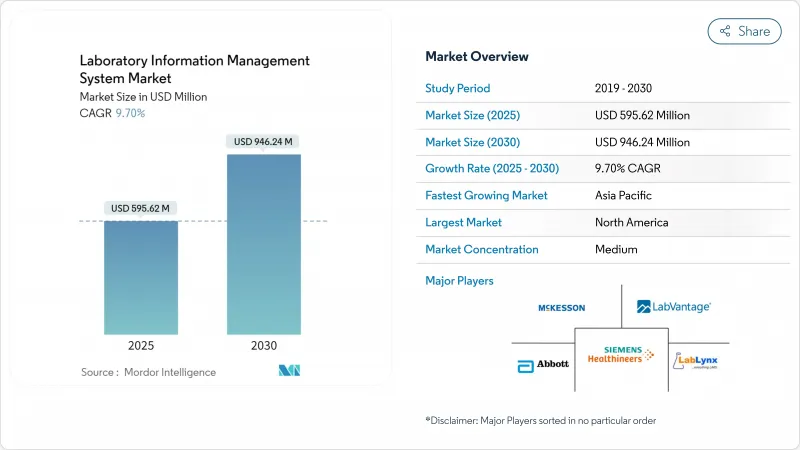
실험실 정보 관리 시스템(LIMS) 시장 규모는 2025년에 5억 9,562만 달러에 이르고, 2030년까지 9억 4,624만 달러로 확대한다고 예측되고 있어 CAGR은 9.7%를 나타낼 전망입니다.
본 보고서는 구성 요소(소프트웨어 및 서비스), 제품 유형(범용/다목적 LIMS 등), 도입 모델(On-Premise, 웹 호스팅형, 클라우드 기반), 기업 규모(대규모 연구소 네트워크 등), 용도(신약 개발·전임상, 임상시험·바이오 분석 등), 최종 사용자(제약·바이오기술 기업 등), 지역
전 세계 실험실 정보 관리 시스템(LIMS) 시장 동향 및 인사이트
제약·바이오기술 기업의 연구개발 파이프라인의 급속한 확대
현재 전 세계 신약 개발 프로그램의 유효 후보 물질 수는 2만 건을 넘어섰으며, 2020년 대비 38% 증가했습니다. 새로운 분자가 추가될 때마다 실험실 데이터의 양은 증가하며, 맥락 부여 및 감사 추적을 자동화하는 확장 가능한 LIMS에 대한 수요가 높아지고 있습니다. AI를 활용한 이상치 감지 기능을 갖춘 플랫폼을 통해 품질 관리 실험실의 데이터 검토 주기가 43% 단축되어 분석가의 업무 부담이 경감될 뿐만 아니라, 배치 출시도 가속화되고 있습니다. LIMS와 전자 노트, 과학 데이터 허브 간의 원활한 통합을 통해 정보의 장벽이 제거되어, 다분야에 걸친 팀이 수동으로 데이터를 내보낼 필요 없이 신약 개발부터 스케일업에 이르는 데이터 세트를 분석할 수 있게 됩니다. 이 기능을 통해 개발 지속 또는 중단 결정이 신속해지며, 전반적인 개발 기간을 단축하는 적응형 임상시험 설계를 지원합니다.
바이오뱅크에 대한 수요 증가
정밀의료 프로그램의 70% 이상은 동의를 얻은 검체를 수십 년에 걸쳐 안전하게 보관하는 바이오 리포지토리에 의존하고 있습니다. 최신 시스템에서는 IoT 지원 냉동고 모니터링과 이벤트 기반 알림을 결합하여 온도 편차를 미연에 방지하고 있습니다. 주요 기관에서 바코드를 중심으로 한 재고 관리를 통해 검색 시간이 67% 단축되는 동시에 수량 불일치 문제도 해결되었습니다. 블록체인 기반의 보관 이력 관리가 실제 운영 환경에 도입되어, 사용권이 기증자의 동의와 직접 연결되는 유전자 치료용 검체에 필수적인, 위조가 불가능한 출처 기록을 제공합니다. 이러한 첨단 기능을 통해 LIMS는 단순한 수동적 기록 관리 도구에서 검체의 무결성을 능동적으로 지키는 수호자로 진화하고 있습니다.
높은 총소유비용(TCO)과 장기화되는 검증 기간
기업 도입 시 라이선스 비용이 100만 달러를 초과하는 경우가 있으며, 6-9개월에 달하는 검증 기간이 필요하기 때문에 투자 회수가 지연될 가능성이 있습니다. 버몬트주 공중보건연구소에서는 맞춤 설정 및 유지보수에 170만 달러의 비용이 소요된 것으로 보고되었습니다. 구독 방식의 SaaS 옵션은 초기 투자를 줄여주지만, 인프라 외주화에 소극적인 보수적인 품질 보증 팀에게는 여전히 과제로 남아 있습니다. 벤더 측은 인증 주기를 단축하는 사전 검증된 템플릿, 수명 주기 비용에 상한을 설정한 매니지드 서비스 계약 번들 제공 등으로 대응하고 있습니다.
부문 분석
실험실 정보 관리 시스템(LIMS) 시장에서는 2024년 기준 서비스가 매출의 52%를 차지하고 있으며, 검증, 통합, 지속적인 개선 과정에서 검사 기관이 외부 전문 지식에 의존하고 있는 실태가 드러나고 있습니다. 이러한 계약은 대개 수년에 걸쳐 지속되며, 규제 업데이트나 새로운 장비 도입에 맞추어 워크플로가 진화하도록 보장합니다. 이와 동시에, 클라우드 네이티브 구독 서비스에 대한 수요는 실험 작업의 중단을 방지하는 탄력적인 확장 및 기능의 자동 롤아웃에 힘입어 연평균 성장률(CAGR) 10.8%로 가속화되고 있습니다. 서비스 제공업체들은 포트폴리오를 확대하고 ‘서비스형 검증(Validation-as-a-Service)’ 및 AI 모델 스튜어드십을 도입함으로써, 인력 부족으로 인해 제약받던 기능에 고객이 턴키 방식으로 접근할 수 있게 되었습니다. 이러한 추세는 시스템 구성을 진화하는 과학적 목표에 부합하도록 조정하는 전략적 전문 지침과 결합될 때만 소프트웨어의 유용성이 극대화됨을 보여줍니다.
2세대 매니지드 서비스 모델에서는 알고리즘 훈련 및 성능 모니터링에 대한 책임을 점점 더 많이 맡고 있으며, SaaS(Software-as-a-Service) 개념을 반영한 지속적인 수익원을 창출하고 있습니다. 연구소에서는 특히 단일 세포 시퀀싱과 같은 새로운 모달리티를 다룰 때, 예측 가능한 지출과 가치 실현까지의 시간 단축이 높이 평가되고 있습니다. 현재 여러 공급업체가 서비스 요금을 정량화된 효율 향상과 연동시키는 성과 기반 가격 책정 방식을 도입하고 있으며, 이 구조는 일회성 도입 마일스톤이 아닌 지속적인 최적화를 촉진합니다. 따라서 실험실 정보 관리 시스템(LIMS) 시장에서는 구성 가능한 플랫폼과 기술 및 규정 준수의 양측면을 아우르는 심도 있는 컨설팅 역량을 결합할 수 있는 공급업체가 높이 평가받고 있습니다.
규제가 엄격한 시설에서는 인프라, 검증 스크립트, 데이터 접근 정책을 직접 관리하는 것을 선호하기 때문에 On-Premise형 시스템은 2024년 매출의 55%를 계속 차지했습니다. 그러나 검사 기관들이 원격 액세스 및 IT 관리 부담 경감을 요구함에 따라, 클라우드 기반 시스템 시장은 연평균 성장률(CAGR) 10.2%를 나타낼 것으로 예측됩니다. 익숙한 워크스테이션 UI를 재현하면서도 데이터를 주권형 클라우드에 저장하는 하이브리드 설계는 감사인의 요구를 충족시키면서 분석 부하의 급증에 대응할 수 있는 탄력적인 컴퓨팅을 가능하게 하는 적절한 가교 역할을 합니다. 소규모 연구소의 경우, 클라우드 구독을 통해 설비 투자가 대폭 절감되고 도입 기간이 몇 주로 단축됨에 따라, 과거에는 대형 제약사의 예산으로만 실현할 수 있었던 모범 사례 워크플로가 널리 보급되게 되었습니다.
팬데믹으로 인한 봉쇄 기간 동안 얻은 운영 경험은 브라우저 기반 액세스의 견고성을 입증했으며, 보수적인 품질 관리 책임자조차도 비 GxP 기능을 위해 SaaS 샌드박스를 시범 도입하는 계기가 되었습니다. 신뢰도가 높아짐에 따라 프로덕션 워크로드의 이전이 진행되고 있으며, 대부분의 경우 안정성 시험이나 환경 모니터링 모듈에서 시작하여 이후 중요한 출시 분석으로 이전하고 있습니다. 향후 실험실 정보 관리 시스템(LIMS) 시장에서는 엣지 어플라이언스가 장비로부터의 데이터 수집을 처리하고, 규제 준수 등급의 사본이 지역별 클라우드 저장소에 저장되는 통합 아키텍처가 보급될 것으로 예측됩니다. 이를 통해 지연 최소화와 규정 준수가 모두 보장됩니다.
지역별 분석
2024년, 북미는 실험실 정보 관리 시스템(LIMS) 시장 매출에서 35%라는 최대 점유율을 차지했습니다. 이는 제약 분야의 대규모 연구개발 투자와 인포매틱스 벤더 및 통합업체가 구축한 성숙한 생태계에 힘입은 결과입니다. FDA 등 규제 당국의 감독에서는 데이터 무결성이 최우선으로 간주되며, 실험실은 LIMS가 제공하는 종합적인 감사 추적 기록과 전자 서명을 유지해야 합니다. 예방적 품질 감시를 위한 AI 통합이 급속히 진전되고 있으며, 주요 제조업체들은 출하 중단 사태가 발생하기 전에 잠재적인 편차를 경고하는 예측 분석을 도입하고 있습니다. 정밀 의학의 높은 보급률에 더해, 유전체 검사에 대한 보험 환급 경로가 정비됨에 따라 시퀀싱 데이터와 환자 동의서를 통합된 기록 내에 포함시키는 플랫폼에 대한 수요가 더욱 높아지고 있습니다.
아시아태평양은 가장 빠른 성장 궤도를 보이고 있으며, 2030년까지 연평균 성장률(CAGR)은 11.3%로 예측됩니다. 중국과 인도에서의 백신 및 생물학적 제제 제조의 지역적 확대에 더해, 실험실 인프라의 디지털 전환을 촉진하는 정부의 인센티브도 맞물려, 싱가포르와 한국에서 사업을 전개하는 위탁연구기관(CRO)은 LIMS를 도입해 우수실험실관리기준(GLP) 준수를 입증함으로써, 비용 대비 효과가 높고 품질이 보장된 파트너를 찾는 다국적 스폰서로부터 계약을 수주하고 있습니다. 일본의 국가 유전체 이니셔티브에서는 개인정보 보호를 중시하는 동의 획득 워크플로가 통합되어 있으며, LIMS는 윤리적인 데이터 관리의 중심적인 역할을 수행하고 있습니다. 한편, 호주의 애그리테크 이해관계자들은 지속 가능한 농업의 요구를 지원하기 위해 토양 마이크로바이옴 정보학을 채택하고 있으며, LIMS의 보급 범위는 의료 분야를 넘어 확대되고 있습니다.
유럽에서는 엄격한 데이터 보호 규제와 견고한 바이오의약품 제조거점에 힘입어 LIMS 도입 규모가 여전히 큰 임베디드니다. GDPR(EU 개인정보보호규정)(일반 데이터 보호 규정)은 시스템 설계에 영향을 미치며, 지역 제한적인 데이터 거주 요건과 세밀한 동의 관리를 의무화하고 있습니다. 제약 기업에서는 LIMS를 ‘적격자(Qualified Person)’에 의한 출하 승인 시스템과 통합하여, 원재료 입고부터 최종 제품 인증에 이르기까지의 추적성을 확보하고 있습니다. 유럽 대륙의 광범위한 바이오뱅크 네트워크에서는 전문 모듈을 활용하여 종단적인 검체 추적 및 범유럽 연구 컨소시엄 내의 국경을 초월한 데이터 교환이 이루어지고 있습니다. 브렉시트 이후 영국의 규제 기준 변화로 인해, 의약품 및 의료제품 규제청(MHRA)의 가이드라인을 충족하기 위한 시스템 구축 프로젝트가 잇따라 진행되며, 도입 파트너 기업에 새로운 서비스 수익을 창출하고 있습니다.
기타 혜택:
- 엑셀 형식 시장 예측(ME) 시트
- 3개월간의 애널리스트 지원
자주 묻는 질문
목차
제1장 서론
제2장 조사 방법
제3장 주요 요약
제4장 시장 구도
제5장 시장 규모와 성장 예측
제6장 경쟁 구도
제7장 시장 기회와 향후 전망
JHS 26.08.11According to Mordor Intelligence, the laboratory information management system market size reached USD 595.62 million in 2025 and is projected to climb to USD 946.24 million by 2030, reflecting a 9.7% CAGR.
This report is Segmented by Component (Software and Services), Product Type (Broad-Based / Multi-Purpose LIMS, and More), Deployment Model (On-Premise, Web-Hosted, and Cloud-Based), Enterprise Size (Large Laboratory Networks, and More), Application (Drug Discovery & Pre-Clinical, Clinical Trials & Bioanalysis, and More), End User (Pharmaceutical & Biotech Companies, and More), and Geography
Global Laboratory Information Management System Market Trends and Insights
Rapid Growth of Pharmaceutical & Biotech R&D Pipeline
Global drug-development programs now exceed 20,000 active candidates, a figure 38% higher than in 2020. Each new molecule multiplies laboratory data volumes, intensifying the need for scalable LIMS that automate contextualization and audit trails. Platforms equipped with AI-driven outlier detection are shortening data-review cycles by 43% in quality-control labs, freeing analyst capacity and accelerating batch release . Seamless integration of LIMS with electronic notebooks and scientific data hubs breaks down informational barriers, letting multidisciplinary teams interrogate datasets from discovery through scale-up without manual exports. This capability speeds go/no-go decisions and supports adaptive trial designs that cut overall development timelines.
Growing Demand for Biobanking
More than 70% of precision-medicine programs depend on biorepositories that safeguard consented samples across decades. Modern systems pair IoT-enabled freezer monitoring with event-driven alerts that avert temperature excursions. Barcode-centred inventory in leading institutions has trimmed retrieval times by 67% while eliminating count discrepancies .Blockchain-anchored chain-of-custody is entering production environments, providing immutable provenance logs critical for gene-therapy samples whose usage rights link directly to donor consent. These advanced features elevate LIMS from passive record-keepers to proactive guardians of specimen integrity.
High Total Cost of Ownership and Prolonged Validation
Enterprise deployments may exceed USD 1 million in license fees and require validation periods that stretch 6-9 months, delaying return on investment. A Vermont public-health lab documented a USD 1.7 million spend covering customization and maintenance. Subscription-priced SaaS options mitigate capital outlay yet still confront conservative quality-assurance teams reluctant to outsource infrastructure. Vendors are countering with prevalidated templates that shorten qualification cycles and bundled managed-services contracts that cap lifetime costs.
Other drivers and restraints analyzed in the detailed report include:
- AI-Enabled Genomic-Testing Workflows
- Rapid Expansion of Decentralized Clinical Trials
- Precision-Agriculture Soil-Microbiome Analysis
- Data Security and Sovereignty Concerns
- Scarce Bioinformatics Talent Slowing Advanced LIMS Uptake
For complete list of drivers and restraints, kindly check the Table Of Contents.
Segment Analysis
The laboratory information management system market recorded services commanding 52% revenue in 2024, underscoring laboratories' reliance on external expertise for validation, integration, and continuous refinement. These engagements often extend for multiple years, ensuring workflows evolve with regulatory updates and new instrumentation. In parallel, demand for cloud-native subscriptions is accelerating at 10.8% CAGR, encouraged by elastic scaling and automatic feature rollouts that avoid interruption to bench activities. Service providers are broadening portfolios to include validation-as-a-service and AI-model stewardship, giving clients turnkey access to capabilities otherwise constrained by talent gaps. This pattern illustrates how software utility is maximized only when paired with strategic domain guidance that aligns system configuration with evolving scientific aims.
Second-generation managed-service models increasingly assume responsibility for algorithm training and performance monitoring, creating recurring revenue streams that mirror the software-as-a-service mindset. Laboratories appreciate predictable expenditure and quicker time-to-value, especially when tackling novel modalities such as single-cell sequencing. Several vendors now embed outcome-based pricing that links service fees to quantified efficiency gains, a structure that encourages ongoing optimization rather than one-off implementation milestones. The laboratory information management system market therefore rewards suppliers able to combine configurable platforms with consultative depth that navigates both technology and compliance landscapes.
On-premise systems retained 55% of 2024 revenue because heavily regulated facilities favour direct control over infrastructure, validation scripts, and data-access policies. However, the cloud cohort is forecast to grow 10.2% CAGR as laboratories seek remote accessibility and lighter IT overhead. Hybrid designs that mirror familiar workstation UIs while storing data in sovereign clouds provide an acceptable bridge, satisfying auditors yet permitting elastic compute for analytics bursts. For smaller labs, cloud subscriptions slash capital outlay and compress deployment into weeks, democratizing best-practice workflows once confined to big-pharma budgets.
Operational experience gained during pandemic lockdowns demonstrated the resilience of browser-based access, prompting even conservative quality leaders to pilot SaaS sandboxes for non-GxP functions. As confidence builds, production workloads migrate, often beginning with stability studies or environmental monitoring modules before moving critical release assays. Over time, the laboratory information management system market is expected to show a converged architecture in which edge appliances handle instrument ingestion while regulatory-grade copies reside in regional cloud vaults, ensuring both latency control and compliance.
Complete Report Scope:
- By Component
- Software
- Services
- By Product Type
- Broad-based / Multi-purpose LIMS
- Pharma-specific LIMS
- By Deployment Model
- On-premise
- Web-hosted
- Cloud-based
- By Enterprise Size
- Large Laboratory Networks
- Small & Medium-sized Laboratories
- By Application
- Drug Discovery & Pre-clinical
- Clinical Trials & Bioanalysis
- Manufacturing Quality Control (QC)
- Biobanking & Sample Tracking
- By End User
- Pharmaceutical & Biotech Companies
- Contract Research / Development & Manufacturing Orgs (CROs / CDMOs)
- Academic Medical & Research Institutes
- Hospital & Clinical Diagnostic Labs
- By Geography
- North America
- United States
- Canada
- Mexico
- Europe
- Germany
- United Kingdom
- France
- Italy
- Spain
- Rest of Europe
- Asia-Pacific
- China
- Japan
- India
- South Korea
- Australia
- Rest of Asia-Pacific
- Middle East
- GCC
- South Africa
- Rest of Middle East
- South America
- Brazil
- Argentina
- Rest of South America
- North America
Geography Analysis
North America generated the largest share of laboratory information management system market revenue in 2024 at 35%, underpinned by extensive pharmaceutical R&D investment and a mature ecosystem of informatics vendors and integrators. Regulatory scrutiny from agencies such as the FDA prioritizes data integrity, pressing laboratories to maintain comprehensive audit trails and electronic signatures that LIMS deliver. Integration of AI for proactive quality monitoring is progressing rapidly, with leading manufacturers deploying predictive analytics that flag potential deviations before release-blocking events occur. High adoption of precision medicine, coupled with reimbursement pathways for genomic testing, further stimulates demand for platforms that capture sequencing data and patient consents within unified records.
Asia-Pacific registers the fastest trajectory, with an 11.3% CAGR projected through 2030. Regional expansion of vaccine and biologics manufacturing in China and India is paired with government incentives encouraging digital transformation of laboratory infrastructure. Contract research organizations operating in Singapore and South Korea deploy LIMS to demonstrate Good Laboratory Practice compliance, winning contracts from multinational sponsors seeking cost-effective yet quality-assured partners. Japan's national genomics initiatives integrate privacy-centric consent workflows, making LIMS central to ethical data stewardship. Meanwhile, Australian agri-tech stakeholders adopt soil-microbiome informatics in support of sustainable-farming imperatives, extending LIMS penetration beyond healthcare.
Europe maintains a sizable footprint driven by stringent data-protection regulations and a robust biopharma manufacturing base. GDPR influences system design, mandating region-locked data residency and granular consent management. Pharmaceutical laboratories integrate LIMS with Qualified Person release systems, ensuring traceability from raw material intake through final product certification. The continent's extensive biobanking network leverages specialized modules for longitudinal sample tracking and cross-border data exchange within pan-European research consortia. Post-Brexit divergence of U.K. regulatory codes triggers configuration projects to meet Medicines and Healthcare products Regulatory Agency guidelines, generating fresh service revenue for implementation partners.
- Thermo Fisher Scientific
- LabWare
- LabVantage Solutions
- Abbott Informatics (STARLIMS)
- Autoscribe Informatics
- Accelerated Technology Laboratories
- Genologics (Illumina Inc.)
- LabLynx
- Siemens Healthineers
- Dassault Systemes SE (BIOVIA)
- Agilent Technologies
- Waters Corporation (NuGenesis)
- PerkinElmer Inc. (Signals Notebook)
- Cerner Corp. (Oracle Health)
- Clinisys Group Ltd.
- Sunquest Information Systems Inc.
- Blomesystem GmbH
- Sapio Sciences LLC
- Benchling Inc.
- Ocimum Biosolutions Ltd.
- Computing Solutions Inc.
- Labworks
Additional Benefits:
- The market estimate (ME) sheet in Excel format
- 3 months of analyst support
TABLE OF CONTENTS
1 Introduction
- 1.1 Study Assumptions & Market Definition
- 1.2 Scope of the Study
2 Research Methodology
3 Executive Summary
4 Market Landscape
- 4.1 Market Overview
- 4.2 Market Drivers
- 4.2.1 Rapid Growth of Pharmaceutical & Biotech R&D Pipeline
- 4.2.2 Growing Demand for Biobanking
- 4.2.3 AI-Enabled Genomic-Testing Workflows Boosting LIMS Demand in Precision Medicine Labs
- 4.2.4 Rising adoption of contract research and manufacturing outsourcing
- 4.2.5 Rapid Expansion of Decentralized Clinical Trials Requiring Remote Sample Logistics
- 4.2.6 Precision-Agriculture Soil-Microbiome Analysis Labs Deploying LIMS
- 4.3 Market Restraints
- 4.3.1 High Total Cost of Ownership and Prolonged Validation
- 4.3.2 Interoperability challenges with legacy laboratory information systems and heterogeneous instrument interfaces.
- 4.3.3 Data Security and Sovereignty Concerns
- 4.3.4 Scarce Bioinformatics Talent Slowing Advanced LIMS Uptake
- 4.4 Value / Supply-Chain Analysis
- 4.5 Regulatory & Technological Outlook
- 4.6 Porter's Five Forces Analysis
- 4.6.1 Threat of New Entrants
- 4.6.2 Bargaining Power of Buyers
- 4.6.3 Bargaining Power of Suppliers
- 4.6.4 Threat of Substitutes
- 4.6.5 Intensity of Competitive Rivalry
5 Market Size & Growth Forecasts (Value)
- 5.1 By Component
- 5.1.1 Software
- 5.1.2 Services
- 5.2 By Product Type
- 5.2.1 Broad-based / Multi-purpose LIMS
- 5.2.2 Pharma-specific LIMS
- 5.3 By Deployment Model
- 5.3.1 On-premise
- 5.3.2 Web-hosted
- 5.3.3 Cloud-based
- 5.4 By Enterprise Size
- 5.4.1 Large Laboratory Networks
- 5.4.2 Small & Medium-sized Laboratories
- 5.5 By Application
- 5.5.1 Drug Discovery & Pre-clinical
- 5.5.2 Clinical Trials & Bioanalysis
- 5.5.3 Manufacturing Quality Control (QC)
- 5.5.4 Biobanking & Sample Tracking
- 5.6 By End User
- 5.6.1 Pharmaceutical & Biotech Companies
- 5.6.2 Contract Research / Development & Manufacturing Orgs (CROs / CDMOs)
- 5.6.3 Academic Medical & Research Institutes
- 5.6.4 Hospital & Clinical Diagnostic Labs
- 5.7 By Geography
- 5.7.1 North America
- 5.7.1.1 United States
- 5.7.1.2 Canada
- 5.7.1.3 Mexico
- 5.7.2 Europe
- 5.7.2.1 Germany
- 5.7.2.2 United Kingdom
- 5.7.2.3 France
- 5.7.2.4 Italy
- 5.7.2.5 Spain
- 5.7.2.6 Rest of Europe
- 5.7.3 Asia-Pacific
- 5.7.3.1 China
- 5.7.3.2 Japan
- 5.7.3.3 India
- 5.7.3.4 South Korea
- 5.7.3.5 Australia
- 5.7.3.6 Rest of Asia-Pacific
- 5.7.4 Middle East
- 5.7.4.1 GCC
- 5.7.4.2 South Africa
- 5.7.4.3 Rest of Middle East
- 5.7.5 South America
- 5.7.5.1 Brazil
- 5.7.5.2 Argentina
- 5.7.5.3 Rest of South America
- 5.7.1 North America
6 Competitive Landscape
- 6.1 Market Concentration
- 6.2 Strategic Moves
- 6.3 Market Share Analysis
- 6.4 Company profiles (includes Global level Overview, Market level overview, Core Segments, Financials as available, Strategic Information, Market Rank/Share for key companies, Products & Services, and Recent Developments)
- 6.4.1 Thermo Fisher Scientific Inc.
- 6.4.2 LabWare Inc.
- 6.4.3 LabVantage Solutions Inc.
- 6.4.4 Abbott Informatics (STARLIMS)
- 6.4.5 Autoscribe Informatics
- 6.4.6 Accelerated Technology Laboratories Inc.
- 6.4.7 Genologics (Illumina Inc.)
- 6.4.8 LabLynx Inc.
- 6.4.9 Siemens Healthineers AG
- 6.4.10 Dassault Systemes SE (BIOVIA)
- 6.4.11 Agilent Technologies Inc.
- 6.4.12 Waters Corporation (NuGenesis)
- 6.4.13 PerkinElmer Inc. (Signals Notebook)
- 6.4.14 Cerner Corp. (Oracle Health)
- 6.4.15 Clinisys Group Ltd.
- 6.4.16 Sunquest Information Systems Inc.
- 6.4.17 Blomesystem GmbH
- 6.4.18 Sapio Sciences LLC
- 6.4.19 Benchling Inc.
- 6.4.20 Ocimum Biosolutions Ltd.
- 6.4.21 Computing Solutions Inc.
- 6.4.22 Labworks LLC
7 Market Opportunities & Future Outlook
- 7.1 White-space & Unmet-Need Assessment


