
|
시장보고서
상품코드
2100608
자율형 항공기 시장 : 점유율 분석, 업계 동향 및 통계, 성장 예측(2026-2031년)Autonomous Aircraft - Market Share Analysis, Industry Trends & Statistics, Growth Forecasts (2026 - 2031) |
||||||
 Mordor Intelligence
자율형 항공기 시장 규모는 2025년에 88억 3,000만 달러로 평가되었고 2026년 107억 달러에서 2031년까지 279억 9,000만 달러에 이를 것으로 예측되며, 예측 기간(2026-2031년) CAGR은 21.19%를 나타낼 전망입니다.
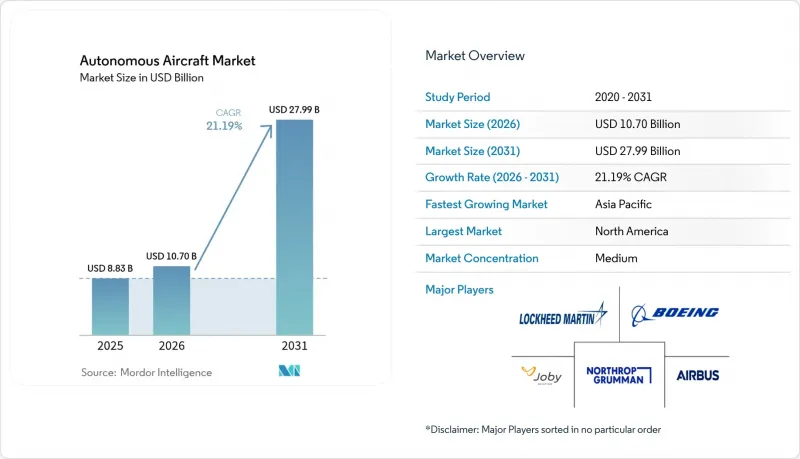
본 보고서는 항공기 유형(고정익, 회전익, 하이브리드(VTOL)), 자율 수준(자율성 향상형, 완전 자율형), 용도(화물기 등), 추진 방식(기존 터빈, 전기식 등), 구성 부품(비행 제어 컴퓨터 등), 지역(북미, 유럽 등)별로 분류되어 있습니다. 시장 전망은 금액(달러) 기준으로 제시되어 있습니다.
전 세계 자율형 항공기 시장 동향과 인사이트
AI 기반 비행 제어 시스템의 발전
실시간 머신러닝 알고리즘을 통해 조종사의 개입 없이 전술적 기동, 장애물 회피 및 경로 최적화가 이루어집니다. 사브(Saab)사의 자율형 그리펜 E 시험 비행은 전투기 수준의 AI가 순간적인 판단을 수행함을 보여주며, 규칙 기반 자동화에서 적응형 인지로의 전환을 입증하고 있습니다. 2024년 6월에 발표된 FAA의 'AI 안전 보증 로드맵'에서는 정적 학습형 및 지속적 학습형 AI에 대한 인증 수준이 개요로 제시되어 있으며, 민간 항공기 함대의 발전을 위한 로드맵이 제시되고 있습니다. 미국 공군의 ‘협동 전투기’ 등 밀리초 단위의 의사결정 루프가 요구되는 전투 프로그램에서는 검증된 아키텍처가 상용 시스템으로 확산되고 있으며, 화물 운항 사업자나 신생 에어택시 기단이 항법, 감지·회피, 상태 모니터링 기능을 위한 견고한 AI 스택을 계승할 수 있게 되었습니다.
도심항공모빌리티(UAM)와 eVTOL의 급속한 보급
대도시권의 기획 담당자들은 3차원 모빌리티를 교통 체증 완화와 지역 간 연결성을 높이는 수단으로 점점 더 중요하게 여기고 있습니다. Vertical Aerospace사는 2028년까지 VX4의 인증을 획득하기 위해 Honeywell사에 10억 달러 상당의 항공전자 장비 발주를 확정했습니다. 이는 공급망에 대한 신뢰의 표현이라고 할 수 있습니다. 일본 최초의 eVTOL 노선은 2028년 오사카 엑스포를 목표로 하고 있으며, SkyDrive사는 300건 이상의 가예약을 확보하여 첨단 에어 모빌리티에 대한 국가의 우선순위와 발맞추고 있습니다. Urban-Air Port 등 버티포트 개발 업체들이 에너지, 정비, 항공 교통 서비스를 통합한 200곳의 거점을 계획하고 있어 네트워크 효과가 확대되고 있습니다. 규제상의 장벽도 점차 완화되고 있습니다. 유럽항공안전청(EASA)은 VTOL에 관한 규제 패키지를 발표했으며, 미국 연방항공청(FAA)의 동력 드리프트 항공기 관련 최종 규정에서는 조종사 면허 요건이 명확해짐에 따라 활주로가 필요 없는 항공기의 서비스 확대 길이 열리고 있습니다. 배터리 기술의 발전과 인증된 자율 비행 기능 덕분에, 시간 단축이 높은 운임을 정당화할 수 있는 20-100마일 구간의 도시 간 단거리 이동에 대한 사업 타당성이 확립되고 있습니다.
인증 및 공역 통합에 따른 규제의 복잡성
기존 항공 규제는 기내에 승무원이 탑승하지 않는 항공기에 적용하는 데 어려움을 겪고 있습니다. FAA는 2026년까지 종합적인 BVLOS(시야 외 비행) 규정을 제정하는 것을 목표로 하고 있으며, 현재의 면제 기반 운항을 일반 상업 노선으로 확대할 예정입니다. EASA의 인증 범주에서는 유인 항공기와 동일한 형식 인증 및 항공 사업자 승인이 요구되며, 자율 비행 프로그램 일정은 수년에 걸쳐 진행됩니다. 규제 조화가 불완전한 상태이기 때문에 국경을 넘는 노선에서는 복잡성이 더욱 가중되어, 제조업체들은 병행하여 승인을 취득할 수밖에 없는 상황에 몰리고 있습니다. 항공 교통 통합은 기존의 항공 교통 관제(ATC)와 원활하게 연계되어야 하는 무인 항공기 교통 관리 시스템에 더욱 의존하고 있습니다. 자원이 제한적인 스타트업 기업들은 장기간에 걸친 인증 절차에 필요한 자금 조달에 어려움을 겪는 경우가 많아, 그 결과 경쟁 우위는 기존 항공우주 대기업 쪽으로 기울고 있습니다.
부문 분석
2025년 자율형 항공기 시장에서 고정익기 모델은 50.62%를 차지하고 있으며, 장거리 ISR(정보·감시·정찰) 및 화물 수송 임무에서 공기역학적 효율과 항속 거리의 우위가 두드러집니다. 제너럴 아토믹스(General Atomics)사의 MQ-20 어벤저(Avenger) 업그레이드는 기존 기체에 완전한 자율 기능을 사후 장착할 수 있음을 입증하여, 성능을 향상시키면서도 수명 주기 비용을 낮게 유지할 수 있습니다. 한편, 하이브리드 고정익 VTOL 시스템은 연평균 성장률(CAGR) 26.12%로 성장을 지속하고, 있으며, 이는 순항 성능을 유지하면서도 활주로에 의존하지 않는 운용을 원하는 기체 기획 담당자들 수요가 높음을 보여줍니다. 도시 지역에서의 네트워크 구축에 있어 수직 이착륙이 가능하면서도 200노트의 순항 속도를 유지할 수 있는 항공기에 대한 수요가 높아짐에 따라, 하이브리드 VTOL 플랫폼과 관련된 자율형 항공기 시장 규모는 급속히 확대될 것입니다.
하이브리드 VTOL의 성장은 보잉사의 MQ-25 스팅레이와 같은 국방용 공중급유 개념에서도 기인하고 있습니다. 이 기체는 갑판 공간을 희생하지 않고도 항공모함에 탑재가 가능함을 입증하고 있습니다. 회전익 항공기는 의료 수송이나 소방 활동 등 호버링을 많이 사용하는 임무에서 틈새 역할을 담당하고 있지만, 현재는 틸트로터나 틸트윙 아키텍처가 유사한 수직 기동성에 더해 더 넓은 활동 범위를 제공합니다. 이러한 설계를 결합함으로써 광활한 활주로와 밀집된 도심 사이의 격차를 해소하고, 인프라 제약을 완화하며, 임무의 폭을 넓힐 수 있습니다.
2025년에는 자율성이 향상된 것으로 분류되는 플랫폼이 운용 중인 인도 기체의 67.78%를 차지했습니다. 이는 규제 당국과 운영 사업자가 급격한 도약보다는 단계적인 기능 업그레이드를 선호하는 경향을 반영합니다. AeroVironment사의 ARK와 같은 사후 장착형 키트는 기존 기체 군에 고도의 자율성을 추가하여, 운영 사업자가 신형 기체 인증을 취득하지 않고도 그 혜택을 누릴 수 있게 해줍니다. 완전 자율 시스템은 여전히 시장 점유율이 작지만, AI의 신뢰성, 센서 융합, 클라우드 연결성이 결합됨에 따라 연평균 성장률(CAGR) 26.96%로 성장하고 있습니다.
완전 자율 항공기 시장 규모는 감독 하에 이루어지는 운항 데이터를 통해 규제 당국의 신뢰가 높아짐에 따라 확대될 것입니다. 선택적으로 승무원을 탑승시키는 설계를 채택한 군사 프로그램은 지각 스택에 대한 실제 환경에서의 스트레스 테스트를 제공하며, 기술의 성숙을 가속화하고 있습니다. 민간 부문에서는 조비 에비에이션(Joby Aviation)의 Xwing 자율 비행 부문 인수가 여객 서비스용 턴키형 AI 비행 갑판에 자본이 집중되고 있음을 여실히 보여주고 있습니다. 예측 기간 동안, ‘휴먼 온 더 루프(Human-in-the-Loop)’ 방식의 거버넌스는 예외적인 상황에만 개입하는 방식으로 점진적으로 전환되어, 운영 비용 절감과 연중무휴 24시간 가동률 향상으로 이어질 것입니다.
지역별 분석
2025년, 북미는 전 세계 매출의 36.74%를 차지했습니다. 협업 전투기 및 고고도 ISR 드론에 대한 미국 국방부의 자금 지원이 국내 수요를 뒷받침하는 한편, FAA(연방항공청)의 규제 측면에서의 주도적인 역할이 전 세계 인증 절차를 형성하고 있습니다. 주요 주계약사인 보잉, 록히드 마틴, 노스롭 그루먼은 AI 스타트업과 제휴하여 무인 전투기 및 배송용 드론을 시장에 출시하고 있으며, 대학에서 실리콘밸리의 연구소에 이르기까지 인재 공급원을 확충하고 있습니다. 캐나다는 항공 전자 장비 및 복합재료 제조를 통해 공급 체계를 강화하고 있으며, 멕시코는 국경을 초월한 프로그램을 뒷받침하는 비용 효율적인 조립 라인을 보유하고 있습니다. 명확해진 BVLOS(시야 외 비행) 프레임워크 하에서 국방 예산 및 도시 모빌리티 시범 사업이 성숙해짐에 따라 자율형 항공기 시장 규모는 계속해서 복합적으로 확대될 전망입니다.
아시아태평양은 2031년까지 연평균 성장률(CAGR)이 23.92%에 달하고, 가장 빠르게 성장하는 시장입니다. 2025년까지 1조 5,000억 위안의 항공 산업 생산액을 목표로 하는 중국의 저고도 경제 계획은 EHang의 허페이 공장 등 eVTOL 생산 거점에 보조금을 지원하고 있습니다. 일본은 2028년 오사카 엑스포에 맞추어 상용 에어택시 운항을 목표로 하고 있으며, 버티포트 구역 지정 및 자율 비행 시험에 대한 민관 협력이 주목받고 있습니다. 한국에서는 인천을 중심으로 한 버티포트망 구축이 진행되고 있으며, 호주에서는 전기 에어택시의 실현 가능성 조사가 이루어지고 있어 지역 차원의 실증 실험이 확대되고 있습니다. 인도에서는 국방 분야 연구개발(R&D)에 대한 우대 조치와 위성 통신망 확충을 통해, 외딴 지역에서의 자율형 ISR(정보·감시·정찰) 및 화물 수송 기회가 확대되고 있습니다. 한편, 동남아시아에서는 도서국이라는 지역의 지리적 조건을 고려하여 의료 물자 보급에 드론을 활용하는 방안이 검토되고 있습니다. 유럽은 엄격한 안전 문화와 지속가능성에 대한 요구 사이의 균형을 맞추면서 전략적 발판을 다지고 있습니다. EASA(유럽항공안전청)의 단계적인 VTOL 규제는 세계적 기준을 정의하는 동시에 독일, 프랑스, 영국의 도시 계획 담당자들에게 신뢰의 기반이 되고 있습니다. 이들 국가에서는 각각 Volocopter사와 Vertical Aerospace사의 eVTOL 프로토타입이 도입되고 있습니다. 지역 기금은 수소 추진 및 재활용 가능한 구조물을 대상으로 하고 있어, 환경을 중시하는 입찰에서 유럽 OEM 제조업체들에게 우위를 제공합니다. 이탈리아의 전국적인 버티포트 회랑 계획과 스웨덴의 자율형 스웜 비행 실증 실험은 이 대륙에서 민간 및 군사 양측에 걸친 노력을 반영하고 있습니다. 유럽의 성장 속도는 아시아태평양(APAC)보다 완만하지만, 정책에 대한 영향력과 탄소 배출 감축 목표 덕분에 중요한 참조 시장으로서의 입지를 확고히 하고 있습니다.
기타 혜택:
- 엑셀 형식 시장 예측(ME) 시트
- 3개월간의 애널리스트 지원
자주 묻는 질문
목차
제1장 서론
제2장 조사 방법
제3장 주요 요약
제4장 시장 구도
제5장 시장 규모와 성장 예측
제6장 경쟁 구도
제7장 시장 기회와 향후 전망
JHS 26.08.11According to Mordor Intelligence, the autonomous aircraft market size was valued at USD 8.83 billion in 2025 and estimated to grow from USD 10.7 billion in 2026 to reach USD 27.99 billion by 2031, at a CAGR of 21.19% during the forecast period (2026-2031).
This report is Segmented by Aircraft Type (Fixed-Wing, Rotary-Wing, and Hybrid (VTOL)), Autonomy Level (Increasingly Autonomous, and Fully Autonomous), Application (Cargo Aircraft, and More), Propulsion Type (Conventional Turbine, Electric, and More), Component (Flight Control Computers, and More), and Geography (North America, Europe, and More). The Market Forecasts are Provided in Terms of Value (USD).
Global Autonomous Aircraft Market Trends and Insights
Advancements in AI-Driven Flight Control Systems
Real-time machine-learning algorithms guide tactical maneuvers, obstacle avoidance, and route optimization without pilot intervention. Saab's autonomous Gripen E trials illustrate fighter-grade AI executing split-second decisions, validating moves from rule-based automation to adaptive cognition. The FAA's AI Safety Assurance Roadmap, released in June 2024, outlines certification tiers for statically trained and continuously learning AI, clearing a progression path for civil fleets. Combat programs demanding millisecond decision loops, such as the US Air Force's collaborative combat aircraft, spill proven architectures into commercial systems, enabling cargo operators and emerging air-taxi fleets to inherit hardened AI stacks for navigation, sense-and-avoid, and health-monitoring functions.
Rapid Growth in Urban Air Mobility and eVTOL Adoption
Metropolitan planners increasingly view three-dimensional mobility as a lever for congestion relief and regional connectivity. Vertical Aerospace committed USD 1 billion of Honeywell avionics orders to certify the VX4 by 2028, a signal of supply-chain confidence. Japan's first eVTOL routes target the 2028 Osaka Expo, with SkyDrive capturing over 300 provisional orders, aligning national priorities for advanced air mobility. Network effects amplify as vertiport developers such as Urban-Air Port plan 200 sites that bundle energy, maintenance, and air-traffic services. Regulatory hurdles ease: EASA released its VTOL package, and the FAA's powered-lift final rule clarifies pilot licensing, paving the runway-free aircraft toward scaled service. Improved batteries and certified autonomy underpin business cases for 20-100-mile urban hops where time savings justify premium fares.
Regulatory Complexity in Certification and Airspace Integration
Legacy aviation rules struggle to fit aircraft with no onboard crew. The FAA aims to publish comprehensive BVLOS regulations by 2026, extending present waiver-based operations into routine commercial lanes. EASA's certified category demands type certificates and air operator approvals similar to manned fleets, stretching autonomous programs to multi-year timelines. Cross-border routes magnify complexity because harmonization remains partial, pushing manufacturers to chase parallel approvals. Air-traffic integration further hinges on unmanned-traffic-management systems that must interface seamlessly with conventional ATC. Resource-constrained startups often struggle to fund long certification paths, tilting competitive advantage toward incumbent aerospace primes.
Other drivers and restraints analyzed in the detailed report include:
- Cost Reduction Incentives for Logistics via Autonomous Cargo Drones
- Increased Military Investments in ISR and Combat Autonomy
- Limitations in Battery Technology and High Capital Costs
For complete list of drivers and restraints, kindly check the Table Of Contents.
Segment Analysis
Fixed-wing models accounted for 50.62% of the autonomous aircraft market 2025, underscoring their aerodynamic efficiency and range advantages for long-haul ISR and cargo missions. General Atomics' MQ-20 Avenger upgrade proves that legacy airframes can be retrofitted with full autonomy, keeping lifecycle costs low while enhancing capability. Hybrid fixed-wing VTOL systems, however, register a 26.12% CAGR, indicating fleet planners' appetite for runway-independent operations that preserve cruise performance. The autonomous aircraft market size attached to hybrid VTOL platforms will broaden sharply as urban networks demand aircraft that lift vertically yet sustain 200-knot cruise.
Hybrid VTOL growth also springs from defense refueling concepts such as Boeing's MQ-25 Stingray, which proves carrier compatibility without deck-space penalties. Rotary-wing craft hold niche roles for hover-intensive tasks like medevac and firefighting, but tilt-rotor and tilt-wing architectures now offer similar vertical dexterity with extended reach. Combining designs bridges the gap between sprawling runways and tightly packed city cores, easing infrastructure constraints and expanding mission sets.
In 2025, platforms classed as increasingly autonomous made up 67.78% of active deliveries, reflecting regulators' and operators' preference for step-wise feature upgrades over radical leaps. Retrofittable kits such as AeroVironment's ARK add advanced autonomy to existing fleets, enabling operators to harvest benefits without new-type certification. Fully autonomous systems-still a smaller slice-are growing at 26.96% CAGR as AI reliability, sensor fusion, and cloud connectivity converge.
The autonomous aircraft market size for fully autonomous craft will expand as regulatory confidence builds through supervised operations data. Military programs embracing optionally crewed designs provide real-world stress tests for perception stacks, accelerating tech maturity. On the civil side, Joby Aviation's takeover of Xwing's autonomy division highlights capital gravitating toward turnkey AI flight decks aimed at passenger services. Over the forecast period, human-on-the-loop governance will gradually yield to exception-only intervention, cutting operating costs and extending 24/7 utilization.
Complete Report Scope:
- By Aircraft Type
- Fixed-wing
- Rotary-wing
- Hybrid (Fixed-Wing VTOL)
- By Autonomy Level
- Increasingly Autonomous
- Fully Autonomous
- By Application
- Cargo Aircraft
- Passenger Aircraft
- Special Mission/ISR
- Air Taxi/UAM
- By Propulsion Type
- Conventional Turbine
- Electric
- Hybrid-Electric
- Hydrogen Fuel-cell
- By Component
- Flight Control Computers
- Sensors and Navigation
- Communication and Data Links
- Software and AI Algorithms
- Propulsion Systems
- Airframe and Structure
- By Geography
- North America
- United States
- Canada
- Mexico
- Europe
- United Kingdom
- France
- Germany
- Italy
- Russia
- Rest of Europe
- Asia-Pacific
- China
- India
- Japan
- South Korea
- Australia
- Rest of Asia-Pacific
- South America
- Brazil
- Rest of South America
- Middle East and Africa
- Middle East
- United Arab Emirates
- Saudi Arabia
- Rest of Middle East
- Africa
- South Africa
- Rest of Africa
- Middle East
- North America
Geography Analysis
North America accounted for 36.74% of global revenue in 2025. Pentagon funding for collaborative combat aircraft and high-altitude ISR drones underpins domestic demand, while the FAA's regulatory leadership shapes global certification pathways. Major primes-Boeing, Lockheed Martin, Northrop Grumman-pair with AI start-ups to field pilotless fighters and delivery drones, enriching a talent pipeline spanning universities to Silicon Valley labs. Canada bolsters supply with avionics and composite manufacturing, and Mexico hosts cost-effective assembly lines that feed cross-border programs. The autonomous aircraft market size will continue to compound as defense appropriations and urban mobility pilots mature under clarified BVLOS frameworks.
Asia-Pacific is the fastest-growing arena at 23.92% CAGR through 2031. China's low-altitude economy plan, which targets 1.5 trillion yuan aviation output by 2025, funnels subsidies into eVTOL production bases such as EHang's Hefei plant. Japan aims for commercial air-taxi launches coinciding with the 2028 Osaka Expo, spotlighting public-private coordination on vertiport zoning and autonomous flight-testing. South Korea's Incheon-centered vertiport grid and Australia's electric air-taxi feasibility studies widen regional experimentation. India's defense R&D incentives and increasing satellite connectivity open opportunities for autonomous ISR and cargo operations in remote terrain, while Southeast Asia eyes drones for medical resupply amid archipelagic geography.Europe maintains a strategic foothold, balancing a stringent safety culture with sustainability imperatives. EASA's phased VTOL regulations define global benchmarks and anchor confidence for city planners across Germany, France, and the United Kingdom, each hosting eVTOL prototypes from Volocopter and Vertical Aerospace. Regional funds target hydrogen propulsion and recyclable structures, giving European OEMs an edge in eco-centric tenders. Italy's plan for nationwide vertiport corridors and Sweden's autonomous swarm trials echo the continent's dual civilian-military thrust. Although the continent grows more slowly than APAC, its policy influence and carbon targets position it as a key reference market.
- Northrop Grumman Corporation
- The Boeing Company
- Lockheed Martin Corporation
- RTX Corporation
- Elbit Systems Ltd.
- AeroVironment, Inc.
- Saab AB
- BAE Systems plc
- Airbus SE
- Textron Inc.
- Israel Aerospace Industries Ltd.
- General Atomics
- Joby Aviation, Inc.
- Volocopter Technologies GmbH
- Guangzhou EHang Intelligent Technology Co. Ltd.
- Archer Aviation Inc.
- Wisk Aero LLC
- Kratos Defense & Security Solutions Inc.
- Kaman Corporation
Additional Benefits:
- The market estimate (ME) sheet in Excel format
- 3 months of analyst support
TABLE OF CONTENTS
1 INTRODUCTION
- 1.1 Study Assumptions and Market Definition
- 1.2 Scope of the Study
2 RESEARCH METHODOLOGY
3 EXECUTIVE SUMMARY
4 MARKET LANDSCAPE
- 4.1 Market Overview
- 4.2 Market Drivers
- 4.2.1 Advancements in AI-driven flight control systems
- 4.2.2 Rapid growth in Urban Air Mobility (UAM) and eVTOL adoption
- 4.2.3 Cost reduction incentives for logistics via autonomous cargo drones
- 4.2.4 Increased military investments in ISR and combat autonomy
- 4.2.5 Deployment of BVLOS air corridors and Unmanned Traffic Management (UTM)
- 4.2.6 Increased availability of flight-certified autonomous avionics and sensor suites
- 4.3 Market Restraints
- 4.3.1 Regulatory complexity in certification and airspace integration
- 4.3.2 Limitations in battery technology and high capital costs
- 4.3.3 Heightened vulnerability to cyber threats and system hijacking
- 4.3.4 Semiconductor supply disruptions affecting AI processing units
- 4.4 Value Chain Analysis
- 4.5 Technological Outlook
- 4.6 Regulatory Landscape
- 4.7 Porter's Five Forces Analysis
- 4.7.1 Bargaining Power of Suppliers
- 4.7.2 Bargaining Power of Buyers/Consumers
- 4.7.3 Threat of New Entrants
- 4.7.4 Threat of Substitute Products
- 4.7.5 Intensity of Competitive Rivalry
5 MARKET SIZE AND GROWTH FORECASTS (VALUE)
- 5.1 By Aircraft Type
- 5.1.1 Fixed-wing
- 5.1.2 Rotary-wing
- 5.1.3 Hybrid (Fixed-Wing VTOL)
- 5.2 By Autonomy Level
- 5.2.1 Increasingly Autonomous
- 5.2.2 Fully Autonomous
- 5.3 By Application
- 5.3.1 Cargo Aircraft
- 5.3.2 Passenger Aircraft
- 5.3.3 Special Mission/ISR
- 5.3.4 Air Taxi/UAM
- 5.4 By Propulsion Type
- 5.4.1 Conventional Turbine
- 5.4.2 Electric
- 5.4.3 Hybrid-Electric
- 5.4.4 Hydrogen Fuel-cell
- 5.5 By Component
- 5.5.1 Flight Control Computers
- 5.5.2 Sensors and Navigation
- 5.5.3 Communication and Data Links
- 5.5.4 Software and AI Algorithms
- 5.5.5 Propulsion Systems
- 5.5.6 Airframe and Structure
- 5.6 By Geography
- 5.6.1 North America
- 5.6.1.1 United States
- 5.6.1.2 Canada
- 5.6.1.3 Mexico
- 5.6.2 Europe
- 5.6.2.1 United Kingdom
- 5.6.2.2 France
- 5.6.2.3 Germany
- 5.6.2.4 Italy
- 5.6.2.5 Russia
- 5.6.2.6 Rest of Europe
- 5.6.3 Asia-Pacific
- 5.6.3.1 China
- 5.6.3.2 India
- 5.6.3.3 Japan
- 5.6.3.4 South Korea
- 5.6.3.5 Australia
- 5.6.3.6 Rest of Asia-Pacific
- 5.6.4 South America
- 5.6.4.1 Brazil
- 5.6.4.2 Rest of South America
- 5.6.5 Middle East and Africa
- 5.6.5.1 Middle East
- 5.6.5.1.1 United Arab Emirates
- 5.6.5.1.2 Saudi Arabia
- 5.6.5.1.3 Rest of Middle East
- 5.6.5.2 Africa
- 5.6.5.2.1 South Africa
- 5.6.5.2.2 Rest of Africa
- 5.6.5.1 Middle East
- 5.6.1 North America
6 COMPETITIVE LANDSCAPE
- 6.1 Market Concentration
- 6.2 Strategic Moves
- 6.3 Market Share Analysis
- 6.4 Company Profiles (includes Global level Overview, Market level overview, Core Segments, Financials as available, Strategic Information, Market Rank/Share for key companies, Products and Services, Recent Developments)
- 6.4.1 Northrop Grumman Corporation
- 6.4.2 The Boeing Company
- 6.4.3 Lockheed Martin Corporation
- 6.4.4 RTX Corporation
- 6.4.5 Elbit Systems Ltd.
- 6.4.6 AeroVironment, Inc.
- 6.4.7 Saab AB
- 6.4.8 BAE Systems plc
- 6.4.9 Airbus SE
- 6.4.10 Textron Inc.
- 6.4.11 Israel Aerospace Industries Ltd.
- 6.4.12 General Atomics
- 6.4.13 Joby Aviation, Inc.
- 6.4.14 Volocopter Technologies GmbH
- 6.4.15 Guangzhou EHang Intelligent Technology Co. Ltd.
- 6.4.16 Archer Aviation Inc.
- 6.4.17 Wisk Aero LLC
- 6.4.18 Kratos Defense & Security Solutions Inc.
- 6.4.19 Kaman Corporation
7 MARKET OPPORTUNITIES AND FUTURE OUTLOOK
- 7.1 White-space and Unmet-Need Assessment