

|
시장보고서
상품코드
2100616
항감염제 시장 : 점유율 분석, 업계 동향 및 통계, 성장 예측(2026-2031년)Anti-Infective Drugs - Market Share Analysis, Industry Trends & Statistics, Growth Forecasts (2026 - 2031) |
||||||
 Mordor Intelligence
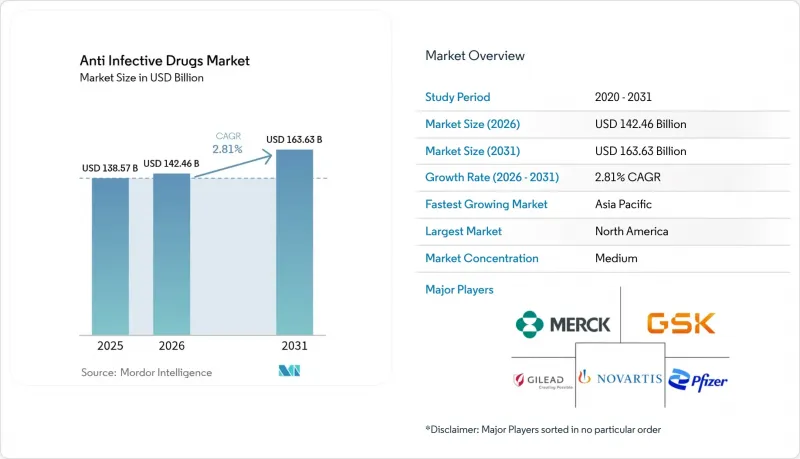
Mordor Intelligence에 의하면, 2026년 항감염제 시장 규모는 1,424억 6,000만 달러로 추정되고 있어 2025년 1,385억 7,000만 달러에서 확대해, 2031년에는 1,636억 3,000만 달러에 이를 것으로 예측됩니다.
2026년부터 2031년까지의 연평균 성장률(CAGR)은 2.81%를 나타낼 전망입니다.
본 보고서는 약물 분류별(항생제, 항바이러스제, 항진균제, 항기생충제), 적응증(HIV 감염증, 폐렴 등), 투여 경로(경구, 비경구 등), 유통 채널(병원 약국 등), 지역(북미, 유럽, 아시아태평양, 중동 및 아프리카, 남미)별로 분류되어 있습니다. 시장 전망은 금액(달러) 기준으로 제시되어 있습니다.
전 세계 항감염제 시장 동향 및 인사이트
감염병 부담 증가
대부분의 의료 시스템에서 패혈증과 관련된 입원 일수, 의료비 및 사망률이 지속적으로 증가하고 있어, 신뢰할 수 있는 항감염 치료법에 대한 수요가 높아지고 있습니다. 고령자 및 면역결핍 환자에서 신속하고 광범위한 스펙트럼의 치료가 필요한 중증 감염증의 발병 빈도가 증가하고 있으며, 이로 인해 입원 기간이 장기화되어 평균 입원 일수는 팬데믹 이전 수준을 상회하고 있습니다. 질환 유병률의 상승으로 인해 병원체 확인에 소요되는 시간을 수 시간 단축하고, 보다 조기적이고 정확한 치료를 가능하게 하는 AI 기반 신속 진단 플랫폼에 대한 투자가 촉진되고 있습니다. 전 세계 정책 입안자들은 사회적 취약 계층을 지원하는 지역 밀착형 감염병 대책 프로그램에 자원을 투입하고 있으며, 이는 항감염제 시장에서 분산형 치료 모델의 형성에 기여하고 있습니다. 그 결과, 전통적인 분자 의약품의 가격 하락을 상쇄하고, 성숙한 경제권에서도 판매량 성장을 뒷받침하는 지속 가능한 수요 기반이 형성되고 있습니다.
병원체의 내성 확산
크레브시엘라 뉴모니아에 및 아시네토박터 바우마니의 초내성 균주가 현재 전 세계 병원에서 만연하고 있으며, 아시아태평양의 카르바페넴계 항균제에 대한 내성률은 31.3%에 달하여, B-락탐계 항균제와 B-락타마제 억제제의 병용 요법으로의 긴급한 전환을 촉구하고 있습니다. 제약 기업의 파이프라인에서는 돌연변이 장벽을 몇 자릿수나 높이는 이중 결합 부위형 항생제 등, 내성 출현을 억제하는 작용기전이 점점 더 우선시되고 있습니다. 경제적 영향도 막대합니다. 내성 감염증은 입원 기간을 연장하고 더 고가의 진단이 필요하기 때문에 지불 주체의 예산을 압박하며 가치 기반 가격 협상을 불가피하게 만들고 있습니다. 지역별 차이는 현저하여, 남아시아는 전 세계 내성 곡선에서 선두를 달리고 있는 반면, 북미와 서유럽에서는 니트로플란토인이 요로 분리균에 대해 여전히 광범위하게 유효합니다. 감시 체계 강화와 새로운 작용기전을 가진 분자에 대한 인센티브로 인해, 항감염제 시장의 혁신 기업들에게는 새로운 수익 확대의 여지가 생기고 있습니다.
심화되는 항생제 내성(AMR)
베다킬린에 대한 내성률은 이미 전 세계적으로 5.7%에 달했으며, 남아프리카에서는 10.4%라는 최고치를 기록하여 다제내성 결핵 치료의 여지를 좁히고 있습니다. 병원에서는 반코마이신 내성 장구균 및 카르바페넴 내성 아시네토박터의 발생률 증가가 보고되고 있으며, 이는 경험적 치료를 복잡하게 만들고 사망률을 높이고 있습니다. 제약 기업들은 내성으로 인해 제품의 수명이 단축되면서 수익 감소에 직면하고 있으며, 과거 수십 년간 수익을 창출해 왔던 기존의 광범위 항균제 계열 약물에 대한 투자를 주저하고 있습니다. 이에 반해, 보험 지급 기관은 내성 억제 효과가 입증된 약물에 대해서만 프리미엄 가격을 인정하는 방침을 취하고 있어, 새로운 작용기전을 갖지 않은 분자의 매출 전망을 제약하고 있습니다. 이러한 임상적·경제적 부담의 복합적인 영향으로 인해, 항감염제 시장의 장기적인 성장세는 둔화되고 있습니다.
부문 분석
항생제는 항감염제 시장에서 42.62%의 점유율을 차지했습니다. 이는 병원 치료 프로토콜에서 β-락탐계, 마크로라이드계, 카르바페넴계에 대한 임상적 의존도가 여전히 높기 때문입니다. 그러나 지속적인 내성 문제와 적정 사용 노력으로 인해 판매량 증가에는 한계가 나타나고 있으며, 연구개발 투자는 2025년 2월 FDA 승인을 획득한 아즈트레오남·아비박탐 등 차세대 병용 요법으로 전환되고 있습니다. 항바이러스제의 경우, HIV, RSV 및 간염 치료제가 분기별 또는 반기별 투여라는 편의성을 보장하는 장기 작용형 주사제나 항체 칵테일로 전환되고 있어 4.58%라는 가장 견실한 연평균 성장률(CAGR)이 예상됩니다. 이러한 혁신 파이프라인을 통해 이 부문은 항감염제 시장에서 전략적 성장 동력으로서의 입지를 확고히 했습니다.
획기적인 호흡기 계통 항바이러스제 역시 수요 급증에 대응할 수 있는 역량 강화 및 비축 물량 확보를 위한 팬데믹 대책 예산의 혜택을 받고 있습니다. 성숙한 치료 분야에서는 기존 브랜드 제품이 바이오시밀러에 맞서 시장 점유율을 지키려 하는 한편, 벤처 자본을 바탕으로 한 바이오테크 기업들이 좁은 스펙트럼의 박테리오파지를 도입함에 따라 경쟁이 심화되고 있습니다. 그 결과, 가격과 판매량 동향은 엇갈리고 있습니다. 항생제의 경우 가격이 완만하게 하락하는 추세이지만, 이미 확보된 대규모 판매량에 의해 상쇄되고 있는 반면, 항바이러스제는 프리미엄 가격을 유지하고 있으나 치료 대상 환자 수가 적다는 과제에 직면해 있습니다. 이러한 상호작용이 전체 매출 성장을 뒷받침하며, 장기적인 연구개발(R&D)에 대한 자본 배분을 형성하고 있습니다.
HIV 치료제는 인테그라제 억제제를 핵심으로 하는 치료법의 보급과 노출 전 예방(PrEP)의 채택 확대에 힘입어, 2025년에도 항감염제 시장 규모의 27.05%를 차지했습니다. 레나카파비르의 연간 생산 비용이 40달러로 예상에 따라, 저·중소득 국가(LMIC)에서의 접근성 확대가 기대되며, 성숙한 유럽 및 미국 시장이 정체되는 상황에서도 판매량의 안정성을 뒷받침하고 있습니다. 대조적으로, 호흡기 바이러스 감염증 시장은 닐세비맙 투여로 영아 입원 건수가 78% 감소했다는 데이터를 바탕으로, RSV 예방이 탄력을 받으면서 연평균 성장률(CAGR) 4.38%를 나타낼 것으로 예측됩니다.
결핵은 여전히 주요 임상적 관심사이며, 6개월간의 단기 BPaL/M 요법을 통해 2026년까지 전 세계적으로 12만 6,792명의 환자가 치료를 받을 것으로 예측되어, 이로 인해 총 치료 일수가 단축되고 의료 시스템의 비용 부담이 경감될 것입니다. 발병 후 1시간 이내에 광범위 항균제를 투여하는 것을 우선시하는 패혈증 프로토콜로 인해 생존율이 4.9배 향상된 사실이 응급 현장에서 즉시 사용 가능한 주사제에 대한 수요를 높이고 있습니다. 이러한 다양한 적응증 동향이 맞물려 항감염제 시장의 다양화를 촉진하고, 특정 병원체 영역에 대한 의존도를 낮추고 있습니다.
지역별 분석
북미는 확립된 혁신 생태계, 역동적인 지불자 구성, 그리고 신약의 조기 도입에 힘입어 2025년 매출의 33.41%를 차지했습니다. FDA의 미충족 의료 수요에 관한 지침이 간소화되면서 과학적 자문 주기는 단축되었으나, 시판 후 조사 의무가 강화됨에 따라 규정 준수 비용이 증가하고 있어 제조업체들은 이를 가격 책정 모델에 반영해야 합니다. 미국에서는 패혈증으로 인한 입원 환자 수가 연간 250만 명에 달하고 총 비용은 521억 달러에 이르는데, 이는 광범위 스펙트럼 주사제의 안정적인 사용을 뒷받침하고 처방약 목록의 갱신을 촉진하고 있습니다. 캐나다와 멕시코는 북미 및 남미로 향하는 무역 흐름을 뒷받침하는 전문적인 충전 및 마무리 생산 능력을 제공함으로써 이 지역에서의 입지를 강화하고 있지만, 의약품 가격 규제의 차이는 여전히 상업적 고려 사항으로 남아 있습니다.
유럽에서는 AMR(항생제 내성)에 대한 통일된 전략적 입장이 나타나고 있습니다. 개정된 EU 의약품법은 내성 모니터링 요건을 조화시켜, 기업이 모든 회원국에 대해 단일 감시 계획을 제출할 수 있도록 하고 있습니다. GSK와 영국의 AMR 프로그램으로 대표되는 민관 협력은 위험 분담형 자금 조달이 후기 단계 항생제 후보 물질의 개발을 어떻게 가속화하는지를 보여주고 있습니다. 그러나 남유럽의 재정 긴축 정책으로 인해 고가 의약품의 보험 급여가 제한되고 있어, 유럽 전역의 평균 판매 가격을 낮추는 차별적 가격 전략을 채택할 수밖에 없는 상황입니다. 브렉시트로 인해 규제가 양극화되면서, 기업들은 시장 전체에 완전히 진출하기 위해 이중 승인 절차를 거쳐야 하는 상황에 직면해 있습니다.
아시아태평양은 2031년까지 연평균 성장률(CAGR) 3.68%를 나타낼 것으로 예측되며, 항감염제 시장에서 가장 빠르게 확대될 지역이 될 전망입니다. 중국은 전 세계 항생제 유효 성분 생산량을 독점하고 있으며, 국가의 항생제 내성(AMR) 대책 우선순위에 따라 17개 현지 기업이 진행 중인 20건의 항균제 프로젝트가 진행 중입니다. 인도는 비용 경쟁력이 있는 화학 기술을 활용하고 있지만, 장기적인 제조 간접비를 상승시킬 가능성이 있는 환경 배출 규제에 대응하는 데 어려움을 겪고 있습니다. 일본에서는 우선순위가 높은 항균제에 대한 신속 승인 제도를 통해 시장 출시까지의 기간이 최대 12개월 단축됩니다. 한편, 호주에서는 국내 공급을 확보하기 위해 혁신적인 항생제에 대한 시장 진입 장려금을 지급하고 있습니다. 그러나 해당 지역의 카르바페넴계 항생제 내성 유병률이 31.3%로 높은 수준을 기록함에 따라 임상적 시급성이 커지고 있으며, 내성 억제에 관한 확실한 데이터를 보유한 약제에 대한 조달 경향이 강해지고 있습니다.
기타 혜택:
- 엑셀 형식 시장 예측(ME) 시트
- 3개월간의 애널리스트 지원
자주 묻는 질문
목차
제1장 서론
제2장 조사 방법
제3장 주요 요약
제4장 시장 구도
제5장 시장 규모와 성장 예측
제6장 경쟁 구도
제7장 시장 기회와 향후 전망
JHS 26.08.11According to Mordor Intelligence, the anti-infective drugs market size in 2026 is estimated at USD 142.46 billion, growing from 2025 value of USD 138.57 billion with 2031 projections showing USD 163.63 billion, growing at 2.81% CAGR over 2026-2031.
This report is Segmented by Drug Class (Antibiotics, Antivirals, Antifungals, Antiparasitics), Indication (HIV Infection, Pneumonia, and More), Route of Administration (Oral, Parenteral, and More), Distribution Channel (Hospital Pharmacy, and More), and Geography (North America, Europe, Asia-Pacific, Middle East & Africa, South America). The Market Forecasts are Provided in Terms of Value (USD).
Global Anti-Infective Drugs Market Trends and Insights
Rising Burden of Infectious Diseases
Sepsis-linked inpatient stays, costs and mortality continue to rise in most healthcare systems, magnifying demand for reliable anti-infective regimens. Older adults and immunocompromised patients now present more frequently with severe infections that require prompt, broad-spectrum cover, lengthening inpatient admissions and driving average lengths of stay above pre-pandemic levels. Heightened disease prevalence has stimulated investment in AI-enabled rapid-diagnostic platforms that can shave hours off identification times, thus enabling earlier and more targeted therapy. Global policymakers channel resources toward community-based infection programs that serve disadvantaged groups, helping shape decentralized treatment models in the anti-infective drugs market. The net effect is an enduring demand baseline that offsets price erosion in traditional molecules and anchors volume growth even in mature economies.
Growing Resistance Among Pathogens
Hyper-resistant strains of Klebsiella pneumoniae and Acinetobacter baumannii now circulate across hospitals worldwide, lifting carbapenem resistance to 31.3% in Asia-Pacific and prompting urgent shifts toward B-lactam/B-lactamase inhibitor combinations. Pharmaceutical pipelines increasingly prioritize mechanisms that impede resistance emergence, such as dual-binding site antibiotics that raise mutation barriers by several orders of magnitude. Economic implications are material: resistant infections lengthen hospital stays and require costlier diagnostics, diluting payer budgets and forcing value-based price negotiations. Geographic variation is pronounced; South Asia leads global resistance curves, whereas nitrofurantoin remains broadly effective against urinary isolates in North America and Western Europe. Heightened surveillance and incentives for novel mode-of-action molecules create fresh revenue headroom for innovators within the anti-infective drugs market.
Escalating Antimicrobial Resistance (AMR)
Bedaquiline resistance has already reached 5.7% globally, peaking at 10.4% in South Africa, compressing therapeutic windows for multidrug-resistant tuberculosis. Hospitals report rising vancomycin-resistant Enterococcus and carbapenem-resistant Acinetobacter rates, complicating empiric therapy and elevating mortality. Pharmaceutical firms confront diminishing returns as resistance shortens product life, deterring investment in traditional broad-spectrum classes that once delivered decades of revenue. Payers respond by limiting premium pricing to drugs with demonstrable resistance-suppression properties, constraining top-line prospects for molecules lacking novel mechanisms. The compounding clinical and economic toll moderates the longer-term momentum of the anti-infective drugs market.
Other drivers and restraints analyzed in the detailed report include:
- Robust R&D Investment & Public-Private Collaborations
- Advanced Drug Development Technologies
- Strict Regulatory Environment & Safety Concerns
For complete list of drivers and restraints, kindly check the Table Of Contents.
Segment Analysis
Antibiotics delivered a 42.62% market share of the anti-infective drugs market share, as clinical reliance on B-lactams, macrolides, and carbapenems remained heavy in hospital protocols. Persistent resistance and stewardship initiatives, however, have capped volume growth, channeling R&D investment toward next-generation combinations such as aztreonam-avibactam, which gained FDA clearance in February 2025. Antivirals posted the most robust 4.58% CAGR outlook as HIV, RSV, and hepatitis formulations shift to long-acting injectables and antibody cocktails that promise quarterly or semi-annual dosing convenience. That innovation pipeline repositioned the segment as a strategic growth engine inside the anti-infective drugs market.
Breakthrough respiratory antivirals also benefit from pandemic preparedness budgets that bankroll surge capacity and stockpiling. Competitive intensity deepens as brand-name incumbents defend share against biosimilars in mature classes while venture-backed biotech entrants introduce narrow-spectrum bacteriophages. Price-volume dynamics therefore diverge: antibiotics witness modest price erosion offset by large installed volume, whereas antivirals command premium pricing but face smaller treated-patient bases. The interplay sustains overall revenue growth and shapes long-term R&D capital allocation.
HIV therapy retained 27.05% of the anti-infective drugs market size in 2025 thanks to widespread adoption of integrase inhibitor backbones and growing uptake of pre-exposure prophylaxis (PrEP). Lenacapavir's potential annual production cost of USD 40 invites broader LMIC access, underpinning volume stability even as mature Western markets plateau. In contrast, respiratory virus infections are projected to log a 4.38% CAGR as RSV prophylaxis gains momentum following data showing a 78% reduction in infant hospitalizations with nirsevimab.
Tuberculosis remains a major clinical focus, with shorter six-month BPaL/M regimens projected to treat 126,792 patients globally by 2026, shrinking total therapy days and reducing health-system cost burdens. Sepsis protocols that prioritize broad-spectrum coverage within the first hour have driven a 4.9-fold survival benefit, intensifying demand for ready-to-reconstitute injectables in emergency settings. These varied indication trajectories collectively reinforce the anti-infective drugs market diversification, lessening dependence on any single pathogen area.
Complete Report Scope:
- By Drug Class
- Antibiotics
- B-lactam & B-lactamase inhibitors
- Macrolides
- Tetracyclines
- Fluoroquinolones
- Cephalosporins
- Carbapenems
- Others
- Antivirals
- NRTIs
- NNRTIs
- Protease inhibitors
- Integrase inhibitors
- Polymerase inhibitors
- Others
- Antifungals
- Azoles
- Echinocandins
- Polyenes
- Allylamines
- Others
- Antiparasitics
- Antimalarials
- Anthelmintics
- Antiprotozoals
- Others
- Antibiotics
- By Indication
- HIV Infection
- Pneumonia
- Respiratory Virus Infection
- Sepsis
- Tuberculosis
- Urinary Tract Infection
- Skin & Soft-Tissue Infections
- Other Indications
- By Route of Administration
- Oral
- Parenteral
- Topical
- Inhalation
- Others
- By Distribution Channel
- Hospital Pharmacy
- Retail Pharmacy
- Online Pharmacy
- Mail-order Pharmacy
- By Geography
- North America
- United States
- Canada
- Mexico
- Europe
- Germany
- United Kingdom
- France
- Italy
- Spain
- Rest of Europe
- Asia-Pacific
- China
- Japan
- India
- Australia
- South Korea
- Rest of Asia-Pacific
- Middle East & Africa
- GCC
- South Africa
- Rest of Middle East & Africa
- South America
- Brazil
- Argentina
- Rest of South America
- North America
Geography Analysis
North America controlled 33.41% of 2025 revenue through an entrenched innovation ecosystem, dynamic payer mix, and early adoption of novel agents. The FDA's streamlined unmet-need guidance reduces scientific advice cycles, yet heightened post-market study obligations inflate compliance costs that manufacturers must factor into pricing models. U.S. sepsis admissions number 2.5 million annually with aggregate costs of USD 52.1 billion, anchoring steady utilization of broad-spectrum injectables and driving formulary turnover. Canada and Mexico augment the regional footprint by contributing specialized fill-finish capacity that feeds northbound and southbound trade flows, though divergent pharmaceutical price controls remain a commercial consideration.
Europe exhibits a unified strategic stance against AMR. Revised EU pharmaceutical legislation harmonizes resistance-monitoring requirements, enabling companies to file a single surveillance plan for all member states. Public-private alliances exemplified by the GSK-UK AMR program demonstrate how shared-risk funding accelerates late-stage antibiotic candidates. However, austerity in Southern Europe constrains reimbursement for premium-priced agents, forcing differential pricing strategies that weigh on pan-European average selling prices. Brexit introduces regulatory bifurcation, with companies navigating dual approval channels to achieve full market reach.
Asia-Pacific is projected to grow at 3.68% CAGR to 2031, making it the fastest-expanding component of the anti-infective drugs market. China dominates global antibiotic active-ingredient output and hosts 20 antibacterial projects across 17 local firms that align with national AMR priorities. India leverages cost-competitive chemistry capabilities but grapples with environmental discharge controls that could raise long-term manufacturing overhead. Japan's expedited approval pathway for high-priority antimicrobials shortens time-to-market by up to 12 months, while Australia funds market-entry rewards for innovative antibiotics to safeguard local supply. Yet, elevated carbapenem resistance 31.3% regional prevalence amplifies clinical urgency and shapes procurement preferences toward agents with robust resistance-suppression data.
- Abbott Laboratories
- Astellas Pharma
- Bayer
- Bristol-Myers Squibb
- Gilead Sciences
- GlaxoSmithKline
- Merck
- Novartis
- Pfizer
- Sanofi
- Lupin
- Dr. Reddy's Laboratories Ltd.
- Glenmark Pharmaceuticals
- Johnson & Johnson
- AstraZeneca
- Abbvie
- Cipla
- Teva Pharmaceutical Industries
- Sun Pharmaceuticals Industries
- ViiV Healthcare
Additional Benefits:
- The market estimate (ME) sheet in Excel format
- 3 months of analyst support
TABLE OF CONTENTS
1 Introduction
- 1.1 Study Assumptions & Market Definition
- 1.2 Scope of the Study
2 Research Methodology
3 Executive Summary
4 Market Landscape
- 4.1 Market Overview
- 4.2 Market Drivers
- 4.2.1 Rising Burden of Infectious Diseases
- 4.2.2 Growing Resistance Among Pathogens
- 4.2.3 Robust R&D Investment & Public-Private Collaborations
- 4.2.4 Advanced Drug Development Technologies
- 4.2.5 Improved Access Through Stewardship & Global Health Programs
- 4.2.6 Analytics-Driven Antimicrobial Stewardship Adoption
- 4.3 Market Restraints
- 4.3.1 Escalating Antimicrobial Resistance (AMR)
- 4.3.2 Strict Regulatory Environment & Safety Concerns
- 4.3.3 Global Supply Chain Disruptions
- 4.3.4 Proliferation of Falsified or Substandard Medicines
- 4.4 Regulatory Landscape
- 4.5 Porter's Five Forces Analysis
- 4.5.1 Threat of New Entrants
- 4.5.2 Bargaining Power of Buyers
- 4.5.3 Bargaining Power of Suppliers
- 4.5.4 Threat of Substitutes
- 4.5.5 Competitive Rivalry
5 Market Size & Growth Forecasts (Value in USD)
- 5.1 By Drug Class
- 5.1.1 Antibiotics
- 5.1.1.1 B-lactam & B-lactamase inhibitors
- 5.1.1.2 Macrolides
- 5.1.1.3 Tetracyclines
- 5.1.1.4 Fluoroquinolones
- 5.1.1.5 Cephalosporins
- 5.1.1.6 Carbapenems
- 5.1.1.7 Others
- 5.1.2 Antivirals
- 5.1.2.1 NRTIs
- 5.1.2.2 NNRTIs
- 5.1.2.3 Protease inhibitors
- 5.1.2.4 Integrase inhibitors
- 5.1.2.5 Polymerase inhibitors
- 5.1.2.6 Others
- 5.1.3 Antifungals
- 5.1.3.1 Azoles
- 5.1.3.2 Echinocandins
- 5.1.3.3 Polyenes
- 5.1.3.4 Allylamines
- 5.1.3.5 Others
- 5.1.4 Antiparasitics
- 5.1.4.1 Antimalarials
- 5.1.4.2 Anthelmintics
- 5.1.4.3 Antiprotozoals
- 5.1.4.4 Others
- 5.1.1 Antibiotics
- 5.2 By Indication
- 5.2.1 HIV Infection
- 5.2.2 Pneumonia
- 5.2.3 Respiratory Virus Infection
- 5.2.4 Sepsis
- 5.2.5 Tuberculosis
- 5.2.6 Urinary Tract Infection
- 5.2.7 Skin & Soft-Tissue Infections
- 5.2.8 Other Indications
- 5.3 By Route of Administration
- 5.3.1 Oral
- 5.3.2 Parenteral
- 5.3.3 Topical
- 5.3.4 Inhalation
- 5.3.5 Others
- 5.4 By Distribution Channel
- 5.4.1 Hospital Pharmacy
- 5.4.2 Retail Pharmacy
- 5.4.3 Online Pharmacy
- 5.4.4 Mail-order Pharmacy
- 5.5 By Geography
- 5.5.1 North America
- 5.5.1.1 United States
- 5.5.1.2 Canada
- 5.5.1.3 Mexico
- 5.5.2 Europe
- 5.5.2.1 Germany
- 5.5.2.2 United Kingdom
- 5.5.2.3 France
- 5.5.2.4 Italy
- 5.5.2.5 Spain
- 5.5.2.6 Rest of Europe
- 5.5.3 Asia-Pacific
- 5.5.3.1 China
- 5.5.3.2 Japan
- 5.5.3.3 India
- 5.5.3.4 Australia
- 5.5.3.5 South Korea
- 5.5.3.6 Rest of Asia-Pacific
- 5.5.4 Middle East & Africa
- 5.5.4.1 GCC
- 5.5.4.2 South Africa
- 5.5.4.3 Rest of Middle East & Africa
- 5.5.5 South America
- 5.5.5.1 Brazil
- 5.5.5.2 Argentina
- 5.5.5.3 Rest of South America
- 5.5.1 North America
6 Competitive Landscape
- 6.1 Market Concentration
- 6.2 Market Share Analysis
- 6.3 Company Profiles (includes Global level Overview, Market level overview, Core Segments, Financials as available, Strategic Information, Market Rank/Share for key companies, Products & Services, and Recent Developments)
- 6.3.1 Abbott Laboratories
- 6.3.2 Astellas Pharma Inc
- 6.3.3 Bayer AG
- 6.3.4 Bristol-Myers Squibb Co.
- 6.3.5 Gilead Sciences Inc.
- 6.3.6 GlaxoSmithKline plc
- 6.3.7 Merck & Co. Inc.
- 6.3.8 Novartis AG
- 6.3.9 Pfizer Inc.
- 6.3.10 Sanofi SA
- 6.3.11 Lupin Ltd.
- 6.3.12 Dr. Reddy's Laboratories Ltd.
- 6.3.13 Glenmark Pharmaceuticals Ltd.
- 6.3.14 Johnson & Johnson
- 6.3.15 AstraZeneca plc
- 6.3.16 AbbVie Inc.
- 6.3.17 Cipla Ltd.
- 6.3.18 Teva Pharmaceutical Industries
- 6.3.19 Sun Pharma
- 6.3.20 ViiV Healthcare
7 Market Opportunities & Future Outlook
- 7.1 White-space & Unmet-need Assessment


