

|
시장보고서
상품코드
2100618
MEMS 시장 : 점유율 분석, 업계 동향 및 통계, 성장 예측(2026-2031년)MEMS - Market Share Analysis, Industry Trends & Statistics, Growth Forecasts (2026 - 2031) |
||||||
 Mordor Intelligence
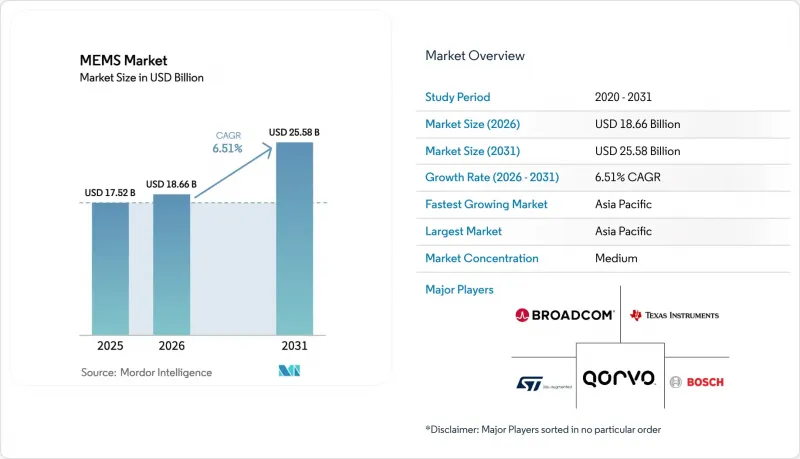
Mordor Intelligence에 의하면, MEMS 시장 규모는 2025년 175억 2,000만 달러에서 2026년에는 186억 6,000만 달러로 확대되어 2026년부터 2031년까지 CAGR 6.51%로 성장을 지속하여, 2031년에는 255억 8,000만 달러에 이를 것으로 예측됩니다.
본 보고서는 디바이스 카테고리(센서, 액추에이터 등), 센서/액추에이터의 유형(관성, 압력 등), 용도(소비자용 전자기기, 자동차 등), 제조 공정(벌크, 표면 등), 소재(실리콘, 폴리머, 압전체, 금속 등), 지역(북미, 남미, 유럽 등)별로 분류되어 있습니다. 시장 전망은 금액(달러) 기준으로 제시되어 있습니다.
세계 MEMS 시장 동향과 인사이트
IoT 에지 노드에서의 센서 보급
에지 게이트웨이에는 불과 3년 전만 해도 2-3개에 불과했던 MEMS 디바이스가 현재는 5-8개 탑재되어 있어, 디바이스 상에서 진동 분석, 가스 감지, 온도 모니터링이 가능해졌습니다. 퀄컴의 2025년형 IoT 서비스 스위트에서는 MEMS 가속도계와 머신러닝 모델을 결합하여 오경보를 40% 줄였습니다. RISC-V 마이크로컨트롤러를 핵심으로 한 20달러 미만의 센서 노드는 도입 장벽을 낮추고 있습니다. 스마트 농업 도입 사례에서는 토양 수분 및 기상 센서가 필터링된 데이터를 클라우드에 업로드하기 전에 로컬에서 중계함으로써 규모의 경제 효과가 입증되었습니다. 펌웨어 규격의 불일치는 여전히 시스템 통합을 지연시키고, 제품 인증 주기를 장기화시키고 있습니다.
ADAS 안전성 향상을 위한 전기차 1대당 MEMS 탑재 수 확대
레벨 3 자율주행 세단에는 ISO 26262 기능 안전 요건을 준수하기 위해 기존 자동차의 12개에서 증가하여 현재 18-22개의 MEMS 디바이스가 탑재되어 있습니다. TDK의 IAM-20685 모듈에는 10밀리초 이내에 드리프트를 감지하는 자가 진단 회로가 내장되어 있어, Tier 1의 페일 오퍼레이셔널(Fail Operational) 요건을 충족합니다. 전기기계식 Brake-by-wire 시스템에는 1kHz로 샘플링하는 고정밀 압력 센서가 필요합니다. 한편, 중국에서 2026년에 시행될 타이어 공기압 규제로 인해 연간 2,500만 개의 추가 수요가 발생할 전망입니다. 그러나 제조 거점이 독일과 일본에 집중되어 있어, 자동차 제조업체는 공급망 혼란에 노출될 위험이 있습니다.
특수 공정 라인에 대한 막대한 초기 설비 투자
2025년, Rogue Valley Microdevices사는 200mm 베이 1기에 심반응성 이온 에칭 장비 및 웨이퍼 본딩 장비를 도입하기 위해 1억 8,000만 달러를 투자했습니다. 다양한 칩에 비용을 분산할 수 있는 CMOS 팹과 달리, MEMS 라인은 제한된 제품군만 지원하기 때문에 다각화가 제한됩니다. ‘CHIPS 법’이나 ‘유럽 칩 법’은 기존 주요 기업에 보조금을 배분하고 있지만, 스타트업은 여전히 8자리 수의 진입 비용에 직면해 있습니다. 자동차용 및 의료용 공정의 재인증에는 18개월이 소요될 수 있어 파운드리 업체들은 변경에 소극적이며, 이는 혁신의 둔화로 이어지고 있습니다.
부문 분석
2025년에는 스마트폰 및 자동차용으로 10억 개 단위로 출하된 관성 센서 모듈 덕분에 센서가 MEMS 시장의 61.43%를 차지하며 시장을 주도했습니다. 마이크로플루이딕스 칩은 7.23%라는 가장 높은 연평균 성장률(CAGR)을 이끌고 있습니다. 이는 분산형 진단이 검사 주기를 며칠에서 몇 분으로 단축하는 일회용 카트리지에 의존하고 있기 때문입니다. 단위당 경제성은 센서의 대량 생산에 유리하지만, 랩온칩(Lab-on-Chip)용 소모품의 이익률은 여전히 높아, 다각화를 모색하는 공급업체들이 마이크로플루이딕스 파운드리 생산 능력을 확충하는 동기가 되고 있습니다. 잉크젯 헤드 등의 액추에이터는 교체 주기가 성숙 단계에 접어들어 성장이 제한되고 있지만, MEMS 발진기는 5G의 타이밍 동기화 요건의 혜택을 받고 있습니다. 신흥 파워 하베스터는 변환 효율이 10% 미만이어서 틈새 시장 수준에 머물러 있지만, 배터리 교체 비용이 많이 드는 외딴 지역의 산업 거점에서는 도입이 진행되고 있습니다.
확대되는 마이크로플루이딕스 분야는 대상 헬스케어 고객 기반을 넓히고 있습니다. 응급 의료 분야에서 병상 옆 혈액가스 검사가 도입됨에 따라, 애보트(Abbott)사의 일리노이주 시설 확장은 카트리지 수요 증가를 뒷받침하고 있습니다. FDA 510(k) 승인을 기반으로 한 규제 경로를 통해 증분형 바이오 MEMS 시장 출시 기간이 단축되면서 기존 기업들의 우위가 더욱 공고해지고 있습니다. 한편, 상품화 압력에 직면한 센서 분야에서는 각 벤더들이 가격 책정을 정당화하기 위해 온칩 융합 및 머신러닝으로의 전환을 강요받고 있습니다. 이러한 대조적인 상황은 MEMS 시장이 ‘양산형 센서’와 ‘고수익률의 특정 용도용 마이크로플루이딕스’로 양분되어 있으며, 각각 서로 다른 제조 로드맵이 필요함을 보여줍니다.
2025년에는 가속도계와 자이로스코프가 스마트폰의 화면 회전, 피트니스 추적, 자동차의 안정성 제어를 뒷받침함에 따라 관성 센서 시장 점유율은 42.53%를 차지했습니다. 음성 어시스턴트가 플래그십 모델에서 중급 기기로 확대됨에 따라, MEMS 마이크는 연평균 성장률(CAGR) 8.31%를 나타낼 것으로 예측되며, 70dB의 신호 대 잡음비(SNR)를 통해 원거리에서 음성 명령을 내릴 수 있게 될 것입니다. 압력 센서는 타이어 공기압 모니터링 시스템 및 인공호흡기용 수요가 견조한 추세를 보이고 있는 반면, RF-MEMS 부품은 5G의 보급에 따라 수요가 계속 확대되고 있으나 여전히 가격에 대한 민감도가 남아 있습니다. 광학 MEMS는 프로젝션 및 LiDAR와 같은 틈새 시장을 대상으로 하며, 성능 면에서의 우위가 판매량 부족을 상쇄하고 있습니다.
GoerTek은 2025년에 12억 개의 마이크를 출하할 전망이며, 비용 및 소형화 측면에서 Knowles에 과제가 있습니다. 소비자용 가속도계의 평균 판매 가격은 0.50달러 미만으로, 공급업체들은 차별화를 꾀하기 위해 센서 퓨전 엔진 통합을 추진하고 있습니다. RF-MEMS 공급업체들은 Qorvo와 Broadcom이 특허 포트폴리오를 방어하는 가운데 로열티 누적에 직면하고 있어, 신규 진입 장벽이 높아지고 있습니다. 범용 관성 디바이스와 고부가가치 마이크의 공존은 MEMS 시장의 세분화와 분야별로 상이한 혁신 동력을 부각시키고 있습니다.
지역별 분석
아시아태평양은 2025년 매출의 52.31%를 차지하며 1위를 기록하며, 2031년까지 연평균 성장률(CAGR) 7.13%로 성장을 이어갈 것으로 예측됩니다. 중국의 타이어 공기압 모니터링 시스템 의무화로 인해 연간 2,500만 개의 압력 센서 수요가 추가되는 한편, 일본과 대만은 각각 압전 박막 및 28nm MEMS 로직의 공동 집적화를 전문으로 하고 있습니다. 한국은 전 세계 스마트폰 브랜드를 대상으로 수직 통합형 마이크를 공급하고 있으며, 이를 통해 리드 타임을 단축하고 지역 내 우위를 공고히 하고 있습니다. 인도와 동남아시아는 급성장하고 있는 가격 민감형 시장으로, 관성 센서가 탑재된 중저가 단말기의 채택은 증가하고 있으나, 상시 켜져 있는 음성 인식 기능 등 프리미엄 기능의 도입은 미뤄지고 있습니다.
북미는 자동차, 방위, 의료 각 클러스터에 힘입어 2025년 매출의 약 23%를 차지했습니다. 'CHIPS 법'에 따른 520억 달러의 보조금은 국내 MEMS 생산 라인에 배정되었으며, Rogue Valley Microdevices사는 오리건주의 생산 능력 확장을 위해 7,500만 달러의 자금을 확보했습니다. FDA의 510(k) 승인 절차를 통해 의료용 MEMS의 상용화 주기가 12개월로 단축되어 수익 전망이 가속화되고 있습니다. 인건비가 높기 때문에 대량 생산되는 스마트폰용 센서는 여전히 해외 생산이 주류를 이루고 있지만, 특수 디바이스나 방위용 관성 측정 장치는 보안상의 이유로 국내 생산이 유지되고 있습니다.
유럽은 약 18%의 점유율을 차지하고 있으며, 독일의 자동차용 센서 대기업인 보쉬, 인피니언, 콘티넨탈 3사를 핵심으로 하고 있습니다. 430억 유로 규모의 ‘유럽 칩 법’은 X-FAB의 300mm 공정 업그레이드에 자금을 지원하며, ADAS용 가속도계의 단가를 2달러 미만으로 낮추겠다는 목표를 뒷받침하고 있습니다. 프랑스의 ST마이크로일렉트로닉스는 전 세계 웨어러블 기기를 위한 멀티 센서 모듈을 공급하고 있으며, 한편 영국의 케임브리지 클러스터에서는 LiDAR 및 증강현실(AR) 디스플레이용 광학 MEMS 스타트업 기업을 육성하고 있습니다. RoHS 및 REACH에 기반한 규제 체계로 인해 납계 및 특정 폴리머 소재에 대한 인증 기준이 엄격해져 공급업체의 소재 로드맵에 영향을 미치고 있습니다. 남미, 중동 및 아프리카의 합계 점유율은 7% 미만이지만, 브라질의 자동차 수요, UAE의 스마트 시티 프로젝트, 남아프리카의 광업용 센서가 성장의 견인차 역할을 하고 있습니다. 그러나 수입 관세와 인프라 부족으로 인해 성장이 제약을 받고 있습니다.
기타 혜택:
- 엑셀 형식 시장 예측(ME) 시트
- 3개월간의 애널리스트 지원
자주 묻는 질문
목차
제1장 서론
제2장 조사 방법
제3장 주요 요약
제4장 시장 구도
제5장 시장 규모와 성장 예측
제6장 경쟁 구도
제7장 시장 기회와 향후 전망
JHS 26.08.11According to Mordor Intelligence, the MEMS market size is expected to grow from USD 17.52 billion in 2025 to USD 18.66 billion in 2026 and is forecast to reach USD 25.58 billion by 2031 at 6.51% CAGR over 2026-2031.
This report is Segmented by Device Class (Sensors, Actuators, and More), Sensor/Actuator Type (Inertial, Pressure, and More), Application (Consumer Electronics, Automotive, and More), Fabrication Process (Bulk, Surface, and More), Material (Silicon, Polymers, Piezoelectric, Metals, and More), and Geography (North America, South America, Europe, and More). Market Forecasts are Provided in Terms of Value (USD).
Global MEMS Market Trends and Insights
Sensor Proliferation in IoT Edge Nodes
Edge gateways now embed five to eight MEMS devices compared with two to three just three years ago, enabling on-device vibration analysis, gas detection, and temperature monitoring. Qualcomm's 2025 IoT services suite pairs MEMS accelerometers with machine-learning models that cut false alarms by 40%. Sub-USD 20 sensor nodes built around RISC-V microcontrollers lower adoption barriers. Smart-agriculture deployments illustrate scale benefits as soil-moisture and weather sensors relay filtered data locally before cloud upload. Fragmented firmware standards still slow system integration and extend product-qualification cycles.
Expanding MEMS Content per EV for ADAS Safety
Level-3 autonomous sedans now integrate 18-22 MEMS devices, up from 12 in conventional cars, to comply with ISO 26262 functional-safety mandates. TDK's IAM-20685 module embeds a self-test circuit that flags drift in 10 ms, satisfying Tier-1 fail-operational requirements. Electromechanical brake-by-wire systems require high-precision pressure sensors sampling at 1 kHz, while China's 2026 tire-pressure mandate adds 25 million units of annual demand. Regional fabrication concentration in Germany and Japan, however, exposes automakers to supply-chain disruptions.
High Up-Front Capex for Specialty Process Lines
Outfitting a single 200 mm bay with deep-reactive ion-etch and wafer-bond tools cost Rogue Valley Microdevices USD 180 million in 2025. Unlike CMOS fabs that amortize spend across diverse chips, a MEMS line supports narrow families, limiting diversification. CHIPS and European Chips Acts channel subsidies to established players, yet startups still face eight-figure entry costs. Requalifying automotive or medical processes can take 18 months, so foundries resist modifications, slowing innovation.
Other drivers and restraints analyzed in the detailed report include:
- 5G Adoption Boosting RF-MEMS Filters and Switches
- Transition to 300 mm Wafer-Level MEMS Manufacturing
- Lack of Foundry-Grade Design Rules and Standards
For complete list of drivers and restraints, kindly check the Table Of Contents.
Segment Analysis
Sensors dominated the MEMS market with a 61.43% share in 2025, as inertial modules shipped in billion-unit volumes for smartphones and vehicles. Microfluidic chips drive the fastest 7.23% CAGR because decentralized diagnostics rely on disposable cartridges that compress test cycles from days to minutes. Unit economics favor sensor volumes, yet margins on lab-on-chip consumables remain high, enticing diversified suppliers to add microfluidic foundry capacity. Actuators such as ink-jet heads see mature replacement cycles that limit growth, while MEMS oscillators benefit from 5G timing-synch requirements. Emerging power harvesters stay niche because conversion efficiencies sit below 10%, but adoption rises in remote industrial nodes where battery swaps are costly.
The expanding microfluidic segment widens the addressable healthcare customer base. Abbott's Illinois facility expansion underlines cartridge demand as emergency departments adopt bedside blood-gas tests. Regulatory pathways under FDA 510(k) clearance shorten time-to-market for incremental bio-MEMS, reinforcing incumbent advantages. Meanwhile, commoditization pressures sensors, pushing vendors toward on-chip fusion and machine learning to justify pricing. The contrast illustrates how the MEMS market bifurcates into volume-driven sensors and high-margin, application-specific microfluidics, each demanding distinct fabrication roadmaps.
Inertial sensors held a 42.53% share in 2025 as accelerometers and gyros underpin phone screen rotation, fitness tracking, and automotive stability control. MEMS microphones are projected to post an 8.31% CAGR as voice assistants migrate from flagship to mid-tier devices, with 70 dB signal-to-noise ratios enabling far-field commands. Pressure sensors maintain a steady demand for tire-pressure monitoring systems and ventilators, while RF-MEMS components continue to rise with the adoption of 5G, yet remain cost-sensitive. Optical MEMS address projection and LiDAR niches where performance premiums offset lower volumes.
GoerTek shipped 1.2 billion microphones in 2025, challenging Knowles in terms of cost and miniaturization. Average selling prices for consumer accelerometers slipped below USD 0.50, prompting suppliers to embed sensor-fusion engines for differentiation. RF-MEMS suppliers face royalty stacking as Qorvo and Broadcom defend patent estates, raising barriers for new entrants. The mix of commodity inertial devices and high-value microphones underscores the MEMS market's segmentation and varying innovation levers.
Complete Report Scope:
- By Device Class
- Sensors
- Actuators
- Oscillators and Timing
- Microfluidic Chips
- Power / Motion Micro-Generators
- By Sensor / Actuator Type
- Inertial Sensors
- Pressure Sensors
- RF MEMS
- Optical MEMS
- Environmental Sensors
- MEMS Microphones
- Micro-Bolometers and IR Detectors
- Ink-Jet Heads
- Other Sensor / Actuator Types
- By Application
- Consumer Electronics
- Automotive
- Industrial and Robotics
- Healthcare and Medical Devices
- Telecom Infrastructure
- Aerospace and Defense
- Other Applications
- By Fabrication Process
- Bulk Micromachining
- Surface Micromachining
- Deep-Reactive Ion Etch (DRIE)
- Silicon-on-Insulator (SOI) MEMS
- LIGA / X-ray Lithography
- Advanced 3-D-Printed MEMS
- By Material
- Silicon
- Polymers
- Piezoelectric (AlN, PZT)
- Metals
- Compound Semiconductors
- Quartz and Glass
- By Geography
- North America
- United States
- Canada
- Mexico
- South America
- Brazil
- Argentina
- Rest of South America
- Europe
- Germany
- United Kingdom
- France
- Italy
- Spain
- Russia
- Rest of Europe
- Asia Pacific
- China
- Japan
- South Korea
- India
- Australia
- New Zealand
- Rest of Asia Pacific
- Middle East
- United Arab Emirates
- Saudi Arabia
- Turkey
- Rest of Middle East
- Africa
- South Africa
- Nigeria
- Kenya
- Rest of Africa
- North America
Geography Analysis
Asia Pacific led with 52.31% of 2025 revenue and will advance at a 7.13% CAGR through 2031. China's tire-pressure mandate adds 25 million pressure sensors annually, while Japan and Taiwan specialize in piezoelectric thin films and 28 nm MEMS-logic co-integration, respectively. South Korea's vertically integrated microphone supply to global smartphone brands shortens lead times and reinforces regional dominance. India and Southeast Asia represent fast-growing, price-sensitive markets that increasingly adopt mid-tier devices with inertial sensors but defer premium features such as always-on voice activation.
North America contributed roughly 23% of 2025 turnover, underpinned by automotive, defense, and medical clusters. CHIPS Act subsidies of USD 52 billion earmark funds for domestic MEMS lines, with Rogue Valley Microdevices securing USD 75 million to expand Oregon capacity. FDA 510(k) pathways enable 12-month commercialization cycles for medical MEMS, accelerating revenue visibility. High labor costs still drive high-volume smartphone sensors offshore, but specialty devices and defense inertial units remain local for security reasons.
Europe held about 18% share, anchored by Germany's automotive sensor triad of Bosch, Infineon, and Continental. The EUR 43 billion European Chips Act funds 300 mm upgrades at X-FAB, supporting sub-USD 2 accelerometer goals for ADAS. France's STMicroelectronics supplies multi-sensor modules to global wearables, while the U.K.'s Cambridge cluster incubates optical MEMS startups for LiDAR and augmented-reality displays. Regulatory frameworks under RoHS and REACH raise qualification hurdles for lead-based and certain polymer materials, shaping supplier material roadmaps. South America, Middle East, and Africa collectively account for under 7%, driven by Brazil's automotive demand, UAE smart-city projects, and South Africa's mining sensors, yet growth is constrained by import tariffs and infrastructure gaps.
- Robert Bosch GmbH
- Broadcom Inc.
- STMicroelectronics N.V.
- Texas Instruments Inc.
- Qorvo Inc.
- TDK Corporation (InvenSense)
- Infineon Technologies AG
- NXP Semiconductors N.V.
- Knowles Electronics LLC
- Panasonic Corporation
- GoerTek Inc.
- Honeywell International Inc.
- Murata Manufacturing Co., Ltd.
- Analog Devices Inc.
- Alps Alpine Co., Ltd.
- Omron Corporation
- Sensata Technologies
- Silex Microsystems AB
- Teledyne MEMS
- Rogue Valley Microdevices Inc.
Additional Benefits:
- The market estimate (ME) sheet in Excel format
- 3 months of analyst support
TABLE OF CONTENTS
1 INTRODUCTION
- 1.1 Study Assumptions and Market Definition
- 1.2 Scope of the Study
2 RESEARCH METHODOLOGY
3 EXECUTIVE SUMMARY
4 MARKET LANDSCAPE
- 4.1 Market Overview
- 4.2 Market Drivers
- 4.2.1 Sensor Proliferation in IoT Edge Nodes
- 4.2.2 Expanding MEMS Content per EV for ADAS Safety
- 4.2.3 5 G Adoption Boosting RF-MEMS Filters and Switches
- 4.2.4 Transition to 300 mm Wafer-level MEMS Manufacturing
- 4.2.5 Growth of Microfluidic Bio-MEMS for Point-of-Care Dx
- 4.2.6 Ultra-Low-Power Piezo-MEMS Speakers for Hearables
- 4.3 Market Restraints
- 4.3.1 High Up-Front Capex for Specialty Process Lines
- 4.3.2 Lack of Foundry-Grade Design Rules and Standards
- 4.3.3 Supply Risk for Sc-Doped AlN and Other Niche Materials
- 4.3.4 RF-MEMS IP Thickets Escalating Royalty Costs
- 4.4 Industry Value Chain Analysis
- 4.5 Regulatory Landscape
- 4.6 Technological Outlook
- 4.7 Impact of Macroeconomic Factors on the Market
- 4.8 Porter's Five Forces Analysis
- 4.8.1 Threat of New Entrants
- 4.8.2 Bargaining Power of Suppliers
- 4.8.3 Bargaining Power of Buyers
- 4.8.4 Threat of Substitutes
- 4.8.5 Intensity of Competitive Rivalry
5 MARKET SIZE AND GROWTH FORECASTS (VALUE)
- 5.1 By Device Class
- 5.1.1 Sensors
- 5.1.2 Actuators
- 5.1.3 Oscillators and Timing
- 5.1.4 Microfluidic Chips
- 5.1.5 Power / Motion Micro-Generators
- 5.2 By Sensor / Actuator Type
- 5.2.1 Inertial Sensors
- 5.2.2 Pressure Sensors
- 5.2.3 RF MEMS
- 5.2.4 Optical MEMS
- 5.2.5 Environmental Sensors
- 5.2.6 MEMS Microphones
- 5.2.7 Micro-Bolometers and IR Detectors
- 5.2.8 Ink-Jet Heads
- 5.2.9 Other Sensor / Actuator Types
- 5.3 By Application
- 5.3.1 Consumer Electronics
- 5.3.2 Automotive
- 5.3.3 Industrial and Robotics
- 5.3.4 Healthcare and Medical Devices
- 5.3.5 Telecom Infrastructure
- 5.3.6 Aerospace and Defense
- 5.3.7 Other Applications
- 5.4 By Fabrication Process
- 5.4.1 Bulk Micromachining
- 5.4.2 Surface Micromachining
- 5.4.3 Deep-Reactive Ion Etch (DRIE)
- 5.4.4 Silicon-on-Insulator (SOI) MEMS
- 5.4.5 LIGA / X-ray Lithography
- 5.4.6 Advanced 3-D-Printed MEMS
- 5.5 By Material
- 5.5.1 Silicon
- 5.5.2 Polymers
- 5.5.3 Piezoelectric (AlN, PZT)
- 5.5.4 Metals
- 5.5.5 Compound Semiconductors
- 5.5.6 Quartz and Glass
- 5.6 By Geography
- 5.6.1 North America
- 5.6.1.1 United States
- 5.6.1.2 Canada
- 5.6.1.3 Mexico
- 5.6.2 South America
- 5.6.2.1 Brazil
- 5.6.2.2 Argentina
- 5.6.2.3 Rest of South America
- 5.6.3 Europe
- 5.6.3.1 Germany
- 5.6.3.2 United Kingdom
- 5.6.3.3 France
- 5.6.3.4 Italy
- 5.6.3.5 Spain
- 5.6.3.6 Russia
- 5.6.3.7 Rest of Europe
- 5.6.4 Asia Pacific
- 5.6.4.1 China
- 5.6.4.2 Japan
- 5.6.4.3 South Korea
- 5.6.4.4 India
- 5.6.4.5 Australia
- 5.6.4.6 New Zealand
- 5.6.4.7 Rest of Asia Pacific
- 5.6.5 Middle East
- 5.6.5.1 United Arab Emirates
- 5.6.5.2 Saudi Arabia
- 5.6.5.3 Turkey
- 5.6.5.4 Rest of Middle East
- 5.6.6 Africa
- 5.6.6.1 South Africa
- 5.6.6.2 Nigeria
- 5.6.6.3 Kenya
- 5.6.6.4 Rest of Africa
- 5.6.1 North America
6 COMPETITIVE LANDSCAPE
- 6.1 Market Concentration
- 6.2 Strategic Moves
- 6.3 Market Share Analysis
- 6.4 Company Profiles (includes Global Level Overview, Market Level Overview, Core Segments, Financials as Available, Strategic Information, Market Rank/Share for Key Companies, Products and Services, and Recent Developments)
- 6.4.1 Robert Bosch GmbH
- 6.4.2 Broadcom Inc.
- 6.4.3 STMicroelectronics N.V.
- 6.4.4 Texas Instruments Inc.
- 6.4.5 Qorvo Inc.
- 6.4.6 TDK Corporation (InvenSense)
- 6.4.7 Infineon Technologies AG
- 6.4.8 NXP Semiconductors N.V.
- 6.4.9 Knowles Electronics LLC
- 6.4.10 Panasonic Corporation
- 6.4.11 GoerTek Inc.
- 6.4.12 Honeywell International Inc.
- 6.4.13 Murata Manufacturing Co., Ltd.
- 6.4.14 Analog Devices Inc.
- 6.4.15 Alps Alpine Co., Ltd.
- 6.4.16 Omron Corporation
- 6.4.17 Sensata Technologies
- 6.4.18 Silex Microsystems AB
- 6.4.19 Teledyne MEMS
- 6.4.20 Rogue Valley Microdevices Inc.
7 MARKET OPPORTUNITIES AND FUTURE OUTLOOK
- 7.1 White-Space and Unmet-Need Assessment


