

|
시장보고서
상품코드
2100619
유럽의 항공우주 및 방위 시장 : 시장 점유율 분석, 업계 동향 및 통계, 성장 예측(2026-2031년)Europe Aerospace and Defense - Market Share Analysis, Industry Trends & Statistics, Growth Forecasts (2026 - 2031) |
||||||
 Mordor Intelligence
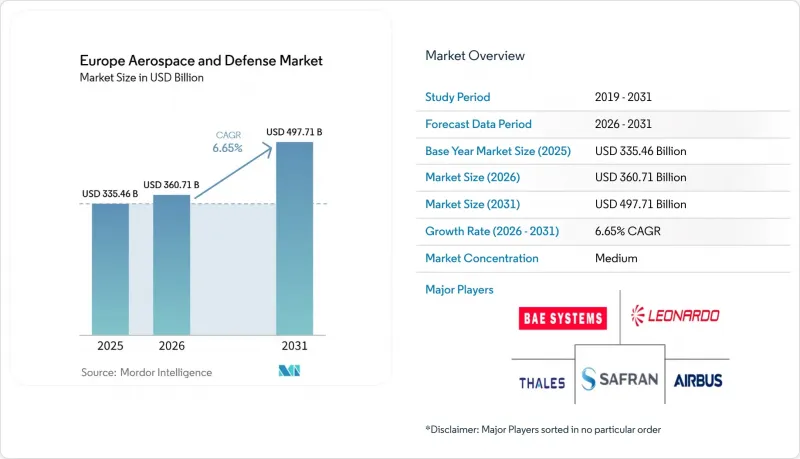
Mordor Intelligence에 의하면, 유럽 항공우주 및 방위 시장 규모는 2025년 3,354억 6,000만 달러로 평가되었고, 2026년에는 3,607억 1,000만 달러로 확대될 것으로 추정되고, 2026-2031년 CAGR 4.90%로 성장을 지속할 전망이며, 2031년에는 4,977억 1,000만 달러에 이를 것으로 예측됩니다.
본 보고서는 산업별(민간 항공, 방위, 우주), 유형별(플랫폼, 시스템, MRO), 구성 부품별(구조·재료, 추진·동력 시스템, 임무 페이로드, 센서 등), 판매 채널별(OEM 및 개조/업그레이드), 지역별(영국, 프랑스 등)로 분류되어 있습니다. 시장 전망은 금액(달러) 기준으로 제시되어 있습니다.
유럽의 항공우주 및 방위 시장 동향 및 인사이트
EU 방위 기금 및 ‘전략적 나침반(Strategic Compass)’의 예산 배분 증가
유럽 방위 기금(EDF)은 2025년에 15억 유로(17억 5,000만 달러)를 지출했습니다. 이는 전년 대비 15% 증가한 수치로, 차세대 전차, 초음속 요격 미사일, 안전한 위성 통신 등을 아우르는 61건의 국경을 초월한 프로젝트에 자금이 투입되었습니다. 2022년에 승인된 ‘전략적 나침반’ 이니셔티브에서는 2025년까지 5,000명의 병력으로 구성된 신속 전개 능력 구축이 요구되고 있으며, 이를 위해서는 기존 각국의 아키텍처로는 실현할 수 없는 상호 운용 가능한 지휘통제(C2) 네트워크가 필요합니다. 이에 따라 다국적 공동 개발이 가속화되고 있습니다. 프랑스와 독일의 합작 기업인 KNDS는 공동 입찰을 우선시하는 자금 조달 규정을 충족하여 주력 지상 전투 시스템(MGCS)의 시제품 개발 자금을 확보했습니다. 또한, 듀얼 유스(군민 양용)의 우선화에 따라 AI를 활용한 표적 인식 및 자율형 물류 시스템 개발이 추진되고 있으며, 이를 통해 유럽과 미국의 주요 기업 간에 존재하던 역사적인 격차가 점차 줄어들고 있습니다. 선진적인 능력 개발 프로그램이 구상 단계에서 자금 지원을 받는 개발 단계로 전환되고, 수년에 걸친 파이프라인 전망이 확보됨에 따라 유럽의 항공우주 및 방위 시장은 직접적인 혜택을 보고 있습니다.
기후 중립 항공 및 SAF 의무화가 항공우주 분야의 연구개발 투자 견인
'ReFuelEU Aviation'은 2030년까지 SAF 혼합 비율을 6%로, 2050년까지 70%로 높이는 것을 의무화하고 있으며, 이 요건을 준수하지 않는 공급업체에는 금전적 제재가 부과됩니다. 에어버스는 2035년까지 수소 추진 기술 연구에 예산을 배정하고 있으며, 툴루즈의 최종 조립 라인을 저온 탱크에 대응할 수 있도록 개조 작업을 진행하고 있습니다. 사프란은 연료 소비량을 20% 절감하고 SAF와의 완벽한 호환성을 약속하는 오픈 로터 방식의 'RISE' 엔진 검증을 진행 중이며, 지상 시험은 2025년에 완료될 전망입니다. 로테르담에 건설될 예정인 쉘과 토탈에너지의 합작 ‘파워 투 리퀴드(P2L)’ 플랜트는 2028년까지 연간 20만 톤의 e-케로신을 생산하여 원료의 안정적인 공급을 확보할 예정입니다. 이러한 규제로 인해 연구개발의 위험 프로파일이 변화하고, 대체 추진제 프로그램이 주류를 이루며, 민간 및 군용 항공기가 저탄소 기술로 전환됨에 따라 유럽 항공우주 및 방위 시장에 장기적인 성장 여지가 생겨나고 있습니다.
티타늄 및 희토류 소재 공급망 취약성
제재가 발효되기 전, 유럽 항공우주용 티타늄의 30%를 러시아가 공급했으나, 재고는 2026년 중반까지 고갈될 것으로 예측됩니다. 일본 제철소와의 대체 공급 계약을 통해 일부 부족분은 보충되었으나, 2024년부터 2025년에 걸쳐 가격이 40% 상승하면서 고정 가격 항공기 계약의 이익률이 압박받고 있습니다. 유사한 위험은 희토류 자석 분야에서도 존재합니다. 이 분야에서 중국은 전 세계 정제 능력의 85%를 장악하고 있으며, 2025년에 수출 할당량을 더욱 엄격하게 제한했습니다. 탈레스와 사프란이 공동으로 추진하는 재활용 합작 사업은 2028년까지 연간 네오디뮴 수요의 15%를 회수하는 것을 목표로 하고 있으나, 국내 채굴 프로젝트는 아직 착공 단계에 이르지 못했습니다. 따라서 유럽의 항공우주 및 방위 시장에는 원자재 비용 변동 위험이 존재하며, 이는 프로그램의 수익성을 저하시키고 납기를 지연시킬 가능성이 있습니다.
부문 분석
2025년 매출액 중 방위 분야가 68.75%를 차지했습니다. 이는 각국 정부가 재고를 보충하고 즉각 대응 태세를 강화했기 때문입니다. 우주 분야의 규모는 작지만, IRIS2 및 상업용 지구관측 위성군(Constellation)의 호조로 인해 연평균 성장률(CAGR) 8.19%로 확대되고 있습니다. 감시 위성의 군민 겸용 특성으로 인해 민간 및 군사 예산 양쪽에서 자금을 조달하고 있어, 유럽 항공우주 및 방위 시장을 더욱 확대시키고 있습니다. 민간 항공은 팬데믹 기간 동안의 침체에서 회복되고 있습니다. 에어버스는 2025년에 793대의 제트기를 인도했으나, 8,600대를 넘는 미인도 주문량은 공급망 병목 현상이 여전히 지속되고 있음을 보여줍니다.
우주 분야의 성장세는 소형 로켓의 보급과 저궤도 광대역 수요 증가에 힘입어 가속화되고 있으며, 센서 페이로드, 지상 부문용 소프트웨어, 주파수 할당 서비스에 지속적인 성장 여지를 제공합니다. 방위 분야의 성장은 견조하지만, 초기 비축 물자 보충이 정점에 달한 후에는 둔화될 가능성이 있습니다. 다만, 2031년 이후 국내 지출이 정체될 경우, 수출 프로젝트가 이를 상쇄할 수 있다면 성장은 유지될 것입니다. 민간 항공 분야는 지속 가능한 항공 연료(SAF)공급 상황과 인증 일정에 좌우될 것이며, 이로 인해 유럽 항공우주 및 방위 시장 규모 추이가 단축되거나 장기화될 가능성이 있습니다.
2025년에는 전투기, 개량형 프리깃함, 위성 버스의 견인에 힘입어 플랫폼 부문이 매출의 62.37%를 차지했습니다. 한편, 각 군이 구형 함정에 디지털 백본을 사후 장착하는 움직임에 따라 시스템 분야는 연평균 성장률(CAGR) 7.22%로 확대될 것으로 예측됩니다. 폴란드, 독일, 이탈리아의 MBDA사에 대한 미사일 발주는 네트워크화된 이펙터로의 전환을 상징하는 사례입니다. 무인항공기(UAV) 플랫폼 수요는 계속해서 견조합니다. 에어버스의 ‘제퍼(Zephyr)’는 64일간의 성층권 비행을 달성하며, 적은 비용으로 장시간 감시가 가능함을 입증했습니다.
시스템 분야의 성장은 개방형 아키텍처의 채택을 반영하고 있으며, 함대의 전면적인 갱신을 필요로 하지 않고 단계적인 능력 추가가 가능해졌습니다. 예측 기간 동안 예산 담당자들은 신속하게 통합할 수 있고 작전 준비 태세를 향상시키는 소프트웨어 정의 무선, AESA 레이더, 사이버전 모듈을 우선시하고 있으며, 이에 따라 유럽 항공우주 및 방위 시장의 시스템 분야 점유율이 더욱 확대될 전망입니다.
기타 혜택 :
- 엑셀 형식 시장 예측(ME) 시트
- 3개월간의 애널리스트 지원
자주 묻는 질문
목차
제1장 서론
제2장 조사 방법
제3장 주요 요약
제4장 시장 구도
제5장 시장 규모 및 성장 예측
제6장 경쟁 구도
제7장 시장 기회 및 향후 전망
AJY 26.08.07According to Mordor Intelligence, the Europe aerospace and defense market size is expected to grow from USD 335.46 billion in 2025 to USD 360.71 billion in 2026 and is forecasted to reach USD 497.71 billion by 2031 at a 4.90% CAGR over 2026-2031.
This report is Segmented by Industry (Commercial Aviation, Defense, and Space), Type (Platform, Systems, and MRO), Component (Structures and Materials, Propulsion and Power Systems, Mission Payload, Sensors, and More), Point of Sale (Original Equipment Manufacturer and Retrofit/Upgrade), and Geography (United Kingdom, France, and More). The Market Forecasts are Provided in Terms of Value (USD).
Europe Aerospace and Defense Market Trends and Insights
Increased EU Defense Fund and Strategic Compass Budget Allocations
The European Defence Fund (EDF) disbursed EUR 1.5 billion (USD 1.75 billion) in 2025, representing a 15% year-on-year increase, which financed 61 cross-border projects covering next-generation tanks, hypersonic interceptors, and secure satellite communications. The Strategic Compass initiative, approved in 2022, calls for a 5,000-troop Rapid Deployment Capacity by 2025, requiring interoperable Command and Control (C2) networks that legacy national architectures cannot deliver. Multinational teaming has therefore accelerated; KNDS, a Franco-German joint venture, secured funds to prototype the Main Ground Combat System, satisfying funding rules that privilege collaborative bids. Dual-use prioritization is also driving the development of AI-enabled target recognition and autonomous logistics, thereby narrowing Europe's historical gap with US primes. The Europe aerospace and defense market benefits directly as advanced capability programs transition from concept to funded development, securing multi-year pipeline visibility.
Climate-Neutral Aviation and SAF Mandates Driving Aerospace R&D Investments
ReFuelEU Aviation requires a 6% SAF blend by 2030, escalating to 70% by 2050, and imposes financial penalties on suppliers that fail to comply with this requirement. Airbus has earmarked research on hydrogen propulsion through 2035 and is retrofitting its Toulouse final-assembly lines to handle cryogenic tanks. Safran is validating its open-rotor RISE engine, which promises 20% lower fuel burn and full SAF compatibility, with ground tests expected to be completed in 2025. A joint Shell-TotalEnergies power-to-liquid plant slated for Rotterdam will produce 200,000 tons of e-kerosene annually by 2028, ensuring feedstock availability. These mandates shift R&D risk profiles, pulling alternative-propellant programs into the mainstream and creating long-run upside for the Europe aerospace and defense market as civil and military fleets converge on low-carbon technologies.
Supply Chain Vulnerabilities in Titanium and Rare-Earth Materials
Russia supplied 30% of European aerospace-grade titanium before sanctions took hold, and stockpiles are forecast to run dry by mid-2026. Substitution contracts with Japanese mills closed some gaps, but prices climbed 40% between 2024 and 2025, eroding margins on fixed-price airframe deals. Parallel exposure exists in rare-earth magnets, where China controls 85% of global refining capacity and tightened export quotas in 2025. A Thales-Safran recycling venture aims to recover 15% of annual neodymium demand by 2028, yet no domestic extraction projects have broken ground. The Europe aerospace and defense market, therefore, carries raw material cost volatility that could dilute program profitability and stretch delivery schedules.
Other drivers and restraints analyzed in the detailed report include:
- Ukraine Conflict Accelerating Demand for Munitions and Land-Based Defense Systems
- Expansion of Europe's Commercial Small-Launch Ecosystem
- Persistent Skills Shortages in Avionics and Propulsion Engineering
For complete list of drivers and restraints, kindly check the Table Of Contents.
Segment Analysis
Defense accounted for 68.75% of 2025 revenue as governments replenished inventories and elevated readiness. Space captures a smaller baseline but is advancing at an 8.19% CAGR on the strength of IRIS2 and commercial Earth-observation constellations. The dual-use nature of surveillance satellites attracts both civil and military budgets, further enlarging the Europe aerospace and defense market. Commercial aviation is recovering from pandemic-era troughs; Airbus delivered 793 jets in 2025, yet a backlog of over 8,600 aircraft highlights ongoing supply chain bottlenecks.
Space momentum is reinforced by the proliferation of mini-launchers and growing demand for low-Earth-orbit broadband, adding durable upside for sensor payloads, ground-segment software, and frequency-allocation services. Defense growth, though strong, may moderate after initial restocking peaks unless export pipelines offset plateauing domestic spend post-2031. Commercial aviation will hinge on the availability and certification timelines of SAF, which could either compress or stretch the trajectory of the Europe aerospace and defense market size.
Platforms delivered 62.37% of turnover in 2025, driven by fighter aircraft, upgraded frigates, and satellite buses. Systems, however, are projected to expand at a 7.22% CAGR as militaries retrofit digital backbones onto legacy fleets. MBDA's missile order from Poland, Germany, and Italy typifies the shift toward networked effectors. Platform demand remains healthy for unmanned aerial vehicles; Airbus's Zephyr achieved a 64-day stratospheric flight, showcasing long-endurance surveillance at a fractional cost.
Growth in systems reflects the adoption of open architecture, allowing for incremental capability insertions without requiring wholesale fleet replacement. Over the forecast horizon, budget holders favor software-defined radios, AESA radars, and cyber-warfare modules that integrate swiftly and elevate operational readiness, further tilting the share toward systems within the Europe aerospace and defense market.
Complete Report Scope:
- By Industry
- Commercial Aviation
- Defense
- Space
- By Type
- Platform
- Commercial Aviation
- General Aviation
- Military Land Vehicles
- Military Aircraft
- Military Naval Vessels
- Unmanned Systems
- Satellites
- Systems
- Weapons and Munitions
- Sensors
- C4ISR and Tactical Communications
- Electronic and Cyber Warfare Systems
- Air and Missile Defense
- Soldier Systems
- Military Infrastructure
- Training and Simulation
- MRO
- Military MRO
- Commercial aviation MRO
- General Aviation MRO
- Platform
- By Component
- Structures and Materials
- Propulsion and Power Systems
- Mission Payload
- Sensors
- Electronics
- Communications
- Cyber Warfare
- Software and Digital Systems
- Services and Sustainment
- By Point of Sale
- Original Equipment Manufacturer (OEM)
- Retrofit/Upgrade
- By Geography
- United Kingdom
- France
- Germany
- Italy
- Spain
- Russia
- Rest of Europe
List of Companies Covered in this Report:
- Airbus SE
- BAE Systems plc
- Leonardo S.p.A.
- Thales Group
- Safran SA
- Rolls-Royce Holdings plc
- Dassault Aviation
- Saab AB
- Rheinmetall AG
- MBDA
- KNDS N.V.
- Hensoldt AG
- Indra Sistemas S.A.
- Fincantieri S.p.A.
- Navantia S.A.
- MTU Aero Engines AG
- ArianeGroup SAS
- OHB SE
- Patria Oyj
- Diehl Stiftung & Co. KG
- Volocopter Technologies GmbH
- QinetiQ Group
Additional Benefits:
- The market estimate (ME) sheet in Excel format
- 3 months of analyst support
TABLE OF CONTENTS
1 INTRODUCTION
- 1.1 Study Assumptions and Market Definition
- 1.2 Scope of the Study
2 RESEARCH METHODOLOGY
3 EXECUTIVE SUMMARY
4 MARKET LANDSCAPE
- 4.1 Market Overview
- 4.2 Market Drivers
- 4.2.1 Increased EU defense fund and strategic compass budget allocations
- 4.2.2 Climate-neutral aviation and SAF mandates driving aerospace R&D investments
- 4.2.3 Ukraine conflict accelerating demand for munitions and land-based defense systems
- 4.2.4 Expansion of Europe's commercial small-launch and mini-launcher ecosystem
- 4.2.5 Adoption of digital engineering and MBSE to reduce program life-cycle costs
- 4.2.6 Urban air mobility corridor pilot programs advancing next-generation air transport
- 4.3 Market Restraints
- 4.3.1 Supply chain vulnerabilities in titanium and rare earth materials
- 4.3.2 Persistent skills shortages in avionics and propulsion engineering
- 4.3.3 Stringent noise and emissions regulations extending civil certification timelines
- 4.3.4 Fragmented export-control frameworks constraining multinational programs
- 4.4 Value Chain Analysis
- 4.5 Regulatory Landscape
- 4.6 Technological Outlook
- 4.7 Porter's Five Forces Analysis
- 4.7.1 Bargaining Power of Suppliers
- 4.7.2 Bargaining Power of Buyers
- 4.7.3 Threat of New Entrants
- 4.7.4 Threat of Substitutes
- 4.7.5 Competitive Rivalry
5 MARKET SIZE AND GROWTH FORECASTS (VALUE)
- 5.1 By Industry
- 5.1.1 Commercial Aviation
- 5.1.2 Defense
- 5.1.3 Space
- 5.2 By Type
- 5.2.1 Platform
- 5.2.1.1 Commercial Aviation
- 5.2.1.2 General Aviation
- 5.2.1.3 Military Land Vehicles
- 5.2.1.4 Military Aircraft
- 5.2.1.5 Military Naval Vessels
- 5.2.1.6 Unmanned Systems
- 5.2.1.7 Satellites
- 5.2.2 Systems
- 5.2.2.1 Weapons and Munitions
- 5.2.2.2 Sensors
- 5.2.2.3 C4ISR and Tactical Communications
- 5.2.2.4 Electronic and Cyber Warfare Systems
- 5.2.2.5 Air and Missile Defense
- 5.2.2.6 Soldier Systems
- 5.2.2.7 Military Infrastructure
- 5.2.2.8 Training and Simulation
- 5.2.3 MRO
- 5.2.3.1 Military MRO
- 5.2.3.2 Commercial aviation MRO
- 5.2.3.3 General Aviation MRO
- 5.2.1 Platform
- 5.3 By Component
- 5.3.1 Structures and Materials
- 5.3.2 Propulsion and Power Systems
- 5.3.3 Mission Payload
- 5.3.4 Sensors
- 5.3.5 Electronics
- 5.3.6 Communications
- 5.3.7 Cyber Warfare
- 5.3.8 Software and Digital Systems
- 5.3.9 Services and Sustainment
- 5.4 By Point of Sale
- 5.4.1 Original Equipment Manufacturer (OEM)
- 5.4.2 Retrofit/Upgrade
- 5.5 By Geography
- 5.5.1 United Kingdom
- 5.5.2 France
- 5.5.3 Germany
- 5.5.4 Italy
- 5.5.5 Spain
- 5.5.6 Russia
- 5.5.7 Rest of Europe
6 COMPETITIVE LANDSCAPE
- 6.1 Market Concentration
- 6.2 Strategic Moves
- 6.3 Market Share Analysis
- 6.4 Company Profiles (includes Global level Overview, Market level overview, Core Segments, Financials as available, Strategic Information, Market Rank/Share for key companies, Products and Services, and Recent Developments)
- 6.4.1 Airbus SE
- 6.4.2 BAE Systems plc
- 6.4.3 Leonardo S.p.A.
- 6.4.4 Thales Group
- 6.4.5 Safran SA
- 6.4.6 Rolls-Royce Holdings plc
- 6.4.7 Dassault Aviation
- 6.4.8 Saab AB
- 6.4.9 Rheinmetall AG
- 6.4.10 MBDA
- 6.4.11 KNDS N.V.
- 6.4.12 Hensoldt AG
- 6.4.13 Indra Sistemas S.A.
- 6.4.14 Fincantieri S.p.A.
- 6.4.15 Navantia S.A.
- 6.4.16 MTU Aero Engines AG
- 6.4.17 ArianeGroup SAS
- 6.4.18 OHB SE
- 6.4.19 Patria Oyj
- 6.4.20 Diehl Stiftung & Co. KG
- 6.4.21 Volocopter Technologies GmbH
- 6.4.22 QinetiQ Group
7 MARKET OPPORTUNITIES AND FUTURE OUTLOOK
- 7.1 White-space and Unmet-Need Assessment


