

|
시장보고서
상품코드
2100631
미국의 항공우주 및 방위 시장 : 점유율 분석, 업계 동향 및 통계, 성장 예측(2026-2031년)US Aerospace and Defense - Market Share Analysis, Industry Trends & Statistics, Growth Forecasts (2026 - 2031) |
||||||
 Mordor Intelligence
Mordor Intelligence에 의하면, 미국 항공우주 및 방위 시장 규모는 2026년에 4,630억 6,000만 달러가 되어, 예측 CAGR 5.67%로 성장을 지속하여, 2031년까지 6,101억 5,000만 달러에 이를 전망입니다.
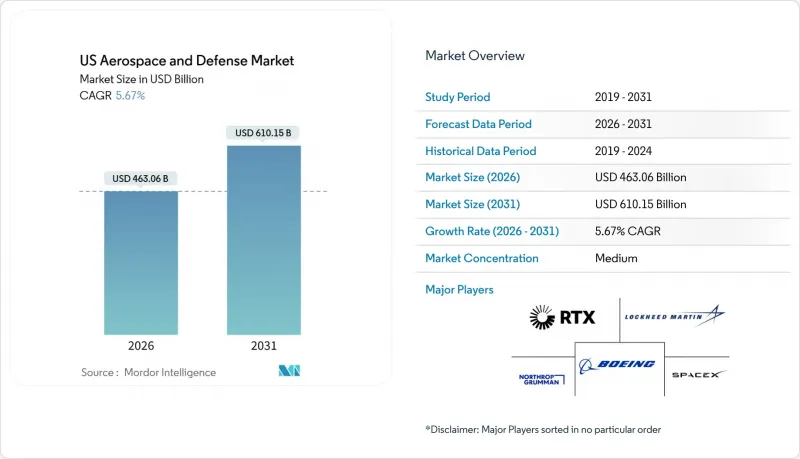
본 보고서는 부문(항공우주, 방위), 플랫폼(항공, 지상, 해군, 우주), 서비스 유형(제조, MRO), 구성품(기체 및 구조, 추진 시스템 및 엔진, 전자기기 및 미션 시스템, 복합재료 및 탄소섬유 구성품 등), 그리고 지역(미국)별로 분류되어 있습니다. 시장 전망은 금액(달러) 기준으로 제시되어 있습니다.
미국 항공우주 및 방위 시장 동향과 인사이트
급증하는 미국 국방부(DoD)의 조달 및 연구개발·시험·평가(RDT&E) 예산
2024 회계연도 예산안에서는 국방비로 8,498억 달러가 편성되었으며, 연구개발·시험·평가(RDT&E) 예산은 사상 최고치인 1,450억 달러에 달했습니다. 이 자금은 B-21 레이더, 컬럼비아급 잠수함, 그리고 ‘리플리케이터’ 자율 시스템 구상 등의 프로그램을 추진하고 있습니다. 다년간에 걸친 조달 계약을 통해 주요 계약업체들은 수요의 급격한 변동으로부터 보호받고 있습니다. 한편, 기술 준비도(TRL)의 향상으로 인해 초음속 무기, 전자전, 대-UAS(무인 항공기 시스템) 프로토타입이 양산 단계로 전환되는 속도가 가속화되고 있습니다. 이러한 급증에 따라 사이버 보안 요건도 더욱 엄격해지고 있습니다. '사이버 보안 성숙도 모델 인증(CMMC) 레벨 3'을 취득한 기업들은 기밀 취급 단독 조달 계약을 수주하며 경쟁 우위를 강화하고 있습니다. 규정 준수 대응으로 인해 프로그램 비용은 5-8% 증가하지만, 장기적인 총 예산 규모의 가시성 덕분에 민간 공급업체들이 계속해서 방위 분야에 진출하고 있습니다.
민간 및 일반 항공기의 기단 갱신 주기
2025년 말 기준, 보잉과 에어버스의 수주 잔고는 14,773대이며, 그 중 80% 이상을 나로우드바디 기종이 차지하고 있습니다. 공급망 병목 현상이 완화됨에 따라 인도 속도는 정상화되고 있으며, 2026년 총 인도 목표는 1,400대입니다. 2025년 시점에서 미국의 항공기 평균 사용 연수는 14.2년으로, 이로 인해 구형 757 및 737NG의 퇴역이 촉진되고 있으며, 엔진, 항공전자장비, 객실 개조에 대한 수요가 증가하고 있습니다. 또한, 조종사의 업무 부담을 줄여주는 합성 시야 조종실(SVC)의 FAA 인증에 힘입어 일반 항공기의 인도 상황도 마찬가지로 개선되고 있습니다. 지속 가능한 항공 연료(SAF) 사용 의무화로 인해 연료비는 15% 증가했으나, 이는 보다 효율적인 기종의 구매를 촉진하고 있으며, 그 결과 기체 교체 주기가 단축되고 있습니다.
항공우주 산업의 만성적인 공급망 병목 현상과 숙련된 인력 부족
스피릿 에어로시스템즈(Spirit AeroSystems)는 패스너, 유압 피팅, 프리프레그 부족으로 인해 2024년 기체 생산 계획의 70%에 그쳤습니다. 이는 미국 항공우주 및 방위 산업 전반에 걸쳐 지속되고 있는 공급망 및 인력 문제를 여실히 드러내고 있습니다. 노동통계국(BLS) 자료에 따르면, 2028년까지 기계공 및 복합재료 기술자의 미충원 직위가 3만 5,000건에 달하고, 15%의 인력 부족이 발생할 것으로 예측됩니다. 러시아의 수출 규제로 인해 2024년에는 티타늄 스폰지 가격이 22% 급등했고, 알루미늄 압출 성형품의 리드타임은 52주에 달하게 되었습니다. 보잉과 록히드 마틴이 시작한 견습 프로그램에서는 향후 10년 후반이 되어야 숙련 기술자가 배출될 전망이며, 이로 인해 기존의 제약이 장기화될 것으로 보입니다. 그 결과 발생한 일정 지연으로 인해 F-15EX나 CH-53K와 같은 플랫폼의 초기 운용 능력 달성이 최대 12개월 늦어지게 되었습니다.
부문 분석
2025년, B-21 레이더, 컬럼비아급 잠수함, 차세대 공중 우세(NGAD) 프로그램에 대한 확정 지출에 힘입어, 방위 부문 매출은 미국 항공우주 및 방위 시장의 69.78%를 차지했습니다. 안정적인 다년 계약은 주요 계약업체를 경기 변동에 따른 충격으로부터 보호하고, 장기적인 현금 흐름 전망을 명확하게 해줍니다. 육군의 ‘옵션 유인 전투 차량(OMFV)’과 같은 지상 시스템 업그레이드 및 버지니아급 잠수함의 블록 구매를 포함한 해군 프로그램이 추가 성장의 기반이 되고 있습니다. 사이버 보안 관련 규제 요건에 따른 압박은 진입 장벽을 높여 해외 경쟁을 제한하는 한편, 국내 공급업체의 규정 준수 비용을 증가시키고 있습니다.
민간 및 군용 항공을 포함한 항공우주 분야는 2031년까지 연평균 성장률(CAGR) 5.82%를 기록하며, 방위 분야의 5.54%를 상회하고 있습니다. 737 MAX와 A320neo를 중심으로 한 협폭기(narrow-body)의 미인도 주문량은 2026년까지월50대 및 65대로의 생산 확대를 뒷받침하고 있습니다. 군용 항공 분야는 전투기 교체 수요의 혜택을 받고 있으며, 공군이 연간 80대의 F-35A를 구매하고 있는 데다 B-21이 소량 생산 단계에 접어들었습니다. 방위 분야가 여전히 수익의 대부분을 차지하고 있지만, 민간 제트 여객기 인도 및 일반 항공의 현대화에 힘입어 미국 항공우주 및 방위 시장 전체의 규모는 꾸준한 속도로 확대되고 있습니다.
우주 플랫폼은 저궤도 위성 군집의 보급과 대형 발사체의 성장에 힘입어 7.12%라는 최고 연평균 성장률(CAGR)을 기록했습니다. 우주개발청(SDA)의 300기 위성 조달 계획과 스타링크(Starlink), 카이퍼(Kuiper)와 같은 상용 광대역 네트워크는 메시 네트워크의 경제성을 입증하고 있습니다. 항공 플랫폼은 협폭체 항공기 인도 및 전투기 조달에 힘입어 여전히 미국 항공우주 및 방위 시장 규모의 31.25%를 차지하고 있습니다. 무인 항공 시스템은 6.2%의 속도로 확대되고 있으며, V-280 바롤(V-280 Barrol) 등의 회전익기 프로그램이 헬리콥터 수요를 견인하고 있습니다.
고정익기 생산은 여전히 항공 플랫폼 수익의 주축이지만, 소모성 드론으로의 전환은 향후 제품 구성의 변화를 시사하고 있습니다. 육상 및 해군 플랫폼은 장갑차 현대화 및 수상 전투함 건조를 배경으로 5-6%의 성장세를 이어가고 있지만, 어느 부문도 우주 분야에서 보이는 것과 같은 성장세를 보이지는 못하고 있습니다.
기타 혜택:
- 엑셀 형식 시장 예측(ME) 시트
- 3개월간의 애널리스트 지원
자주 묻는 질문
목차
제1장 서론
제2장 조사 방법
제3장 주요 요약
제4장 시장 구도
제5장 시장 규모와 성장 예측
제6장 경쟁 구도
제7장 시장 기회와 향후 전망
JHS 26.08.11According to Mordor Intelligence, the US aerospace and defense market size is USD 463.06 billion in 2026 and, at a forecast CAGR of 5.67%, is projected to reach USD 610.15 billion by 2031.
This report is Segmented by Sector (Aerospace, Defense), Platform (Aerial, Terrestrial, Naval, Space), Service Type (Manufacturing, MRO), Component (Airframes and Structures, Propulsion Systems and Engines, Electronics and Mission Systems, Composite and Carbon Fibre Components and More), and Geography (United States). Market Forecasts are Provided in Terms of Value (USD).
US Aerospace and Defense Market Trends and Insights
Surging DoD Procurement And RDT&E Budgets
Fiscal-year 2024 legislation appropriated USD 849.8 billion for national defense, raising RDT&E to a record USD 145 billion. These funds are propelling programs such as the B-21 Raider, Columbia-class submarines, and the Replicator autonomous systems initiative. Multi-year procurement contracts are insulating prime contractors from demand shocks, while higher technology readiness levels are accelerating the transition of hypersonic, electronic-warfare, and counter-UAS prototypes into production. The surge is also heightening cybersecurity requirements; companies that have secured Cybersecurity Maturity Model Certification Level 3 are winning sole-source classified awards, reinforcing competitive moats. Although compliance adds 5-8% to program costs, the visibility of a long-term budget topline continues to attract commercial suppliers into defense work.
Commercial and General-Aviation Fleet-Modernization Cycles
The Boeing and Airbus backlogs stood at 14,773 jets at the end of 2025, with narrow-body models representing over 80% of the orders. Delivery rates are normalizing as supply-chain bottlenecks ease; combined hand-overs are targeted at 1,400 aircraft in 2026. The US fleet averaged 14.2 years in 2025, stimulating retirements of older 757s and 737NGs and lifting demand for engines, avionics, and cabin retrofits. General-aviation deliveries are improving in tandem, supported by FAA certification of synthetic vision cockpits that reduce pilot workload. Sustainable aviation fuel mandates are adding 15% to fuel bills but are encouraging the purchase of more efficient models, thereby reinforcing the replacement cycle.
Chronic Aerospace Supply-Chain Bottlenecks and Skilled-Labor Shortages
Spirit AeroSystems operated at 70% of its planned fuselage output in 2024 due to shortages of fasteners, hydraulic fittings, and prepreg, highlighting ongoing supply chain and workforce challenges across the US Aerospace and Defense Industry. Bureau of Labor Statistics data indicate that there will be 35,000 unfilled machinist and composite-technician roles by 2028, resulting in a 15% workforce gap. Titanium sponge prices jumped 22% in 2024 after Russian export restrictions, and lead times for aluminum extrusions stretched to 52 weeks. Apprenticeship programs initiated by Boeing and Lockheed Martin will not yield journey-level staff until late in the decade, prolonging existing constraints. Resulting schedule slips have pushed initial operating capability for platforms such as the F-15EX and CH-53K by up to 12 months.
Other drivers and restraints analyzed in the detailed report include:
- Rapid Growth in Commercial Launch and Satellite Constellations
- Supply-Chain Reshoring Incentives and DPA Funding
- Tightening Export-Control and Cybersecurity Compliance Costs
For complete list of drivers and restraints, kindly check the Table Of Contents.
Segment Analysis
Defense revenues accounted for 69.78% of the US aerospace and defense market in 2025, supported by committed outlays for the B-21 Raider, Columbia-class submarine, and Next-Generation Air Dominance programs. Stable, multi-year contracts shield prime contractors from cyclical shocks and provide visibility into long-term cash flows. Land-system upgrades, such as the Army's Optionally Manned Fighting Vehicle, and naval programs, including Virginia-class submarine block buys, further anchor growth. Regulatory pressure via cybersecurity mandates is raising barriers to entry, limiting foreign competition yet intensifying compliance costs for domestic suppliers.
Aerospace, covering civil and military aviation, is posting a 5.82% CAGR to 2031, outpacing Defense's 5.54%. Narrow-body backlogs, led by the 737 MAX and A320neo, underpin production ramps toward 50 and 65 units per month by 2026. Military aviation benefits from fighter recapitalization, with the Air Force buying 80 F-35As annually and B-21 entering low-rate production. While Defense retains the lion's share of revenue, commercial jetliner deliveries and general aviation modernization are expanding the overall US aerospace and defense market size at a steady pace.
Space platforms posted the highest 7.12% CAGR, propelled by proliferated low-Earth-orbit constellations and heavy-lift launch vehicles. The Space Development Agency's 300-satellite tranche and commercial broadband networks such as Starlink and Kuiper validate mesh-network economics. Aerial platforms still account for 31.25% of the US aerospace and defense market size, driven by narrow-body deliveries and fighter procurement. Unmanned aerial systems are expanding at a rate of 6.2%, while rotary-wing programs, such as the V-280 Valor, reinforce helicopter demand.
Fixed-wing production remains the revenue backbone of aerial platforms, yet the shift to attritable drones signals a future transformation in the mix. Terrestrial and naval platforms continue to grow at a rate of 5-6% on the back of armored-vehicle modernization and surface-combatant construction, but neither category matches the momentum seen in space.
Complete Report Scope:
- By Sector
- Aerospace
- Civil Aerospace
- Military Aerospace
- Defense
- Land Systems
- Naval Systems
- Air Combat Systems
- Aerospace
- By Platform
- Aerial
- Fixed Wing Aircraft
- Rotary Wing Aircraft
- Unmanned Aerial Systems
- Terrestrial
- Armored Vehicles
- Artillery and Missile Systems
- Soldier Systems and Electronics
- Naval
- Surface Combatants
- Submarines
- Naval Aviation
- Space
- Navigation Satellites
- Earth Observation/Remote Sensing Satellites
- Scientific Research/Astronomical Satellites
- Communication Satellites
- Aerial
- By Service Type
- Manufacturing
- Maintenance, Repair, and Overhaul (MRO)
- By Component
- Airframes and Structures
- Propulsion Systems and Engines
- Electronics and Mission Systems
- Composite and Carbon Fibre Components
- Electronic Warfare (EW) and Sensors
List of Companies Covered in this Report:
- Lockheed Martin Corporation
- RTX Corporation
- The Boeing Company
- General Dynamics Corporation
- Northrop Grumman Corporation
- L3Harris Technologies, Inc.
- AeroVironment Inc.
- Huntington Ingalls Industries, Inc.
- Textron Inc.
- Kratos Defense & Security Solutions, Inc.
- Space Exploration Technologies Corp. (SpaceX)
- Blue Origin Enterprises, L.P.
- Rocket Lab USA, Inc.
- GE Aerospace
- Rolls-Royce plc
- Leidos, Inc.
- Oshkosh Corporation
- General Atomics
- Safran SA
- Honeywell International Inc.
Additional Benefits:
- The market estimate (ME) sheet in Excel format
- 3 months of analyst support
TABLE OF CONTENTS
1 INTRODUCTION
- 1.1 Study Assumptions and Market Definition
- 1.2 Scope of the Study
2 RESEARCH METHODOLOGY
3 EXECUTIVE SUMMARY
4 MARKET LANDSCAPE
- 4.1 Market Overview
- 4.2 Market Drivers
- 4.2.1 Surging DoD procurement and RDT&E budgets
- 4.2.2 Commercial and general-aviation fleet-modernization cycles
- 4.2.3 Rapid growth in commercial launch and satellite constellations
- 4.2.4 Supply-chain reshoring incentives and Defense Production Act funding
- 4.2.5 AI-enabled digital MRO twins lowering lifecycle costs
- 4.2.6 Demand for low-cost attritable autonomous aircraft programs
- 4.3 Market Restraints
- 4.3.1 Chronic aerospace supply-chain bottlenecks and skilled-labor shortages
- 4.3.2 Tightening export-control and cybersecurity compliance costs
- 4.3.3 Launch-services overcapacity driving price compression
- 4.3.4 Environmental mandates (SAF, PFAS clean-up) escalating compliance spend
- 4.4 Value Chain Analysis
- 4.5 Regulatory Landscape
- 4.6 Technological Outlook
- 4.7 Porter's Five Forces Analysis
- 4.7.1 Threat of New Entrants
- 4.7.2 Bargaining Power of Buyers
- 4.7.3 Bargaining Power of Suppliers
- 4.7.4 Threat of Substitutes
- 4.7.5 Intensity of Competitive Rivalry
5 MARKET SIZE AND GROWTH FORECASTS (VALUE)
- 5.1 By Sector
- 5.1.1 Aerospace
- 5.1.1.1 Civil Aerospace
- 5.1.1.2 Military Aerospace
- 5.1.2 Defense
- 5.1.2.1 Land Systems
- 5.1.2.2 Naval Systems
- 5.1.2.3 Air Combat Systems
- 5.1.1 Aerospace
- 5.2 By Platform
- 5.2.1 Aerial
- 5.2.1.1 Fixed Wing Aircraft
- 5.2.1.2 Rotary Wing Aircraft
- 5.2.1.3 Unmanned Aerial Systems
- 5.2.2 Terrestrial
- 5.2.2.1 Armored Vehicles
- 5.2.2.2 Artillery and Missile Systems
- 5.2.2.3 Soldier Systems and Electronics
- 5.2.3 Naval
- 5.2.3.1 Surface Combatants
- 5.2.3.2 Submarines
- 5.2.3.3 Naval Aviation
- 5.2.4 Space
- 5.2.4.1 Navigation Satellites
- 5.2.4.2 Earth Observation/Remote Sensing Satellites
- 5.2.4.3 Scientific Research/Astronomical Satellites
- 5.2.4.4 Communication Satellites
- 5.2.1 Aerial
- 5.3 By Service Type
- 5.3.1 Manufacturing
- 5.3.2 Maintenance, Repair, and Overhaul (MRO)
- 5.4 By Component
- 5.4.1 Airframes and Structures
- 5.4.2 Propulsion Systems and Engines
- 5.4.3 Electronics and Mission Systems
- 5.4.4 Composite and Carbon Fibre Components
- 5.4.5 Electronic Warfare (EW) and Sensors
6 COMPETITIVE LANDSCAPE
- 6.1 Market Concentration
- 6.2 Strategic Moves
- 6.3 Market Share Analysis
- 6.4 Company Profiles (includes Global-level Overview, Market-level Overview, Core Segments, Financials, Strategic Information, Market Rank/Share, Products and Services, Recent Developments)
- 6.4.1 Lockheed Martin Corporation
- 6.4.2 RTX Corporation
- 6.4.3 The Boeing Company
- 6.4.4 General Dynamics Corporation
- 6.4.5 Northrop Grumman Corporation
- 6.4.6 L3Harris Technologies, Inc.
- 6.4.7 AeroVironment Inc.
- 6.4.8 Huntington Ingalls Industries, Inc.
- 6.4.9 Textron Inc.
- 6.4.10 Kratos Defense & Security Solutions, Inc.
- 6.4.11 Space Exploration Technologies Corp. (SpaceX)
- 6.4.12 Blue Origin Enterprises, L.P.
- 6.4.13 Rocket Lab USA, Inc.
- 6.4.14 GE Aerospace
- 6.4.15 Rolls-Royce plc
- 6.4.16 Leidos, Inc.
- 6.4.17 Oshkosh Corporation
- 6.4.18 General Atomics
- 6.4.19 Safran SA
- 6.4.20 Honeywell International Inc.
7 MARKET OPPORTUNITIES AND FUTURE OUTLOOK
- 7.1 White-space and Unmet-Need Assessment


