

|
시장보고서
상품코드
2100660
자율주행차용 센서 융합 시장 : 점유율 분석, 업계 동향 및 통계, 성장 예측(2026-2031년)Sensor Fusion in Autonomous Vehicles - Market Share Analysis, Industry Trends & Statistics, Growth Forecasts (2026 - 2031) |
||||||
 Mordor Intelligence
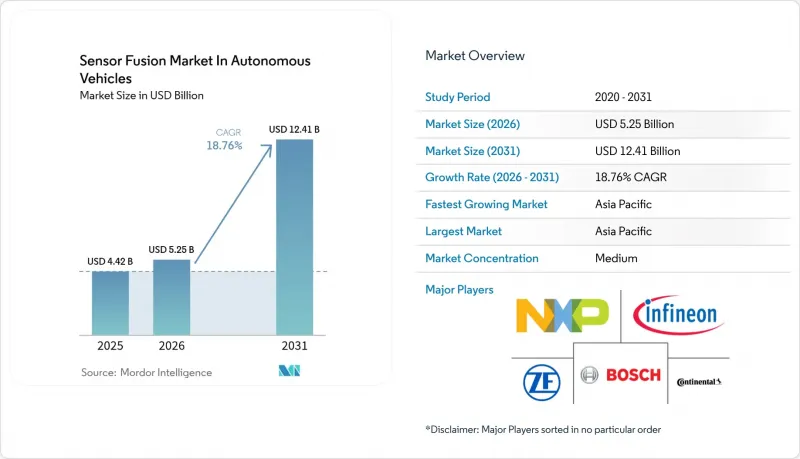
Mordor Intelligence에 의하면, 자율주행차용 센서 융합 시장 규모는 2025년 44억 2,000만 달러에서 2026년에는 52억 5,000만 달러로 확대되어 2026년부터 2031년까지 CAGR 18.76%로 성장을 지속하여, 2031년에는 124억 1,000만 달러에 이를 것으로 예측됩니다.
본 보고서는 센서 유형(LiDAR 등), 구성 요소(하드웨어 등), 기술(MEMS 센서 및 비-MEMS 센서), 자동화 수준(레벨 1 등), 추진 방식(내연기관 차량 등), 차종(승용차, 소형 상용차 등) 및 지역별로 분류되어 있습니다. 시장 전망은 금액(달러) 기준으로 제시되어 있습니다.
자율주행차용 센서 융합 시장 인사이트 및 동향
ADAS 보급이 멀티 센서 채택을 가속화
Euro NCAP의 2025년 규정에 따르면, 5성급 평가를 획득하기 위해 전방 충돌 완화 기능과 차선 유지 기능이 의무화되어 있어, 유럽의 주요 자동차 제조업체들은 멀티 센서 스택 채택을 서두르고 있습니다. 미국 FMVSS 127 최종 규정에서는 2029년까지 보행자용 자동 긴급 제동 시스템 도입이 의무화되어 있으며, 도시 지역에서의 오인식을 줄이기 위해 카메라를 통한 분류와 레이더의 거리 변화율을 결합할 것을 요구하고 있습니다. 중국의 C-NCAP 2024년판 평가 기준 개정에서 야간 보행자 감지가 평가 대상에 추가됨에 따라, BYD와 지리(Geely)는 905나노미터 LiDAR와 mm파 레이더를 통합하고 있습니다. 일정이 촉박해짐에 따라 검증 주기가 단축되면서, 시뮬레이션 라이브러리나 주석이 달린 에지 케이스 데이터를 제공하는 공급업체들이 유리한 입지를 점하고 있습니다. 규제가 통일됨에 따라 자율주행차용 센서 융합 시장에서는 주요 브랜드들 간에 수요가 서로를 강화하는 선순환이 형성되고 있습니다.
솔리드 스테이트 LiDAR 단가가 400달러 미만으로 하락할 전망
Hesai사의 2024년 로드맵에 따르면, ASIC 통합과 자동 광학 조정을 통해 2026년까지 부품 원가(BOM)를 200달러 미만으로 낮추는 것을 목표로 하고 있습니다. Innoviz사는 유럽의 프리미엄 OEM 제조업체와 50만 대 분량에 대해 350달러에 공급하는 계약을 체결했으며, 이는 LiDAR가 레이더와의 가격 평준화에 빠르게 접근하고 있음을 보여줍니다. 기계식 미러를 제거함으로써 고장률이 감소하고, AEC-Q100 등급 2의 열 사이클 시험을 충족하므로, 감지 임계값의 향상이 요구되는 레벨 2+ 차량에 탑재할 수 있게 됩니다. 비용 곡선이 하락함에 따라 자율주행차용 센서 융합 시장은 레이더·카메라 중심의 구성에서 LiDAR를 통합한 지각 시스템으로 전환되고 있습니다. 특히 소비자가 안전성을 위해 프리미엄을 지불하는 프리미엄 세단이나 크로스오버 차량에서 이러한 경향이 두드러집니다.
OEM 간 세계 센서 데이터 규격의 부재
ISO 23150은 여전히 초안 단계에 머물러 있어, 각 벤더는 고객별로 레이더, 라이다, 카메라용 미들웨어를 개별적으로 개발할 수밖에 없습니다. SAE J2735에는 융합 스키마가 명시되어 있지 않으며, AUTOSAR Adaptive 24-11에는 센서 간 타임스탬프에 관한 구속력 있는 사양이 부족합니다. 그 결과, Tier 1 공급업체는 병렬 코드 브랜치를 유지할 수밖에 없으며, 이로 인해 엔지니어링 비용이 20-30% 증가하고 제품 출시가 지연되고 있습니다. 중소기업들은 검증 비용 회수에 어려움을 겪고 있어, 자율주행차용 센서 융합 시장에서의 경쟁력이 점차 약화되고 있습니다. 규제 당국이 표준 인터페이스를 규정해야만 돌파구가 열릴 가능성이 있지만, 미국, EU, 중국 간에 합의가 이루어지기까지는 앞으로 2개의 모델 사이클이 더 소요될 것으로 보입니다.
부문 분석
레이더는 저렴한 비용과 전천후 환경에서의 신뢰성 덕분에 2025년 자율주행차용 센서 융합 시장에서 35.72%의 점유율을 유지했습니다. 한편, 자율주행차용 라이다(LiDAR) 센서 융합 시장 규모는 2031년까지 연평균 성장률(CAGR) 21.63%로 확대될 것으로 예측됩니다. 이는 메르세데스-벤츠의 ‘드라이브 파일럿’ 등 Euro-NCAP 기준을 준수하는 레벨 3 시스템이 센티미터 단위의 깊이 측정에 의존하고 있기 때문입니다. 열악한 조건에서도 물체 분류 정확도가 높기 때문에 라이다는 프리미엄 OEM 업체들에게 위험을 완화해 주는 투자 수단이 되고 있습니다. 카메라 센서는 풍부한 색감과 높은 화소 밀도를 구현하지만, 확산 글레어 환경에서는 성능이 저하됩니다. 따라서 자동차 제조업체들은 보행자의 궤적을 안정화하기 위해 카메라 센서와 레이더의 도플러 측정을 융합하고 있습니다. 초음파 센서와 IMU는 특정 틈새 시장을 채우고 있지만, 감지 범위가 제한적이기 때문에 핵심 지각 기능을 보완하는 역할일 뿐, 이를 대체하는 것은 아닙니다.
라이더(LiDAR)에 대한 수요는 여전히 상위 등급의 크로스오버 차량이나 로보택시에 편중되어 있으며, 이러한 분야에서는 고객이 핸즈프리 주행을 위해 높은 비용을 감수하는 경향이 있습니다. 레이더의 세대별 비용이 단계적으로 하락하고 있는 점이 대중 시장용 ADAS에서의 우위를 공고히 하고 있습니다. 하지만 솔리드 스테이트 LiDAR 유닛의 가격이 300달러에 가까워짐에 따라, 중형 전기차(EV)에서는 2027년 모델 체인지 시 이를 채택할 계획이 진행 중입니다. 각 공급업체들은 각도 분해능과 눈에 안전한 파장을 놓고 경쟁하고 있으며, 1,550나노미터 레이저에 대한 규제가 명확해짐에 따라 설계의 폭이 넓어질 가능성이 있습니다. 그 결과, 라이다 매출 성장률은 레이더를 상회하며, 자율주행차용 센서 융합 시장 내 공급업체 점유율 구도를 재편하고 있습니다.
2025년 매출에서 하드웨어가 차지하는 비중은 60.12%로, 여기에는 트랜시버, 광학 부품, 마이크로컨트롤러가 포함됩니다. 그러나 자동차 제조업체들이 차량 군 단위에서 지속적인 재학습이 필요한 신경망 융합으로 전환함에 따라, 소프트웨어의 연평균 성장률(CAGR)은 21.34%로 하드웨어를 상회하고 있습니다. 자율주행차용 센서 융합 시장의 소프트웨어 서비스 규모는 보정, 매핑, 사이버 보안 업데이트를 포괄하며 지속적인 수익원을 형성하고 있습니다. 콘티넨탈의 ‘Advanced Radar Sensor 540’은 원시 데이터를 압축하여 이더넷 트래픽을 70% 줄이고 있으며, 에지에서의 전처리 및 클라우드에서의 추론을 통해 워크로드를 분담하는 공동 설계 이념을 구현하고 있습니다.
모빌아이(Mobileye)의 ‘Road Experience Management’와 같은 서비스는 익명화된 주행 데이터를 고해상도 지도로 변환하여, 초기 장비 판매를 넘어선 이용 가치를 수익화하고 있습니다. OTA(Over-the-Air) 관리 플랫폼은 특히 구독형 모델을 지향하는 전기차 브랜드에서 도입률이 확대되고 있습니다. 가격 압박으로 인해 하드웨어의 이익률은 압박받고 있지만, 인증을 받은 미들웨어에는 프리미엄 가격이 책정되고 있습니다. 이러한 변화로 인해 협상력이 변하고 있으며, 풀스택 솔루션을 제공하는 공급업체는 순수한 부품 벤더보다 자율주행차의 이익 풀에서 센서 융합 시장의 더 큰 점유율을 확보하고 있습니다.
지역별 분석
아시아태평양은 41.88%의 점유율을 차지하고 있으며, 2025년 중국의 레벨 2 의무화 및 일본의 ‘사회 5.0’ V2X 예산 6억 7,000만 달러에 힘입어 연평균 성장률(CAGR) 21.57%를 유지할 전망입니다. 이 지역의 제조 클러스터는 센서 제조 공장과 자동차 조립 라인 간의 반복 주기를 단축하고 있습니다.
북미는 계속해서 기술 실증의 장으로서의 역할을 수행하고 있으며, FCC가 30 MHz의 C-V2X 주파수 대역을 할당하고, 캘리포니아주가 로스앤젤레스와 샌프란시스코에서 무인 로봇 택시의 운행을 승인했습니다. 유럽에서는 UNECE 규정의 시행과 ‘사망 사고 제로’ 목표를 위한 경제 부양책으로 인해 판매 대수 증가세가 둔화되고 있음에도 불구하고, 프리미엄 OEM 업체들의 투자는 유지되고 있습니다.
남미, 중동 및 아프리카는 출발이 늦었지만, 브라질 상파울루와 UAE 두바이의 물류 회랑에서는 선도적인 시범 사업이 진행되고 있습니다. 환율 변동과 인프라 격차로 인해 대규모 확장은 미뤄지고 있지만, 라이다(LiDAR) 비용 감소로 인해 2028년까지 가격에 민감한 용도가 확대될 가능성이 있습니다. 전반적으로 지리적 분산이 경기 변동에 따른 충격을 완화하여, 자율주행차용 센서 융합 시장의 수익 전망을 안정시키고 있습니다.
기타 혜택:
- 엑셀 형식 시장 예측(ME) 시트
- 3개월간의 애널리스트 지원
자주 묻는 질문
목차
제1장 서론
제2장 조사 방법
제3장 주요 요약
제4장 시장 구도
제5장 시장 규모와 성장 예측
제6장 경쟁 구도
제7장 시장 기회와 향후 전망
JHS 26.08.11According to Mordor Intelligence, the sensor fusion market size in autonomous vehicles is expected to grow from USD 4.42 billion in 2025 to USD 5.25 billion in 2026 and is forecast to reach USD 12.41 billion by 2031 at 18.76% CAGR over 2026-2031.
This report is Segmented by Sensor Type (LiDAR, and More), Component (Hardware, and More), Technology (MEMS Sensors and Non-MEMS Sensors), Level of Automation (Level 1, and More), Propulsion Type (Internal Combustion Engine Vehicles, and More), Vehicle Type (Passenger Cars, Light Commercial Vehicles, and More), and Geography. The Market Forecasts are Provided in Terms of Value (USD).
Insights and Trends of Sensor Fusion Market in Autonomous Vehicles
Mainstream ADAS Mandates Accelerating Multi-Sensor Adoption
Euro NCAP's 2025 rules make forward-collision mitigation and lane-keeping mandatory for a five-star rating, pushing every major automaker in Europe to adopt multi-sensor stacks. The U.S. FMVSS 127 final rule requires the implementation of pedestrian automatic emergency braking by 2029, combining camera classification with radar range-rate to reduce urban false positives. China's C-NCAP 2024 scoring upgrade rewards nighttime pedestrian detection, prompting BYD and Geely to integrate 905-nanometer LiDAR with millimeter-wave radar. Tighter timelines compress validation cycles, favoring suppliers that provide simulation libraries and annotated edge-case data. As mandates converge, the sensor fusion market in autonomous vehicles gains a self-reinforcing demand loop among mainstream brands.
Declining Solid-State LiDAR Costs Below USD 400 per Unit
Hesai's 2024 roadmap aims to achieve a sub-USD 200 bill-of-material cost by 2026 through ASIC integration and automated optical alignment. Innoviz secured a USD 350 supply deal for 500,000 units with a European premium OEM, signaling that LiDAR is fast approaching radar price parity. Removing mechanical mirrors reduces failure rates and meets AEC-Q100 Grade 2 thermal cycles, enabling deployment in Level 2+ cars that require improved cut-in detection. As cost curves bend, the sensor fusion market in autonomous vehicles shifts from radar-camera dominance toward LiDAR-inclusive perception, especially in premium sedans and crossovers where consumers pay a safety premium.
Absence of Global Sensor-Data Standards Across OEMs
ISO 23150 remains in draft, leaving vendors to custom-code radar, LiDAR, and camera middleware per customer. SAE J2735 omits fusion schemas, and AUTOSAR Adaptive 24-11 lacks binding cross-sensor timestamp specs. Tier-1 suppliers, therefore, maintain parallel code branches, which inflates engineering spend by 20-30% and delays launches. Smaller firms struggle to recoup validation costs, thinning competition in the sensor fusion market for autonomous vehicles. A breakthrough may arrive only when regulators codify a canonical interface, but consensus across the U.S., EU, and China looks two model cycles away.
Other drivers and restraints analyzed in the detailed report include:
- In-Vehicle Edge-AI Chipsets Enabling less than and equal to 10 ms Fusion Latency
- Over-the-Air Regulation Requiring Continuous Perception Updates
- Double-Digit Tariffs on LiDAR and IMU Imports in 2025
For complete list of drivers and restraints, kindly check the Table Of Contents.
Segment Analysis
Radar retained 35.72% of the sensor fusion market share in autonomous vehicles in 2025, thanks to its low cost and all-weather reliability. The sensor fusion market size in autonomous vehicles for LiDAR, however, is projected to rise at a 21.63% CAGR through 2031, as Euro-NCAP-compliant Level 3 offerings, such as Mercedes-Benz Drive Pilot, rely on centimeter-level depth. Greater object-classification confidence in adverse light conditions makes LiDAR a de-risking investment for premium OEMs. Camera sensors deliver rich color and pixel density, but they falter in diffuse glare. Therefore, automakers fuse them with radar Doppler to stabilize pedestrian trajectories. Ultrasonic and IMU units fill specific niches, yet their limited range means they augment, not replace, core perception.
Demand for LiDAR remains skewed toward upper-trim crossovers and robotaxis, where customers are willing to tolerate higher costs for hands-free operation. Radar's incremental generational cost drops cement its dominance in mass-market ADAS. Still, as solid-state LiDAR units approach USD 300, mid-segment EVs plan to adopt them in the 2027 refresh. Suppliers compete on angular resolution and eye-safe wavelengths, while regulatory clarity on 1,550-nanometer lasers could broaden design windows. Consequently, LiDAR's dollar growth outstrips that of radar, reshaping supplier shares within the sensor fusion market in autonomous vehicles.
Hardware accounted for 60.12% of revenue in 2025, encompassing transceivers, optics, and microcontrollers. Yet, the software CAGR of 21.34% outpaces hardware as automakers pivot to neural-network fusion that requires constant fleet-scale retraining. The sensor fusion market size in autonomous vehicles for software services covers calibration, mapping, and cybersecurity updates, forming recurring revenue streams. Continental's Advanced Radar Sensor 540 compresses raw data to reduce Ethernet traffic by 70%, demonstrating a co-design ethos where edge preprocessing and cloud inference split workloads.
Services such as Mobileye's Road Experience Management turn anonymized drive data into high-definition maps, monetizing usage beyond initial equipment sales. Over-the-air management platforms expand attach rates, especially in subscription-oriented EV brands. Hardware margins compress under price pressure, while certified middleware commands a premium. The shift alters bargaining power: suppliers offering full-stack solutions capture a bigger share of the sensor fusion market in the autonomous vehicle profit pool than pure-play component vendors.
Complete Report Scope:
- By Sensor Type
- LiDAR
- Radar
- Camera
- Ultrasonic
- Inertial Measurement Units (IMU)
- By Component
- Hardware
- Software
- Services
- By Technology
- MEMS Sensors
- Non-MEMS Sensors
- By Level of Automation
- Level 1
- Level 2
- Level 3
- Level 4
- Level 5
- By Propulsion Type
- Internal Combustion Engine Vehicles
- Battery Electric Vehicles
- Hybrid Electric Vehicles
- Fuel Cell Electric Vehicles
- By Vehicle Type
- Passenger Cars
- Light Commercial Vehicles
- Heavy Commercial Vehicles
- Other Autonomous Vehicles
- By Geography
- North America
- United States
- Canada
- Mexico
- South America
- Brazil
- Argentina
- Rest of South America
- Europe
- Germany
- United Kingdom
- France
- Italy
- Spain
- Rest of Europe
- Asia-Pacific
- China
- Japan
- India
- South Korea
- Australia
- Rest of Asia-Pacific
- Middle East and Africa
- Middle East
- Saudi Arabia
- United Arab Emirates
- Turkey
- Rest of Middle East
- Africa
- South Africa
- Nigeria
- Egypt
- Rest of Africa
- Middle East
- North America
Geography Analysis
Asia Pacific captured 41.88% share and will hold a 21.57% CAGR, buoyed by China's Level 2 mandate in 2025 and Japan's USD 670 million Society 5.0 V2X budget. The region's manufacturing clusters compress iteration loops between sensor fabs and vehicle assembly lines.
North America remains a technology testbed, with the FCC allocating 30 MHz C-V2X spectrum and California green-lighting driverless robotaxis in Los Angeles and San Francisco. Europe enforces UNECE regulations and stimulus for zero-fatality targets, sustaining premium OEM spending despite softer unit demand.
South America, the Middle East, and Africa lag, but they operate lighthouse pilots in Brazil's Sao Paulo and the UAE's Dubai logistics corridors. Currency volatility and infrastructure gaps defer mass rollouts, but falling LiDAR costs could unlock price-sensitive applications by 2028. Overall, geographic diversification cushions cyclical shocks, stabilizing revenue visibility for the sensor fusion market in autonomous vehicles.
- Robert Bosch GmbH
- Continental AG
- ZF Friedrichshafen AG
- NXP Semiconductors N.V.
- Infineon Technologies AG
- STMicroelectronics N.V.
- Denso Corporation
- Aptiv PLC
- Texas Instruments Incorporated
- Analog Devices, Inc.
- NVIDIA Corporation
- Mobileye Global Inc.
- Valeo SA
- Renesas Electronics Corporation
- ON Semiconductor Corporation
- TDK Corporation
- TE Connectivity Ltd.
- Elmos Semiconductor SE
- LeddarTech Inc.
- BASELABS GmbH
- Kionix, Inc. (Rohm Co., Ltd.)
- CEVA, Inc.
- Memsic, Inc.
- Sensata Technologies, Inc.
- Velodyne Lidar, Inc.
- Innoviz Technologies Ltd.
- Ouster, Inc.
- Quanergy Systems, Inc.
- PlusAI Inc.
Additional Benefits:
- The market estimate (ME) sheet in Excel format
- 3 months of analyst support
TABLE OF CONTENTS
1 INTRODUCTION
- 1.1 Study Assumptions and Market Definition
- 1.2 Scope of the Study
2 RESEARCH METHODOLOGY
3 EXECUTIVE SUMMARY
4 MARKET LANDSCAPE
- 4.1 Market Overview
- 4.2 Market Drivers
- 4.2.1 Mainstream ADAS Mandates Accelerating Multi-Sensor Adoption
- 4.2.2 Declining Solid-State LiDAR Costs Below USD 400 per Unit
- 4.2.3 In-Vehicle Edge-AI Chipsets Enabling <10 ms Fusion Latency
- 4.2.4 Over-the-Air Regulation Requiring Continuous Perception Updates
- 4.2.5 Smart-City V2X Pilots Demanding High-Fidelity Environmental Models
- 4.2.6 Insurance Telematics Incentives for Fused Safety-Score APIs
- 4.3 Market Restraints
- 4.3.1 Absence of Global Sensor-Data Standards Across OEMs
- 4.3.2 Double-Digit Tariffs on LiDAR and IMU Imports in 2025
- 4.3.3 Real-Time Cyber-Security Certification Bottlenecks
- 4.3.4 Processor Power-Budget Limits in BEVs Below 20 W
- 4.4 Industry Value Chain Analysis
- 4.5 Regulatory Landscape
- 4.6 Technological Outlook
- 4.7 Impact of Macroeconomic Factors
- 4.8 Porter's Five Forces Analysis
- 4.8.1 Bargaining Power of Suppliers
- 4.8.2 Bargaining Power of Buyers
- 4.8.3 Threat of New Entrants
- 4.8.4 Intensity of Competitive Rivalry
- 4.8.5 Threat of Substitute Products
- 4.9 Key Patents and Research Activities
- 4.10 Major and Emerging Applications
- 4.10.1 Adaptive Cruise Control (ACC)
- 4.10.2 Autonomous Emergency Braking (AEB)
- 4.10.3 Electronic Stability Control (ESC)
- 4.10.4 Forward Collision Warning (FCW)
- 4.10.5 Other Applications
5 MARKET SIZE AND GROWTH FORECASTS (VALUE)
- 5.1 By Sensor Type
- 5.1.1 LiDAR
- 5.1.2 Radar
- 5.1.3 Camera
- 5.1.4 Ultrasonic
- 5.1.5 Inertial Measurement Units (IMU)
- 5.2 By Component
- 5.2.1 Hardware
- 5.2.2 Software
- 5.2.3 Services
- 5.3 By Technology
- 5.3.1 MEMS Sensors
- 5.3.2 Non-MEMS Sensors
- 5.4 By Level of Automation
- 5.4.1 Level 1
- 5.4.2 Level 2
- 5.4.3 Level 3
- 5.4.4 Level 4
- 5.4.5 Level 5
- 5.5 By Propulsion Type
- 5.5.1 Internal Combustion Engine Vehicles
- 5.5.2 Battery Electric Vehicles
- 5.5.3 Hybrid Electric Vehicles
- 5.5.4 Fuel Cell Electric Vehicles
- 5.6 By Vehicle Type
- 5.6.1 Passenger Cars
- 5.6.2 Light Commercial Vehicles
- 5.6.3 Heavy Commercial Vehicles
- 5.6.4 Other Autonomous Vehicles
- 5.7 By Geography
- 5.7.1 North America
- 5.7.1.1 United States
- 5.7.1.2 Canada
- 5.7.1.3 Mexico
- 5.7.2 South America
- 5.7.2.1 Brazil
- 5.7.2.2 Argentina
- 5.7.2.3 Rest of South America
- 5.7.3 Europe
- 5.7.3.1 Germany
- 5.7.3.2 United Kingdom
- 5.7.3.3 France
- 5.7.3.4 Italy
- 5.7.3.5 Spain
- 5.7.3.6 Rest of Europe
- 5.7.4 Asia-Pacific
- 5.7.4.1 China
- 5.7.4.2 Japan
- 5.7.4.3 India
- 5.7.4.4 South Korea
- 5.7.4.5 Australia
- 5.7.4.6 Rest of Asia-Pacific
- 5.7.5 Middle East and Africa
- 5.7.5.1 Middle East
- 5.7.5.1.1 Saudi Arabia
- 5.7.5.1.2 United Arab Emirates
- 5.7.5.1.3 Turkey
- 5.7.5.1.4 Rest of Middle East
- 5.7.5.2 Africa
- 5.7.5.2.1 South Africa
- 5.7.5.2.2 Nigeria
- 5.7.5.2.3 Egypt
- 5.7.5.2.4 Rest of Africa
- 5.7.5.1 Middle East
- 5.7.1 North America
6 COMPETITIVE LANDSCAPE
- 6.1 Market Concentration
- 6.2 Strategic Moves
- 6.3 Market Share Analysis
- 6.4 Company Profiles (includes Global level Overview, Market level overview, Core Segments, Financials as available, Strategic Information, Market Rank/Share for key companies, Products and Services, and Recent Developments)
- 6.4.1 Robert Bosch GmbH
- 6.4.2 Continental AG
- 6.4.3 ZF Friedrichshafen AG
- 6.4.4 NXP Semiconductors N.V.
- 6.4.5 Infineon Technologies AG
- 6.4.6 STMicroelectronics N.V.
- 6.4.7 Denso Corporation
- 6.4.8 Aptiv PLC
- 6.4.9 Texas Instruments Incorporated
- 6.4.10 Analog Devices, Inc.
- 6.4.11 NVIDIA Corporation
- 6.4.12 Mobileye Global Inc.
- 6.4.13 Valeo SA
- 6.4.14 Renesas Electronics Corporation
- 6.4.15 ON Semiconductor Corporation
- 6.4.16 TDK Corporation
- 6.4.17 TE Connectivity Ltd.
- 6.4.18 Elmos Semiconductor SE
- 6.4.19 LeddarTech Inc.
- 6.4.20 BASELABS GmbH
- 6.4.21 Kionix, Inc. (Rohm Co., Ltd.)
- 6.4.22 CEVA, Inc.
- 6.4.23 Memsic, Inc.
- 6.4.24 Sensata Technologies, Inc.
- 6.4.25 Velodyne Lidar, Inc.
- 6.4.26 Innoviz Technologies Ltd.
- 6.4.27 Ouster, Inc.
- 6.4.28 Quanergy Systems, Inc.
- 6.4.29 PlusAI Inc.
7 MARKET OPPORTUNITIES AND FUTURE OUTLOOK
- 7.1 White-space and Unmet-need Assessment


